



 Claim Ownership
 Buddhist Geeks
Subscribed: 7,938Played: 63,781
Subscribe


© Vince Fakhoury Horn
Description
497 Episodes
Reverse

Recorded on the first evening of a 2026 Pragmatic Dharma meditation retreat, this dharma talk from Brian Newman offers a wide-ranging exploration of jhāna practice, the Pa-Auk tradition, the jhānic factors, and the role of faith in concentration meditation, grounding listeners in both historical context and practical instruction.If you’re inspired by this dharma talk, consider joining us for the real thing in Boone, North Carolina.💬 TranscriptBrian Newman: This talk tonight is called No One Has Ever Got Jhāna.I’m not sure if that’s the right way to start. If we could get jhāna, that would imply that there’s an agent doing the getting, and then if we could get it, it would be an object that could be gotten—stored, saved, put in a safe, buried in the ground, passed to my friends. But none of that is true, and that would mean there’s this agent going out and acquiring things.Acquiring objects—basic Dharma theory just says that’s completely invalid right from the get-go. And if jhāna could be gotten, Vince and I would have called this retreat How to Get Jhāna. We would have had like four times the number of people in here. It would be better sales and marketing to say we’re going to teach you how to get jhāna.Which kind of puts us at the heart of the paradox: even though we can’t get it, it does happen. And for at least 2,500 years of written history, we know that human beings have been experiencing these states. We’re pretty sure it predates written history—way, way, way back.Because when the Buddha, even before he was the Buddha, went out into the world, that was the first practice he found. It was probably the predominant practice of the time. And as many of you have heard, the end times for the Dharma will come when people don’t practice jhāna anymore—it’s said that. So we’re doing our best here to keep the Dharma going, the wheel turning.So anything that’s been around for 2,500 years and the book still exists is probably pretty good stuff. Until fairly recently, there were still Bibles in most hotels or motels across America. A book that’s been around for a really long time—and it’s still today in the bedside table of a hotel in Asia, actually. They have suttas sometimes in the hotels. You open up the bedside table and find a book of suttas. Really wonderful.So we can’t get it. It doesn’t seem we can create it, but maybe we can create the causes and conditions that allow it to arise. People have been experiencing it for 2,500 years, and this paradox points us toward faith.Faith is really interesting. It’s the exact opposite of one of the five hindrances: skeptical doubt. Christian traditions and other wisdom traditions talk a lot about faith. I don’t know that we talk about faith so much in Buddhist traditions, in Dharma. Traditionally, the faith required for a Dharma practitioner is faith in the teachings, faith in the ancient tradition itself, faith in the teacher, and faith in oneself—that you can actually do this practice.I spoke a little bit about this earlier: this idea that human society has advanced over the past 2,500 years in every single way possible, except the ability to get jhāna, and that the people who were in caves 2,500 years ago would be better at that than us. That seems to me to be a cognitive error.They were Buddhist geeks hanging out with their friends, talking about these rarefied concentration states. They did exactly what we would be doing today, or exactly what we did when we were talking earlier. I think they were exactly like us. They smelled like us. They went to the bathroom like us. They ate similar food. They had the same IQ. Of course we can do what they did—and probably do it better, since human society has progressed.So faith is to do something and not have it work, but believe that it’s going to work eventually if you keep doing it.The faith that’s not talked about very often is faith in the meditation object itself. There are forty concentration objects. People have been using their breath to get concentrated for millennia. This object works. It’s been validated. We all have teachers; we all know people who have made great progress with this object.This idea of doing something—I compare it to endurance sports—where there are long, long periods of nothing happening, and then something happens.There’s a saying people quote: “Gradually, then suddenly.” You’ve probably heard that. It’s kind of a meme these days. That’s actually from Hemingway, in regard to bankruptcy. Someone asks, “How did he go bankrupt?” “Well, gradually, then suddenly.” Jhāna is kind of like that.We have experience of this. It’s not like this is the only thing in our lives that requires a bunch of time to get some sort of benefit. What about learning a foreign language? There are so many bilingual people in this room—maybe trilingual. I learned a foreign language. It took forever. I couldn’t understand anything with my homestay family in Japan when I was 18. And then suddenly, around month eight, I could understand everything. It seemed to happen overnight—gradually, then suddenly.How about deep psychotherapy, really doing some work? I probably didn’t get fixed in three weeks—maybe three years. A typical Jungian analysis would take seven years. I don’t know—ten years.Who can play a musical instrument? How long did that take? How long did your parents suffer until you figured it out? They were so patient.How about raising kids? That takes eighteen years, and you still don’t know if you did it right.How about compound interest? Your IRA looks like shit for ten years, and then suddenly you’re like, “Whoa, what happened?”So faith is where we land when we are in despair, but we’re not going to give up.There’s a quote from Thomas Moore. Thomas Moore is a depth psychologist in the tradition of James Hillman. He has a book called Care of the Soul. It’s a really wonderful book. I recommend it to everybody—related, but unrelated, to the Dharma. The subtitle is A Guide for Cultivating Depth and Sacredness in Everyday Life.He has a quote about faith: “We have to arrive at that difficult point where we don’t know what is going on or what we can do. That precise point is an opening to true faith.”Just when it’s at its worst, as they say, there are no atheists in foxholes. When you’re being bombed, you’ll pray to God, even if you said you were a non-believer.I want to tell a little story about faith for me, related to jhāna practice. I wanted to learn jhāna, and I didn’t know where to go. It wasn’t like now, where there are all these jhāna things going on. From what I could gather, there was Shaila Catherine, who had been at Pa-Auk. I wanted to do the Pa-Auk tradition.Shaila Catherine was teaching, but not really—she was doing wellness retreats in New Mexico. Then there were Tina and Stephen Snyder and Lee Brasington. Lee wasn’t Pa-Auk, so I wasn’t as interested in that. After I read his book, I found Stephen and Tina. They had a retreat, and I wanted to go in hot. I wanted to go in warm.So I reached out and signed up for the retreat, and I asked if I could speak to them before the retreat. Tina agreed to talk to me. We got on a call, did introductions, and I asked, “Can you give me some advice on how to prepare for this retreat? What would you suggest I do?”She was very explicit, and I think she was happy to have that question. She said, “Here’s what you’re going to do. We have about two months. I need you to get off all media. No TV, no radio, no podcasts, definitely no news. No magazines, no newspapers. Dharma books are okay.”She asked how long I was practicing. I said maybe an hour a day. She said, “Start adding incrementally. By the time I meet you, I want you to be able to sit for two hours at a time.”That felt like a high bar. And keep in mind, I didn’t have a jhāna practice. I’d never had a jhāna teacher. I’d read Lee Brasington’s book and was finding piti in my hands—the very low end of practice. But I had faith.She seemed realized. She’d been val… Get full access to Buddhist Geeks at www.buddhistgeeks.org/subscribe
Vince Fakhoury Horn lays out three ways to prepare a dharma talk for teachers-in-training, exploring how detailed notes can polish a talk into dead words, why speaking with no preparation depends on being prepared not to be prepared, and whether minimal preparation is really the middle way between the previous two, or just the approach he happens to prefer.If you find this helpful, consider our year-long meditation teacher training.💬 TranscriptVince: The dharma talk. It’s a public talk in a way, but it’s a unique kind of public talk, because you’re talking about something of such deep importance and intimacy, and yet something that can be easily misunderstood or misconstrued.So there’s some need to be precise at times in the dharma talk, right, to say things in a way that are easily understood and not easily misconstrued. And at the same time, there’s, I think, a recognition, right, as dharma students, that sometimes, like after you’ve heard the same story 10,000 times from your favorite teacher, or whatever, it starts to sound kind of like dull, or like it lacks the same kind of aliveness that it used to have.Part of the reason could be because it is actually in fact dull and just kind of like old hat and rehearsed to death. And so as a dharma teacher, we want to talk in a way that’s alive and fresh and relevant to the moment and to who we’re speaking with, that is enacting that ideal of skillful means that’s so important here in the Second Turning. How do we do that in reality? And here I want to present a model of preparation for the dharma talk in which there are three positions that I’ll throw out there. One is the detailed preparation approach. This is the position in which you spend a good amount of time preparing your dharma talk.And you get what’s basically like a close to script level detail. You almost could read the dharma talk from your notes. It’s that detailed. It may not be completely script, but it’s close enough that you can gather all of the relevant information directly from your notes. And it has a very clear and planned out structure, and logical flow from one thing to another, perhaps building on a point, or presenting a list and going very methodically from one point to another subpoint of the list, the overall list you’re teaching, or whatever it might be. There’s some very clear and planned out structure. So that’s the detailed preparation.On the other end, the other side here is no preparation. So this is where you do little to no upfront preparation, aside from trusting your practice and trusting all the preparation you’ve already done. You’re really responding to the moment as it’s arising and changing, who’s present. Maybe you have kind of a theme or title to work with, or maybe you’re just responding to questions in the moment. Maybe there’s some very minimal structure, but there’s within that a lot of formlessness in terms of your preparation. So that’s the no-prep dharma talk. And then if you imagine these as two existing on a spectrum, right? Detailed preparation, no preparation. Then I want to present an apex position here called minimal preparation.In the minimal preparation mode, there is a core structure, that you can see an overall flow or logic to the talk, but there are as few bullet points needed as possible to describe and detail out the subject matter that you’re getting into. In fact, within minimal preparation notes, for me, I wouldn’t expect to see any quotes. I would have a separate page, maybe just one page for quotes, if I have stuff I want to share that I can’t, you know, remember all the specifics from. But within my actual just minimal prep thing, it’s just bullet points, some basic subject headlines and some basic points.Just something to remind me of what it is I’m talking about. And then within that minimal structure, there’s a lot of space for improvisation and for flow. So I want to talk about each of these a little bit more, and the relative upsides and downsides, and then just open it up for conversation.So in terms of the detailed preparation mode, this is kind of how I started teaching, in which you spend a lot of time, painstaking effort, in getting your presentation prepared. And so there’s a lot of upside to this.You have a lot of control over what you end up saying. And if you get good at using these detailed notes, you’re not going to make a lot of flubs, verbally, linguistically. You’re not going to sound like you’re all over the place. It’ll actually sound pretty logical, and it’ll be easier to follow, more cognitively coherent.There’s a way in which over time, you’re constantly editing your notes from dharma talk to dharma talk. So you give the same dharma talk over and over again, and you kind of get to perfect it.That’s one thing I really noticed at IMS and Spirit Rock. The Insight Meditation tradition teachers is like, some of them had these dharma talks that they’d been perfecting for decades, and like, they were brilliant. Like, they were like a really well-performed comedy act that had been refined to the nth degree. And the only reason it would be no longer relevant anymore is it just has been around long enough that culture changes and times change. You know, in terms of the form of it, it’s perfect, perfect as you can get for the relative world. But there are downsides to this approach, and I’m sure you’re aware of at least some of them just thinking about them now, right? I mean, for one thing, it’s hard to change that much. You know, you could change things, but if you change things a lot, it’s a lot of work. So this kind of form of really detailed notes are kind of hard to adapt. They can be a little rigid. Can be hard to edit, since everything is so detailed and refers to everything else.You know, if you change one thing, you have to change five, 10 other things. Whereas with, you know, the minimal preparation approach, for instance, you might just change one bullet point, and then over here, another bullet point. Because of the increased detail, there’s more maintenance to maintain the style of notes.The other thing, I think the main downside with these kind of notes, is if we get disconnected from the deeper spirit of what we’re saying and we start to just sound rehearsed, then this comes across as—in the Zen tradition, they call this dead words. We start sounding like we’re just saying some dead words.And I shared this experience with many of you before, but I had the ultimate detailed-note, dead-word teaching experience with Kenneth Folk one day on retreat, when I was teaching on Dongshan’s Five Ranks. And it was so sad to me too, because I had taught on this in a previous retreat, and had really been alive and very much live words.And so because I was trying to look good in front of my teacher and be, you know, I guess like, validated, I ended up making the mistake of just too much reliance on the words, and got lost in words. And I think that’s what can happen. We get lost in these kind of concepts, and we’re just throwing around words and trying to make this beautiful word salad. And it’s like, no, it’s a salad. It’s a word salad. There’s something missing underneath it. You know, there’s some sustenance and some substance that’s lacking. So that’s the dead word challenge. Now, no preparation can respond to that challenge, right? If you come in without any preparation, if you come in and you’re just like, “Okay, here we go. Uh, what’s the topic? What’s the question? Go.” Then there is this potential for more flow and more spontaneity. And if you really have done some training, and you’ve learned some stuff, and you have access to it, then it’ll come—at least some of it will. And so you can kind of trust that these words will be alive.I have some notes here. I’m using the minimal preparation method for this presentation. Here, the upside of the no preparation is you can learn how to trust your intuitive wisdom. You can start to kind of get a sense for what yo… Get full access to Buddhist Geeks at www.buddhistgeeks.org/subscribe
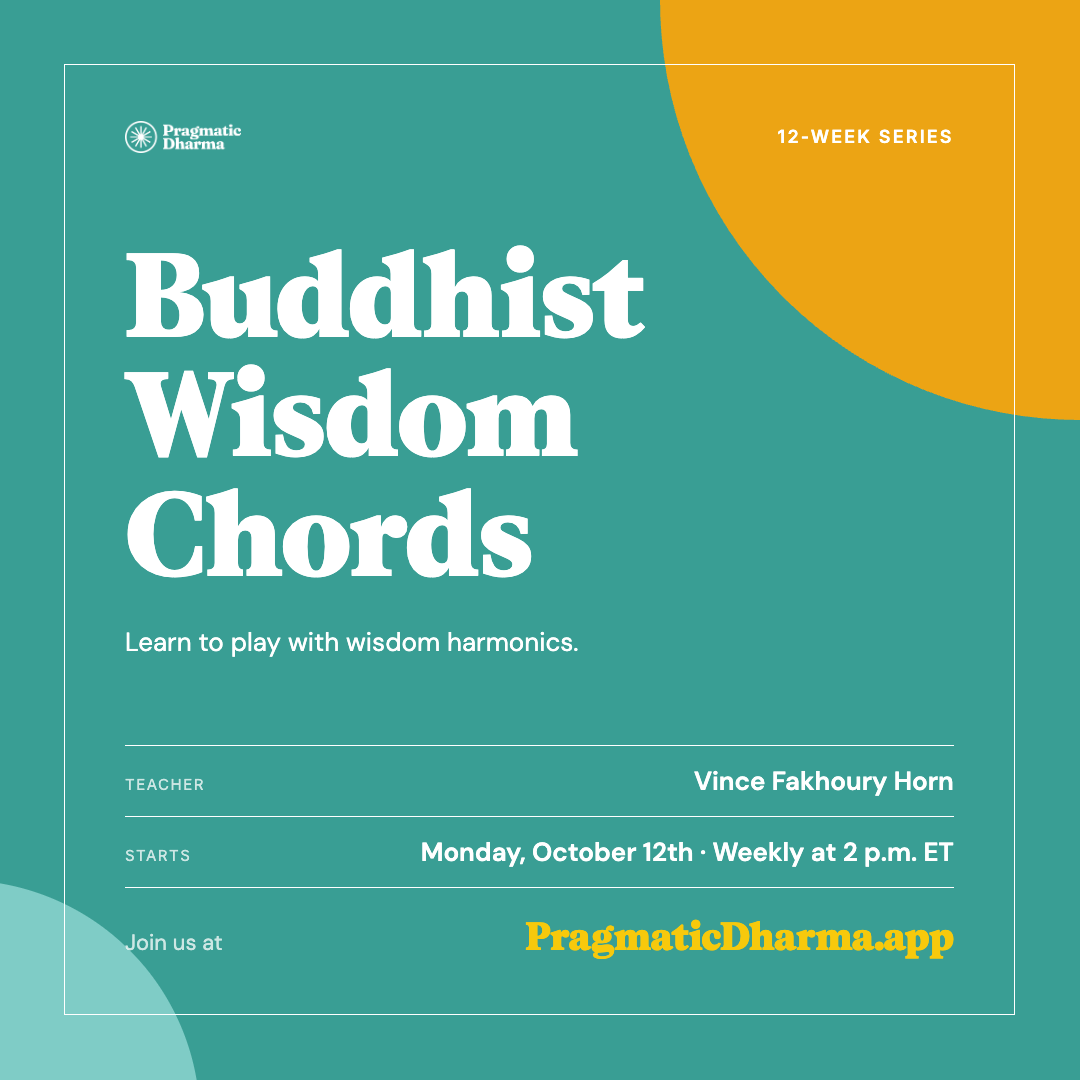
Vince Fakhoury Horn introduces the Buddhist Wisdom Chords, which is both a teaching model, and a live training in the Pragmatic Dharma app, that looks at each Buddhist lineage as a chord made up of seven meditative notes, played across the Four Turnings of Buddhism’s evolution, looking at what each tradition emphasizes, what it leaves out, and why being able to strum a simple chord is not the same as playing a beautiful piece of music.💬 TranscriptVince Horn: Okay, I want to give you a little introduction to the Buddhist Wisdom Chords. This is both a schema and model that I’m presenting to help understand the practice orientations of different Buddhist wisdom traditions, presented within a larger framework of the Four Turnings, which is a evolutionary framework for understanding the way that Buddhadharma has evolved and is currently evolving in today’s world.It’s also a training that I’m leading in the Pragmatic Dharma app, and it’s a live twelve-week training, and let me just give you a sense for what this model is. In this training, over twelve weeks, we’ll be exploring each of twelve different wisdom chords.These chords are made up of different notes, you could say, using the metaphor here in music, of notes making up a chord. The notes here are concentration, mindfulness, heartfulness, inquiry, awareness, embodiment, and finally, imaginal meditation.No tradition in this model plays just one note. Each tradition is made up of and uses multiple techniques, and weaves them together into a larger whole.But that said, no lineage is also completely comprehensive or does not have a shadow side, blind spots, et cetera. So this model helps us to understand lineage in terms of the practice focus, and also to see what some of the blind spots might be so we can address them in our practice. Here’s the basic model:If you visualize it as a cone or triangle, awareness sits at the top. It’s at the apex of this model. It’s a special way of meditating in that you don’t do anything. There’s no doing in awareness. As you go up this model, you go toward non-doing. As you go down, you work toward more effortful practice. Embodiment, there’s some amount of effort involved in becoming embodied, but really when you’re in the body, it just takes care of itself. Mindfulness, there’s even more effort. With inquiry and imaginal, a similar amount. Concentration and heartfulness, the most effortful practices. Here, if you look from the left to right, you also see another axis of difference that divides and describes the distinctions between these ways of meditating, which is apophatic, or subtraction, on the one side, on the left side, and kataphatic on the right.So you see imaginal practice being an example of a very kataphatic practice, where you’re adding something to your experience. With inquiry, we’re taking it away by using a question. What is this? We’re taking away all of our knowing, our answers. That’s apophatic practice. Some of these practices are more in the middle or slightly lean, like heartfulness toward the kataphatic, concentration toward the apophatic.There’s some more detail here about the notes. You can visit this at pragmaticdharma.com/chords if you want to see the full detail. I do want to just give you an overview of the chords themselves, because this is what we’ll cover from week to week. We’re going to begin in the First Turning and work our way through each of the turnings.We’ll start with my favorite, which was also my own path: the Power Chord. The Power Chord is when you’re strumming both concentration and mindfulness and you’re hitting those two really hard. You see this in the Mahasi Sayadaw tradition of mental noting, in the early Pragmatic Dharma lineage of Daniel Ingram.This is how I practiced coming up in the dharma, and it can lead to fast results, big insight, movement across the maps, progress of insight, etc., stages of enlightenment. And yet, notice how it leaves out the heart, leaves out the body, leaves out awareness. A lot is left out here in order to make this rapid progress, and the downside of this approach is you have to loop back around, in my experience, and fill in your understanding of the dharma.A little bit more filled-in model here, or chord, is the Insight Chord. This is something you see across many of the early Buddhist traditions, in the modern Theravāda lineages. Concentration here is the telescope we use to focus. Mindfulness is what we’re looking through, and heartfulness keeps our looking warm, keeps it from turning cold and icy.So these three together form the Insight Chord. Notice how different lineages in the Theravāda tradition emphasize one of these different notes more than the other while still strumming all three. Like the Pa-Auk Sayadaw lineage of Burma really emphasizes concentration. Or the tradition I trained in, the Mahasi lineage, really emphasizes [mindfulness], while you see a modern lineage like the TWIM lineage of Bhante Vimalaramsi really doing the same thing but using heartfulness as its main note. So here we’ll begin to explore, in this training, the way that different notes can be strummed or emphasized, and how that changes the wisdom chord that we’re playing or practicing.Finally, in the First Turning, we’ll cover the Forest Chord. Also a really nice one in terms of getting the body involved, seeing an embodied lineage that also touches on awareness as one of its notes. Notice the Insight Chord and the Power Chord before didn’t emphasize the always-already nature of awareness.But here, this lineage, which is also part of my training background and my lineage through Ajahn Chah, emphasizes awareness and leads with embodiment. We can and will explore the Second Turning, for instance, the classic tension between the Rinzai and Sōtō schools of Zen. And we’ll look at it from this point of view: how the Rinzai emphasizes a very apophatic approach, which is inquiry-dominant.It includes awareness, but awareness isn’t the main note, whereas in the Sōtō school of Dōgen, awareness is the lead. “Zazen is enlightenment.” You’re just sitting as awareness. Now, it is embodied as well. Both Rinzai and Sōtō have the body involved, and both have concentration, but Sōtō is less inquiry-based and more awareness-driven.So you have to see some differences here in the traditions, and we’ll practice some practices in this training that emphasize, and hopefully will give us a felt sense for, each of these harmonics. The Pure Land Chord and the Daimoku Chord: very kataphatic expressions in the Second Turning, compared to the more apophatic, awareness-driven.These are more gradual-path approaches. Interestingly, they also present as a kind of chord with different notes being strummed. So we’ll explore those together. The Third Turning, we get into the Vajra Chord. Very different, very kataphatic, very relational. And then we can see within this larger chord, you can break it down.You know, you can dissect it into these different sublineages. The Dzogchen Chord, for instance, and the Mahāmudrā Chord. Very interestingly, the Mahāmudrā Chord and later the Western Insight Chord share a basic same shape. We’ll look at that. The Lamrim Chord, the Gelug tradition in Tibetan Buddhism, playing a very different strum and bringing in inquiry as a kind of counterbalance to the lack of inquiry in the Vajra Chord.So we’ll understand the evolution of the tradition through this chord lens as well, seeing how the focus on practices, it is contextual. It arises within a cultural context.We’ll look at the Fourth Turning also. This is probably the most exciting part of this training for me, looking at my own tradition of the Western Insight Chord, which gave birth to the Secular Mindfulness Chord, the Soulmaking Chord of Rob Burbea’s Soulmaking Dharma, the EcoDharma Chord through teachers like David Loy and others, the Integral Chord of Ken Wilber, the Pragmatic Chord of my own lineage.We’ll explore the differences and distinctions … Get full access to Buddhist Geeks at www.buddhistgeeks.org/subscribe
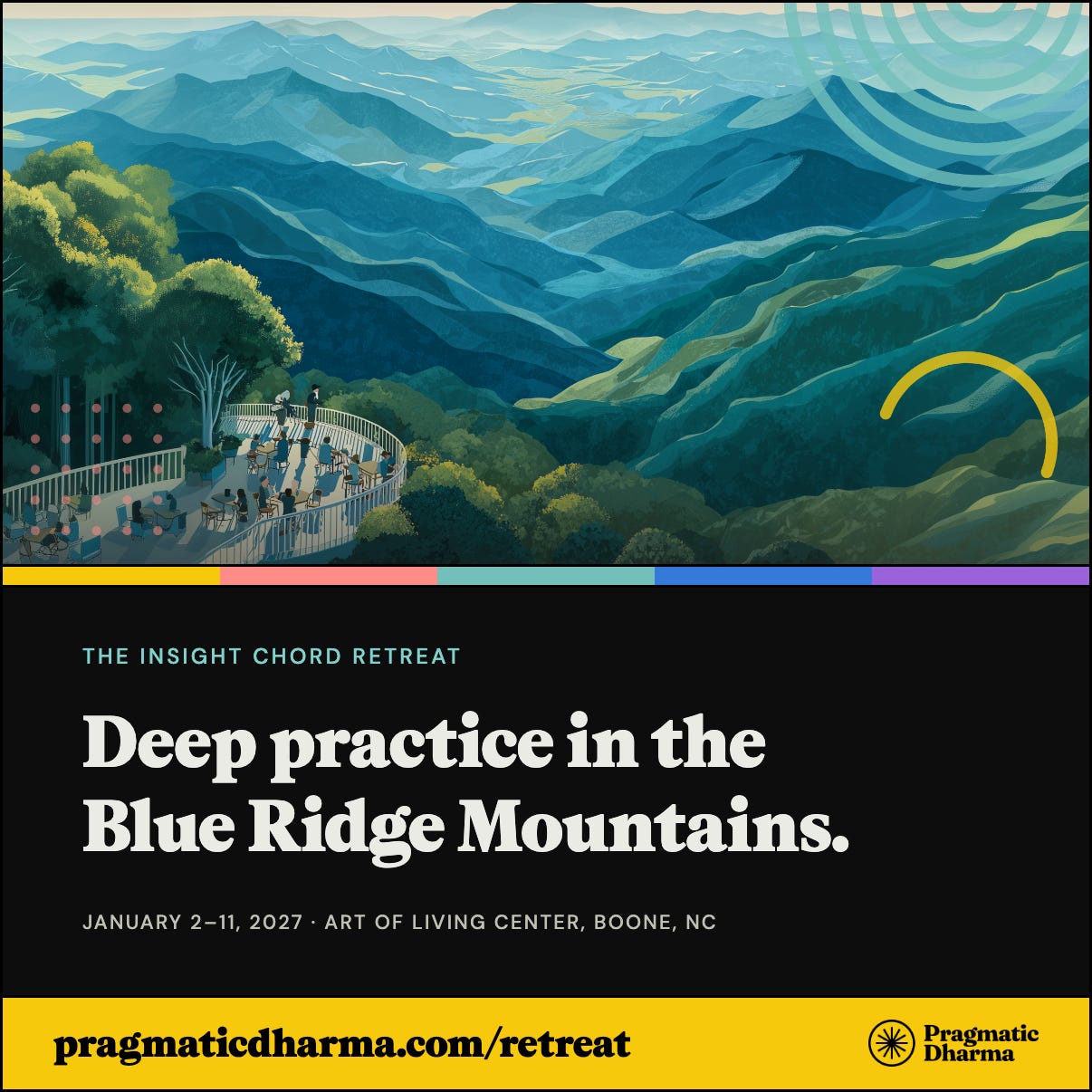
Vince Fakhoury Horn describes the insight meditation tradition as a chord in which concentration, mindfulness and heartfulness sound together, with concentration giving mindfulness its depth and heartfulness keeping the whole enterprise from turning dry and frightening.My teaching colleagues & I are leading a 10-day meditation retreat focusing on The Insight Chord. We’d love to see you there!💬 TranscriptVince Horn: Practically speaking, we’ve been focused on kind of three different forms of practice over our time together.We started with concentration practice, which is related to the training in concentration. We talked about mindfulness practice, which is often associated with the training in wisdom. And then last week we started to get into the heartfulness-style practice, or metta practice as it’s known in the early Buddhist tradition. Or brahmavihāra practice, another term that’s used to describe some of the heart qualities that early Buddhism is really interested in cultivating, developing. And you could say for sure that you can get into concentration states with heartfulness.And they also can be very helpful in terms of the first training of morality and ethics. They can come in very handy there, as in all the meditation practices.I remember when I was on a two-month retreat with Emily at Spirit Rock, someone asked during one of the Q&As with Jack Kornfield, they said, “I’ve heard that metta practice, heartfulness practice, is a relative practice, that you can’t actually get to the absolute, the universal goal of emptiness through metta, that you have to do vipassanā. Is that true?” To which Jack responded something like, “If you can’t awaken through the heart, I don’t know how else you can do it.”“If you can’t awaken through love, what are we even talking about?” And I thought that was a nice response, because it challenged that notion in the early Buddhist tradition — it does creep up, actually, a lot — that heartfulness is a relative practice. Well, maybe not. Maybe it could actually lead to ultimate wisdom. Or maybe it is an expression of ultimate wisdom. That’s my view.So we’ve looked at these three forms of practice, all of which are, in the broader sense, meditation practice, but they all connect to these three trainings, and are useful and skillful things to do.So I want to explore how these three come together. It’s something that I noticed as Emily and I started to come up with this framework of the different ways to meditate, to try to describe our own experience. I noticed that when I looked back at my training in the early Buddhist tradition, these three forms of practice were the ones that predominated. I didn’t really experience a tremendous amount of focus on inquiry practice in the early tradition. It does pop up from time to time. You do get an occasional question or occasional inquiry. You might find some Theravada teachers that have an interest in that, but it’s not predominant. Nor is the sort of awareness-style practice that you then find in a more mature form later in the Tibetan Buddhist tradition, in Mahāmudrā, or in Zen and Shikantaza, or Dzogchen — these practices where you’re just being, there’s no technique, no form, just awareness. Again, you can find examples of it in early Buddhism for sure, but it just doesn’t seem to be emphasized in the same way. Likewise with embodiment practices, there’s just not a whole lot of emphasis on inhabiting or being in the body. More about mindfulness of the body—like the body’s an object that you’re being mindful of, rather than something that you’re learning to inhabit the mystery of. And so for me, these three—and likewise with the imaginal practice too—it’s these other styles of meditation that we’ve touched on that just don’t seem to be as predominant as concentration, mindfulness, and heartfulness. And so I started thinking of that. It’s, in a way, what makes the insight meditation tradition—which comes out of the early Buddhist tradition, is in a way like a modern lineage of that, which is also a little confusing, because it’s not completely that, because it’s also interfacing with all these other traditions and teachers and has incorporated elements from them. So in that sense it’s more like really a fourth-turning tradition. But nonetheless, if we take the emphasis to be on these three, then we have a kind of—you could imagine, from a musical perspective, thinking of this as like a chord.If you’ve ever played a guitar, you know that you have a few different notes that you strum together at once. Those can, in certain circumstances, work together to form what’s called a chord. That chord is a harmony of different things that come together to form something more than the sum of their parts.And this is in some ways how I think about traditions: that they’ve hit on these really interesting combinations of different ideas and practices to form something that’s very unique and seems to be pretty anti-fragile. It can continue delivering value and being useful over time for many people. So they hit on something deep here.Likewise, if you think about food, I think this is another way it’s obvious. You think about cuisine, and you think about the kind of traditions of cuisine that emerge in different areas. Think about Thai cuisine or French cuisine or whatever type of cuisine you like. There are certain ingredients that are endemic to those areas where the cuisine developed. And over many hundreds, thousands of years, these ingredients were cultivated, combined, experimented with, until certain kinds of combinations, flavor combinations, start to emerge as being particularly powerful. Why is it that every Thai dish I learn how to cook, it all calls for curry and it calls for fish sauce? There’s certain things that you just tend to find. These ingredients end up working together in harmony, balancing each other, providing different elements. I think here too with the early Buddhist tradition, we’ve got these kind of ingredients, these basic meditation ingredients, that come together to form something more.It’s like something that’s so good that we want to pass it on, and we don’t want to see it die, because it really works. And the insight chord—one thing I’ll point out about this is, if you look at each of these forms of practice, all of them can be seen from, and are often seen from, a gradual cultivation point of view. Like, we gradually cultivate our concentration and develop our concentration. We develop our mindfulness, cultivate mindfulness; we develop our heartfulness, we cultivate heartfulness. All of these practices in the insight chord are really usually held in that way, that this is a gradual practice. This is something we’re gonna cultivate gradually over time, sometimes step by step or stage by stage. And so one of the unique things about the insight chord is that it’s a gradual progression. You could say it’s a progressive tradition, in that it’s interested in, focused on progress, on the progress of meditation, development, cultivation of these qualities.Another thing to say about the insight chord, I think, is the non-duality of mind and heart. You could say there’s an emphasis on both mindfulness and heartfulness together. And if you look back at the term citta, the way that it’s often translated as “mind” in Western cultures, because we like minds so much—but often people will have to correct that translation, as actually it means something like mind and heart. It’s understood traditionally more broadly than that. And in the early Buddhist tradition—yeah, heart and mind—these ideas, these notions weren’t so different from each other. There wasn’t such a sharp and clean distinction drawn between them. So the citta is not something that we would think of as just existing up here in the head or being associated with the brain, but rather citta is something that is more inclusive than that.The other thing I’d say about the insight chord is that concentration pr… Get full access to Buddhist Geeks at www.buddhistgeeks.org/subscribe
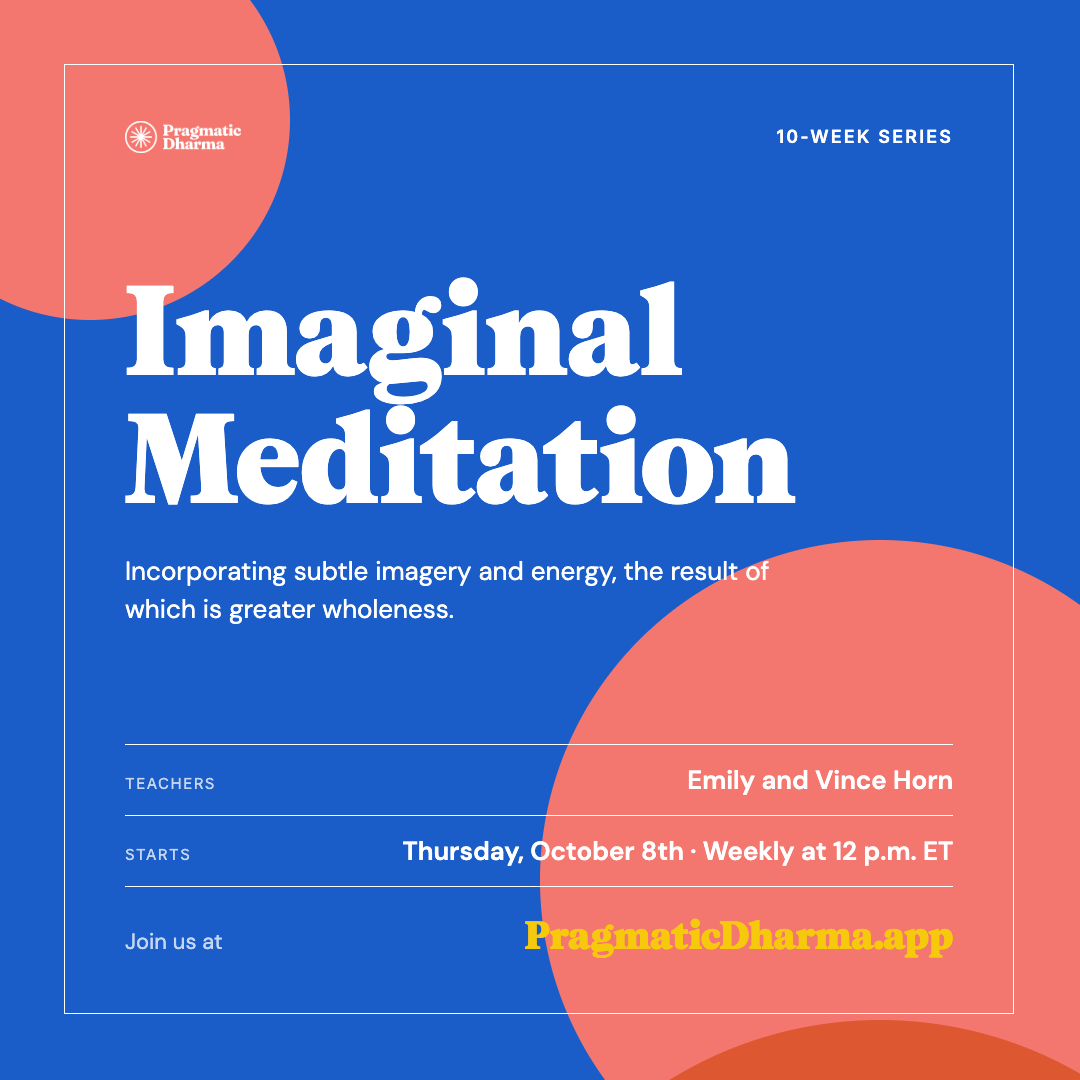
In “Imaginal Meditation,” Emily West Horn introduces an approach to imaginal practice—drawing on Vajrayana deity yoga, Jack Kornfield, Chögyam Trungpa, and Dzongsar Khyentse Rinpoche—to show how invoking, dissolving, and embodying the image of the Buddha can loosen the boundary between self & world, inclining the mind toward non-duality.💬 TranscriptEmily Horn: So I want to explore imaginal meditation with you all today. And I want to start just simply with the Buddhist Geeks definition of it, and then I’m going to unpack what imaginal meditation means in the context of the third turning, and in particular Vajrayana practice. I’m not going to unpack what Vajrayana is or some of these terms that we’ve already previously unpacked.So if you have questions about Vajrayana and Buddhism, things like that, you can watch the other recordings with these sessions. I’m also going to talk about a few of the challenges that I’ve seen and that I’ve experienced with imaginal meditation. And then, of course, we’ll actually practice it after this concludes.So, the general definition that Buddhist Geeks offers and proposes for you all is: imaginal meditation is the practice of incorporating subtle imagery and energy, the result of which is fullness. So we’re moving into a somewhat — for some people — challenging practice, because it’s really asking us to move beyond our ordinary way of perceiving.It’s asking us to shift outside of whatever framework you might be entering through. Imaginal meditation asks us to actually sense into the possibilities. It’s a creative practice. And it also challenges the rational mind a little bit, because we’re moving from perceiving to imagining what you might not have even perceived or recognized before.And it’s also aiming at incorporating subtle vibes. I think “vibe” is the new word, not “energy” necessarily, so we can go with that. If you have these kinds of experiences where it’s like, “Huh, I’m not sure exactly what that is, but I felt it” — I’ve had a lot of those experiences around people. It’s like I can feel this certain kind of energy, vibe, and I’m like, what is that? Well, imaginal meditation is asking us to actually say, okay, there is something beyond our ordinary perception that we can actually get more and more attuned to, and then start to embody.For example, in the meditation, in the way that I’m going to zoom in today with you all, we’re going to be working with the image of the Buddha. So that image in itself has a certain kind of vibe, and it invokes a certain kind of experience. I’ll give you more information about that in a moment. But I want to also offer you a little bit about what it is from the Vajrayana perspective.He says, “The technique of visualization” — and I want to highlight and bold “visualization,” and I’m going to honor his way of talking about things, but then I’m also going to tell you all why Buddhist Geeks has changed that to “imaginal.” So “visualization” isn’t the way we’re going to be talking about it. However, I do want to honor where this is coming from and the way that it’s spoken about typically. So: “The technique of visualization is employed throughout the Vajrayana practices of Tibetan Buddhism. Its use of our imagination makes it quite different from other meditations such as shamatha, which is concentration or calm abiding. Imagination also plays a major part in our deluded experience of life. Everything we encounter and perceive in our daily life is a product of our imagination, but because we believe in the illusions we create, they become such deeply rooted mental habits that we completely forget that they’re little more than fantasy. The imagination is therefore one of our most powerful tools, and working with it by changing the ways we look at our world is what we call the practice of visualization.”So it’s really aimed at starting to sense into: okay, wait, maybe we are creative beings. Maybe there is more here than we actually can recognize. And what’s it like to imagine a different way of living, of being? In some ways, what would it be like to imagine that human beings could all live together and thrive? It can go into that way of looking at it.Now, I’ve also done a lot of different kinds of visualization or imaginal practices. There are so many different kinds. When I studied with Jack Kornfield, he taught me and others how to guide people. It’s kind of like a mix between a psychological framework and a Buddhist framework. He would offer ways to unlock different ways of knowing through symbols. There were healing journeys. There was a healing temple that we would imagine and venture into. There are time-travel visualizations, imaginal practices where you get on magic carpets and go exploring. And it’s really just a way of getting to know these parts of us that we don’t typically recognize.There’s also, in psychotherapy, if you’ve done trauma work, which I have — there was a whole thing with my therapist before I could even do EMDR, which is an alleviation-of-trauma technique. And “resourcing”: I had to visualize and imagine a place that brought me some nurturing and comfort. That was my go-to place when things got intense. I would go back to the beach in LA, or wherever. I think that was my safe spot at the time.So there are all kinds of ways that this has been incorporated into meditation in the West. A lot of the teachers that I’ve studied with, I know, have drawn from Vajrayana and some of the imaginal practices in that tradition. Today, though, we’re going to zoom into a type of deity yoga — or deity imaginal practice. And we’re going to use the Buddha, and I’ll tell you a little bit more about that again in a minute.So I also want to touch on this: when we sense into imaginal practice, I’m not sure what your relationship to it is. So take a moment and just sense in — have you done this before? Do you feel a little reactive, like, “Oh,” about this? Is it really intriguing, “Ooh, what’s going to happen?” So just sense into what’s going on for you as we explore this, because it does ask us to engage a part of us that, for whatever reasons, is not very well known.I’m not sure how many people in the United States visualize Buddhas and then start to embody them, let alone Europe, and then as we expand. So I think some of you are there. One of the challenges that comes up with this practice is — again, I highlighted and bolded that word “visualization” — that can be a challenge, with thinking that it’s only visual. So I want to see what we can do in the session to expand and imagine in so many different ways. It can be very unique to you how your imagination actually takes form and shape and senses in this practice.To think of it as visualization — sometimes visualization gets equated, or there’s this association, with images: like you think in pictures, you see pictures. And I just want to invite us to soften around that, because this practice — some people will see very clearly in images, and that’s not the case for everyone. So just soften around what you might think this needs to look like. It might be kinesthetic. And for me, thought imprints are a way that, a lot of times, I’ve gotten really attuned to sensing the vibes behind thoughts and intuition in these imaginal practices. Sometimes it comes in the form of a thought. So just allow yourself to expand and include more and more and more when we go into the practice. That’s part of where imagination practices take us — to include more and more and more in our experience.Another challenge — and this is pretty much for all practices, and in particular this one — in a lot of ways it can bring up these thoughts like, “Am I doing this right? Am I doing this right?” The important thing to keep in mind with this practice is that however you invoke the image — we’re going to be working, of course, with imagery and imagining — however that imagining process happens for you, see if you can, if that thought comes in, “Am I do… Get full access to Buddhist Geeks at www.buddhistgeeks.org/subscribe

Comments

Download from Google Play

Download from App Store
 United States