


 Claim Ownership
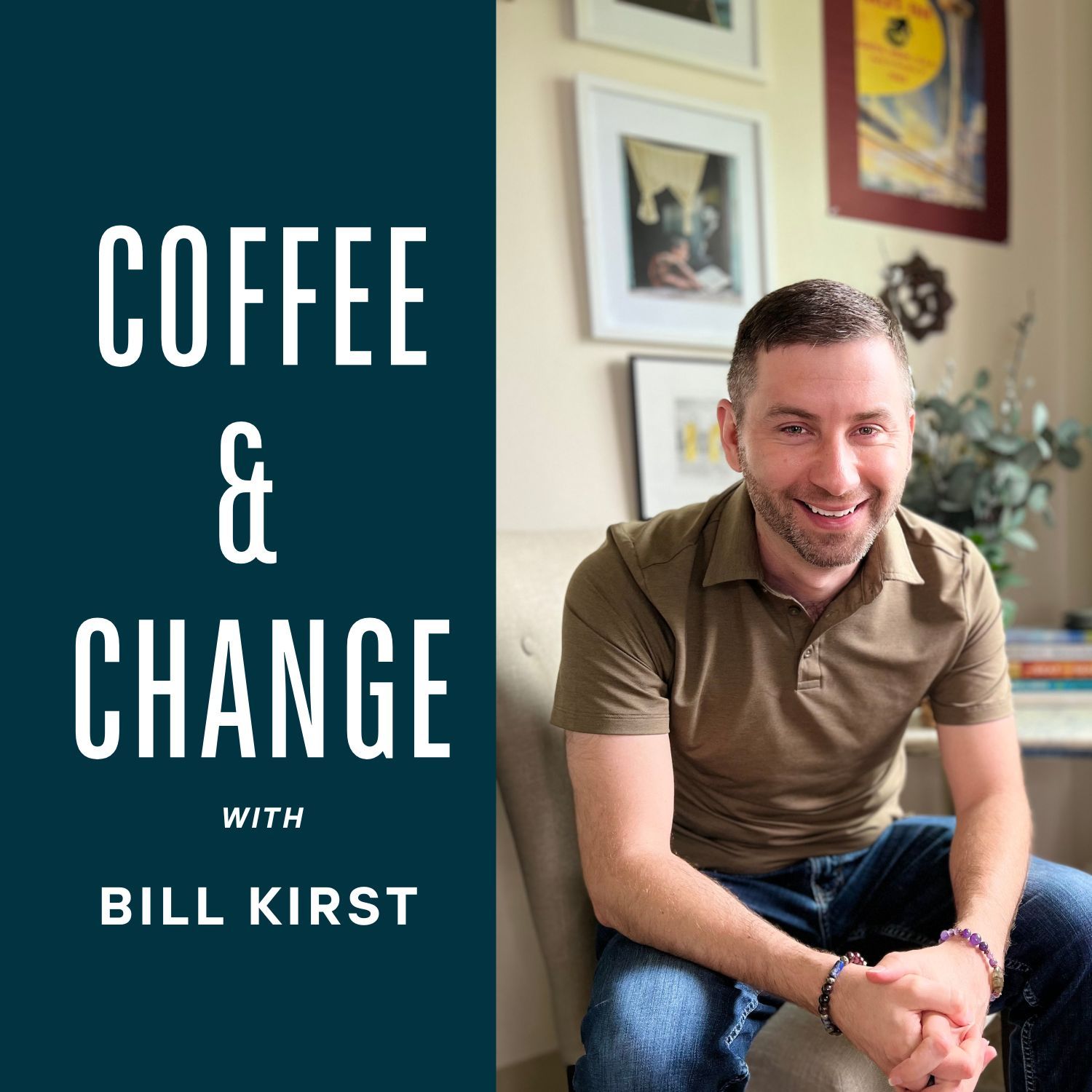
Coffee & Change
Subscribed: 22Played: 129
Subscribe

© All rights reserved
Description
Bill Kirst, an organizational change leader, supports organizations and clients navigating change in order to thrive, to overcome personal obstacles and to reach their full potential. Bill's blended approach has been cultivated over many years by consulting with individuals and offering leadership in military service.
In his podcast, Bill talks with a diverse set of guests on the topic of leading change in today's ever-changing world. Brew up a cup of coffee, or tea, and enjoy the listen.
*Disclaimer: Any views and opinions expressed in this podcast are personal and belong solely to the podcast owner and do not represent those of people, institutions or organizations that the owner may or may not be associated with in professional or personal capacity.
In his podcast, Bill talks with a diverse set of guests on the topic of leading change in today's ever-changing world. Brew up a cup of coffee, or tea, and enjoy the listen.
*Disclaimer: Any views and opinions expressed in this podcast are personal and belong solely to the podcast owner and do not represent those of people, institutions or organizations that the owner may or may not be associated with in professional or personal capacity.
186 Episodes
Reverse
Shari Foos is the founder of The Narrative Method, a 501(c)(3) nonprofit that connects people to themselves and each other through creative writing. She is a marriage and family therapist and spent many years as a writer and performer before that. The program began in 2012 as an in-person practice. It now runs mostly as free online writing salons where people write to prompts, read aloud in small groups, and receive no feedback or criticism. Her book, The Narrative Method: A Writing Practice for Not Hating Yourself and Discovering Who You Really Are, comes out from HarperCollins on April 6 and is available for pre-order.
Episode Summary
Bill and Shari begin with a shared question: who gets to call themselves creative? Bill describes the days in 2020 when he couldn't accept the word. Shari describes creative expression as a right, and the doubt most of us carry about it as something learned. She calls the source "the cult of culture," her term for the steady message from media, advertising, and politics that we aren't enough.
From there the conversation moves through the ideas in her book. Shari walks through "Lantern in the Cave," which draws on Plato's allegory, and explains how writing to a prompt can produce small moments of recognition. Bill brings in the Odyssey and a recent interview he heard with Miley Cyrus, which leads to a discussion of why vulnerability draws people in more than success does. They talk about the difference between being known and being famous, and about community as a practical response to isolation.
Shari talks about what parents can pass on when they weren't given permission to dream themselves.
Topics Discussed
- Why creative expression can be treated as a right, and how self-doubt gets learned
- The "cult of culture" and the habit of comparing and judging ourselves
- Being known versus being famous, and what intimacy and legacy have to do with it
- Vulnerability in public life, illustrated by Bill's account of the Miley Cyrus interview with Zane Lowe
- Community and human contact in everyday transactions
- "Lantern in the Cave": Plato's allegory, the shadow we see when we turn around, and aha moments
- Letting yourself imagine the ideal, and tolerating disappointment when reality falls short
- Awe, and the way facing painful feelings can open into connection
- Parents, protection, and dreams handed down across generations
- How a salon works: prompts, breakout rooms, witnessing, and no feedback
- Working with veterans, and the difference between being thanked and being listened to
- Ideas Worth Sitting With
- Shari's view is that feedback of any kind, including praise, interrupts a person's first experience of their own voice.
- She argues that people can tolerate disappointment better than they can tolerate a world with no possibilities.
- She says that listening to someone read is a way of making them feel more whole, and that the listener benefits too.
- Her position on imperfect writing is that misspellings and rough language are part of what makes a piece relatable.
Salons are free. Sign up at thenarrativemethod.org under Events, then Salons. Each salon has its own link. There is no commitment to attend again.
Connect
Website: thenarrativemethod.org
Salons: thenarrativemethod.org/salons
Book: The Narrative Method, HarperCollins, April 6 (pre-order link: [add])
Email: [email protected]
Instagram, Facebook, TikTok, and YouTube: @thenarrativemethod
This is a book launch-week conversation. David Pearlman joins to mark the release of his first book, Lead by Design: The Human Side of Leadership in an Age of Change. Rather than a standard author interview, Bill and David walk through how the book actually came together over two years — the writing process, the developmental editing partnership between two people who'd never met in person, but walked the same paths, and the personal story at the book's center. They close with reflections on what happens after a book ships: reader reactions, speaking invitations, and what David calls "the riches" that follow publishing something honest.
David Pearlman spent roughly 23-24 years across Great Plains Softward and Microsoft, moving through about sixteen roles — people strategy, product, and large-scale fielding — with his last 18 years focused on the public sector: healthcare, K-12, and higher education. Along the way he served as chief of staff and spent time in the Army, active duty and reserves. He's currently at Adobe, working at the intersection of education, healthcare, and AI. Lead by Design is his first book.
Visit: www.thedavidpearlman.com to order his book.
Travis Hahler is Senior Director of Global Strategy & Transformation at Salesforce, where he leads teams through large-scale organizational change. Alongside his corporate work, Travis is a keynote speaker and the author of Rethink Resistance: Embracing Neuroscience to Lead Transformational Change, published by Fast Company Press.
Travis joins to unpack what happens neurologically when people encounter change — and why most leaders are misreading the signals. Drawing on his book Rethink Resistance, Travis makes the case that resistance isn't a problem to overcome. It's data. The conversation moves from the science of six neurological barriers to change, to the surprisingly practical value of body language, to an unexpected live tarot card reading that turns out to be a fitting metaphor for the whole conversation: if you know what to look for, you can see what's coming.
Travis also addresses the AI transformation moment head-on — arguing that how companies are currently introducing AI mirrors one of the most primal threat responses in the human brain, and that leaders who don't understand that are setting their organizations up to fail.
Bonus: Resistance Tarot Card Giveaway
During the episode, Travis revealed that he's creating a physical deck of Resistance Tarot Cards — a tangible extension of the frameworks in his book. If you purchase Rethink Resistance and send Travis proof of purchase, you'll be entered into a drawing to receive a packet of the cards. This was unplanned, unscripted, and announced here first.
To enter: buy the book, then reach out to Travis directly via his website or LinkedIn with your purchase confirmation.
Links & Resources
Book — Rethink Resistance: linktr.ee/theneurologicalnomad
Travis's Website: travishahler.com
Book Page: travishahler.com/book
Podcast Snippets: travishahler.com/podcast
LinkedIn — The Neurological Nomad: linkedin.com/company/the-neurological-nomad
In this episode, Father and Son Jeff and Brad share a deeply personal conversation about family, authenticity, and the uncharted paths that shape us. They explore themes of love, integrity, vulnerability, and purpose across generations, illustrating how moments of stillness and authenticity define our true journey.
Key Topics:
The significance of intergenerational connection and storytelling
How authenticity and integrity shape leadership and creativity
The transformative power of love stories and life's uncharted moments
The role of vulnerability and intimacy in building human connection
Lessons from water’s stillness teaching patience and listening
The importance of purposeful work and the journey over results
Building resilience through discipline and emotional awareness
How embracing vulnerability enhances leadership and personal growth
The profound impact of family, love, and shared stories on legacy
Resources & Links:
Connect with Brad Ton:
Brad Ton on LinkedIn: https://www.linkedin.com/in/bradton/
Jeff's latest book "Uncharted Moments" available on Amazon
Connect with Jeffrey S. Ton:
LinkedIn: https://www.linkedin.com/in/jtonindy/
Website: jeffreyston.com
Todd LeMieux is an artist, art director and graphic designer based in Springfield, MA, with a career spanning multiple decades across agencies, corporate environments, higher education, and independent practice. He specializes in logos and branding, with deep experience in music industry work — including album reissues for major labels and a logo for a Warner Music digital imprint that was cast in metal and embedded in the floor of their Midtown Manhattan offices. He has taught graphic design at the college level, been published in books and magazines, and received industry recognition for his work.
Portfolio: Todd LeMieux on Behance
LinkedIn: linkedin.com/in/toddmlemieux
I met Todd at a celebration of life — a fitting origin point for a conversation about work that endures. Todd reflects on a career that began in traditional agency environments and evolved through every major wave of technological change in the design field. His perspective is grounded: he loves the work, has watched tools come and go, and holds a clear-eyed view of where human skill still matters.
The episode closes on the question of where human designers will continue to thrive. Todd's answer: the humanity is already in the question.

Comments

Download from Google Play

Download from App Store
 United States