


 Claim Ownership
Firm Foundation with Bryan Hudson
Subscribed: 0Played: 75
Subscribe

© Copyright 2023 . All rights reserved.
Description
Bryan Hudson, D.Min offers Practical Insight and inspiration for You! Follow Bryan at his Firm Foundation blog, www.BryanHudson.com
430 Episodes
Reverse
Ecclesiastes 10:10, If the ax is dull, and one does not sharpen the edge, then he must use more strength; but wisdom brings success.
Message from Sunday, December 28
Joy is Delight – Bent for God
Psalm 37:3, Trust in the Lord, and do good; Dwell in the land, and feed on His faithfulness. 4 Delight yourself also in the Lord, And He shall give you the desires of your heart. 5 Commit your way to the Lord, Trust also in Him, And He shall bring it to pass.
DOWNLOAD KEYNOTE SLIDES
Psalm 37:3, Trust in the Lord, and do good; Dwell in the land, and feed on His faithfulness. 4 Delight yourself also in the Lord, And He shall give you the desires of your heart. 5 Commit your way to the Lord, Trust also in Him, And He shall bring it to pass.
Dr. Bryan Hudson teaches that biblical joy is not dependent on circumstances but is a deep, settled gladness rooted in God’s presence, promises, and purposes. Joy is defined as delight—being “bent” toward God in devotion, obedience, and purpose—rather than temporary happiness that comes and goes.
Drawing from Luke 2, Psalm 37, Nehemiah, and Habakkuk, the message explains that true joy develops as believers delight themselves in the Lord, abide in Him daily, and remain committed to His will even in difficulty. Using Nehemiah’s example, Dr. Hudson shows that joy is strengthened when people refuse to become comfortable in complacency, stay aligned with God’s mission, and serve others faithfully. Ultimately, “the joy of the Lord is your strength” because a life bent toward God produces enduring resilience, purpose, and spiritual power.
Message from Sunday, December 21
"Good Tidings of Great Joy"
Luke 2:8, Now there were in the same country shepherds living out in the fields, keeping watch over their flock by night. 9 And behold, an angel of the Lord stood before them, and the glory of the Lord shone around them, and they were greatly afraid. 10 Then the angel said to them, “Do not be afraid, for behold, I bring you good tidings of great joy which will be to all people. 11 For there is born to you this day in the city of David a Savior, who is Christ the Lord.
In Good Tidings of Great Joy, Pastor Bryan Hudson teaches that joy is central to God’s redemptive plan and flows from living in God’s presence. Drawing from Psalm 16:11 and Luke 2, he explains that joy is not the same as happiness—happiness is momentary, but joy is constant, like the air we breathe when we remain in God’s presence.
The angelic announcement of Jesus’ birth reveals that the gospel itself is “good tidings of great joy” meant for all people. Jesus came to create the conditions for humanity to experience God’s presence, receive new life, and live in sustained joy. Pastor Hudson emphasizes that rejoicing is the outward expression of inward joy, and believers are called not only to experience joy themselves but to share it with others through acts of love, service, and outreach—helping people encounter the lasting joy found only in Christ.
Listen to My Message from Sunday, December 14
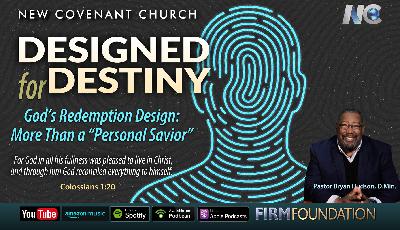
God's Redemption Design: More Than a Personal Savior
Part Two of Designed for Destiny
TRANSCRIPT:
Greetings, and welcome to another Firm Foundation Inspiration Minute. As a matter of fact, this is talk #200! Praise God! We began this series in January of 2022. I thank God for His grace that empowers me to bring you these inspirational talks. I trust you’ve been blessed and encouraged by them.
Our topic today is “The Last Adam Solved Our Problem.”
Reading from 1 Corinthians 15:45, “And so it is written, the first man Adam became a living being. The last Adam became a life-giving Spirit.”
The problem we had was the disobedience of Adam in the Garden of Eden. He and his wife did not follow God’s instruction. When they disobeyed God, death entered the world. There was first a spiritual death, and then humanity succumbed to physical death. They were not designed to die physically, but sin always brings death—both spiritually and physically.
However, this did not take God by surprise. In that same moment, God made a promise that the seed of the woman would crush the head of the serpent, which is a type of the devil. Jesus destroyed the works of the devil.
While neither Adam, nor Eve, nor the serpent understood what God said at the time, we know in hindsight that this Seed was preserved all the way to the coming of Jesus through the Virgin Mary.
Romans 5:15 reads: “For if by one man’s offense death reigned through the one, much more those who receive abundance of grace and the gift of righteousness will reign in life through the One.”
Jesus, the Last Adam, became a life-giving Spirit.
This text explains that by one man’s offense, Adam’s, death reigned through that one sinful seed. The Scripture goes on to say that those of us who receive the abundance of grace and the gift of righteousness will reign in life through the One, Jesus Christ.
Through Jesus, we live in the gift of righteousness, and we reign in life over sin, Satan, and defeat. Amen!
So the Last Adam, Jesus, solved our problem. Rejoice in that!
God bless. Have a great day, and be encouraged.
DOWNLOAD KEYNOTE SLIDES
In this message, Pastor Bryan Hudson teaches that while Jesus is indeed our personal Savior, God's redemptive design is far greater than individual salvation. From Romans 8:29 and Colossians 1:19–20, he shows that God predestined believers to be conformed to Christ, forming a collective people—His church—through whom He reconciles and influences the world. Salvation is not merely personal but part of God’s broader plan to redeem humanity and creation.
Dr. Hudson contrasts man-made design, shaped by sin and selfishness, with God-made design, in which believers are God’s workmanship created for good works. He emphasizes that destiny is expressed through service, not self-service, and warns against reducing Christianity to private spirituality or political power. God calls His people to be “salt and light,” influencing systems with righteousness—not taking them over.
Using the parable of the Good Samaritan, he explains that we do not choose our neighbors; love requires us to serve anyone in need, even those unlike us. Jesus transforms “neighbor” from a category into a calling. The sermon also traces the biblical design of redemption from Genesis, showing how Jesus—the “last Adam”—undoes the failure of the first Adam and restores humanity.
Dr. Hudson concludes that believers “reign in life” (Romans 5:17) not as earthly rulers but through the shared authority and life of Christ. Salvation is personal, but not for personal ends. God’s destiny for us is collective: a chosen, royal, holy people who fulfill His purposes together.
Listen to My Message from Sunday, December 7
Designed for Destiny: Created for Good Works
Romans 8:29
For whom He foreknew, He also predestined to be conformed to the image of His Son, that He might be the firstborn among many brethren.
As a visual communications major in college and a designer for almost 50 years, ever since high school, I appreciate God's intention as the ultimate designer. You have also been responsible for design in one way or another, whether formally or by making decisions about how your home looks and functions.
On your job, through your volunteer tasks, planning a vacation, or working with others, design is always a vital part of any fruitful task. Design is the engine of purpose, or what we also call destiny. While the concept of destiny is large, the actions of destiny are comprised of consistent small steps—something we also call process.
From the foreknowledge of God, our text states that we were predestined to be conformed to the image of His Son Jesus.
That's a big concept, but it was manifested in many smaller steps. From God anticipating the fall of Adam and Eve, stating, “He shall bruise your head, and you shall bruise His heel”—foretelling of Jesus’ death as a bruised heel, resulting in defeating Satan and the power of death, “a bruised, or busted, head.” From that beginning in the garden, God protected and preserved the messianic seed all the way to the virgin Mary.
Here's the important thing about design: the designer is always paying attention to his or her design. Because it is an investment of time and resources, there's no way a designer will neglect the design.
I say that to remind you that because you are designed by God, He pays attention to you. In the words of the Hebrews writer (2:6),
“What are mere mortals that you should think about them, or a son of man that you should care for him? Yet for a little while you made them a little lower than the angels and crowned them with glory and honor.”
Because you and I were designed or made a little lower than the angels and crowned with glory and honor, your Designer never stops thinking about you and adjusting His work in your life and in our lives together.
Let that thought live in your heart and mind today.
DOWNLOAD KEYNOTE SLIDES
Romans 8:29, For whom He foreknew, He also predestined to be conformed to the image of His Son, that He might be the firstborn among many brethren.
Ephesians 2:10, For we are His workmanship [masterpiece], created in Christ Jesus for good works, which God prepared beforehand that we should walk in them.
Summary
Pastor Bryan Hudson, D.Min. teaches that every believer is designed by God with intention and created for a purposeful destiny, which Scripture calls “good works.” Drawing from Romans 8:29, he explains that God has predestined us—not by pre-programming our choices, but by providing a divine design we must willingly discover and walk in. Destiny is not a single large event; it is the consistent, faithful, everyday actions done in alignment with God’s purpose. Pastor Hudson contrasts manmade design, which produces spiritual deadness and conformity to the world, with God’s design, which brings life, identity, and transformation through His love, grace, and mercy. Believers are God’s “workmanship”—His masterpiece—uniquely created like fingerprints, each with a distinct role that strengthens the collective body of Christ.
Emphasizing that identity in Christ is both individual and communal, he reminds the church that we are a chosen generation, a royal priesthood, a holy nation, and God’s special people. As such, we reject the “pandemic of self-service” and embrace a life of service to God and others. The sermon concludes by calling believers to walk in their God-given design, encourage one another, and live as salt and light in the world.
Download Keynote Slides
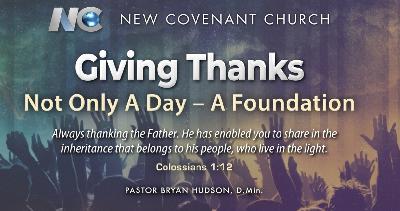
Colossians 1:12, Always thanking the Father. He has enabled you to share in the inheritance that belongs to his people, who live in the light.
1 Thessalonians 5:18, In everything give thanks; for this is the will of God in Christ Jesus for you
In this message, Pastor Bryan Hudson, DMin. teaches that thanksgiving is far more than a holiday—it is a foundational posture for a victorious Christian life. Drawing from Colossians 1:12, 1 Thessalonians 5:18, and other Scriptures, he explains that giving thanks is evidence of the inheritance God has placed within us and a continual practice that renews our minds, stabilizes our emotions, and keeps our hearts clear. Like the peace offerings in Leviticus—voluntary, heartfelt, and spontaneous—true thanksgiving flows from love, not obligation. Using the redwood tree’s shared root system as an illustration, he shows that believers are rooted together in Christ and strengthened through collective gratitude. Pastor Hudson warns that withholding thanks leads to darkened thinking, while a lifestyle of gratitude brings joy, peace, and spiritual resilience even amid trials. Ultimately, giving thanks is a continual offering, the “fruit of our lips,” that keeps us in God’s presence (coram Deo) and grounds our identity as accepted, blessed people who live in the light.
1 Peter 2:9–10 (NKJV)
“But you are a chosen generation, a royal priesthood, a holy nation, His own special people, that you may proclaim the praises of Him who called you out of darkness into His marvelous light; who once were not a people but are now the people of God, who had not obtained mercy but now have obtained mercy.”
Listen to my Message from Sunday, November 16
Ministry in The Margins: How Small Acts Have Eternal Impact
MESSAGE SUMMARY PDF
Proverbs 4:23, Above all else, guard your heart, for everything you do flows from it.
DOWNLOAD KEYNOTE SLIDES
DOWNLOAD SERMON SUMMARY
SERMON SUMMARY (by OpenAI)
Ministry in the Margins: How Small Acts Have Eternal Impact
By Pastor Bryan Hudson, D.Min.
Matthew 25:31 “When the Son of Man comes in His glory, and all the holy angels with Him, then He will sit on the throne of His glory. 32 All the nations will be gathered before Him, and He will separate them one from another, as a shepherd divides his sheep from the goats. 33 And He will set the sheep on His right hand, but the goats on the left. 34 Then the King will say to those on His right hand, ‘Come, you blessed of My Father, inherit the kingdom prepared for you from the foundation of the world: 35 for I was hungry and you gave Me food; I was thirsty and you gave Me drink; I was a stranger and you took Me in; 36 I was naked and you clothed Me; I was sick and you visited Me; I was in prison and you came to Me.’ 37 “Then the righteous will answer Him, saying, ‘Lord, when did we see You hungry and feed You, or thirsty and give You drink? 38 When did we see You a stranger and take You in, or naked and clothe You? 39 Or when did we see You sick, or in prison, and come to You?’ 40 And the King will answer and say to them, ‘Assuredly, I say to you, inasmuch as you did it to one of the least of these My brethren, you did it to Me.’
1. Introduction: Jesus will separate those who served from those who did not.
Dr. Hudson opens with Matthew 25, where Jesus describes the Son of Man returning in glory, separating people like a shepherd divides sheep and goats. This passage reveals how God evaluates lives—not by spectacle or prominence, but by compassionate actions taken toward “the least of these.”
Jesus lists personal, human-scale acts:
Feeding the hungry
Giving drink to the thirsty
Welcoming the stranger
Clothing the naked
Visiting the sick
Ministering to the imprisoned
The righteous are surprised—they don’t remember doing these things for Jesus. But He replies:
“Inasmuch as you did it to the least of these My brethren, you did it to Me.”
This text reveals Christ’s heart for people and His identification with the marginalized.
2. Two Levels of Ministry: Macro & Micro
Dr. Hudson explains that Jesus operated at two simultaneous levels:
A. Macro (Big Picture)
The “40,000-foot view”
God enthroned in heaven
Christ coming in glory with angels
The sweeping rule of God over all creation
Jesus doing “big things”—miracles, world-changing acts
This is the majestic, transcendent dimension of Christ’s ministry.
B. Micro (Personal & Individual)
Jesus noticing one hungry person
One thirsty person
One stranger
One sick or imprisoned person
One woman touching His garment
One boy with a small lunch
The same King who rules the universe also sees individual people in need.
"Jesus sees you right where you are.”
Christ never stops seeing the person while seeing the big picture.
The Problem With People Who Only See Macro
Some people only want big, impressive ministry. They become “legends in their own minds.”
But without micro-vision—tenderness, compassion, awareness—you cannot truly minister to people.
3. What God Actually Pays Attention To
Dr. Hudson stresses that we live in a culture fascinated by entertainment, showmanship, and spectacle. But:
God is not impressed with big platforms or big productions.
God does not measure greatness the way people do.
God pays attention to people and their conditions, especially those who are suffering.
Illustration: Prison Ministry
Prison ministry strips away props, technology, and fanfare.
You can’t take your laptop, phone, Apple Watch, or screens.
You go in with:
A Bible
A simple watch
Glasses
A few notes
And Jesus in your heart
This is micro-level ministry—core, simple, compassionate.
God pays attention to that.
4. A Big God Who Sees and Uses Small Things
A. God Sees Small Things
Luke 12:6–7 – God cares about sparrows and numbers every hair on your head.
Jesus regularly highlights small acts of faith, not big personalities.
B. God Uses Small Things
Biblical examples:
A boy’s small lunch (loaves & fishes)
Rahab’s small but courageous lie to protect the spies
David’s sling and five smooth stones
Samson’s donkey’s jawbone
The woman’s touch of Jesus’ garment
Gideon’s 300 soldiers
A man loaning Jesus his donkey
All small acts. All with massive impact.
C. God Uses Simple Things
Especially in ministry to the marginalized—juvenile centers, prisons, people at the margins of society.
Simplicity reveals Christ most clearly.
5. Ministry in the Margins: The Meaning of “Margins”
The sermon uses the metaphor of a book:
The text is the main content—where “most people” live.
The margin is outside the center—where people feel unseen, unwelcome, or displaced.
Some people live in the margins because:
Society pushes them there
They don’t fit expected norms
They experience hardship, injustice, or lack
They aren’t embraced by the “main text”
Jesus, however, identifies with people in the margins.
He says:
“I was hungry… I was thirsty… I was a stranger…”
He does not say “they were hungry.”
Jesus dignifies the marginalized by identifying with them personally.
Christ’s Identification With the Marginalized
Jesus Himself:
Was never literally sick or imprisoned
Was never homeless in the modern sense
But He chooses to identify with those who are.
Why? Because if you are trapped in the same condition yourself, you cannot lift someone else out.
He identifies so He can elevate.
6. The Problem in American Christianity
Dr. Hudson warns against a version of Christianity obsessed with:
Power
Privilege
Proximity to the wealthy
Cultural influence
Celebrity preachers
“Macro-only ministry”
The Gospel calls us back to the heart of Christ—a heart that sees the hungry, thirsty, undocumented, imprisoned, and sick.
As his grandfather preached:
“You got what you wanted, but lost what you had.”
7. Macro & Micro Together in Scripture
Examples:
Proverbs 16:9
Macro: A man plans his way
Micro: The Lord directs his steps
James 2:14
Macro: Faith
Micro: Works
Both are required.
8. Sheep vs. Goats: A Call to Be a Sheep
A. Sheep Characteristics
Gentle
Stay close together
Easily follow the shepherd
Respect boundaries
Stay where God places them
Ready to inherit the kingdom because they’ve been walking with the King
B. Goat Characteristics
Wander into danger
Break boundaries
Independent
Do their own thing
Resist leadership
Not oriented to the flock
Self-willed
This explains the behavior of many people.
C. Why Sheep Inherit the Kingdom
Not because God “picked” them that day, but because:
They were already aligned with Christ
Their lives consistently reflected His compassion
Their hearts were shaped by love, not self-service
“Be a sheep and not a goat.”
9. Final Exhortation: God’s Kingdom Is Love in Action
Jesus separates people not by:
Religion
Church attendance
Public image
Size of ministry
Amount of Bible knowledge
But by compassion expressed toward others.
Two realities:
The unrighteous (goats) face judgment for indifference and self-service.
The righteous (sheep) inherit the kingdom because they carry the King’s heart.
“Faith works through love.” — Galatians 5:6
10. Closing Prayer Themes
Gratitude for the Word
Correction and reorientation of our attitudes
Desire to reflect the compassion of Christ
Awareness that God sees even sparrows—and certainly sees us
Thankfulness for people who care and serve quietly
A commitment to be sheep, not goats
A call to draw close to Jesus and His heart for the marginalized
One-Sentence Summary
This sermon teaches that while God is great and majestic (macro), He pays the closest attention to small, compassionate acts done for people in the margins (micro), and those who consistently walk in such compassion—His “sheep”—are the ones who inherit His kingdom.
Matthew 25:31 “When the Son of Man comes in His glory, and all the holy angels with Him, then He will sit on the throne of His glory. 32 All the nations will be gathered before Him, and He will separate them one from another, as a shepherd divides his sheep from the goats. 33 And He will set the sheep on His right hand, but the goats on the left. 34 Then the King will say to those on His right hand, ‘Come, you blessed of My Father, inherit the kingdom prepared for you from the foundation of the world: 35 for I was hungry and you gave Me food; I was thirsty and you gave Me drink; I was a stranger and you took Me in; 36 I was naked and you clothed Me; I was sick and you visited Me; I was in prison and you came to Me.’
37 “Then the righteous will answer Him, saying, ‘Lord, when did we see You hungry and feed You, or thirsty and give You drink? 38 When did we see You a stranger and take You in, or naked and clothe You? 39 Or when did we see You sick, or in prison, and come to You?’ 40 And the King will answer and say to them, ‘Assuredly, I say to you, inasmuch as you did it to one of the least of these My brethren, you did it to Me.’
Hebrews 1:1 God, who at various times and in various ways spoke in time past to the fathers by the prophets, 2 has in these last days spoken to us by His Son, whom He has appointed heir of all things, through whom also He made the worlds; 3 who being the brightness of His glory and the express image of His person, and upholding all things by the word of His power, when He had by Himself purged our sins, sat down at the right hand of the Majesty on high, 4 having become so much better than the angels, as He has by inheritance obtained a more excellent name than they.
John 15:12–13, “This is My commandment, that you love one another as I have loved you. Greater love has no one than this, than to lay down one’s life for his friends.”
Listen to the Message from Sunday, October 26
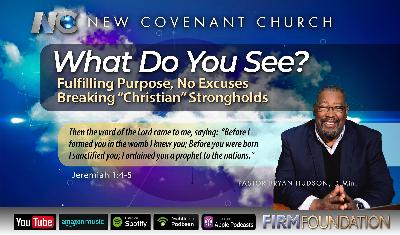
What Do You See? Fulfilling Purpose, No Excuses
Breaking “Christian” Strongholds
Summary: “What Do You See? Fulfilling Purpose—No Excuses”
Pastor Bryan Hudson, D.Min.
Primary Texts: Jeremiah 1:1–12; Esther 4:13–14; John 18:36; 2 Cor. 10:3–5
DOWNLOAD THIS SUMMARY
Jeremiah 1:3 It came also in the days of Jehoiakim the son of Josiah, king of Judah, until the end of the eleventh year of Zedekiah the son of Josiah, king of Judah, until the carrying away of Jerusalem captive in the fifth month. 4 Then the word of the Lord came to me, saying: 5 “Before I formed you in the womb I knew you;
Before you were born I sanctified[a] you; I ordained you a prophet to the nations.” 6 Then said I: “Ah, Lord God! Behold, I cannot speak, for I am a youth.” 7 But the Lord said to me: “Do not say, ‘I am a youth,’ For you shall go to all to whom I send you, And whatever I command you, you shall speak. 8 Do not be afraid of their faces, For I am with you to deliver you,” says the Lord. 9 Then the Lord put forth His hand and touched my mouth, and the Lord said to me: “Behold, I have put My words in your mouth. 10 See, I have this day set you over the nations and over the kingdoms, To root out and to pull down, To destroy and to throw down, To build and to plant.” 11 Moreover the word of the Lord came to me, saying, “Jeremiah, what do you see?” And I said, “I see a branch of an almond tree.” 12 Then the Lord said to me, “You have seen well, for I am ready to perform My word.”
Thesis: How you see—with Spirit-given vision, not just physical sight—determines how God can use you. Vision silences excuses and activates purpose right where you already are.
1) Vision vs. Sight
Opens with Dr. Myles Munroe’s line: sight is with the eyes; vision is with the heart.
We act out of what we see internally; no one acts beyond their beliefs and understanding.
Best motivator of action: God’s purpose and love of neighbor.
Worst motivator: self-interest.
Greatest enemy to purpose: accepting limitations and making excuses.
2) Jeremiah’s Context and Call
Jeremiah ministers in a divided kingdom (Israel & Judah). Israel already fell; Judah still “with God” yet drifting into idolatry and injustice.
God’s word to Jeremiah (Jer 1:4–10):
Before birth—God knew, formed, sanctified, appointed him.
Jeremiah’s excuse (“I’m too young / can’t speak”) is dismissed by God.
God gives a threefold redirection:
Command: “You shall go…and speak.”
Prohibition: “Do not fear their faces.”
Promise: “I am with you to deliver you.”
Provision: God touches Jeremiah’s mouth, putting His words there—empowerment. Assignment: “Root out, pull down, destroy, throw down”—then “build and plant.”
3) Inside the System, Yet Unconformed
God often uses people already inside systems if they refuse to be conformed.
Jeremiah: born into priestly establishment, yet called to confront corruption.
Esther: positioned in power and tempted to silence; Mordecai reminds her she’s there “for such a time as this.”She risks comfort to challenge an evil decree.
4) Two “Kingdoms”: Counterfeit vs. Christ’s
Dr. Hudson contrasts “Christianity without Christ” with the Christianity of Christ:
Manifest Destiny and the Doctrine of Discovery (historical justifications for conquest and displacement) and chattel slavery are cited as religiously-coated systems that harmed people—ends never justify means.
Frederick Douglass is quoted distinguishing the pure Christianity of Christ from the hypocritical religion of his time.
“I love the pure, peaceable, and impartial Christianity of Christ; I therefore hate the corrupt, slaveholding, women-whipping, cradle-plundering, partial, and hypocritical Christianity of this land. Indeed, I can see no reason, but the most deceitful one, for calling the religion of this land Christianity. I look upon it as the climax of all misnomers, the boldest of all frauds, and the grossest of all libels.” (Frederick Douglass, Narrative of the Life of Frederick Douglass, an American Slave)
Contemporary Christian nationalism seeks to wield state power to impose religion. Jesus said, “My kingdom is not of this world” (John 18:36); the Gospel changes hearts, not by coercive law.
Christians hold dual citizenship: we preach the Gospel, love neighbors, pursue justice, and elect competent public servants, but we do not try to “Christianize” worldly power.
5) Excuses vs. God’s Plan
God ignores excuses—they only “work” for the one making them.
Inadequacy is real, but not a hiding place; the God who formed you increases capacity.
Expect trouble for obedience; God already factored it in and promises presence and deliverance.
6) Weapons and Work of the Kingdom
Our warfare is not carnal (2 Cor. 10:3–5). We pray, speak truth to power, show up, help people, and support leaders who serve the common good rather than self-interest.
“Rooting out” includes exposing deception; “building/planting” means constructive actions that bless people and communities.
7) “What Do You See?”—The Almond Branch
God asks Jeremiah what he sees (1:11–12).
Almond branch—earliest to bloom—pictures God’s watchfulness and swift action.
Key: Jeremiah didn’t need full interpretation to obey; he only needed to see what God showed.
When Jeremiah saw God’s adequacy more than his own inadequacy, God declared, “You have seen well… I am ready to perform My word.”
8) Applications & Practices
Confession: Renounce excuses; receive assignment where you are; refuse fear; trust God’s presence.
Act where placed: Identify your sphere (home, work, school, civic board, ministry team).
Two moves each week:
One “tear down” act (truth-telling, intercession, challenging injustice).
One “build/plant” act (mentoring, proposing just processes, starting prayer/helps initiatives).
Discernment: Judge by fruit, not labels; avoid fruitless arguments; invest in people with ears to hear.
9) Closing Appeal & Prayer
Place hope in Christ, not systems. Worldly empires fail; God’s kingdom endures.
Ask for grace to discern counterfeit religion, to shine light without anger, and to participate in God’s change by changed hearts leading to changed conditions.
Call to salvation, consecration, and immediate obedience—letting the “light turn on” and walking out purpose with no excuses.
Bottom line:
Seeing with kingdom vision—not merely with natural sight—positions you to confront lies, build what blesses people, and walk confidently in the assignment God prepared before you were born.
James 1:17, Every good gift and every perfect gift is from above, and comes down from the Father of lights, with whom there is no variation or shadow of turning.
1 John 1:5, The Apostle John wrote, “This is the message which we have heard from Him and declare to you, that God is light and in Him is no darkness at all.”
John 1:4–5, “In Him was life, and the life was the light of men. And the light shines in the darkness, and the darkness did not comprehend it.”
"The Light That Blinds: When Power Creates Darkness – Moral Clarity in an Age of Injustice"
by Bryan Hudson, D.Min.
This is audio of an article read by a digital voice. To read the article VISIT THIS LINK on my blog.
Philippians 3:12, Not that I have already attained, or am already perfected; but I press on, that I may lay hold of that for which Christ Jesus has also laid hold of me.

Comments

Download from Google Play

Download from App Store
 United States