


 Claim Ownership
Divided Argument
Subscribed: 519Played: 10,320
Subscribe

© Will Baude & Dan Epps
Description
An unscheduled, unpredictable Supreme Court podcast. Hosted by Will Baude and Dan Epps. In partnership with SCOTUSblog.
122 Episodes
Reverse

 1
1We recap and reflect on the oral arguments in Trump v. Barbara (the birthright citizenship case) and then analyze the Court's recent decision in Chiles v. Salazar, about the First Amendment limits on Colorado's conversion therapy ban. We also confront the taboo question: Are judicial opinions too long?
We're live at WashU Law's Admitted Students Day! After catching up on some shadow docket activity, we dig into Olivier v. City of Brandon, the Court's unanimous March 2026 decision by Justice Kagan. A Mississippi street preacher pleads no-contest to violating an amphitheater protest-zone ordinance, pays his $304 fine, then sues under §1983 to stop future enforcement — and the Fifth Circuit says the puzzling Heck v. Humphrey rule bars the whole thing. We work through why Heck is stranger than it first appears, what the Court got right in resolving the circuit split, and what the decision reveals about the ongoing mess at the intersection of §1983 and habeas.
We announce an exciting new partnership with SCOTUSblog and introduce the show to new listeners. We then return to the mysterious origins of the Chief Justice's "no, no, a thousand times no," debate the Court's new policy designed to maintain secrecy, and then take a close look at Galette v. New Jersey Transit Corporation, a sovereign immunity decision in which the Court may, or may not, have paid attention to Will's amicus brief.
It's our live show at the University of Chicago! Hosted by the University of Chicago Federalist Society, we discuss this week's big shadow-docket rulings about gender transitions in California Schools (Mirabelli v. Bonta) and redistricting in New York (Malliotakis v. Williams), and also break down the recent merits decision about the right to counsel when a defendant is testifying (Villareal v. Texas).
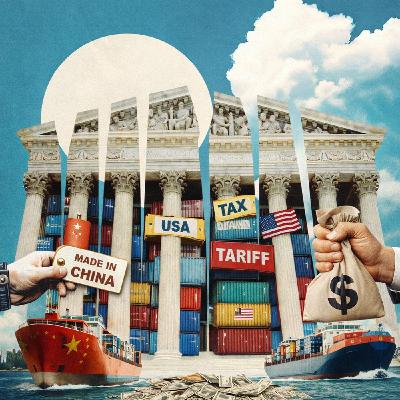
With unpredictable timeliness, we have a quasi-emergency episode on the 170-page tariffs decision, Learning Resources, Inc. v. Trump. Come for the in-the-weeds legal analysis, stay for the deep dive into the origins of the phrase "no, no, a thousand times no."
We're back for another live show at the Northwestern Pritzker School of Law, hosted by the Northwestern Federalist Society! We discuss the term's two Second Amendment arguments -- first recapping the oral argument in Wolford v. Lopez, featuring Hawaii's law about getting consent to bear arms on private property; and then previewing the oral argument in United States v. Hemani, about the ban on possession of guns by drug users.
With shocking and uncharacteristic efficiency, we manage to discuss three merits opinions and one orders list dissent in only 47 minutes. Specifically, we revisit Coney Island Auto Parts Unlimited, Inc. v. Burton (time limits for moving to vacate void judgments) and break down Berk v. Choy (an Erie doctrine puzzle), and Ellingburg v. United States (criminal restitution and the Ex Post Facto Clause), while also managing to discuss Justice Jackson's broadside against the Court's practice of "martinization."

We didn't get the tariffs decision this week, but we discuss two of the opinions we did get -- Bost v. Illinois Board of Elections, a decision about standing and election law, and Case v. Montana, a rare Fourth Amendment case -- in a remarkably efficient episode (after a brief detour into Grok's jurisprudence and the announcement of a major gift to the Constitutional Law Institute).

We're back with the first episode of the new year, breaking down the interim docket opinion/order in Trump v. Illinois, the national guard case, after first warming up with new Erie scholarship, state criminal jurisdiction over federal officers, and some recent online discourse.
We're back to break down a month's worth of shadow docket activity -- three recent summary reversals, plus the stay in the Texas gerrymandering case (Abbott v. LULAC). We also discuss the launch of the SCOTUSblog "interim docket blog."

Will and Dan record a rare live show in an unusual venue: the Salamander Resort in Middleburg, Virginia, at the annual attorney retreat for trial boutique Wilkinson Stekloff. Dan teaches Will some of the new lingo he's learned from the firm's trial experts before a deep dive into civil procedure. First, we dig into the recently argued Coney Island Auto Parts Unlimited v. Burton, which presents a seemingly easy legal question and harder questions about SCOTUS advocacy and ethics. Then we look back at last Term's LabCorp v. Davis, which the Court DIG'd but which raises some fundamental questions about class action litigation that the Court is likely to revisit down the road.
After a predictably unpredictable set of detours through Latin grammar, parenting philosophies, and 90s video games, we catch up on the latest shadow (interim?) docket activity and recap the oral argument in the tariffs cases.

Divided Argument is in its sixth season! Our first episode of the term focuses, of course, on the latest developments on the shadow docket. These include several grants of interim relief to the Trump administration, as well as some dissents from the denial of certiorari. But first, an update on Dan's travel schedule and ChatGPT usage, and an important correction to our previous episode.
For the season finale, we're joined by Yale law professor Justin Driver to talk about his new book, "The Fall of Affirmative Action: Race, the Supreme Court, and the Future of Higher Education." We discuss the conservative cases for and against affirmative action, the post-SFFA world of university admissions, the promise and limits of colorblindness, and the effects of admissions policies on students' sense of belonging.

We extend our record-breaking run with a discussion of the Court's two big recent emergency docket rulings: Noem v. Vasquez Perdomo and NIH v. American Public Health Association.

We're joined by Michigan law professor Richard Primus to talk about his new book, "The Oldest Constitutional Question: Enumerated and Federal Power." Richard describes one of the the most widespread beliefs about constitutional law -- that the federal government is one of limited, enumerated powers -- and why he thinks it is actually wrong. Along the way, we discuss methods of constitutional interpretation, the relationship between the official story of the law and legal practice, and wrestle with the surprisingly hard question of how many congressional powers are listed in the Constitution.
Continuing our long slog through the end-of-Term opinion dump, it's fraud day! We dig into Kousisis v. United States and Thompson v. United States, two interesting federal criminal law puzzles.
We finally circle back to the two big structural constitutional law cases from the last day of the term. First is Kennedy v. Braidwood Management, which upheld the appointment structure of the U.S. Preventative Services Task Force under the Affordable Care Act. Then is FCC v. Consumers' Research, which upheld the universal-service contribution scheme against a pair of non-delegation challenges. Our second-longest episode of the season.
Acting with unpredictable alacrity and unpredictable brevity, we break down the Supreme Court's recent interim order in Trump v. Boyle, and discuss what it means for the unitary executive, and for the shadow docket. We also debate the best name for the Court's emergency/interim orders docket.
Moving with shockingly unpredictable efficiency, we respond to feedback, debate which of us is more composting-friendly, catch up on the emergency docket, and chip away at our end-of-Term backlog by digging into Diamond Alternative Energy v. EPA.

Comments

Download from Google Play

Download from App Store
 United States