


 Claim Ownership
Case by Case
Subscribed: 25Played: 207
Subscribe

© 871298
Description
Luke Zadkovich and Calum Cheyne of Floyd Zadkovich discuss a new case each week, focused on shipping, international trade and commercial law.
We each read the case, then jump straight on the podcast and hit record. All you hear is our organic conversation and our thoughts on what the case is about, what the Court decided, and how the decision may affect the industry.
*any guidance or suggestions given in any podcast episode is generic in nature and not to be considered as legal advice. Please contact lawyers for specific, legal advice.
www.floydzad.com / marketing@floydzad.com
We each read the case, then jump straight on the podcast and hit record. All you hear is our organic conversation and our thoughts on what the case is about, what the Court decided, and how the decision may affect the industry.
*any guidance or suggestions given in any podcast episode is generic in nature and not to be considered as legal advice. Please contact lawyers for specific, legal advice.
www.floydzad.com / marketing@floydzad.com
101 Episodes
Reverse

In this episode of Case by Case, Luke Zadkovich and Calum Cheyne welcome FZ London associate Lucy Noble. Lucy has been a real star in our team since joining on qualification a couple of years ago. This interesting case about compliance with Charterers' orders was right in her sweet spot.The three discuss the English Commercial Court case of CM P-Max III Ltd v Petroleos Del Norte SA (Re MT Stena Primorsk Voyage Charter) [2022] EWHC 2147 (Comm) (12 August 2022). The case turned on whether or not the Master reasonably decided not to follow Charterers' instructions to berth, citing safety grounds. As ever, we get into it and it prompts a lot of interesting discussion.Don't forget to check out our new YouTube channel for the video recording of this episode!
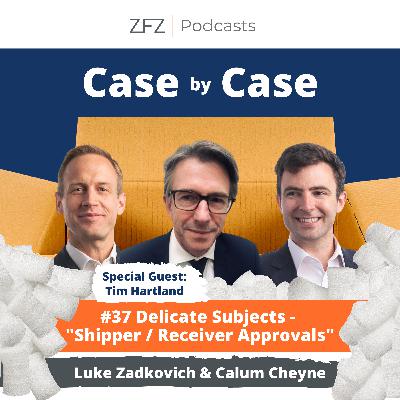
In this episode of Case by Case, Luke Zadkovich and Calum Cheyne are delighted to welcome maritime arbitrator and shipbroker, Tim Hartland, to discuss a recent English Commercial Court case DHL Project & Chartering Ltd v Gemini Ocean Shipping Co Ltd [2022] EWHC 181 (Comm).
The curly area of "subjects" always makes for a good discussion.
Subjects are all about whether a contract is formed with something that must happen in the future OR whether something must first happen before a contract is formed.
We got into here. Surprise and debate about whether the right decision was arrived at.
Asking big questions like does the law meet industry practice? Does the industry understand the law?
A combination of education, better drafting and clearer law would help the cause here.
Tim, thank you immensely for reaching out and joining us on the pod. It was a pleasure having you on.
Calum, your knowledge in this area is market leading. Great to hear your insights, as always.
Case by Case goes video this time! Check out our YouTube channel for the podcast video: Case by Case Podcast - YouTube

This week, Luke and Calum discuss the English Commercial Court case of Lenkor Energy Trading DMCC v Irfan Iqbal Puri [2022] EWHC 2113 (Comm).
World-wide freezing orders draw a lot of attention. When obtained, they can have a drastic impact on a defendant. A freezer does what it says. It maintains the status quo over a defendant's assets and prevents dissipation, while an underlying substantive claim is resolved and ultimately paid.
However, there are typically exceptions in the order. One exception is that the defendant can continue to pay legal costs from its assets notwithstanding the freezer (something Luke knows well from another case he handled).
Another exception - the Angel Bell exception - allows the defendant to continue to use its assets in the usual course of business.
The question here is whether the Angel Bell exception should continue to be part of a freezing order (in the circumstances of this case), after the underlying claim has crystallised into a judgment against the defendant and before the debt has been paid.
Does obtaining a judgment change the dynamic? Listen in for a healthy exploration of the topic, along with a few tangents on freezing orders more broadly.

Thank you to our regular listener, Jim Leighton, for this suggested London arbitration case. You were right about the Yuta controversy, Jim! We always welcome feedback and suggestions.
To do the topic justice we brought in a big hitter. Philip Vagin knows this territory like the back of his hand. And he is coming on the podcast in top form, having had his published article in the Tulane Maritime Law Journal (ed. 45, pg 509) on the recovery of economic losses in collisions cited on Monday in the US federal judgment of Shallow Water Equipment v. Pontchartrian 2022 WL 3755041. A major scholarly achievement to be quoted by a court.
In this episode, they delve into whether maritime liens are substantive or procedural in nature, whether bunker suppliers should be able to contractually carve out a US statutory lien from substantive English law, and what is the scope of the agency between bareboat charterer and time charterer in respect of purchasing bunkers on credit.
Really interesting topics. Luke has had a keen interest in agency principles running through the charter chain for some time now. There is much, much more to explore in this area.
Follow on Spotify or Apple Podcasts to get notified when our weekly episodes drop.
On this episode - we have the return of the Divinegate... listeners may remember we looked at a jurisdictional preliminary issue regarding arrest on this case a while back. Now the High Court Judgment is with us.There was not a lot of quantum in dispute, but we're glad this case was run, because it has given us a really interesting judgment on two distinct points:1 - Speed and Performance - particularly the application of a current factor. Some 'new law' on that in this Judgment.2 - Wrongful arrest - The arresting party got the arrest 'wrong'. There was no question of that. But how 'wrong' do you have to be to be 'wrongful'? A very interesting question, and one that might cause a bit of debate.We're very interested to hear thoughts from any of our listeners on this one!Follow Case by Case to get notified when our episodes drop.
We are seeing legal decisions on Covid cases regularly come through the courts and arbitral panels now. And this is an interesting one.
Turns on wording in an influenza clause, and how that interacts with the usual clause 15 NYPE off-hire clause and a pestilence and illness clause. There's also a curly causation question in there for good measure.
Calum and Luke worked very closely together at the height of the pandemic in 2020 on various of these legal cases on responsibility for delays caused by Covid-19. They've been dealing with them ever since.
Follow Case by Case on Spotify to get notified when our next episode drops.
In this episode of Case by Case, Luke and Calum discuss the recent ship finance decision of OCM Maritime Nile LLC & Anor v. Courage Shipping Co Ltd & Others (Courage and Amethyst) [2022] EWHC 452 (Comm) from the English Court of Appeal coming from the Commercial Court.
With the imposition of recent US/UK/EU sanctions regimes, we’ve been advising extensively on the consequences. They can be drastic.
This case highlights the dramatic impact of the US government’s listing of an UBO as a “specially designated global terrorist”. Here it resulted in the loss of ships. Largely due to contractual wording in a bareboat charter.
That’s the rub of these cases. How to reconcile the sanctioning status with the contractual matrix.
The borrower/charterers' misconduct in and around the proceedings also did not help them - under equity principles.
Well worth a listen for anyone potentially exposed to counterparty sanction risk or seeking to mitigate such risk in drafting their contracts. A must-know case for anyone in ship or asset finance, where borrowers or their owners could be designated on govt sanctions lists.
Listen through for the details on this interesting one and make sure to follow on Spotify to get notified when our next episode drops.

Yes, we have strayed away from commercial litigation and arbitration in the world of PR, celebrity, football, gossip mags, leaks, lies and truth. This case is a surreal insight into the media industry and what goes on around the world of professional football.
It is amazing that this case went through to hearing. That we have a High Court judgment detailing the ins and outs of text messages between ‘wags’ of the English football team and between celebrity and agent. The English football national former captain in the witness box.
Was Ms Rooney’s great reveal Instagram Post that Ms Vardy was leaking personal information about her life a true statement or a lie?
Huge reputations on the line. Some have been smashed by this decision - in no uncertain terms. In football, it was also risky going toe to toe with Mr Rooney. Seems as though, in celebrity PR maneuvering, going toe to toe with Ms Rooney is just as risky...
Us being us, we couldn’t only focus on the personality of the decision. We talk about some quite serious takeaways on legal case strategy, evidence gathering, evidence presentation and how to win a high-stakes case.
If you’ve enjoyed this podcast episode, please do share it in your networks, and like and subscribe to our Case by Case podcast on Spotify. More topical or interesting cases dropping each Thursday.
A little over two years ago, Covid swept across the world for the first time, swiftly followed by law firm bulletins addressing the question of "What is Force Majeure?". Two years on, one of the earliest examples of alleged Force Majeure caused by Covid is subject to a High Court Judgment.
The parties had agreed a contract for the sale of a ship. Due to Covid restrictions, the sellers could not get the ship into the port at which delivery was anticipated to take place. The buyer alleged force majeure, and sought a return of the deposit. The sellers denied that force majeure applied, and claimed that they were entitled to maintain the deposit (plus other sums).
Luke and Calum discuss the principles of "Force Majeure" and the construction points that the Judge considered in reaching a Judgment.
Thank you for listening, and please like/share/subscribe.
Case citation: NKD Maritime Ltd v Bart Maritime (No. 2) Inc [2022] EWHC 1615 (Comm)
In this episode, Joe Gosden, FZ partner, joins Luke to discuss a fascinating topic in shipping law.A bill of lading in the hands of a charterer is a mere receipt of goods. It is not yet a contract of carriage between bill holder and carrier. When that bill is endorsed, it becomes a contract of carriage in the hands of the non-charterer endorsee.But what happens if the shipper/charterer holding the bill as a receipt novates away the charterparty. Is the bill operable in the hands of that shipper (and no longer the charterer)?We study the status of the bill - is it only "suspended" when in the hands of the charterer, or does it "spring to life" on endorsement? A birth, so to speak.There is also an interesting causation argument on whether the bank would have insisted upon presentation of original bills in any event. If not, then did the failure to present OBLs cause any loss?Joe and Luke also discuss some of the complications for trade finance banks/companies in protecting their position with adequate security and a few war stories they've experienced along the way.
What is litigation privilege? When does it apply? When doesn’t it?
There is a fine line between a probable prospect of litigation and a mere possibility of it. Where to draw that line is the challenge. We explore this in detail.
This episode also serves as a user guide on litigation privilege, highlighting the key principles and how to navigate them.
The dreaded ‘waiver of privilege’ is often on a lawyer’s mind when referring to legal advice in open communications or as in this case, a witness statement. And if it isn't, then it should be...

This is one for arbitration enthusiasts.
“We’ve always done it that way,” is said to be one of the most dangerous phrases in business.
Sometimes a case comes along that questions a process you’ve been doing for years. Appointing arbitrators - easy enough, right?! Well…
In this episode, Calum and Luke discuss what is required for an effective arbitrator appointment.
Is it a contract, is it status or is it a stand-alone three-part test…? Listen in to find out.
One of aspects Luke enjoys most about practising international trade and shipping law is its multi-faceted nature. Some of those facets include:
➡️ substantive law - who is right and wrong on the arguments in the underlying dispute?
➡️ jurisdiction - where in the world should the dispute be heard?
➡️ arguably most importantly, security and enforcement - how do you secure that there are assets to enforce against your arbitral award or court judgment at the end of the day?
This case primarily focuses on the second of those, but is also relevant for the third point.
Mr Justice Foxton of the English Commercial Court explains in very clear terms what is the test for whether a foreign proceeding brought outside the agreed forum is truly one for security or whether it goes beyond seeking security and infringes on seeking substantive relief. Luke and Calum explore this test in the podcast.
These seem like ancillary, sideline battles in the grand scheme of things. But no. For those active in this area of law, these decisions can have a massive effect on the ultimate success of parties to the dispute.
If you’ve enjoyed this podcast episode, please do share it in your networks, and like and subscribe to our Case by Case podcast on Spotify. More topical or interesting cases dropping each Thursday.
We're back from a brief break with a fresh episode of Case by Case. This time Luke and Calum review London Arbitration 16/22.
No - the analogy is not about the lights being turned off and on our podcast series. We are looking at vessel blackouts causing off-hire under a charterparty. A topic we know well from other cases we've handled recently. In addition to off-hire, our chat also touches on redelivery, notice under early termination clause and repudiatory breach.
Listen in over the coming weeks and months, as we work our way through a fascinating bunch of cases and catch up with new guests.
If you have a special case you'd like us to discuss, let us know - happy to receive suggestions and feedback anytime.
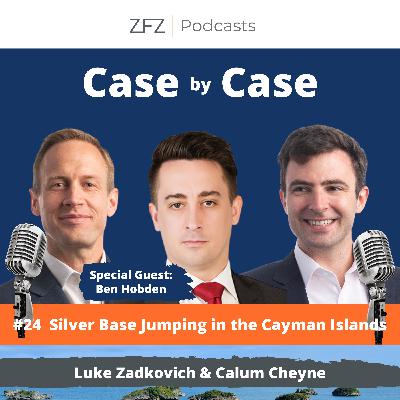
Calum and Luke have been wanting to share this episode for a while now. It was great to catch up with Ben Hobden of Forbes Hare - a leading and highly regarded restructuring and insolvency lawyer in the Cayman Islands. Here it is:
Administration and insolvency proceedings are on the rise. This was before the horrific events in Eastern Europe of the past week, which have caused major turmoil on global markets and remain front of mind for us all. Of course, the pandemic had a significant impact on a variety of businesses, and not uniformly so. Some businesses have benefitted and many have not. This plays into the rising prominence of administration and insolvency law, globally.
Ben takes us through the recent decisions in the Silver Base matter. This shines a spotlight on administrative proceedings in the Cayman Islands, the interaction with the Hong Kong jurisdiction, questions of comity, and how the Cayman Islands is viewed as a serious jurisdiction of choice for incorporation, with a robust legal system. The nuance involved in the judgment, which we discuss, is evidence of this.
These decisions also provide an excellent platform to look at new upcoming legislative changes in the Cayman Islands. Those changes should provide greater certainty to parties, creditors and other stakeholders looking to this jurisdiction.
Ben - thank you very much for your time and getting involved in Case by Case. Really enjoyed catching up with you!
Read more about Ben here: https://forbeshare.com/team/ben-hobden-partner-litigation-and-insolvency-forbes-hare-cayman-islands/
Yes, that’s right - we recorded our first live podcast episode to an audience! And what an exceptional audience it was. The luncheon was put on by the Society of Maritime Arbitrators, New York, and we were very fortunate to speak with approximately 40 leading US maritime arbitrators and counsel at the event.
We took the recent English Court of Appeal decision in the Eternal Bliss to the US. Literally and theoretically.
The episode explores whether demurrage covers all kinds of losses arising from a breach of laytime. It’s a one breach / two losses case. Not as simple as it sounds. Indeed, Calum and Luke saw this one somewhat differently.
We rounded off by examining how this type of case may rest within the demurrage landscape of US maritime law. There are notable distinctions and similarities in the comparison.
Thank you very much to the SMA for the invitation, and in particular to Molly McCafferty, member of the SMA Board of Governors, and LeRoy Lambert, President of the SMA for their kind introductions and words.
I suppose all that is left to say is that Case by Case is now formally accepting invitations for live speaking slots!
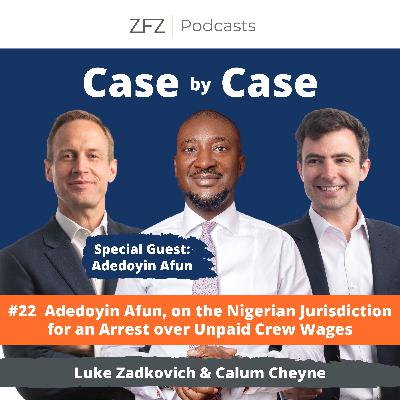
For the first time, we welcome an external colleague onto the show. Among many accolades and prestigious awards, Ade is a highly-respected Nigerian lawyer, with an expertise in maritime disputes.
Ade joins Luke and Calum on today's episode to discuss a recent decision in the Nigerian Courts, the effect of which appears to constrain the ability of the Nigerian Courts to give an order for a vessel arrest in respect of unpaid crew wages. Good news for Owners - but a decision that would make the Nigerian Court system a real outlier.
This conversation discusses issues of constitutional law and the problems that can arise where a codified constitution comes into conflict with a historical right of arrest.
Ade's profile can be found here: https://www.bloomfield-law.com/our-people/adedoyin-afun
Luke and Calum review London Arbitration 5/22 - A decision which looks at issues involving mitigation, remoteness and correctly particularising a damages claim.
During the podcast, Calum references Court of Appeal obiter comments, which deal with a potentially large claim for failure to re-deliver a vessel on time. The case is The Achilleas, and the citation is: Transfield Shipping v. Mercator Shipping (The Achilleas) [2007] 2 Lloyd’s Rep. 555 (C.A.). The relevant passage is Rix LJ's comments at Para 122 and is set out below:
As for illegitimate voyages, it seems to me that special considerations may arise here, but they have not been the subject of any debate before us, and I would be cautious about expressing any opinion. I would merely mention the possibility that an illegitimate voyage, being outside the contract and, if insisted upon, an anticipatory breach in repudiation of it (The Gregos), may amount in effect to a form of new offer: so that, if an owner in response says "No, but I warn you that I have fixed the vessel for a new charter, and if you insist on the voyage and I perform it, not waiving my right to damages, and I lose my new fixture, I will look to you for compensation", it is not impossible that, albeit late in the day, the charterer will be fixed with knowledge of the new charter (see Mr Gross QC arguendo in The Gregos in the Court of Appeal at [1993] 2 Lloyd’s Rep. 335 at page 345, albeit cf Scrutton’s comment at page 349 at footnote 11). That is not very different from what the parties agreed in The Gregos.
The leading sports news story of 2022 has been a legal one. Novak Djokovic has run the full gamut of the Australian immigration system. First he had a visa, then he was put into detention, then he was released, before finally the Australian Government revoked the visa and sent him home.
In this episode of case by case, Luke and Calum look at the final decision of the Federal Court, by which Djokovic was unceremoniously booted out of the country.
A fair result for someone who clearly didn't want to play by the rules?
A misapplication of the law?
Or a legal system designed to constrain the judiciary on matters of immigration and put all possible power in the hands of the Government?
This episode makes for an interesting look at the law behind the news.
Today it is all about Chocolate, and not in the way you are thinking. Luke and Calum are delving into the legal implications of the decision made on 16 November 2023, by the Honourable Mr Justice Foxton in ChocolateCity Ltd v WEA International Inc [2023] EWHC 2874 (Comm).Chocolate City is a case that highlights what happens when a lawyer is let lose in the wild to establish a successful record label. In this case a pre-eminent record label in Nigeria. However, where lawyers tread, litigation is never far behind. Join Luke and Calum as they take the wrapper off the Chocolate and shed some light on what transpired when WEA (part of the Warner Group) and Chocolate City executed a convertible term loan facility agreement. WEA served as the lender and Chocolate City as the borrower. However, when Chocolate City expressed its intention to prepay the loan WEA contested Chocolate City's right to prepay. If you want to read more about the case you can access the judgment here: Chocolate City Ltd v WEA International Inc [2023] EWHC 2874 (Comm) (16 November 2023) (bailii.org).Thank you for listening.

Comments

Download from Google Play

Download from App Store
 United States