


 Claim Ownership
Talking Indonesia
Subscribed: 3,138Played: 24,058
Subscribe

© All rights reserved
Description
In the Talking Indonesia podcast, Dr Jemma Purdey, Dr Jacqui Baker, Tito Ambyo and Dr Elisabeth Kramer present an extended interview each fortnight with experts on Indonesian politics, foreign policy, culture, language and more. Find all the Talking Indonesia podcasts and more at the Indonesia at Melbourne blog.
299 Episodes
Reverse

How did Indonesia, a place where wheat, the main ingredient of instant noodles, does not grow, become the second-largest consumer in the world and one of the top five exporters?
Instant noodles are a familiar staple for many of us, whether enjoyed occasionally or kept on hand as a pantry essential. First developed after World War II, they have since become a fixture of modern food consumption. According to the World Instant Noodles Association, global consumption exceeded 124 billion servings in 2025.
In this episode of Talking Indonesia, Dr Clara Siagian is joined by Dr Elna Tulus, who recently graduated from the University of Technology Sydney. Elna’s research traces the history of instant noodle production in Indonesia, which mapped onto the geopolitical turbulence and the aftermath of the 1965 violent purge of communism. During this period, food aid to Indonesia dropped almost to zero that year, then rose sharply from 1971, when the world’s largest wheat mill, Bogasari, opened in Tanjung Priok, Jakarta.
They also talk about the success of Indomie worldwide as part of what she calls as gastro-capitalism: a system where we labour for the food system and are also its market for corporate profits. She argues that instant noodles should be seen as an ultra-processed food: designed to be irresistible, super convenient, high in calories and low in nutrition. Their consumption can mask food insecurity where communities are continued to be lamed for eating them while overlooking the power of large corporations over what food is produced and available to buy.
Is cutting consumption enough? Listen in to hear why Elna points instead to local food and food sovereignty.
Abdil Mughis Mudhoffir - disorder and the preman state
Indonesian modern history is littered with stories of shadowy figures, underworld groups, militia, and criminal gangs, commonly known as preman. For its co-option and adoption of the activities and characteristics of these groups, scholars described the New Order period of Suharto’s authoritarian regime as the ‘preman state’. Almost three decades later, the role of these informal violence networks, protection racketeers, and gangsters, remains entwined within the political, social, and economic structures of democratic Indonesia.
Recently, public discussion and investigations have focused on one of these groups – Gerakan Indonesia Rakyat Bersatu or GRIB Jaya, its leader Rosario de Marshall, known as Hercules, and his close relationship with President Prabowo. This group's role in the Jakarta protests, which erupted into deadly violence on 27 August, has again raised questions about the underlying system of disorder that enables such criminality and gives groups like GRIB Jaya access to those at the highest levels of state power.
In this week's episode, Jemma chats with Abdil Mughis Mudhoffir, an Alexander von Humboldt research fellow at the GIGA Institute for Asian Studies and the Hamburg Institute for Advanced Study in Germany. He is also an honorary fellow at the Asia Institute, University of Melbourne. Mughis is author of 'State of Disorder: Privatised Violence and the State in Indonesia' and has written widely on Indonesian law and politics.
In 2026, the Talking Indonesia podcast is co-hosted by Dr Jemma Purdey from the Australia-Indonesia Centre, Dr Jacqui Baker from Murdoch University, Dr Elisabeth Kramer from the University of New South Wales, Tito Ambyo from RMIT and Dr Clara Siagian from University College, London.
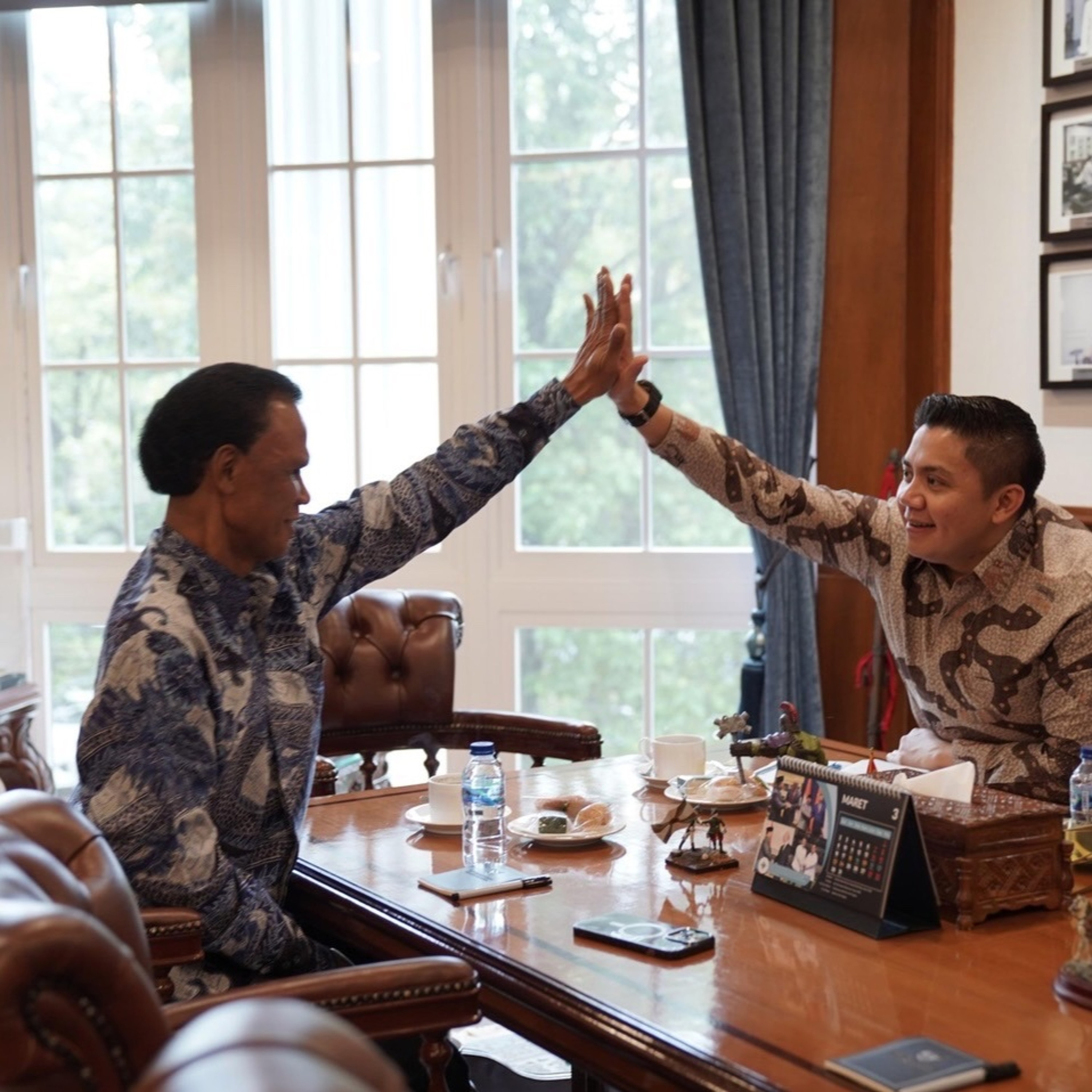
Image: United Indonesian People’s Movement (Gerakan Rakyat Indonesia Bersatu Jaya, GRIB Jaya) leader Hercules Rosario Marcal at the office of Cabinet Secretary Teddy Indra Wijaya, in a photo posted by the Cabinet Secretary's Instagram account on 27 March 2026. Photo from instagram.com/teddy_hq

Under the Prabowo Subianto government, the Indonesian military’s (Tentara Nasional Indonesia, TNI) long-cherished role in national economic development and governance has been vastly enhanced. The TNI seems to be everywhere. Active-duty officers now run ministries, head a state food company, and even manufacture medicine. Soldiers cook meals for Prabowo's flagship nutrition program. Prabowo has long argued that the military provides an efficient and committed labour force for the Indonesia’s development ambitions. But this too was his father-in-law, President Suharto’s argument, and that line justified a 32-year-long, vastly corrupt authoritarian military regime that ultimately had to be overthrown through people power.
Ironically, these political developments are occurring at a time of historic good relations between the Indonesian military and the Australian Defence Force. Much has changed since former president B.J. Habibie famously tore up the AMS, the Agreement on Maintaining Security, in 1999 after Australia announced it would lead a force into East Timor. In the last two years under the Labor government, we have seen the Australia-Indonesia Defence Cooperation Agreement superseding the 2008 Defence Cooperation Agreement and this year, the Jakarta Treaty, or the Australia-Indonesia Treaty on Common Security, in which both countries agree to communicate on matters of mutual security. Both are landmark security agreements, but they occur at a time when the military’s domestic role is transforming rapidly.
To help us understand how civil-military relations are changing under the Prabowo government and its impact on Australia’s defence relations with Indonesia, meet my guest Dr Natalie Sambhi. Natalie is Founder and Executive Director of the independent think tank Verve Research, which provides analysis on Southeast Asian foreign policy and security issues. She is also a Non-Resident Fellow with the Brookings Institution, where she publishes on Indonesian foreign and defence policy issues as well as Southeast Asian security. Natalie holds a PhD on the history of the Indonesian military from the Strategic and Defence Studies Centre, Australian National University.
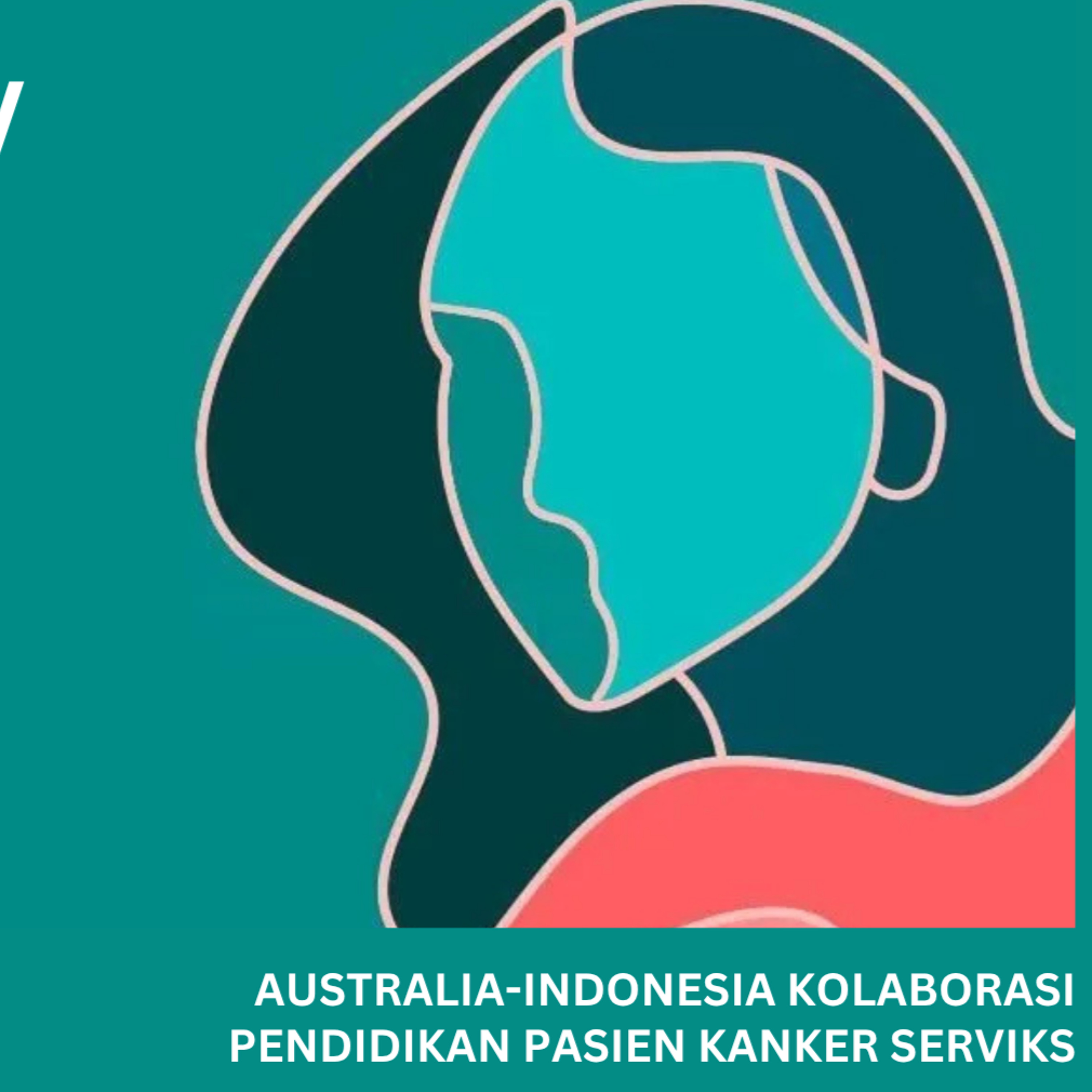
Any cancer diagnosis will leave the patient with lots of questions. What is this disease, and why has it happened to me? What are my chances, what are my options, and what will it mean for me and my family? For Indonesian women diagnosed with cervical cancer, the answers have not always been easy to come by. Until recently, no formal patient education materials were being provided at the point of diagnosis — and where good information is scarce, myths fill the gap, the biggest one being that a diagnosis is simply a death sentence.
In this episode, we look at what happened when a team of Australian and Indonesian researchers set out to change that. Dr Mitha Eka and Professor Linda Rae Bennett, with colleagues at the Centre for Reproductive Health at Universitas Gadjah Mada, spent a year co-designing the first patient education materials of their kind in Indonesia. Funded by the Australia-Indonesia Institute, the project brought together survivors, clinicians, four hospitals in Yogyakarta, community organisations, and government at both provincial and national levels.
With our guests, host Dr Elisabeth Kramer discusses what it takes to build something like this inside a health system where clinicians may see a hundred patients a day, why the team developed a new “collaborative equilibrium” approach rather than importing international guidelines, and how questions of culture, hierarchy and collective family decision-making shaped every stage of the work. They also share what came out of it: a diagnostic flipchart for clinicians, take-home fact sheets for patients and families, and a word bank to help clinicians explain complex medical information in everyday spoken Indonesian.
About the guests
Dr Mitha Eka is an educational specialist and early career researcher who works across the University of Melbourne and Federation University. She has more than a decade of experience designing, delivering and evaluating educational programs spanning global health, social innovation and plant biosecurity, in both Australia and Indonesia.
Professor Linda Rae Bennett is a medical anthropologist based at the Nossal Institute for Global Health at the University of Melbourne. She has thirty years of experience in research and health capacity building in Indonesia, and for the past decade has collaborated with the Centre for Reproductive Health at Universitas Gadjah Mada on a range of projects related to HPV and cervical cancer.
Find out more
The project is the Australia-Indonesia Collaboration for Cervical Cancer Patient Education (AI-KPPKS / Australia Indonesia Kolaborasi untuk Pendidikan Pasien Kanker Serviks), funded by the Australia-Indonesia Institute. Full details are available on the Nossal Institute for Global Health project page:
Collaborative curriculum development for cervical cancer patient education in Indonesia
https://mspgh.unimelb.edu.au/research-groups/nossal-institute-for-global-health/Prevention-and-Management-of-Health-Conditions/collaborative-curriculum-development-for-cervical-cancer-patient-education-in-indonesia

Six years ago, in a village in West Sumatra, a tiger died and its human relatives moved to bury it — because the tiger is understood as their own family. The Indonesian wildlife conservation authority BKSDA intervened, fearing poachers might take the carcass; the villagers, in deep grief, buried the tiger anyway. It's not an isolated case: similar stand-offs have played out in southern Aceh and elsewhere, as Sumatra's forests are cut into ever-smaller patches by plantations and logging, pushing tigers and people into closer contact than ever before, and tensions grow between different ontologies and practices on how to manage the relationship.
This is why, as Universitas Indonesia anthropologist Imam Ardhianto puts it, human-tiger relations are best read not as belief systems in isolation, but as sensitive registers of ongoing socio-ecological change. So what happens to a centuries-old relationship between people and tigers when plantations fragment the forest, a virus jumps species from village dogs, and social media reshapes how a new generation understands the animal at all?
In this week's episode, Tito Ambyo chats with Imam Ardhianto, an anthropologist and Chair of the Department of Anthropology at Universitas Indonesia. Imam's research on the cosmopolitics of human-tiger relations draws on fieldwork in Sumatra, tracing how ancestral guardian tigers, were-tigers, and “outsider” tigers are understood — and how those categories are shifting as the forest itself changes.
In 2026, the Talking Indonesia podcast is co-hosted by Dr Jemma Purdey from the Australia-Indonesia Centre, Dr Clara Siagian from the University of College London, Dr Jacqui Baker from Murdoch University, Dr Elisabeth Kramer from the University of New South Wales, and Dr Tito Ambyo from RMIT

Comments

Download from Google Play

Download from App Store
 United States