


 Claim Ownership
RowingChat
Subscribed: 154Played: 6,584
Subscribe

© All rights reserved
Description
Rowing Chat is the podcast network dedicated to rowing. We have many shows hosted from around the world on specialist topics from Strength Training to USA news, from interviews to data analysis. Produced by Rebecca Caroe, it brings rowing news, coaching advice and interviews to you.
Go to https://rowing.chat/ for links to the latest episodes & subscribe in your favourite podcast software.
Go to https://rowing.chat/ for links to the latest episodes & subscribe in your favourite podcast software.
627 Episodes
Reverse

The most experienced rowers aren't thinking about every movement: they are hitting three key checkpoints only. The finish, quarter slide and three quarter slide.
Timestamps
01:30 The Finish
The finish is the only point where the boat, the blades and your body are all travelling in the same direction (the direction the boat is moving in). This gives the finish a stillness where you can be relaxed and sit still - the work is done. You should feel balanced and symmetrical with a low centre of gravity. This is the most stable part of the stroke.
Your posture contributes to the stillness - an open chest posture. As your hands move away the finish is over and your mass starts to move up the slide towards the stern (opposite direction to the hull movement).
You feel incontrol of time - if you feel rushed in the recovery use this point at the finish to reset.
Recommended drill - single strokes to the finish. Leave your handle(s) next to the body, feathered.
05:00 Quarter Slide
Here you have the body set in the catch angle - this is so you can begin to feel the boat moving under you. Recover your body mass and start it moving towards the stern.
Your handle continues past your knees at this point - as a consequence this draws your shoulders forward and your trunk rocks naturally. You are nearly in the catch position (except for your leg compression). If you don't get your handle past your knees you tend to row upright and don't get the trunk movement and you rock late in the recovery which disrupts the boat. If you lift your handle too early later on you have to push it down to give room to square - another disruption.
In sweep at quarter slide your nose, chin and sternum line up with your inside knee.
Recommended drill - row pausing at quarter slide checking you get into the right position at the pause.
10:30 Three Quarter Slide
This is the 'danger zone' where hull speed gets lost. Your mass is 5-7 times the mass of the boat hull. If you are sliding faster than the hull your mass works against the boat. Going fast up the recovery slows your boat.
Imagine doing a squat jump - if you descend too fast and drop your weight to the floor makes you feel heavier on the floor making it harder to jump up again. This is similar to rushing the slide.
Things to check at 3/4 slide - is your handle height low enough for you to square if needed? Is your upper body relaxed with minimal pressure on the footstretcher? Feel the boat is free under your feet.
Test this by rowing at 3/4 slide and then return to full slide. If your boat speed is the same at 3/4 and at full slide it's a sign you could be more effective at 3/4 slide.
Your centre of mass needs to be low in the boat, your torso should not be braced - it's in the same posture as at quarter slide.
Recommended drill - shadow rowing drill. Row the recovery without holding the oars. Try shutting your eyes. Call out each position as you go through it - finish, quarter slide, three quarter slide. Naming the point helps.
Summary
The finish resets you and gives you time, the quarter slide sets your body before the boat begins to move and three quarter slide is where you preserve or lose hull speed. When you get tired or under pressure that's the moment to focus back into these three points.
Robin Williams' article
https://plus.britishrowing.org/2022/02/07/the-recovery-2/
Tapering is reducing volume while maintaining intensity. Deloading is drop volume and intensity. Remember form = fitness minus fatigue.
Timestamps
00:45 How fit are you to race and train?
Three ideas for your race preparation - taper compared to deloading; the form formula explained; and a practical taper blueprint.
When you ease off training do you feel flat and slow in the boat? A taper is pre-competition where you reduce volume but increase the intensity of your workouts. The conclusion is to arrive at the race feeling fresh and you haven't lost your sharpness.
A deload is a recovery strategy where you reduce both volume and intensity. This lets your body get more rest during a hard training block.
They feel similar but the effect is different.
03:45 What is rowing form?
Fitness rises lowly and fades slowly - notice this if you have time off. You can come back to the level of fitness you had before the break quickly.
Fatigue is the acute training load which is on top of your fitness.
Form is what's left when we clear out the fatigue - the fitness available to you on race day.
As masters our fatigue can be amplified as it takes us longer to recover.
A taper keeps your fitness steady and rapidly drops your fatigue - think of your fitness as a glass of water and the fatigue is a layer of mud sitting on the top surface of the water. Clear away the mud and you can access your fitness reserves.
06:00 Taper blueprint
All Faster Masters Rowing training programs include tapers for the major masters rowing races and months of the year. Most masters only peak with a taper twice a year - a long distance race and a sprint 1k race.
In the taper we cut volume by 40-50% across the taper period. Shorter sessions but nearly every session has elements at or above race pace e.g. racing starts practice. Do not add in anything new in a taper week - no new equipment, drills or nutrition changes.
The urge to train more during the taper because you feel flat during the mid-taper. This urge is nearly always long and you'll feel flat in days 2-4 as your fatigue is clearing. Remember you aren't losing fitness.
For multi-day regattas start the taper one week before your first race.
Review your race week training and plan how you are going to manage your fatigue. Your taper is a way on collecting on what you've already earned in your training.
Dr Malcolm Howard, Canadian eight Beijing 2008 “People say it was always so easy for you, so straightforward. But it’s always been about the work. Rowing, by its nature, is a beautiful sport because you get out of it exactly what you put in. The harder I worked at rowing the more success I had.”
Timestamps
00:45 Why your brain is working against you
Many masters rowers are putting in less than they think believing in a ceiling which is not real. And limited by a brain that pulls the 'alarm cord' long before you've reached your limit.
02:00 The effort ledger
Are you paying what rowing actually costs? This is a way of measuring work and exposes pretend work. If you train by feel (Rate of Perceived Effort RPE) but feel and reality diverge with age. RPE rises as recovery slows. When you bring tiredness into training sessions your RPE can be higher even if your work output is lower.
The three columns - What you planned to do this workout, what you actually did, honest quality rating (1-5 range). Average the scores at the end of each week.
Map the gap between what you intended and your execution. Write it down and bring honesty to your training.
05:30 Your effort ceiling
Some masters may be leaving more on the table than you think. A limiting belief is that your effort is limited by age. This kicks in before your actual physical limit occurs - mind working separately from the body.
Test yourself by picking one thing on your training plan that you dislike and so avoid doing.
Am I avoiding this because my body can't do it or because I don't want to find out what it reveals about me?
Masters have more choice and may take more recovery between workouts than pro athletes.
Do that one session which you've been avoiding next week and notice if the ceiling is your body or your mind.
07:45 The repeated bout effect
The science behind your brain limiting you in an effort to protect you. Your brain lies in order to protect you - so renegotiate with your brain. Brains are survival machines and send a STOP signal before you reach your actual limit. It's conserving resources and energy reserves in case you need it.
The Central Governor Theory by Tim Noakes - brain limiting your output based on predicted cost not actual capacity.
When you expose your body once to a hard effort - your brain re-anchors what hard feels like. Next time you do it the alarm goes off later. Perceived difficulty and the urge to stop reduces on the second exposure to the same stimulus. The brain's prediction model adapts.
This is the physiological underpinning of Malcolm Howard's quote. The work doesn't just build the engine, it teaches the brain what your engine can do.
Faster Masters Rowing training programs include workout repeats in order to help you use the repeated bout effect in your training.
https://fastermastersrowing.com/racing-program/
11:30 Three layer synthesis
The ledger shows what you're actually putting in; the ceiling test shows what's still available; the repeated bout effect shows why doing it once is enough to retrain your brain.

Why do so many masters rowers struggle with catch timing despite endless practice? Al Morrow's counterintuitive principle. The causes and cures of rigidity in your body and the amazing catch timing waiting for you (when you cure it).
Timestamps
00:45 Rigidity problem
Al Morrow's remark when talking about Good Rowing is Horizontal - the issue that rigidity kills how you approach the catch.
"The more rigid you are, the lower the probability you will have a good catch." Al Morrow
Feeling you are in control in rowing can lead to tension, particularly in your hands. There's a balance between having control and being so tight that you do not have good control.
Controlled, accurate movements are your goal.
Test this for yourself by gripping your handle tighter than usual and note how your catch timing and depth is or your feather/square movement.
Poise is a balance between the right amount of control and tension to facilitate the rowing movement, Enough tension to get into the right positions but not so much that you are rigid and hamper your strength, movement and oar control.
Rigidity kills your strength. 90% of your power in rowing is below your arm pits.
When rigid it's hard to respond in real time to a gust of wind, balance issues or wake. When relaxed, the boat absorbs the energy from the wind or waves and you don't react to the disruption.
07:00 Al Morrow's drill
This is a catch drill - put the oar in the water fast so it arrives at the perfect depth under the surface.
From the catch position, push down on the handles so the oar spoon is high above the water. Let go of the handles quickly and listen to the sound the oar makes as it enters the water.
An oar arriving in the water under zero tension - you will see it arrive at the perfect depth.
The perfect depth happens when you are relaxed and do not interrupt gravity. Progress the drill by gradually holding the handle without tension - fingers extended. Make the same sound.
Move to holding a normal grip while keeping the same blade entry sound. Then take one stroke. Stop rowing and try it again.
Move towards making the perfect catch sound but starting at the finish - roll up the recovery and unweight the handle to place the oar in the water.
Work on the timing of unweighting your hands and the slide change of direction. The hand action has to precede the slide stopping.
Remove rigidity from your neck shoulders, arms and hands at the catch using this drill.
11:00 Trust the release of tension
The best possible catch at higher stroke rates comes from being proactive placing the catch - that can negate the lack of rigidity you've been working on.
12:00 Active Catches
Build trust that you won't flip when unweighting the handle. Move the moment when you release the tension to being earlier in the recovery. Listen to the sound of the blade entry.
The risks of abrupt changes of your training and surprising outcomes from practice lineups, rigging, and winter to summer transitions with guest Marlene Royle.
Timestamps
00:45 The effect of abrupt changes
Marlene sees these as a red flag for masters rowers. Her experience as a coach when racing season comes around was a trend from mid-summer on where their season got derailed. All were caused by quick changes, unfamiliar boats and doing a training session from another coach on top of their normal training.
These are all avoidable.
04:00 Transition from winter to summer
Let your muscles and tendons adapt to different stresses like moving from an indoor rower to a boat. The difference between a sculling erg and a sweep boat is clear in movement patterns.
All these abrupt changes resulted in injury to tendons or muscle strain.
Rule of thumb for moving onto the water is to start at 50% volume in week one and build up to full training in the new mode over 4 weeks. You won't get as fit on the water initially as you did on the rowing machine so use this time for technique.
07:00 Three injury scenarios
- An athlete with mild tennis elbow changed the grips on her scull handles. The new grips were a different size and it flared her tendonitis. Be aware of any pain (it may be a very small thing).
- Another had a glute / sacrum tendon tenderness and while somewhat fatigued did a practice with another club member and the following day was in a quad doing a race simulation. The boat was rigged high for her and she rowed the quad two days in a row doing another race simulation. This pushed the ligament strain and stopped her rowing for a month.
- Two athletes visited another club for a quad outing and found the rigging/boat changes led to a hamstring strain and the consequent race was "cautious" and not full power.
A soft tissue injury takes 6-8 weeks to heal, at best, with physical therapy.
19:00 When in an wobbly boat
The temptation is to stop rowing your normal pattern and instead to "flex" and go with what you feel in the boat. This is an abrupt change in technique and not conducive to protecting your body.
If you have a sensitive low back, then an unstable boat can cause a flare up.
Common sense - think before you do. Common sense is not very common.
For equipment make gradual changes.
Want easy live streams like this? Instant broadcasts to Facebook, YouTube, LinkedIn. Faster Masters uses StreamYard: https://streamyard.com/pal/d/5694205242376192

Join Santiago Fuentes to discuss
- the growth in masters rowing in South America (country by country differences)
- the main rowing events in the region - long distance head races and sprint.
— What you hope will happen next in the future
Ways to adjust your stroke to match the boat hull speed.
Timestamps
00:45 The boat velocity changes through the rowing stroke cycle and you can feel these changes as you row.
01:30 Efficiency is key
This is a measure of the difference between a skilful crew and less experienced athletes. When watching crews in a race you can see some crews just inch ahead of the others. Efficiency is a key to why the best crews do well - they use their power efficiently; they help the boat hull to move through the water with greater efficiency - how do they do this? They manage their body mass well.
Body mass is resistance to changes in velocity.
This matters because the entire boat is moving forwards all the time (even though you may think you go backwards and forwards on the slide).
Because of the sliding seat, the boat hull doesn't travel level, the bow moves up and down through the stroke cycle.
03:40 Maximum Boat Speed
Diagram of boat speed through the water (credit British Rowing)
https://fastermastersrowing.com/getting-ahead-or-behind-the-boat-speed/
Maximum boat speed DOES NOT happen in the power phase. The point of maximum velocity is after the oars have come out of the water. [NOTE: not maximum acceleration as said in the video.] At this point you are transitioning onto the recovery (arms away / body rock forwards).
On a video filmed square off 90 degrees to the rowing boat - when the bow ball is at its highest point is when the athletes have moved closest to the stern (on the recovery) and the point of maximum acceleration is when the bow ball is lower and when the athlete is transitioning from the power phase onto the recovery phase.
The diagram shows the boat at low and high rates (right hand side). At higher rates the point of maximum acceleration is nearer to the catch on the recovery.
The boat moves differently at high stroke rates from low stroke rates.
Understanding and noticing the boat acceleration feeling and how your body moves are two things you can control. If you can learn how to feel the boat movements you can make refined adjustments to how you are rowing at race pace compared to steady lower rates.
07:30 Low rate endurance rowing
We get good at efficiency at low rates because rowers do a lot of endurance training. Yet athletes who race want the effect of efficiency at race rates. Can we improve our agility and how we are moving with the hull and practice in training?
Periodised training plans do not include a lot of high rate work. What we can do to keep the boat skills of handling the oars and body mass at low and high rates?
08:45 Agility Drills
These are key to learning the skills. Ways to move quickly and keep the handle speed in time with the boat. These can be spliced into endurance rows for short periods of time. This doesn't upset the physiological training effect.
Try doing agility drills for 1 minute in every 10 minutes low rate rowing.
- Half Slide rowing - go from stroke rate 20 down to half slide the rate will change to around 26-28. This forces you to prepare the handle earlier for the catch, to move with more precision around the finish - you have less time on the recovery.
- Half Slide Up Twos -
- Double quick hands round the recovery -
- Pause drills - choose where you pause for example quarter slide or weight on the feet. Look for the moment when the boat glide begins on the slide and the athlete body is relaxed.
- Double quick hands and pause at weight on the feet.
Learn how to feel whether you are getting ahead or behind the boat hull speed is key to going really fast when you are racing.
Get easy live streams like this
https://streamyard.com/pal/c/5694205242376192

Hear Becky Wilson for an in-depth review of the considerations for the masters athlete in terms of cardiac health.
- Understanding your cardiac risk profile
- New to rowing or returning after a long break?
- How training for sport changes as we age from a cardiac health perspective.
- A common mistake many masters athletes make with their training.
- Age related adjustments to heart rate with respect to training in UT2, UT1 etc.
- Understand and use the Karvonen Method for finding Heart Rate Zones.
- Beta Blocked athletes need to do this with their calculation
- Is it safe to train/compete after a cardiac event or a diagnosis of a cardiac condition?
Download the slides
https://fastermastersrowing.com/cardiac-health-and-rowing/
Improve your rowing ratio while lifting in the gym.
Timestamps
00:45 Rowing can be improved by strength training
Lifting heavy has lots of benefits - today we'll talk about ratio. The contrast between the power phase and recovery phase. How to use this concept of ratio in strength training.
02:00 Improve range of movement
As we age we find our muscles and tendons don't have the same range and so our stride gets shorter. Strength training can help improve or maintain RoM.
Weight lifting works in two planes - when you lift the weight and when you return it to the start point.
Concentric muscle movements are shortening the muscle (as you lift).
Eccentric muscle movements are lengthening the muscle (as you return the weight to the start).
Eccentric muscle work can help improve your range of movement. Working on this part of the strength lift can use the rowing ratio as part of the movement.
03:45 Ratio in strength training
The braking effect that you use as you control the weight in the eccentric lengthening muscle phase as you lower the weight down can enable you to have greater force production.
When lifting heavy for few repetitions or using small muscles e.g. doing chin-ups against your body weight you may find the difference between the last successful lift and when you fail is large.
Do your first chin up
One way to improve your strength and do your first chin up is to start at the top of the lift with your chin over the bar (you may need a chair to step or jump up there). Then slowly lower yourself by straightening your arms doing just the eccentric part of the lift. You will gain strength more quickly by doing this slowly muscle lengthening under load. When you've done this a few times, try doing one chin up - you probably can lift yourself up.
Use approximately a 3:1 ratio in your lifting. The more ratio you can manage the more you will be working the braking effect on the eccentric lift.
06:45 Improve range of movement
Consider a difficult lift like a squat using an olympic bar. Getting a deeper squat - to 90 degrees or to a deep squat position is challenging.
08:00 6 week challenge to improve your ROM.
3x per week for 6 weeks.
Start each lift with an ultra-light load. This helps refamiliarise your muscles with the movement. Then add weight so that you keep good form. Try to do 3-5 sets of each lift each time you go to the gym.
Do 6 sessions on power - increase the load you can lift. Position a bench behind you so you squat down to just touching your bum on the bench. Goal is 90 degrees. For a deep squat choose a lower block to sit down to. Start with 5-8 reps on power - increase load.
Do 6 sessions on range of movement - lower the bench. You may need to reduce the load in order to do this. Have someone spotting for you and checking your movements.
Do 6 sessions on speed - lower for 3 and push up fast for 1. So build your ratio into these sessions.
11:30 Take your ratio training from the gym back into the boat. Can you push the oar faster through the water so that you can take longer on the slide recovery? You may be able to increase your ratio thanks to your work in the gym.

A visual reference to aide adjustments to blade depth.
Timestamps
00:45 Low technology solutions for rowing too deep.
The tape goes around the oar shaft so that when the oar is under the water at the correct depth and the handle is at the correct height for you to old. Mark exactly where the shaft is level with the water surface. You can do this where the oar shaft is wet if you do this carefully. Measure the spot, return the oars to land and transfer that measurement to all the other oars and put white tape on them too.
While rowing you can look sideways at your oar to see if the white tape is going under the water and where in the stroke it goes too deep (and you can no longer see the tape).
03.30 Causes of rowing too deep
Usually it's caused by the athlete holding the handle too high. Modern oar designs naturally sit at the correct depth. If you row 'over the barrel' the path of the handle is too high mid-stroke (and usually too low at the finish so your oar spoon washes out). The water is flat and so the path of the handle in the power phase should also be flat.
At the catch if you take the catch by lifting your shoulders it can also cause the oar to go too deep.
Tension in the hand grip also can cause the oar to go too deep. In sweep this is often the inside hand holding on too tightly.
05:55 Drills to help you correct blade depth
- Backing down into the catch. Push the oars from the finish backing down and then leave the oar in the water and take the stroke. Go backwards and forwards gradually lengthening from half slide to full slide. This helps you to work out the correct handle height.
- Row in circles. One person row in sweep and look out at your oar as you row so you can see the depth. In sculling just row with one oar and get a friend to hold the boat steady.
- Half blade depth rowing. Row with only half the oar under the water - feel the depth by controlling the handle precisely with very small movements.
- The amount of power you put on can affect blade depth. So try alternating light and firm pressure strokes to help you work out depth.
How watching videos of good rowing can help improve your technique.
Timestamps
00:45 Using mirror neurons
Parts of our brain get activated when watching movement. Researchers noticed monkeys' brains were firing when watching the researchers eat lunch - as if the monkeys were also eating.
Mirror neurons help you to understand and internalise actions, emotions and intentions.
This is helpful when learning the subtleties of rowing timing points.
03:00 Yawning is contagious
When I yawn the chances are you will too. This is your mirror neurons.
Dr Laby from Sports Vision researched if you watch correct performances and see the technique being used. He noted that the video needs to be as close as possible to reality.
This means you get best results watching at race stroke rates, not slow motion. Try to create a race situation rather than a training row. You need both - understand the movement first and then be able to do it at stroke rates comparable to a race.
05:50 Watching video
Find videos online to watch - they need to be good athletes, rowing well in high cadence high stroke rate situations. Check out MostynARC YouTube channel for Penny Chuter's video collection.
07:00 Coaching demonstration
When a coach tells a story about rowing, your mirror neurons activate as you listen. They make you feel that you are experiencing what the coach describes. Neural coupling with the story teller.
First get the athletes to observe the task done well - demonstrate the task first yourself. This is more likely to trigger the mirror neurons as the athletes think themselves into what you're describing.
Then explain the action at the same time as demonstrating as a second stage.
Our Drills Compendium uses this method and adds written captions as well.
https://fastermastersrowing.com/member-register/drills/
Real-time observation and real time skill correction improves skill acquisition.
The experts recommend peer-to-peer observation as a further stage. Teach observation and comparison to good technique - this also has a permission-based feedback structure allows the athletes to see if they are getting the movement right.
Masters have to pay attention to our range of motion as we age, without it we lose stroke length and raise injury risk.
Timestamps
00:45 What this is and how to get more of it.
Masters rowing is rowing with compromises - we may be less mobile or carrying old injuries.
Our goal is full movement potential which helps our performance - with full range of movement we get longer strokes. Things which limit us are tight glutes, hamstrings or back muscles.
Injury prevention gets more important as we age - a good range of motion supported by strong musculature helps prevent injury.
Muscle capacity for the rowing movement. It's hard to teach rowing to people who cannot sit with their legs straight, who cannot get into the catch position or whose arm extension is insufficient to get the oar handle around the arc.
03:00 Things to do to improve range of motion (ROM)
Active isolated stretching is different from a traditional stretch you get movement more of the time and it's a short stretch and hold. One muscle group works (agonist) and the opposite muscle group (antagonist) is relaxing and lengthening.
https://fastermastersrowing.com/active-isolated-stretching-rowing/
04:45 Decline with age
We lose our full movement potential as age causes our bodies to change. Natural connective tissue elasticity reduces with age - strive to retain what you have; joint cartilage reduces too, and muscle flexibility lessens. Scar tissue from prior injuries may also exist.
06:00 Range of motion
Things you can do to improve - know what ROM you have at the moment. 10 tests for yourself and video exercises / stretches you can do. Free webinar
https://fastermastersrowing.com/member-register/functional-movement-assessment/
Simple changes to your rigging which help you to get into the correct rowing positions when you have movement limitations.
Adapting rowing rigging for masters physiology
https://fastermastersrowing.com/adapting-rowing-rigging-for-masters-physiology/
Start a practice to improve your range of motion - do it with your rowing friends.
Get easy video streams like this https://streamyard.com/pal/c/5694205242376192

Looking backwards to go forwards: what rowing taught me about big tech and what big tech taught me about rowing with Matt Brittin.
Timestamps
01:00 From schoolboy to the Olympics - from a family of ball sport heros.
Matt was inspired by Martin Cross to row to a high level - he was his school teacher. Later he was President of his university club where he led the introduction of professional coaching.
04:00 Rowing teaches skills
Matt was running Google in Africa, Middle East and Europe for the past 10 years - he tells a lot of anecdotes about rowing. Steve Gunn (a harsh coach) taught how to take responsibility for what you are doing. Are you a piece of sh*t on the end of the oar?
When the mindset is right but the self-appraisal was not.
The things Matt learned at rowing were the human things - more useful than Business School, Consultancies and University. I wouldn't be where I am in the business world without the rowing lessons.
08:30 Act like an owner
The unique side of rowing is that when I'm seat racing, I'm against you. When we are in the crew, I'm with you. Act like an owner at Google - take responsibility for what you're doing and win as a team. We collaborate hard - and sometimes a collaborative competitiveness gives a better outcome.
11:00 High Pressure Situations
The start line of a Henley Royal Regatta final is where Matt felt the most intense pressure.
Take confidence from the feeling of nerves and the adrenaline surge - this is a sign you are ready for a big performance. Get the attention off yourself - focus on the process is helpful. Know there is someone there who wants you to succeed.
14:45 Henley Royal Regatta Progress
Matt is a Henley steward - he marks the progress over recent years. Sir Steve Redgrave asked Matt to help the committee to plan a 10 year strategy. It looks unchanging yet it's always evolving. Three new womens quad scull events were announced - near parity in Open events and Womens events. Since 2015 every race has been on YouTube live and on demand. You Win or You Learn.
20:00 Returning to Rowing
It has been a joy and a recalibration too. The gains as you come back are lovely - rediscovering the joy. A lot is about remembering the feelings.
How to balance training and travelling for work. How you manage your time at work is important. Matt blocks his diary to take kids to school twice a week - the most important time of the week.
He does the same for rowing training. The discipline when traveling of visiting the hotel gym.
The more senior you get the more important it is to show up refreshed and feeling great - in good shape. Leaders need to be in the moment and to have time for staff.
Matt is planning to mentor people in business, improve his sculling, rowing strength training this year.
Masters rowing is "running up the down escalator". It doesn't have to be the same each year - unlike younger rowing years. Choose something fun to plan for your future rowing.
Alex Wolf & Sam Dutney in conversation. Two leading thinkers and innovators for masters rowing discuss strength training for masters.
The principles around maximal force applies everywhere.
Teach athletes how to express maximal force. Learn the ceiling of what you can do. Turn muscles on and off.
Practice being forceful really quickly.
Building habitual capability. your day to day. Take a small change from what you do now and a little bit more than you can already do. That's enough.
Strength training is one of the most potent stimuluses for our health.
The only thing which can repair your muscle structure is targeted loading, not rest.
The kenee takes a load of up to 2 times body weight for rowers - masters it will be 1.2 to 1.7 times body weight.
When squatting the leg is not the limiting factor - the lumbar spine tolerance is the limit. This is not the case in a rowing boat because the forces are horizontal.
The 7 stroke max test has a strong correlation to performance. Increasing this has got a 1:1 correlation with improvement.
How can you know if the improvement will come from force production or maximal force?
The rowing stroke is primarily concentric force production. Does eccentric have an effect?
Yes, it's a long stretch shortening cycle. The end of the drive back to the catch has a significant contribution to boat speed. The Reactive Strength Index. How you control a decelerating force and turn it round into an accelerating force.
Rate of force is how much, when and how quickly.
Utilise each exercise efficiently is key. The king of exercises is the one that reaches your outcome. You must lift enough to create an adaptive response.
Want easy live streams like this? Instant broadcasts to Facebook, YouTube, LinkedIn. Faster Masters uses StreamYard: https://streamyard.com/pal/d/5694205242376192

Defensive protectors for oars and sculls to prevent the paint wearing off and the spoon degrading.
Things you can do to preserve the spoons and handles.
Timestamps
00:45 Oars get wear and tear
You paint the spoons in the club colours and the paint wears in the middle of the back of the oar and the tips of the blades get worn off at the corners (so you no longer have a sharp corner).
Defensive protectors for oars
Our dock is wood and the surface gets greasy and is a slip hazard. We put non-slip matting onto the dock - water drains through the holes. The brand is Ako Matting and is recommended for ice, snow and water uses. The downside is the surface is abrasive on oars because of the non-slip elements.
03:00 Rules for oars
We have a rule that when you land and leave the dock we always put our oars tip side down on the dock. This helps to preserve the paint and stop the wear patterns on the back of the oars.
Tips down meant we got wear on the tip of the blade.
Croker Oars have tip protectors - little triangles which fit over the corners and you superglue in place.
https://www.crokeroars.com/product-page/row-tip-protectors-pair-4-tips
The plastic takes the wear rather than the carbon oar.
Concept2 oar users can use the vortex edge - it's a strip which goes along the length of the oar tip.
https://www.concept2.com/oars/sculls/blades#vortexedge
The wear on the tip of the oars reduces the surface area of the spoon. And the wear is always in the same direction - my sculls ended up thinner than 3mm. This is the legal minimum for World Rowing rules - I had to sand down the tips of the blade to restore the minimum 3mm.
05:30 Protective decals
A scuff pack kit made to protect the back of the oar from rubbing when your oars are on the bank.
Defensive protectors for oars https://crayfishrowing.com/shop/ols/products/scuffpatch-kit-for-two-oars and the Croker oar corners
Lastly - blade wraps - vinyl that is pre-printed with your club colours and they are cut to the oar spoon shape. Use a heat gun to apply them and it also gives some protection to the oar spoon.
https://regattaprint.com/blade-wraps-team-sweep-oars/
How to wrap oars
https://www.youtube.com/watch?v=FxcaeTeOz_g&t=10s
Take care of your oars to make them last longer.
If you paint your oars the old fashioned way is to sand them and use marine-grade gloss paint with undercoat and topcoat paint layers. Others have used spray can car paint too.
We had stickers (decals) of the club logo made to put on the shaft of the oars so that they can be identified - helpful if you don't paint your oars and they look the same as every other club. Easy for them to get lost at a regatta.
Want easy live streams like this? Instant broadcasts to Facebook, YouTube, LinkedIn. Faster Masters uses StreamYard: https://streamyard.com/pal/d/5694205242376192

Ways to improve speed of the oar through the water. Keep the stroke rate the same and increase the speed.
Timestamps
00:45 This is a long term project.
Less experienced rowers push the oar less hard than the more experienced and you need to train this.
Time through the water at stroke rate of 20 is approximately 3 seconds per stroke. Pushing the oar through the water on the power phase takes 1.2 to 1.5 seconds and yet we row with a ratio of at least 2:1 at low rates.
Experienced rowers get more rest every stroke. They push the oar with high intensity through the water and so they have more time with the oar out of the water.
03:30 Same rate more speed
How to row at the same stroke rate and deliver more force into the boat hull. The key to training this on the erg was to start with a focus point once every 5 minutes for 10 strokes.
For ten strokes push harder through the power phase but you're not allowed to take the rate up.
This showed us how much harder we could push and how much more rest we got as a result.
It depends on your muscular strength and fitness. Then we moved to doing this for a minute. After each intense stroke period we allowed 5 strokes to recover and take a little rest. Over time, you don't need to take that rest.
06:00 Up one: down one
Taking the same principle of increased intensity into the boat. We call "Up one down one" which means take the stroke rate up one point in rate through the water and down one point in rate on the slide. So at rate 20 you move to rate 21 through the water and rate 19 on the slide - which averages to 20.
This has the effect of intensifying the power phase.
Train yourself to do this and it gets a better ratio in the stroke - you learn how to relax more as you rest on the recovery.
The benefit is slightly more boat speed, slightly more rest and this helps to keep the boat moving fast through the water.
Here's an earlier episode which covers this topic further of how to train yourself to relax.
https://fastermastersrowing.com/get-more-speed-on-the-recovery/
Do this for short periods to begin with as it's tiring. Introduce it to your warmup just for 5 strokes at each stage in the pick drill.
Want easy live streams like this? Instant broadcasts to Facebook, YouTube, LinkedIn. Faster Masters uses StreamYard: https://streamyard.com/pal/d/5694205242376192
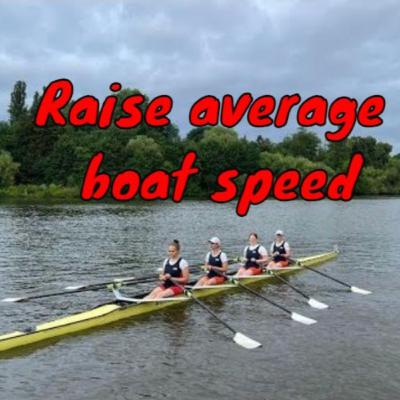
Three ways to get faster (or avoid slowing down) in training.
Timestamps
00:45 Can you increase the average speed of your boat?
The net of how fast it accelerates in the power phase and how much it slows in the recovery phase.
Our past episode about how to get speed on the recovery
https://youtube.com/live/RRF3o7LxNXM
01:45 Row to the Conditions
Pay attention to the water surface, to the wind and waves, to the water swirls under a bridge. This allows you to make subtle changes to how your boat is moving.
Rowing in a headwind - at the start the waves are highest (they've progressively built up) and these lower as you get closer to the end of 1k. With large waves you cannot rate high. When rowing to the conditions as you notice the wave height reducing, push on and increase the rate by half a point. You can also change the ratio (intensity through the water compared to relaxation up the slide).
04:30 No huge moves
If you do a big push the chances are you will suffer a large fall off in boat speed after the push is done. Choose moderate moves and you are more likely to be able to hold the new boat speed after it ends. Make your moves sustainable longer.
Pushing hard means you may compensate by trying to save energy and your pace judgement may suffer.
06:00 Avoid rowing in dirty water
The puddles of the crew in front are disturbed water. When the water block is churned by someone else's oar it makes the water unstable and hard for you to get your oar to grip the water. This affects the boat run and your ability to put energy into pushing the boat forwards.
When rowing near other crews, put their puddles under your riggers - between the hull and your spoon. The disturbed water will neither affect the run of your hull nor your spoon grip on the water.
Rowing in dirty water is hard to avoid if your eight has an unconventional rig (Two people on the same side in sweep eights) this may result in bow and stroke being on the same side. Only the fastest mens eights can avoid stroke rowing into bow's previous puddle.
Want live streams like this? https://streamyard.com/pal/c/5694205242376192
David Frost reviews Practical and Personal Looks at Coronary Artery Diseases (CAD) in Master's Rowers - download the additional information link below.
Timestamps
00:45 David Frost's journey through CAD
Coronary artery calcification - men need checking after age 70 more than women.
Even rowers who are known for being stoic - if you feel something in your chest, get it checked out.
"You have the coronary arteries of a 92 year old" was my signal that I needed help. The Agatston Score is is a proxy for heart health.
04:30 Five things that cause inflammation
- environmental stress
- toxins stress
- too much sunlight
- smoking
- exercise
Inflammation in your arteries can cause an issue if you work too hard, too fast for too long.
08:00 Rowers have a higher than average incidence of atrial fibrillation (AFIB)
Maybe rowers are doing themselves a disservice by training long and hard. What to do about this?
12:00 Heart age vs calendar age
There are interesting heart age metrics - pulse wave velocity measure tells how elastic your arteries are. Heart Rate Variability - the higher it is the better you are recovering.
David encourages masters to measure these and track their trends.
Dr Churchill in Boston is studying masters rowers' aorta for ASCVD.
Get a calcium CT scan - it helped David understand his condition.
18:00 A self-scan system
Perceived exertion, rest and hydration are a good guide to how you are feeling each day. David is mindful of recovery as well.
What age should you start getting the calcium CT scan done?
For men from age 40 and women maybe 50. For the plus wave velocity test this could be done from mid life - age 40 maybe ladies a bit later. Note David is a layman, not a doctor.
Rowing training is more 80% steady state and 20% higher intensity. This has trended upwards from about 60% when David was younger.
As humans we are slow to recognise when our body moved into the "next" stage. The competitive mindset can make us live in denial of aging.
It's not good for you to carry to much body fat - your waist to hip ratio is worth checking.
25:00 Burden or banish? David's new book
Sloth and gluttony contribute to heart disease - 80% is preventable. Lifestyle measures can defer the onset of heart disease.
Hopefully rowers can start to banish the preventable problem.
STRESSED spelled backwards is DESSERTS.
David's package of information
https://1drv.ms/p/c/af369003831e6951/EZ82vA6IqaRAtv172PZYmW0BV8HomDD4kselkTqn1Ykffw
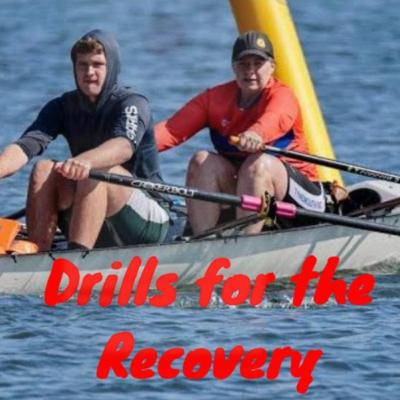
Three more drills to learn sequentially which will improve your recovery. These will help fix balance issues.
Timestamps
00:45 Finesse really helps in the recovery
Crew alignment, bladework skills and body movement. The benefit is that the boat slows down less when you achieve these. The biggest gains in boat speed can be achieved here (assuming you aren't going to get much fitter/stronger).
By keeping the same peak in the power but slow the boat down less on the recovery, the average speed of the boat each stroke will be higher, and you will go faster.
Our teaching method: do one drill and then layer another drill on top of it - making it progressively harder. this allows you to build your skill and also crews of different ability can row together.
04:00 Skimming drill
Understand the impact your hands and handle heights have on boat balance.
On the recovery - let your oars run along the surface during the recovery. This teaches where the oar handles need to be relative to each other. The water is level - so your handles reflect the correct height during the power phase. In sculling this also helps to recognise the left hand over the right hand differential. Check the "nested" versus "stacked" hands demonstration at the crossover position.
Then add progressively deeper tap downs on the recovery - 1 cm, 2 cm, 3, cm. Can you keep the boat level?
It can be hard to keep your left hand higher than the right from half slide to the catch (the left hand is always higher than the right).
08:45 Pauses drills
From hands away / body over / quarter slide. Advanced rowers can also pause at weight on the feet. This is explained in the drills compendium.
Build on the skimming drill - now check your hands and body posture at different stages of the recovery. Watch the elbows of the person in front for timing.
10:15 Reverse ratio drill
The idea here is to arrive at full compression with your blade already in the water. Time the movement so the blade placement is before you change direction on the seat. Go fast up the slide and then drift your oars through the power phase. This helps you to make handle movements fluid.
Buy the Drills Compendium (24 drills and 3 bonus ebooks)
https://fastermastersrowing.com/member-register/drills/
Want easy live streams like this? Instant broadcasts to Facebook, YouTube, LinkedIn. Faster Masters uses StreamYard: https://streamyard.com/pal/d/5694205242376192
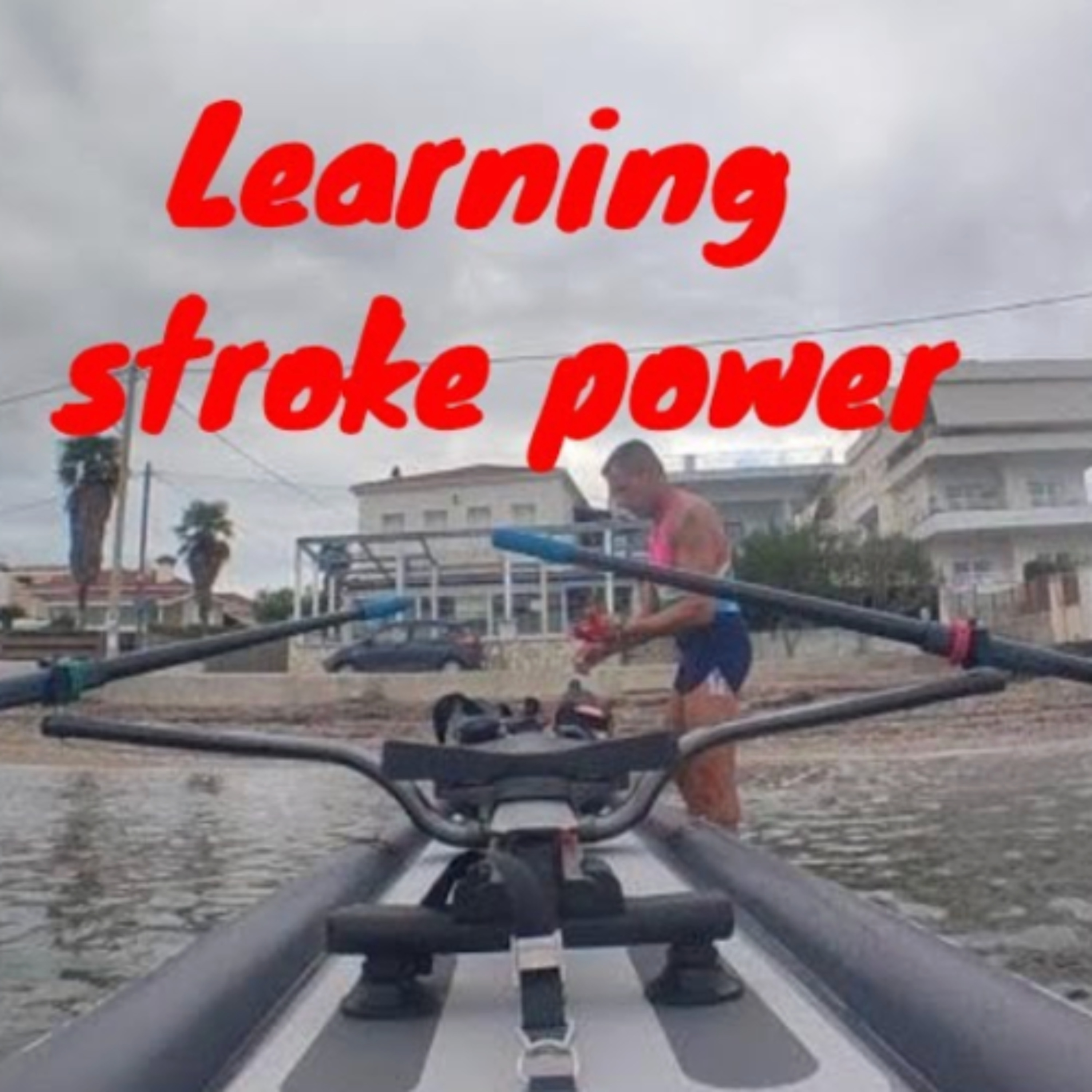
How to increase stroke power using three layered drills.
Timestamps
00:45 Drills for power
These are all part of the Drills Compendium (24 drills + 3 ebooks bundle).
Masters rowers tend to row a good leg drive and arm draw but neglect the back swing. The back is crucial to joining the leg drive and arm draw. How to ensure back swing adds to the speed of the boat.
03:15 The body sequence
From the catch (where boat is slowest) the stroke power takes the boat to its fastest speed. After the leg drive is half completed you need to start to layer the back swing so it overlaps with the end of the leg drive. Later the arm draw overlaps with the end of the back swing.
Learn how to use each body part in turn without dropping boat power at the changeover.
04:30 Body swing only drill
This is the least intuitive part! Start with legs straight and arms straight with blade in the water while leaning forwards. Swing your back to take the stroke and take the oars out when your. back swing is completed. Do this square blades and then once confident, add power to the stroke by engaging your core and glutes.
06:00 Body and arms and half slide rowing are the second and third parts of this drill. The glutes provide the connection between the legs and back. By building up the stroke progressively you should feel the spoon of the blade accelerate through the water - as you add in more body parts this must continue. The arms have to pick up already moving water (from your back swing) and make it faster still.
In a crew add in more people so the boat goes faster - notice how your body movements have to change to take account of the boat moving faster. If you aren't adding to the acceleration you should feel that you have no pressure on the end of the blade.
Try an exaggeration rowing at half slide and finish your legs/back/arms at the same time.
10:30 Our teaching method
The way we teach is designed to work for adult learners. We teach how we row and then make it progressively harder so you can continue to challenge yourself, continue to experiment with ways to make the movement and lastly check your experience with your crew mates - am I getting the right feeling here? Even the most experienced rowers can do these alongside the less experienced.
Do the drills at least 3 times in a single practice so you're familiar with the drill and can see your progress as you do it better each time.
Want easy live streams like this? Instant broadcasts to Facebook, YouTube, LinkedIn. Faster Masters uses StreamYard: https://streamyard.com/pal/d/5694205242376192

Comments

Download from Google Play

Download from App Store
 United States