



 Claim Ownership
CIRCUIT CAST
Subscribed: 7Played: 39
Subscribe

© All rights reserved
Description
CIRCUIT CAST is a podcast produced by CIRCUIT Artist Moving Image, interviewing contemporary artists about recent exhibitions and how they approach their practice. CIRCUIT is Aotearoa/New Zealand's leading distributor of artists' moving image works.
www.circuit.org.nz.
www.circuit.org.nz.
136 Episodes
Reverse
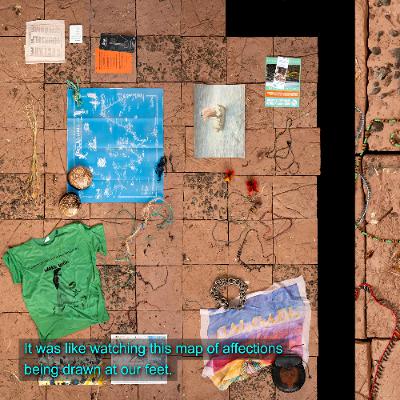
For the second episode of ‘Ka Mua Ka Muri – Walking Backwards Into the Future’ we present a conversation between Maria de Lima (UK/ Brazil) and Alex Monteith (NZ), two artists using moving image in a time of fragile ecologies as a platform for global knowledge exchange, deep time awareness and human rights. Hosted by Mark Williams.
From 9-22 March 2026 we will be presenting Alex Monteith's, ‘Deepwater Currents’ (2020) alongside Maria de Lima’s ‘This Map of Affections’ (2024) on LUXScotland.org.
This podcast series has been made possible with support from the British Council and their programme Connections through Culture.
Image: Maria de Lima, ‘This Map of Affections’ (2024). Courtesy of the artist.
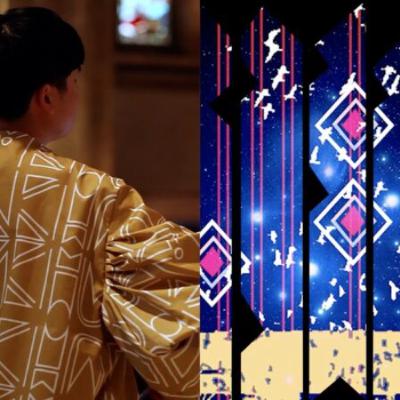
Ka Mua Ka Muri - Walking Backwards Into the Future is a thee-part podcast series that brings together artists who work with CIRCUIT and LUX Scotland.
In this episode Thulani Rachia and Jamie Berry (Te Aitanga-a-Mahaki, Rongowhakaata, Ngāti Porou, Ngā Puhi) discuss Thulani's obuyile (2021-ongoing) and Jamie's Hiwa-i-te-rangi (2023). Both works are based on a shared interest in dreaming, abstraction, repetition and rest as a contemporary continuum of ancestral knowledge.
obuyile and Hiwa-i-te-rangi show on LUX Scotland from 23 Feb-8 March 2026.
Ka Mua Ka Muri has been made possible with the support of the British Council arts fund Connections Through Culture.
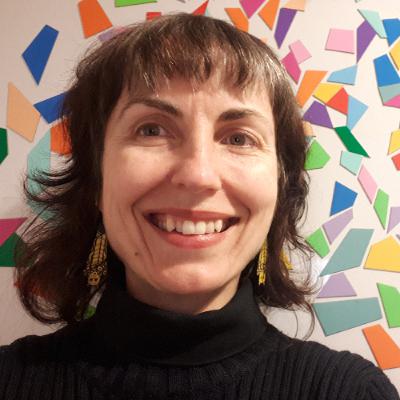
Tessa Laird: Cinemal
“All film is made out of hooves”. Mark Amery speaks to writer Tessa Laird about her new publication Cinemal: The Becoming-Animal of Experimental Film, and discusses the various animal qualities of cinema, like scratching and sniffing, vibrant colours, and voices.
00:00: Introduction
01.52: What is a Cinemal?
On the hybrid of Cinema and Animal. Inspiration of films by Australian film-makers Arthur and Corinne Cantrill. The idea of 'a cinematic animal...(while watching a film) the human viewer may also become animal...”
The subtitle 'the becoming animal of experimental film', where does that come from?
Tessa discusses the book A Thousand Plateaus: Capitalism and Schizophrenia (1980) by the French philosopher Gilles Deleuze and the French psychoanalyst Félix Guattari, Tessa's resistance to reading it, discovery of the books assertion that “all art comes from the animal… when we are engaged in artistic production we are at our most animal”. Discusses our “current hyper separation from the natural world".
7.14: What is experimental film?
Discusses non-narrative film, the work of Australian film-makers Arthur and Corinne Cantrill.
9.52: Meeting the Cantrills, following research into work by Nova Paul, discusses three colour separation, “the lingering of ghosts”. Seeing the Cantrill films in the original format, understanding the tactility of film. Understanding celluloid film as a dying medium, much as natural species were dying out. Mentions the Cantrills'film in new Zealand, 'Bubbling mud pools in Rotorua'.
15.29: Community of film-makers around the Cantrills from the 1960s onwards, the magazine Cantrills Fllm Notes, which included New Zealander Phil Dadson, Nam Jun Paik and others. “They were a network”.
16:40: In what way is film like animal? Discusses how celluloid includes a gelatin component. The book Animal Capital: Rendering Life in Biopolitical Times (2009), and how animal parts have furnished the rise of capitalism. “All film is made out of hooves”. “You can’t have a vegan cinema that’s made out of celluloid”. Film being full of toxic chemicals. The colour, grain and translucency of film. Question of whether the interest in film is just a nostalgic medium. “I think it’s more than that but I’m prepared to be challenged on that”.
20:15: Film being animal. Technological analogy between watching animal movement and media. Discusses the book The Squid Cinema From Hell: Kinoteuthis Infernalis and the Emergence of Chthulumedia (2020) and animals as screens. Animal attributes as technology.
23:00: The sixth sense and our bodily feel for cinema, the inexplicable - spirit, energy. The human and the non-human.
25:20 The eye of the camera.
25:50: On film programme accompanying the Cinemal book launch. The work of Nova Paul, and her phyto-filmic practice, working with trees. Vegan Cinema. On Sriwhana Spong working with film, realising the specificity of the medium in her practice, film as an entity.
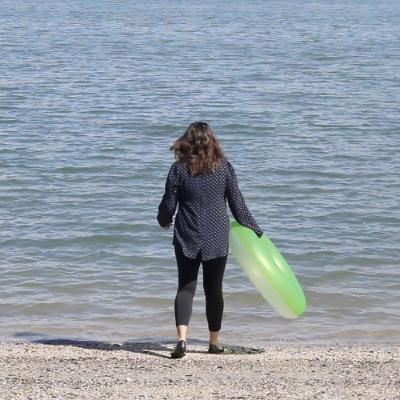
"Sometimes even a cup of tea can fail"
In a hyper-connected world, Samantha Cheng's durational performances examine failure as a generative space. In the final episode of Comic Release Joe Jowitt talks to Samantha about time, labour and the body.
00:00: Introduction to Samantha's practice by Joe Jowitt
1.50: Joe - "There seems to be a real tension between comedy and exhaustion in your practice. Could you start by describing what draws you to humour as a material or method?" Samantha describes her masters research on failure.
3.30: Humour as a personal practice. Samantha asks Joe "What do you find funny? Where does your humour come from?"
5.00: On making the video Happy Ever After (2021). The classic film trope of a happy ending. The repetitive gesture in Happy Ever After.
7.10: Joe compares the work to classic cinema devices "the fall, the loop, the failed gag". He compares the work to Bas Jan Ader and the slapstick tradition of Buster Keaton
8:13: The 'failure of narrative' in the work. Samantha describes watching it with an audience. Joe on the Sisyphean metaphor of human striving but never getting there.
9:20: Failure as a response to the problem of a highly optimised society. On failure, paranoia and contemporary digital surveillance and data harvesting.
12:00: Humour and abstract art. Inefficiency in Samantha's practice. Samantha - "It's not the really big failures that I'm interested in... smaller ones have more of a disruptive agency".
13:00: On the work Take a 10 (2022), work and labour. Time as money. "...making that work allowed me to kind of view what 10 minutes actually really felt like. 'Cause in a break, 10 minutes goes by so quickly doing that video felt like doing it for hours".
15:30: How does the absurd fit in your practice? Being "in on the joke".
16:30 Western academic descriptions of humour versus origins of Samantha's own humour. Family.
17:10: How important is it to perform the work yourself?
18:10: Social media as influence
19:30: On work Steep dreams (2024).
21:00: Humour found in everyday life. How do you write about the big subjects? "You can start by writing about the small ones and then maybe we'll get there".
22:00: On Passengers (2023) public event, produced for Chez Derriere.
23:30: Mass/Mess project at Window Gallery.
24:24: On spontaneity and not over-working humour. Working in a space where humour is not welcome.
26:00: What does it offer the viewer to ask questions about boundaries?
26:43: Anti-ICE protests in USA using costumes. "Autocrats hate humour".
27:30: Is humour a way to stay present in the world? Weaponisation of humour. Individual sense of what's funny versus other people's interpretation.
28:58: END
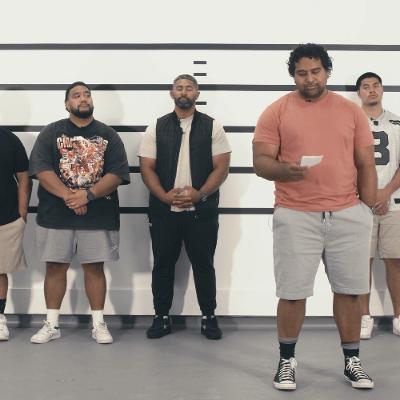
“The smile goes away the longer they experience the work” - John Vea
Comic Release is a three-part podcast series hosted by artist Joe Jowitt which explores the use of humour in artists' moving image.
In this conversation, Joe meets Tāmaki Makaurau Auckland-born, Ōtautahi-based artist John Vea, whose work uses humour as a device to draw viewers into deeper dialogues around Pasifika identity.
Image: John Vea, Is your name Siliga? No? Oh, you’re Pati? (2025) (detail)
List of Topics:
00:00: Introduction
01:34: What is Talanoa? John - “a holistic way of experiencing information... a learning mechansim”.
03.20: On the video work Is your name Siliga? No? Oh, you’re Pati? (2025)' included in the exhibition Ini Mini Mani Mou (2025) at the Christchurch Art Gallery. John describes the genesis of the work; coming from the real life experience of being mistaken for someone else. In the video, friends “narrate their experiences of these stereotypical events. “It’s funny… it’s not sort of funny”.
05.50: Was the humour in the video intentional? John - “We’re used to laughing at our trauma, which is sad cos we glaze over it... especially when we're kids”.
07:30: John on the nature of Pacific humour generally; and then on integrating it into his work. He discusses the 2019 installation If I pick your fruit, will you put mine back? shown in Sydney. Humour as a 'Trojan horse'.
10:00: On adjusting a work for different social and class contexts "If it has to be subtle... because of the community, then I'll change it up". The difficulty of reinstalling works in a new space, a new context.
12:30: The line between poetic and humorous. How does John "walk that line?" John - “It starts off quite heavy”.
14:30: Joe on the effect on him as an audience member of watching Is your name Siliga? No? Oh, you’re Pati? (2025). John discusses the common Pasifika experience of changing one's name to “fit in”.
16:30: On site specificity; and showing the video Is your name Siliga? No? Oh, you’re Pati? to Christchurch audiences.
17:00: Is the current political climate influencing new work? John - “It's sad that my practice is almost relying on trauma“.
18:00: On John's recent move to Otautahi from Tāmaki Makaurau, being Pasifika in Otautahi.
20:30: John on making Tribute to American Samoa and Tonga (2009); combining sculpture and video, objects as projection surface. The story of the making of the work, and the first installation releasing salt water from the sea into the gallery.
24:00: On conceptualising the work and discarding various sculptural options during this process.
25:30: “Is it a problem if someone comes out of a work and just goes, oh, that was so funny, and then that's it?" John discusses how viewers absorb the work the more time they spend with it.
26:30: Using the body in John’s videos. On the work Finish this week off and that’s it! (2009). John - "I wanted (the audience) to just experience working for two hours... not working in terms of the physical, but... to make them sit there and engage with the work for that amount of time".
28:00: John discusses how the audiences limited attention span for the two hour work is analogous to the lack of interest in acknowledging the cost of labour on Pasifika bodies, and the poor wages for this work.
29:00 On eating below the poverty line for six weeks whilst making Finish this week off and that’s it!
30:00 Comedy as a vehicle for hard conversations. Joe - “...what's interesting is the uncomfortable laughter... is that something you purposefully go for?"
31:00 Joe - "Is it okay for people to laugh at your work?" John - "Humour is welcomed in my practice. But expect the humour to be wiped off your face once you experience the works longer."
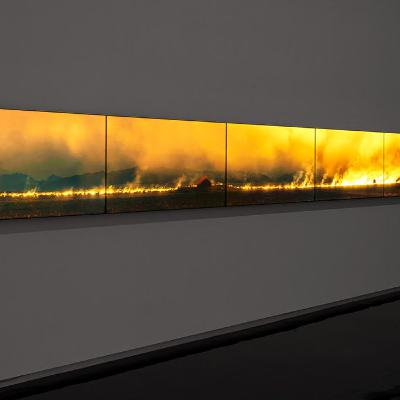
How do moving image artists work with visual effects? In this follow up podcast to CIRCUIT Cast 123: Brett Graham, interviewer Kathryn Graham speaks to Sam Tozer from LOT23. They discuss Sam's work on Whangamārino, a six channel video by Brett included as part of his installation The Wastelands at Auckland Art Gallery Toi o Tāmaki. Sam discusses the process of working with Brett, the digital challenges of adding visual effects to documentary footage and working through ‘impossible lenses’.
List of topics:
0:20 How did you first get to know Brett? Sam discusses making one of Nat Tozer’s works (Erotic Geologies (2024)) and forging a mutual connection with Brett via Gow Langsford gallery, and the inclusion of a Fred Graham sculpture in the video.
2.30: Sam describes the original documentary footage which Whangamārino is based on.
3.25: The unusual size of the six screen video installation - “11 times wider than it is high…immediately really exciting”.
4.00: What was the process of choosing not to use the original footage?
4:30: Sam discusses ‘impossible lenses’, and the difference between showing The Wastelands in Venice in 2024 versus the 2025 Auckland Art Gallery installation which features the video work Whangamārino.
6:00: How LOT23 work with artists - technologically and learning about the artists' kaupapa, looking at previous works, examining narrative and aesthetic threads in existing works - “so we’re part of a continuum”
7 :00: The technical challenges of making a work “12 times wider than it’s high” at a resolution of 11,500 pixels wide
8:25: Brief discussion of unusual screen sizes in projects with Lisa Reihana and Nat Tozer
10:00: More discussion of working at large scale, Kathryn makes anology of working on a mural and the impact of scale on the viewer
12:30 Sam discusses beginning with grass, rock and trees as "touchpoints for a scale reference” Different lens sizes with a virtual camera. The process of creating natural environments. Using NASA Lidar data, using images of the actual sites in Brett’s video.
15:00 Working with Brett - suggesting inclusion of other details, thinking about depth of field “you get to play God with it…to create something larger than life…that is hyper real”.
18:00 “There’s all sorts of Easter eggs of meaning…” Discussion of Brett’s personal references to whenua in the work.
19:30 Ends
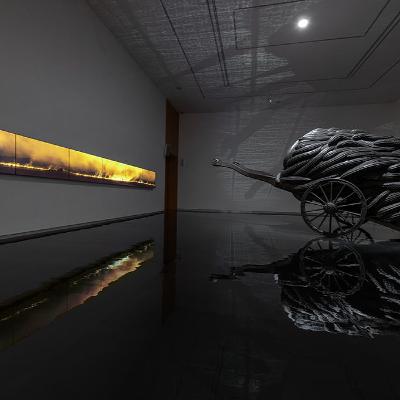
Brett Graham's exhibition Wastelands opened at Auckland Art Gallery Toi o Tāmaki in June 2025. Featuring a monumental sculpture of the same name that was commissioned for the 60th Venice Biennale in 2024, the haunting installation is expanded to include a new multi-channel video work, titled Whangamārino (2025). Re-working footage shot by news company Aukaha of a 2024 fire in the Whangamārino wetlands, Graham's new work adds layers of animation, personal history, and an ominous soundtrack.
The resulting installation addresses both the history of colonial exploitation and our contemporary ecological crisis. Over 1.2 million acres of Waikato-Tainui land were confiscated by the colonial government following the Waste Lands Act (1858), the Waikato War (1863–64), and the New Zealand Settlements Act (1863), with devastating consequences for tangata whenua and te taio. In this exhibition, Graham powerfully addresses the resulting degradation of the Waikato River and its surrounding wetlands, a precious resource and taonga for his iwi.
In this kōrero with Kathryn Graham, Brett discusses Wastelands, his earlier work Tai Moana Tai Tangata (2020), and presenting Wastelands at the Venice Biennale in 2024.
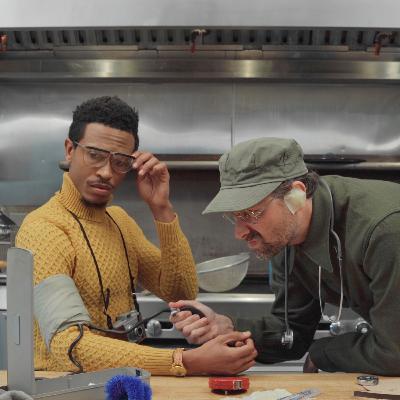
"If I didn't laugh, I'd cry."
Comic Release is a three-part podcast series hosted by artist Joe Jowitt which explores the use of humour in artists' moving image.
In this conversation, Joe meets Tāmaki Makaurau Auckland-born, Los Angeles-based artist and filmmaker Sean Grattan, whose debut feature film, Policy Wonks, explores the clash of liberal ideologies through an absurd intersection of "money, guns and yoga." Joe and Sean discuss using slogans as dialogue, working with clichés, and deprogramming problematic humour from one's own cultural upbringing.

"There is a vitality that is held in the earth." Artist Nat Tozer and CIRCUIT director Mark Williams talk archaeology, deep time and kaitiakitanga on the occasion of the Aotearoa premiere of Erotic Geologies, Tozer's most complex work to date.
Nat Tozer’s Erotic Geologies (2024) is an ambitious new video project described as "a sci-fi parable that seeks knowledge from the underground." Shifting through an otherworldly landscape where rocky outcrops meet tumultuous skies, the setting of the film makes reference to post-earthquake Ōtautahi in Te Waipounamu and the Tongariro Crossing in Te Ika-a-Māui. The narrative follows protagonists Rangi and Liberté, characters inspired by both Māori mythologies surrounding the figures of Ranginui and Papatūānuku’s children, and Greek figures Deucalion and Pyrrha. Archaeology, time and kaitiakitanga are central to the work, which merges a local, contemporary narrative with deep time and mythology.
While several of Tozer's earlier video works were one-person productions shot on her iPhone, Erotic Geologies marks a profound shift in production methodologies, and incorporates actors, technical collaborators, and apocalyptic animated landscapes.
In this kōrero, Tozer discusses her expansive practice, reflecting on "the slippery mess of our built environment."

"I see the environment as a creative partner." — Tia Barrett
Hihi Aho is a three-part podcast series hosted by Emma Hislop (Kāi Tahu). Hihi Aho (ray of light) unfolds from Rematriation, a screening programme of six moving image works which explore the legacy of wāhine Māori knowledge and its resonance in the present day.
In this kōrero, Emma talks to artist Tia Barrett (Waitaha, Ngāti Māmoe, Ngāi Tahu, Ngāti Tamainupō, Ngāti Maniapoto). Emma and Tia discuss Tia's film 'He Pounamu Ko Aū' (2022). Tia explains how her practice has journeyed from a process of "healing myself … to (giving) back to the whenua."

"Whanaungatanga is this gift we have as Māori to connect and to relate"
Hihi Aho is a three-part podcast series hosted by Emma Hislop (Kāi Tahu). Hihi Aho (ray of light) unfolds from Rematriation, a screening programme of six moving image works which explore the legacy of wāhine Māori knowledge and its resonance in the present day.
In this kōrero, Emma talks to artist Sandy Wakefield (Ngapuhi, Ngāi Tahu). Emma and Sandy discuss the making of Sandy's film 'Nakunaku' (2020), a "wairua journey" to Rakiura supported by local iwi wāhine, which is included in Rematriation. Sandy also discusses her earlier works, which appropriated Disney and b-movie footage to tell Māori stories.

Hihi Aho is a three-part podcast series hosted by Emma Hislop (Kāi Tahu). Hihi Aho (ray of light) unfolds from Rematriation, a new screening programme of five moving image works which explore the legacy of wāhine Māori knowledge and its resonance in the present day.
In this conversation, Emma talks to Rematriation's curator Tanya Te Miringa Te Rorarangi Ruka (Ngā Puhi, Ngati Pakau and Waitaha). Tanya is CIRCUIT's inaugural Kaitiaki Kiriata, a new role that supports a Māori curator to develop moving image projects which speak through the lens of Te Ao Māori. Emma and Tanya discuss the works in Rematriation, concepts of time, the impact of growing up outside of their ancestral whenua, and Tanya's own video practice.
For details on Rematriation's screening venues, see www.circuit.org.nz/rematriation
For distribution/hire enquiries, please write to: info@circuit.org.nz

How is Tāmaki Makaurau Auckland City described outside of official city maps? Is it possible to navigate off-road, off-grid? What discrete spaces exist in the plain sight of everyday work, life and commerce? How are these activated by people, flora and fauna?
In front of a live audience, artists Layne Waerea, Leala Faleseuga, Gavin Hipkins, Jae Hoon Lee, Gabriel White, and Tia Barrett discuss their video works for Wild Wild Life, a public art project commissioned by Auckland Council, curated by Mark Williams for CIRCUIT, and presented as part of the 2024 Te Ahurei Toi o Tāmaki Auckland Arts Festival.
Installed at a series of site-specific locations across the inner city, the artists’ works were presented in proximity to the construction of the City Rail Network, a massive engineering project that has temporarily remapped downtown Tāmaki Makaurau Auckland as a construction site, and, when completed, will fundamentally alter its psycho-geography.

In part 3 of the series Sites of Connection Dani McIntosh speaks to artist Hana Pera Aoake (Ngāti Hinerangi, Ngāti Mahuta, Ngāti Haua, Tainui/Waikato, Ngāti Waewae, Waitaha, Kai Tahu). Often juxtaposing poetic text with handheld moving images, Hana’s video work addresses the tension between industry and sacred whenua; the presence of deep time and new parenthood.
0:00 Introduction
1:00 Hana discusses her video 'I saw the mountain erupt' (2023); working with an essay by her partner Morgan Godfery; the town of Kawerau as formerly one of NZ’s wealthiest towns and now one of the poorest, and also the town as the site of Māori pūrākau.
5:54
Dani asks; Why entwine the writing with the moving image?
8:09
Dani introduces the video work A eulogy to love (2019); Dani asks why juxtapose shots of Italian actress Monica Vitti with the landscape in Aotearoa? Hana explains the video was shot in many sites including Aotearoa, Portugal and other European locations. She discusses Vitti as an image of an “hysterical woman”, and the ongoing theme in her practice of "the tension of industry versus caring for the whenua (landscape)”.
13.08
Dani asks about the line “I will not be afraid despite the fear tumbling through my body”.
15:50
Hana on how parenthood has affected their work. Se discusses 'deep time', the relationship between the human and non-human and the whakataukī 'Ka Mua, Ka Muri' (walking backwards into the future).
20:00
Hana on David Lynch’s movie Eraserhead (1977).
23:00
Hana discusses and the writing of New Zealand author Keri Hulme (Kāi Tahu, Kāti Māmoe), which was part of her work with Ke te Pai Press (with Morgan Godfery), shown in the group exhibition Matarau
24:41
Working with musician Ruby Solly (Kai Tahu)
27:24
End

"Dwelling in the void space" — a conversation between Selina Ershadi and Dani McIntosh, the second part of the CIRCUIT Cast series Sites of Connection.
In this podcast, artist Selina Ershadi discusses three films: Hollywood Ave (2017), Amator (2019) and The hands also look (2020), alongside a new work in progress, The Blue Dome (forthcoming). In conversation with artist Dani McIntosh, Selina reflects on navigating personal and family histories as guided by Chantal Akerman, Maya Deren and Derek Jarman; ideas of dwelling, homemaking and displacement; oral storytelling traditions and the poetic potential of decentering the visual.

A conversation between artists James Tapsell-Kururangi and Dani McIntosh on the metaphoric and poetic potential of the moving image.

A conversation with writers Tina Makereti, Gregory Kan, and Gwynneth Porter, on the dynamic possibilities for writing to respond to art beyond the essay, chaired by Thomasin Sleigh. Recorded at Te Pātaka Toi Adam Art Gallery.

How can artists in the regions discover and experiment with emergent technologies?
In this pod host Mark Williams speaks to Maggie Buxton, the Director of AwhiWorld, a Northland—based creative technology studio. AwhiWorld’s latest project is Bios, an installation at Whangārei Art Museum which presents an interactive research and practice area for artists to experiment with VR, 3d projection mapping, interactive sensors, E-textiles and organic materials.
Bios runs until 18 June.
https://awhiworld.com/
BIOS was produced in collaboration with ThoTho and in partnership with a number of community partners. It was funded by Ministry of Culture and Heritage.

In this pod Horowhenua-based artist Leala Faelseuga speaks to Mark Williams about her new work Vessel: Dissolution | It's in the milk.
Commissioned for Masons Screen, It’s in the milk reflects on "visceral motherhood", photography and memory. Leala discusses her iterative processes, what it means to exhibit personal work in public space, and inspiration gathered from the films of MD Brown and her collective 7558.

"The air was sucked out of the room".
In this final podcast for 2022 we discuss the year that was with artist Judy Darragh, Gloriana Meyers (TAUTAI) and Andrew Clifford (Te Uru). As well as Judy nominating the Academy Awards as the new performance art spectacle, we discuss memorable shows, new artists, spaces, and publishing, and our hopes and dreams for 2023.

Comments

Download from Google Play

Download from App Store
 United States