


 Claim Ownership
Root Causes: A PKI and Security Podcast
Subscribed: 62Played: 5,261
Subscribe

© All rights reserved
Description
Digital certificate industry veterans Tim Callan and Jason Soroko explore the issues surrounding digital identity, PKI, and cryptographic connections in today's dynamic and evolving computing world. Best practices in digital certificates are continually under pressure from technology trends, new laws and regulations, cryptographic advances, and the evolution of our computing architectures to be more virtual, agile, ubiquitous, and cloud-based. Jason and Tim (and the occasional guest subject matter expert) will help you stay current on developments in this essential technology platform and to understand the whys and wherefores of popular Public Key Infrastructures.
586 Episodes
Reverse
Jason describes a recent intrusion almost entirely operated by off-the-shelf AI tools. This is an important milestone in security. We describe its potential consequences.
We expand on the concept of trust-now-forge-later to list a whole bevy of additional attacks that eventually will be enabled by cryptographically relevant quantum computers.
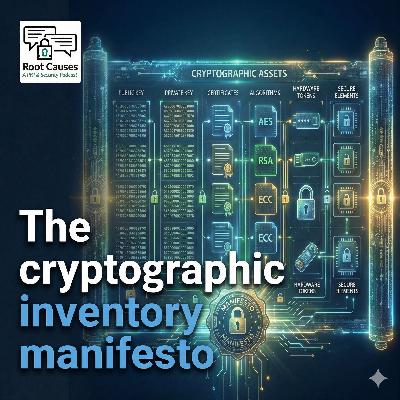
We all love a good manifesto! Jason spells out the ten principles of the Cryptographic Inventory Manifesto, and we discuss.
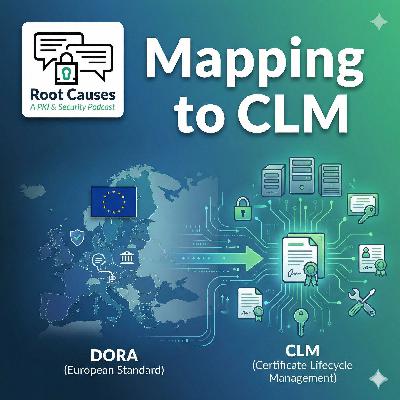
We look at the new European DORA and NIS2 regulations and how Certificate Lifecycle Management is a key requirement to meet these requirements. You will be surprised how explicit these requirements are.
Recorded in Ottawa Ontario.
New research indicates that the number of qubits necessary to achieve cryptographic relevance has reduced by two orders of magnitude. We cover this breaking news and its implications.
By CABF ballot all manual methods of Domain Control Validation (DCV) will be deprecated by 2028. We explain which methods are due for deprecation and when.
We go over the qualities in abstract of a use case that strongly invites the use of hybrid certificates and then run down a list of specific use cases that meet these criteria. This includes OT systems, code signing, secure boot, WiFi, enterprise S/MIME, and more.
In this episode Jason declares that we must make cryptography boring again. We get into what that means and why it matters.
We have seen much talk of the upcoming drop of maximum TLS term to 200 days, followed by 100 days, and eventually down to 47 days. It happens that all those numbers are too large and the actual maxima will be less than that. We explain.
March 2026 is due to be the most eventful month in the history of the WebPKI. Join us as we go over all the many changes coming next month.
A large investment firm divests from Bitcoin for fear of the quantum threat.
Everybody knows about March 15 and the drop in maximum public TLS certificate term to 200 days. But that only scratches the surface on key dates with this maximum term reduction. Join us as we go over "all the dates" for TLS maximum term reduction.
We score our 2025 predictions in this second of two parts.
Every new year we make predictions for the year to come, and every year we go back and see how we did. This is the first of two parts scoring our 2025 predictions.
We discuss the idea that not all cryptographic entropy is equally "random" and potential consequences.
We discuss the idea that it might be impossible to actually create a cryptographically relevant quantum computer and weigh in on this idea.
Repeat guest Chris McGrath shares what enterprises need to be doing now to stay on track for the NIST PQC deadline in 2030.
Repeat guest Chris McGrath joins us to discuss how increasingly strict regulations are requiring increased rigor, visibility, and auditability for enterprise digital certificates and PKI.
Senior cyber security advisor Chris McGrath joins us to discuss redefining digital certificates and their role in your organizational security profile, increasing regulation of certificates, and how enterprises can up their certificate game.

Comments

Download from Google Play

Download from App Store
 United States