


 Claim Ownership
Women In Government Podcast
Subscribed: 14Played: 13
Subscribe

© All rights reserved
Description
Podcast by Women In Government
37 Episodes
Reverse
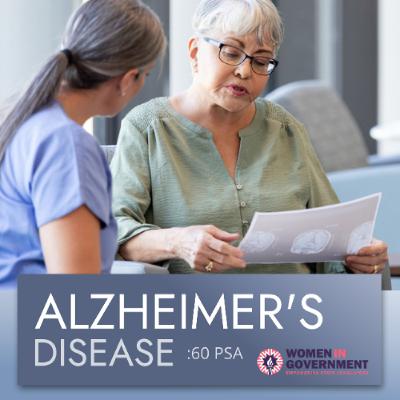
Almost seven million Americans are living with Alzheimer’s disease, and two-thirds are women.
Alzheimer’s disease often starts subtly with a memory slip, lost word, or forgotten appointment. In fact, changes in the brain can happen 20 years before symptoms even appear. That’s why early detection and diagnosis are so important.
For patients experiencing memory and thinking issues, there are FDA-cleared blood biomarker tests that can help detect the buildup of proteins in the brain, that can lead to the symptoms of Alzheimer’s disease.
Memory and thinking issues that come with age may be slight at first and can be easily dismissed, but for some, these changes become more common and can progress over time.
Early detection of Alzheimer’s disease in patients experiencing symptoms can lead to more options for planning, support, and care. Sharing details about your memory and thinking issues with your doctor can help determine if testing is right for you.
Find more at WomenInGovernment.org.
••••• ••••• •••••
Women In Government Foundation, Inc., headquartered in Washington, D.C., is a national non-profit, non-partisan organization of women state legislators that provides leadership opportunities, expert forums, and educational resources to address and resolve complex public policy issues to all women state legislators across the country.
••••• ••••• •••••
For more information, please visit womeningovernment.org
Audio courtesy of OSUCHLUCK Productions, osuchluck.com
Alzheimer's Disease PSA - Vermont Rep. Esme Cole by Women In Government
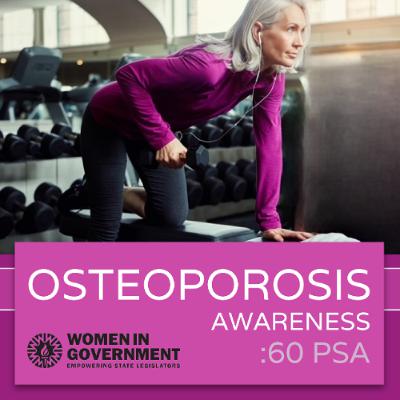
Every 20-seconds in the U.S., a woman aged 50 or older suffers a fracture. That’s about the time it takes to tie your shoes. It could be your mom, your neighbor… or even you. And it usually happens doing something common and low-impact, like bending over, lifting something heavy, or falling from standing height.
It’s time to get serious about bone health. Nearly 2-million fractures happen every year and they’re often the first sign of postmenopausal osteoporosis. Spinal fractures are the most common, yet 70% go undiagnosed, because patients don’t have symptoms, or height loss and back pain are overlooked.
This lack of diagnosis leads to a domino effect where patients are 5-times more likely to break another bone within a year after their first osteoporotic fracture.
Talk to your healthcare provider about osteoporosis screening and treatment. Find more at WomenInGovernment.org.
••••• ••••• •••••
Women In Government Foundation, Inc., headquartered in Washington, D.C., is a national non-profit, non-partisan organization of women state legislators that provides leadership opportunities, expert forums, and educational resources to address and resolve complex public policy issues to all women state legislators across the country.
••••• ••••• •••••
For more information, please visit womeningovernment.org
Audio courtesy of OSUCHLUCK Productions, osuchluck.com
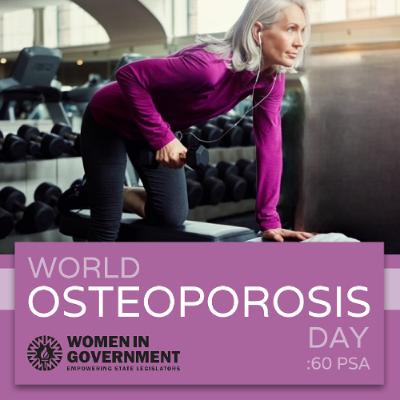
It’s called a silent disease, because we most likely won’t feel pain or weakness until a fracture occurs.
October 20th is World Osteoporosis Day. Osteoporosis can affect anyone over 50, even vibrant and athletic women. A hunched back may appear in advanced cases, but most of us don’t show outward signs of bone loss at all. That’s what makes this bone disease invisible and potential bone breaks so serious.
Spinal fractures are the most common, yet heavily undiagnosed, because height loss and back pain are often associated with aging or strain.
This lack of diagnosis leads to a domino effect where patients are 5-times more likely to break another bone within a year after their first osteoporotic fracture.
Talk to your healthcare provider about osteoporosis screening and treatment.
Find more at WomenInGovernment.org.
••••• ••••• •••••
Women In Government Foundation, Inc., headquartered in Washington, D.C., is a national non-profit, non-partisan organization of women state legislators that provides leadership opportunities, expert forums, and educational resources to address and resolve complex public policy issues to all women state legislators across the country.
••••• ••••• •••••
For more information, please visit womeningovernment.org
Audio courtesy of OSUCHLUCK Productions, osuchluck.com
Women In Government Podcast
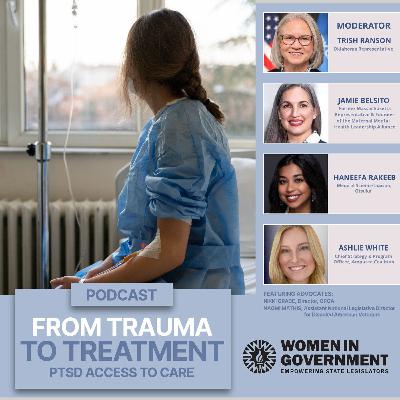
From Trauma to Treatment: PTSD Access to Care
Based on current findings, about 20-million Americans will develop post-traumatic stress disorder or (PTSD) at some point in their lives. While most associated with military service, this condition touches people of all ages and sexes, including survivors of sexual trauma, natural disasters, and chronic medical conditions… just to name a few.
Although most people who go through a traumatic event will not develop PTSD, current research finds that about 5% of the U.S. is living with the condition in any given year. For example, during the COVID-19 pandemic about 13-million Americans had PTSD.
Up to 40% of people with PTSD recover within one year. There are many effective treatment options for people living with the condition. Evidence-based psychological interventions are usually the first choice, and can be delivered to individuals or groups, in person or online. Self-care can also play an important role in supporting treatment for PTSD, along with medication. This is a decision for both the patient and health care professional. However, there are barriers to care, including lack of awareness that PTSD can be treated, lack of availability of mental health services, lack of trained mental health care providers, and social stigma.
On this episode, Trauma to Treatment: PTSD Access to Care, the panel discusses different types of PTSD, how communities can come together to provide more access to care, and what legislation is helping, or hindering recovery. Listeners will also hear a few personal stories from people who have experienced PTSD, sharing how it all started, how they managed to keep moving forward, and how they’re feeling today.
PTSD impacts millions of individuals in the United States, including new mothers, disaster survivors, veterans, and individuals living with limb loss… just to name a few. The good news is that awareness is growing, and action is being taken. We're creating a future where mental health is prioritized through legislation, research, peer support, and education.
••••• ••••• •••••
MODERATOR: Trish Ranson, Oklahoma Representative
GUEST #1: Jamie Belsito, Former Massachusetts State Representative, and Founder of the Maternal Mental Health Leadership Alliance
GUEST #2: Haneefa Rakeeb, Medical Science Liaison, Otsuka
GUEST #3: Ashlie White, Chief Strategy & Program Officer, Amputee Coalition
ADVOCATE SOUNDBITES:
1. Nikki Grace, Director, OPGA
2. Naomi Mathis, Assistant National Legislative Director for Disabled American Veterans
••••• ••••• •••••
For more information, please visit www.womeningovernment.org
Audio & artwork courtesy of OSUCHLUCK Productions, www.osuchluck.com
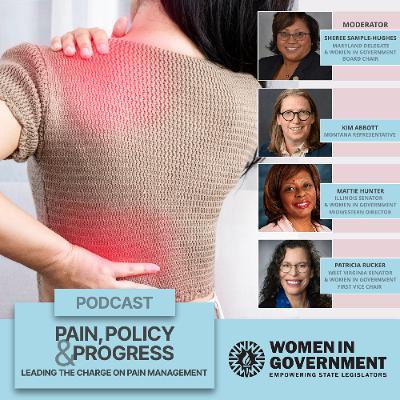
Women In Government Podcast
Pain, Policy & Progress: Leading the Charge on Pain Management
It's a story so often heard, someone suffers an injury requiring medical attention and ultimately is prescribed post-surgery pain medication as part of their treatment plan. From there, the grim statistics take over, with millions of newly persistent opioid users walking down a slippery slope which can lead to addiction, overdose, and maybe even death.
It has been found that more than 100-million Americans are living with pain or addiction, and more than 90% of surgical patients receive an opioid prescription following surgery.
On this episode, our panel discusses chronic pain, and how they’re working to prevent opioid addiction in the United States by increasing access and use of non-opioid pain management approaches. You’re also going to hear personal stories from two women about their journey with pain and the choices they made along the way regarding health and treatment options.
••••• ••••• •••••
MODERATOR: Maryland Delegate and Women In Government Board Chair, Sheree Sample-Hughes
GUEST #1: Montana Representative, Kim Abbott
GUEST #2: Illinois Senator and Women In Government Midwestern Director, Mattie Hunter
GUEST #3: West Virginia Senator and Women In Government First Vice Chair, Patricia Rucker
ADVOCATE SOUNDBITES:
1. Former Navy Veteran and Ambassador for Global Genes, Corrina Dahlin
2. Peer Support Specialist for Chronic Pain, Michelle Marikos
••••• ••••• •••••
For more information, please visit www.womeningovernment.org
Audio courtesy of OSUCHLUCK Productions, www.osuchluck.com
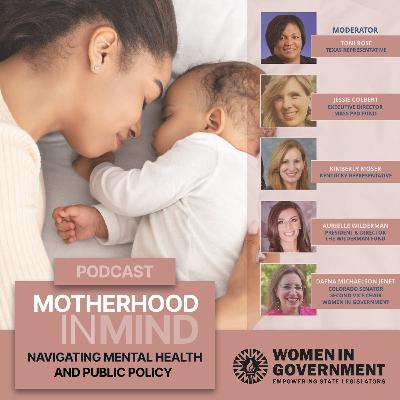
Women In Government Podcast
Motherhood in Mind: Navigating Mental Health and Public Policy
Postpartum depression or PPD is a common condition that many mothers face. It’s more intense than the ‘baby blues’ and often lasts longer, usually three to six months. One in seven women develops PPD after giving birth. That is why it is so important to talk openly about its symptoms, like depression, fatigue, feelings of guilt, anxiety, and difficulty bonding with the baby… just to name a few.
This episode is a safe space. The panel discusses a variety of topics, including screening, medication, and barriers to treatment, all while doing their best to help stop the stigma and empower each other to create change in our local communities.
••••• ••••• •••••
MODERATOR: Texas Representative Toni Rose
GUEST #1: Jessie Colbert, executive director of the Mass. PPD Fund
GUEST #2: Kentucky Representative Kimberly Moser
GUEST #3: Aurielle Wilderman, president and director of The Wilderman Fund
SOUNDBITE: Colorado Senator and Second Vice Chair, Women In Government, Dafna Michaelson Jenet
••••• ••••• •••••
For more information, please visit www.womeningovernment.org
Audio courtesy of OSUCHLUCK Productions, www.osuchluck.com
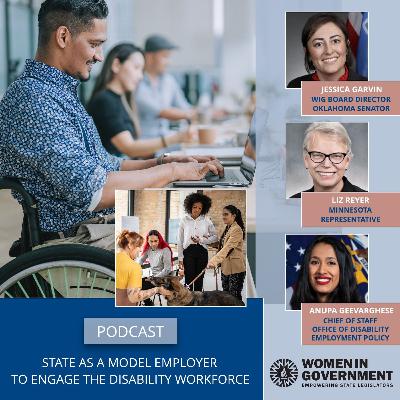
Women In Government Podcast
State as a Model Employer to Engage the Disability Workforce
According to the most recent U.S. Census data, there are more than 42-million Americans with disabilities. Across all age groups, these folks are more likely to be unemployed. That’s why state leaders, government agencies, and task forces are uniting to help advance inclusive policies and best practices that lead to increased employment opportunities for disabled people, and a stronger, more diverse American workforce and economy.
This episode highlights how states can send a clear message that employment of people with disabilities is a high priority by implementing a comprehensive set of policies, practices, and processes, known collectively as State as a Model Employer (SAME) policies, to increase representation of people with disabilities within their own public-sector workforce. When acting as model employers, the states also have an opportunity to serve as test cases for private employers, demonstrating the economic and organizational benefits of hiring people with disabilities.
Now is the time for leaders to take action.
••••• ••••• •••••
MODERATOR: Women In Government Board Director, Oklahoma Senator, Jessica Garvin
GUEST #1: Minnesota Representative, Liz Reyer
GUEST #2: Chief of Staff for the Office of Disability Employment Policy (ODEP), United States Department of Labor, Anupa Geevarghese
••••• ••••• •••••
For more information, please visit www.womeningovernment.org
Audio courtesy of OSUCHLUCK Productions, www.osuchluck.com
Women In Government Podcast
Mental Health Matters
We’ve learned a lot over the past few years, especially about our nation’s resiliency and ability to come together in times of crisis. However, we continue to uncover the hard truths about some people who regularly suffer and live with disadvantages based on their overall health and well-being.
One area of interest that’s certainly capturing our nation’s attention is mental health. As it has been reported, more than 50-million Americans live with a mental health condition, and over half of adults don’t receive treatment.
Untreated mental health conditions can negatively impact employee performance, rates of illness, absenteeism, accidents and turnover. People often quit their jobs, and some may entirely drop out of the workforce. This doesn’t just hurt our country on the human-level, but there are other consequences, like a smaller tax base, a reduced workforce and increased social expenditures for states and local communities.
For all these reasons, and many others, (SEED) the State Exchange on Employment & Disability launched the Mental Health Matters National Task Force to develop a series of frameworks to help state and local policymakers craft and adopt policies to promote the inclusion of people with mental health conditions in the workplace and bolster the behavioral health workforce.
What's more, the CDC finds over half of Americans are diagnosed with a mental health condition at some point in their lives, and one in five will experience a mental health condition in a given year. These are more than numbers and statistics. These are the faces of our neighbors, friends and family members.
This episode highlights how state and local lawmakers can work on policy and strategies that lead to the best and most promising practices that advance legislation which supports, promotes, and enriches the lives of those living with a mental health condition.
••••• ••••• •••••
MODERATOR: Women In Government Board Member, Colorado Representative, Dafna Michaelson Jenet
GUEST #1: Oklahoma Representative, Ajay Pittman
GUEST #2: Arkansas Representative, DeAnn Vaught
••••• ••••• •••••
For more information, please visit www.womeningovernment.org
Audio courtesy of OSUCHLUCK Productions, www.osuchluck.com
Women In Government Podcast
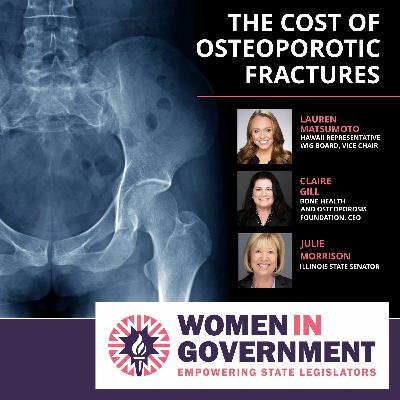
The Cost of Osteoporotic Fractures
Low bone mass and the deterioration of bone tissue are two ways to describe Osteoporosis. More the 53 million people either have this bone disease or are at high risk of bone fractures due to low bone mass. How does this affect us on the state-level, and what does this mean for our country’s overall health and wellness?
On this episode of the Women In Government Podcast, our panel discusses the action steps we can take today to address the differences in the clinical and economic impact of fractures suffered by Americans on Medicare.
••••• ••••• •••••
MODERATOR: Hawaii Representative, Lauren Matsumoto, WIG Board Vice Chair
GUEST #1: Illinois State Senator, Julie Morrison
GUEST #2: Claire Gill, CEO, Bone Health and Osteoporosis Foundation
••••• ••••• •••••
For more information, please visit www.womeningovernment.org
Audio courtesy of OSUCHLUCK Productions, www.osuchluck.com
Women In Government Podcast
Disparities in Cancer Outcomes
Cancer is comprised of more than 100-diseases affecting all population groups in the United States. However, due to social, environmental, and economic disadvantages, a few groups bear a disproportionate burden of cancer.
Hispanic/Latino and Black women have higher rates of cervical cancer. American Indians/Alaska Natives have higher death rates from kidney cancer. Those numbers are surprising and hopefully eye-opening to many in the medical community.
On this episode of the Women In Government Podcast, our panel discusses the unique barriers that women and Black, Indigenous and People of Color (BIPOC) face in accessing screening, diagnosis, and treatment of cancer.
#AccessToHealthCare
••••• ••••• •••••
MODERATOR: Omeria Scott, Mississippi State Representative and Women In Government's Newest State Director
GUEST #1: Dr. Gary Puckrein, Ph.D., President National Minority Quality Forum (NMQF)
GUEST #2: Dr. Liza Kunz, M.D., Medical Affairs Leader, Roche
••••• ••••• •••••
For more information, please visit www.womeningovernment.org
Audio courtesy of OSUCHLUCK Productions, www.osuchluck.com
Women In Government Podcast
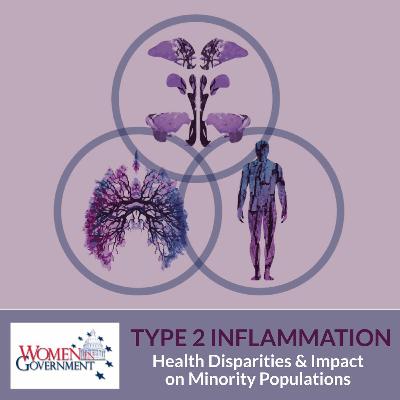
Type 2 Inflammation: Health Disparities & Impact on Minority Populations
People living with type 2 inflammatory diseases often feel limited by unpredictable symptoms and isolated in their experiences. For example, the condition can contribute to the debilitating itch of atopic dermatitis or (AD), and sometimes life-threatening asthma attacks, or the loss of smell and taste associated with chronic rhinosinusitis or (CRS) with nasal polyps. Living with these chronic diseases and searching for control, people have looked for answers and found few.
On this episode of the Women In Government Podcast, our panel discusses the health disparities of this chronic condition, the disproportionate impact on minority populations, and the prevalence of this disease across the country.
••••• ••••• •••••
MODERATOR: Illinois State Senator, Mattie Hunter, Midwestern Regional Director, WIG Board of Directors
GUEST #1: Dr. Gary Puckrein, Ph.D., President, National Minority Quality Forum (NMQF)
GUEST #2: Kenny Mendez, CEO and President, the Asthma and Allergy Foundation of America (AAFA)
GUEST #3: Dr. Debra Sierka, PharmD., Head of Dermatology, US Medical Affairs, Sanofi Genzyme
••••• ••••• •••••
For more information, please visit www.womeningovernment.org
Audio courtesy of OSUCHLUCK Productions, www.osuchluck.com

Women In Government Podcast
New Normal, Same Cancer
COVID-19 has also brought with it a challenge to those facing a cancer diagnosis. Within less than 2 months following the start of the pandemic, average weekly new cancer cases dropped by about 46% across six major types of cancers, including breast, colorectal, lung, pancreatic, gastric and esophageal cancer combined.
On this episode of the Women In Government Podcast, our panel discusses the ways we can work to identify cancer earlier through improving screening and testing capabilities, ensuring equitable care, while leveraging digital platforms and prioritizing personalized medicine.
••••• ••••• •••••
MODERATOR: Massachusetts State Representative Kim Ferguson
GUEST: Camille Hertzka, Vice President, Head of Medical, US Oncology at AstraZeneca
••••• ••••• •••••
For more information, please visit www.womeningovernment.org
Audio courtesy of OSUCHLUCK Productions, www.osuchluck.com
Women In Government Podcast
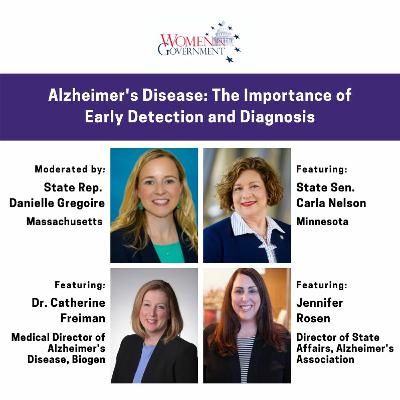
Alzheimer’s Disease: The Importance of Early Detection & Diagnosis
Quality care for people with Alzheimer’s disease and other dementias starts with an early, documented and disclosed diagnosis. However, less than 50% of people with dementia are diagnosed and of those who are—less than 50% are told.
According to the World Health Organization, tens of millions of people worldwide live with Alzheimer’s disease, and that number is expected to grow in the coming years, outpacing the healthcare resources needed to manage it and costing billions of dollars.
On this episode of the Women In Government Podcast, our panel discusses why it's important for states to consider policies that promote early detection and diagnosis - including public awareness programs and health care professional education and training that creates the infrastructure necessary to address the growing public health crisis.
••••• ••••• •••••
MODERATOR: Massachusetts Representative, Danielle Gregoire
GUEST #1: Catherine Freiman, Medical Director – Alzheimer’s, Biogen
GUEST #2: Jennifer Rosen, Director of State Affairs, Alzheimer’s Association
GUEST #3: Minnesota State Senator, Carla J. Nelson
••••• ••••• •••••
For more information, please visit www.womeningovernment.org
Audio courtesy of OSUCHLUCK Productions, www.osuchluck.com
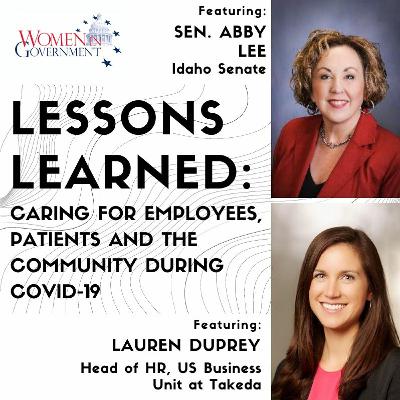
Women In Government Podcast
Lessons Learned: Caring for Employees, Patients and the Community During COVID-19
To say that the COVID-19 pandemic made us readjust to a “new normal” is an understatement. Over the past several months, we’ve grown accustomed to social distancing, wearing masks everywhere we go, working from home and attending multiple virtual meetings throughout the day.
On this episode of the Women In Government Podcast, our panel discusses the lessons learned while caring for employees, patients and the community during these uncertain times.
Over the past few months, we have seen unprecedented levels of collaboration, increased use of technology, and new ways of working that we would never have thought possible. 2020 may have been a year like no other, but it has certainly transformed our workforce and health care community into stronger versions of themselves.
••••• ••••• •••••
MODERATOR: Idaho State Senator, Abby Lee
GUEST: Lauren Duprey, Head of HR U.S. for Takeda
••••• ••••• •••••
For more information, please visit www.womeningovernment.org
Audio courtesy of OSUCHLUCK Productions, www.osuchluck.com

Women In Government Podcast
The Co-Pandemic: Breaking Down Barriers to Mental Health Access in the Age of COVID-19
The COVID-19 pandemic is making an existing mental health crisis worse. Experts are warning mental health issues and substance use disorders will be exacerbated for people who already have these conditions, and may lead to new mental health and substance use issues in the general population.
On this episode of the Women In Government Podcast, our panel discusses how methods to restrict access to lifesaving medications can hurt patients and state budgets. Health outcomes data shows that prior authorization policies for psychotropic medications in Medicaid patient populations have led to poorer outcomes for patients, including medication discontinuation, lapses in care, homelessness, emergency room visits, incarceration and an increased use of crisis services.
Mental health treatments are not one size fits all. Treatment plans should be designed between a patient and their doctor.
••••• ••••• •••••
MODERATOR: Connecticut State Representative and Women In Government Eastern Regional Director, Christie Carpino
GUEST #1: Reyna Taylor, Vice President of Public Policy & Advocacy, The National Council for Behavioral Health
GUEST #2: Dr. Manpreet K. Singh, MD, MS, Director for the STANFORD Pediatric Mood Disorders Program
GUEST #3: Brenda Gleason, President and Founder, M2 Healthcare Consulting
••••• ••••• •••••
For more information, please visit www.womeningovernment.org and check out https://www.protectaccesstomhmeds.com/
Audio courtesy of OSUCHLUCK Productions, www.osuchluck.com
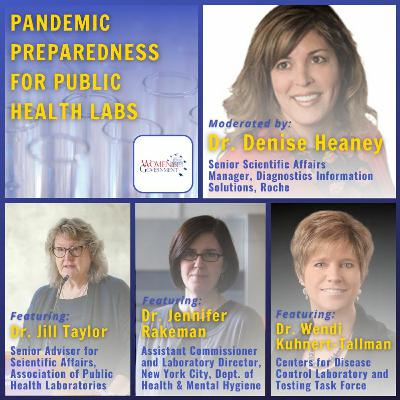
Women In Government Podcast
Pandemic Preparedness for Public Health Labs
COVID-19 has been a game changer for the healthcare industry. The pandemic has engulfed our work streams and has both highlighted our collective successes, and elevated our inefficiencies.
On this episode of the Women In Government Podcast, our panel discusses how critical it is that we continue to address these challenges and adopt long-term key best practices to support patient care in this critical time and any future preparedness needs.
••••• ••••• •••••
MODERATOR: Dr. Denise Heaney, Senior Scientific Affairs Manager, Diagnostics Information Solutions, Roche Diagnostics
GUEST #1: Dr. Jill Taylor, Senior Advisor for Scientific Affairs, Association of Public Health Laboratories
GUEST #2: Dr. Jennifer Rakeman, PhD, Assistant Commissioner and Laboratory Director, New York City Department of Health and Mental Hygiene
GUEST #3: Dr. Wendi Kuhnert-Tallman, Centers for Disease Control Laboratory and Testing Task Force
••••• ••••• •••••
For more information, please visit www.womeningovernment.org
Audio courtesy of OSUCHLUCK Productions, www.osuchluck.com
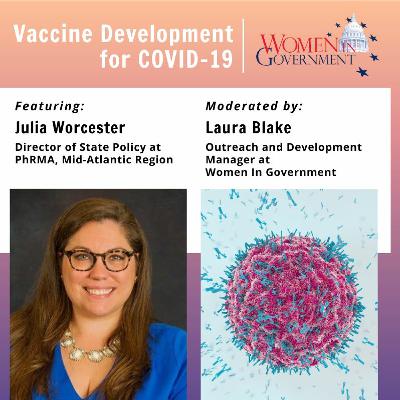
Women In Government Podcast
Vaccine Development for COVID-19
The past eight months have transformed our daily lives. We’ve seen masks, social distancing, and washing our hands for 20 seconds or more become part of regular routines—all while we wait for a treatment or vaccine for COVID-19.
As we head into the cooler months and the infection rates increase around the country, the biopharmaceutical industry is working around the clock to find solutions.
On this episode of the Women In Government Podcast, our panel discusses one of the most important topics affecting lives around the world, the outbreak of COVID-19, a disease caused by a novel strain of coronavirus, and where we stand in terms of a vaccine.
••••• ••••• •••••
MODERATOR: Laura Blake, Outreach and Development Manager
GUEST: Julia Worcester, Director of State Policy at PhRMA, Mid-Atlantic Region
••••• ••••• •••••
For more information, please visit www.womeningovernment.org
Audio courtesy of OSUCHLUCK Productions, www.osuchluck.com
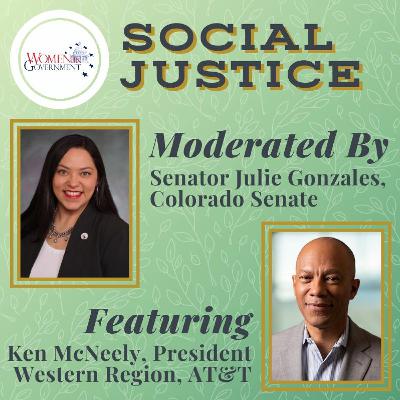
Women In Government Podcast
Social Justice
Our country has been at unrest for quite some time now, but it seems like everything came to a head the moment an African American man took his last breath while in police custody. George Floyd’s untimely death in Minneapolis, Minnesota sparked outrage all around the U.S. resulting in protests and cries for police reform.
At times, it may seem like no one is listening—but a group of high power chief executives of almost 200 large companies are working hard to move the needle when it comes to “real change.”
On this episode of the Women In Government Podcast, our panel discusses one of the hottest topics in our country, social justice and how people in influential positions are working with civil rights organizations, law enforcement, elected officials and other businesses on the local, state, and federal levels pushing for change that addresses injustices in law enforcement.
••••• ••••• •••••
MODERATOR: Colorado State Senator, Julie Gonzales
GUEST: Ken McNeely, President of AT&T West
••••• ••••• •••••
For more information, please visit www.womeningovernment.org
Audio courtesy of OSUCHLUCK Productions, www.osuchluck.com
Women In Government Podcast
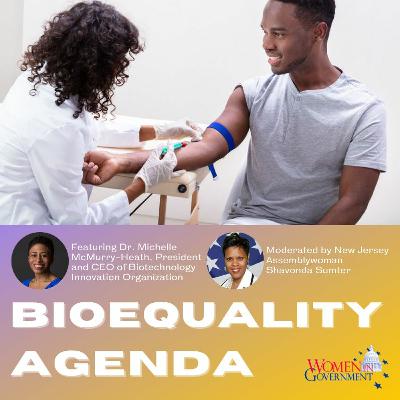
BIOEquality Agenda
“All men are created equal.” Five simple words that when put together lay the foundation of what our Founding Fathers had in mind for this great land that we live in.
To make that dream a reality for all people, especially underrepresented populations, like women, people of color, and those in the LGBTQ+ community it takes bold and brave leaders who challenge companies, the government, even ourselves to make diversity more than just a word or program, but a true part of who we are and what we stand for.
On this episode of the Women In Government Podcast, our panel discusses the BIOEquality Agenda—ensuring scientific justice by building bridges to minority communities. We’re tackling some big issues by taking on the inequality, injustice and unfair treatment aimed at women and communities of color through the positive force of biotechnology.
••••• ••••• •••••
MODERATOR: New Jersey Assemblywoman, Shavonda Sumter
GUEST: Dr. Michelle McMurry-Heath, president and CEO, Biotechnology Innovation Organization (BIO)
••••• ••••• •••••
For more information, please visit www.womeningovernment.org
Audio courtesy of OSUCHLUCK Productions, www.osuchluck.com

Comments

Download from Google Play

Download from App Store
 United States