


Museum Archipelago
Subscribed: 625Played: 3,226
Subscribe


© 2026 Ian Elsner
Description
A tiny show guiding you through the rocky landscape of museums. Museum Archipelago believes that no museum is an island and that museums are not neutral. Taking a broad definition of museums, host Ian Elsner brings you to different museum spaces around the world, dives deep into institutional problems, and introduces you to the people working to fix them. Each episode is rarely longer than 15 minutes, so let’s get started.
113 Episodes
Reverse

Steel from the World Trade Center has spread to every corner of the U.S. When the 10th anniversary of the 9/11 attacks approached, the Port Authority of New York and New Jersey gave away more than 1,800 pieces of steel saved from Ground Zero, and communities in all 50 states built them into memorials. A few were designed by famous architects, but most were welded by volunteers.
Artist and researcher Sam Holleran first encountered the steel in a posting for a small-town public art commission. The listing described the steel in almost sacred terms and requested that the material be unaltered. Holleran and his brother Max, a sociologist, spent the next several years figuring out how the distribution of these relics turned the steel from the World Trade Center into a nationally dispersed collection of memorials. Their new book is called Scattered Steel: The Afterlife of the World Trade Center.
In this episode, Sam Holleran describes how archivists hand-picked the most "charismatic" pieces of bent steel from the pile at Ground Zero, why firefighters became the keepers of 9/11 memory, and what these 1,800 memorials might mean once the towers have been gone longer than they stood.
Image: The 9/11 Memorial in Tallahassee, FL
Topics and Notes
00:00 Welcome to Museum Archipelago
00:15 Berlin Wall Everywhere
00:54 Sam Holleran
02:22 WTC Steel After 9/11
03:44 Saving the Shrouds
05:29 Hangar 17
08:00 How Steel Was Distributed
09:47 Civic Spaces and Odd Sites
10:59 Tallahassee Memorial Story
12:37 Firefighters as Memory Keepers
14:03 What We Remember
15:12 25 Years Later
16:07 Visit Your Local Memorial
16:29 Scattered Steel: The Afterlife of the World Trade Center
16:45 Outro | Join Club Archipelago 🏖
DIVE DEEPER WITH CLUB ARCHIPELAGO 🏖️
Unlock exclusive museum insights and support independent museum media for just $2/month.
Join Club Archipelago
Start with a 7-day free trial. Cancel anytime.
Your Club Archipelago membership includes:
🎙️Access to a private podcast about how pop culture reflects the museum world back to us. Each episode is WAY longer than 15 minutes :)
✨A warm feeling knowing you're helping make this show possible.
Transcript
Here is a transcript of Museum Archipelago episode 113. For more information on the people and ideas in the episode, refer to the links above.
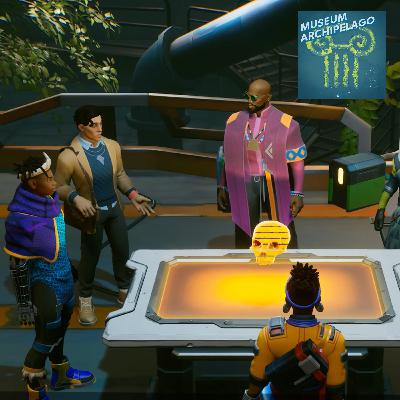
It's 2099, and you and your heist team are about to case an unnamed high-security museum in Europe. One of the targets: the Kabwe skull, a roughly 300,000-year-old early human skull found in present-day Zambia in 1921. This is Relooted, a new video game from South African game studio Nyamakop, where your job is to steal back looted artifacts by mapping entrances and exits, positioning your crew, and making it past robot security using your parkour skills. Several things about this are unrealistic. For one, the actual Kabwe skull, currently on display in the Natural History Museum in London, might not need such an elaborate plan.
But there is a damningly realistic fact at the heart of the game: every single one of the roughly 70 objects you steal was taken from the African continent and currently sits in a Western museum or private collection. And the way museums in the game wiggle out of a fictional treaty to return stolen artifacts doesn't sound fictional at all. It mirrors the real-world tactics that have kept the Kabwe skull in London for over a century, despite Zambia's repeated requests for its return.
In this episode, Ben Myers, CEO and creative director at Nyamakop, and Mohale Mashigo, the studio's narrative director, talk about why heists are the perfect genre for a game about repatriation, what they found when they visited the real artifacts in person, and why their video game often does a much better job telling the story of these objects than the museums that hold them.
Image: The Kabwe skull as it appears in a Relooted heist briefing.
Topics and Notes
00:00 Welcome to Museum Archipelago
00:15 Relooted
01:30 "We overstated the security capabilities on museums"
01:45 Meet Ben Myers
02:50 Meet Mohale Mashigo
03:04 The Kabwe Skull
04:45 Labels and Missing Context in Museums
06:08 A Digital Museum
06:53 Treaties and Red Tape
09:37 Prosperous Future Africa
12:05 Hans Sloane and the Origins of the British Museum on Episode 39
12:16 Museum of Black Civilizations
14:50 Outro | Join Club Archipelago 🏖
DIVE DEEPER WITH CLUB ARCHIPELAGO 🏖️
Unlock exclusive museum insights and support independent museum media for just $2/month.
Join Club Archipelago
Start with a 7-day free trial. Cancel anytime.
Your Club Archipelago membership includes:
🎙️Access to a private podcast about how pop culture reflects the museum world back to us. Each episode is WAY longer than 15 minutes :)
✨A warm feeling knowing you're helping make this show possible.
Transcript
Here is a transcript of Museum Archipelago episode 112. For more information on the people and ideas in the episode, refer to the links above.
Museums today are filled with software, yet they've largely avoided being "eaten" by the tech industry. Unlike music or movies, exhibitions can't be downloaded or scaled infinitely. There's only one Mona Lisa. But if the wrong platform finds the right leverage, that immunity may not last.
Which is why the kind of software museums choose matters. TilBuci is a free, open-source tool used by museums to build touchscreens, kiosks, and projections. It was created by Brazilian software developer Lucas Junqueira after watching too many digital exhibitions quietly break down once the opening buzz faded. Designed to be usable by museum staff long after developers leave, TilBuci treats software not as a product, but as infrastructure.
In this episode, Lucas Junqueira talks about what it takes to build museum software that lasts. Through the story of a projection still running on the facade of the Space of Knowledge museum in Belo Horizonte over a decade after it opened, we explore how open, locally controlled tools extend the life of museum systems, and what's at stake if a tech platform ever inserts itself between museums and their audiences.
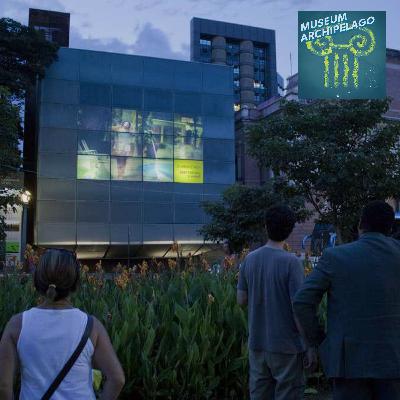
Image: A projection animates the façade of the Espaço do Conhecimento (Space of Knowledge) museum at Praça da Liberdade (Liberty Square) in Belo Horizonte, Brazil. Lucas Junqueira's software Managana, a previous version of TilBuci is running the projection.
Topics and Notes
00:00 Intro
00:15 The Rise of Software in Museums
00:56 Software Eating the World
02:19 Why Are Museums Different?
03:16 Lucas Junqueira and TilBuci
05:09 Challenges and Innovations
08:09 The Flash Apocalypse
10:12 What's at Stake
11:48 Jurassic Park on Club Archipelago
13:00 Outro | Join Club Archipelago 🏖
DIVE DEEPER WITH CLUB ARCHIPELAGO 🏖️
Unlock exclusive museum insights and support independent museum media for just $2/month.
Join Club Archipelago
Start with a 7-day free trial. Cancel anytime.
Your Club Archipelago membership includes:
🎙️Access to a private podcast that guides you further behind the scenes of museums. Hear interviews, observations, and reviews that don't make it into the main show.
🎟️ Archipelago at the Movies, a bonus bad-movie podcast exclusively featuring movies and other pop culture that reflect the museum world back to us.
✨A warm feeling knowing you're helping make this show possible.
Transcript
Below is a transcript of Museum Archipelago episode 111. For more information on the people and ideas in the episode, refer to the links above.
View Transcript
Welcome to Museum Archipelago. I'm Ian Elsner. Museum Archipelago guides you through the rocky landscape of museums. Each episode is rarely longer than 15 minutes. So let's get started.
If you've been to a museum lately, any museum big or small, you've probably noticed ever more software-driven experiences. Interactive touchscreens, projections, buttons, videos are all controlled by software.
Lucas Junqueira: I've seen mostly all exhibitions have at least some kind of interaction or some pieces of the exhibition that require some kind of software to enable it.
This is Lucas Junqueira, a Brazilian museum professional and software developer.
Lucas Junqueira: Okay. My name is Lucas Junqueira. I've been working on this exhibition museum scene for quite some time right now.
It's tempting to see the increase of software in museums as another example of software eating the world. This phrase, "software eats the world", was coined by investor Marc Andreessen in a 2011 Wall Street Journal opinion piece.
The idea isn’t that software replaces everything. It’s that software absorbs the value layer of company after company, industry after industry.
In the "software eats the world" thesis, traditional music labels only exist to provide software companies (like Apple Music and Spotify) with content. The software, everything from how the app looks on your phone to what song is recommended next, sits higher on the value chain than the music itself. Even the network effects of which app your friends use, matter more than what you listen to.
Netflix, Salesforce, and the game Angry Birds are some examples Andreessen mentioned back in that 2011 essay, plus plenty of other companies I barely remember. But the core of the thesis, even if it's not explicitly mentioned, is the zero-marginal cost nature of distributing software. Whatever the up-front cost of developing Angry Birds is, it doesn't actually matter since the company can distribute it to every phone on the planet for zero dollars. Once it exists, it can be copied endlessly, instantly, and globally. Which is exactly what museums can’t do.
And this is where museums are different.
Museums aren’t infinitely scalable, and they aren’t frictionless. You can't really download an exhibition in the way that you can download a song. You have to show up. There's only one Mona Lisa.
And that's why software in museums is (so far at least) immune from software eating the rest of the world.
Yes, there's more software in museums than ever, but that software rarely becomes the value layer.
Museum software doesn't own the audience relationship, and it doesn't become the product like Spotify was able to do. Instead, it supports the product. As long as museums continue to control distribution, software remains infrastructure: a tool to help museums tell their stories.
Lucas and I are both software developers, specializing in building exactly that infrastructure.
One of Lucas's early projects was creating software to project images onto the facade of the Space of Knowledge museum, which faces Liberty Square plaza in the Brazilian town of Belo Horizonte.
Lucas Junqueira: We provided them a tool so they can make, a projection. They do have a projection on the front wall of the museum. It's a very big projection, and it is right in front of a square here in my city that is very crowded all the time.
So they wanted to use this to show something they are exhibiting right now the museum is funded by a university, so they wanted to show some scientific evolutions. They want to use it like an information tool. They wanted to do that and provided them with the software used to produce the content to show on this big projection.
Almost always, the cost of these projects is front-loaded: museums pay Lucas, or me, to create the software that projects the images and everyone is focused on that opening day. Lucas explains that this focus on new exhibitions is related to sponsorship funding.
Lucas Junqueira: We see that,, most of the museums had some requirements when they start a new exhibition, they usually have some kind of budget and some kind of funding to that. And that doesn't really happen when these institutions have to maintain their spaces. They can get some sponsors to new exhibitions, but they don't get so many sponsors when they are just keeping the museum open, right?
And this is what happened to the projection on the facade of the Space of Knowledge museum. Long after Lucas finished building the software, and long after the project had successfully finished, the museum wanted to update that projection to show new content.
Lucas Junqueira: And it was these, that, brought me the idea of creating a tool so the people on museum can use it without technical knowledge, because I felt they were needing to create some interactive content, but they needed to do it by themselves.
Lucas wanted to make software that acted like infrastructure.
Lucas Junqueira: And I felt this need to create something that the museums and the, institutions can use to both create the big exhibitions, the big interactions for the new exhibitions, but also something that they can use, on by day, day basis.
Lucas Junqueira: Because they don't have that sort of technical people or budget to fund these on a day by day basis. Right? And so when I started thinking about creating something that they can used for both things. They can use it when something new is coming and they can hire people to do it. They can hire technical people, they can hire developers to do it, but something that they can install on their computers and with minimal knowledge they can use to solve day by day problems.
The result is TilBuci, a piece of software that Lucas developed on his own. It's a tool for helping build the software infrastructure a museum might need. The name TilBuci comes from Lucas's dog.
Lucas Junqueira: His name is Busi He, he keeps company for me. He is always where I am. When I'm working, he's close to me all the time. So when I had to think about that name first I thought, that would be perfect, let's name after him!
TilBuci, which you can download for free on any OS platform you want, is an impressive suite: capable of doing anything from slideshows, interactive menus with animation, dialogue systems, survey kiosks, and quiz games.
Lucas Junqueira: It started growing slowly with the functions that started growing slowly because of course it's a free software and it's not funded by anyone. Well, it's funded by my own work. Right? So, I started creating like this. So when someone hired me to develop, for example, a kiosk and I had to build a, a in specific function instead of creating it somewhere else, I use it on that case, I create, I use it to create the code and incorporate it on the base software.And so the, the, the basis of, of TilBuci started that. It started growing from the day by day work, my of myself.
But it wasn’t without setbacks. Lucas’s early code was written to be distributed on Flash. Flash Player was, for a long time, an easy way to make interactive media work on the web and in museums. It was a browser plugin developed and controlled by Adobe, and it allowed designers to build animations, videos, games

For the 50th anniversary of the end of World War II, the Smithsonian National Air and Space Museum planned to display the Enola Gay, the Boeing B-29 that dropped the atomic bomb on Hiroshima. The plane was restored to be part of a full exhibit, presented alongside context about the atomic bombing's mass civilian casualties.
But that exhibit never opened. Instead, after years of script revisions and intense pressure from veterans' groups and Congress, the museum displayed the restored bomber's fuselage with minimal interpretation. The exhibit was primarily dedicated to the technical process of restoring the aircraft; as one visitor noted, "I learned a lot about how to polish aluminum, but I did not learn very much about the decision to drop the atomic bomb."
In this episode, historian Gregg Herken, who served as Chairman of the museum's Space History Division during the controversy, recounts how the exhibit went from reckoning with the bomb's full impact to re-enforcing a patriotic narrative. He recalls the specific moments that led up to one of the museum industry's cautionary tales, like when the director agreed to remove evocative artifacts like a schoolgirl's carbonized lunchbox from Hiroshima from the exhibition plans, and how the Air Force Association demanded the exhibit say the bombing saved 1 million American lives and other assertions that have been challenged by generations of historians.
Today, a new presidential executive order dictates how the Smithsonian interprets American history.
Topics and Notes
00:00 Intro
00:15 The Enola Gay in the 1980s
01:07 Gregg Herken
02:21 Initial Planning
02:40 Martin Harwit
03:48 Herken's Visit to Hiroshima
04:39 'The Lunchbox'
05:32 Initial Exhibit Script
06:26 Opposition and Controversy
07:15 Revisions and Criticisms
10:49 Air Force Association's Demands
11:59 Exhibit Cancellation
13:37 "Pale Shadow"
14:10 Reflecting on History and Censorship
20:55 Outro | Join Club Archipelago 🏖
DIVE DEEPER WITH CLUB ARCHIPELAGO 🏖️
Unlock exclusive museum insights and support independent museum media for just $2/month.
Join Club Archipelago
Start with a 7-day free trial. Cancel anytime.
Your Club Archipelago membership includes:
🎙️Access to a private podcast that guides you further behind the scenes of museums. Hear interviews, observations, and reviews that don't make it into the main show.
🎟️ Archipelago at the Movies, a bonus bad-movie podcast exclusively featuring movies and other pop culture that reflect the museum world back to us.
✨A warm feeling knowing you're helping make this show possible.
Transcript
Below is a transcript of Museum Archipelago episode 110. For more information on the people and ideas in the episode, refer to the links above.
View Transcript
Welcome to Museum Archipelago. I'm Ian Elsner. Museum Archipelago guides you through the rocky landscape of museums. Each episode is rarely longer than 15 minutes. So let's get started.
By the late 1980s, the Enola Gay – the Boeing B-29 Superfortress that dropped the atomic bomb on Hiroshima – had been sitting disassembled at the Smithsonian's Paul E. Garber Preservation, Restoration, and Storage Facility in Suitland, Maryland for decades. What was once a beautiful shiny machine with four powerful engines, just powerful enough with the right banking maneuver to escape the hell it unleashed, was scattered and severed, with disheveled tubes where the wings used to be and the remains of birds nests in the turrets.
Gregg Herken: It was shortly after I joined the museum and I went out to the restoration facility that the Smithsonian operates in Garber in Maryland. And they wanted to show me around. And since I was the new chairman of the Department of Space History, they said I could get into the fuselage of the Enola Gay.
This is Gregg Herken, retired professor of American Diplomatic History at the University of California, and Chairman of the National Air and Space Museum's Space History Division from 1988 to 2003.
Gregg Herken: Hello. My name is Gregg Herken. I'm a retired professor of American Diplomatic History at the University of California.
Herken was part of the team planning the exhibition at the National Air and Space Museum that would feature the restored Enola Gay and of course he accepted the invitation and climbed up into the fuselage.
Gregg Herken: So I sat in Tibbets' seat, in the pilot seat for a second, and then I sat in the bombardier seat. And off to the left was a panel that had, I think it was five toggle switches. And one of them had the label "bombs." And actually on the day of the Hiroshima mission, it would've said in a little tag underneath that "special."
Gregg Herken: But I remember just thinking that I could sit in, I'm sitting in that seat, I could just reach over and flip that switch. And that was the switch that released the Little Boy bomb on Hiroshima. And I thought there is bad juju with that. I did not want to touch it.
At the other end of that switch was about 80,000 people, civilians of Heroshima.
Herken was chosen to be part of the exhibition team by the museum's new director, Martin Harwit.
Gregg Herken: I've written about and taught the subject of nuclear history, and that's why I think Martin chose me to begin at last the effort to get the Enola Gay on exhibit.
Director Martin Harwit, who was hired in 1987, was a bit of a departure from previous National Air and Space Museum directors who tended to be pilots or astronauts. Harwit was an astrophysicist. Gregg Herken thought that it was a signal that the Smithsonian was interested in not just displaying but also interpreting the artifacts that represent the nation's past.
The planned exhibition intended to showcase the restored plane along with multiple perspectives on the first atomic bombings in warfare – including their devastating human toll. Harwit still has his first written notes from when he first arrived at the museum and started thinking about, which show his brainstorm about the historical context of the bombing of Hiroshima in the escalation of bombing in World War II.
"This is not an exhibit about the rights and wrongs of war," Harwit wrote in 1987, "about who started what, and who were the bad guys and who the good. It is about the impact and effects of bombing on people and on the strategic outcome of conflicts. Is bombing strategically effective? Are the costs worth the strategic gains? How great is human error?"
As part of the early planning process, Gregg Herken visited the Hiroshima Museum in Japan in 1991.
Gregg Herken: Yes, Martin asked me to go to Hiroshima. The exhibit was just getting started and really in the planning stages. And we wanted to see if we could get artifacts from the Hiroshima Museum. So I was sent there and I met with the director. And I was frankly a little concerned about how I'd be received, that the idea of shipping artifacts about the atomic bombing to the Smithsonian for an exhibit they didn't really know about. I thought they might be hostile or at least suspicious, but he was very welcoming. He was actually a survivor of the atomic bombing.
The director offered to loan the Smithsonian any of the artifacts his museum had in its collection, for as long as the "Enola Gay" remained on display at the National Air and Space Museum.
Gregg Herken: I do remember walking around the museum and there was one artifact that really stood out to me and we wanted to include it in the exhibit and we nicknamed it "the lunchbox" and it was just a ceramic tube that had contained rice and peas and it had been taken by a young girl to school as her lunch. And she obviously did not survive the bombing and the tube - you could see that the rice and the peas in it had been carbonized by the heat of the bomb.
Gregg Herken: So we were never going to show any terrible pictures of burned bodies. We didn't need to. That's all any adult had to do was to look at this lunchbox, at the carbonized food in the little ceramic tube to realize what had happened to that little girl and what it must have been like to have been on the ground at Hiroshima at that time.
Back in the United States the exhibition team continued developing their plans and by early 1994, the National Air and Space Museum had completed the script for the exhibit, now titled "The Crossroads: The End of World War II, the Atomic Bomb, and the Origins of the Cold War."
The team sought input from various stakeholders including veterans' groups and the Air Force Association. Initially, feedback seemed positive.
Gregg Herken: The Air Force Association is basically a private lobby based in Washington DC for the Air Force. And we knew – the museum, Martin knew that they might be early critics, so they were brought into the planning of the exhibit as was the Air Force historian, Richard Hallion, and were shown the original exhibit script. And I remember we had a meeting in the director's conference room and everybody seemed to be, "Well, this looks good."
But behind the scenes, an opposition was mobilizing.
Gregg Herken: And then they all left. And then we found out that the Air Force Association had hired a public relations firm in DC to essentially stop the exhibit going forward, at least as it was conceived. Even though there had been no criticism at the meeting itself.
This was the beginning of what would become a full-scale public relations battle over how the Enola Gay should be represented at the National Air and Space Museum. The controversy began to spill into the media, with accusations that the exhibition denigrated American heroism and technological achievement by focusing too much on Japanese suffering.
Herken acknowledges that, in hindsight, some of the criticisms had merit, and the museum continued updating the script and the exhibition pla
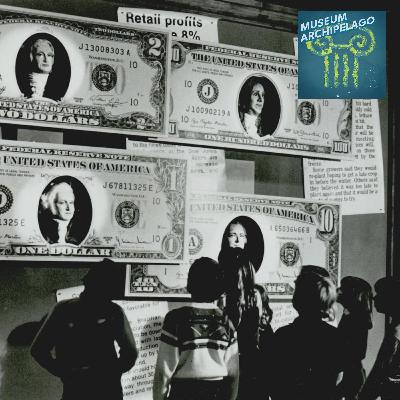
For the last few decades of the 20th century, if you visited Oklahoma City, Oklahoma, you could have been serenaded by a barbershop quartet of audio-animatronic portraits of America's founders as framed on U.S. currency. This was one of the many exhibits at Enterprise Square, USA, a high-tech museum dedicated to teaching children about Free Market Economics. The museum, which found itself out of money almost before it opened, shut down in 1999.
Barrett Huddleston first encountered these exhibits as a wide-eyed elementary school student in the 1980s, mesmerized by the talking puppets, giant electronic heads, and interactive displays that taught how regulation stifled freedom. Years later, he returned as a tour guide during the museum's final days, maintaining those same animatronics with duct tape and wire cutters, and occasionally being squeezed inside the two-dollar bill to repair Thomas Jefferson.
He joins us to explore this collision of education, ideology, and visitor experience, and how the former museum shapes his own approach to teaching children today.
Cover Image: Children watch audio-animatronic portraits of America's founders, as framed on U.S. currency, sing a song about freedom. [Photograph 2012.201.B0957.0912] hosted by The Gateway to Oklahoma History
Topics and Notes
00:00 Intro
00:15 Buzludzha Again
00:46 Enterprise Square, USA
01:32 Barrett Huddleston
02:05 The Origins and Purpose of Enterprise Square
03:09 The Boom and Bust of Oklahoma's Economy
05:47 The Disney Connection and Animatronics
07:54 The Decline of Enterprise Square
11:42 Huddleston's Reflections on Education
13:41 Outro | Join Club Archipelago 🏖
DIVE DEEPER WITH CLUB ARCHIPELAGO 🏖️
Unlock exclusive museum insights and support independent museum media for just $2/month.
Join Club Archipelago
Start with a 7-day free trial. Cancel anytime.
Your Club Archipelago membership includes:
🎙️Access to a private podcast that guides you further behind the scenes of museums. Hear interviews, observations, and reviews that don't make it into the main show.
🎟️ Archipelago at the Movies, a bonus bad-movie podcast exclusively featuring movies and other pop culture that reflect the museum world back to us.
✨A warm feeling knowing you're helping make this show possible.
Transcript
Below is a transcript of Museum Archipelago episode 109. For more information on the people and ideas in the episode, refer to the links above.
View Transcript
Welcome to Museum Archipelago. I'm Ian Elsner. Museum archipelago guides you through the rocky landscape of museums. Each episode is rarely longer than 15 minutes. So let's get started.
Buzludzha comes up a lot on Museum Archipelago. The monument was built in 1981 to look like a futuristic flying saucer parched high on Bulgarian mountains. Every detail of the visitor experience was designed to impress, to show how Bulgarian communism was the way of the future. Once inside, visitors were treated to an immersive light show, where the mosaics of Marx and Lenin and Bulgarian partisan battles were illuminated at dramatic moments during a pre-recorded narration.
But within a year of Buzludzha welcoming its first guests, all the way across the world in Oklahoma City, Oklahoma, another museum opened to promote the exact opposite message. And it even had its own flying saucer connection.
Barrett Huddleston: The framing device of the museum is you have these two alien puppets that crash down in Oklahoma City, Oklahoma, and they need to get fuel for their spaceship so they can go back. I saw these animatronic puppets and I was like, oh, well this is just like Disney World, except they're talking about having to commodify their space technology so they can buy gold to put in their spaceship so they can get back to their planet or whatever.
This is Barrett Huddleston, who first visited Enterprise Square, USA as an elementary school student in the mid-1980s, and later worked there as a tour guide.
Barrett Huddleston: Hi, my name is Barrett Huddleston. I am an educational enrichment provider. I own a business called Mad Science of Central Oklahoma and Finer Arts of Oklahoma. I travel all over my state and a few others, delivering STEAM based workshops and assemblies to elementary school students. But In this instance, I also worked as a tour guide for Enterprise Square USA for over two years.
The story of Enterprise Square, USA begins in a boom, actually a few overlapping booms. In the late 1970s, oil had been found in the nearby Anadarko Basin and energy companies and money were rushing into Oklahoma City. As Sam Anderson puts it in his excellent book Boom Town, which is also where I first learned about this museum:
Excerpt from Boom Town: “Capitalism had blessed Oklahoma City, and the city wanted to express its thanks. At the height of the boom, local businessmen pooled their money to create a brand-new attraction that, even by the standards of Oklahoma City, was spectacularly strange. It was an interactive museum, a kind of secular shrine to free enterprise, designed to help local children appreciate the sanctity of capitalism.”
Barrett Huddleston: And I think at that point in the state of Oklahoma, it was one out of every six or eight people were either directly or indirectly employed by big energy in one respect. Now it's way, way, way lower than that. And we've got a much more diversified economy. But Enterprise Square was also attached to an evangelical Christian university at a time where there was a lot of deregulation in education because of the Reagan administration. So if you were evangelical. And if you were pro laissez faire capitalism then you were definitely going to get the kind of funding that it would take from the donor class to build a museum for children that was pro free market.
Huddleston also turned me on to a different kind of boom – the baby boomer’s children were beginning to go to college around this time too. Echo booms are always more diffuse than the original boom, since people choose to have children at different times. But pretty much any college or university in the country, including Oklahoma Christian University, which hosted the museum on their campus, could expect increasing enrollment year after year no matter what they did.
Barrett Huddleston: Enterprise Square opened in 1982, and I believe as early as first, second, or third grade, school trips were being taken there, and I must have been about seven or eight years old. So much of my childhood education was, sort of, that curriculum that was created between the Great Society and the Reagan administration. So a lot of the education that I got as hand me down education from the previous generation was very pro regulation, very pro safe market approaches, et cetera, et cetera.
And I think that by the time that Enterprise Square came along, it was like, well no, we need to, we need to unlearn what these kids have learned in school and then retrain them about how bad regulation can be and how wonderful a free market can be and how they need to really pay attention to the weather forecast if they're going to make their own lemonade stands and that kind of thing.
And it’s clear from the contemporary news coverage, like this one from Action 4 in Oklahoma City, that Enterprise Square, USA represented something different.
Contemporary News Coverage: This is the first group to tour the nation's only museum devoted solely to free enterprise. The 15 million Enterprise Square, USA has been six years in the making. Every penny and minute of time spent shows up in a big way on the inside. It's an economic learning experience. And with a touch of animation. It's Disneyland in a classroom. But there’s more. These digital readouts update all sorts of nationwide figures, minute by minute, on employment, taxes, traffic deaths, and so on. Dan Slocum, Action 4 at Enterprise Square.
Disney comes up a lot in these discussions about Enterprise Square, USA. Epcot, Disney’s second park in Florida, opened just one month before Enterprise Square in October 1982.
Barrett Huddleston: I think at that point, one of the mechanics that designed Enterprise Square was an Imagineer from Epcot Center.
Even the museum’s name evokes “Main Street, USA”, a Disney themed area that’s an amalgamation of feelings or memory or history rather than a specific place. In the late 1950s, eyeing expansion of his Disneyland park, Walt Disney developed -- but never built -- a spur off of Main Street, USA that was to be called Edison Square, dedicated to all things progress and industry. It’s hard not to see the connection.
Another connection is the audio-animatronics. Reading from Boom Town again:
Excerpt from Boom Town: “Next to the world's largest cash register, four enormous paper bills hung on the wall, and their giant Founding Father heads sang a barbershop quartet about freedom, the animatronic faces jerking around like figures in a Chuck E. Cheese band.”
[Singing barbershop quartet]
Barrett Huddleston: You've got a barbershop quartet of sort of the hall of president's heads of George Washington and Benjamin Franklin and Alexander Hamilton, Thomas Jefferson, singing about freedom, freedom, freedom. they're inside the paper currency. It's hollowed out. When I was, and. a tour guide. I remember on several occasions Thomas Jefferson had a tendency to just break down by that time because it had been 15 or 20 years. So because I was the smallest tour guide, they would remove his head and shove me through his 2 bill and have me get back there with a pair of needle nose pliers.
Ian Elsner: Oh my god.
Barrett Huddleston: Cut the blue wire so that Thomas Jefferson could sing about freedom again. Yeah
Ian Elsner: That's amazing. I thought they were going to say they replaced the ani

Comments

Download from Google Play

Download from App Store
 United States