


 Claim Ownership
The Academic Citizen
Subscribed: 22Played: 71
Subscribe

© All rights reserved
Description
An independent podcast about critical issues in higher education. All episodes are free to download and share.
------
An academic citizen is anyone who is part of the higher education community. They are engaged in pedagogy or research or both, and are committed to furthering knowledge, education and the advancement of society from their disciplinary position.
An academic citizen sees their work in higher education as a public project, both in terms of being partially funded by taxpayer money, and in terms of the contributions they wish to make to the world around them.
Although citizenship implies an exclusive form of belonging, here we use it to signal the role of academic work in collective life in a non-exclusionary way, and to anchor it in a public project to which all humanity belongs.
We create knowledge not only for our individual benefit but for the benefit of all.
The Academic Citizen is an independent podcast series produced and funded in its second iteration by the South African Research Chair in Science Communication in 2022. It was originally supported by the Academic Staff Association of Wits University (ASAWU) when it was first established in 2016.
------
An academic citizen is anyone who is part of the higher education community. They are engaged in pedagogy or research or both, and are committed to furthering knowledge, education and the advancement of society from their disciplinary position.
An academic citizen sees their work in higher education as a public project, both in terms of being partially funded by taxpayer money, and in terms of the contributions they wish to make to the world around them.
Although citizenship implies an exclusive form of belonging, here we use it to signal the role of academic work in collective life in a non-exclusionary way, and to anchor it in a public project to which all humanity belongs.
We create knowledge not only for our individual benefit but for the benefit of all.
The Academic Citizen is an independent podcast series produced and funded in its second iteration by the South African Research Chair in Science Communication in 2022. It was originally supported by the Academic Staff Association of Wits University (ASAWU) when it was first established in 2016.
76 Episodes
Reverse
In this final episode of the season, we focus on the intricate web that connects life on our planet. We zoom out to hear about how Marion Island is a location for space science, and then zoom in to learn how SA Agulhas II and Marion Island serve as extraordinary training grounds for the next generation of scientists. Young researchers learn technical skills of their fields and also how to observe, question, and collaborate in environments that demand accuracy and humility. South African research plays a crucial role in the global community of Antarctic and sub-Antarctic science. It provides an essential piece of the puzzle in understanding how ecosystems across the globe are interconnected. What happens in this isolated archipelago ripples outward, informing our knowledge of climate, biodiversity, and the delicate balance that sustains life.
This episode invites listeners to explore how scientific knowledge, cultural understanding, and lived experience come together in the pursuit of discovery. And perhaps the most powerful insight from the Marion 2025 voyage is that every scientist spoken to views their work not as an individual effort, but as part of an intergenerational project. It is a testament to the episode's theme: everything is connected.
It has been an absolute pleasure to work on this season and to share the journey to Marion Island. We extend our gratitude to Prof. Charne Lavery and Prof. Jean Brundrit for conceptualising and leading the SANAP Artists and Writers Programme, and for the valuable access, experiences, and insights this initiative has provided. We also like to thank all the guests who agreed to be interviewed for this season.
We thank the following guests on this episode:
-Mr Marcel van der Berg, Dr Azwianewu Makhado, Mr Mutshutshu Tsanwani, Dr Zimkhita Gebe, Dr Thato Mtshali from the Department of Forest, Fisheries and Environment.
-Ms Eleanor Weideman from the South African Polar Research Institute.
-Prof. Michael Kosch from the South African National Space Agency.
-Ms Sarah du Preez and Ms Emma Swanepoel from the University of Cape Town
-Prof. Guillaume Delpech from the Universite’ Paris Saclay.
For more information on the work discussed in this episode, visit:
-Department of Forestry, Fisheries and Environment: www.dffe.gov.za/antarctica-and-so…rn-oceans-islands
-South African National Antarctic Programme: www.sanap.ac.za/
-South African Polar Research Infrastructure: www.sapri.ac.za/
-South African National Space Agency: https://www.sansa.org.za/
-Marine Information Management System: https://ocims.environment.gov.za/DataResources.html
This season is funded by the NRF-South African Research Chair in Science Communication, located within the Centre for Science Communication at Stellenbosch University. Prof Mehita Iqani is the Chairholder. | www.imidibaniso.co.za
The ocean surrounding Marion Island is a breathing wilderness - a vast and mysterious realm where familiar giants coexist with tiny creatures that emit an almost magical light. These diverse beings move through the water in intricate ways that we are only beginning to understand. On the surface, it may seem simple and ordinary, but beneath the steel-blue waves lies a vibrant, lively world teeming with life and secrets waiting to be uncovered.
We follow the creatures we recognise as they slice, glide, and hunt through the sub-Antarctic waters, and we uncover the vital role of microscopic organisms that quietly sustain the entire ecosystem and keep the heartbeat of the ocean alive. This episode encourages curiosity to witness an ocean in transition, from iconic species navigating these waters to the importance of microscopic life, and how its chemistry and rhythms are shifting with profound consequences for the creatures that call it home.
We thank the following guests on this episode:
-Dr Zimkhita Gebe, Dr Azwianewu Makhado, Mr Marcel van der Berg from the Department of Forestry, Fisheries and Environment.
-Mr Chandler Patel, Ms Megan Clarkson, Mr Dylan Manyoka, Mr Peter Cunningham, Mr Yinhla Shihlomule,Ms Camilla Smyth Mr Kwanele Khuzwayo, Ms Janu Rau from the South African Polar Research Infrastructure.
-Ms Emma Swanepoel and Ms Sarah du Preez from the University of Cape Town.
For more information on the work discussed in this episode, visit:
-Department of Forestry, Fisheries and Environment: www.dffe.gov.za/antarctica-and-so…rn-oceans-islands
-South African National Antarctic Programme: www.sanap.ac.za/
-South African Polar Research Infrastructure: www.sapri.ac.za/
This season is funded by the NRF-South African Research Chair in Science Communication, located within the Centre for Science Communication at Stellenbosch University. Prof Mehita Iqani is the Chairholder. | www.imidibaniso.co.za
Marion Island may be thousands of kilometres from the South African mainland, but it buzzes with activity: tiny, and large fluttering, crawling, nesting, scurrying movements. In this episode, we dig deeper into the island’s living world to explore the extraordinary creatures that inhabit this subantarctic terrain. From insects smaller than a fingernail to birds that undertake vast journeys across the Southern Ocean, and even the mice whose presence has altered the ecosystem, we examine some of the animals that live in this harsh environment.
Why are these species important? What makes their survival so exceptional? And what insights are scientists gaining about biodiversity, adaptation, and ecological vulnerability at one of the planet’s most remote research locations? Using vivid descriptions, expert knowledge, and field observations, this episode explores the diverse life forms coexisting on this windswept island and the vital research aimed at protecting them. We start with the tiniest inhabitants and gradually broaden our focus to include some of the feathered and furry creatures that define life here.
We thank the following guests on this episode:
-Ms Camilla Smyth, Mr Chandler Patel, Mr Andile Khuzwayo, Ms Janu Rau, Ms Rhiannon Gill and Ms Eleanor Weideman from the South African Polar Research Institute.
-Dr Daniela Monsanto from the University of Johannesburg
-Ms Naomi Monk from the University of Pretoria
-Dr Keith Springer from Mouse Free Marion
For more information on the work discussed in this episode, visit:
-BirdLife South Africa: www.birdlife.org.za/ and Peter Ryan’s book: https://shop.birdlife.org.za/product/guide-to-seabirds-of-southern-africa-new-edition/
-Department of Forestry, Fisheries and Environment: www.dffe.gov.za/antarctica-and-so…rn-oceans-islands
-Mouse Free Marion: mousefreemarion.org
-South African National Antarctic Programme: www.sanap.ac.za/
-South African Polar Research Infrastructure: www.sapri.ac.za/
This season is funded by the NRF-South African Research Chair in Science Communication, located within the Centre for Science Communication at Stellenbosch University. Prof Mehita Iqani is the Chairholder. | www.imidibaniso.co.za
With only five days’ notice, Mehita was thrown into a whirlwind of preparation: rushing between medical clearances, work arrangements, and the essential question: what does one even pack for a month on the ice-cold Southern Ocean? In this unexpected turn of events, she found herself standing on East Pier beneath the warm autumn sun, flanked by two kit bags and staring in awe at her home for the next 33 days - the SA Agulhas II. Her destination: Marion Island. Hear her story of sudden departures, scientific voyages, and the quiet awe of life changing somewhere in the middle of learning about the science of the subantarctic ocean.
The South African National Antarctic Programs Artist and Writers Project was devised and is run by Prof Charne Lavery at the University of Pretoria and Prof Jean Brundrit from the University of Cape Town. It is a pilot program designed to improve public engagement with South Africa's Antarctic involvement through the arts and humanities. The Project is funded and supported by the South African National Research Foundation (NRF) and the South African Government. This episode introduces the SA Agulhas II, South Africa’s national scientific research vessel, and Marion Island, South Africa’s subantarctic territory.
We want to thank the following guests on this episode:
- Mr Marcel van der Berg and Dr Azwianewu Makhado from the Department of Forestry, Fisheries and Environment
- Mr Yinhla Shihlomule, Ms Eleanor Weideman, Mr Chandler Patel, and Mr Peter Cunningham from the South African Polar Research Infrastructure.
- Prof. Guillaume Delpech from the Universite’ Paris Saclay
- Prof. David Hedding from the University of South Africa
- Ms Nicola Marneweck from the University of Pretoria
- Ms Kanyisa Makubalo from the South African Weather Service.
For more information on the work discussed in this episode, visit:
- Department of Forestry, Fisheries and Environment: https://www.dffe.gov.za/antarctica-and-southern-oceans-islands
-Marine Information Management System: https://ocims.environment.gov.za/DataResources.html
- South African National Antarctic Programme: https://www.sanap.ac.za/
- South African Polar Research Infrastructure: https://www.sapri.ac.za/
- South African Weather Service: https://www.weathersa.co.za/
This season is funded by the NRF-South African Research Chair in Science Communication, located within the Centre for Science Communication at Stellenbosch University. Prof Mehita Iqani is the Chairholder. | www.imidibaniso.co.za
What happens when you combine science with electrifying and nostalgic sonic experimentation? In this episode, we explore the ideal fusion of music and science as we share stories of scientific research with researcher, science communicator, and producer, Prof Alice Motion. Focusing on the psychological aspects of public understanding of science, this episode illustrates that, much like facts, emotions and social relationships play a significant role in how we create, share, and absorb knowledge. Music, much like science, holds epistemic authority, making the partnership between science and music immensely valuable for improving access to and understanding of scientific research in society. Come with us with the last episode of season.
Humans need to re-establish our connection with the Earth. In this episode, we explore the role of sound in helping us understand how waste has impacted the spaces and experiences of our planet with sociologist, filmmaker, and performer Dr. Julie Patarin-Jossen. Through feminist and queer perspectives, this episode helps us develop a new emotional relationship with the natural world, especially as we are called to protect our home, Earth. Come with us.
Similar to spoken and written language, clothing conveys important symbolic meaning and serves as a creative space for preserving daily traditions. In this episode, we highlight indigenous language and knowledge systems with independent fashion practitioner, researcher, and archivist Siviwe James. Through the use of sound, we emphasize the significance of traditional clothing as primary cultural materials, allowing for a deeper exploration of history and culture, particularly in relation to isintu and intlonipho. Listen to the episode on our website or on all streaming platforms. Come with us.
The sounds of nature can offer a unique listening experience and make us aware of our spaces and the species that exist. In this episode, we head deep into the green urban belts and wild spaces of Aoteroa with wildlife filmmaker, storyteller and host of Tune into Nature Podcast, Karthic SS. This episode guides our attention and appreciation to nature's soundscapes where listening can offer whole different modality to learning about the presence of species and growing conservation efforts. Come with us.
When we think of museums, we often envision a traditional building with objects and artefacts. In this episode, we challenge this notion with Dr. John Kannenberg from The Museum of Portable Sound. This episode delves into the concept of collecting and showcasing sound as cultural and museological heritage, offering a new perspective on traditional museum and music practices. By examining the portability of sound, this episode emphasizes that sound is an integral part of our cultural heritage and is not confined to a single space. Come with us.
Listening is dynamic, especially in recreating historical places. In this episode, we explore Willow Road in Fairview, Gqeberha with musician and sound artist Andrei Van Wyk. It focuses on using sound to evoke the lost homes and communities of Willow Road, destroyed by the Group Areas Act of 1950. By reconstructing the past through sound, this episode highlights how audio can revive aspects of lost spaces. Come with us.
In this episode, we take a journey through time to explore radio archives from the colonial era. Presented by Luc Marraffa, a PhD candidate at the Amsterdam School for Cultural Analysis at the University of Amsterdam, this episode focuses on the histories that have been erased from radio records. It examines these narratives through the interdisciplinary lenses of sound studies, critical archive studies, and decolonial approaches. By revisiting these colonial radio archives, this episode encourages us to rethink how we engage with archives, urging us to carefully uncover and give voice to unheard and non-verbal cues. Come with us.
On the premiere episode of Season 7, listeners are treated to an interstellar auditory experience in the form of an audio postcard. Narrated by Sarah Kane, a PhD researcher in Astronomy from Cambridge University, this episode offers a captivating exploration into the innovative realm of data sonifications. Kane, along with her esteemed team, sheds light on groundbreaking research insights concerning the effectiveness of utilising data sonification in astronomy outreach and communication, with a specific focus on reaching audiences with visual impairments. Come with us.
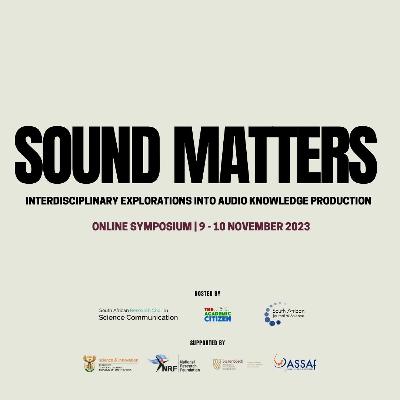
Are you interested in, passionate about or working on the possibilities of using audio to create, shape, and distribute scientific and academic research to the public? Submit a proposal/abstract for our upcoming virtual symposium "Sound Matters: Interdisciplinary Explorations Into Audio Knowledge Production" in collaboration with the South African Research Chair in Science Communication and the South African Journal of Science. To participate, submit a 300-word proposal and a 100-word bio (in one document) by 9 October 2023. We welcome suggestions for presentations of individual or collaborative contributions, panels, or showcases of audio scholarship. More info here: https://lnkd.in/dQiGY6Z4. No conference or registration fees!
Are you an academic, researcher or institution or department of higher education? Do you want to make a podcast to share your research with the world? Speak to us, we can help! We are open to being commissioned from 2023.
Intro and Outro Music by The Academic Citizen
Backing Music by Music Unlimited from Pixabay
In this episode, we explore three ways of understanding journeys from movement as knowledge with A/Professor Harmony Signaporia, to the ethics of flying and climate change with Dr Henri-Count Evans and to the elusiveness of nature and the wild by Dr Gabriella Leighton. Journeys is the final episode of Season 6. Come with us.
Being delayed is not being denied. In this episode, we explore the choppy waters of what it means to be success? with Adv Thato Toeba, who or what determines failure with Dr Sthabile Kolwa and unpacking the enabling conditions that aid us in taking risks and learning from our failure with Dr Dee Marco. Come with us.
Breath is life. In this episode, our academic citizens explore how breathing helps our mental and physical well-being with Dr. Ela Manga and the advocacy for improved air quality in our cities and health with A/Prof Tolullah Oni. A special thank you to Dr Nosipho Mngomezulu for permission to use excerpts from her ethnographic audio Hold For Sixty, None, Two and Seven, which focuses on the use of breath in our personal and academic life during the COVID-19 pandemic. Breathe with us.
The past informs the present while the past and the present inform the future. In this episode, our academic citizens help us trace the importance of knowing the events and memories that inform our heritage with archaeologist and heritage specialist Dr Sven Ouzman, to our identities with feminist free radical Youlendree Appasamy, and academic genealogies with music curator and DJ Dr Mohammad Shabangu.
The deep colour blue: often associated with vastness, the fear of the unknown yet calming, enduring and complete. Continuing from the last episode where we explored the colour Green, our three academic citizens help us explore and expand our understanding behind the symbolism of the colour blue. Our journey takes us from exploring the journey and unpredictability of the ocean with artist and oceanic researcher Meghan Judge, to understanding the noise pollution affecting our seas with zoologist and behavourial ecologist Professor Aliza le Roux and understanding how ocean can play a meaningful role in our food processes and health with artist and PhD candidate Zayaan Khaan.
As universities grapple with what it means to take seriously the imperative to green our campuses and research practice, this episode explodes the colour green: to consider the importance of indigenous knowledge, the relationship between ecological and social diversity and how envy and competition shape our relationship to academic work. In this episode, we think out loud with the colour green with three academic citizens. Our journey takes us from a conversation with a philosopher turned organiser (Dr Alex Lenferna), to reflecting on biodiversity with applied conservationist (Dr Zoe Nhleko) and settle back into our bodies with narrative psychologist (Dr Jill Bradbury). Come with us.

Comments

Download from Google Play

Download from App Store
 United States