


 Claim Ownership
Appamada
Subscribed: 404Played: 584
Subscribe

© All rights reserved
Description
Appamada is a contemporary center for Zen practice, inquiry, and community, located in Austin, Texas. If you appreciate these offerings, please consider making a contribution to support Appamada with the link below.
1324 Episodes
Reverse

Why love what you will lose?
There is nothing else to love.
“From the Japanese” by Louise Gluck
2026-03-02 | Depth In Practice | Vimalakirti & the Awakened Heart by Appamada
2026-03-09 | Depth In Practice | Vimalakirti & the Awakened Heart by Appamada
2026-03-07 I Erin Curtis Memorial by Appamada
What does it mean to live a “good life”?
This dharma talk starts there. We'll spend some time with Hui-Neng's teaching on one practice samadhi, which, it turns out, offers a surprising and slightly subversive take on living well.
Prompts for discussion:
1. What makes a good life?
2. How well are you living this good life?
Nate's reading is from the Platform Sutra, by Huineng.

2026-03-03 I Inquiry I Joel Barna by Appamada

This is a Dharma talk on the Ocean Mudra Samadhi (Kai-In-Zanmai) from the Shōbōgenzō, written by our Sōtō Zen ancestor, Eihei Dōgen in 1242.
In this writing, Dōgen points to “attaining the way and entering realization” as nothing other than this moment, appearing through this very body. We reflect on what shifts when we move from trying to grasp the dharma with the mind and instead allow it to be lived and embodied within the mudra (shape) of Zazen.
Below is an excerpt from the text:
The Buddha said:
Elements come together and form this body.
At the time of appearing, elements appear.
At the time of disappearing, elements disappear.
When elements appear, I do not say “I” appear.
When elements disappear, I do not say “I” disappear.
Past moments and future moments do not arise in sequence.
Past elements and future elements are not in alignment.
This is the meaning of Ocean Mudra Samadhi.
Full text available here: https://kokyohenkel.weebly.com/uploads/1/2/7/4/127410773/kaiin_zammai__tanahashi_.pdf.
We make every effort to share the teachings with those who cannot attend at the scheduled time by posting recordings to both Soundcloud and YouTube. Everyone has the option to be edited out of the recording, whether audio or visual. If that is your choice, please use the “contact us” link at the bottom left of the Appamada website.
2026-02-24 I Inquiry I Attending to our actions I Suzanne Kilkus by Appamada
2026-02-23 | Depth In Practice | Vimalakirti & the Awakened Heart by Appamada

2026-02-22 | Dharma Talk | Signal and Noise | Joel Barna by Appamada
2026-02-17 I Inquiry I Our dancing and songs are the Voice of the Dharma I Trudy Johnston by Appamada
2026-02-16 | Depth In Practice | Vimalakirti & the Awakened Heart by Appamada
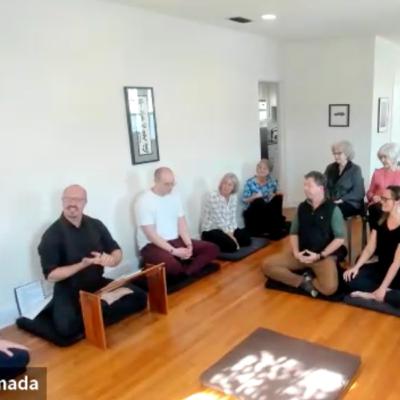
Our practice is a relational one, which means sooner or later we’re bound to experience some friction between us. Friction is not a failure. It's an edge, an opportunity, and a Dharma gate.
What do we do when someone unsettles us? How do we respond when tension lingers in the room? What do we say when something needs to be said, and we’re unsure how to say it? This Sunday we continue our exploration of living in sangha by leaning into these edges together.
Discussion scenarios:
Scenario 1:
You are sitting in the zendo at Appamada during a well-attended Sunday service. Before kinhin, Michael,the head student, quietly leans toward Sarah and whispers, “Sit upright. You’re collapsing.” There is no physical contact, but several people near you hear it. You see Sarah stiffen. Her breathing changes. After service, she leaves quickly without lingering. Later that week, in a small group you’re part of, someone mentions she hasn’t returned. Michael says calmly, “We’re a Zen center. Posture matters. If we don’t uphold the form, what are we doing?” As he speaks, you feel something move in the room. You also notice something in yourself—agreement, discomfort, uncertainty.
Scenario 2:
You are on a sangha working group tasked with improving communication. You are discussing plans to update the website. Aisha again speaks first, synthesizes the discussion, and proposes next steps. The meeting is efficient. When you begin to share an idea, she reframes it into clearer language and moves the group forward. Everyone nods. Afterward, you notice a heaviness in your body. Maybe irritation. Maybe something subtler—like being unnecessary. You also know Aisha carries a great deal and seems tired. She later mentions she feels responsible for keeping things from drifting. Nothing explicit has occurred. Yet something in you is contracting.
Scenario 6:
In practice discussion, you share something vulnerable about doubt. The teacher responds, “That is just your ego trying to be special.” You bow and leave. On the walk home you feel both gratitude and a sharpness in your chest. Was it strong medicine, or something misaligned? A few days later, you hesitate before signing up for another meeting. Something in you feels unsettled.

It took me an embarrassingly long time
to realize these magical flower arrangements
were more than exotic flowers and divine creativity.
Much more than the product of artistry, thoughtfulness, and generosity.
Such a long time to understand how important, how transformative,
was their presence - ushering us from our daily existence into the sublime.
These arrangements, these gifts - and the intention, artistry, and commitment to create them - inspired us without spoken word or sound.
I imagine these creations told us we were safe.
That we were held in the safest of ways.
That we were seen, that we were known, maybe - that we were loved.
I look at them from time to time, and they always make me smile.
For the memorable, unrepeatable experiences they represent.
For the joy they created in us.
For the spirit that joined us.
For the outpouring of love that surrounded them.
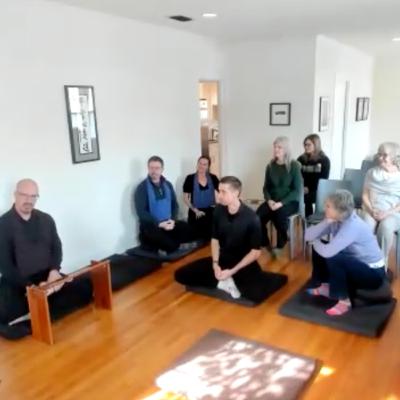
Some people help us cultivate patience without trying. This Sunday we explore Dealing with Difficult People—a surprisingly nourishing practice, if we let it be so. Join us as we continue considering how to live in sangha.

This is the link to Stillness was a gift : https://www.bbc.co.uk/programmes/w3ct6wyn
2026-02-02 | Depth In Practice | Not Two: The Appamada Story by Appamada
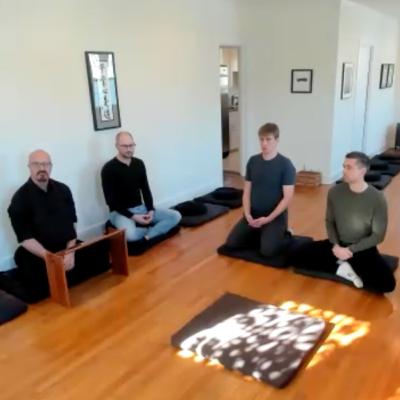
This Sunday, Nate opens our practice period theme, "Living in Sangha". In the first of a three-part series of dharma talks, we explore sangha not as comfort or belonging alone, but as the ground that reshapes how we show up in the world. Grounding in Dogen’s teachings in Tenzo Kyōkun (Instructions to the Cook), we remind ourselves how practicing fierce, attentive care together becomes both a refuge and an act of resistance.

link to science and zen
https://scienceofzen.org
Link to Mary Oliver poem
https://wordsfortheyear.com/2018/04/14/at-the-river-clarion-by-mary-oliver/
2026-01-26 | Depth In Practice | Not Two: The Appamada Story by Appamada

Comments

Download from Google Play

Download from App Store
 United States