


 Claim Ownership
Hi-Phi Nation
Subscribed: 5,621Played: 52,285
Subscribe

© Slate Magazine
Description
Hi-Phi Nation is philosophy in story-form, integrating narrative journalism with big ideas. We look at stories from everyday life, law, science, popular culture, and strange corners of human experiences that raise thought-provoking questions about things like justice, knowledge, the self, morality, and existence. We then seek answers with the help of academics and philosophers. The show is produced and hosted by Barry Lam of UC Riverside.
Hosted on Acast. See acast.com/privacy for more information.
68 Episodes
Reverse

Is a mobile home a home or a car? Is a car parked inside a home part of the home? The answer to these stoner philosophical questions determine the scope of police power. Over the last 100 years, the Supreme Court has presided over the expansion of police discretionary powers to stop, search, and arrest people through litigation over automobiles. In this episode from 2020, we look at the stories of those decisions, including Carroll, Ross, and Whren. Then, we turn to the political morality of police discretion, and why John Rawls’ test of public reason places far more constraints on law enforcement than the Supreme Court ever would. We investigate the consequence of public reasons tests for targeted policing, racial profiling, and consider whether police should have the power to overrule democratically elected criminal laws. Guest voices include Sarah Seo, Brandon del Pozo, and archival audio from SCOTUS.Brandon del Pozo’s book is called The Police and the State: Security, Social Cooperation, and the Public Good. Host Barry Lam’s new book is called Fewer Rules, Better People: The Case for Discretion, published by Norton.Join Slate Plus to unlock full, ad-free access to Hi-Phi Nation and the rest of your favorite Slate podcasts. Subscribe directly from the Hi-Phi Nation show page on Apple Podcasts or Spotify. Or, visit slate.com/hiphiplus to get access wherever you listen. Hosted on Acast. See acast.com/privacy for more information.
With a small gesture of good will toward Syrian refugees, one woman incurred the wrath of evangelical Christians on social media. The resulting chaos helped write the next chapter in a thousand-year-old controversy concerning Christianity, Islam, their shared origins, and the nature of God. Guest voices include Larycia Hawkins, Michael Mangis, Karly Bothman, Paul Griffiths, and Amir Hussain.Join Slate Plus to unlock full, ad-free access to Hi-Phi Nation and the rest of your favorite Slate podcasts. Subscribe directly from the Hi-Phi Nation show page on Apple Podcasts or Spotify. Or, visit slate.com/hiphiplus to get access wherever you listen. Hosted on Acast. See acast.com/privacy for more information.
With a new season of Hi-Phi Nation coming in early 2027, Barry is digging through the archives and sharing some of his favorite episodes, including this one from Season 3. Pyotr Tchaikovsky composed and conducted his final symphony in 1893. He died nine days later, after having knowingly drunk an unboiled glass of water during a cholera epidemic. Deep into Symphony No. 6, there is a paradoxical passage that, when played, no one will be able to hear. This is because Tchaikovsky scored it to contain a musical illusion. We uncover the mystery of why he put it there. Sound illusions reveal some of the most puzzling features of the human mind, most notably its insistence that it knows reality better than reality itself. In this episode from 2019, we listen to some of the most curious auditory illusions to find out how some of the features of sounds are generated by the human mind, rather than features of the external world. The illusions reveal something deep about some of the most treasured human endeavors, including music and language. Guest voices include Diana Deutsch, Casey O'Callaghan, and Christine Howlett. Thanks to Kenna Tuggle for violin passages. Join Slate Plus to unlock full, ad-free access to Hi-Phi Nation and the rest of your favorite Slate podcasts. Subscribe directly from the Hi-Phi Nation show page on Apple Podcasts or Spotify. Or, visit slate.com/hiphiplus to get access wherever you listen. Hosted on Acast. See acast.com/privacy for more information.
Barry’s been busy—which means new episodes are on the way! Hi-Phi Nation's host shares the details and a preview of one story from the upcoming Season 7. Make sure you and your friends are following the show in your podcast apps, then explore our past episodes!Want to hear this show uninterrupted? Join Slate Plus to unlock full, ad-free access to Hi-Phi Nation and the rest of your favorite Slate podcasts. Subscribe directly from the Hi-Phi Nation show page on Apple Podcasts or Spotify. Or, visit slate.com/hiphiplus to get access wherever you listen. Hosted on Acast. See acast.com/privacy for more information.
 1
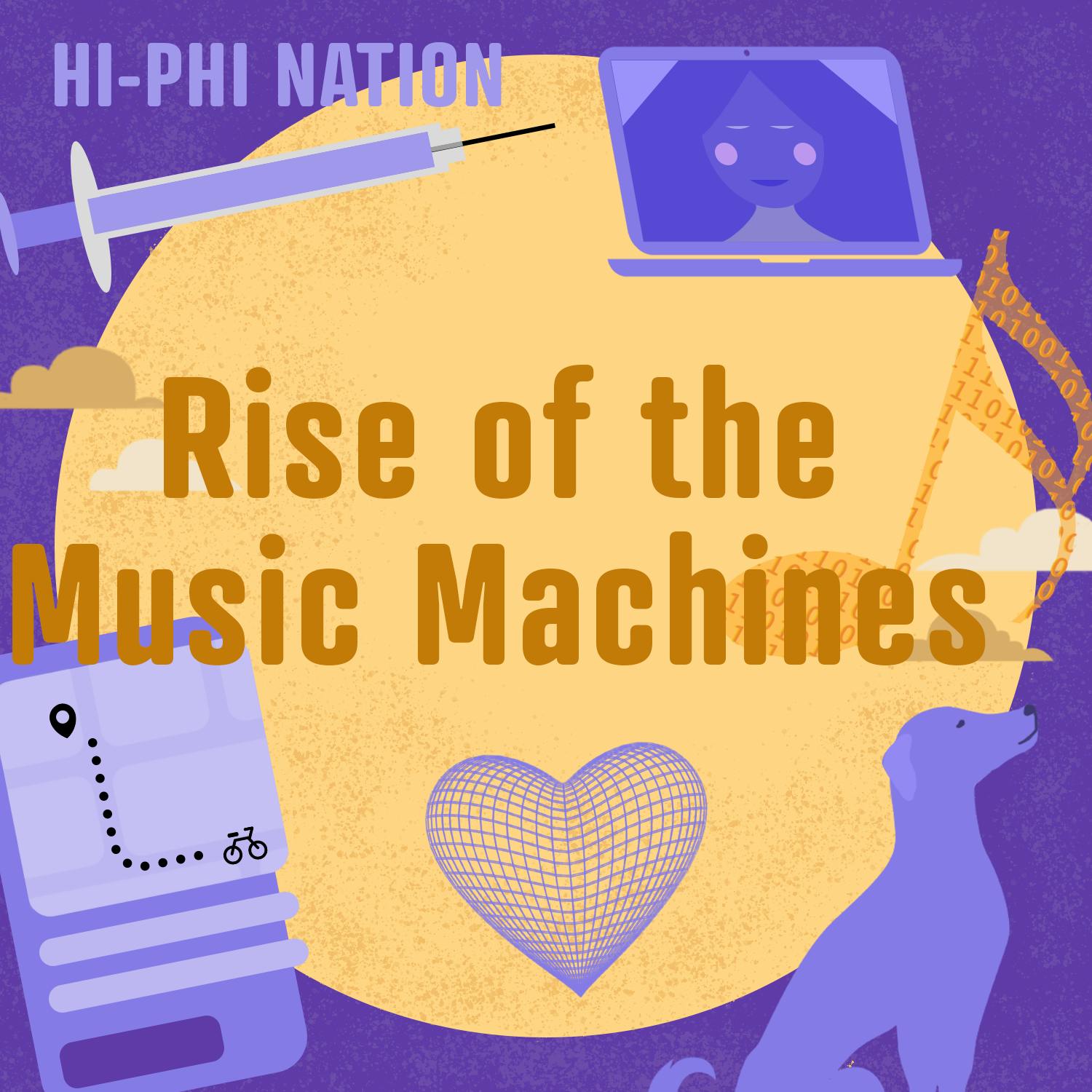
On this show we explore three different AI and machine-generated music technologies; vocal emulators that allow you to deep fake a singer or rapper’s voice, AI-generated compositions and text-to-music generators like Google Music LM and Open AI’s Jukebox, and musical improvisation technologies. We listen to the variety of music these technologies generate, and two guitarists face off against an AI in improvised guitar solos.Along the way, we talk to philosophers of music Robin James and Theodore Gracyk about what musical creativity is and whether machines are more or less creative than human musicians, and Barry gives his take on each of the technologies and what they mean for the future of musical creativity.Join Slate Plus to unlock full, ad-free access to Hi-Phi Nation and the rest of your favorite Slate podcasts. Subscribe directly from the Hi-Phi Nation show page on Apple Podcasts or Spotify. Or, visit slate.com/hiphiplus to get access wherever you listen. Hosted on Acast. See acast.com/privacy for more information.

Comments

Download from Google Play

Download from App Store
 United States