


 Claim Ownership
The Kingless Generation
Subscribed: 31Played: 340
Subscribe

© George Psalmanazar
Description
A podcast on the deep history of class struggle, paleo-parapolitics, and the demonology of capital.
Hosted on Acast. See acast.com/privacy for more information.
81 Episodes
Reverse
![Organizing Bourgeois Revolution in East Eurasia [PREVIEW]: The Water Margin (水浒传) w/ River](https://s3.castbox.fm/01/bf/4f/83b6822a7dce54bde9fdf80aa16cc88802_scaled_v1_400.jpg "Organizing Bourgeois Revolution in East Eurasia [PREVIEW]: The Water Margin (水浒传) w/ River")
First externally attested in 1524, the Ming-dynasty Chinese novel Water Margin collects legends about a band of merry men of genius who love righteousness, and who fight to stop a corrupt imperial bureaucracy from exploiting the people. However, the leader of these social bandits, Song Jiang, comes to see his mission in terms of a monarchist restorationism which is a common conservative reaction to capitalist upheaval in early modernity, known internationally by the Russian name “Good Tsar, Bad Boyars”—the breakdown of feudal order under market relations is blamed on the ministers around the monarch, while the monarch himself is seen as a pure, ideal figure who must only be rescued from corruption and he will save the world. Midway through the longer versions of the novel—there are countless versions with different political slants and (on the original prints) commentary on every page by various ideologues of the time—Song Jiang finally receives his longed-for imperial pardon, but now the heroes must join the imperial army as an elite unit fighting to put down rebellions much like their own across the country, as promises of elevation to the bureaucracy are deferred again and again. When (after the smartest of the heroes go back to the thug life) they finally receive their emoluments and sinecures and retire to their country villas, one by one they are poisoned by the bureaucrats with (as the narrator quasi-grudgingly admits) the full knowledge of the emperor. A final poignant scene caps the long debate throughout the novel between Song Jiang and his loyal and simple stalwart Iron Ox, who has argued throughout against Song Jiang’s monarchist fantasies and in favor of something like socialism and democracy. Giving the lie to Eurocentric ideas that revolution is alien to East Eurasia where “oriental despotism” prevails—in fact, the roots of modernity including the modern revolutionary tradition lie in the East—this novel had a tremendous influence on China’s thwarted bourgeois revolution, Japan’s successful bourgeois revolution (it, far more than the Kojiki or anything else, is the bible of the Japanese right wing and the foundation of Japanese monarchism), and a complicated legacy in China’s socialist revolution. In Red Star Over China, Mao is seen praising the Water Margin as an inspiration, but during the Great People’s Cultural Revolution he held it up as a “negative example” (反面教材), calling Song Jiang’s desire for a pardon “capitulationism” and equating it to the attitude of the capitalist roaders. So who was correct: Song Jiang or Iron Ox? Hosted on Acast. See acast.com/privacy for more information.

Seasoned organizer and noided leftist River from River to Reality joins us to share their theoretical concept of organizational proprioception: just as our nervous systems need to communicate well with all parts of our bodies in order to experience all the parts of our bodies as our own and have control and feedback signals flow back and forth unimpeded through our nervous systems—incidentally, scientists are finding that body parts other than our brains can even store memories (maybe even participate in thought!), and the total state of the whole nervous system may be the minimum unit that we can call a conscious entity—in the same way, political organizations on the left, where transparency and trust are of the essence, must conduct audits of local organs with member-decided questions. The lack of organizational proprioception can and does lead to organizations being encapsulated and misdirected, as they are in the many proxy wars of national liquidation that form the basis of the emerging necro-capitalist world system today: gangs and counter-gangs like ISIS and YPG shredded Syria and broke the back of regional resistance to Zionist aggression, and one would hate to see, for example, a CIA-encapsulated leftist militia emerge to fight ICE but end up only running cover for further controlled demolition of society for the workers and colonized peoples of Turtle Island—speaking purely hypothetically. Hosted on Acast. See acast.com/privacy for more information.
![A Holiday Ramble in Hibiya Park [PREVIEW]](https://s3.castbox.fm/b9/25/fb/9bf74bc42e12ab29a9be7dfb1ebdfe377b_scaled_v1_400.jpg "A Holiday Ramble in Hibiya Park [PREVIEW]")
A quick, chatty, catch-up episode recorded in a park in central Tokyo. Hosted on Acast. See acast.com/privacy for more information.

On this podcast I have often argued against the “anti-conspiracy left”, but now that everyone and your mom can’t help but be noided, the relevant question is no longer, “If you’re on the left, can you be noided?” but rather, “Since you’re noided, should you be on the left or the right?” To argue this question, I do a quick hate-read of the Bible of 20th-c anti-revolutionary ideology on the cusp of the End of History, Fire in the Minds of Men, by Ronald Reagan’s Librarian of Congress—followed by a wide-ranging conversation with the roaring River, of the must-listen podcast River to Reality. The final song my incompetent rendition of “Happy Paddle”, a song about going by canoe to a festival, composed by Casey James of the Musqueam nation. Hosted on Acast. See acast.com/privacy for more information.
![Britain is a Figment of the Crusader Imagination [PREVIEW]: King Arthur as Farang Mahdī](https://assets.pippa.io/shows/60daf5ffba5f4f0012e7c022/1756872945407-cb54e505-de1f-4f5c-9579-af81e1221e56.jpeg "Britain is a Figment of the Crusader Imagination [PREVIEW]: King Arthur as Farang Mahdī")
Much modern scholarship on King Arthur has revolved around the question of his historicity and origins, the recent greatest example being Higham’s magisterial 2018 survey of all the major theories—except the one that I advance here: Arthur was only one of many legendary chivalric heroes with whom continental Crusader and Reconquistador storytellers populated the North Atlantic archipelago, in their imaginations the spiritual homeland of a fictional Europe innocent of Semitic influences (both Muslim and Jewish). First, we run through all the major Arthurian theories—including the all-time banger whereby Arthur was a Croatian-Roman general who led nomadic Iranian horse-rider recruits to fight off the Angles and Saxons in the last days of Roman Britain—as exhaustively investigated by Higham. Then I state the obvious: that all the most distinctive features of the Arthur story appear for the first time in French chivalric romance (with many parallels in Spanish, Italian, and Catalonian stories featuring other characters) in the twelfth and thirteenth centuries, as the new Crusader concept of taking territory “back” from Muslims became the conceit of knightly adventure and conquest of “islands that the Emperor of Rome could not hold”, and the phenomenon of Crusaders bringing back relics from the holy land grew into legends like that of the Holy Grail. Finally, we explore one of foundational Japanese novelist Natsume Sōseki’s very first literary ventures, the Arthurian story “Kairokō” (“A Dirge”, 1905) and the modern, pseudo-modern, or hyper-modern twists and turns that it imposes on earlier Arthurian stories by Malory (1485) and Tennyson (1833), while trying to steer clear of allegedly un-civilized and un-modern predecessors in Edo-period kabuki and puppet theatre—which were perhaps in fact more authentically modern because rooted in Afro-Asiatic silk road capitalism. Hosted on Acast. See acast.com/privacy for more information.

In this final session, we put the proverbial big old boulder into the sweltering primordial pond with meditations on myths of brother-sister marriage and divorce from the Kojiki (712), the taboo on sibling incest in the mother-right kinship structures of Trobriand Islanders as seen in the anthropology of Malinowski and his debates with dogmatic Freudians in the 1930s, and finally the persistent postwar Japanese cultural theme of Japan as hotbed of incestuous “bed-creeping” (yobai), a feature which is either the dysgenic cause of the nation’s staunch patriarchy, persistent class rule, and gangsterismo (as in less helpful versions), or (as Nathan and I think) rather the effect of the mythopoetic comprador infestation of working-class movements and Indigenous resistance to dispossession which we have been discussing in this series. Hosted on Acast. See acast.com/privacy for more information.
![The Birth of the Comprador Chief and the Defeat of the Secret Society [PREVIEW]: Profound Desires of the Gods w/ Nathan, part 2](https://assets.pippa.io/shows/60daf5ffba5f4f0012e7c022/1754114086922-9efe9cc4-89d5-4598-9829-42935aa298c2.jpeg "The Birth of the Comprador Chief and the Defeat of the Secret Society [PREVIEW]: Profound Desires of the Gods w/ Nathan, part 2")
This time we hit our stride, discussing the interplay of Indigenous state and deep state, chief and secret society, sometimes in resistance to colonization and sometimes in service of comprador opportunism—though as Nathan points out, which it might be in any given moment is worked out through a collective mythopoetic process. Hosted on Acast. See acast.com/privacy for more information.

Nathan, AKA KUBARK Stare, @postcyborg on Twitter, an organizer of a film club in London which listeners should check out, joins me for a conversation about noided proletarian filmmaker Imamura Shōhei’s 1968 film Profound Desire of the Gods. Former Ozu disciple Imamura rejected the neat and clean nationalist family values of his early mentor to explore the deepest and most powerful forces slumbering fitfully at the bottom of fourth-reich Japanese society. Here he goes back to the “dawn of everything” (as he conceives of such things) to take up some prime paleo-parapolitical material—outcast shamans, tribal secret societies, masked death squads—so you know we have to check it out. Hosted on Acast. See acast.com/privacy for more information.
![Japanese First! (into the digital prison and the war machine) [PREVIEW]](https://s3.castbox.fm/c9/7f/b6/7f187c1cbced29fd457597491ef10de91a_scaled_v1_400.jpg "Japanese First! (into the digital prison and the war machine) [PREVIEW]")
I have several episodes in development, but each one I feel like I need to read at least one more book before it’s ready, so for now, some newsy musings on current events mostly in Japan, where this weekend’s election sees a far-right populist party set to pick up a dozen seats: Sanseitō, whose draft constitutional amendments would abolish all individual rights and invest sovereignty in the state and not the people, and which is heavily astroturfed by all the usual suspects, including not only the original Unification Church but also Sean Moon’s Rod of Iron (known by the less openly violent name “Sanctuary” in Japan). All this they package under the racially provocatory slogan “Japanese people first!”, backed up by mass media campaigns about a wave of “crimes and annoying behavior by foreigners”—but of course tending in reality to shunt all Japanese class tensions onto the East, South, and West Asian captive nations that make up Japan’s proletariat, beef up digital surveillance and social credit systems, and further prepare Japan to become the Ukraine of the Pacific. Hosted on Acast. See acast.com/privacy for more information.

Sina Rahmani of The East is a Podcast and Red Media had planned to come on the show before this, and in light of the Zionist entity’s unprovoked attack on his ancestral country of Iran in violation of international law I offered him every chance to back out, but hardworking podcaster that he is, he joins us for some light vibing and riffing and unstructured meditations about, among other things, the unexpected similarities between the entity and postwar Japan, as well as the bright future that I nevertheless hope for in the latter (my adopted homeland in my recovering-settler existence)—which future must lie beyond the whiteness that Japan too has claimed for itself in the postwar, thereby following a path of delusion that many countries in Africa and West Asia are still being forced down today pending the working and peasant classes rising up and showing the way. Hosted on Acast. See acast.com/privacy for more information.
![English for Compradors on the Eve of the Final Enclosure [PREVIEW]: A Journey into TED Talk Hell](https://s3.castbox.fm/0e/c5/d9/71c22a8b2ff2fd65cc693de2722e63ef37_scaled_v1_400.jpg "English for Compradors on the Eve of the Final Enclosure [PREVIEW]: A Journey into TED Talk Hell")
It’s a pungent bouquet of TED Talks! A blast from the past! Some shots from the aughts! Put on your Pynchon goggles, your Mabeuf plague mask, and your Cuttlefish gloves, because we’re opening up this most dracular document of the moment before the long 2014.P.S. The episode art is from the actual cover art of the book in question, and it’s tragic that I neglected to discuss it: You there, third-world comprador! Walk on with me, deeper, yes, deeper, into ever darker and more eerie post-apocalyptic tunnels of the English language! Aren’t glad you survived the Cull? Hosted on Acast. See acast.com/privacy for more information.
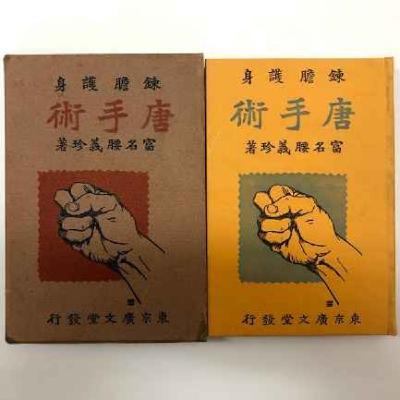
If you had a male-coded childhood at all recently in the Anglo-American world, you have felt the influence of the Soldier of Fortune culture of the 1980s, within which martial arts and other action films featuring Silvester Stallone, Chuck Norris, and Steven Seagal were prominent, and accompanied by dojos proliferating even in mid-sized American towns. But what you may not know is that, like the sushi boom around the same time period this shadow-reich version of the East Asian martial arts was quite deliberately seeded into the pop culture of the Reagan Era by a rogue’s gallery of all the usual WACL suspects: Moon Seonmyeong of the Unification Church, his high-ranking lieutenant Jhoon Rhee, Sasakawa Ryōichi—as well as Zionists like Menachem Golan and Haim Saban. Moreover, the hyper-individualism and hierarchicalism of this WACL school of karate, far from being inherent to the art, represents its co-optation and enlistment in a fight against its true roots in the struggles of the colonized and the working class in the Japanese Empire. In the proletarian fiction of 1920s Japan we find a little-known earlier chapter in the story of karate, when it was a new and exotic weapon, developed by Ryukyuan peasants under early-modern feudal and mercantile rule, and now wielded by Ryukyuan proletarians and the Korean and Japanese comrades to whom they taught it, to devastating effect against the bosses and their yakuza goons. Hosted on Acast. See acast.com/privacy for more information.
![Eat the Yellow Powder, Get in the Wara [PREVIEW]: The first king, the first collapse, and the first underground bunker society in the Avesta and the Ṛigveda](https://s3.castbox.fm/f3/1a/11/eb44a261c1fb1e0df6adaa5af3a02af189_scaled_v1_400.jpg "Eat the Yellow Powder, Get in the Wara [PREVIEW]: The first king, the first collapse, and the first underground bunker society in the Avesta and the Ṛigveda")
What is the difference between East and West? One helpful line to draw is that between Iranian and Indo-Aryan cultures, as seen in the extremely ancient traditions of the Avesta and the Ṛigveda, respectively. Whereas the common Indo-European heritage of multiple generations of gods (ahuras/asuras vs daēwas/devas, see also titans vs gods—which, as long as we’re painting with broad brushes, we might imagine have something to do with memory of past relations of production as “ages”) is ultimately nondual, the Iranian tradition demonizes the gods (Skt. devas, Av. daēwas) and elevates one of the earlier ahuras (cf. Skt. asuras) into an absolute good creator, to whom is opposed an absolute evil which has corrupted the world and from which a series of saviors must be sent to save us, culminating in a final eschaton, a resurrection and final judgment, etc—the whole apparatus of Abrahamism is basically here already. Within this, we explore the Indo-European myth of the first man and the first king, whose Avestan expression features a societal collapse and a post-apocalyptic remnant surviving in some sort of secure underground enclosure called the wara. The new Japanese translation of the entire Avesta by Prof. Noda Keigō (2020), the first into any language in nearly a hundred years, as well as the new English Ṛigveda of Jamison and Brereton (2014), equip us uniquely well for this investigation. Our main takeaway is the sheer age of ruling class myths of the need to hole up in a cult compound to survive the collapse of class society—when in fact (even supposing we will need counter-waras and defensive tunnels of our own to survive climate collapse and extermination campaigns) it was always the ruling class who most needed to hide away, whereas the masses have always found a way out and forward in the struggle for production and human flourishing. Hosted on Acast. See acast.com/privacy for more information.

人類30万年。その大半を占めるさまざまな平等・自由・創造性ある先「史」社会、そして穀物国家における階級闘争五千年のごく小さな誕生。 Hosted on Acast. See acast.com/privacy for more information.
![The Conversion of Kevin Gaijinson ケビン・ガイジンソンの転向 [PREVIEW]](https://assets.pippa.io/shows/60daf5ffba5f4f0012e7c022/1739585505219-a661ed53-45b0-46a0-9f52-82a473ce615b.jpeg "The Conversion of Kevin Gaijinson ケビン・ガイジンソンの転向 [PREVIEW]")
To introduce Kevin Gaijinson, the show’s new Japanese language host, I share an old conversation with him from back when he was still a raging weeb spreading Anglo-American imperialism in blissful ignorance while speaking better Japanese than the Emperor, gambling with the yakuza, and teaching very special English lessons to the bored housewives of the rich and powerful. He began a journey that day that led him to become a member of the Kingless Generation, and now that he is between jobs as a result of the dissolution of USAID, the NED, and all associated influence operations, and since he’s still such a weeb that he insists on speaking nothing but Japanese, he will be joining the show to host Japanese language episodes from time to time.俺はケビン・ガイジンソン、世界一日本語上手な人。これから本ポッドキャストで日本語ホストを務めるわけですが、まずはちょっとした身の上話を聞いてください。天皇陛下を歌カルタで倒したり、ヤクザと博打を打ったり、著名人の有閑婦人にとても丁寧に英会話を教えたり、日本人よりもよく知っている知日派として理想の生活を送っていましたが、三つ四つ目の諜報局がらみの反共カルトにうんざりきた頃、何か違うなと思ってきました。本ポッドキャストの英語ホストにそんな身の上相談をしたときの音声が今回の主な内容で、僕は日本オタクすぎて日本語しか話せないためバイリンガルの漫才のようなノリになりました。その結果、英語がさっぱりわからなくても結構面白く聞いていただけるかもしれません。ともあれ、USAID/NEDの解体で僕は浪人中ですし、このポッドキャストの日本語ホストをやることになりました。次回からは普通に日本語だけのわかりやすいポッドキャストになりますが、とりあえずはこちらのケビン・ガイジンソン縁起を聞し召せ。 Hosted on Acast. See acast.com/privacy for more information.
![Ritual Serial Murder and the Birth of a Ruling Class: Popol Vuh, Title of Totonicapán (Maya, 16th c.) [PREVIEW]](https://assets.pippa.io/shows/60daf5ffba5f4f0012e7c022/1736666361209-bd7aed85-e254-43fc-a887-d2f226fd4f6d.jpeg "Ritual Serial Murder and the Birth of a Ruling Class: Popol Vuh, Title of Totonicapán (Maya, 16th c.) [PREVIEW]")
At the end of the ancient mythology section we discussed last time, the Popol Vuh (here paralleled by the Title of Totonicapán) depicts the restoration of militaristic class society in the K’iche’ corner of the Maya world in the 13th c. CE, after some centuries of relative freedom and equality following the overthrow of the Classic Maya around 950. The founders of the new ruling class are an itinerant, mountain-dwelling secret society who begin their attack on the stateless, classless society around them by prosecuting a covert campaign of ritual serial murder. For perhaps obvious reasons, this passage seems practically untouched in modern scholarship—the most recent English translation of Popol Vuh silently cuts it entirely!—but we of the Kingless Generation have all the right tools to make sense of it in our own little way: the immortal science of historical materialism, the anthropological theories of Brian Hayden regarding the roots of ruling classes in secret society religion, and leftist parapolitics research on Fort Bragg, Marc DuTroux, the Atlanta child murders, and many other modern instances of ritualized abuse and murder for which good evidence exists for the involvement of a wider network of Euro-American military, intelligence, and high bourgeois elements. Hosted on Acast. See acast.com/privacy for more information.
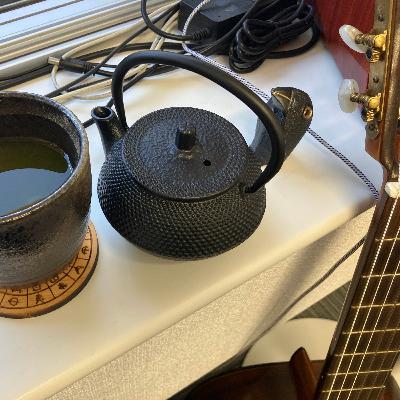
Before the dawn of what I hope will be a much more productive year for the podcast, join me in a warm and toasty room for some green tea, guitar, and guileless meditations. Hosted on Acast. See acast.com/privacy for more information.

I did it, folks: I returned to the burning bouncy castle that is the small town settler entity on Turtle Island. In between fulfilling various karmic obligations and reconnecting with fellow settlers, relatives and friends on both sides of the Trump/Kamala cultic divide, I managed to do some real-life investigation of Indigenous reservations, visiting museums and cultural events, albeit in a shallow, short-term capacity. Herein I share some musings on this experience of questionable depth but with fireside vibes aplenty.This version is a short take which I did earlier on in the visit and which got interrupted, though it’s nice and snappy and focused. A longer take done later with a bit more information and a lot more vibes will follow on the premium feed only. Hosted on Acast. See acast.com/privacy for more information.

The first half of the Popol Vuh as we have it from the Kʾicheʾ colonial tradition is a quintessentially Kingless epic, as the story revolves around pre-human gods, successive generations of hero twins, who must defeat a series of aggrandizer figures, including the lords of death in the underworld, in order to bring about the dawning of the human age. Although the same basic story can be found in earlier art and hieroglyphic inscriptions which since the 1990s are being deciphered at an exhilarating pace, recent research has pointed out that this anti-accumulative tendency of the story may be somewhat unique to the Popol Vuh as we have it, which, it is hypothesised, may represent a retelling slanted toward anti-colonial resistance. While I agree that this may also be the case, I (based on my limited understanding as an ignorant outsider) think it might make even more sense to take this story, written down only some thirty years after first European contact, as faithfully reflecting older layers, though perhaps not of the somewhat exploitative and stratified Classic Maya (ca 250–950 CE) but rather of the socially creative, decentralized, and egalitarian Postclassic Maya (950–1539), which represents one of the great examples in world history of the deescalation of class struggle, when people came together to build the Kingless Generation. Hosted on Acast. See acast.com/privacy for more information.
![Asiatic Athena: karmic roots of Greek culture in Hittite class struggle (Song of Release, 15th c. BCE) [PREVIEW]](https://s3.castbox.fm/ce/f7/59/0b7d48f1d6c9734ccba918bde9663c47d3_scaled_v1_400.jpg "Asiatic Athena: karmic roots of Greek culture in Hittite class struggle (Song of Release, 15th c. BCE) [PREVIEW]")
 1
1In a series that I hope will include Martin Bernal’s classic Black Athena (about the modern British fabrication of “ancient Greece” and its true roots in ancient Egypt), we start with the East: in recent decades, great advances in Hittite studies have illuminated much of the mechanics of transmission of Mesopotamian literature and religion to a nascent Greece from a grain state in Anatolia (modern-day Turkey) which used cuneiform writing (in addition to their own distinctive hieroglyphs) and was ruled over by an Indo-European-speaking ruling class. In addition to illuminating details of class struggle between slave-owning city council members against a king who wants to free the slaves—though perhaps only in order that they may serve the cult of his ancestors in the temple—we contemplate the dependent origination and lack of perduring essence of ‘ancient Greece’, that flimsy idol enshrined at the center of the white supremacist worldview. Hosted on Acast. See acast.com/privacy for more information.


Download from Google Play

Download from App Store
 United States
IxKik' is the Moon Goddess; she is a Noble Female Goddess of the Underworld of Night of Darkness of Death...these Powers of Night and Day will form maize and shape cacao into Human Beings of Sacred Sustenance...Jun Batz Jun Chowen...JUN NIM K'AT IXIM...Jun K'at Jal Jun K'at Aj IxToj Ix Q'anil Ix IxKakaw IxTziYa...This IS the Maize Matriarchy of Horticulturalists IxMuqane...She of the Buried Maize as she names the names of the Bames of Names of their Siwing Place...Matriarchal and PatriaLineages
Classic Colonialist Arrogance by a 'dude' who thinks it is 'legitamate' for him to take in and appropriate a Sacred Native American Indigenous text out of its original context to then make a mess of it because of his vast ignorance founded in a colonial arrogance that only a colonizer would be capable of bringing forth in public...I am shocked, after living with the K'iche Maya for over three decades I cannot believe they-the Maya-might end up listening to this distorted disruptive discourse.
OOPS the Colonist Storyteller makes a massive storytelling mistake when he tells of Jun Junajpu Wuqub Junajpu in Xibalaba...The Generational Story of Vengence and Revenge of Junajpu Ixbalamkej...the Materialist Marxist does not understand how to read andcrelate to Maya Mythic Metaphors of the Maize Lords....This poor guy-THIS ASSHOLE in his words doesnt realize this is the story of Initiation of the Noble Lords of the K'iche..What arrogance of a Self Aggrandizer who cannot hear his Settleriness
JAW...JUNAJPU shoots Wuqub Kaqix shoots a clay ball bliwgun shot in the JAW! THE JAW is what the Warrior and Capturer of the Captive Sacrificial Gift...the Jaw is the Sign of Sacrifice given by Warrior Hunter Ballplayer...Tedlockntranslate PUAQ as Metal when it iis SILVER...Your disrespect of this Sacred Text is CLASSIC COLONIALIST PLAYING WITH THE K'ICHE MAYA'S DIVINE BOOK OF RITUAL DRAMA...Pobrecito, a young racist that doesnt realize he is using the Maya for his Natural Resource...RESPECT??
Xpiyakok IxMuqane; Jun Junajpu Wuqub Junajpu IxKik Junajpu Ixb'alamkej...Noble Lords are Artisans and Ballplayers...Popol Wuj is a Counsel Book to counsel Rulers on how to Rule as a Wise Noble Lord and not just a highly adorned Big Man like Wuqub Kaqix...This Interpretation is so Materialistic that we lose the many metaphors of this Mythopoetic Masterpiece...The Agrandizer Deity of the Small Noble Lord Wuqub Kaqix in this story of Empire...How to be like Ajaw Quetzalcoatl, Great Lord of Tollan..
The Story of the Tools of the Wooden People are the enslaved hands who are treated without respect...tools speak out as the young women who must grind day and night; maize and cacao.. BLOWGUN NOT SLING SHOT...THE BOYS HIT the Jaw of Wuqub Kaqix; Wiqub Kaqix Sipakna Kabraqan: Self Agrandizemente; KI Three Day Drink Oxib Q'ij; TEDLOCK miss translates NAWAL as Genius when it is just the Nawal or Transformative Power and Sacrificial Acts or PUS but Tedlock does not want to translate ritual violence.
Too bad the Host keeps speaking of the Jesuits when the Popol Wuj comes from a Dominican Conquest of the K'iche Soul; Soul of the Head; the Heart; the Liver...Day Keeper; Prayer Maker...Worshipper...Singer Painter Writter...Sacrificer...Sacrificial Priest...Wooden Men, Reed Women...the Tedlock Translation being used here cause quite a few misinterpretation...No...not just VEGITARIAN DIETS Maya always place a little piece of meat or fish or shrimp or crab in toasted squash seed sauce y chili...
There are no Jesuits at Conquest in the K'iche'; Dominican and Franciscan Orders bring the Spiritual Conquest to Mesoamerica...The Maya maintain their Traditio of Day-keepers and Ancestral Metaphors of Maize and Venus and Sun and Moon; the Maya Hide their Books, Mythic Maps of K'iche Identity such as those Lienzos Pintados or Painted Histories known as Ilobal...See el Mapa de Cuauhtinchan or the Cuauhtemallan Mapa known as el Mapa de Cuauhquechollan...Painted Books Painted Mythic Histories...
Jun Junajpu; Ixb'alamkej are the Decolonial speliings of the Hero Twins or Sons-K'ajolab'...Kiche' Winaq Many Tree People; Look to Decolonizing Time at Popol Nah for a Mesoamerican Group of Scholar-Activists...Willy Barreno and Jose Chamalé...These women and men are all about Class Struggle and Ancestral Forms of Knowledge and Contemporary Content Shaping through Scholarly Engagement with Indigenous Descendants of Mesoamerican who speak English being born and raised en el Norte...DACA...DREAMERS