


 Claim Ownership
Language of Love with Dr. Laura Berman
Subscribed: 493Played: 18,852
Subscribe

© 2021 The Language of Love with Dr. Laura Berman
Description
Language of Love is a podcast about love and intimacy in all its forms and the relationships that shape our lives. Hosted by renowned relationship therapist and bestselling author Dr. Laura Berman, the show explores romantic partnership, family, friendship, desire, healing, grief, and self-connection through a mind, body, and spiritual lens. Featuring expert conversations, listener Q&A, and real-life coaching moments, Language of love offers, honest insight, and practical wisdom for navigating modern relationship relationships with greater presence, clarity, and intention.
410 Episodes
Reverse
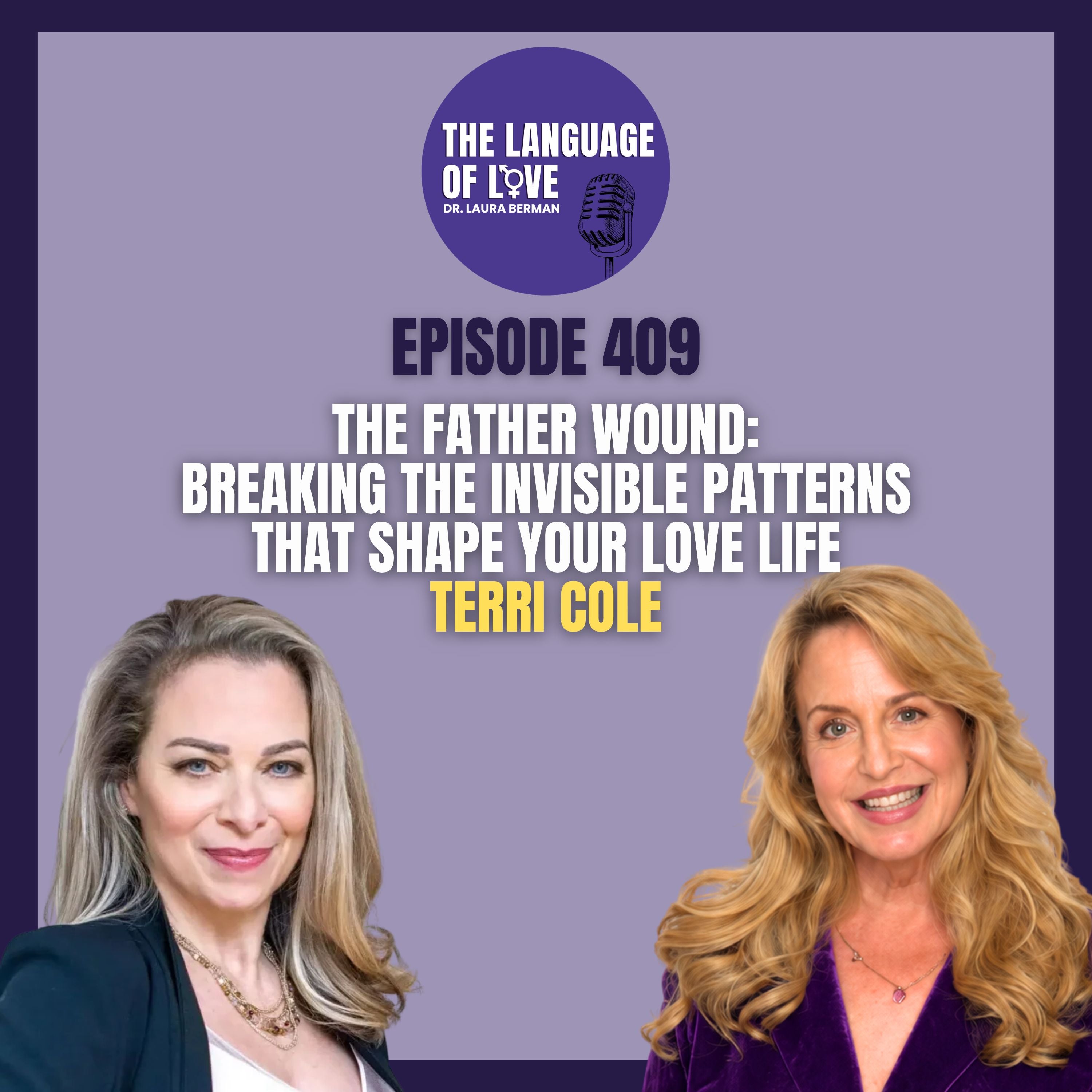
You swore you'd never end up with someone like your father. You've done the therapy. You're successful, independent, and pretty self-aware. So why do you keep finding yourself in relationships that feel painfully familiar?
What if some of the patterns you can't seem to break started long before you ever went on your first date?
In this episode of The Language of Love Conversations, I'm joined by psychotherapist, relationship expert, and bestselling author Terri Cole to talk about the father wound and how it can quietly shape who we love, what we tolerate, and what we believe we deserve.
Terri's new book, Father Wound: Break Unhealthy Patterns to Reclaim Your Worth and Power, explores how our earliest relationships can influence our adult romantic lives, even when we think we've moved past them.
We get into some fascinating territory, including why emotionally unavailable partners can feel so attractive, how hyper-independence can actually be a trauma response, and why what feels like chemistry might really be anxiety.
We also explore:
Why the father wound is often a wound around worthiness
How mothers can either protect us from or deepen these wounds
Why high-achieving women may have the hardest time recognizing their father wounds
How we can develop different attachment patterns with each parent
Why we unconsciously seek partners who give us another chance to win the love we didn't get
How a resentment inventory can reveal where we're abandoning ourselves
How to identify the patterns you've inherited and finally begin changing them
One thing I especially appreciate about this conversation is that it's not about blaming our fathers. It's about understanding how those early experiences shaped us, often in ways we never recognized.
And once we can see those patterns, we have a much better chance of making different choices.
If you've ever looked at your dating history and wondered, How did I end up here AGAIN?, you're going to want to hear this conversation.
You can learn more about Terri through her book, Father Wound, her website, Instagram, and The Terri Cole Show.
And as always, I'd love to hear what this conversation brings up for you. Email me at [email protected] or visit my website for more resources.
To learn more about Terri and her work, pick up a copy of her book, The Father Wound: Break Unhealthy Patterns to Reclaim Your Worth and Power. You can also connect with her on Instagram and visit her website. For more insights on boundaries, relationships, and healing, tune in to The Terri Cole Show.
If this episode resonates with you, I'd love to hear your thoughts. Email me at [email protected] or visit my website for more resources, tools, and upcoming events.
This episode is for anyone who was told they should be grateful for everything they had but still felt like something important was missing.
Learn more about your ad choices. Visit megaphone.fm/adchoices

Do you say yes when you mean no? Stay quiet when something hurts you? Convince yourself you're just being "easygoing" when really you're scared of disappointing people?
Then the resentment builds. You feel disconnected from everyone, including yourself. And you start to wonder: How do I speak up for my needs without feeling selfish or afraid people will leave?
That's exactly what Brenda asked in this session, and if it sounds familiar, you're not alone.
In this episode, I answer Brenda's question about what's really underneath the fear of speaking up. We unpack why so many of us learned that love was conditional on being agreeable, and why the terror you feel when you imagine setting a boundary is often the child in you, not the grown-up you. (I share my own story too: it took my world imploding, losing my mother and a breast cancer diagnosis, before I truly understood how much of myself I was draining to keep everyone else happy.)
In this episode you'll learn:
Why people who withhold their truth to keep the peace usually grew up in homes where love and safety were conditional, and how parentification and anxious attachment keep that pattern running
How to tell the difference between the child's terror and the adult's reality (your world is not going to fall apart now, even when it feels like it will)
Why "no" is a complete sentence, and how to set a boundary calmly, in writing if you can, without over-explaining or over-apologizing
Why the people who benefit from your lack of boundaries will push back, and why holding your ground anyway is the whole point
I'd love to hear from you! Is there something you've been afraid to tell your partner about sex, or something you've always wanted to ask?
Email me at [email protected] or leave a voicemail at languageoflovepod.com. Your question could be featured in a future episode.
And follow The Language of Love wherever you listen to podcasts. If this episode resonates, share it with someone who might need to hear it
Learn more about your ad choices. Visit megaphone.fm/adchoices

After more than 30 years as a sex therapist, I've heard men share things about their sex lives they've never told anyone. Sometimes not even their partners.
And I think a lot of women would be surprised by what they have to say.
We tend to assume men are always thinking about sex, always ready for it, and pretty straightforward about what they want. But there's a lot more vulnerability around male sexuality than most people realize.
Many men feel enormous pressure to perform, to initiate, and to satisfy their partners. When their desire changes or their bodies don't cooperate, it can shake their confidence and even their sense of masculinity. And while plenty of men long to feel desired themselves, they often have no idea how to ask for it.
So they stay quiet. And their partners are left wondering what's wrong, sometimes assuming it's about them.
In this Language of Love Bite, I'm sharing what men have told me over three decades about their sexual fears, insecurities, and desires. And more importantly, how couples can start having the conversations that so often get avoided.
In this episode, you'll learn:
What men wish women understood about their sexuality
Why performance pressure can create so much shame and anxiety
Why men need to feel desired, too
How sexual struggles can be mistaken for rejection
How to create enough emotional safety to talk honestly about sex
I'd love to hear from you! Is there something you've been afraid to tell your partner about sex, or something you've always wanted to ask?
Email me at [email protected] or leave a voicemail at languageoflovepod.com. Your question could be featured in a future episode.
And follow The Language of Love wherever you listen to podcasts. If this episode resonates, share it with someone who might need to hear it.
Learn more about your ad choices. Visit megaphone.fm/adchoices

There’s a kind of relationship that makes you question your own sanity.
From the outside, everything looks perfect. The grand gestures. The relentless pursuit. The intoxicating feeling of being the one they chose above everyone else.
And then, slowly, the ground shifts beneath you.
The warmth becomes conditional. The rules keep rewriting themselves. You start walking on eggshells through your own life, making excuses for behavior you swore you’d never tolerate. You cling to who they were in the beginning while bracing yourself for who they’ve become.
That’s the quiet trap of a trauma bond.
And Dr. Nadine Macaluso knows what it feels like from the inside.
The world saw a throne. She lived inside a cage.
From the outside, her marriage to Jordan Belfort looked like a fairy tale printed in the tabloids. Private jets. Champagne-soaked parties. A life most people could barely imagine.
But behind the velvet rope of Belfort’s empire, a very different story was unfolding.
At 22, Nadine was a Brooklyn model when Jordan swept her off her feet. His pursuit was relentless. The attention was intoxicating. She didn’t see danger. She saw destiny. She saw a man who chose her above everyone else.
What started like a whirlwind romance became an eight-year marriage marked by addiction, infidelity, control, and abuse.
The movie gave us the spectacle.
In this episode of the Language of Love Conversations, Nadine gives us what it felt like to live inside it.
Now a licensed therapist, trauma bond specialist, and author of Run Like Hell, she takes us behind the story audiences think they know. We go back to the beginning, when the red flags didn’t look like red flags. They looked like passion. Like devotion. Like someone who couldn’t get enough of her.
She walks us through the slow unraveling, the love-bombing that curdled into coercion, the addiction that consumed everything, and the fear that became her constant companion.
We also get into the psychology of intermittent reinforcement. When affection comes and goes unpredictably, your brain can become focused on chasing that next moment of connection. It’s the same mechanism that can keep gamblers pulling slot machines, and it helps explain why people can stay attached to relationships that are hurting them.
We go off-script from the Hollywood version. We talk about the parts of her story the cameras never captured, the secrets she buried, the panic she learned to silence, and the moments her body knew the truth long before her mind was ready to accept it.
And eventually, there were three “straw moments” that pushed her toward the door.
But leaving was only the beginning.
After the divorce, Nadine had to rebuild her identity from the ground up. She found healthy love, survived two forms of cancer, went back to school, and earned her PhD at 45.
The experience that nearly destroyed her became the reason she became a therapist. Today, she helps others recognize trauma bonds, calm their nervous systems, rebuild their trust in themselves, and learn what healthy love feels like when you no longer have to abandon yourself to keep it.
In this episode, we explore:
Why trauma bonds can begin with the very things that feel most romantic
How love-bombing can create an attachment that becomes difficult to break
Why unpredictable affection can keep you chasing the next good moment
The psychology behind intermittent reinforcement and why it can be so addictive
Why intelligent, empathetic people can still become vulnerable to manipulation
How affection can slowly become a tool for control
What Nadine experienced inside her eight-year marriage to Jordan Belfort that the movie never showed
Why cognitive dissonance can make us defend relationships that are hurting us
The moments when Nadine’s body knew something was wrong before she could admit it
The three “straw moments” that eventually pushed her toward leaving
What happens to the nervous system inside a trauma bond
How to rebuild trust in yourself after manipulation and abuse
What Nadine learned about healthy love after leaving
How surviving an unhealthy relationship can eventually become part of your healing and purpose
You may come to this episode because you know Nadine’s story from The Wolf of Wall Street.
But this conversation goes far beyond Hollywood.
It’s about what happens when love becomes tangled with fear, unpredictability, control, and self-doubt.
And it’s about the moment you stop asking, "How can I make this relationship work?" and start listening to what your body has been trying to tell you.
If Dr. Nae’s story resonates with you, you can learn more about her work, her book Run Like Hell, and her Trauma Bond Recovery community at her website.
Her Trauma Bond Recovery community is $30 per month and gives women a supportive space to work through trauma bonds through education, support groups, expert speakers, and connection with others who understand what they're experiencing. Her website also offers free resources, meditations, and worksheets.
For more resources, tools, and upcoming events, visit my website.
And if something from this conversation stays with you, I’d love to hear from you at [email protected].
Learn more about your ad choices. Visit megaphone.fm/adchoices

I've spent more than 30 years as a therapist helping people navigate grief, trauma, and some of the hardest experiences of their lives. But when my 16-year-old son Sammy died, I found myself in a place that all my professional training could never have prepared me for.
Almost six years later, I've written the book I desperately needed back then, Crying Out Loud: A Path Through Grief Into a Life Reimagined. And in this special episode, I want to share some of what I've learned, both from my own grief and from the thousands of people I've had the privilege of working with.
What does it actually mean to cry out loud? It means allowing ourselves to experience grief in all its messy, complicated, sometimes frightening forms. The anger, guilt, jealousy, despair, and even the moments of joy that can make us feel like we're betraying the person we've lost.
I talk about why we can't simply think our way through grief, how our bodies hold what our minds can't process, and why learning to care for our nervous systems is so important. I share the practices that helped me when I could barely function, how my relationships changed, and how I've learned to keep my connection with Sammy alive in ways I never could have imagined.
And I talk about something I believe deeply: grief changes us. I've said before that I didn't survive Sammy's death. The woman I was before he died is gone. I've had to discover who I am now, how to live with this enormous loss, and how to let joy back in without feeling guilty about it.
I believe healing is possible, even when the loss itself can never be undone. And I believe we can build meaningful, even beautiful lives while still wishing with every fiber of our being that none of this had happened.
In this episode, I explore:
What it really means to cry out loud and why we need to stop apologizing for our grief
How to work with anger, guilt, and the emotions we're often afraid to express
Why grief lives in the body and the somatic practices that can help us move through it
How grief changes friendships, relationships, and our sense of who we are
Choosing life again, even when that choice starts with simply getting out of bed
Letting joy return without feeling like we're leaving our loved ones behind
Continuing bonds and the ways our relationships with those we've lost can evolve
How grief can transform us and what it means to create a life reimagined
My new book, Crying Out Loud, brings together what I've learned as a therapist, a grieving daughter, and a grieving mother, along with research, spiritual wisdom, and nearly 100 practical tools to help you find your own way through grief.
I wrote it because I know how desperately we need something to reach for when our world falls apart. And because I want you to know that whatever you're feeling, wherever you are in your grief, there are ways to begin finding your footing again.
Crying Out Loud: A Path Through Grief Into a Life Reimagined, is available now, wherever books are sold.
And The Grief Healing Collective is here for more live support. None of us are meant to carry this alone.
If something in this episode spoke to your heart, share your story or send your questions to [email protected].
And if you want to explore more of how our brains, bodies, histories and emotional patterns shape the way we love and connect, come find me on my other podcast, The Language of Love. Every week, I talk with leading experts and share what I've learned in more than 30 years as a therapist about relationships, intimacy and healing. You can find The Language of Love wherever you're listening to Crying Out Loud.
Learn more about your ad choices. Visit megaphone.fm/adchoices

Comments

Download from Google Play

Download from App Store
 United States