


 Claim Ownership
Gospel Tangents Podcast
Subscribed: 184Played: 27,415
Subscribe

© 2025 Gospel Tangents - All Rights Reserved
Description
A 360-degree view of Mormonism. We interview the best Mormon scholars, scientists, and clergy from all restoration branches, including LDS, Community of Christ, Strangites, Bickertonites, Temple Lot, Remnant, etc.
1174 Episodes
Reverse
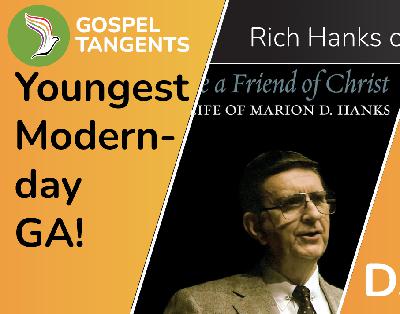
Marion Hanks was one of the youngest modern-day GA (general authorities.) At just age 31, he was called to be one of the 7 presidents in the First Council of 70! His son Richard Hanks has written a biography called “To Be a Friend of Christ.” We will learn more about Marion’s life without a father growing up. Check out our conversation…
https://youtu.be/SWCBWl0zS-w
Don’t miss our other conversations with Richard: https://gospeltangents.com/people/richard-hanks/
transcript to follow
Copyright © 2025
Gospel Tangents
All Rights Reserved
Except for book reviews, no content may be reproduced without written permission
transcript to follow
Copyright © 2025
Gospel Tangents
All Rights Reserved
Except for book reviews, no content may be reproduced without written permission

The Kingston Group, also known as the Davis County Cooperative Society, is one of the most reclusive Mormon Fundamentalist groups around. I was able to attend a funeral, which was open to the public. Here’s what I learned!
https://youtu.be/RoX9ldV4NU0
Don’t miss our other conversations on Mormon fundamentalism: https://gospeltangents.com/
transcript to follow
Copyright © 2025
Gospel Tangents
All Rights Reserved
Except for book reviews, no content may be reproduced without written permission
transcript to follow
Copyright © 2025
Gospel Tangents
All Rights Reserved
Except for book reviews, no content may be reproduced without written permission
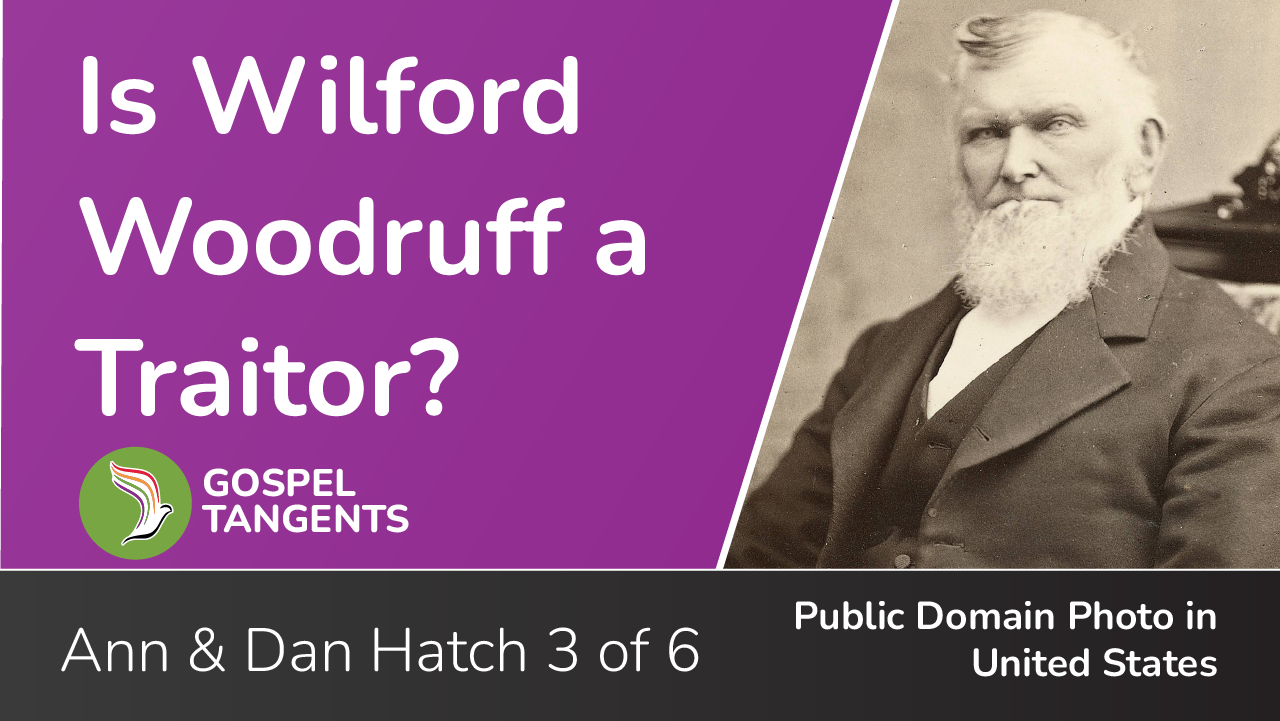
When Wilford Woodruff issued the Manifesto banning polygamy in the LDS Church, supporters of polygamy called him a traitor. Is that how Christ’s Church feels? Dan & Ann Hatch are the pres and matron of the Nevada Temple and share their opinions about Woodruff. Check out our conversation…
https://youtu.be/Eu_TuzaKI3A
Don’t miss our other conversations with Ann & Dan: https://gospeltangents.com/people/ann-hatch/
transcript to follow
Copyright © 2024
Gospel Tangents
All Rights Reserved
Except for book reviews, no content may be reproduced without written permission
transcript to follow
Copyright © 2024
Gospel Tangents
All Rights Reserved
Some people think the Exodus story is more myth than real. How does George Potter explain it? Check out our conversation…
https://youtu.be/ysWSrWN0WTQ
Don’t miss our other conversations with George: https://gospeltangents.com/people/george-potter/
transcript to follow
Copyright © 2024
Gospel Tangents
All Rights Reserved
Except for book reviews, no content may be reproduced without written permission
transcript to follow
Copyright © 2024
Gospel Tangents
All Rights Reserved
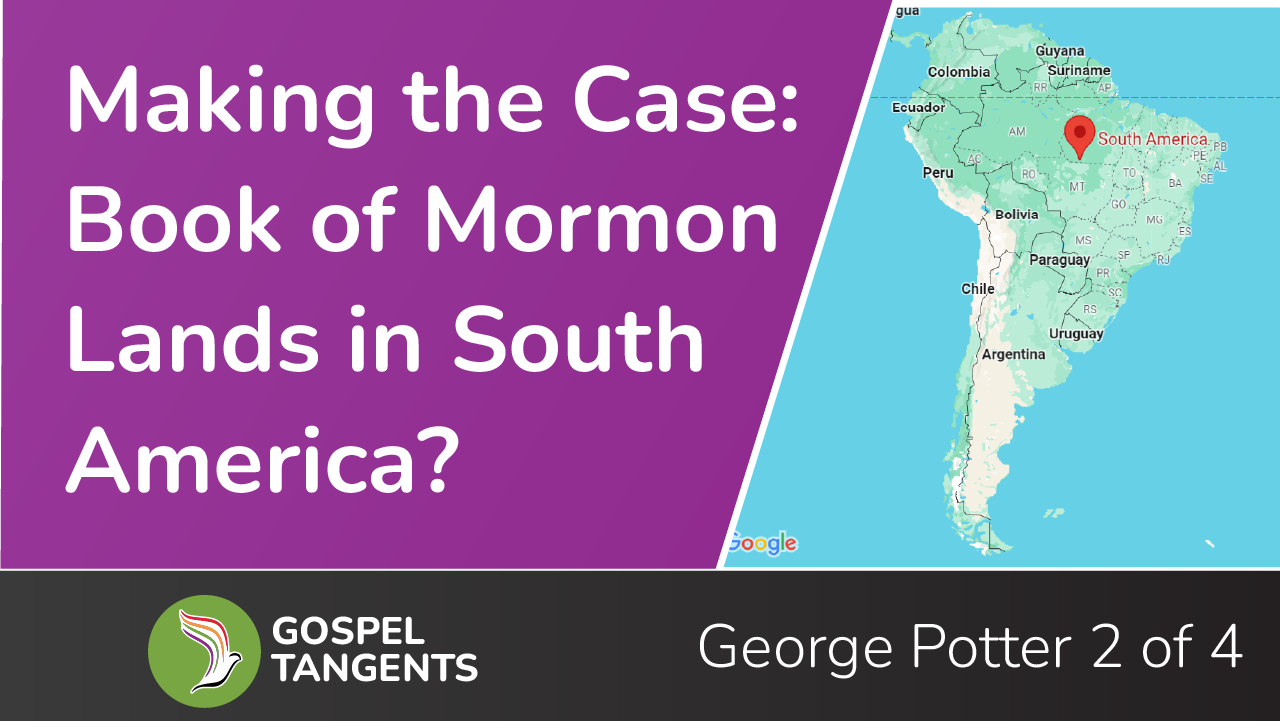
George Potter makes the case that Lehi landed in modern-day Chile in South America. We'll discuss his reasons for making the case, and anachronisms. Check out our conversation...
https://youtu.be/1E6V7l8Ovx0
Don't miss our other conversations with George: https://gospeltangents.com/people/george-potter
Copyright © 2023
Gospel Tangents
All Rights Reserved
Except for book reviews, no content may be reproduced without written permission
Charting Nephi’s Ocean Journey
GT 00:25 Okay, so you're going with what Joseph Smith taught. You're going with the 30 degrees south latitude. Is that Chile or is that Peru?
George 00:32 That's Chile.
GT 00:33 Chile?
George 00:33 Well, it's just part of ancient Peru.
GT 00:35 Okay.
George 00:36 I mean, I was with a person last night who works with Richard Hawk down in Khor Kofut, and he was down mountain climbing in Argentina and found Inca ruins as far down as, almost down to Patagonia in Argentina. So, ancient Peru took in a vast area. It was as large as the Roman Empire, all the way from Colombia down to Chile.
GT 01:00 Okay.
George 01:01 So, it's all Peru. But until the Smiths’ time, that was now a nation called Chile. It's indicated, it's purported that he taught that they landed 30 degrees south in Chile, that was supported by many of the apostles, the people who knew him at the time. That's what they taught. They didn't teach the Heartland model. They didn't teach the Mesoamerican model. That's what the early church leaders taught. That Joseph Smith had indicated.
GT 01:33 The early church leaders believe that South America was the land southward and North America was the land northward. It was more of a hemispheric model, right?
George 01:42 I don't know that.
GT 01:44 But that's the way I understand it.
George 01:46 Okay, I have not...
GT 01:47 Panama's the narrow neck of land.
George 01:49 Yeah, I don't know that that is what they taught.
GT 01:53 Let me ask you another question. Are you familiar with a book by Venice Priddis? The Book and the Map, I think it's called? [It's a ] blue book.
George 02:01 Unfortunately.
GT 02:02 You're unfortunately familiar with it?
George 02:04 Well, let’s put it this way. It's a pretty naive notion that South America just rose out of the ocean 2000 years ago, it's been there for millions of years.
GT 02:15 Okay, because it does look like, for those who aren't familiar with it. Basically, the Amazon River was an ocean, basically. And so it's nice because you've got a narrow neck of land. It makes it more of a land northward/land southward. Um, it's great. The problem is, like you said, that may have been true 2 million years ago, it wasn't true 2000 years ago.
George 02:40 Like 50 million years ago, maybe?
GT 02:41 Yeah.
George 02:42 Okay, let's just kind of get...
GT 02:45 So, you don't think South America was flooded?
George 02:47 For these, well, they call them internal models of the Book of Mormon. Now, it has to be a narrow neck of land, there has to be this or that, and that. That, to me is absolute nonsense. Because all those things are based on assumptions that people are making about the language in the Book of Mormon.
GT 03:06 Okay.
George 03:07 They went down to Zarahemla. What does that mean? They went up to the city of Nephi. Are they going up in altitude? Are they simply going north or south? You don't know. Because in Hebrew, the semitic languages, like in English, up means north. It could also mean they're going up in altitude, and they travel for a period of time. "Oh, it had to be exactly 19 days?" How do you know that? It's all based on people's assumptions as to if it fits. There are so few geographical clues in the Book of Mormon, you cannot make a map out of it. Or you could turn around, you could make up, using assumptions, 30 different maps and I've seen at least 30 maps of people,

I had a fun time attending the first Bickertonite baptism in Utah. On a frigid 30 degree day, I witnessed a baptism in the Jordan River. I'll share my thoughts on their church services. Check out our conversation...
https://youtu.be/0NRBxMvB1Qg
If you would like to know more about this Restoration Church, check out these other episodes: https://gospeltangents.com/denominations/bickertonites/
Copyright © 2023
Gospel Tangents
All Rights Reserved
Except for book reviews, no content may be reproduced without written permission
1st Bickertonite Baptism in Utah
GT 00:00 I've got a special for you today. About a week ago I attended a Bickertonite baptism. The official name of their church is The Church of Jesus Christ. They're based in Monongahela, Pennsylvania. And I found out they had their first Utah baptism. So it was fun. Steve Pynakker was out here in Utah, and we got to attend. And, you know, especially since I had David Boice on recently. I'm not going to take over his 52 Churches in 52 Weeks, but I thought it would be fun, just to do one church in this weekend and just tell you my experiences at attending a Church of Jesus Christ baptism here in Utah. The first thing that you'll notice was, it was very cold. I can't remember if it was 30 or 32 degrees. Apparently, the Bickertonites believe that, just like Jesus, you should be baptized in an open body of water, {chuckling} even if it's December. They joked about cutting holes in the ice to baptize somebody in the winter. Personally, if it was me, I would probably wait untill summer. {laughing} That's very cold. But the baptism occurred in the Jordan River. And so, I thought I would show you a clip here of the first baptism in Utah, for the Bickertonite Church. The Church of Jesus Christ, here in the Jordan River. And here we go.
[Video of Reid being baptized in Jordan River.]
01:38 Jacob Reid Betts, having authority given me of Jesus Christ, I baptize you in the name of the Father, and in the name of the Son, and in the name of the Holy Ghost, amen. (Congregation singing.)
GT 02:17 So, the guy who got baptized, his name is Reid Betts and I've got a picture of him here. I just can't believe [he got in cold water.] I'm not that brave. I'm not a polar bear at all. But yeah, it was really cool in the Jordan River. Obviously, that would have a little bit of significance because Jesus was baptized in the Jordan River. But of course, this is Jordan river in Utah--Jordan river of Israel are not exactly the same. But it was very, very cold. So we did that. I think Reid lives in the Murray area or something because after the baptism, we got in our cars and we rode to the one of the libraries there in Salt Lake City, in Murray and did the confirmation service. One of the things that I find interesting about the Church of Jesus Christ, the Bickertonite Church, is they have amazing music and I guess this is the second time I've attended. I didn't really talk about the first time, but I'll kind of share some thoughts there. The first time I attended was in Florida with Steve Pynakker, also. And I swear they have the best piano players, because their music-- I think I might even have a little clip here, I hope. (jazzy gospel music playing with the congregation singing)
GT 04:30 Anyway, that kind of gives you a little bit of taste of the music, and it's just really fun and really, really cool. And so we sang songs for a long time while Reid was getting warm and drying off. {chuckling} Then he showed up. If you've ever been to an LDS baptism or confirmation service, in a lot of ways it is very, very similar. They give the laying on of hands and we give to the Holy Ghost and that sort of thing. One of the interesting things about the Bickertonite service is the fact that in every service that I've attended, and so at this baptism, for example, after, I believe it was after the confirmation, they made an announcement.
Lynne Whitesides is a convert to the LDS Church and has a different perspective on things than a lifelong member. We'll talk about her perspective on the Sept Six. Check out our conversation...
https://youtu.be/oef3Zc0OLj4
Copyright © 2023
Gospel Tangents
All Rights Reserved
Except for book reviews, no content may be reproduced without written permission
Growing up Outside the Church
Interview
GT 00:25 So let's, go back and talk about you growing up. So, you grew up Italian Catholic or?
Lynne 00:30 No, actually, my grandmother's from Italy. My grandfather was from Germany. And my mom grew up with basically immigrants. My grandmother, I think, was either pregnant, or she was born here. But she spoke only Italian until she was in eighth grade. So I grew up with those people. They were my grandparents, I hung out with them. So. My grandmother made really just one, what's the word, concession to my grandfather. She became a Lutheran and let go of Catholicism. So, I was raised Lutheran, actually. And it's a long story, but my parents moved a lot when I was kid. I moved in 8th, 9th, 10th, 11th and 12th grade. And at some point, I didn't want to do that anymore. And I started investigating the Mormon Church. And I thought that there was something about it that felt stable, to me, I think, at 17. And they were totally against me becoming Mormon, completely, because they just thought it was the weirdest church. And so, I started investigating, and I've got to also say the missionaries were very cute, and I was 17. {Rick laughing} So I was in Florida, and then they moved back up to Pennsylvania. I went from Pennsylvania to Florida a bunch of times. So, they moved back to Pennsylvania, and that's where I became a Mormon. I was baptized in New Jersey. And then my parents went to my baptism, and two months later, they became Mormon.
GT 01:54 Oh, wow.
Lynne 01:55 And then all of my Italian family became Mormon.
GT 01:58 No way!
Lynne 01:58 Yeah, I don't know. There's like [about] 30 of them that [joined:] my aunts, my uncles, my cousins, my brother.
GT 02:03 Is that because of you?
Lynne 02:05 I wasn't. It was my parents [who] were going around doing it all. I was at BYU by this point.
GT 02:10 Okay.
Lynne 02:10 So everybody just became Mormon.
GT 02:14 Wow.
Lynne 02:15 Like, maybe 20, something like that, became Mormon. That changed everything, too. Because by this time I was at BYU. At BYU, I was becoming a little clearer, because the Church in Pennsylvania is very different.
GT 02:30 Very different.
Lynne 02:31 Yeah. And then I went to BYU.
GT 02:31 Okay. {chuckling}
Lynne 02:31 Than the Church in Provo, Utah. And I remember thinking, "Oh, man, this is--now all these people are joining. What am I going to do?" Like, this is not the way they said, they didn't-- when I joined, they didn't talk about racism. They didn't talk about misogyny. They didn't talk about--they didn't talk about much, really. They just like, "Come in. It's this lovely family thing." So, when you're 17, you're not investigating too much because the missionaries are cute. So that's how I got into the Church. So, I went to BYU.
GT 02:42 So you went to BYU. You were kind of a fish out of water at BYU?
Lynne 03:06 Totally a fish out of water.
GT 03:08 Okay.
Lynne 03:08 My second year at BYU, I got called in and they said, "We think another university might be better for you." I think it may have been because I was hitchhiking to church, and I was wearing--it just wasn't a match. It just wasn't a match. And I realized it wasn't. So that's what happened.
GT 03:25 You were hitchhiking. Don't you just go to your classes to go to church?
Lynne 03:29 No, actually, because the wards were all over the place back in '70's. I mean, they were all over Provo. But, anyway, the whole thing is they said [that] we think another university would...
It appears that the LDS Church brands the scarlet letter A for apostasy on the chest of those guilty of apostasy in order to make their teachings appear dangerous to orthodox members of the Church. Despite all that, Janice continues to attend church in Provo, Utah. But this scarlet letter has affected her children, and not in a good way. Check out our conversation....
https://youtu.be/oq5UJdNf-rk
Copyright © 2023
Gospel Tangents
All Rights Reserved
Except for book reviews, no content may be reproduced without written permission
Would Janice Come Back?
Interview
GT 00:37 Very good. I'm trying to think of who else in there. So Avraham, Maxine, both came back. Lavina applied and didn't [get accepted.] Have you ever applied to get back?
Janice 00:50 No, no, I won't.
GT 00:51 You won't? Why not?
Janice 00:55 Several reasons. One, I'll go through them. I can only think of three today. Sometimes I can think of—the most important one. First, in order to get back, again, I take the laws and regulations of the Church seriously. In order to get back, it's required to go back to the court that excommunicated you, and to look at what happened, and the applicant is required to repent of what they did. Now, repentance must be sincere. I don't believe I did anything wrong. Therefore, I cannot say I repent of what I did. So, I can't, in good conscience, apply for rebaptism, because that is the process. The second one is, through everything that happened in the process of my church discipline, it became very clear to me that the Church requires obedience to Church authorities. And they also require me to claim, to say, that I recognize the leaders of the Church as prophets, seers, and revelators. I do not recognize the leaders of the Church as prophets, seers and revelators.
GT 02:11 Oh, wow.
Janice 02:11 And I am not willing to submit to their authority. Therefore, although, I don't think the Church should require that, however, that's what they require. So, for that reason, I won't do it. The third reason is, it would be futile, since they rejected my dear friend, Lavina. Why would they accept me who has written many, many more things since then, which go farther, farther, farther from what I did at that time. So, it would be wrong and futile, and so I don't.
GT 02:50 So if your bishop came to you and said, "Janice, we want you back in Church." You'd say?
Janice 02:58 I'd say for these—it's interesting, because my bishop has never said that. One of the Relief Society presidents, who was a friend of mine, said to me, "You should reapply." I told her my reasons. She said she had talked to the bishop, and he said that he would be willing to go through the process. And I said, "No, it would not..." Again, it would not be fair to put people through this process, which I know is going to fail, and which I also know that I cannot maintain a willingness to have my speaking, writing, publishing, overseen by them.
GT 03:44 Well, because Maxine speaks at Sunstone now.
Janice 03:47 She does.
GT 03:48 So do you think that's still a condition?
Janice 03:51 Well, I don't think it was ever a condition. I don't know Maxine's history. Speaking at Sunstone, many Church members still do that.
GT 04:01 What I'm saying is, and I have to talk to her, so we'll get more of her story. But I would assume she probably had a similar prohibition: Don't speak.
Janice 04:14 No, as far as I know, and listening to Maxine, she was not active. She was not going to church at the time. She did not go to her court.
GT 04:26 Oh, when she was excommunicated?
Janice 04:28 Right. So I don't know what she was told. I mean, I don't know. And I doubt, again, I don't know for sure. I doubt if she made any contact with Church authorities for some time, for many years until she decided to...
GT 04:44 I know she became a priest in another gnostic religion or something.
Bill Russell is one of my favorite Community of Christ historians. He taught at Graceland University, and told Bruce Jenner to train hard for the 1600 meters in the Olympic Decathlon. We'll learn about RLDS history, and his unorthodox beliefs. Check out our conversation...
https://youtu.be/NGjRr_5-c8g
Copyright © 2022
Gospel Tangents
All Rights Reserved
Except for book reviews, no content may be reproduced without written permission.
Coaching Bruce Jenner at Graceland?
Introduction
I'm excited to have one of my favorite RLDS historians, Bill Russell from the Community of Christ. We're going to talk about some of his days at Graceland University and find out that he actually coached Bruce Jenner, the Olympic decathlete, now known as Caitlyn Jenner. So, that'll be a lot of fun. Check out our conversation….
Interview
GT 01:07 Welcome to Gospel Tangents. I'm so excited to have, can I call you one of the premier historians in the Community of Christ?
Bill 01:16 You might be lying, but, no. I think that would be okay.
GT 01:22 All right. Well, tell us who you are.
Bill 01:23 I'm Bill Russell and I have sort of specialized in Latter-day Saint history since about 1970.
GT 01:35 Okay, so tell us a little bit about your academic background. I understand you're a JD. You're a lawyer, I guess. But I know you taught at Graceland.
Bill 01:44 Yeah.
GT 01:45 Tell us about all your degrees, bachelor's, stuff like that.
Bill 01:48 I took a religion major at Graceland, undergraduate. Then I got my Master of Divinity. That's a three-year degree from the Methodist Seminary in Kansas City. I loved it. I mean, it's just some of the best professors I've ever had. Lindsey Farrago in New Testament, I've often thought of him as the best professor I've ever had.
GT 02:14 What was the name of that seminary?
Bill 02:16 St. Paul School of Theology, a Methodist Seminary in Kansas City, Missouri. I just loved it there. So, I graduated there. Then Graceland said, 'Well, we really need somebody to teach Bible and history of Christianity. And that's kind of your strength from seminary. Come on, up to Graceland and teach." So, I said, "Sure." I had always been kind of a goal of mine to eventually teach at Graceland, although early on I thought, I would love to teach something and coach at Graceland. But that now had long, left my objectives by this time. I did coach cross country three times during my career, three times each, for a total of nine years. But that's just because I had a record running cross country and had been pretty successful at it. So, they roped me and the first time that I coached cross country, this is off above the subject.
GT 03:23 We're all into tangents on Gospel Tangents. So that's okay.
Bill 03:25 So, the first time I coached cross country was I came to Graceland as a freshman. The coach and athletic director said, "Russell, I understand you were successful running cross country at Flint Northern High School in Michigan. I would like you to start the cross-country program at Graceland. So, I did, as a freshman. I went around the men's dormitories and got about five or--we got about six or seven guys.
GT 03:51 Because you need at least five.
Bill 03:53 At least five. Some meets I only had five, but I think I had a maximum of like a six or seven. I did that for three years and then my senior year, LD Weldon, the guy who later would coach Bruce Jenner, came my senior year. So I was able to back away from him. But the funny thing about it was LD Weldon was the third coach that I had--I had three coaches, but I only considered him the third best. My high school coach was better than any of them. He had been one of the top three hurdlers in the country. I learned, even though I was a distance runner, I learned how to hurdle from Norbert Badar, my coach. Yeah,
We’re continuing our conversation with David Rosenvall. He’s the guy who came up with who came up with the idea that the Book of Mormon lands may have occurred in the Baja Peninsula. We’ll also discuss some other issues with the Book of Mormon. Are there two Hill Cumorahs?
We don’t know where he goes but we do know how long it took him that he wandered. He again buries the plates in 420 A.D. We believe in the hill north of Manchester where Joseph Smith would eventually meet with him. That’s a period of about 36 years.
How would one get plates that one can carry, these few plates to that sort of distance? Well if you want to break it down per year it’s about the distance from Provo to Ogden every year that Moroni would have had to travel with these plates. We don’t know. We have one point that’s kind of interesting. Manti, Utah is a place that Brigham Young states that Moroni dedicated the temple site. If you go down there, there’s a statue of Moroni there, dedicating.
You can see if one started in Baja and had to get to New York in 36 years, one could easily take that path. Our theory isn’t so much about two Cumorahs, it’s about two hills: one in the text called the Hill Cumorah, and one where Joseph Smith got the plates called the hill north of Manchester. Now I kind of like that we as the saints call that hill in New York, Cumorah.
Had you heard about this statue of Moroni in Manti? What about steel swords?
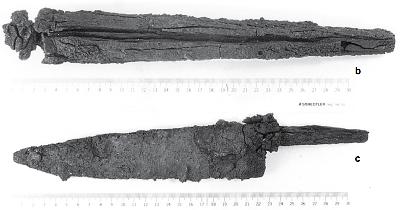
One of the things most interesting that we have learned since we started this: if you go down to the museums in Baja California, specifically the museum in La Paz, they’ll have a display of swords. Half of them are Spanish swords that they know are very beautiful. They have a certain design and they’re on display. It just so happens they have this other collection which is a completely different design, much older, very rusted that are swords, and knives, and all sorts of metal implements that they say they have gotten from some burial sites when they dig up. They’ve found them in of the ground.
So we have metal swords, just as described from the Baja Peninsula. What we are missing is a full archaeological excavation of more of that. So we’re finding it very exciting that (1) we’ve got areas where metal is still there today that you can take from outcroppings, (2) you’ve got smelting sites that are ancient. They all claim they are pre-Spanish. They’re smelting sites. Number (3), they do have evidence on the peninsula, so at this point, the Book of Mormon is holding together. Now the rest of North America, yeah you’ve got a problem with it, but not the Baja Peninsula. They’ve got metal implements.
Were you aware that metal swords have been found in Baja, or is David overstating his case? What do you think of this theory? (Check out part 1 and part 2.)
Don't forget there is less than a week left to sign up for a free book!
https://youtu.be/let3ElsNmA8

Rick B (host of Gospel Tangents and LDS Faith Journeys) interviews Josh Gehly, an Evangelist for The Church of Jesus Christ (historically known as the Bickertonites), during Josh’s visit to Salt Lake City. Josh reveals that The Church of Jesus Christ has a small but growing domestic presence, including a mission in Salt Lake City. The church reports significant international growth, particularly in Africa, while noting that the domestic church maintains a close-knit, “lowarchy” structure where leaders are servants rather than prophets. The conversation highlights significant theological divergences between the “Bickertonite” church and the mainstream LDS Church. Josh clarifies that his church is strictly anti-polygamy, viewing the practice as a sin, though they welcome members with varying historical views on whether Joseph Smith actually practiced it. They also reject the LDS concepts of eternal marriage, becoming gods (exaltation), and a Heavenly Mother, adhering instead to a more traditional view of the Godhead and the Bible/Book of Mormon. However, they are a “charismatic” faith, believing in and practicing spiritual gifts such as speaking in tongues, visions, and miracles. Throughout the Q&A with the live audience, we addressed sensitive topics including LGBTQ+ issues—which Josh’s church views as sinful—and the challenges of maintaining faith in a secular world. Despite these differences, the dialogue emphasizes mutual respect, the centrality of Jesus Christ, and the value of interfaith friendship.
https://youtu.be/Y-9jR1lEqYs
Don’t miss our other Tangent Trips! https://gospeltangents.com/denominations/bickertonites
Copyright © 2026
Gospel Tangents
All Rights Reserved
Growth and Identity
While the church maintains a modest domestic presence of about 3,000 members, it has seen substantial international growth, with current global numbers estimated well above 30,000. Recently, the church has established a small but active mission in Salt Lake City, holding meetings in locations ranging from hotel conference rooms to a local ninja gym. Josh clarified that although they revere the Book of Mormon, they do not identify as “Mormon,” preferring to be known strictly as The Church of Jesus Christ to emphasize their foundation in Christ rather than in any man.
A Strict Stance on Polygamy
One of the most significant distinctions between The Church of Jesus Christ and the LDS Church is their historic and unwavering opposition to polygamy. Josh explained that they view polygamy as a sin and have held this stance since the days of William Bickerton. Interestingly, the church remains a “refuge” for those with differing historical views; Josh noted that their “pews are open” to everyone, whether they believe Joseph Smith practiced polygamy or not, because their faith is contingent on Jesus Christ, not the actions of Joseph Smith.
Church Structure and Spiritual Gifts
The church’s organization consists of 12 living apostles and 70 evangelists, as well as elders, teachers, and deacons. Notably, they also ordain deaconesses, a role they support through New Testament precedents. A hallmark of their worship is a “radical belief in the ministry of the spirit,” which includes the active presence of spiritual gifts such as prophecy, dreams, and the gift of tongues. Josh shared that while these manifestations do not necessarily happen every Sunday, they are a vital, living part of their “charismatic” tradition.
Scripture: Inspired but Not Inerrant
Regarding scripture, the church utilizes the King James Version of the Bible and the Book of Mormon. Their view on these texts is that they are “inspired but not inerrant,” acknowledging that while the revelations are divine, they are recorded by “imperfect people” and may contain the “mistakes of men.” They do not utilize the Joseph Smith Translation of the Bible, preferring to stick to the King James Version for the sake of unity.
A Simple, Core Faith
Ultimately, the church prides itself on a “simple core truth” and a “lowarchy” leadership style focused on humble service rather than titles. Whether meeting in established buildings or temporary hotel spaces, their goal is to provide a spiritual home where the “pure living water” of the gospel is accessible to all.
Don’t miss our other Tangent Trips! https://gospeltangents.com/denominations/bickertonites
Copyright © 2026
Gospel Tangents
All Rights Reserved
Rick Bennett asks the hard questions about gender and race within independent fundamentalism. Do women bless the sick? The Erickson family—Joshua, Melissa, and Charlotte—discuss the reality of “patriarchal” polygamy, refuting the stereotype of oppressed, silent wives. Melissa Erickson opens up about her personal experience performing healing blessings by the laying on of hands. The group also tackles the controversial topic of Black priesthood holders in fundamentalism, their support for the inclusive “Missouri Temple” group, and Melissa’s unique scriptural interpretation of the “One Man” rule in D&C 132.
https://youtu.be/xfeTRIw8iw0
Don’t miss our other conversations on Mormon fundamentalism: https://gospeltangents.com/denominations/fundamentalim/
Here are 5 engaging titles and detailed show notes for Episode 1125, based on the provided transcript.
• Debunking the “Silent Wife” Stereotype
Melissa and Charlotte push back against the idea that plural wives are “brainwashed, stupid, or oppressed.” Instead, they describe their marriage as a single “unit” that shifts and adapts. For example, when Melissa is in midwifery training or Joshua is editing scriptures, the other spouses pick up the slack. They emphasize that plural marriage should be cooperative, not competitive.
• Women Bless the Sick
Rick asks if women can perform ordinances if the husband is incapacitated. Melissa reveals that she has blessed the sick by the laying on of hands, noting there is historical precedent for it. She distinguishes this from the sacrament; she views healing as an emergency act of faith, whereas the sacrament is administrative and can wait for a priesthood holder. Interestingly, they would be more comfortable receiving the sacrament from a married woman than a 12-year-old deacon.
• Race and the Priesthood
The Ericksons discuss their openness to Black polygamists, a stance that separates them from many other fundamentalist groups. They praise the independent temple in Missouri for allowing mixed-race individuals to enter, even though other groups claim this “desecrates” the temple. Joshua argues that while he believes priesthood is for Israelites, anyone can become an Israelite.
• Racism: Thoughts vs. Actions
The group discusses the nature of sin and racism. Melissa argues that how you act matters more than what you feel or think. She shares a story from a mainstream LDS ward where members gossiped about a South American sister making tamales with lard, using it as an example of cultural offense that bordered on racism. She concludes that “gossip is less kosher” than lard.
• Reinterpreting the “One Man” Rule (D&C 132)
Melissa provides a unique exegesis of D&C 132:7, which states the keys are conferred on “never but one on the earth at a time.” She interprets this not as a dictatorship where only one man holds authority, but as a procedural instruction that ordination happens one person at a time—similar to how Jacob blessed his sons individually rather than as a group.
——————————————————————————–
00:00 – The “Patriarchal” Stereotype Rick asks if the man does all the talking while women sit quietly. Melissa explains how their family operates as a fluid “unit” rather than a hierarchy.
04:00 – Co-Parenting and the “Cookie System” The benefits of three parents: the children can seek out the parent whose personality matches their current need, though they also try to game the system to get extra treats.
07:30 – Women Healing the Sick Melissa confirms she has administered to the sick by the laying on of hands. A discussion ensues on the difference between emergency blessings (faith) and the sacrament (authority).
12:00 – Centennial Park’s Yearly Sacrament Rick shares a story about the Centennial Park group instituting a yearly public sacrament meeting specifically for women who do not have a priesthood holder in their home.
16:00 – Black Polygamists & The Missouri Temple The Ericksons affirm they would welcome Black polygamists. They discuss the controversy surrounding the independent temple in Missouri allowing Black people to participate.
21:00 – The Tamale Incident: Acting Above Your Instincts A discussion on whether feeling racist is a sin. Melissa argues that maturity is treating neighbors with love regardless of internal biases, sharing a story about a ward dispute over tamales.
31:00 – The “One Man” Myth in D&C 132 Melissa reads the famous “one man” scripture and reinterprets it as a description of individual ordination (like Patriarchal blessings) rather than exclusive authority.
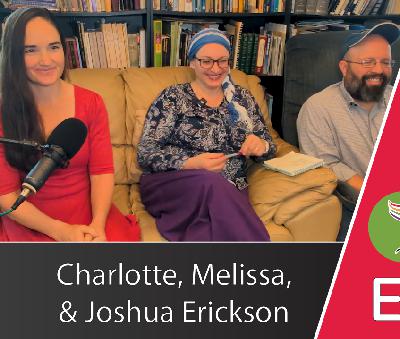
The largest group of Mormon polygamists don’t belong to a group! I’m talking to the Ericksons: Joshua, Charlotte, & Melissa who purchased the Sister Wives home from Kody Brown and his 4 wives from the TLC channel. We’ll talk about the resources independent Mormon fundamentalists can participate in, how they got their authority to do polygamy, and talk about priesthood in their family. Check out our conversation…
https://youtu.be/7itxEX5H8nk
Don’t miss our interviews with Mormon polygamists: https://gospeltangents.com/denominations/fundamentalim/
I sat down with the Erickson family—Joshua, Melissa, and Charlotte—independent Mormon fundamentalists who purchased the Lehi, Utah home formerly owned by Kody Brown of TLC’s Sister Wives. The Ericksons discuss their journey from mainstream LDS Church membership to independent polygamy, their blog Speaking of Polygamy, and their efforts to restore biblical feasts and practices.
00:00 – Welcome to the Sister Wives Brown Hotel:
The Ericksons, who now live in the home designed for polygamy discuss the unique architecture, which includes connected apartments that facilitate communal living.
08:00 – Excommunication & New Fellowship:
The family shares their transition out of the LDS Church. While they were excommunicated, they describe the experience as cordial and devoid of hard feelings. They soon found the Zarahemla Foundation, a non-denominational fellowship for restoration believers.
14:00 – Defining Independent Fundamentalism:
Joshua explains that fundamentalism isn’t just about polygamy; it is about preserving original restoration principles. They discuss the misconception that leaving the church means losing opportunities to serve, arguing they have found even more ways to be “anxiously engaged”.
18:00 – Restoring the Feasts:
We did a deep dive into why the Ericksons celebrate ancient Israelite holidays like Passover, the Feast of Tabernacles, and Yom Kippur. Joshua provides scriptural justification from Zechariah 14 and the JST of Luke 22, arguing these feasts are for all of Israel, not just the Jews.
26:00 – Wine Making & The Word of Wisdom:
The family discusses their wine-making classes. They adhere to D&C 89 and Section 27, believing wine should be “of your own make” for sacraments, rather than water.
32:00 – Mormon Legacy Ministries:
Introduction to a broad coalition of independent fundamentalists who provide a “soft landing” and fellowship for those questioning mainstream changes.
36:00 – The Temple in Missouri:
The Ericksons recount their participation in the independent temple built near Humansville, Missouri, describing the celestial room’s fiber-optic star field and the dedication they felt among independent groups.
How does a married man add another wife to his family? Is his wife involved in dating? What is courtship for polygamists like? Josh Thompson shares his experiences and cultural expectations.. Check out our conversation…
https://youtu.be/Q4wpdBUjheg
Don’t miss our other conversations on Mormon Fundamentalism! https://gospeltangents.com/denominations/aub
Copyright © 2024
Gospel Tangents
All Rights Reserved
Except for book reviews, no content may be reproduced without written permission.
transcript to follow
Copyright © 2024
Gospel Tangents
All Rights Reserved
Except for book reviews, no content may be reproduced without written permission.

Dr Jonathan Stapley takes us inside LDS temple ceremonies, including the Initiatory, Endowment, and Sealing ceremony changes over the years. Was the sealing ceremony more egalitarian under Joseph Smith than Brigham Young? Check out our conversation….
https://youtu.be/uOdluwXxYVQ
Don’t miss our other discussions with Jonathan. https://gospeltangents.com/people/jonathan_stapley
Copyright © 2026
Gospel Tangents
All Rights Reserved
Dr. Jonathan Stapley, author of Holiness to the Lord, explores the fascinating historical evolution of temple ordinances, clarifying the differences between early Kirtland practices, the introduction of Masonic elements in Nauvoo, and the shifting language of the sealing ceremony.
Myth of the “OG” Endowment
When asked about fundamentalist groups attempting to reconstruct an “original” eight-hour endowment complete with wrist-and-ankle-length garments, Stapley states bluntly that a static, “Platonic ideal” of the endowment never existed. Because the early liturgy was transmitted orally, the ceremony has continually adapted and changed from its very inception. It wasn’t until the Wilford Woodruff era in the St. George Temple that the endowment ceremony was finally written down. Stapley pushes back against the idea that changes to the wording prove apostasy, noting that Brigham Young continuously made changes to the ritual in Nauvoo, the Council House, the Endowment House, and finally the St. George temple.
LDS Temple Ceremonies: Kirtland vs. Nauvoo Ordinances
Stapley clarifies a common historical misconception: in the Kirtland era, the washing and anointing was a completely separate event from the “endowment”.
Washing and Anointing: This was an annual ritual limited strictly to male priesthood officers, purposely patterned after the biblical consecration of ancient Israelite priests.
The Kirtland Endowment: This was a solemn assembly where participants feasted on the Lord’s supper, washed each other’s feet, and experienced charismatic spiritual outpourings. It wasn’t until the Nauvoo era that these concepts merged and expanded to include all men and women. Furthermore, Stapley notes that there is no compelling historical data to support the idea that the modern temple liturgy is hidden within the text of the Book of Mormon as Don Bradley has suggested.
Masonic “Social Technology”
In 1842, Joseph Smith participated in a Masonic initiation, a fraternity ritual that used dramatic progression, hand clasps, and promises of secrecy to tell the mythical story of Hiram Abiff, the builder of Solomon’s temple. Stapley explains that Joseph Smith borrowed this Masonic “social technology”—the structural framework of the ritual—but used it to tell a completely different story. Instead of Masonic lore, Latter-day Saints used this interactive format, alongside biblical priestly clothing, to teach the plan of salvation, including the creation, the fall, and humanity’s return to the presence of God.
The Evolving Sealing Ceremony
The episode also reveals fascinating details about the first sealing ceremonies. The earliest known text is an 1842 polygamous sealing ceremony written by Joseph Smith for the Whitney family, which is currently available on the Joseph Smith Papers website. When historians compare this 1842 text to a Nauvoo Temple sealing ceremony published by Orson Pratt in 1852, they find substantive differences. According to Stapley, the 1842 ceremony under Joseph Smith was notably more egalitarian, while the later Nauvoo versions incorporated Brigham Young’s views on the subordination of women. (To be fair, Jonathan stated there is no such thing as egalitarian in the 19th century, just varying levels.)
Ultimately, Stapley reminds us that early Latter-day Saints simply did not value word-for-word repetition the way modern members do; even foundational prayers, like the sacrament and baptismal prayers, were often extemporized during Joseph Smith’s lifetime.
Don’t miss our other discussions with Jonathan. https://gospeltangents.com/people/jonathan_stapley
Copyright © 2026
Gospel Tangents
All Rights Reserved
0:00 Sealing More Egalitarian?
13:33 Evolution of Endowment Ceremony
24:48 Temples Used to Be Public
35:27 24 Temples
LDS-Temple Lot Differences: Unique Priesthood Structure
We’re going to discuss LDS-Temple Lot differences. Unlike the LDS Church, the Church of Christ (Temple Lot) does not divide its priesthood into Aaronic and Melchizedek branches. Furthermore, they do not have the office of High Priest, believing that Jesus Christ was and remains the last High Priest.
https://youtu.be/WvM-kU-YDsI
Don’t miss our other discussions about Hedrickites. https://gospeltangents.com/denominations/hedrickites
Copyright © 2025
Gospel Tangents
All Rights Reserved
Their active priesthood offices consist of:
Elders: The spiritual heads of the church who have the authority to perform administrations, lay on hands, and perform baby blessings. The Twelve Apostles are also chosen from among the Elders.
Priests: Authorized to baptize and serve the sacrament.
Teachers: Authorized to preach and assist the Elders.
(Note: While the office of Deacon exists on record, there have been no active Deacons in the church for a long time).
Another major difference is how men receive the priesthood. Priesthood callings are not treated as a coming-of-age milestone for young men; instead, every ordination requires a divine calling, spiritual witnesses, and the individual’s formal acceptance. Because not every father holds the office of Elder, baby blessings in the Church of Christ are typically performed by the older, ordained Elders of the congregation rather than the child’s father.
Local Autonomy and Global Reach
The Church of Christ is highly autonomous at the local level. As long as a local congregation has at least six members and one Elder, they are officially recognized and can elect their own pastor annually. These pastors have the freedom to set their own meeting schedules, which typically include Sunday worship and Wednesday evening prayer, testimony, or singing services.
While historically rooted in Independence, Missouri, the church has experienced surprising global growth since the late 1990s, expanding into the Philippines, East Africa, Mexico, and even establishing contacts in places like Argentina and Dubai. Though Malone estimates the total church population is relatively small, they utilize a secure online system so that isolated global members can vote during the church’s annual General Conference, held around April 6th every year.
Miracles and Spiritual Gifts
Malone shared powerful testimonies regarding the church’s reliance on divine intervention, particularly when calling leaders. Apostles can only be ordained during General Conference following a vote of acceptance by the people. Malone recounted a miraculous event where thirteen men were identified for the quorum of apostles through overwhelming spiritual witnesses. Tragically, one of the called men suffered a fatal heart attack shortly after. Soon after, another apostle in Mexico had a prophetic dream of a golden rope, which clarified the exact regional assignments and confirmed the final twelve men meant to serve.
Malone also shared a rare but electrifying firsthand experience of the spiritual gift of speaking in tongues. As a teenager in Phoenix, he witnessed an apostle named Don Hausenik speak in an unknown tongue and then provide the interpretation, an event that filled the room with a palpable, physical spiritual power.
Views on LDS Temple Ordinances
When asked about differences in worship, Malone frankly noted his confusion over LDS temple practices. The Church of Christ firmly rejects secret ordinances such as baptisms for the dead and eternal sealings, arguing that these practices are not found in the Book of Mormon. They believe all church functions should be public and see no need for a temple that operates in secrecy.
Don’t miss our other conversations on Hedrickites: https://gospeltangents.com/denominations/Hedrickites/
Copyright © 2026
Gospel Tangents
All Rights Reserved

Is White & Delightsome racist scripture in the Book of Mormon. Brant Gardner will tackle that in out next conversation. He’s the author of 2 books, “Plates of Mormon” & “Engraven Upon Plates, Written Upon Paper.” He’ll also discuss KJV English (or is it Tyndale English?) & horses in the Book of Mormon. Check out our conversation…
https://youtu.be/4v-mi7HYS7w
Don’t miss our other conversations with Brant Gardner! https://gospeltangents.com/people/brant-gardner
Copyright © 2024
Gospel Tangents
All Rights Reserved
Except for book reviews, no content may be reproduced without written permission.
transcript to follow
Copyright © 2024
Gospel Tangents
All Rights Reserved
Except for book reviews, no content may be reproduced without written permission.
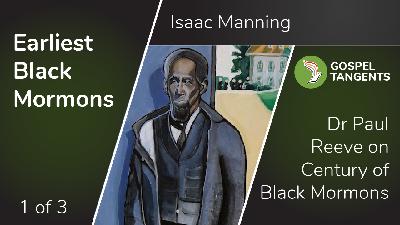
I'm happy to have Dr Paul Reeve back on the show! We'll talk about the earliest black Mormons who did and did not hold the priesthood. Paul has a new book published by Deseret Book titled "Let's Talk About Race and Priesthood." He will introduce the book and discuss his amazing website called "Century of Black Mormons." It will include not only famous ones like Elijah Abel, but others you haven't heard of like his son Moroni Abel. Check out our conversation...
https://youtu.be/jWGxwREuH3g
Copyright © 2023
Gospel Tangents
All Rights Reserved
Except for book reviews, no content may be reproduced without written permission
Earliest Black Mormons
GT 00:36 Welcome to Gospel Tangents. I'm excited to have one of my favorite historians. It's been a long time since he's been on the show. Some of you new listeners may not have even known that Paul was my second interview ever. Paul, could you go ahead and tell us who you are and where we are?
Paul 00:52 I'm Paul Reeve and I'm a Simmons Chair of Mormon studies in the history department at the University of Utah.
GT 01:00 Perfect. I remember the last time I talked to you, you had just received a promotion. And this is not the same office that we were in last time.
Paul 01:12 That's right.
GT 01:13 I think you've received a couple of promotions since then. Last time you were a full professor. What's happened in the last seven years?
Paul 01:20 So I am now chair of the History Department at the University of Utah. It's a three-year appointment. I'm in the first of three years as chair at the department.
GT 01:32 And that's your favorite job?
Paul 01:35 Well, I'd probably rather be in the classroom.
GT 01:40 You know, it's funny because Margaret Toscano, she's been on a couple of times, and she was department chair. And she was like, "I can't wait until I'm done with this."
Paul 01:48 Yes.
GT 01:49 What's the big deal about department chair? Why is it such a terrible job?
Paul 01:54 {Chuckles} Well, hopefully no one from my department listens to this. It's a lot of bureaucratic work that just isn't my favorite thing.
GT 02:05 Okay. I can see that. So, you're just much more of a researcher.
Paul 02:10 Yeah, I'd rather be in the classroom and researching and writing.
GT 02:15 Well, very good. Okay. Well, you've got a new book. Now, why don't you go ahead and show it to the audience? It's a big book, you can see.
Paul 02:24 (Chuckling) It's very small.
GT 02:25 What's it called?
Paul 02:26 Let's Talk About Race and Priesthood. It's a part of Deseret Book's, "Let's talk About" series. Darius Gray wrote the foreword and I'm really honored to have his story at the beginning of the book. He's a remarkable Latter-day Saint and I'm really honored that he was willing to participate and write the foreword.
GT 02:57 Yeah, Darius is a great guy. I actually talked to him when I saw you last week at Writ & Vision. So, he's going to be on the show. But for those people who don't know who he is, could you just give a short blurb about Darius?
Paul 03:11 Yeah, Darius joined the Church of Jesus Christ of Latter-day Saints before the 1978 revelation and has been just an important black Latter-day Saint ever since. He was a part of the original Genesis group leadership and became president of Genesis, which is a support group for black Latter-day Saints officially organized by the Church. He was a counselor from 1971 to 1997. So, think about the tenure that he spent there. And then he became president of Genesis from 1997 to 2003.
GT 03:55 You know, they used to have 20-year callings. We didn't think those still were around, but apparently, they are.
Paul 04:00 In Darius' case, they were, yes. And he really became the face of Genesis and really made it what it is today. I think he's lived through being a black Latter-day Saint and all of the changes that the 1978 Revelation brought abo...

Tom Bennett invited me to visit Centennial Park, Arizona, a group that practices polygamy. It’s just south of the Utah border and about 50 minutes southeast of St George, Utah. Come along as we visit the community and I share my impressions of my church visit. Check out our conversation…
https://youtu.be/o8z5wSg8olQ
Don’t miss our other episodes on Mormon fundamentalism! https://gospeltangents.com/denominations/fundamentalism/
Copyright © 2025
Gospel Tangents
All Rights Reserved
Except for book reviews, no content may be reproduced without written permission.
transcript to follow
Copyright © 2025
Gospel Tangents
All Rights Reserved
Except for book reviews, no content may be reproduced without written permission.
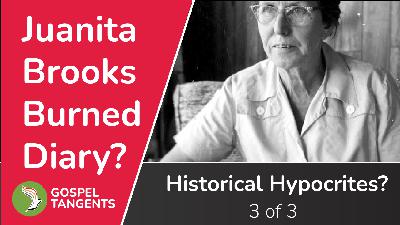
Where are the lost diaries of 2 of Modern Mormonism’s most famous authors: Juanita Brooks & Michael Quinn? Joe Geisner tells us. Joe also gives a sneak peek to Writing Mormon History Volume 2. Check out our conversation…
https://youtu.be/WoF9w0gZUpo
Don’t miss our other conversations with Joe! https://gospeltangents.com/people/joe-geisner/
You can get a printed transcript or Kindle version too.
Copyright © 2024
Gospel Tangents
All Rights Reserved
Except for book reviews, no content may be reproduced without written permission.
Juanita Brooks
Joe 00:43 These last two are the two great Mormon historians. We’ve talked quite a bit about them throughout this paper. We’ve talked about them as being amazing. Everything about them [is amazing.] I never got to know Juanita Brooks. By the time I became interested in the new Mormon history, she was in a rest home and had severe dementia. She died shortly after. Mike Quinn, I had a friendship with him from 1981 until he died. This is the two great Mormon historians from there. Now this first is from Lindsay Hansen Park’s forthcoming volume that’s going to be published by the University of Utah Press. Lindsay writes beautifully, as you’ll see from this.
Joe 01:53 I’m quoting Lindsay’s book, but she has intermittent quotes from Juanita Brooks. “Few writings of this time exist…” This is Juanita Brooks’s early life. “…because she desperately tried to conceal her pain. Emblematic of a new marriage, Juanita began this chapter of her life with a new journal to record her thoughts in. On June 27, 1933, she opened the first entry with tepid despair. ‘I don’t know whether I dare begin another diary or not.’ She explained that she had earlier kept a diary for two years, writing only the things that mattered to her, to conceal nothing and to be honest with herself. She wanted it to be a record of her inner life, but shame got the best of her. ‘After I had nearly 200 pages, I became panicky lest someone should get it and read it,’ she later confessed, ‘because it was most intimate, the only recourse was to burn it to ashes. There wasn’t a soul in the world.’ she justified, ‘to whom I would have shown it. Now I began one equally as futile,’ And yet she lamented that she still had to write ‘as I have no other safety valve.’ As a Mormon and emerging researcher, Juanita understood how her religious community encouraged everyone to be a record keeping people. Her propriety, however, demanded something else. Juanita felt a deep nakedness about revealing her emotions to anyone but herself. Her honest thoughts weren’t fully integrated with her outer life. Her path increasingly placed her in position to probe more authentic, honest, and raw history, and yet her heart and experiences sought exceptions for her own life. Destroying the diary erased the historical record of her true feelings. What remained was the scattered elegy of a woman struggling in her new role as wife and mother in a blended family.”
Joe 04:03 One other thing…
GT 04:06 Well, let me ask really quick.
Joe 04:09 Yeah. Let that sink in. Right?
GT 04:10 But as historians, we love it when we can get journals. But are we hypocrites because we don’t want anybody to see our own?
Joe 04:18 Yeah. Gary always asked me. He said, “Joe, are you going to let your journals?” I said, “I’m going to be dead. I don’t care.” Seriously, I’m going to be dead. So, I mean, I’m not a really good journal keeper. I only write down what I want to write, which is usually conversations like with Eldred Smith or something. I’ll write that kind of stuff down. Mike Quinn, a lot of times I’d write down our conversations. But beyond that, I’m not a great [writer.] I don’t write my personal stuff. Maybe because I’ve done enough research, my mission letters, I wouldn’t even read them.
GT 05:01 I’m the same way.
Joe 05:02 You can ask my wife. You can ask my wife. I refuse. There are love letters between the two of us, because we actually knew one another before my mission.
GT 05:12 Oh.
Joe 05:13 I will not read them. I’m so embarrassed about what I wrote that I will not look at them. She goes, “These are letters I cherish.” It’s like, I don’t. I do not want to look at them.
GT 05:30 See, and I’m going to tell you this. I interviewed Richard and Claudia Bushman. Claudia said to me, “Rick, are you keeping a journal?” I was like, “I’m not, Claudia. I’m sorry.”
Joe 05:42 Yeah, you are. {Joe points to the camera.} You’re keeping one on [Youtube.]
GT 05:44 Yeah, but, I always try to keep my personal feelings out of it.
Joe 05:47 I know.
GT 05:48 So, there’s nothing to burn, first of all. But secondly, when I did keep a journal, like on my mission, or even when I was a teenager. Actually, I will say this. I think it was about the fifth grade. We’re supposed scared to keep a journal. This is how my journal was. “Today was Sunday. I went to church. Cowboys, 28 Steelers, 6. Or, Dodgers 7 Yankees 4, or whatever.” It was just scores.
Joe 06:23 Those are actually way better than mine, because mine are, ”I went tracting today, not happy.”
GT 06:32 On my mission. I wrote when things were really bad, and they’re going to think this guy is just depressed.
Joe 06:37 That’s what mine is. When you read mine, mine sound like I’m manic, depressed.
GT 06:43 Well, exactly. That’s why I don’t want to read them. But every time I wrote, it was when I was upset. When things were good, I didn’t write. And so they’re going to get a really skewed opinion of me, especially if they just read [my journals.] I will say this. Well, I was just telling somebody at Sunstone. I don’t even remember her name, but she goes, there’s this little thing. You just write, like, three sentences every day.
Joe 07:07 Right.
GT 07:08 I was like, oh, maybe I can do that. But my dad passed away in 2018. He had written, by the time he was younger than me, than my current age, he had written two life histories.
Joe 07:22 Wow.
GT 07:23 And it was great.
Joe 07:24 Wow.
GT 07:25 It was really helpful for the funeral. It did inspire me to write a life history, but the problem is, I wrote too much, and I only got up to my mission, and then I’ve gotten busy.
Joe 07:36 And then you just stopped. Right, right.
GT 07:39 [The mission] was all the depressing. {chuckles} Although I tried to be a little bit reflective.
Joe 07:45 Well, I write. Actually, both the forthcoming volume of Writing Mormon History [Volume 2] and this one [Volume 1]…
GT 07:54 We need to talk about this book too {holding up volume 1}, and it’s already been what? I’m trying to look here. [We’ve talked] two and a half hours.
Joe 07:59 Well, people are bored out of their mind, I’m sure. But I do write some personal stuff. My first meeting with Leonard Arrington, I write about that and stuff.
GT 08:12 We do write a couple of interesting things.
Joe 08:14 I try. So there’s at least something there. But missionary journals…
GT 08:22 They are hard. It’s a hard time of your life.
Joe 08:24 They’re not very interesting most of the time. I’ve read a lot of them. Though the Hawaiian Mission journals are little bit different story.
GT 08:36 You’re talking about Joseph F. Smith.
Joe 08:37 Well, all of them: Francis Hammond, all those guys, they actually kept their [journals.] George Q Cannon’s Hawaiian journal, and we’re getting off topic again. But the George Q. Cannon Hawaiian journals are so fun because what the missionaries would do in their conferences that the missionaries had, they would get together. They had journal parties, and they would share journals. What the fun part is on that is George Q. Cannon journals are redacted in certain things. There’s a whole excommunication of the most important Hawaiian in the Hawaiian Mission, because he’s out going through Lahaina. He’s hitting every whore house and bar…
GT 09:25 Oh no.
Joe 09:26 …in the process. Then he confesses, and they have to excommunicate him. So, there’s this whole write up that’s all redacted from the George Q Cannon journals. You go to the other Hawaii missionary journals, the entire details [are there] because they were copying each other’s mission journal, and so you have the exact account word for word that George Q. Cannon would have had redacted. it is in the other missionary journals.
GT 09:54 Oh, wow.
Joe 09:55 It’s fun. That’s what makes Mormon history fun. Because when the Church is trying to cover something up, it’s like putting fingers in the holes in the boat. Because that boat’s going down. They’ve got all these people at the Church History Library trying to plug those holes. The problem is, there’s a leak over there that nobody can reach. It’s still leaking information. My friends at the Church History Library are not going to be very happy about me, but anyway. Yeah, that’s what they did. So yeah. Pretty much everything that they redact in George Q. Cannon’s journals, the Hawaiian journals, you can find other journals, almost everything.
GT 10:45 Oh, wow. Because wasn’t your presentation To Redact or Not to Redact?
Joe 10:49 Yeah. That is the question.
GT 10:50 I remember!
Joe 10:51 That is the question!
GT 10:52 That was a good question.
Joe 10:53 I was playing around with Shakespeare. I can’t remember. Somebody said to me, that’s a really dumb title. I told Lindsay Hansen Park. She goes, I love the title. Leave it.
GT 11:08 It was good. I liked it. I was there.
Michael Quinn
Joe 11:11 Well, the other great Mormon historian, D. Michael Quinn; this comes from the published Memoirs Signature Books just did. You can read this in that. I’m pretty sure it’s all in there. I added some of Mike’s diaries to different things.
GT 11:38 This is Michael Quinn you’re talking about.
Joe 11:40 Mike Quinn, sorry, yeah. But this is from, I’m pretty sure, and I really highly recommend people get that memoir of that Signature just published. It’s a wonderful book.
GT 11:53 I have a chance to re

Comments

Download from Google Play

Download from App Store
 United States