


 Claim Ownership
Aca-Media
Subscribed: 58Played: 408
Subscribe

© 759126
Description
Aca-Media is a monthly podcast sponsored by the Society for Cinema and Media Studies that presents an academic perspective on media. Hosts Christine Becker and Michael Kackman explore current scholarship, issues in the media industries, questions in pedagogy, professional development, and events in the world of media studies. Questions and comments can be sent to info@aca-media.org.
108 Episodes
Reverse

Our special series “Talking Television in a Time of Crisis” continues with episode 13: Publics. What new viewing publics have been created over the past year? How have such TV publics both connected and disconnected us, particularly in these times of media bubbles, and with what effects?Hear the conversation with:Hannah Hamad [Cardiff University]Charlotte Howell [Boston University]Rahul Muhkerjee [University of Pennsylvania]Swapnil Rai [University of Michigan]Mel Stanfill [University of Central Florida]
Our special series “Talking Television in a Time of Crisis” continues with Ep. 12: Aesthetics. Questions include: How is television transforming aesthetically, and what new developments in TV form and style have emerged in this time of crisis? How have new forms of television changed our relationship to the TV image?Featuring:Josie Torres Barth [North Carolina State University]Elana Levine [University of Wisconsin, Milwaukee]Yael Levy [Northwestern University]Jason Mittell [Middlebury College]Isabel Pinedo [Hunter College/CUNY]Nick Salvato [Cornell University]

Episode 11 of our special series “Talking Television in a Time of Crisis” is here: Optics. How does television seek to manage social and political crises around the world? How does television manage its own internal crises (of representation and of legitimation) in such a precarious cultural moment and climate of unrest?This conversation is hosted by Mimi White (Northwestern University) and features Eva Hageman (University of Maryland College Park), Darnell Hunt (UCLA), Melissa Phruksachart (University of Michigan), and Brenda Weber (Indiana University).This episode is dedicated to the late Jane Feuer
Episode 10 of our special series “Talking Television in a Time of Crisis” is here: Economics. How has the business of television, from streaming to legacy media, changed in 2020? How can we rethink notions of value in the industry that might contest capitalist modes of production and consumption? Hosting is Miranda Banks (Loyola Marymount University), and our guest scholars for this episode are Sarah Banet-Weiser (London School of Economics), Melanie Kohnen (Lewis and Clark College), Al Martin (University of Iowa), and Alisa Perren (University of Texas, Austin).

Our special series “Talking Television” is back for a second season, now as “Talking Television in a Time of Crisis”! In this second episode, we discuss tactics: How can we best analyze and address the power of television, particularly in times of crisis and controversy? How might we define a televisual activism—or is that a contradiction in terms?Guest Scholars: Jonathan Gray (University of Wisconsin—Madison); Daniel Marcus (Goucher College); Quinn Miller (University of Oregon); Eve Ng (Ohio University); Samantha Sheppard (Cornell University)
Our special series “Talking Television in a Pandemic” is back for a second season! In this episode we discuss how television manages, amplifies, and contains our collective anxieties about the election and about other political issues, and we ask: How can we best use television to promote democratic aims? Guest Scholars: Matt Delmont [Dartmouth College], Sarah Kessler [University of Southern California], Kayti Lausch [University of Michigan], Roopali Mukherjee [Queens College], Susan Ohmer [University of Notre Dame]

In this episode, we discuss television and epistemology in a global pandemic: How do we know TV and how do we know through TV? What are the implications of people tuning in more and more to TV to attempt to gain knowledge (and cope with that knowledge) of the pandemic? What sorts of knowledges (or ignorances) might emerge, in various ways, from various genres on TV—not only news/documentary/public affairs but drama, comedy, fantasy, reality programming, etc.? What are the power effects of TV's production of knowledge and ignorance? How can we attempt to know television without just reproducing its own strategies, power dynamics, and blindspots?Guest scholars: Herman Gray, Amelie Hastie, Taylor Cole Miller, Laurie Ouellette. Host: Lynne Joyrich.For more on the participants, see http://www.aca-media.org/pandemic-tv

Lift yourself out of the dregs of summer and everything else with this chat Mike Miley, author of the new book David Lynch's American Dreamscape. Miley shares his first encounter with Lynch’s Dune – as a 5-year-old! -- and his insights into the intertextuality of Lynch’s work, particularly Inland Empire. He also talks about being a high school teacher publishing academic books. Chris and Michael wrap up with brief reflections on the impact of AI on academia and an upcoming symposium on critical media literacy that we’ll feature in the next episode.

We have a special treat for listeners in this episode as DePauw University’s Jordan Sjol sits down with acclaimed playwright, screenwriter, and TV writer José Rivera for a conversation about his journey from playwriting to Hollywood, writing across different media, adapting literary classics, and balancing artistic integrity with commercial demands.

Chris chats with Swapnil Rai about her book on how Bollywood stars transformed Hindi cinema into a global phenomenon, as well as how she uses podcasting activities in her classroom. And if you’ve got ideas for how students can study media by making media, you’re invited to submit a proposal for a symposium at Notre Dame on that very topic.

Aca-Media producer David Lipson was in Paris for the 2024 Olympics/Paralympics, so we sent him out into the field. He captured some sounds of the city and the people flocking to arenas and also turned modern journalism’s most essential tool – a smartphone – toward journalists themselves, uncovering the challenges, and a few joys, that unite media professionals across the globe today.

Stephanie Brown delves into the dangerous world of women laughing in this conversation with Maggie Hennefeld about her new book Death By Laughter: Female Hysteria and Early Cinema.
Covering everything from 19th-century obituaries blaming giggle fits (rather than girdle fits) for women’s deaths to the modern-day political power of a vice presidential cackle, we’re certain this episode will entertain you … just short of killing you.

We’ve reached that late post-spring time of year, as Michael judiciously puts it, and if you’re lucky and industrious enough to have finished writing something over summer and you’d like to get published, we’ve got just the roundtable for you! One side of the table features experienced editors and the other side has young scholars with questions, so the end result is an engaging and enlightening discussion about how academic publishing works these days.
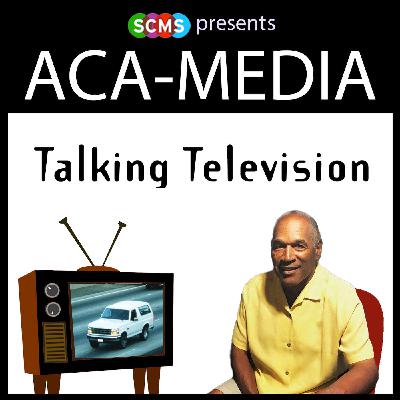
O.J. Simpson died on April 10, 2024. Along—and intertwined—with the impact that he had on formations of "law and order," celebrity and scandal, race and gender, class and nation, Simpson had an enormous impact on U.S. television. This episode of "Talking Television" considers that impact, as TV scholars Hunter Hargraves, Lynne Joyrich, Brandy Monk-Payton, and Samantha Sheppard talk about the televisual construct of "O.J. Simpson" and about media and culture in the wake of "OJ TV."

In this episode of Aca-Media, David Lipson talks with Shawn Glinis and Arlin Golden, the creators of Wiseman Podcast, which is devoted entirely to discussing the films of--you guessed it—Frederick Wiseman. Shawn and Arlin explain how the podcast is produced and why they feel Wiseman should be mentioned in the same breath as Kubrick, Coppola, and Scorsese. Also, Chris and Michael banter about an exciting result of a past episode.

Bust out your fancy headphones for this episode, folks. In one our best episodes ever from an audiophilic perspective, Jonathan Nichols-Pethick talks with Jacob Smith about his recent experimental audiobooks, ESC: Sonic Adventure in the Anthropocene and Lightning Birds: An Aeroecology of the Airwaves, both of which are available as open access files on the University of Michigan Press website. Then Chris and Michael chat about the gratification of SCMS volunteering, wish you a happy eclipse, and tout the glories of NCAA women’s basketball tournament.

Recorded live on the scene! (so please forgive any less-than-ideal audio quality) Convening at the 2024 SCMS conference in Boston and gathering “after dark” on the conference eve (i.e. after the opening reception and its free bar, which might have made us all a little giddy), Chris and Michael chat with longtime Conference Manager Leslie LeMond and new president Vicky Johnson about what goes into choosing a conference city and what the future may hold, as well as some of the unique challenges the organizing team faced this year (yes, they talked about the awards situation). We then welcome Aniko (Madison friends, update your pronunciation) Bodroghkozy, who tells us about the new Television and Radio History Scholarly Interest Group. And we end with a few suggestions from Michael for sites to see, things to eat, and horrific animal scenes you may encounter while in Boston.

Stephanie Brown chats with Justin Rawlins about his new book on method acting (Imagining the Method: Reception, Identity, and American Screen Performance) and the discourse the method has generated over the years. Meanwhile, Michael tries to channel his inner authentic podcaster and nearly goes full-Leto.

A conversation between Jonathan Nichols-Pethick and Jordan Sjol about Sjol’s JCMS article, “A Diachronic, Scale-Flexible, Relational, Perspectival Operation: In Defense of (Always-Reforming) Medium Specificity” and the recent feature film that Sjol co-wrote, How to Blow Up a Pipeline.

We continue on with our coverage of media industry labor, as Stephanie Brown talks with Andrea Ruehlicke about reality TV contestants fighting for fair rights and against exploitative conditions. Then Chris and Michael banter about a drag show and a symposium on drag performance bans held at Notre Dame last month.


Download from Google Play

Download from App Store
 United States
Right wing comedy. 🧐😆🤪🤔