


 Claim Ownership
Financial Coaches Network - The Podcast: Build your Financial Coaching Business
Subscribed: 16Played: 368
Subscribe

Description
Looking to build a successful financial coaching business? Join thousands of others in the Financial Coaches Community who are building successful financial coaching businesses. Hosted by Joshua Escalante-Troesh (CFP®, MBA), Garrett Philbin (AFC®, CMC®), Amelie Riendl (AFC®, PMP®), and Emily Blain (AFC®), each episode they take a deep dive into strategies, tools, and best practices for getting clients, working with clients, and running the back-end of your business.
205 Episodes
Reverse

This episode with Josh and Amelie explores the difference between guilt and shame around money, why so many people internalize financial mistakes, and how those emotions can either motivate change or shut it down. The hosts break down how societal pressure, financial pundits, and even well‑meaning professionals can unintentionally fuel shame — and what it takes to separate your identity from your financial actions. They close with practical steps for rebuilding a healthier relationship with money through small, consistent decisions.
Top takeaways:
Guilt is about actions (“I made a mistake”), while shame attacks identity (“I am a bad person” or “I don’t have self control”).
Shame often comes from external sources — society, family, financial pundits — while guilt tends to come from within.
Tone and language matter: even well‑meaning financial professionals can unintentionally trigger shame.
Common guilt triggers include debt, retirement savings, renting vs. owning, parenting pressures, and social comparison.
Social media amplifies unrealistic comparisons, making people feel uniquely flawed even when their struggles are common.
The first step in healing is separating you from your financial actions — you are not your mistakes.
Professional psychological support can help untangle shame and build healthier thinking patterns.
Change starts with identifying specific actions, not broad failures (“What exactly led to this?”).
Not all “bad” financial outcomes mean the decision was wrong — context and long‑term impact matter.
Small, repeated good decisions compound over time; you don’t need perfection, just a better ratio of good to bad choices.

Amelie discusses FINRA Foundation Military Spouse Fellowship Program, a path to AFC Certification for mil spouses! She is joined by Valerie Richards from AFCPE® and Cherie Stueve, a frequent FINRA Fellowship Instructor to discuss the process!
Top takeaways:
The FINRA Fellowship process is a great networking and community building opportunity.
The AFCPE Symposium is a huge networking and community building conference for everyone!!
It’s a very strong, tightknit group with strong interpersonal connections and support both during and after the certification process.
There are regular, virtual, regional meetings as well to chat and connect.
Applications are open now! You can find more info here: https://www.finrafoundation.org/military-spouse-fellowship-program
2026 Deadline: April 15, 2026

Joshua and Amelie break down what an estate really is, why everyone already has an estate plan (even if they never created one), and why the Last Will and Testament is often the least powerful document in the entire process. The conversation explores essential documents like advance medical directives and powers of attorney, clears up common misconceptions, and highlights the one crucial role a will play for parents of minor children.
Top takeaways:
An “estate” includes far more than real estate — it’s everything you own, owe, or control before and after death, including digital assets.
If you don’t create an estate plan, your state already has one for you — and it may not reflect your wishes.
The most essential documents for nearly everyone are: an advance medical directive (living will), durable powers of attorney (health + finances), and, for parents of minors, a will.
Guardianship designations for minor children only live in a will, making it critical for parents.
Titling and beneficiary designations (in that order) override your will, meaning most financial assets never pass through it. Trusts also override the will.
Wills are often less powerful than people assume; they mainly serve as a safety net for anything not handled elsewhere.
Trusts can provide control, clarity, and protection — but they require thoughtful planning and aren’t one‑size‑fits‑all.
Estate plans should be reviewed after major life events — both in your family and in the lives of your chosen guardians or decision‑makers.
Executors often have less responsibility than people expect when the rest of the estate plan is structured well.
Estate Planning Podcast Series
What Is an Estate Plan?
A practical overview of what an estate includes, why everyone already has an estate plan by default, and the essential documents every adult should have in place.
Trusts: How They Work & When They Matter (episode 151)
A clear breakdown of what trusts actually do, common misconceptions, and when they’re useful for clients.
https://www.financialcoachesnetwork.com/podcasts/financial-coaches-network-the-podcast-build-your-financial-coaching-business/episodes/2148895609
Executors, Trustees & Key Roles in an Estate Plan (episode 152)
An explanation of what executors and trustees really do, how to choose them, and common pitfalls to avoid.
https://www.financialcoachesnetwork.com/podcasts/financial-coaches-network-the-podcast-build-your-financial-coaching-business/episodes/2148898929
Marital Assets, Separate Property & Your Estate Plan (episode 153)
A discussion of how marital vs. separate assets are defined, how different states treat them, and why that matters for estate planning decisions.
https://www.financialcoachesnetwork.com/podcasts/financial-coaches-network-the-podcast-build-your-financial-coaching-business/episodes/2148903744
DIY Estate Planning: When It Works and When It Doesn’t (episode 155)
An exploration of when simple, do‑it‑yourself estate planning tools can be appropriate and when they may create costly problems.
https://www.financialcoachesnetwork.com/podcasts/financial-coaches-network-the-podcast-build-your-financial-coaching-business/episodes/2148917443
Your Role as a Financial Coach in Estate Planning (episode 156)
A conversation about how far coaches can go, where the line to legal advice is, and how to collaborate effectively with attorneys
https://www.financialcoachesnetwork.com/podcasts/financial-coaches-network-the-podcast-build-your-financial-coaching-business/episodes/2148921115

Joshua and Amelie explore how financial coaches can confidently create content that truly resonates with their niche—whether for speaking engagements, freebies, or prospecting. They break down why generic financial topics fall flat, how to anchor your message based on real pain points, and why saying “yes” to opportunities (even before you feel ready) is the key to growth.
Top takeaways:
Start with real niche research. You can’t create meaningful content without understanding your audience’s lived experiences, pain points, and financial realities through solid research of large studies or extensive conversations with hundreds within your niche.
Generic financial topics won’t help you stand out. Budgeting, emergency funds, and debt payoff are oversaturated and dominated by huge voices; your differentiation comes from specificity, not repetition.
Pain points drive everything. People don’t search for “how to budget”—they search for solutions to problems like saving for a down payment.
Good content solves a real problem. Frame your content around a high‑priority pain point, then introduce financial tools as part of the solution—not the headline.
Avoid stretching to make a connection. If you have to force a link between their pain point and your financial solution, skip it. If it’s a stretch for you, it’s a leap for them.
Your expertise is in finances, not their profession. You don’t need to know more about being a pilot than a pilot—you need to know how money works for people like them. Research fills the gap.
The worst‑case scenario isn’t actually bad. If a talk doesn’t land, they weren’t going to hire you anyway. The real loss is never taking the opportunity.
Focus on the engaged people in the room. Some attendees will tune out no matter what; they’re not your audience. The ones paying attention are the ones who might become clients.
Prepare content before you need it. Build simple, flexible slide decks or outlines so you can confidently say yes and customize later instead of starting from scratch when an opportunity comes along.
Learn basic teaching skills. Community college or extension courses on lesson planning or pedagogy can make you a stronger, more confident presenter.

Joshua and Amelie break down the basics of tax deductions and tax credits, offering a simple, high‑level overview to help listeners understand how these tools may reduce their tax bill.
Top takeaways:
Tax deductions and tax credits both help you pay less in taxes, but they work differently
Tax credits offer a dollar‑for‑dollar reduction in your taxes owed— the government treats you as if you paid that amount in taxes.
Tax deductions reduce the amount of income the IRS considers taxable.
The value of a deduction depends on your tax bracket; higher‑income earners generally benefit more because of progressive tax rates
In some cases, you can choose between claiming something as a tax credit or a tax deduction
When comparing “above the line” and “below the line” deductions, the “line” refers to your Adjusted Gross Income (AGI).
Above the line deductions (adjustments to income) reduce your AGI, which can affect eligibility for certain benefits and credits.
Common above the line deductions include retirement contributions (like 401(k)s) and legitimate business expenses
Below the line deductions are taken as either the standard deduction or itemized deductions (such as charitable giving or state taxes)
MAGI (Modified AGI) is used throughout the tax code, but calculating it can be complex and varies by program — tax professionals handle this best
A tax professional can sometimes help you legally shift deductions from below the line to above the line
Nearly everyone can benefit from working with a qualified tax professional
Many valuable tax credits exist for people with low income, but they’re often missed when taxes aren’t filed or are filed incorrectly
The Earned Income Tax Credit (EITC) is widely under‑claimed; most eligible households never receive it.
For families with children, the EITC can average around $3,000 — far more than the cost of basic tax preparation.
Check out AICPA’s Guide on How to Choose a CPA
Look for tax professionals with one of these credentials: Certified Public Accountant (CPA), Enrolled Agent (EA), or Tax Attorney
Joshua and Amelie share their thoughts on what should go into a business emergency plan. As a section in your business plan, the emergency plan is there to guide you whenever there is any kind of action that causes a disruption to your normal business operations, from natural disasters that displace you for weeks or months to power outages that last just a few hours.
Top takeaways:
A written emergency plan shows that you care about serving your clients.
The SEC requires a disaster recovery plan for Registered Investment Advisors (RIAs).
Sections to include in your emergency plan include:
Office Space - including short term and long term plans
Equipment - including your computer and phone
Regulatory - including liability and access to client data
Third party vendors - including key contacts at each
Employees - emergency recovery plan for employees
Critical contact list - contact information for clients in the case of an emergency
A small battery back up system for your computer combined with the plan to use your phone as a hotspot are simple starting points.
Having suitable alternative office spaces readily available will help when an actual emergency happens.
A password management system can help give you access to your important websites, passwords and third party vendors.
Include software security for any new or alternative equipment in the appropriate section.
Make a paper copy of your business recovery plan for easy access.
Notify clients of an emergency or change to your business only when they’re impacted (e.g., upcoming meetings you may miss).
Documentation of your plan is important, but you can start with big picture steps and refine it over time.
You can contact an RIA compliance consultant for a template.
In this episode, Josh and Amelie discuss the confusing world of financial advisors and give listeners ideas for evaluating a potential advisor. The hosts explain why job titles are meaningless and certifications vary widely in rigor, with the Certified Financial Planner® (CFP®) standing out as the gold standard. They clarify how the fiduciary standard works, including why just the Series 65–only advisors are legally bound to act in a client’s best interest at all times. The conversation then walks through how to use BrokerCheck and Form ADV to uncover an advisor’s licenses, conflicts of interest, fees, custody arrangements, and more. Together, these tools may help consumers find the right advisor for their needs.
Top takeaways:
Job Titles Are Meaningless: Vice president, wealth manager, and similar titles are unregulated and don’t indicate competence or ethics.
Certifications Vary Widely
Over 400 financial certifications exist; many require little more than paying a fee.
The CFP® is the gold standard for personal financial planning due to its rigorous exam, education requirements, enforced code of ethics, and continuing‑education requirements.
BrokerCheck Is Your First Stop (https://brokercheck.finra.org/)
Every licensed advisor remains in the system permanently.
If an “investment professional” isn’t listed, they’re either an insurance agent or they’re operating illegally.
Review disclosures carefully; multiple complaints or hidden details are red flags.
Fiduciary Status Is Critical
Only advisors with a Series 65 license (look for “IA” in BrokerCheck) and no other licenses are legally bound to act in the client’s best interest at all times.
Advisors with multiple licenses (e.g., IA and broker) can switch roles—and obligations—mid‑conversation (and without telling you they switched roles).
Commissions Influence Advice
Academic studies show that advisors recommend products with higher commissions.
Brokers and insurance agents are legally obligated to act in the best interest of their firms, not their clients.
Form ADV Part 2 Shares Key Information About the Advisor
Required for all registered Investment Advisers (IAs).
Includes services, fee schedule, conflicts of interest, investment philosophy, and custody details (who is the custodian of your money).
Good advisors make their ADV and fee schedule easy to find.
Custody Protects You
Look for advisors who use large, third‑party custodians who will protect you (not the firm).
Small custodians can be vulnerable to conflicts of interest, as seen in the Bernie Madoff case.
Transparency Is Important
Advisors who openly share fees, conflicts of interest, and regulatory documents demonstrate integrity.
Marketing transparency often reflects operational transparency.
One Advisor Profile to Look For (in our opinion)
Series 65 license only (legal fiduciary duty)
CFP® designation (rigorous training and ethics)
Clear, accessible disclosures and fee transparency
Uses a large, reputable third‑party custodian
Want help building or growing a successful financial coaching business? Find resources below based on where you’re at in your journey:
- Deciding whether Financial Coaching is right for you? Join our free Facebook Community with over 5000 current and aspiring financial coaches! https://www.facebook.com/groups/financialcoachescommunity
- Already decided you’re going to be a Financial Coach and want to learn more? Get 30+ tips and best practices in our free 8-part email series! https://www.financialcoachesnetwork.com/pre-launch-email-series
- Ready to Launch your Financial Coaching business? Join FCN Biz DIY, our step-by-step program that will help you successfully launch your business in four months and grow it to a consistent part-time income. https://www.financialcoachesnetwork.com/biz-diy
- Are you excited by financial coaching but not running a coaching business? MoneyCoach Network partners with financial coaches to handle the entire “business” side of having a financial coaching business. Sign up to Beta Test MoneyCoach Network (https://form.jotform.com/231063470154043)

Join Josh and Amelie to discuss everyone’s favorite…taxes! What are your obligations in sending 1099s to someone? Did you know that there may be requirements for you to send 1099s to someone?!
Top takeaways:
If you receive over $600 income through a third party (AdvicePay/Stripe/Paypal etc.), that third party will issue you a 1099 (though this has and will continue to change a lot).
Double check 1099 numbers so they all line up correctly.
If you pay someone/some company over $600 over the course of a year, you have to issue a 1099 to them UNLESS it is a corporation or if you pay by credit card (NOT debit card).
Your deadline is January 30!!!! If you missed that…do it ASAP and be prepared to pay penalties.
Want help building or growing a successful financial coaching business? Find resources below based on where you’re at in your journey:
Deciding whether Financial Coaching is right for you? Join our free Facebook Community with over 5000 current and aspiring financial coaches! https://www.facebook.com/groups/financialcoachescommunity
Already decided you’re going to be a Financial Coach and want to learn more? Get 30+ tips and best practices in our free 8-part email series! https://www.financialcoachesnetwork.com/pre-launch-email-series
Ready to Launch your Financial Coaching business? Join FCN Launch, our step-by-step program that will help you successfully launch your business in four months and grow it to a consistent part-time income. https://www.financialcoachesnetwork.com/launch
Looking for financial coaching software? Sign up for the interest list for FCN MoneyCoach, the premier cash flow analysis software for financial coaches and advisers. https://www.financialcoachesnetwork.com/money-coach
Are you already coaching clients and want to grow your business to a full-time income? Join FCN Grow, our program that helps you scale your business to a full-time income. https://www.financialcoachesnetwork.com/grow

Joshua and Amelie dive into the newly introduced 50-year mortgage option (as of 2025), exploring its potential benefits and drawbacks. They highlight the importance of understanding how any mortgage fits into an individual or family’s financial plan, and why consulting with a trusted financial advisor could help consumers evaluate whether this loan structure may make sense for them.
Topics Discussed:
A brief history of mortgages and how they’ve evolved alongside the rising cost of building homes.
The debate: Why discussions about the 50-year mortgage often exaggerate pros or cons depending on personal bias.
Interest rate considerations:
A 50-year mortgage is more appealing when rates are low.
The interest rate difference compared to a 30-year mortgage is relatively small
Monthly payments are lower than a 30-year mortgage. However, the reduction isn’t as significant as the jump from a 15-year to a 30-year loan.
Refinancing potential: Moving to a 50-year mortgage could ease financial strain by freeing up cash flow
Affordability myth: A 50-year mortgage doesn’t necessarily encourage buyers to purchase “too much house” any more than a 30-year loan would.
Actual mortgage duration: Most homeowners don’t keep a mortgage for the full term—on average, loans last about 8 years before being refinanced or paid off.
Fixed payments: Regardless of length, mortgages lock in principal + interest payments, even as inflation and income levels change.
Total interest: Technically you’ll pay more total interest with a 50-year loan. However, the time value of money matters too—$10,000 in year 40 doesn’t feel the same as $10,000 in year 10 due to inflation and income growth.
Cash flow impact: The interest rate has more of an impact on your current and future cash flow than the length of the mortgage.
Housing market effects: In the short term, 50-year mortgages may affect home prices, but long-term supply -and-demand will likely play a bigger role.
What are the Most Effective Marketing Strategies to Get Clients?
2:15 - The Reality: There's NO Silver Bullet
2:59 - Not All of Your Clients are Active on Facebook
6:33 - Do Your Research and Understand Your Niche
7:57 - Finding Alignment With What You Do and Match It With a Potential Medium
9:16 - You Have to Start With Who is Your Audience
12:11 - Not All Marketing Strategies Have the Same Results
13:53 - Getting People to Go Through a Series of Processes
14:17 - What Ad Campaigns Do in Marketing?
15:44 - Focusing on a Particular Channel and Building Engagement With Your Audience
18:11 - Leveraging the People You Already Have Personal Relationships With
18:46 - You Can Learn a Lot From the Multilevel Marketing Methodology
20:24 - The Basic Ideas of Utilizing Your Existing Network
22:38 - The Stuff That's Going to Work is the Stuff That's Scary
27:22 - Recommendation on a Marketing Strategy to Get Clients
29:40 - The Long-Term Marketing Strategies
32:01 - Leveraging the Relationship With People Who Already Know You
Want help building or growing a successful financial coaching business? Find resources below based on where you’re at in your journey:
Deciding whether Financial Coaching is right for you? Join our free Facebook Community with over 5000 current and aspiring financial coaches! https://www.facebook.com/groups/financialcoachescommunity
Already decided you’re going to be a Financial Coach and want to learn more? Get 30+ tips and best practices in our free 8-part email series! https://www.financialcoachesnetwork.com/pre-launch-email-series
Ready to Launch your Financial Coaching business? Join FCN Launch, our step-by-step program that will help you successfully launch your business in four months and grow it to a consistent part-time income. https://www.financialcoachesnetwork.com/launch
Are you already coaching clients and want to grow your business to a full-time income? Join FCN Grow, our program that helps you scale your business to a full-time income. https://www.financialcoachesnetwork.com/grow
In this podcast episode, Joshua and Amelie discuss lead magnets for financial coaches, focusing on how to create valuable content that attracts your specific niche. They emphasize the importance of understanding your niche, conducting in-depth research, and creating specialized content that appeals to your niche rather than generic material that’s available through a simple internet search. The conversation highlights that successful lead magnets require significant effort to create, and include follow up to provide additional value, helping prospects move through your marketing funnel.
Topics Discussed:
Definition and purpose of lead magnets in the marketing funnel
Common but ineffective lead magnet examples (budget worksheets, quizzes)
How to develop a great lead magnet by researching your niche
Strategies for sharing lead magnets (conferences, paid advertising)
The importance of follow-up content after receiving the prospect’s contact information
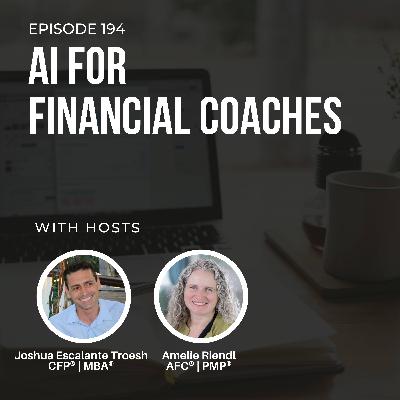
In this episode, we dive into the evolving role of Artificial Intelligence (AI) in financial coaching and counseling. From boosting productivity to streamlining client support, AI offers exciting possibilities—but it also comes with important caveats. We unpack where AI can enhance your practice, what to watch out for, and how to get the most out of these tools without compromising quality or ethics.
Top takeaways:
AI isn’t always cheap: High-performing tools may have a steep price tag.
AI can support nearly every aspect of your work—but don’t expect magic. Results may fall short of expectations.
AI is more time-consuming than you may think: Effective use of AI requires thoughtful input and iterations.
Prompts matter: The more context you provide—your goals, strategy, and desired tone—the better the output.
Refinement is key: Ask for multiple options and be prepared to give feedback across several rounds.
Expect formulaic results: AI tends to default to generic patterns.
Know your sources: Understand where your AI tool pulls its information from.
Copyright limitations: AI-generated content may not be eligible for copyright protection.
Start with your systems: Review your current workflows to identify where AI could improve efficiency or effectiveness.
Tune in to learn how to use AI as a thoughtful partner—not a shortcut—in your financial coaching journey.

In this podcast, we talk to Executive Director of AFCPE Rachael DeLeon about the upcoming AFCPE Symposium, its purpose and why you should attend!
Top takeaways:
The AFCPE is a national nonprofit that certifies, educates and supports financial coaches, counselors, and educators.
The AFCPE Symposium brings together financial professionals from all different professions, who work with clients in a variety of sectors (e.g., military, government, private practice, academia, non profit, financial industry).
The symposium allows people from different practice areas to learn from each other and bring new ideas to their counseling practice.
The magic happens in the halls and the side chats.
4 keynote speakers:
The State of U.S. Financial Health and Capability by Gary Mottola and Lisa Berdie
Redefining How We Understand Financial Behavior by Rahkim Sabree (check out our interview with him from last year)
Every Conversation Counts by Riaz Meghji
Put Your Money Where Your Mouth Is by Erika Wasserman
The theme “Made For This Moment” injects hope and reminds us that collaborations are important to improving the nation’s financial health.
Some topics this year include:
More AI topics than ever before
Members from FPA and Foundation for Financial Planning - building the bridge between financial counseling and financial planning
The importance of systemic behavioral interventions (e.g., nudges) between counseling sessions (the Coaching Operating SystemTM)
Why financial counseling are terrible business owners
Annual State of Financial Coaching/Counseling results
Researchers share information with practitioners
How do you decide which sessions to attend?
Make time to attend different types of presentations, especially those that may be different from your typical community.
Look at this as an opportunity to talk to people you don’t normally have a chance to interact with.
Use your network to “divide and conquer” - take notes and share what you learned with each other
Plan to attend a post-symposium “watch party” to continue learning by watching recorded videos followed by a group discussion - either through the AFCPE or with FCN
The app has some new features to help support networking and collaboration and helps you navigate the events in the 30-day symposium so you don’t miss anything!
Continuing Education (CE) opportunities:
Pre-Approved for 15 CEUs for AFC® and CFP® professionals
AFC Candidates can submit experiential hours for attending and watching sessions
Check out the pre-symposium options available for additional learning opportunities
Sign up for the 2025 AFCPE Symposium here (in person or virtual)
Phoenix-Glendale, Arizona
Renaissance Phoenix Glendale Hotel and Conference Center
Tuesday, November 18 – Thursday, November 20, 2025
Listen for a coupon code to match the early bird discount!
Members can contact AFCPE to get a special code for a deeper discount (listen for info).

We wrap up our series about analyzing the gurus by talking about endorsements!
Top takeaways:
All the “gurus” endorse a product
Be aware of the conflicts of interest with any guru’s recommendations
Anyone who endorses their own product has a conflict of interest
Public gurus or “entertainers” have no obligation to make recommendations based on what’s in your best interest
Endorsed products may not be vetted by the person recommending them
In general, more money is paid for products that aren’t vetted, while less money is paid for products that are vetted
Not all endorsements are bad, but you can’t trust what your favorite guru endorses without doing your own research
People are almost always getting paid for endorsements, though there may be a few exceptions
There are many different ways people can get paid for endorsements, and disclaimers on websites can be misleading (read and understand the meaning of the legalese in the the fine print)
If you click on a link for an endorsed product, the endorser may get a percentage of anything else you buy from that company for a period of time, not just the endorsed product (e.g., Amazon)
A guru’s own product is likely aligned with what they teach publicly
Following a guru’s (“be like me”) course will likely not make you as successful as them if most of their money was made through the course (their success was from selling the shovels, not mining the gold)
Gurus who recommend you work with their “expert” coaches likely receive revenue from those secondary coaches
Recommending secondary “expert” coaches provide a layer of safety to the guru, in case the secondary coaches are advising in areas they are not allowed to by law (e.g., credentials and certifications are required for some advising such as taxes and investing)
Look for consistent messaging and ask, “Are the details of this product consistent with what they’ve said about other similar products?”
Trust in a guru may not translate to trust in a product they endorse
Take the time to understand what an endorsement means – what did that person have to do to receive that endorsement – look for rigorous testing requirements rather than agreeing to teach a guru’s methods (e.g., AFC® Professional, CFP® Professional)

We continue our series about analyzing the gurus! We’ll be spending time discussing several big personal finance names, their recommendations, and why we do or do not agree with those. Josh and Amelie discuss the Money Guy Show, their "Financial Order of Operations" framework, and their philosophy on goals and saving for retirement.
Top takeaways:
A set of financial “rules” supposedly for everyone, doesn’t actually work for anyone.
Paying off student loans (and mortgages) early may or may not be right for you depending on your specific situation
The decision on which tax advantaged accounts to prioritize (e.g., HSA, Roth IRA, 401k) depends on your specific circumstances, and may change year to year
Choosing a high deductible health plan just to have access to an HRA may not be the right solution for all families
The order of recommendations assumes you have a 401(k) with an employer match
Consider contributing to retirement savings, in parallel with other financial “steps,” even if it’s a small percentage compared to other financial goals
Saving towards medium and long term goals may need to be part of your financial plan, prior to reaching the 25% retirement savings goal (e.g., new roof for home)
The percentage of income to save for retirement depends on your specific circumstances, and a generic amount of 25% likely isn’t right for most people
Oversaving for retirement may result in you being undersaved for everything else
Saving for life goals are important to incorporate into your financial plan throughout your life, not just after you complete a set of checklist items
Any generic framework will fail to adequately address your individual goals and values, both now and in retirement
Tax diversification in multiple tax buckets (e.g., tax free, income, capital gains) is a side effect rather than a goal in financial planning (the goal is to lower lifetime taxes paid)

We continue our series about analyzing the gurus! We’ll be spending time discussing several big personal finance names, their recommendations, and why we do or do not agree with those. Josh and Amelie discuss Clark Howard, his philosophy on saving and spending.
Top takeaways:
Saving small amounts of money may not be worth the time or effort involved.
DIY may not be the best approach for you.
Reviews from gurus are not as thorough as other sources (e.g., Consumer Reports).
As your life becomes more complex, you likely have more complex investing needs.
An overemphasis on saving money elevates money above your time, relationships, and life experiences.

We continue our series about analyzing the gurus! We’ll be spending time discussing several big personal finance names, their recommendations, and why we do or do not agree with those. Josh and Amelie discuss Robert Kiyosaki, his philosophy of creating assets to generate money, leverage debt to create these assets, and his beliefs about formal education and savings.
Top takeaways:
With any financial celebrity, watch out for business ecosystems designed to get more money from you.
Choosing not to work for a company (aka “the man”) may limit loan funding options and will impact the terms of a loan, ultimately impacting your ability to get low cost debt.
There is nearly always some of your time required for passive income sources (e.g., real estate), even if you’re paying someone else to manage it.
The more passive an investment is, the less income you’re likely getting from it.
A primary residence is a non-performing asset, which builds your wealth but not as fast as a rental property.
Putting a property into an LLC doesn’t eliminate all the risk with owning that asset.
The biggest risk with owning rental real estate is likely created when you borrow money to purchase the property.
Oversimplification of the complexities and risk associated with real estate investments, coupled with overstating the potential return, often come from the “experts” who are trying to sell their own educational products.
There is a lot of value in formal education.
A real estate education from a community college includes valuable information that will help learn how to invest in real estate.
Having a large savings account allows you to step further out on the risk spectrum.
Institutions (e.g., banks, investment companies) are watched and controlled by regulators (e.g., SEC, state regulators) to protect the investors. Buying a house doesn’t have these same rigorous regulations.

This week we’re making an announcement – Emily will be moving on to new opportunities. She’s been spending time marketing her business this year and it paid off! Learn more about what she did to grow her business. Though she is no longer part of FCN, you will still see her in the Financial Coaches Community Facebook group!
Top takeaways:
Emily’s financial coaching business has grown recently and she will be focusing on continuing to build and grow that business.
Podcasts will change to publishing every other week moving forward (instead of every week).
Small marketing activities can lead to prospects.
Chat GPT is a potential new source of prospects.
Welcome opportunities to present at conferences or other professionals related to your niche.
Presence in multiple locations helps establish you as an expert (e.g., media, social media, conferences, professional groups and services).
Announce to others related to your niche that you’re open to presenting to groups.
Having a hyper specific niche helps establish you as an expert.
Active sales activities (the uncomfortable stuff coaches don’t like) leads to more prospects and clients!
Being more intentional and consistent with sales based activities helps build the business.
Building a successful coaching business takes time.
Don’t go into a conversation expecting it to result in a client (conversion rate may be <1%). The more conversations you have, the more results you’ll see (results may not just be clients, but opportunities).
As an original FCN Launch member and partner behind the scenes, FCN helped Emily build her business that’s ready to scale.

We began a new series about analyzing the gurus! We’ll be spending time discussing several big personal finance names, their recommendations, and why we do or do not agree with those. Josh and Emily discuss Tori Dunlap, her philosophy of capitalism, financial feminism, and her steps for getting control of your finances.
Top takeaways:
Not participating in a system you don’t like (e.g., capitalism) may hurt you more than the system.
Advice geared towards the general public is generally better than specific advice targeting males or females.
Actionable steps are more helpful than philosophical ideas.
Working on mindset at the same time as working on improving your finances is likely more effective than working just one or the other alone.
Research shows that men tend to get back to their pre-divorced net worth within a decade while many women never reach it, primarily due to which assets they each tend to choose. In divorce, women tend to choose family oriented non-income producing assets (e.g., home), while men tend to take income producing assets such as investment accounts.
Overly simplistic advice (supposedly for everyone), doesn’t actually work for anyone.
Separating high interest debt vs. low interest debt is in general a good idea, though the break point depends on current inflation.
The 3 bucket budget system can be a good tool if it fits your particular situation, though there are many others available as well.
Having an accountability partner can help when deciding what budget items are a necessity vs. a want.
Overly simplistic investment advice can be dangerous (e.g., all investments have an upward trajectory at some point, but they don’t forever).
Performance is not the most important factor to look at when choosing investments.
Related episodes:
- Episode 119: Is the snowball method the best way to pay off debt?
- Episode #92: What is cashflow budgeting?
Want help building or growing a successful financial coaching business? Find resources below based on where you’re at in your journey:
- Deciding whether Financial Coaching is right for you? Join our free Facebook Community with over 5000 current and aspiring financial coaches! https://www.facebook.com/groups/financialcoachescommunity
- Already decided you’re going to be a Financial Coach and want to learn more? Get 30+ tips and best practices in our free 8-part email series! https://www.financialcoachesnetwork.com/pre-launch-email-series
- Ready to Launch your Financial Coaching business? Join FCN Launch, our step-by-step program that will help you successfully launch your business in four months and grow it to a consistent part-time income. https://www.financialcoachesnetwork.com/launch
- Are you already coaching clients and want to grow your business to a full-time income? Join FCN Grow, our program that helps you scale your business to a full-time income. https://www.financialcoachesnetwork.com/grow

We began a new series about analyzing the gurus! We’ll be spending time discussing several big personal finance names, their recommendations, and why we do or do not agree with those. Josh and Amelie discuss Suze Orman’s philosophy of debt, preparing for retirement, and investing.
Top takeaways:
Overly simplistic advice (supposedly for everyone), doesn’t actually work for anyone.
People generally need a softer approach to personal finance in order to encourage change.
Paying off your mortgage early doesn’t lower your living costs as much as you think it will and can cause financial issues.
The avalanche and snowball method of debt payment are both overly simplistic and aren’t ideal for anyone.
A 20% downpayment on a home isn’t always (or ever) necessary.
Look at the ROI before taking out student loans, but remember that it needs to be a personal analysis.
Research a potential financial advisor to verify their credentials.
Do-it-Yourself investing may be okay for a start, but comprehensive financial planning is better for more complex situations.
Age 70 may not be the most optimal age to start taking Social Security. When to start taking Social Security is not reversible and will impact the rest of your life.
A specific retirement goal of $1 million or $2 million is arbitrary, as each person’s goal is unique based on their circumstances, goals, and needs.
Related episodes:
- Episode #42: When is debt good?
- Episode #119: Is the snowball method the best way to pay off debt?
- Episode #160: Should I buy a house now or wait?
- Episode #157: Does a mortgage make sense with high interest rates?
- A Nonprofit Guide to Choosing and Interviewing a Financial Planner
Want help building or growing a successful financial coaching business? Find resources below based on where you’re at in your journey:
- Deciding whether Financial Coaching is right for you? Join our free Facebook Community with over 5000 current and aspiring financial coaches! https://www.facebook.com/groups/financialcoachescommunity
- Already decided you’re going to be a Financial Coach and want to learn more? Get 30+ tips and best practices in our free 8-part email series! https://www.financialcoachesnetwork.com/pre-launch-email-series
- Ready to Launch your Financial Coaching business? Join FCN Launch, our step-by-step program that will help you successfully launch your business in four months and grow it to a consistent part-time income. https://www.financialcoachesnetwork.com/launch
- Are you already coaching clients and want to grow your business to a full-time income? Join FCN Grow, our program that helps you scale your business to a full-time income. https://www.financialcoachesnetwork.com/grow

Comments

Download from Google Play

Download from App Store
 United States