


 Claim Ownership
Musically Speaking
Subscribed: 3Played: 108
Subscribe

© Jarrod D. Richey
Description
Jarrod Richey's Musical Meanderings on music education, church music, hymnody, and more.
jarrodrichey.substack.com
jarrodrichey.substack.com
74 Episodes
Reverse
Two singers can sing the same note, yet we instantly know who it is. Why? Because before we hear melody, we hear tone.In this week’s Friday Five, we explore the colors of the human voice — bright and dark, nasal and warm, gritty and clear. Through a few rapid contrasts, we consider how tone color shapes interpretation and even carries biography. This week, listen differently. Don’t just hear the notes. Hear the color.The Friday FIVE is a weekly five-minute podcast series from Musically Speaking that features music commentary, examples, and recommendations from Jarrod Richey. This is a public episode. If you would like to discuss this with other subscribers or get access to bonus episodes, visit jarrodrichey.substack.com
On this “on location” episode from a cabin in Branson, Missouri, I reflect on one of the most unusual and powerful choral works of the twentieth century: “Rejoice in the Lamb” by Benjamin Britten.Drawing from the eccentric and deeply devotional poem Jubilate Agno by Christopher Smart, written in part while Smart was confined in an asylum, Britten’s choral work bursts with rhythmic energy, playful strangeness, and persistent praise.From the famous “For I will consider my Cat Jeoffry” solo to the driving Hallelujah movements, this work reminds us that praise can persist even in fragmentation and confinement.My Delta Youth Chorale is preparing for an upcoming April 30 performance of this remarkable piece in West Monroe, Louisiana.The Friday FIVE is a weekly five-minute podcast series from Musically Speaking that features music commentary, examples, and recommendations from Jarrod Richey.Here’s a recording of the first movement: https://youtu.be/TaRUv0c-Aes This is a public episode. If you would like to discuss this with other subscribers or get access to bonus episodes, visit jarrodrichey.substack.com
No dialogue. Just four minutes of music — and an entire marriage. In this episode, I reflect on Michael Giacchino’s “Married Life” from Up and how music functions as narrator. Through melody, orchestration, and tempo, the score carries decades of joy and sorrow without a single word. Music does not decorate the story. It interprets it.The Friday FIVE is a weekly five-minute podcast series from Musically Speaking that features music commentary, examples, and recommendations from Jarrod Richey.Here's the scene if you've never seen it: https://youtu.be/XO77YuyMOek This is a public episode. If you would like to discuss this with other subscribers or get access to bonus episodes, visit jarrodrichey.substack.com

No dialogue. Just four minutes of music — and an entire marriage. In this episode, I reflect on Michael Giacchino’s “Married Life” from Up and how music functions as narrator. Through melody, orchestration, and tempo, the score carries decades of joy and sorrow without a single word. Music does not decorate the story. It interprets it.The Friday FIVE is a weekly five-minute podcast series from Musically Speaking that features music commentary, examples, and recommendations from Jarrod Richey.Here's the scene if you've never seen it: https://youtu.be/XO77YuyMOek This is a public episode. If you would like to discuss this with other subscribers or get access to bonus episodes, visit jarrodrichey.substack.com
In this episode I ask a simple question: when you sing in worship, who are you singing to? Drawing on Paul Munson’s helpful framework, I reflect on three audiences that show up in Scripture, especially in the Psalms and in Paul’s epistles: sometimes we sing to our own souls, always we sing to God, and often we sing to one another through teaching and encouragement. Remembering the audience of congregational song can change the way we think about worship and the way we participate in it.The Friday FIVE is a weekly five-minute podcast series from Musically Speaking that features music commentary, examples, and recommendations from Jarrod Richey. This is a public episode. If you would like to discuss this with other subscribers or get access to bonus episodes, visit jarrodrichey.substack.com
In this bonus longform episode of Musically Speaking, I sit down with Maestro John Mason Hodges, music director of the Monroe Symphony Orchestra and founder of the Center for Western Studies, for a wide-ranging conversation about music, meaning, and maturity. Maestro Hodges also teaches for us at the Redeemer School of the Arts.What happens when we are surrounded by constant sound but slowly lose the ability to listen? Why does so much modern music feel instantly accessible and instantly forgettable? And how can Christians recover the tools needed to love what is truly worth loving?Drawing on examples from Bach to pop music, we discuss the difference between passive and active listening, the six elements of music, the dangers of both chronological snobbery and cultural laziness, and the importance of musical literacy in forming our affections. From cotton candy versus steak to soda versus fine wine, this episode challenges listeners to expand their musical palate and deepen their engagement.If you’ve ever wondered how to move beyond “Do I like it?” to “What is it doing, and why?”, this conversation will stretch your ears, your mind, and perhaps even your loves. This is a public episode. If you would like to discuss this with other subscribers or get access to bonus episodes, visit jarrodrichey.substack.com
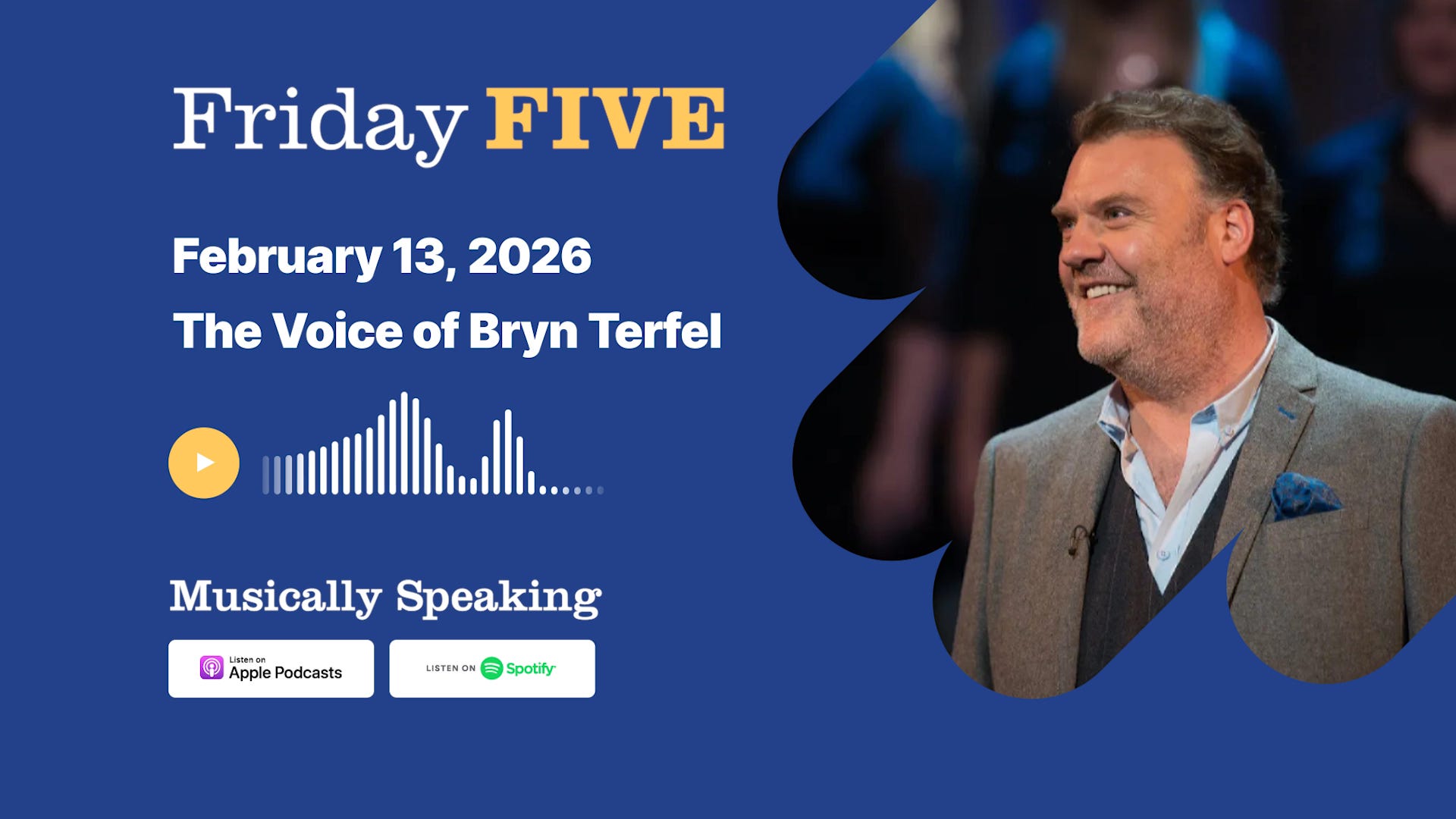
In this episode, I introduce listeners to the Welsh bass/baritone Bryn Terfel, a singer whose career has spanned the world’s great opera houses while also reaching audiences through concerts, recordings, and broadcasts far beyond them. I offer three observations about what makes his artistry so compelling: the depth and flexibility of his voice, his gift for communication and character, and his rare ability to move authentically between opera, musical theater, folk song, and hymnody. If you are new to Terfel, this episode offers a place to begin, with further listening suggestions in the show notes.The Friday FIVE is a weekly five-minute podcast series from Musically Speaking that features music commentary, examples, and recommendations from Jarrod Richey.Here’s Bryn singing Handel’s Ombra Mai Fu aria:https://youtu.be/kUKHAXR34pEHere’s one of my favorite Schubert Lieder, Die Forelle:https://youtu.be/Twp9_JKtKmI This is a public episode. If you would like to discuss this with other subscribers or get access to bonus episodes, visit jarrodrichey.substack.com
As the Winter Olympics begin, I reflect on the music of John Williams and how his work has come to define some of our most recognizable public moments. While he is best known for film scores, Williams’s music reaches far beyond the cinema into television, football broadcasts, and Olympic ceremonies. In this episode, I consider how his commitment to the symphony orchestra, his use of fanfare and leitmotif, and his trust in musical development have helped bring orchestral sound to a global audience, often without listeners even realizing it.The Friday FIVE is a weekly five-minute podcast series from Musically Speaking that features music commentary, examples, and recommendations from Jarrod Richey. This is a public episode. If you would like to discuss this with other subscribers or get access to bonus episodes, visit jarrodrichey.substack.com

In this episode, I share a handful of musical recommendations centered around Joshua Lee Turner and Carson McKee, musicians I first discovered during the early weeks of the COVID-19 pandemic. Beginning with their delightful banjo and guitar cover of ABBA’s “Mamma Mia,” I reflect on what drew me to their work and to collaborations with Tony Lindgren and Elle Cordova, including memorable covers of “Stuck in the Middle with You,” Bob Dylan’s “Don’t Think Twice, It’s All Right,” Paul Simon’s “Baby Driver,” and Peter Gabriel’s “Solsbury Hill.” As the pace of life has slowed again in recent days with Winter Storm Fern, this episode simply offers a few sounds worth revisiting and enjoying at an unhurried pace.The Friday FIVE is a weekly five-minute podcast series from Musically Speaking that features music commentary, examples, and recommendations from Jarrod Richey.Here’s the “Mamma Mia” Cover: https://youtu.be/lWpmALY8Z_sHere’s “Stuck in the Middle of You”: https://youtu.be/1T3B502Ut94Live album on Spotify: https://open.spotify.com/album/7mAGwobSNRrXmcTlfvnWZT?si=boneXJNQSma6UIZ3nWe8IA This is a public episode. If you would like to discuss this with other subscribers or get access to bonus episodes, visit jarrodrichey.substack.com
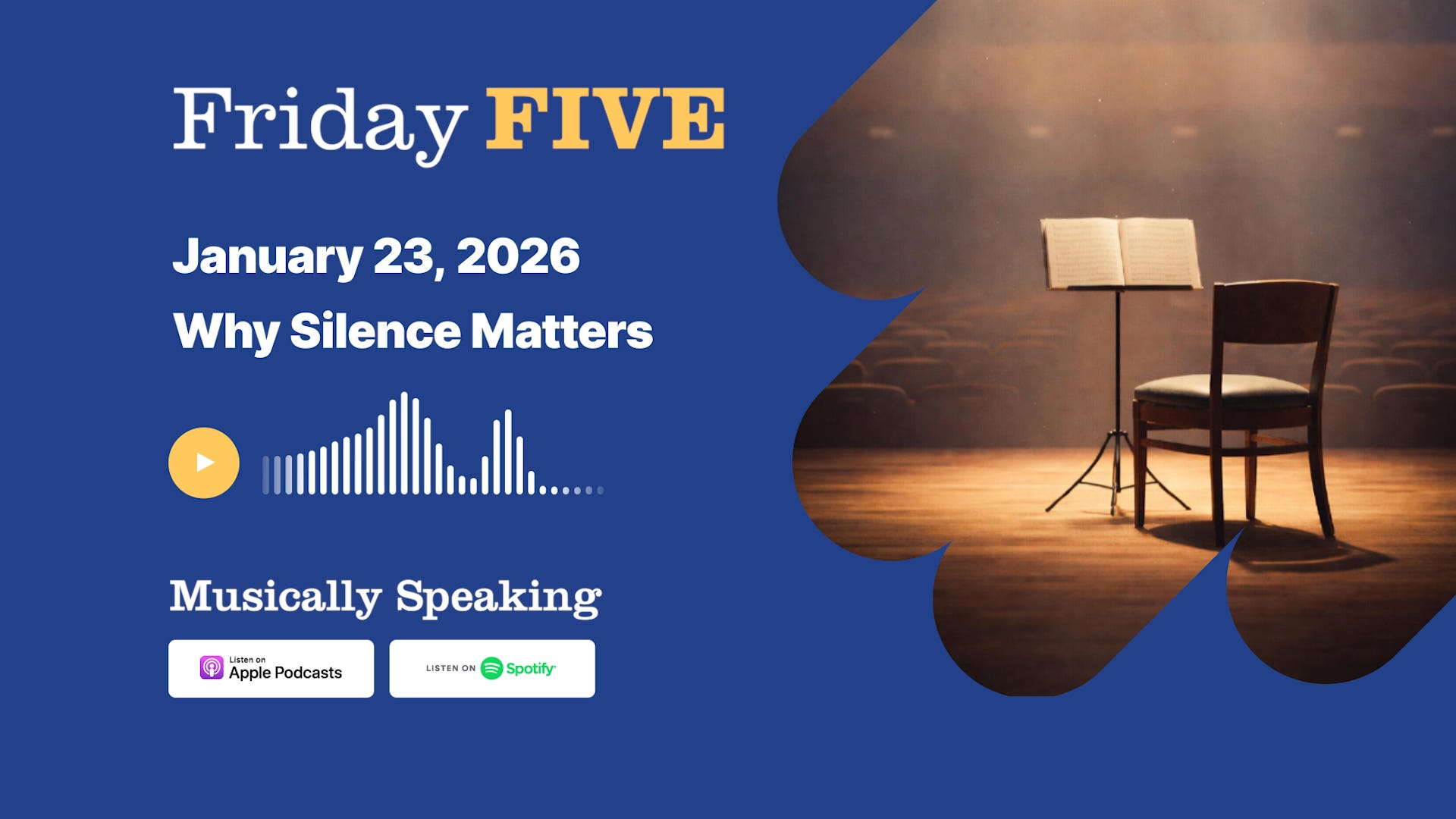
In this episode I reflect on silence, not as the absence of sound, but as an active and necessary partner to music. Drawing on musical examples like rests, cadences, and communal pauses before and after singing, I consider how silence shapes meaning, gives weight to words, and trains our attention. In a culture filled with constant noise and distraction, this episode invites listeners to notice silence again and to let it do its quiet work.The Friday FIVE is a weekly five-minute podcast series from Musically Speaking that features music commentary, examples, and recommendations from Jarrod Richey. This is a public episode. If you would like to discuss this with other subscribers or get access to bonus episodes, visit jarrodrichey.substack.com
In this week's episode, I reflect on how many of us were quietly introduced to orchestral music through cartoons long before we ever set foot in a concert hall. From Tom and Jerry to Looney Tunes, familiar animated worlds trained our ears to recognize musical gesture, drama, and beauty. This episode explores how public domain classical music became the soundtrack of childhood and why those sounds still shape how we hear and feel music today.The Friday FIVE is a weekly five-minute podcast series from Musically Speaking that features music commentary, examples, and recommendations from Jarrod Richey. This is a public episode. If you would like to discuss this with other subscribers or get access to bonus episodes, visit jarrodrichey.substack.com
In this episode, I reflect on why lyrics tend to stay with us when they are sung, but often fade when they are merely spoken. From familiar popular songs to Scripture memory projects, I consider how melody binds words to memory and shapes how those words live inside us. With examples from Integrity Music and Dr. David Erb’s Cantica Sanctorum, this episode invites listeners to reflect on what we allow to lodge in our minds, as what stays with us often shapes us.The Friday FIVE is a weekly five-minute podcast series from Musically Speaking that features music commentary, examples, and recommendations from Jarrod Richey.Here’s a link to hear David Erb’s Cantica Sanctorum on streaming platforms:Spotify: https://spoti.fi/2KL6DXzAmazon Music: https://amzn.to/2ZiBJZVGoogle Music: http://bit.ly/2XnNGLUiTunes: https://apple.co/2Xj8Las This is a public episode. If you would like to discuss this with other subscribers or get access to bonus episodes, visit jarrodrichey.substack.com
What happens when truth is communicated without beauty?In this bonus episode of Musically Speaking, I sit down with Dr. Scott Aniol to argue that beauty is not an optional accessory to truth, but the means by which truth is perceived, embodied, and lived. Drawing from theology, philosophy, and the Western artistic tradition, they explore why aesthetics shape belief, why all art is inherently interpretive, and how modern culture has detached the arts from formation and worship.The conversation also discusses the vision of the Redeemer School of the Arts, a residential, church-based academic program committed to forming artists within community, discipline, and the pursuit of the good life. This is a public episode. If you would like to discuss this with other subscribers or get access to bonus episodes, visit jarrodrichey.substack.com
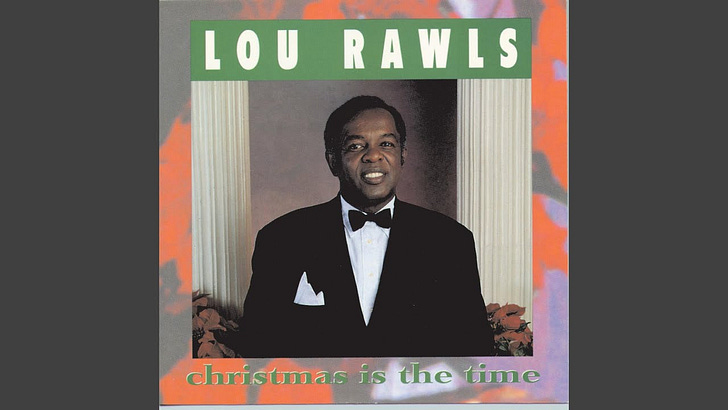
In this episode, recorded in the first days of the new year and still within the twelve days of Christmas, I reflect on the meaning of Auld Lang Syne. Tracing its roots in the poetry of Robert Burns, I consider how this simple and enduring song gives us words for memory, friendship, gratitude, and hope. With reflections on recordings by Harry Connick Jr. and Lou Rawls, I invite listeners to make room for remembering, giving thanks, and carrying what is good into the year ahead.The Friday FIVE is a weekly five-minute podcast series from Musically Speaking that features music commentary, examples, and recommendations from Jarrod Richey.Here’s Lou Rawls’ cover of Auld Lang Syne: https://youtu.be/yBv9_oP7pVA This is a public episode. If you would like to discuss this with other subscribers or get access to bonus episodes, visit jarrodrichey.substack.com
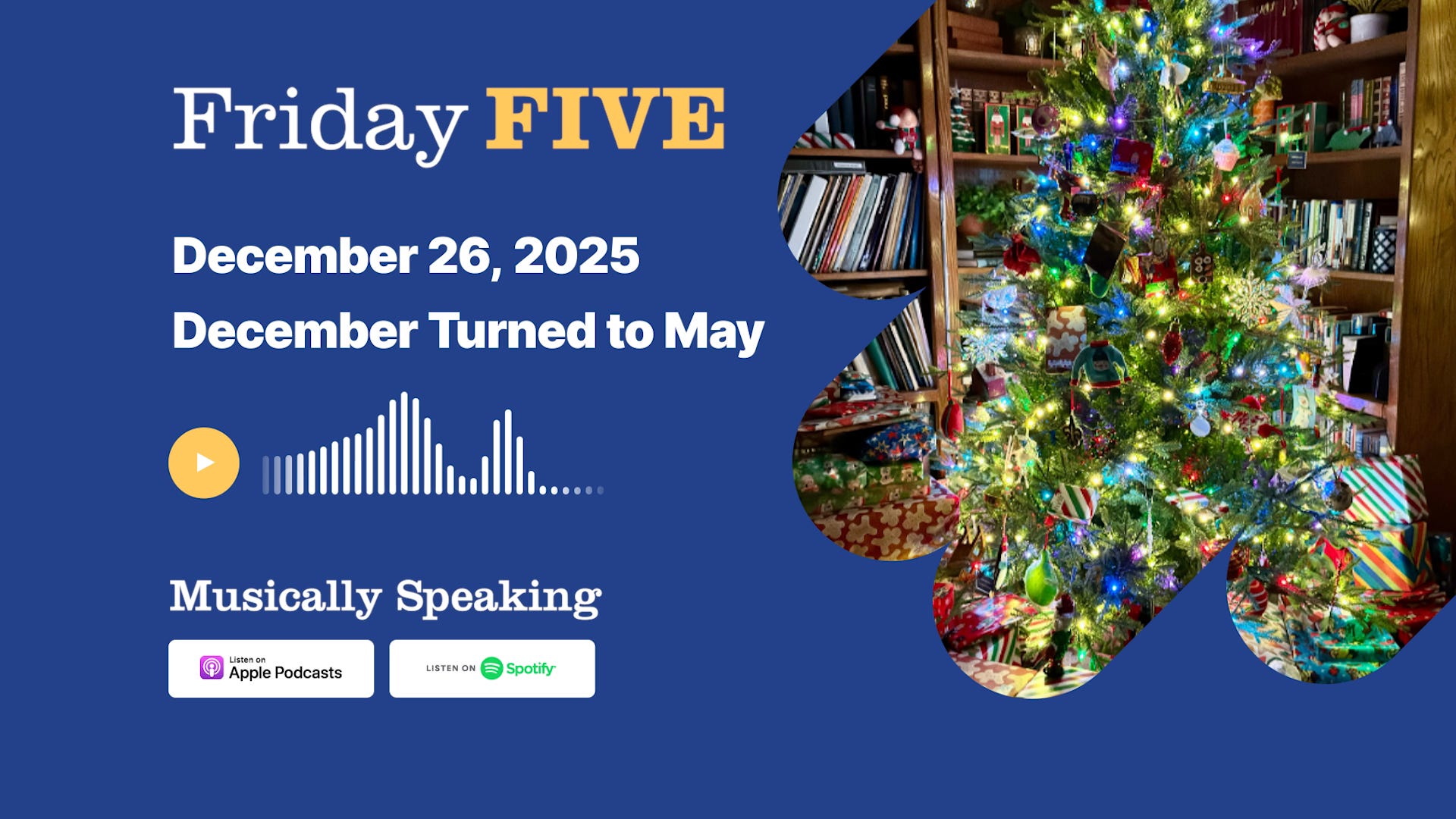
In this episode, I consider the quiet richness of the days that follow Christmas and why the season is worth more than one day. Drawing on Robert Herrick’s Christmas Carol poem, I invite the listener to make room in their mind and heart for the joy that continues beyond December 25.The Friday FIVE is a weekly five-minute podcast series from Musically Speaking that features music commentary, examples, and recommendations from Jarrod Richey.Here’s a recording of Rutter’s musical setting of Herrick’s poem: https://youtu.be/yckjpO1vvnE This is a public episode. If you would like to discuss this with other subscribers or get access to bonus episodes, visit jarrodrichey.substack.com
Merry Christmas Eve - Bonus Mini-Episode This is a public episode. If you would like to discuss this with other subscribers or get access to bonus episodes, visit jarrodrichey.substack.com

In this episode, we reflect on singing as a communal act that forms us in ways private listening cannot. Drawing on recent performances by my Delta Youth Chorale and Geneva Academy students, we consider how making music together binds singers and listeners alike, especially during Advent and Christmas. In an age of earbuds and individualized playlists, this episode invites us to recover the joy, fellowship, and shared presence that come from singing aloud with one another.The Friday FIVE is a weekly five-minute podcast series from Musically Speaking that features music commentary, examples, and recommendations from Jarrod Richey. This is a public episode. If you would like to discuss this with other subscribers or get access to bonus episodes, visit jarrodrichey.substack.com
This episode looks at how a paraphrase of Psalm 98, written centuries ago without a single reference to Bethlehem or the Nativity, found its way into the heart of the Christmas season. From Isaac Watts’s text to the lively tune that echoes Handel’s style, we explore the surprising journey that turned a psalm into a hymn/carol many of us now know by heart.The Friday FIVE is a weekly five-minute podcast series from Musically Speaking that features music commentary, examples, and recommendations from Jarrod Richey. This is a public episode. If you would like to discuss this with other subscribers or get access to bonus episodes, visit jarrodrichey.substack.com

This week’s Friday Five features a recommendation of Béla Fleck and the Flecktones’ Christmas album Jingle All the Way. From a jazz-infused take on Jingle Bells and Linus and Lucy to a stunning twelve-key, twelve-meter setting of The Twelve Days of Christmas, this album offers a playful and virtuosic reimagining of familiar holiday music. With surprising touches like Tuvan throat singing, a Bach tenor aria arranged for banjo, and standout tracks like River, Christmastime Is Here, and The Dance of the Sugar Plum Fairy, this is a Christmas record for listeners ready for something fresh.Here’s the link to the album on Spotify: https://open.spotify.com/album/2W76N8D76BqfRlDjzQSOKL?si=VemG571DRVeM8ygmQH296QAnd here is the link to listen on YouTube: https://youtube.com/playlist?list=OLAK5uy_kwmxu3QlA_NKtaU611KStU7Jqreaf_UGQ&si=Y5GDOqjgKGvjd8qPThe Friday FIVE is a weekly five-minute podcast series from Musically Speaking that features music commentary, examples, and recommendations from Jarrod Richey. This is a public episode. If you would like to discuss this with other subscribers or get access to bonus episodes, visit jarrodrichey.substack.com
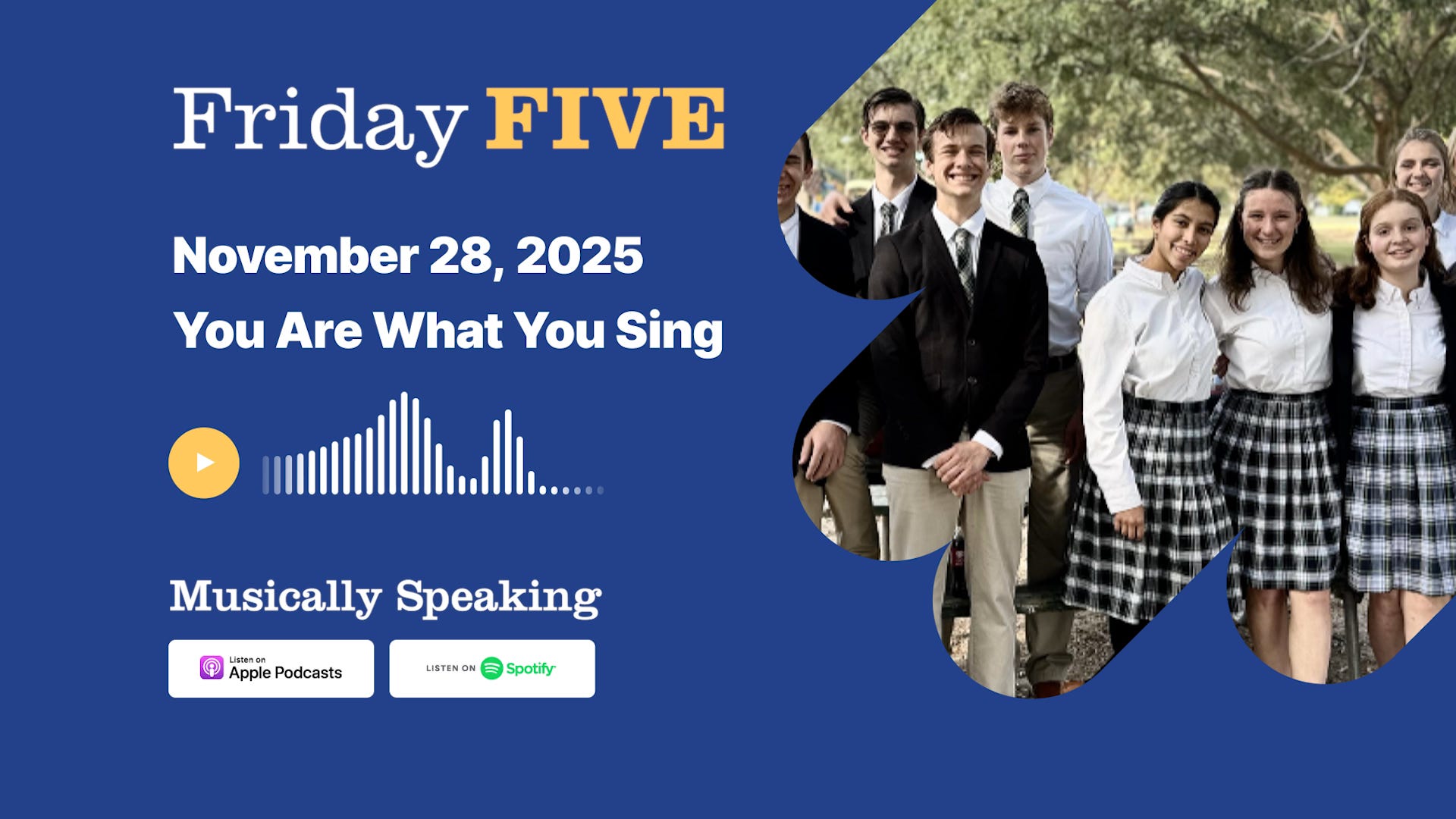
This week we look at how a musical diet shapes musical desires and how teaching students to read music frees them to participate rather than just consume. Featuring recordings from Geneva Academy’s ninth and tenth grade musicianship class, this episode explores why Renaissance polyphony, music literacy, and singing outside our own time form not only better musicians but stronger communities.The Friday FIVE is a weekly five-minute podcast series from Musically Speaking that features music commentary, examples, and recommendations from Jarrod Richey. This is a public episode. If you would like to discuss this with other subscribers or get access to bonus episodes, visit jarrodrichey.substack.com

Comments

Download from Google Play

Download from App Store
 United States