


 Claim Ownership
Medical Device made Easy Podcast
Subscribed: 264Played: 9,200
Subscribe

© Monir El Azzouzi
Description
My name is Monir El Azzouzi and I am a Medical Device Expert specialized in Quality and Regulatory affairs. And on this podcast I will help you place compliant medical devices on the market. For that I will share with you my knowledge or the one of others through discussion or interviews. I will invite experts in the area to tell you what you can do or the challenges you may encounter.
This podcast is hosted by Podcastics, the easiest platform to create and publish your podcast.
419 Episodes
Reverse

Small Business, Smart Start: AI Without Complex InfrastructureArtificial Intelligence is creating new opportunities for businesses to improve productivity, simplify workflows, and reduce repetitive administrative work.However, for many small medical device companies, adopting AI can feel overwhelming.Where should you begin? Which processes are worth automating? Do you need expensive infrastructure or a dedicated development team? And how can you ensure that an AI assistant delivers reliable results?In this episode of Medical Device Made Easy, we welcome Helder Conceicao to explore how small businesses can take their first practical steps with AI agents.With experience in service engineering, business processes, and supporting AI adoption in small companies, Helder brings a practical perspective to a topic that is often presented as more complicated than it needs to be.Understanding AI Agents: Beyond Traditional ChatbotsMany professionals have already experimented with AI tools to answer questions, draft emails, or summarize information.But an AI agent introduces a different way of thinking about how AI can support business processes.Rather than focusing only on individual conversations, the discussion explores how AI assistants can support defined tasks and workflows.Helder explains the differences between traditional chatbots and AI agents, including what these solutions can accomplish and where human involvement remains necessary.The objective is to help business owners understand the practical possibilities before investing in a solution.Choosing the Right First AI ProjectOne of the biggest challenges in AI adoption is deciding where to begin.Businesses may have dozens of processes that could potentially benefit from automation, but not every task is a good starting point.The conversation explores how to identify a first project based on a genuine operational need.For medical device companies, potential areas to investigate include:Documentation: Supporting document preparation, organization, and information retrieval.Quality and Regulatory Affairs: Assisting with administrative activities and information management while maintaining appropriate human review.Field Service: Exploring ways to support service-related workflows and routine processes.The key is to identify a manageable use case with a clear purpose and measurable value.From an Idea to a Working AI AssistantOnce a company has identified a suitable process, what happens next?The episode explores the journey from an initial business problem to a functioning AI solution.This includes understanding what information the company needs to prepare, how the workflow should operate, and what technical resources may be required.An important part of the discussion is determining whether an existing AI platform can meet the company's needs or whether additional development and infrastructure are necessary.For smaller organizations, these decisions can have a significant impact on project complexity, cost, and implementation time.How Much Does AI Implementation Really Require?Cost and resources are common concerns for businesses considering AI.Does every AI project require a large budget? How much time should the company expect to invest? And how involved does the internal team need to be?Helder discusses the practical considerations behind planning an AI implementation, including the importance of defining the project's scope and understanding the resources required.The goal is to help businesses approach AI adoption with realistic expectations rather than assuming that every solution requires a major technology investment.Keeping Humans in ControlFor medical device companies, automation must be considered alongside reliability, accountability, and appropriate oversight.Not every task should be delegated to AI without review.The conversation addresses how to determine which activities an AI assistant can support independently and which require a qualified person to review, approve, or make the final decision.It also explores how businesses can test whether an AI assistant is sufficiently reliable for its intended task, particularly when working with important company documents.AI should support better business processes without removing necessary human judgment and responsibility.Measuring the Value of Your First AI ProjectImplementing an AI assistant is only the beginning.The next question is whether the solution actually improves the business process it was designed to support.The discussion examines common challenges encountered during initial AI projects and how businesses can evaluate their results.Potential considerations include time saved, reduced repetitive work, improved workflow efficiency, and the level of human intervention still required.Understanding these outcomes can help a company decide whether to improve its first solution or move toward another use case.Building Independence and Long-Term CapabilityAn AI solution should not necessarily leave a company dependent on the person who originally developed it.The episode also explores the importance of documentation, knowledge transfer, and ongoing support.Helder discusses how businesses can understand the solutions implemented for them, how they may operate those solutions independently, and what additional assistance could be available after deployment.This is particularly relevant for small companies that want to develop their internal capabilities while keeping their technology manageable.Final Takeaway: Start Small, Learn, and ExpandAI adoption doesn't have to begin with a company-wide transformation.For small medical device businesses, a useful first step is to identify one process that consumes time, creates repetitive work, or could benefit from better information management.Then explore whether an AI assistant can help.Start with a clear problem. Build a focused solution. Test the results. Keep people involved where necessary. Measure the value.Once the first project demonstrates its usefulness, the company can consider what comes next.In this episode of Medical Device Made Easy, Helder Conceicao helps make the first steps toward AI adoption more understandable and practical for small businesses.What is one business task you would like AI to help you improve?Who is Helder Conceição?Helder Conceição is the founder of heconexus®, helping small businesses in Portugal adopt AI in their everyday work. He brings more than 25 years of experience at Johnson & Johnson across local, European and global roles, spanning service engineering, business processes and digital initiatives. His approach focuses on practical processes, measurable value, human oversight and helping teams become confident and autonomous in their use of AI.LinksLinkedIn: https://www.linkedin.com/in/helderconceicao/ AI in SMEs: where to start improving everyday workhttps://www.linkedin.com/pulse/ia-nas-pmes-por-onde-começar-para-melhorar-o-trabalho-conceição-bptae/ choosing a useful first process, testing with the team and measuring value.Which AI is best for your company?https://www.linkedin.com/feed/update/urn:li:activity:7514233631742164992/ choosing a platform around a real business task and the company’s needs.One successful AI example: is that enough for the team to start using it?https://www.linkedin.com/feed/update/urn:li:activity:7510972255170994176/testing varied cases, checking sources and defining human review.Social Media to followMonir El Azzouzi Linkedin: https://linkedin.com/in/melazzouziTwitter: https://twitter.com/elazzouzimPinterest: https://www.pinterest.com/easymedicaldeviceInstagram: https://www.instagram.com/easymedicaldeviceThis podcast is hosted by Podcastics, the easiest platform to create and publish your podcast.

October brings another important round of regulatory developments for the medical device and IVD industry. From updated IVD classification guidance in Europe and potential changes to the UK medical device licensing framework, to new FDA expectations for robotically assisted surgical devices, radiology AI, PMA submissions, and international regulatory reliance, manufacturers have several developments worth following closely.Here is our Medical Device Regulatory Update for October 2026, supported by regulatory intelligence from MedBoard.🇪🇺 European Union – Revised IVD Classification GuidanceThe European Commission has published MDCG 2020-16 Rev.5, updating the guidance on classification rules for in vitro diagnostic medical devices under the IVDR.For IVD manufacturers, classification is a fundamental regulatory decision that can affect the conformity assessment route and regulatory strategy.👉 MDCG 2020-16 Rev.5 – Guidance on Classification Rules for IVDs🇬🇧 UK – The Door Opens to Direct MHRA LicensingProposed amendments to the UK Government's Health Bill could create powers supporting the future development of a medical device licensing regime.The amendments also address information-sharing powers for medicines and medical devices and measures intended to make medicines and medical-device legislation easier to update.This is an important development to watch for manufacturers planning access to the UK market.👉 MHRA Regulatory Reform Amendments – Health Bill🇬🇧 MHRA Warning – Incompatible Components Continue to Cause Serious IncidentsThe MHRA has highlighted ongoing safety concerns involving patient hoists and incompatible components.The warning is an important reminder that medical-device safety does not stop with individual component compliance. Compatibility between components, accessories and systems can directly affect patient safety.Manufacturers and healthcare organizations should pay close attention to compatibility information, instructions for use and the way devices are combined in real-world environments.👉 MHRA – Steps to Prevent Avoidable Harm from Patient Hoists🇨🇭 swissdamed – Importer Linking Is Now OperationalAnother important development comes from Switzerland.Swiss importers can now link their CHRN to imported devices in swissdamed.This adds another operational consideration for manufacturers and importers working in the Swiss medical-device market, particularly as swissdamed becomes increasingly important within the country's regulatory infrastructure.👉 Swissmedic – Information for Importers in swissdamed🌍 Rest of the World🇺🇸 FDA – Robotically Assisted Surgical DevicesThe FDA has issued draft guidance addressing robotically assisted surgical devices.The guidance covers areas including non-clinical testing, clinical evidence and labeling for teleoperated surgical systems.For manufacturers developing robotic surgical technologies, understanding these expectations early can help inform development, testing and premarket strategy.👉 FDA – Robotically Assisted Surgical Devices: Premarket Submissions🤖 FDA Rejects Proposed 510(k) Exemption for Radiology AI DevicesAI remains firmly on the regulatory agenda.The FDA has rejected a proposed exemption from premarket notification for certain radiology computer-aided detection, diagnosis and triage devices.The practical message for manufacturers is clear: these products must continue to obtain the applicable FDA clearance before being marketed.👉 FDA – Radiology Computer-Aided Detection, Diagnosis and Triage Devices🇺🇸 FDA Moves PMA Applications Toward Structured Electronic SubmissionsThe FDA is also moving toward a more structured approach to electronic Premarket Approval (PMA) applications.Draft guidance introduces electronic resources and templates intended to improve submission consistency and review efficiency.Manufacturers working on PMA submissions should follow this development as electronic submission structures continue to evolve.👉 FDA – Electronic Submission Template for PMA Applications🌐 FDA Creates a Regulatory Reliance Resource CentreInternational regulatory reliance continues to gain attention.The FDA has created a dedicated CDRH Regulatory Reliance Portal explaining how other regulatory authorities can leverage FDA regulatory work and decisions while retaining their own national sovereignty and decision-making responsibilities.For an increasingly global medical-device industry, regulatory reliance could play an important role in reducing unnecessary duplication and supporting more efficient regulatory processes.👉 FDA CDRH Regulatory Reliance Portal🛠️ What's New at Easy Medical Device?Alongside this month's regulatory developments, Easy Medical Device continues to expand the resources and services available to medical-device companies.EasyIFUEasyIFU supports medical-device manufacturers working with electronic Instructions for Use.👉 Discover EasyIFUNew Partner ServicesNew partner services are also available in areas including:Software Development & CybersecurityCompany CreationThese services expand the support available to medical-device companies across different stages of their development and market-access journey.🎙️ Latest Easy Medical Device Podcast EpisodesOctober is also a good opportunity to catch up on the latest Medical Device Made Easy episodes.Episode 406 – Your Technical Documentation Has All the Documents… So Why Isn't It Ready?Having every document does not necessarily mean your Technical Documentation is assessment-ready. This episode explores adequacy, consistency, evidence and traceability across the dossier.👉 Listen to Episode 406Episode 407 – Why Management Doesn't Listen to Quality and How to Change ThatWhy do Quality and Regulatory teams sometimes become isolated from the rest of the organization? This episode explores the shift from being the “Quality Police” to becoming a Quality Influencer.👉 Listen to Episode 407Episode 408 – Vertical Slicing for Complex SaMD DevelopmentComplex SaMD development can become fragmented when teams focus on individual components. This conversation explores vertical slicing as a way to look at functionality and clinical workflows end-to-end.👉 Listen to Episode 408Episode 409 – AI Is Already Inside Your QMS – But Is It Under Control?AI may already be used by Quality, Regulatory, Engineering and PMS teams—even without a formal company-wide AI initiative.This episode discusses Shadow AI, risk-based AI control, verification, human accountability and how Quality teams can approach AI without simply banning it.👉 Listen to Episode 409This podcast is hosted by Podcastics, the easiest platform to create and publish your podcast.
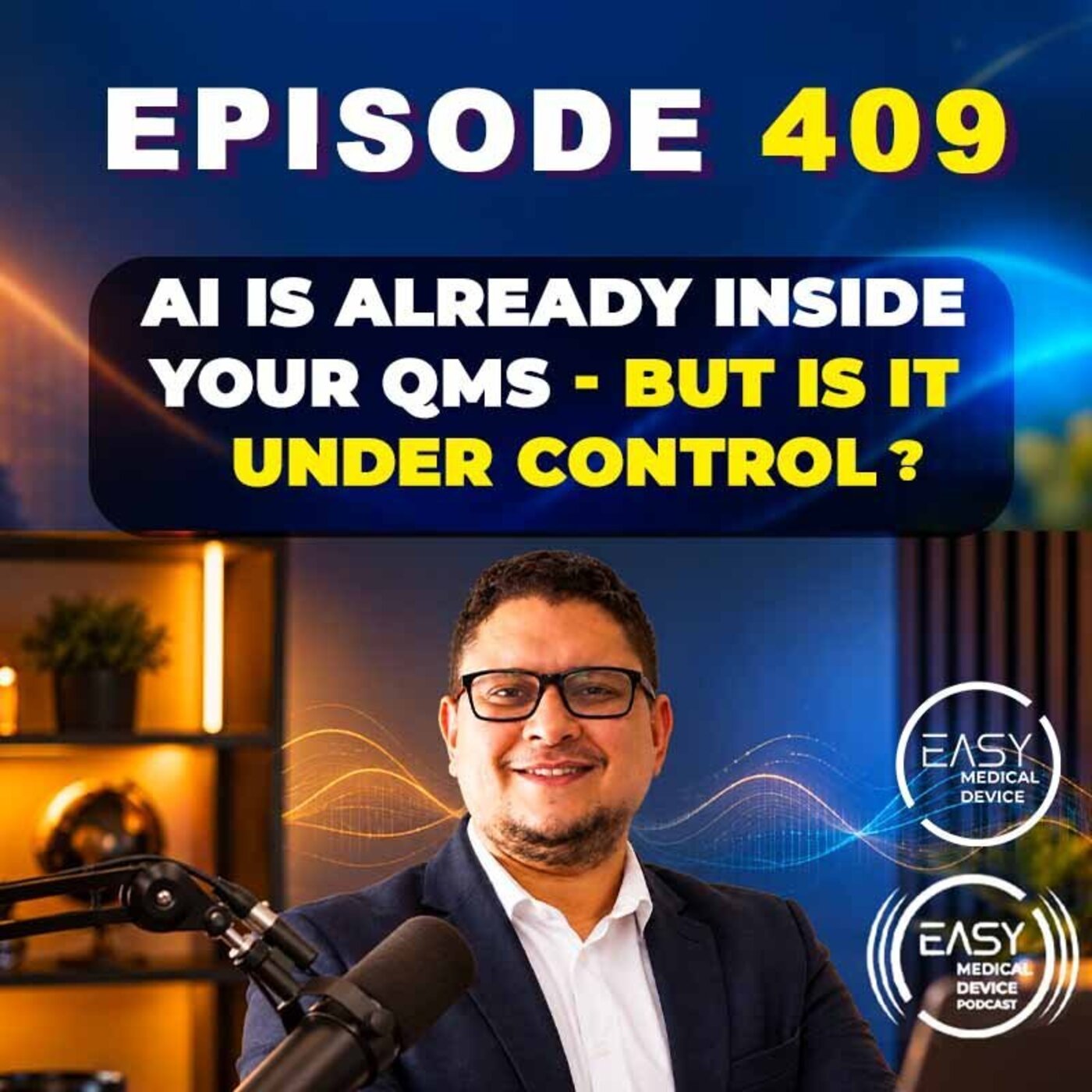
Artificial Intelligence may already be part of your Quality Management System, even if your organization has never formally implemented an AI tool.Regulatory Affairs professionals may use ChatGPT to research requirements. Quality teams may use AI to help draft procedures or summarize meetings. Engineers may ask AI to brainstorm potential failure modes. Post-Market Surveillance teams may experiment with AI to analyze complaints.This creates an important challenge:AI may already be inside your QMS—even though your QMS doesn't know it. Markdown colléThe answer isn't necessarily to ban AI.The answer is to understand where it is being used and introduce controls proportionate to the risk.The Shadow AI ProblemEmployees don't always wait for management to formally implement AI.When a tool can turn a three-hour activity into a thirty-minute task, people naturally become interested.The Quality challenge isn't simply that AI is being used. The problem is that the organization may not know:what activities AI supports, what information employees provide to it, how outputs are verified, and how heavily people rely on those outputs.This is what the episode describes as Shadow AI. Markdown colléNot Every AI Use Has the Same RiskAsking AI to improve the wording of an email isn't equivalent to asking it to determine whether complaint data indicates a safety signal.The key question is:What happens if the AI is wrong?An error in a rewritten email may have limited consequences. An incorrect conclusion about complaint reportability or patient safety could have significantly different consequences.AI governance should therefore be based on intended use and risk, rather than treating every AI application identically. Markdown colléGreen, Amber, Red: A Practical AI FrameworkThe episode introduces a simple traffic-light approach.🟢 Green — AssistAI improves productivity without materially driving a regulated decision.Examples include improving English, formatting documents, brainstorming, summarizing meeting notes or helping structure a presentation.Normal human review, together with appropriate confidentiality and information-security controls, may be sufficient for these lower-risk applications.🟠 Amber — VerifyAI begins influencing regulated work.Examples include helping draft an SOP, suggesting potential FMEA failure modes, summarizing complaints, researching regulatory requirements or suggesting possible CAPA root causes.The principle here is simple:AI can propose. A qualified person must verify.AI can help locate information, but it shouldn't automatically become the regulatory evidence supporting a decision.🔴 Red — Assess Before DeploymentHere, AI makes or materially drives a critical decision.Examples could include automatically determining complaint reportability, accepting suppliers, closing CAPAs, deciding risk acceptability or generating clinical conclusions without independent qualified evaluation.These uses call for formal assessment before the organization relies on the system. Markdown colléHuman Review Is Not Automatically Verification“We have a human reviewing everything” sounds reassuring.But what does review actually mean?Generative AI can produce incorrect information that looks professional and convincing. Reading an AI-generated regulatory assessment and thinking “looks good” isn't necessarily meaningful verification.The episode proposes another important principle:Trust the source, not the sentence.Regulatory requirements should be checked against the regulation. Complaint-analysis results should be checked against the underlying data and methodology. Technical suggestions should be evaluated by qualified personnel. Markdown colléFive Steps for Bringing AI Under ControlRather than immediately writing an AI SOP, the episode recommends starting with discovery.First, inventory where AI is already being used.Then classify each use according to what could happen if the output is wrong.Next, control the input, particularly where patient information, complaints, confidential drawings, clinical data, intellectual property or supplier information may be involved.After that, define how the output will be verified.Finally, maintain human accountability.As the episode puts it:“AI can perform work. It cannot inherit your regulatory accountability.” Markdown colléWhat About AI Validation?Instead of starting with:“Do we need to validate ChatGPT?”Start by asking:What exactly are we using it for?Then:What happens if it gives us the wrong answer?And finally:What level of assurance do we need for that intended use?The framework presented in the episode is:Intended Use → Risk → Control → Evidence. Markdown colléAI Literacy Matters TooAI governance isn't only about procedures and technical controls.People need to understand what AI does well, where it can fail, how errors and hallucinations can occur, how information should be verified, what data they are allowed to enter, and when AI should not be relied upon.That's a much more practical form of AI literacy than simply asking employees to click through another annual training presentation. Markdown colléAI Isn't the Enemy of QualityThe message of the episode isn't to avoid AI.Quite the opposite.AI could create significant opportunities for Quality and Regulatory teams—from supporting complaint analysis and regulatory intelligence to identifying recurring CAPA themes, simplifying procedures, creating training exercises, checking Technical Documentation for inconsistencies, and brainstorming potential hazards for qualified professionals to assess. Markdown colléThe role of Quality shouldn't be to stand in front of innovation and say:“No, because compliance.”It should be to enable innovation with appropriate controls.Final TakeawayInstead of asking your team:“Are you using ChatGPT?”Ask:“Show me where AI is helping you do your job today.”Then build the inventory and ask what happens if the AI gets each task wrong.Green: Assist.Amber: Verify.Red: Assess before deployment.Control the inputs. Verify the outputs. Keep humans accountable.Because banning AI may not stop its use, while ignoring it means losing visibility.A better approach is:Understand it. Control it. Use it. Markdown colléSocial Media to followMonir El Azzouzi Linkedin: https://linkedin.com/in/melazzouziTwitter: https://twitter.com/elazzouzimPinterest: https://www.pinterest.com/easymedicaldeviceInstagram: https://www.instagram.com/easymedicaldeviceThis podcast is hosted by Podcastics, the easiest platform to create and publish your podcast.

Developing complex Software as a Medical Device (SaMD) can quickly become challenging.Requirements, software architecture, dependencies, risk management, verification, regulatory evidence, and cross-functional collaboration all need to work together.But what happens when individual software components appear to work correctly while the complete end-to-end workflow reveals something different?In this episode of the Easy Medical Device Podcast, Monir El Azzouzi welcomes Shreya Sridhar from Medtronic to explore vertical slicing for complex regulated software products.Rather than looking at a system only through individual components or technical layers, vertical slicing provides a way to examine functionality end-to-end.In this episode, we discuss:🔹 What vertical slicing means in practice🔹 The challenges of developing complex SaMD🔹 How end-to-end workflows can reveal hidden problems🔹 How to structure vertical slices🔹 Integrating vertical slicing into Agile development🔹 Risk management, verification, and regulatory evidence🔹 Vertical slicing alongside Design Controls🔹 Cross-functional collaboration in regulated development🔹 What “Done” means for a vertical slice in a medical device environment🔹 The potential role of vertical slicing as AI supports requirements, code, testing, and documentation🔹 Practical advice for teams that want to start using the approachThe conversation connects software development with the realities of regulated medical device development, looking beyond whether individual components work to understand whether the complete functionality works as intended.Who is Shreya Sridhar?Shreya Sridhar is a Principal Systems Engineer and technical leader specializing in complex Software as a Medical Device (SaMD) and AI-enabled medical technologies. Her work focuses on systems architecture, requirements, risk management, verification, and cross-functional product development. She has published and presented on systems engineering, vertical slicing, and the development of complex regulated software, with a particular focus on connecting product strategy to end-to-end engineering execution. Who is Monir El Azzouzi? Monir El Azzouzi is the founder and CEO of Easy Medical Device a Consulting firm that is supporting Medical Device manufacturers for any Quality and Regulatory affairs activities all over the world. Monir can help you to create your Quality Management System, Technical Documentation or he can also take care of your Clinical Evaluation, Clinical Investigation through his team or partners. Easy Medical Device can also become your Authorized Representative and Independent Importer Service provider for EU, UK and Switzerland. Monir has around 16 years of experience within the Medical Device industry working for small businesses and also big corporate companies. He has now supported around 100 clients to remain compliant on the market. His passion to the Medical Device filed pushed him to create educative contents like, blog, podcast, YouTube videos, LinkedIn Lives where he invites guests who are sharing educative information to his audience. Visit easymedicaldevice.com to know more. If you need help implementing QMSR or preparing your teams for FDA inspections, contact: [email protected] If you are located outside the EU/UK/Switzerland and need an Authorized Representative (and possibly an Importer), we can support you as well.LinksShreya LinkedIn: https://www.linkedin.com/in/shreyasridhar/ Links to Articles on Vertical Slicing: 1. Designing SaMD for safety and rethinking risk management through system architecture 2. Decomposing Complexity: A Systems Engineering View of Modern Software — Aligning the V-Model with a Slicing-Based Decomposition Strategy 3. Your roadmap is not a feature list: A two-level slicing framework for better release planning 4. Vertical Slicing as a Foundation for SaMD Development in the Age of Agentic AI Social Media to followMonir El Azzouzi Linkedin: https://linkedin.com/in/melazzouziTwitter: https://twitter.com/elazzouzimPinterest: https://www.pinterest.com/easymedicaldeviceInstagram: https://www.instagram.com/easymedicaldeviceThis podcast is hosted by Podcastics, the easiest platform to create and publish your podcast.
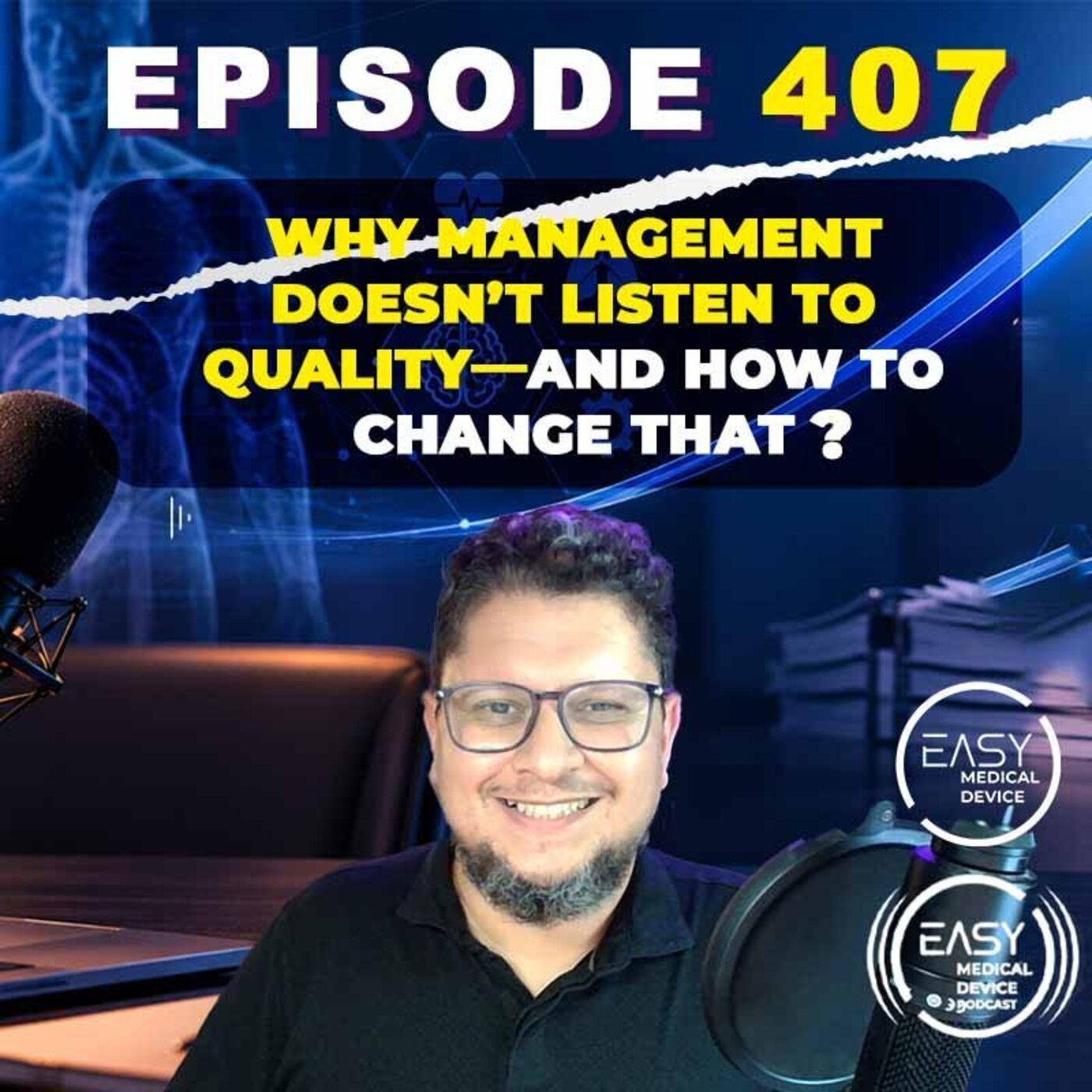
Quality and Regulatory professionals often find themselves in a frustrating position.They identify a problem, explain the compliance risk and recommend an action. But instead of being seen as protecting the organization, they can become perceived as the people creating obstacles.Operations sees a delayed project. Finance sees additional resources. Management sees another problem that needs to be solved.Over time, this dynamic can leave QA/RA professionals frustrated, isolated and exhausted.But the problem isn't always management.Sometimes, the way Quality operates can unintentionally contribute to that isolation.When Quality Owns EverythingConsider a nonconformity that occurs in Production.In some organizations, Quality opens the record, writes the description, gathers the evidence, conducts much of the investigation, pushes for the root cause, proposes the corrective action and follows the issue until closure.The problem happened in Production—but Quality performed almost all the work.The organization eventually learns a dangerous lesson:“When something goes wrong, send it to Quality.”This creates dependency instead of ownership.A better principle is:Ownership stays with the process owner. Quality provides the framework and the challenge.The Quality Tyrant, Invisible Manager and InfluencerUnder pressure, QA/RA professionals can fall into three different behaviours.The Quality Tyrant tries to create compliance through control. They take over investigations, impose solutions and attempt to own every decision.The Invisible Quality Manager moves in the opposite direction. They avoid difficult conversations, accept weak justifications and may close issues before they have been properly understood.The Quality Influencer takes a different approach.They involve the people closest to the process, separate facts from assumptions, challenge weak root causes, verify that actions address the actual problem and keep responsibility with the process owner.Quality Shouldn't Be the Human Shield During an AuditAnother sign of an ownership problem appears when an auditor asks Production a question—and everyone immediately looks at the Quality Manager.A mature QMS isn't demonstrated by how well Quality can answer every question.It's demonstrated by how naturally employees can explain and perform their own activities.When the auditor asks about Purchasing, Purchasing should answer. When the question concerns Production, Production should explain the process.Quality can coordinate, clarify requirements and help locate evidence—but it shouldn't become a human shield between the auditor and the organization.Training Completion Isn't the Same as CompetenceA dashboard showing 100% training completion looks reassuring.But what does an electronic acknowledgement actually prove?It proves that someone acknowledged the document—not necessarily that they understood the change or can perform the activity correctly.Training methods should therefore be proportionate to the activity, its complexity and its risk. Depending on the situation, competence might require a discussion, scenario-based questions or practical demonstration rather than another signature.Stop Creating Procedures for an Imaginary CompanyQuality can also lose credibility by designing processes that the organization cannot realistically operate.More signatures, approvals, meetings and forms don't automatically create a stronger QMS.Patient safety, product performance and legal requirements are non-negotiable—but QA/RA professionals also need to distinguish between a genuine requirement and a preferred way of meeting that requirement.An effective approach understands the regulatory objective and works with the organization to find a practical, proportionate and defensible way to achieve it.From Quality Police to Quality InfluencerManagement doesn't make decisions using regulatory language alone.Simply saying “Clause X requires us to do this” may be technically correct, but it doesn't always help decision-makers understand the impact.An influential QA/RA professional translates regulatory concerns into consequences management can evaluate.That means speaking several languages:Regulation → Patient/User Risk → Operations → Finance → Management DecisionsInfluence starts when people understand how a Quality concern affects the objective they're trying to achieve.Bring Options, Not Only ObstaclesManagement meetings are decision-making environments.When possible, Quality should explain the problem, identify the non-negotiable regulatory or safety boundaries, and present possible paths forward.Some situations allow different compliant approaches. Others don't: a legal obligation doesn't become optional because the project is late, and an unacceptable safety risk cannot simply be accepted because fixing it is expensive.The role of QA/RA is to inform, warn and guide, while escalating appropriately when necessary.Quality Is a Collective ResponsibilityWhen one Quality professional becomes the author of every nonconformity, owner of every CAPA, coordinator of every audit, author of every procedure and reminder system for every overdue action, burnout becomes almost inevitable.The solution isn't another time-management technique.It's moving from individual dependency to collective ownership.Quality should build the system, support the people operating it, challenge the evidence and monitor effectiveness. But the organization must own the activities that actually create product quality.Final TakeawayThe goal of QA/RA isn't to win every argument, become the most feared department or keep every dashboard green.The goal is to improve the quality of the organization's decisions.Don't become the Quality Tyrant.Don't disappear as the Invisible Quality Manager.Become the Quality Influencer who connects regulatory expectations, patient safety and business reality.Who is Monir El Azzouzi? Monir El Azzouzi is the founder and CEO of Easy Medical Device a Consulting firm that is supporting Medical Device manufacturers for any Quality and Regulatory affairs activities all over the world. Monir can help you to create your Quality Management System, Technical Documentation or he can also take care of your Clinical Evaluation, Clinical Investigation through his team or partners. Easy Medical Device can also become your Authorized Representative and Independent Importer Service provider for EU, UK and Switzerland. Monir has around 16 years of experience within the Medical Device industry working for small businesses and also big corporate companies. He has now supported around 100 clients to remain compliant on the market. His passion to the Medical Device filed pushed him to create educative contents like, blog, podcast, YouTube videos, LinkedIn Lives where he invites guests who are sharing educative information to his audience. Visit easymedicaldevice.com to know more. If you need help implementing QMSR or preparing your teams for FDA inspections, contact: [email protected] If you are located outside the EU/UK/Switzerland and need an Authorized Representative (and possibly an Importer), we can support you as well.Social Media to followMonir El Azzouzi Linkedin: https://linkedin.com/in/melazzouziTwitter: https://twitter.com/elazzouzimPinterest: https://www.pinterest.com/easymedicaldeviceInstagram: https://www.instagram.com/easymedicaldeviceThis podcast is hosted by Podcastics, the easiest platform to create and publish your podcast.

Comments

Download from Google Play

Download from App Store
 United States