DiscoverTechStuff
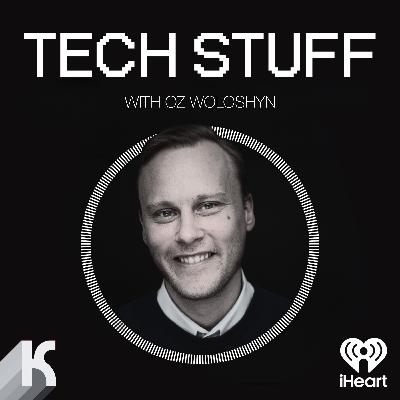
TechStuff
Claim Ownership

TechStuff

Author: iHeartPodcasts

Subscribed: 181,911Played: 2,943,924
Share

Description

Behind every innovation is a new kind of power. TechStuff unpacks how technology reshapes influence, creativity, and control, from Silicon Valley’s rising moguls to the cultural forces they create. Because tech is the new religion, economy, and entertainment, all at once.


Each week, Oz Woloshyn and the brightest minds covering tech dig into the weird, funny, and sometimes unsettling ways technology, AI, and the internet shape our daily lives. From AI and social media to privacy, digital burnout, and the creator economy, they ask how all this innovation is changing who we are, how we work, love, and make meaning.


Smart talk, strange stories, and the questions everyone’s Googling: whether AI will replace us, how social media is affecting our kids, and what it all says about us.


Get in touch here: techstuffpodcast@gmail.com
2560 Episodes
Reverse
A world where customers can buy everything they want, whenever and wherever they want isn’t 100% there—but it’s pretty close. And perhaps no company has been up for that challenge as much as Lowe’s.   In this episode of The Restless Ones, I had the chance to sit down with Seemantini Godbole, EVP and CIO of Lowe’s Companies, Inc., whose early start as an engineer has fueled problem-solving throughout her career. From helping customers prepare for projects via virtual appointments and designs, to making sure their local stores have the physical products needed to complete them, Seemantini is arming Lowe’s teams with the technology solutions to infuse more joy into home improvement without the usual friction.See omnystudio.com/listener for privacy information.
The promise of autonomous vehicles and machinery has been on the minds of industries, consumers and science fiction writers for many years. While advancements in AI, Robotics, Edge Computing and 5G Connectivity have gotten us closer to that vision, we are still quite far from computers solely running the show. The brain’s ability to compute and react to real-life situations is still a critical component to most operations, and companies such as Phantom Auto are working hard to combine these two forces - the advancements in machine learning  and the power of human decision making, opening entire sectors of the labor force previously unseen.    In this episode of The Restless Ones, I had the pleasure of sitting with the founding partners of Phantom Auto, Elliot Katz and Shai Magzimof who are actively merging the world’s needs for autonomous machine operation and dynamic employment opportunities. With skilled labor as a key problem for their clients, Phantom specializes in creating remote controlled solutions for everything from forklifts, to factory and warehouse vehicles and more, all made possible through connecting the power of technology and human intelligence. Their work is also bridging the worker divide, allowing blue collar workers to enjoy the benefits of remote work that their counterparts enjoy, avoiding the hazardous and other physical challenges typically associated with their work. See omnystudio.com/listener for privacy information.
When Craig Rupp left Iowa in the 80s, he never wanted to step foot on a farm again. A whirlwind career as an engineer took him to some of the biggest companies - Motorola, Apple, Samsung - but he always felt a strong connection to his roots. He had an idea he couldn’t shake - an opportunity to change farming forever. Introducing Sabanto and its best-in-class Autonomous Operator, Steward. On the day of their first big test, the tractor froze, stuck in a field in a blizzard - no planting, no company, no future. If Craig wanted this to work, he had to find a solution - and fast.  Ben is back with a series of episodes celebrating businesses from across America, starting with the great state of Iowa and Sabanto Agriculture. Joining Ben is Sachin Seghal Founder of Elevate Digital Marketing in Des Moines and Brian Lamb, Northeast segment head for Middle Market at JPMorgan Chase. Together they discuss the developments in Artificial Intelligence and its importance for small businesses while sharing insights on how small businesses can effectively transition to mid-sized enterprises and beyond.    The Unshakeables is brought to you by Chase for Business and Ruby Studio by iHeartMediaSee omnystudio.com/listener for privacy information.
OpenAI dominated this week's headlines — and it wasn’t all flattering. Reed Albergotti (Semafor) breaks down the chaos: IPO drama and Ronan Farrow's probing New Yorker profile of Sam Altman paint a picture of a company under pressure, even as it remains the most talked-about name in AI. Taylor Lorenz (User Mag) tells us about the AI tools marketed to schools as safety solutions that end up tracking students in ways with real consequences for kids and adults alike. And Kyle Chayka (The New Yorker) reviews the new book, Techno-Negative, tracing the long, often misunderstood history of anti-technology movements. Spoiler: it goes way deeper than the Luddites. Additional Reading:  Leap of Faith | Semafor Sam Altman May Control Our Future—Can He Be Trusted? | The New Yorker OpenAI CEO and CFO Diverge on IPO Timing | The Information They're Putting AI on School Buses | User Mag The Age-Old Urge to Destroy Technology | The New Yorker  Download SAILY in your app store and use our code techstuff  at checkout to get an exclusive 15% off your first purchase! For further details go to https://saily.com/techstuffSee omnystudio.com/listener for privacy information.
TBPN started with a simple premise: what if the tech world got the ESPN treatment? Eighteen months later, it is a profitable independent media company — until last week, when OpenAI acquired it for hundreds of millions of dollars.  Oz sits down with Emily Sundberg, author of the daily business newsletter Feed Me and frequent TBPN guest, to unpack what the deal actually means. They get into why OpenAI went shopping for a media company in the first place, what independence is really worth when a nine-figure offer lands in your inbox, and what this deal reveals about the strange new economy of attention. They also get into how Emily Sundberg built Feed Me into a thriving independent business — and why she's in no rush to follow TBPN out the door.Additional Reading:  You cannot compete with people who are having more fun than you.  Processing my San Francisco trip. - by Emily Sundberg    EXCLUSIVE NordVPN Deal ➼ https://nordvpn.com/techstuff Try it risk-free now with a 30-day money-back guarantee See omnystudio.com/listener for privacy information.
This week: Iranian propaganda gets a Lego makeover — and it's going viral. Kyle Chayka (The New Yorker) tracked down the collective behind the AI-animated videos flooding your feed. Nitasha Tiku (The Washington Post) was in a documentary, The AI Doc: Or How I Became an Apocaloptimist, and the press tour feels like ChatGPT doomsday déjà vu. Reed Albergotti (Semafor) celebrates Apple’s 50th birthday, but wonders if the company is entering its Microsoft era. Plus: SpaceX files for IPO — it could be the largest in history.  Additional Reading:  The Team Behind a Pro-Iran, Lego-Themed Viral-Video Campaign | The New Yorker See omnystudio.com/listener for privacy information.
What drives a man to turn down half a million pounds at 18, test Mark Zuckerberg's sincerity over dinner, and wonder aloud if he can win a second Nobel Prize? For Demis Hassabis, co-founder and CEO of Google DeepMind, the answer is a lifelong pursuit of artificial general intelligence — and an unshakeable belief that the technology he's creating will change everything about what it means to be human. Oz speaks with journalist and author Sebastian Mallaby about his new book, The Infinity Machine: Demis Hassabis, DeepMind, and the Quest for Superintelligence, tracing Demis's extraordinary journey from chess prodigy to the man at the center of the most consequential technological race of our time.See omnystudio.com/listener for privacy information.
The Week in Tech is back with a new roundtable! Every Friday, Oz and three of the best writers covering tech will discuss the latest news, decode emerging trends and debate what actually matters for the future of technology and for us. This week: Big Tech loses in court. Twice. Nitasha Tiku (The Washington Post) breaks down what the verdicts mean for Meta and YouTube and why it seems like we’re living in the past. Reed Albergotti (Semafor) explains why OpenAI killed Sora, its video-generation tool, and what it reveals about the resource war quietly reshaping the entire global economy. Plus, Kyle Chayka (The New Yorker) found a weather app worth caring about. We're as surprised as you are. Additional Reading:  Verdicts against Meta, YouTube reshape legal protections  for Big Tech  A New Cost Crunch | Semafor  Why You Hate Your Weather App | The New Yorker See omnystudio.com/listener for privacy information.
A $30,000-a-year piece of software has tech and finance bros beefing on LinkedIn. The Bloomberg Terminal has a rabid Wall Street fanbase. So when some tech bros claimed to have vibe-coded a version of the terminal, with one prompt, there were some strong emotions among its finance superfans. Oz talked to Isabelle Bousquette, a tech reporter for The Wall Street Journal, to break down the drama and what it says about the future of software. Then, Isabelle updates us on Nvidia’s massive developer conference last week, the company’s new OpenClaw obsession and why making a claw almost broke her brain.  Additional Reaching:  Finance Bros to Tech Bros: Don’t Mess With My Bloomberg Terminal | Wall Street Journal See omnystudio.com/listener for privacy information.
The Week in Tech is now a roundtable! Every Friday, Oz and three of the best writers covering Silicon Valley will discuss the latest news, decode emerging trends and debate what actually matters for the future of technology and for us. This week, guests Reed Albergotti (Semafor), Kyle Chayka (The New Yorker) and returning panelist Taylor Lorenz (User Mag) each share a story. Reed fills us in on what he saw at the Nvidia GTC conference in San Jose, and why we shouldn’t ignore OpenClaw. Taylor gives a primer on Section 230, the 30-year-old foundational internet law, and why there’s a campaign to repeal it. And finally, Kyle tells us what ‘taste’ means to Silicon Valley’s tech bros and why it may annoy you.  Additional Reading:  We’re all living inside Jensen Huang’s ‘triangle’ | Semafor  How Powerful People Became Obsessed w/ Section 230 | User Mag  Why Tech Bros Are Now Obsessed with Taste | The New Yorker See omnystudio.com/listener for privacy information.
Iran's Shahed drone costs $30,000 to build. The US missile sent to destroy it? Up to $4 million. Pulitzer Prize-winning conflict journalist Ben C. Solomon wants you to do the math. Oz sits down with Ben to break down the economics driving the conflict with Iran, why the Pentagon may already be making impossible choices about what to defend, and why Ukraine — largely abandoned by the West — has quietly become the world's leading authority on drone warfare. Additional Reading:  Ben C. Solomon Instagram: Just follow the money.  Pentagon acknowledges tough quest to counter Iranian drones | Military Times  US may not have capacity to take down full barrage of Iranian drones, officials warn | US-Israel war on Iran | The Guardian See omnystudio.com/listener for privacy information.
The Week in Tech is back and it’s growing. Starting this Friday, Oz will be joined by a panel of the brightest minds covering Silicon Valley. Each week, they will discuss the latest news, decode emerging trends and debate what actually matters for the future of technology and for us. This week, TechStuff asked Taylor Lorenz, Stephen Witt and Nitasha Tiku to share a story. Nitasha catches us up on the drama unfolding between Anthropic and the Pentagon. Stephen covers another tragic case of AI psychosis with fatal consequences. And Taylor makes the case for why 'social media addiction' is a harmful framework — and how age-verification laws could lead to mass surveillance and censorship of adults and children alike.Additional Reading:  Anthropic Sues Pentagon Over National Security Risk Label - The Washington Post Gemini Said They Could Only Be Together if He Killed Himself. Soon, He Was Dead. - WSJ  Congress Is Considering Abolishing Your Right to Be Anonymous Online - The Intercept  The world wants to ban children from social media, but there will be grave consequences for us all | Taylor Lorenz | The Guardian  This episode contains mentions of suicide. If you or someone you know needs support, contact the 988 Suicide & Crisis Lifeline by calling or texting 988, or visit 988lifeline.org.See omnystudio.com/listener for privacy information.
This week, we're talking 'human technology' — specifically, neuro-linguistic programming, or NLP. If you have any interest in modern day cults like NXIVM or Twin Flames Universe, you may have heard of it. But did you know that NLP also has roots in therapeutic practices like Eye Movement Desensitization and Reprocessing therapy, or that Tony Robbins was an NLP practitioner before becoming a motivational speaker?In the new podcast Mind Games, journalists and best friends Alice Hines and Zoë Lescaze investigate the origins of NLP, from its roots in the new age movement in 1970s California through the pick-up artist trend of the early 2000s. They even try their hand at hypnotizing themselves. But does it work?  Check out Mind Games from Kaleidoscope and iHeartPodcasts, wherever you get your podcasts.See omnystudio.com/listener for privacy information.
When documentary filmmaker Adam Bhala Lough set out to make a movie about OpenAI’s CEO Sam Altman, he hoped to get an interview with his main character. But when that didn’t happen, Adam found a workaround — he created a chatbot version of Sam Altman. From San Francisco to India to Los Angeles, Adam takes “Sambot” and the audience on a journey through the possibilities of what can happen when you deepfake a real person, and that person becomes your friend. Karah sat down with Adam to discuss the secretive, cult-like nature of OpenAI, Adam’s relationship with “Sambot,” and whether AI chatbots are the future of friendships.  If you’d like to see the film, check out deepfakingsamaltman.com/buy-tickets.See omnystudio.com/listener for privacy information.
This week, we’re bringing you an episode from the podcast No Such Thing. Join Manny, Noah, and Devan — three best friends and journalists — as they settle dumb arguments by actually doing the research.  Each week, they start with a debate or discussion. In this episode, they ask: what’s up with Tesla door handles? And why do microwaves have so many buttons? And why are couches so expensive, but so uncomfortable?  They’re joined by experts to answer these questions, including friend of the pod, Dexter Thomas, host of kill switch.   For more information, please subscribe to their newsletter at www.nosuchthing.show. And if you have any questions you’d like Manny, Devan and Noah to get to the bottom of, email them at or leave a voicemail: ‪(860) 325-0286.See omnystudio.com/listener for privacy information.
Tilly Norwood caused quite a stir when she was introduced in late 2025. Her creator, actor-producer Eline Van der Velden, said she wanted Tilly to be the “Scarlett Johansson” of AI actors. But she immediately felt the backlash from Hollywood. Emily Blunt called Tilly “really, really scary,” and agencies said they wouldn’t sign her. But Eline is pushing forward, creating a TV show around Tilly, filled with all-new AI characters. Karah sat down with Eline to talk about how she created Tilly, how she taught her to “act,” and to discuss how Eline sees the future of AI in filmmaking.See omnystudio.com/listener for privacy information.
How often do you use ChatGPT to evaluate your ailments? Did it work? More and more people are turning to chatbots to diagnose their illnesses — with varied success. But when it does work, it can be life-changing. Dr. Dhruv Khullar heard of a case where ChatGPT identified the cause of one man’s years-long gastrointestinal struggles, in seconds. Given a medical system that can fail so many, Dr. Khullar started to wonder, “If A.I. Can Diagnose Patients, What Are Doctors For?” That’s the title of a recent piece he wrote for The New Yorker. Oz sits down with Dr. Khullar to see if there is an answer to this question.  Additional Reading:  If A.I. Can Diagnose Patients, What Are Doctors For? | The New Yorker  The Role of Doctors Is Changing Forever | The New Yorker See omnystudio.com/listener for privacy information.
Is building data centers in space actually feasible? It may be, thanks to Ariel Ekblaw. The scientist, VC investor and co-founder and CEO of Aurelia Institute has devoted her life to democratizing space and ensuring that humans will one day be a spacefaring species. Ariel sits down with Oz to discuss self-assembling space architecture, how science-fiction influences her inventions, and why she doesn’t think billionaires investing in space is a bad thing.See omnystudio.com/listener for privacy information.
Cristóbal Valenzuela co-founded Runway to rethink how movies are made, and now his technology is spreading across Hollywood. Cristóbal sits down with Oz to discuss how far AI media tools have come in just the past six years, and why the next leap forward could happen even faster than anyone expects. He also addresses many artists' AI fears, by saying that film has always evolved alongside technological breakthroughs and that AI is simply the next chapter in that long history. And finally, Cristóbal and Oz explore Runway's next frontier after Hollywood and why video models might be the key to training humanoid robots.See omnystudio.com/listener for privacy information.
Theatre and tech don't usually share the same stage. But that's changing. This season, two plays caught our eye: Data, a play about the inner workings of a data mining company, and Marjorie Prime, a play where grief, family, and AI collide. Karah interviews both playwrights: Matthew Libby (Data) and Jordan Harrison (Marjorie Prime). They discuss the origins of their plays, from failed collabs with AI chatbots to the internship with Palantir that never was. And how plays about technology can teach us about our humanity.  Data runs through March 29th. Tickets are at lortel.org    Marjorie Prime runs through February 15th. Buy Tickets at 2st.comSee omnystudio.com/listener for privacy information.
loading
Comments (88)

Michelle Hovey

I have loved this show for the last 11 years, between them going away from topic based episodes and the new hosts I can't listen to it anymore I am truly sad to leave tech stuff. I hope someone else can come out with a good topic based technology show

May 11th
Reply (1)

burnoutParadiseReborn

was always here for Jonathan. nice time to the new hosts.

Jan 9th
Reply

philip koekemoer

unhinged take on X/Elon , completely missing that it's not about the money

Jan 4th
Reply

Nik Porosky

as soon as this idiot started talking to cats I unsubsribed

May 26th
Reply

philip koekemoer

"musky" words of a small minded loser

Apr 19th
Reply

philip koekemoer

move to brasil or Scotland, all the authoritarian speech and thought control to your heart's desire

Apr 12th
Reply

farnaz farhand

I hope you become increasingly better by the time and never back to hospital. I think one episode per a week or even two weeks is also resonable as we cannot manage to stay tune by more than that. So relax and thank you so much for keeping us up with technology breakthroughs.

Jan 24th
Reply

Annakaye Bennett

✅WATCH>>ᗪOᗯᑎᒪOᗩᗪ>>👉https://co.fastmovies.org

Jan 16th
Reply

baby rock

one hashtag is meaningless, and of course tictok would antcipate that, and of course it would manipulate data differently in different countries. Very naive take.

Nov 6th
Reply

philip koekemoer

got covid, " you won't get it,you won't spread it"

Oct 6th
Reply

stephen accardo

I love to listen to you. Keep up the great work. I just looked up Annual pass

Oct 1st
Reply

Gabriel Sesto

this episode hits different. ᕕ🤨ᕗ

Sep 8th
Reply (1)

Gabriel Sesto

funny Peter Pan

Sep 6th
Reply

Shahjan RASULY

I want to having text podcast

Sep 5th
Reply

philip koekemoer

"journalist", the CA train was supposed to be done in 2020, and go from LA to SF now it is double the cost, goes from Bakersfield to Merced, will never make money and won't be done by 2030 no mention of any of this. at least try to pretend you are somewhat clued up

Sep 1st
Reply

philip koekemoer

children should be able to read books so that it is easier for them to decide to mutilate themselves, tech news

Aug 16th
Reply

philip koekemoer

"journalist" can't handle CEO who doesn't have the correct opinion rent free

Jul 29th
Reply

philip koekemoer

Funny how this is now a legitimate concern, not like Elon musk has said it before.

May 14th
Reply

philip koekemoer

Did you even listen to the Musk interview? He discussed OpenAi, not chatgpt He said twitter DM's are open and not encrypted

Apr 22nd
Reply

philip koekemoer

Slate is not a credible news source. Parroting talking points is not news. Npr is as credible as Slate , same narratives

Apr 14th
Reply