


 Claim Ownership
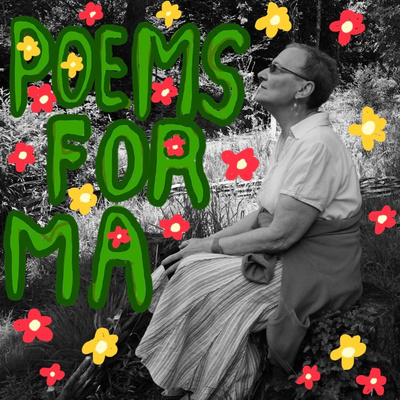
Poems For Ma
Subscribed: 0Played: 0
Subscribe

© Love & Mercy Radio
Description
My mother is ageing. Her cognitive capacities are declining, but her wisdom and life experience are at their peak. This is a podcast that tries to tap into the latter, whilst being aware of the former.
Every few days, I send Ma a poem I think she might like with some questions I have about the poem which I'm interested in talking about with her. I read the poem aloud and then we talk about it, enjoying each other's company.
Every few days, I send Ma a poem I think she might like with some questions I have about the poem which I'm interested in talking about with her. I read the poem aloud and then we talk about it, enjoying each other's company.
7 Episodes
Reverse
A ROSE
Did I dream of a flower
last night or the night
before? That I saw as
if the answer to
the question I'd asked, which
I can't remember. But
in my dream, this
morning, I decided it
was a rose, and it
rematerialized, or rather,
I held up a hologram
of it & showed it to the
boys - Hurry,
I can't hold it here
much longer, I said,
Is it the right one?
They said, Yes.
-Alice Notley
THE PANTHER
His vision, from the constantly passing bars,
has grown so weary that it cannot hold
anything else. It seems to him there are
a thousand bars; and behind the bars, no world.
As he paces in cramped circles, over and over,
the movement of his powerful soft strides
is like a ritual dance around a center
in which a mighty will stands paralyzed.
Only at times, the curtain of the pupils lifts, quietly--.
An image enters in,
rushes down through the tensed, arrested muscles,
plunges into the heart and is gone.
-Rainer Maria Rilke
THE PEACE OF WILD THINGS
When despair for the world grows in me
and I wake in the night at the least sound
in fear of what my life and my children’s lives may be,
I go and lie down where the wood drake
rests in his beauty on the water, and the great heron feeds.
I come into the peace of wild things
who do not tax their lives with forethought
of grief. I come into the presence of still water.
And I feel above me the day-blind stars
waiting with their light. For a time
I rest in the grace of the world, and am free.
-Wendell Berry
DON'T HESITATE
If you suddenly and unexpectedly feel joy,
don’t hesitate. Give in to it. There are plenty
of lives and whole towns destroyed or about
to be. We are not wise, and not very often
kind. And much can never be redeemed.
Still, life has some possibility left. Perhaps this
is its way of fighting back, that sometimes
something happens better than all the riches
or power in the world. It could be anything,
but very likely you notice it in the instant
when love begins. Anyway, that’s often the case.
Anyway, whatever it is, don’t be afraid
of its plenty. Joy is not made to be a crumb.
-Mary Oliver
WARNING
When I am an old woman I shall wear purple
With a red hat which doesn’t go, and doesn’t suit me.
And I shall spend my pension on brandy and summer gloves
And satin sandals, and say we’ve no money for butter.
I shall sit down on the pavement when I’m tired
And gobble up samples in shops and press alarm bells
And run my stick along the public railings
And make up for the sobriety of my youth.
I shall go out in my slippers in the rain
And pick flowers in other people’s gardens
And learn to spit.
You can wear terrible shirts and grow more fat
And eat three pounds of sausages at a go
Or only bread and pickle for a week
And hoard pens and pencils and beermats and things in boxes.
But now we must have clothes that keep us dry
And pay our rent and not swear in the street
And set a good example for the children.
We must have friends to dinner and read the papers.
But maybe I ought to practise a little now?
So people who know me are not too shocked and surprised
When suddenly I am old, and start to wear purple.
-Jenny Joseph
THE SINGING
There’s a bird crying outside, or maybe calling, anyway it goes on and on
without stopping, so I begin to think it’s my bird, my insistent
I, I, I that today is so trapped by some nameless but still relentless longing
that I can’t get any further than this, one note clicking metronomically
in the afternoon silence, measuring out some possible melody
I can’t begin to learn. I could say it’s the bird of my loneliness
asking, as usual, for love, for more anyway than I have; I could as easily call it
grief, ambition, knot of self that won’t untangle, fear of my own heart. All
I can do is listen to the way it keeps on, as if it’s enough just to launch a voice
against stillness, even a voice that says so little, that no one is likely to answer
with anything but sorrow, and their own confusion. I, I, I, isn’t it the sweetest
sound, the beautiful, arrogant ego refusing to disappear? I don’t know
what I want, only that I’m desperate for it, that I can’t stop asking.
That when the bird finally quiets I need to say it doesn’t, that all afternoon
I hear it, and into the evening; that even now, in the darkness, it goes on.
Kim Addonizio
--
The bird in this poem might be called The Bird of Yearning, or The Bird of Longing. Would you say that the things, people, or the experiences that you have yearned for or desired in your life thus far have been consistent over time, the same things over time? Is there a kind of “thread” to your yearning/longing heart in some way? Or do you think the yearning and the longing is more specific to our context as well as where we are in life?
There seems to be a suggestion in some way that if we can “break free“ of the wanting self (I, I, I), that believes it “deserves” or should have access to something or someone, or some kind of experience, we might be a little bit freer? Do you agree? How might this be accomplished?
Why do you think that some of us, including the speaker of this poem, feel that we don’t really get the love that we need? Is it a matter of expectations being too high, or something else?
Do you agree that “ all we can do is listen to [this inner voice], to the way way it keeps on,” recognising that “it’s enough just to launch a voice
against stillness, even a voice that says so little, that no one is likely to answer
with anything but sorrow, and their own confusion.” Should we expect more than this, or is this about as good as it gets?
What is “sweet“ about this “beautiful, arrogant ego” of the I, I, I? It doesn’t feel particularly sweet, and often we experience it in ourselves as painful and equally when it is being foisted on us by others.
What do you think the poem is asking us to do with regard to the mind when it sees the world through this lens of lack or yearning?
--
Intro & Exit music: God Only Knows (piano cover) by Sangah Noona
Please support Sangah's work by subscribing to her wonderful YouTube channel
TO A POOR OLD WOMAN
munching a plum on
the street a paper bag
of them in her hand
They taste good to her
They taste good
to her. They taste
good to her
You can see it by
the way she gives herself
to the one half
sucked out in her hand
Comforted
a solace of ripe plums
seeming to fill the air
They taste good to her
—
What are your feelings towards this woman as she is portrayed in the poem?
Why do you think William Carlos Williams repeats that line “they taste good to her“ over and over again?
What are your memories of comfort food, particularly as a child? What sort of food do you find comforting to eat now?
This poem seems to be a celebration of fruit as life and life as fruit, do you have any particular experiences of eating fruit in this almost transcendent way?
What do you think this woman is thinking about? Or is the rapture of this poem pointing to the fact that she is thoughtless at this moment, completely one with the sensations of eating her bag of plums?
--
Intro & Exit music: God Only Knows (piano cover) by Sangah Noona
Please support Sangah's work by subscribing to her wonderful YouTube channel
WILD GEESE
You do not have to be good.
You do not have to walk on your knees
for a hundred miles through the desert repenting.
You only have to let the soft animal of your body
love what it loves.
Tell me about despair, yours, and I will tell you mine.
Meanwhile the world goes on.
Meanwhile the sun and the clear pebbles of the rain
are moving across the landscapes,
over the prairies and the deep trees,
the mountains and the rivers.
Meanwhile the wild geese, high in the clean blue air,
are heading home again.
Whoever you are, no matter how lonely,
the world offers itself to your imagination,
calls to you like the wild geese, harsh and exciting -
over and over announcing your place
in the family of things.
Questions:
How do you understand the first line of this poem: You do not have to be good?
What did “being good” entail for you as a child, as a teenager as a young adult, and what does “being good” mean to you now?
What are the ways in which “the soft animal of your body” communicates itself to you that it might, as the poem suggests, be responding with love and appreciation to your experience of life?
How does this happen on a daily basis for you? What do you think gets in the way of it happening?
Are there ways in which you can connect with this more for yourself? Or is it a kind of a gift when it happens? A kind of grace? (As in: an unmerited form of favour, or peace bestowed on the mind. Do we get to feel this way by “the grace of God“ (or Life) rather than anything we ourselves do? Or can we cultivate more of this “soft animal pleasure” in our lives.
The word “despair” is such a strong word. In what way does it capture your mind’s response to something going on in your life at the moment?
Does it help, when we are thinking of our despair, to have a “meanwhile the world goes on” going on at the same time in our minds?
Does the “meanwhile” of the rain and the landscapes and the trees and the mountains and the rivers, offer you a kind of solace as I think Mary Oliver intended? Does it help you to think about other things that are occurring unrelated to you at the same time as your despairing?
What do you think she means here when she says that “the world offers itself to your imagination“? In what way in your life at the moment, do you feel that the world is still offering itself to your imagination?
What is our imagination supposed to do with the world? How would you like your imagination to continue interacting with the world.
What for you does the “family of things“ point to? Do you feel yourself part of that “family“ – in what way?
Is this necessarily a family of “things“ or a family of shared experience?
What are the shared experiences that make us feel familiar to each other, that make us feel like we are family? You and me, but maybe also our experience with that of the world, and others?
If you had to choose a couple of lines from this poem to repeat over and over again as you move through the day as a kind of mantra? What would those lines be? What do they mean to you now, and what might they mean to you after repeating them 100 times?
Comments

Download from Google Play

Download from App Store
 United States