


 Claim Ownership
Memristor Podcast
Subscribed: 2Played: 90
Subscribe

© All rights reserved.
Description
Memristor Podcast is the audio platform for IEEE University of Tripoli Student Branch , which comes to you in fortnight episodes, represented by two programs, EE Talk, in which we communicate with engineers, researchers, and inspiring students, to benefit from their experiences and expertise, and Tech Wise in which we outline the latest technologies in different fields.
18 Episodes
Reverse

التقديم : امل فتحي ،منار العرادي الاعداد: شمس الدويبي ،منار العرادي ،امل فتحيمونتاج الصوت : سرور ابوشعالة sources:[1] https://arabicedition.nature.com/journal/2021/06/d41586-021-00533-x/%D9%83%D9%8A%D9%81-%D8%AA%D8%A8%D8%AF%D8%A3-%D8%B1%D8%AD%D9%84%D8%AA%D9%83-%D9%81%D9%8A-%D8%A7%D9%84%D8%AD%D9%88%D8%B3%D8%A8%D8%A9-%D8%A7%D9%84%D9%83%D9%85%D9%8A%D8%A9%D8%9F[2] https://www.ibm.com/topics/quantum-computing[3] https://www.sciencenews.org/article/physics-first-room-temperature-superconductor-discovery[4] https://spectrum.ieee.org/smallest-transistor-one-carbon-atom[5] https://spectrum.ieee.org/google-team-builds-circuit-to-solve-one-of-quantum-computings-biggest-problems

في هذه الحلقة ستتعرّف على د. نوري عن قرب، وعن سبب اختياره للمجال الأكاديمي، وكيف تحصّل على منحة دراسيّة لدراسة الدكتوراة بألمانيا، وسبب اختيار تخصص الميكاترونيكس في رسالة الماجستير، وعلوم الكمبيوتر في رسالة الدكتوراة
EE Talke

EE Talk
تخيّل تقدر تشوف العيوب قبل ما تولّي مشاكل…و تجرّب قرارات خطيرة بدون ما تمس الواقع…وتخش عالم كامل يتحرك مع الحقيقة لحظة بلحظة
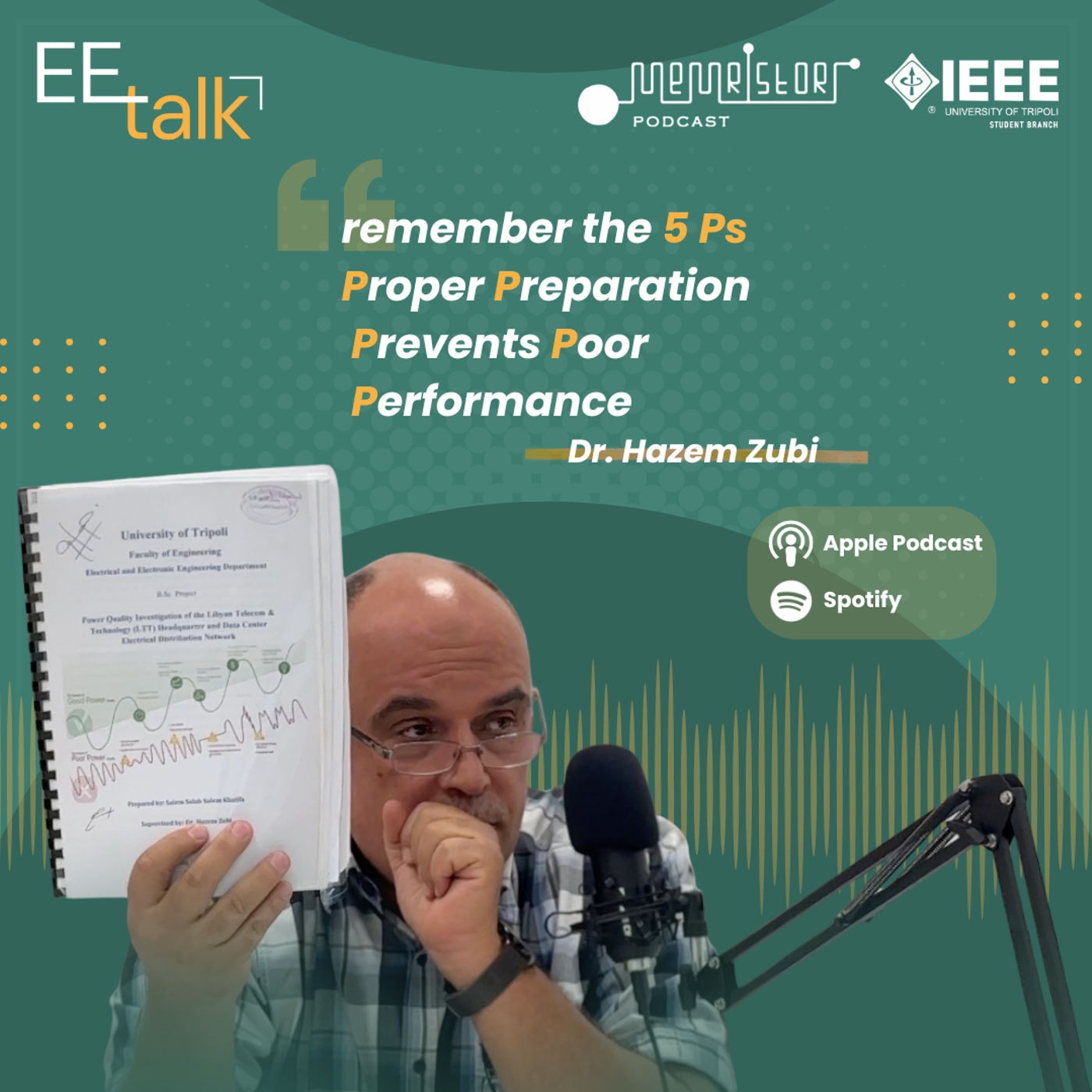
من داخل أسوار كلية الهندسة ومن قلب قسم الهندسة الكهربائية والإلكترونية بودكاست EE Talk يعود بحلقة استثنائية مع أحد الأسماء البارزة في القسم، الدكتور حازم الزوبي
خطوة وحدة… وتلقى روحك في عالم افتراضي ياخذك لتجربة ما صارتش قبل الـ VR هي التقنية اللي بدّلت مفهوم التفاعل مع الواقع.اسمعوا حلقتنا الجديدة من TechWise، وخلّونا نعيشوا في العالم اللي بين الحقيقة الخيال

عشرون عامًا من الخبرة يشاركها معنا أ. حمدي جابر في حلقة جديدة من برنامج EE Talk 💬 ها نحن نعود من جديد في حلقة جديدة مليئة بالتجارب والخبرات، وتُجيب العديد من التساؤلات التي لطالما نبحث عنها.ما المقصود بالخبرة؟ وكيف تتحصل عليها في فترة ما قبل التخرج؟ ما هي وجهة نظر أ. حمدي في القطاع العام، وهل الاستقرار في بيئة واحدة تساهم في تطوير مهاراتك؟ نقديم: تيمة توميةهندسة الصوت: علي بيت المال، تيمة تومية

كيف يمكنك استغلال مجرَد فكرة لطيفة إلى خوارزمية تستخدمها شركات عملاقة كشركة قوقلاعداد: تيمة تومية، معتز الحربيهندسىة الصوت: تيمة تومية

المهندس وسيم جحا تخرّج من كلية تقنية المعلومات قسم هندسة البرمجيات عام 2022يعمل كمطور ويب في شركة كبرى متخصّصة في تطويرتطبيقات الويب، يتمتّع وسيم بمهارات برمجيّة قويّة ويتقن استخدام مجموعة متنوعة من لغات البرمجةتقديم: تيمة تومية تعديل الصوت: علي بيت المال

المهندس محمد الفقيه، خريج برمجة كمبيوتر ويعمل كمدير مبيعات في شركة LTT للاتصالات والتقنية.تقديم: أمل فتحيتعديل الصوت: علي بيت المال ،سرور أبوشعالة

المهندسة أبرار أبو رقيبةcustomer services & technical support managerفي شركة الحداثة العالمية للاتصالات وتقنية المعلومات، وخرّيجة هندسة اتصالات من كلية التقنية الالكترونيّة سنة 2019تقديم: أمل فتحيتعديل الصوت: سرور أبوشعالة ,علي بيت المال

نستكمل رحلتنا من قلب معرض التقنية والتي سنتعرف خلالها على سوق العمل ونخوض في التحديات التي يواجهها الخريجين لسد الفجوات بين سوق العمل والدراسة الأكاديميةضيف حلقتنا اليوم م.مالك أبوعائشة متحصل على درجة البكالوريس من قسم الهندسة الكهربائية والإلكترونية بجامعة طرابلس في سنة 2022 ويعمل اليومas a Solution Manager for Huaweiتقديم: علي بيت المال تعديل الصوت: سرور أبوشعالة

معرض الاتصالات والتقنية هو الفرصة المناسبة لطرح ما يخوضه العالم من تقنيات حديثة، والدكتور أحمد العدل هو أحد الضيوف اللي كان لحضورهم تأثير على نجاح البرنامج العلمي للمعرض د. أحمد العدل من مصر رائد في مجال التكنولوجيا المبتكرة وحاصل على درجة الدكتوراة في مجال الذكاء الاصطناعي، في هذه الحلقة حيحدثنا عن خبراته ومسيرته الدراسيّة والمهنيّة، وحيشاركنا بأهم المواضيع المطروحة في ورشة العمل اللي قدّمها في المعرض والتي كانت بعنوان ( Artificail intelligence smart cities & cognitive twins ) تقديم:أمل فتحي تعديل الصوت:سرور أبوشعالة
Has anyone seen singin in the rain before ?It was in 1952 but the story goes on in the late 20s where sound revolution came in and films were changed from the usual at that time which is silent films to talkies and all the difficulties that came with it From the problem of recoding the voice of the actors without the noises of the set disturbing to synchronizing the sound with picture and so on ,all that with a comedy and musical theme .It emphasized the technological evolution that gave filmmakers new tools to make their films !And this is what’re going to talk about ! so lets start .This episode topic filmmaking.I don’t think there’s someone out there who hasn’t seen at least one film in their life ,films are a work of visual arts and way to present ideas, stories, , feelings, or atmosphere through the use of moving images.But lets back up a little bit before I lose track and believe me when it comes to this I’m ganna.Lets come to this in kinda of a scientific way since that’s kinda our show .Film is kind of illusion based on the optical phenomena know as persistence of vision and the phi phenomenon ,the persistence of vision is the retention or store of a visual image for a short period of time in the brain after the stimulus that produced the image is removed ,and the phi phenomenon an illusion of movement that happens when still objects are placed side by side and displayed to light rapidly one after another, Together these two phenomenas allow the sequence of still frames on a film strip to represent continuous movement when projected at the proper speed.From the first motion picture in 1888 and to the first talking picture the Jazz singer in 1927 to the first film in color the wizard of OZ in 1939 The technology of film emerged mostly from developments and achievements in the fields of projection, lenses, and photography Most early photographic sequences,were not initially intended to be viewed in motion and were typically presented as a serious, even scientific, method of studying movementLets talk about cameras for a little bit A motion-picture camera must be able to advance the medium rapidly enough to allow at least 16 frames per second as well as bring each frame to a full stop to record a sharp image.The principles of modern professional motion-picture cameras are much the same as those of earlier times, although the mechanisms have been freed from impurities . A film is exposed behind a lens and is moved intermittently, with a shutter to stop the light while the film is moving. In the process, the film is unrolled from a supply reel, through the intermittent to the gate where the exposure takes place, and then on to the take-up reel.Cameras became digital With the advancement in electronics which are unlike film cameras digital cameras do not have film and sometimes lack a viewfinder which is a component used to allow the photographer to see the area that will be included in the photograph, which is replaced by an LCD (liquid crystal display).At the core of a digital camera is a semiconductor which measures light intensity and color transmitted through the camera’s lenses. When light strikes the individual light receptors, or pixels, on the semiconductor, an electric current is induced and is translated into binary digits for storage within a flash memory.An important part in cameras either film or digital cameras are the lenses Lenses have gone through a continuous evolution in the last half century, for both still and motion-picture photography. The two major objectives have been to focus properly all the colors of the image at the film plane and to focus portions of a beam coming from different portions of the lens, the center or the edges, at the same point on the film.Both objectives require solution for as large a lens opening as possible, in order to capture maximum light for the exposure, and for as wide a field of view as will be needed. In order to solve these problems, lenses have been made with more and more components. Also, more types of glass have been discovered and developed, to give better achromatic performance.The popularity of the motion picture inspired many inventors to seek a method of reproducing accompanying sound. Inventors and entrepreneurs needed to overcome several problems before sound could be accepted. There was the technological difficulty of matching sound and visuals in such a way that everyone in the audience could hear. In other words, the problems were synchronization and amplification.For the amplification problem lee de froestin1907 invented the audion which Is a amplifying vacuum tube, it provided the basis in the early 1920s for a feasible amplifier that produced an undistorted sound of sufficient loudness.Next came the problem of synchronization of the sound with the picture. A major difficulty turned out to be the securing of constant speed in both the recorder and reproducer.Even after invention, sound presented a host of problems. The early sound cameras and equipment were big and noisy, and had to be kept in their own soundproof room, called a "blimp." And it took a while for someone to figure out that you could move the microphone around by placing it at the end of a stick?calleda "boom"?just above the range of the camera. So very early sound films tended to be very static because actors had to speak to a static mikeThe development of sound technology in the first years of talking pictures focused on two areas. One involved the development of equipments so that sound could be recorded more cleanly at the time of shooting, for example blimped cameras these are cameras with a sound blimp to reduse sounds such as shutter click, and motors on motion picture cameras , and directional microphones that can pick up sound from a specific area , and microphone booms, and quieter lights,. The other technologies involved the ability to add, edit, and mix sound separately from the time the picture was recorded.Today we take colour photography for granted. Taking pictures in full, natural colour is so easy that we don’t pause to consider how it all came about. Yet the search for a cheap and simple process of colour photography followed a long and difficult quest with many a wrong turns and dead endsColour was first added to black-and-white movies through hand colouring, tinting,and toning By 1906, the principles of colour separation were used to produce so-called ‘natural colour’ moving images with the British Kinemacolorprocess which was photographing and projecting a black-and-white film behind alternating red and green filters,and it was wasprimarily used for documentary films .The early Technicolor processes from 1915 onwards were cumbersome and expensive, and colour was not used more widely until the introduction of its three‑colour process in 1932which is a process that uses the fact that any colour can be reproduced solely combining the three primary colours. It was used for films such as Gone With the Wind and The Wizard of Oz (both 1939) in Hollywood and A Matter of Life and Death (1946) in the UK.In the past 20 years, film production has been profoundly altered by the impact of rapidly improving digital technology. Most mainstream productions are now shot on digital formats with subsequent processes, such as editing and special effects, undertaken on computersCinemas have invested in digital projection facilities capable of producing screen images that rival the sharpness, detail and brightness of traditional film projection.The development of motion picture complexity has been driven by a continuing technological evolution, which has afforded filmmakers the opportunity to practice a more complex craft to tell more complex stories, this evolution has driven the development of distinct styles, movements, and methods that would have been impossible without increasingly advanced tools .Even though this evolution has empowered filmmakers by offering a more diverse catalogue of tools and techniques, it is the filmmaker’s ability to effectively use this technology within a temporal and societal context that truly drives cinematic quality.this technology only serves as another option for filmmakers to choose and not a precondition of modern quality.
Hello everyone This is techwise podcast ,I’m Hadeel ,and here we’re or I’m ganna talk about science and Technology,This episode topic is about mars exploration and some of course not all the science and technology that helped explore the red planet. Roughly every two years Mars and Earth wander a bit closer to each other, making the leap between these two planets a little easier.Since 1960, dozens of missions launched to Mars to learn more about our planetary neighborWhy does Mars have such a hold over us?it’s the tantalizing nature of Mars. Here is a planet that we could conceivably walk on (unlike the gas giants), without being crushed by atmospheric pressure (like on Venus), having to deal with the radiation of being closer to the sun (Mercury) or just being far too far away (like Pluto). It calls to us through science fiction and fact, a planet that is so like our own Earth, but so unlike it at the same time. -Active missions:Most of The artificial objects on the surface of Mars, consisting of spacecraft which were launched from Earth are defunct after having served their purpose, the Curiosity rover, InSight lander, Perseverance rover, Ingenuity helicopter, and Zhurong rover are all active. • Curiosity: Curiosity rover landed on Mars in 2012 with a primary mission to find out if Mars is, or was, suitable for life. Another objective is to learn more about the Red Planet's environment.One thing that makes Curiosity stand out is its sheer size: Curiosity is about the size of a small SUV.Engineers at NASA's Jet Propulsion Laboratory designed the rover to roll over obstacles up to (65 centimeters) high and to travel about (200 m) per day , The rover's power comes from a multi-mission radioisotope thermoelectric generator, which produces electricity from the heat of plutonium-238's radioactive decay.Curiosity has four main science goals: Determine whether life ever arose on Mars, Characterize the climate of Mars, Characterize the geology of Mars, Prepare for human exploration.In support of the science, Curiosity has a suite of instruments on board to better examine the environment:• Cameras that can take pictures of the landscape or of minerals close-up• Spectrometers to better characterize the composition of minerals on the Martian surface, • Radiation detectors to get a sense of how much radiation bathes the surface, which helps scientists understand if humans can explore there – and if microbes could survive there• Environmental sensors to look at the current weather. This is the Rover Environmental Monitoring Station• An atmospheric sensor that was primarily used during landing. • InSight:The insight lander is Tasked with peering beneath the Martian surface and mapping the planet’s underworld.The InSight Lander’s three primary instruments, SEISwhich stands for Seismic Experiment for Interior Structure, is a round, dome-shaped instrument that sits on the Martian surface and takes the "pulse" or seismic vibrations of Mars. Its measurements provide a glimpse into the planet’s internal activity. The seismometer waits patiently to sense the pulse, or seismic waves, from marsquakes, and thumps of meteorite impacts. A suite of wind, pressure, temperature, and magnetic field sensors help fine-tune the seismometer's measurementsThere is the Heat Flow and Physical Properties Package or HP3 , Like studying the heat leaving a car engine, it measures the heat coming from Mars' interior to reveal how much heat is flowing out of the body of the planet, and what the source of the heat is. And finally InSight’s Rotation and Interior Structure Experiment or RISE precisely tracks the location of the lander to determine just how much Mars' North Pole wobbles as it orbits the sun. These observations will provide detailed information on the size of Mars' iron-rich core. They will help determine whether the core is liquid, and which other elements, besides iron, may be present. • Perseverance :Like its predecessor Curiosity , Perseverance is a semi-autonomous mobile science platform the size of a small car. It's designed to spend years roving the red planet, looking for (among other things) any evidence of microbial life that may have thrived on Mars in the past.This mission to Mars is arguably the most ambitious one ever launched, combining technically complex science objectives with borderline craziness that includes the launching of a small helicopterWhile the overall design of the rovers is very similar to curiosity , including the radioisotope thermoelectric generator as a power source,. Perhaps the most significant difference between the two rovers in software is that Perseverance is much more autonomous than Curiosity. It'll be able to plan its own driving paths, traveling farther every dayPerseverance is bringing seven science instruments to Mars, including:• Mastcam-Z:Color cameras capable of panoramic and stereoscopic imagery.• SuperCam:A combination camera, rock-vaporizing laser, and spectrometer that can identify the composition of rocks and soils in areas that the rover's arm can't reach• SHERLOC: A close range microscopic camera and spectrometer that Perseverance can move within just a few centimeters of a rock for a detailed analysis, specifically designed to detect organic molecules• PIXL: Another microscopic analysis tool which includes an X-ray fluorescence spectrometer to detect very small scale changes in the composition and texture of rocks.• RIMFAX: Ground-penetrating radar that can detect water or ice 10 meters beneath the surface underneath the rover.• MEDA: A suite of sensors that measure temperature, pressure, humidity, wind speed and direction, and atmospheric dust characteristics• MOXIE: Moxie will try to convert Martian atmosphere (96% CO2) into useful oxygen with carbon monoxide as a byproduct via an electrolyzer heated to 800 degrees C, in a process that NASA says is a bit like a fuel cell running in reverse. Perseverance won't be using the oxygen, but if the technology proves itself humans may one day use it for breathable air and rocket fuel• Sample Caching System: A huge chunk of Perseverance is devoted to taking samples of the Martian surface, analyzing them, and storing them. These samples will be sealed up and left on the surface, with the idea that in a decade or so, another robot will come along, scoop them up, put them into a rocket, and fire them back to EarthAlong with perseverance there was the Mars Helicopter, Ingenuity, which is an experimental technology test, the primary objective is to demonstrate that autonomous, controlled flight can be achieved in the tenuous Martian atmosphere. The helicopter has a mass of roughly 1.8 kg and flies with twin counter-rotating blades which will rotate at almost 3000 rpm. The body of the helicopter has four landing legs. Power is provided by solar panels mounted above the rotors charging lithium-ion batteriesThe helicopter has a heating mechanism for night-time survival. Communications will be relayed through the rover. There are no science experiments on board. • Zhurong:Is a part of the Tianwen-1 mission. The 1.85 meters tall rover is solar-powered, its four solar panels are designed in the shape of foldable butterfly wings. Solar power collection needs to be greater, with Mars receiving around 44% of the levels of sunlight that reach Earth.The rover carries six science payloads to study the topography, geology, soil structure, minerals and rock types and atmosphere in the area:• NaTeCam: A pair of 2048 × 2048 pixel navigation and terrain cameras mounted on the mast of the rover to provide 3D panoramic imaging, assist navigation and study Mars topography and geology.• MSCam: A multispectral camera installed on the mast between the NaTeCams to provide information on surface materials and their distribution across nine spectral bands. It covers eight spectral bands as well as visible light.• MarSCoDe: The Mars Surface Composition Detector includes a laser-induced breakdown spectroscopy (LIBS) spectrometer, which vaporizes rocks to analyze their composition• RoPeR: A penetrating radar picking up echo data to study the soil and potential water ice below the surface.• RoMAG: A mast-mounted magnetometer for measuring the magnetic field. It will work together with another magnetometer aboard the orbiter.• MCS: The Mars Climate Station combines a number of sensors to collect data on temperature, pressure, wind speed and direction. If anyone needs any information on any of NASA’S spacecrafts ,they have an archive with all the information on every mission they ever did just Google NSSDCA, it stands for “NASA Space Science Data Coordinated Archive” I guess you can see why the use the abbreviation!And if you guys have any questions google it ,I’m not a scientist !i’m just a girl who reads …..sometimes !Thank you for listening have a good evening. Tech care !
In classical circuit theory we have 4 fundamental circuit variables: the current, the voltage, charge, and flux linkage.
We can combine these variables in six pairwise relations, five of these relations are well known to us.
The first two pairs define the voltage and the current where the voltage is the rate of change in the flux linkage and the current is the rate of change in the charge.
The other three pairs define the fundamental circuit elements, we have the resistor which relates the current with the voltage, the capacitor which relate the voltage with the charge ,and the inductor which relate the current with the flux linkage.
These elements are called fundamentals because we cannot produce their behavior with other fundamental elements.
This leaves one relation ,which is the relation between the flux and the charge .
In 1971, a University of California, Berkeley, engineer predicted that there should be a fourth element in order to fill this gab .that element is what we’re going to talk about today!
You’re listening to techwise podcast coming to you by the IEEE UOT student branch and here we talk about science and technology from different fields, lets start!

Introducing Memristor Podcast
Comments

Download from Google Play

Download from App Store
 United States