


 Claim Ownership
The Science, Microbes & Health Podcast
Subscribed: 38Played: 996
Subscribe

Description
This podcast covers emerging topics and challenges in the science of probiotics, prebiotics, synbiotics, postbiotics and fermented foods. This is the podcast of The International Scientific Association for Probiotics and Prebiotic (ISAPP), a nonprofit scientific organization dedicated to advancing the science of these fields.
93 Episodes
Reverse
This episode features Prof. Christophe Courtin from KU Leuven (Belgium), speaking about the European HealthFerm initiative. HealthFerm began in September 2022 and brought together multiple institutions and companies to advance the project with a grant of 30 million Euros. The main aim of the project was to improve public acceptance of plant-based foods through fermentation. A citizen science component of the project involved gathering fermented food samples from all over Europe, both home fermenters and small bakeries, to analyze the microorganisms. The researchers received over 650 sourdough starter samples and around 200 other fermented foods samples; from these, they identified some new species that still need to be named. Another part of the project involved a clinical trial on how the body responds if short-chain fatty acids are released in the small intestine versus in the colon. They found that small intestinal release increased GLP-1 levels more than PYY; the opposite happened with colonic release. Another study in the project compared oat to fermented oat, and found that the fermentation changed the fiber (degree of polymerization), and also led to positive health effects. Prof. Courtin says the potential for future research in this area is to find out how to add nutritional benefits through fermentation (for example, vitamin B12 in plant-based foods), as well as how to change the fiber profile in a food to yield specific health benefits.
Episode abbreviations and links:
Study on properties of a plant-based gurt: Process-induced changes in starch, dietary fiber, and protein in a fermented plant-based dairy alternative (yo)gurt.
Paper exploring oat fermentation: Enzyme activity and constituent extractability of kilned and non-kilned oats at pH values relevant for acidic food fermentations.
Study on gut microbiota signatures of type 2 diabetes risk: Gut microbiome composition and functional potential associate with incident type 2 diabetes in 4,685 adults from a Swedish prospective cohort
About Prof. Christophe Courtin:
Prof. Christophe Courtin is a full professor at the Laboratory of Food Chemistry and Biochemistry at KU Leuven, Belgium. His research focuses on cereal constituents, the enzymes that degrade them and microorganisms in cereal processing. The emphasis is on a basic understanding of the structure and properties of these constituents as well as on their technological and health functionality in cereal-based processes and products. Expertise and an extensive network in this area have been built up through over 40 supervised PhDs, projects and national and international collaborations. He coordinates HealthFerm, a 23 partner Horizon Europe project. He is author of 380 peer-reviewed papers (WoS h-index: 74) and inventor on 12 patent families. Recent awards are the Harald Perten Prize (ICC, 2021) and the Belfort Lecture Award (Whistler Centre for Carbohydrate Research, Purdue University, 2023).
This episode features Dr. Mingyang Song ScD from Harvard University (USA), speaking about epidemiological evidence connecting the gut microbiota to colorectal cancer (CRC) and whether the evidence supports the gut microbiota as a ‘driver’ or a ‘passenger. Dr. Song explains how he and colleagues studied the gut microbiome in a subset of people from the Nurses’ Health Study. It’s known that adenoma removal reduces CRC risk, but doesn’t eliminate it. Does the gut microbiome contribute to this remaining risk? The researchers found that many years after adenoma removal, individuals had a different gut microbiota compared with healthy controls, indicating that the microbiome profile is not fully restored by adenoma removal. People with past adenoma removal had a gut microbiota that overlapped with that of current CRC patients, with the caveat that lots of heterogeneity was observed. Diet and lifestyle also correlate with both CRC development and gut microbiome composition, with some of the main factors reducing CRC risk being dietary fiber, fruits, vegetables, whole grains, and calcium. These and other healthy lifestyle factors were associated with fewer of the gut microbial members typically seen in CRC. Next, prospective studies are needed to determine whether gut microbiota changes truly precede CRC and independently contribute to risk. This line of research could also lead to a more tailored approach to CRC screening, with risk factors being taken into account.
Episode abbreviations and links:
Study on a subset of participants in the Nurses’ Health Study, showing those who previously experienced adenoma removal had gut microbial similarities to CRC: Long-lasting gut microbiome and fecal metabolome alterations after colorectal adenoma removal and their relationship to colorectal cancer
About Dr. Mingyang Song ScD:
Mingyang Song, MBBS, ScD is Associate Professor of Clinical Epidemiology and Nutrition and Faculty Director of Graduate Studies in the Department of Epidemiology at the Harvard T.H. Chan School of Public Health, and Associate Professor of Medicine at Harvard Medical School. His research focuses on two complementary areas: (1) integrating large-scale prospective cohort studies with biomarker-driven clinical trials to develop nutrition- and microbiome-based approaches for cancer prevention and treatment; and (2) combining electronic health records with molecular and spatial profiling to enable precision risk prediction and personalized colonoscopy screening and surveillance. Dr. Song has received numerous honors, including the NextGen Star Award from the American Association for Cancer Research (AACR) and the Young Investigator Award from the American Gastroenterological Association (AGA). He currently serves as the Vice Chair of the Obesity, Metabolism and Nutrition (OMN) Section at AGA, Statistics Associate Editor of Gut, Associate Editor of the Journal of the National Cancer Institute (JNCI), and Editor of the European Journal of Epidemiology.
This episode features Prof. Alberto Martin from University of Toronto (Canada), speaking about the molecular mechanisms by which certain bacteria – namely, pks+ E. coli – influence colorectal cancer development. pks+ E. coli secretes a toxin that causes DNA damage; likely its purpose is to keep other microorganisms in check, but it appears to have the effect of promoting colorectal cancer. A low-fiber diet starves mucolytic bacteria, reducing the mucus layer in the gut and allowing pks+ E. coli to come into contact with the colonic epithelial cells, where they secrete the toxin that causes DNA damage. Gut inflammation also factors in, because these bacteria thrive in an inflammatory environment. Interestingly, in looking at the geographic distribution of this microorganism in people around the world, its presence correlates with colorectal cancer rates. Prof. Martin’s lab has clinical trials planned to explore this connection, and other groups are looking at therapies to reduce this microorganism in the gut.
Episode abbreviations and links:
Paper on diet and pks+ E. coli interactions in colorectal cancer development: Dietary fibre counters the oncogenic potential of colibactin-producing Escherichia coli in colorectal cancer
Paper showing a large proportion of bacterial isolates from IBD patients had DNA-damaging agents: Commensal microbiota from patients with inflammatory bowel disease produce genotoxic metabolites
Paper showing correlation of pks+ E. coli in the population and rates of cancer around the world: Geographical variation in the incidence of colorectal cancer and urinary tract cancer is associated with population exposure to colibactin-producing Escherichia coli
Paper showing a distinct mutational signature in human cancer genomes, possibly arising from exposure to genotoxic pks+ E. coli: Mutational signature in colorectal cancer caused by genotoxic pks+ E. coli
About Prof. Alberto Martin PhD:
Dr. Martin is a Professor and Sanofi Pasteur Chair in Human Immunology in the Department of Immunology at the University of Toronto. He completed his B.Sc. degree at McGill University, and his PhD degree in the Department of Immunology at the University of Toronto. He then pursued post-doctoral training at Albert Einstein College of Medicine in New York, U.S.A., with Dr. Matthew Scharff, focusing on characterizing the molecular mechanisms of antibody responses, specifically somatic hypermutation and class switch recombination, which are two processes that are central to the efficient neutralization of pathogens and toxins. In 2003, he was recruited as a faculty member to the Department of Immunology at the University of Toronto.
Dr. Martin’s research program is devoted to understanding the role of genes, their interaction with the environment, and their impact on immunity and pathological conditions, including cancer. His main interest is on antibody production, on how high-affinity antibodies are generated, and how antibodies of different classes are produced. Both of these processes are necessary for an efficient antibody response. Dr. Martin is also investigating the role of the gut microbiota in the etiology of colon cancer and has characterizing the role of diet in modulating the cancer causing effects of specific pathobionts. His lab is also investigating the role of a new gene and how it promotes inflammatory bowel disease (IBD). This work highlights the metabolic effects of the skeletal muscle in supporting a metabolically taxing inflammatory process such as IBD.
This episode features Dr. Georg Zeller PhD from Leiden University Medical Center (the Netherlands), speaking about gut microbiome signatures of colorectal cancer across global populations. An early study Dr. Zeller completed in Peer Bork’s lab suggested that the gut microbiomes of people with colorectal cancer are distinct from controls. This signature, as well as work on the tumor microbiome, all pointed toward Fusobacterium as particularly important. Subsequent studies exploring this idea show wide variation in geography and methods. Accounting for these factors, meta-analyses have confirmed several gut microbiome characteristics that are enriched in colorectal cancer across the global population. Dr. Zeller was interested to see that bile acid metabolism is consistently enriched in the cancer metagenome. The taxonomic profile, however, appears better than the functional profile in distinguishing colorectal cancer from control samples. He emphasizes the importance of linking his insights from bioinformatic efforts to the mechanistic work being done. Initially he was hopeful that a gut microbiome diagnostic could be developed, but currently the highest achievable AUC for the classification models is around 0.85 or 0.9, which may not be adequate for enhancing current clinical tools. The possibility remains for a gut microbiome test to complement existing diagnostics. The most promising area may be targeted gut microbiome modulation for prevention of colorectal cancer, perhaps through diet. His group is also exploring the gut microbiome for early diagnosis of pancreatic cancer, possibly by combining fecal markers with other diagnostic tools.
Episode links:
Early study in French participants suggesting a gut microbiome signature in colorectal cancer: Potential of fecal microbiota for early-stage detection of colorectal cancer
Recent meta-analysis from Zeller’s group; Meta-analysis reveals microbiome signatures for colorectal cancer that are universal across age groups and sequencing methods
Tools for a combination of 16S rRNA & shotgun sequencing data and meta-analysis approaches: Microbiome meta-analysis and cross-disease comparison enabled by the SIAMCAT machine learning toolbox
Paper on the gut microbiota in pancreatic cancer: A faecal microbiota signature with high specificity for pancreatic cancer
About Dr. Georg Zeller PhD:
Georg Zeller studied Bioinformatics (major in Computer Science) at the Universities of Tübingen (DE) and Uppsala (SE). In 2010 he obtained a PhD from the University of Tübingen (DE) for work performed at the Max Planck Institutes there. Afterwards he joined Peer Bork’s group at EMBL Heidelberg (DE) as a postdoctoral researcher. From 2015 to 2024 he was an independent Team Leader establishing his microbiome research group at EMBL. In 2023 he was appointed as Associated Professor (promoted to full professor in 2025) in the newly formed Leiden University Center for Infectious Diseases (LUCID) at the Leiden University Medical Center (LUMC, NL) to head the Microbiome Systems Biology group.
His research is aimed at gaining a better understanding of how the microbiome contributes to human health, disease progression and treatment success, and how it is shaped by host factors such as nutrition and pharmaceutical drugs. To address these questions, his group develops computational, statistical and experimental methods for clinical microbiome studies. His long-term goal is to harness fundamental knowledge on the human microbiome and its interactions with the host for the rational design of microbiome-targeted interventions for prevention and (co-)treatment of disease.
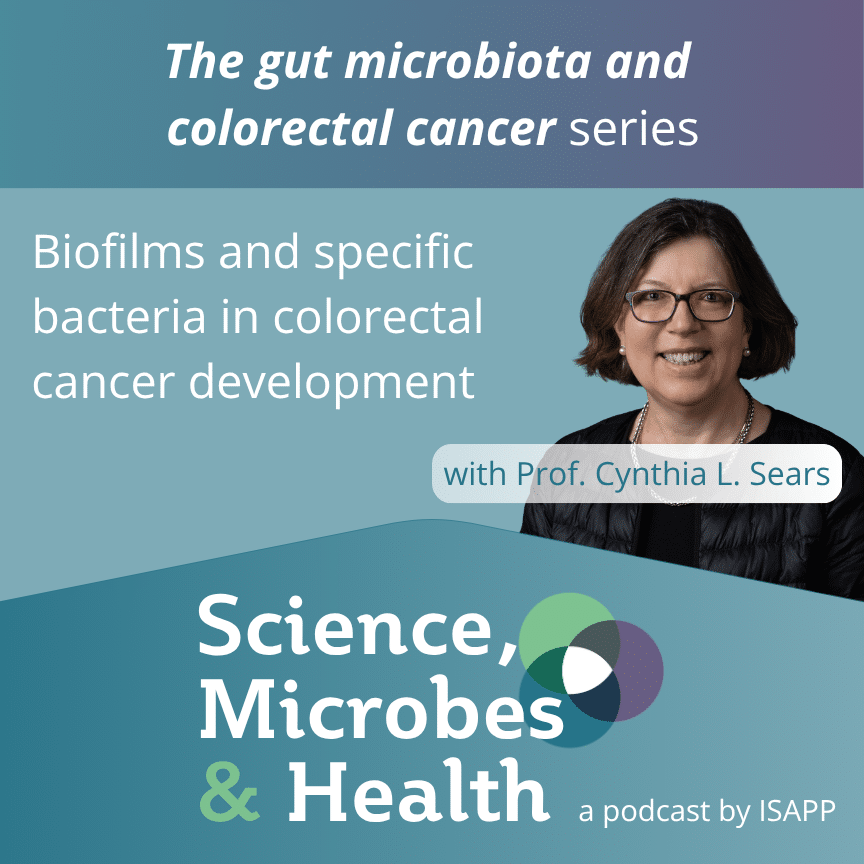
This episode features Prof. Cynthia L. Sears, MD from the Johns Hopkins University School of Medicine and the Bloomberg School of Public Health (USA), speaking about both biofilms and specific gut microorganisms that may contribute to colorectal cancer development. Initially, Prof. Sears became interested in enterotoxigenic Bacteroides fragilis in connection with colon cancer. Further investigation found complex biofilms with multiple bacteria fixed to the surface of the tumor. The biofilms were shown to be oncogenic, and they reassembled very quickly after antibiotic treatment. Interestingly, the biofilms were found to have C. difficile. A subset of the biofilms have a dominant amount of Fusobacterium, and the latest work shows that these bacteria are associated with advancing cancer, stage 2 or beyond. These bacteria and/or biofilms don’t necessarily trigger the onset of mutations that lead to colon cancer, but they accelerate tumor growth. Over time, the gut microbiota may be perturbed in various ways (including by antibiotics), allowing the organisms to create a niche for themselves that ultimately harms the colonic epithelial cells. Prof. Sears is optimistic about prevention strategies for colorectal cancer, such as a tool that helps predict risk in younger populations. Targeted prebiotics, too, show promise for encouraging the growth of beneficial bacteria that prevent the oncogenic species from finding a niche.
Episode abbreviations and links:
2014 review by Sears and Garrett on the role of microbes in colon cancer: Microbes, Microbiota, and Colon Cancer
One of the landmark 2012 papers linking Fusobacterium nucleatum to colorectal cancer: Fusobacterium nucleatum infection is prevalent in human colorectal carcinoma
Examination of biofilms on colon cancer polyps: Epidemiology of bacterial biofilms on polyps and normal tissues in a screening colonoscopy cohort
Association of Fusobacterium with advancing (stage 2) colorectal cancer: Tumor-Associated Fusobacterium nucleatum and Aggressive Architectural Features in Stage II Colorectal Cancer
Paper showing genotoxic microbes increasing colon tumor burden: Combining genotoxic gut bacterial strains increases tumor burden and accelerates onset in a germ-free mouse model of colon carcinogenesis
About Prof. Cynthia L. Sears, MD:
Cynthia L. Sears, M.D. is Professor of Medicine, Oncology and Molecular Microbiology and Immunology at the Johns Hopkins University School of Medicine and the Bloomberg School of Public Health. Through her work as an infectious diseases specialist, she studies how bacteria and the microbiome impact gut diseases, particularly human colon cancer. She has long been an active member of the Infectious Diseases Society of America (IDSA), serving as President of IDSA in 2019, is an AAAS Fellow and is currently Editor-in-Chief of The Journal of Infectious Diseases, the flagship journal of the IDSA.

Comments

Download from Google Play

Download from App Store
 United States