


 Claim Ownership
How to Unsuccessfully Promote a Fake Fight in Montana
Subscribed: 0Played: 0
Subscribe

© Bradley Oliger
Description
The entire book by chapter.
Montanamemoirs.com
Narrated by Matthew S. Newbold
https://www.audible.com/pd/How-to-Unsuccessfully-Promote-a-Fake-Fight-in-Montana-Audiobook/B097YZKNBC
montanamemoirs.substack.com
Montanamemoirs.com
Narrated by Matthew S. Newbold
https://www.audible.com/pd/How-to-Unsuccessfully-Promote-a-Fake-Fight-in-Montana-Audiobook/B097YZKNBC
montanamemoirs.substack.com
6 Episodes
Reverse
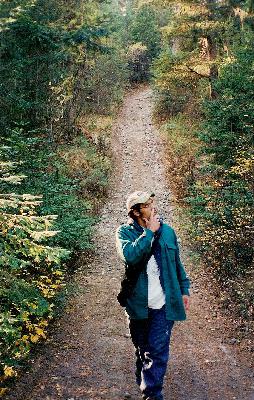
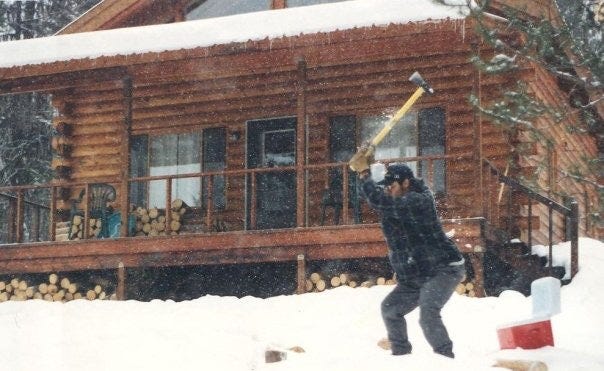
CUTTING THE RIBBON ON ADVENTUREWith all the duties like wood collection or winter prep on deck, those first few days were about savoring the moment. The incubating idea that we had been talking about for months and that I had been envisioning for years was biting through the shell and hatching. All those “responsible” tasks were going to get back in line and take a number. This was a grand opening ceremony to celebrate and get to know the surroundings of an area we would be a denizen of indefinitely.With the cabin stocked of many needs to include fishing supplies, our celebration would kick off with fishing at the lake we had passed about a mile back. Murray Lake. A decent-sized body of water in the mold of an upside-down foam “number 1” hand that is a popular sell at sporting events. The marshy finger pointed towards Kalispell. The access road traveled alongside the eastern portion with some great casting locations on the east, north, and northwest shores. An aesthetic rock formation highlighted the northern tip. A southern section was appealing for fishing also but requested an off-trail trek around the finger of marshland. Behind was a stiff hill that came to be known as “Forgotten Pole’s Ridge” and housed as quality a view available for that wooded section of state forest land. A tranquil place to forget whatever I engaged in previously.As purebred City Slickers, we thought little about the situation we were putting ourselves through. We strolled to the lake with our poles and nothing else. No container to put the fish. No protection. We were in bear country. Daylight would guide us walking towards the lake, so the idea seemed brilliant. Once seated lakeside in wait of aquatic creatures biting the line, thinking a little, and watching the sun set, we realized how poorly planned our outing had become. We had much to learn about this new way of life that we “smokejumped” into. What if we actually caught a fish? Where would we put it? We would have to carry it by hand a mile back to the cabin.The darkness arrived before we could be ready. We did not catch fish, but we smelled like bait. At dark. In bear country. The course home seemed like an eternity. I have known females named “Eternity” and always wondered if that would be an association one would want. We tend to reference “eternity” to something long and awful. The bear was mauling me; seemed like an eternity. It took an eternity for the medevac to arrive. It must have seemed like an eternity for my parents waiting for the doctor to come out and let them know if I’d ever have use of my sexy abs again from the ferocious bear-attack. I’d thereafter need an eternity of medical procedures. The writer had an eternity of overused and abused references to “eternity.”After the eternity, we found safe passage at the cabin which by definition isn’t possible. We made it out to Montana and proved that eternity could be a finite noun. We were alive, and the sky looked peculiar. Very distinct from Toledo or Nashville. There was an eternity of stars in the sky. A positive use of eternity. We had proved that eternity was both finite and positive. What an amazing start to the journey! We started a fire and sat on top of “The Aloha” just overwhelmed by what was up above. I had been out in deserts and countrysides that were comparatively remote with little light pollution. Many of those moments stick out, but this occasion was a cut above the rest. This was home.We roved around the property those first few days to get a feel for the area. We ascended Kim’s Peak to survey the land and inspected the skeet shooting site with its stash of clay pigeons and the metallic launcher. We found where the family was building a small cabin. An occasional train sound passed in the distance. And then there was the discovery and acquaintance to the stockpile of unprocessed firewood.GETTING THE HEATThe ideal location to gather wood was near the skeet shooting site. A short downhill hike off the two-track was a patch of twenty or more dead trees. They had been felled a few years before with just enough time to season to proper firewood conditions. We sawed them into five- or six-foot lengths and hauled them up the hill to the back of my truck. The favored method for hauling was by using a rope tied on one end with a smooth drag up the hill. Other times, with less grace and common sense, we “shotputted” the logs at six feet a thrust up to the finish line. The involuntary and emasculated grunt that accompanied each toss worked seamlessly in keeping away bears and single women.Nearly a whole cord of wood fit in the back of the vehicle at a time, but typically we kept the stack to a more manageable weight of half that capacity. From there, we would take them to the yard and process them into eighteen-inch portions. Select logs were thus split into quarters or smaller for fire starting.The process was tiresome, yet gratifying knowing the heat we needed was coming from our own sweat, blood, and emasculated grunts. A man who cuts his own wood heats himself twice and gets many splinters (or however that saying goes by whoever said it). Almost every day comprised focus time for wood processing. We knew the days were limited before the snow would continually fall. The home for all this lumber was underneath the porch and before too long, that whole porch underside would be full. Tarps covered the inventory to protect from moisture because the porch had some gaps in the flooring.It was eerie out there today. The trees were slowly swaying as the wind whistled through them. It really sounded like somebody whistling in the distance. While I was cutting, I was startled to see Brad collecting logs I had cut. We didn’t acknowledge each other and when I had finished cutting, he was gone. I did the usual log toss relay to get the rest of the logs to the truck that was nearly 100 yards away. When I got there, I was glad to see that Brad had loaded the logs he had gathered. Back at the cabin, he had the fire going in the pit to aid his bread creation. I thanked him for coming out and helping. He looked at me as if he had no idea what I was talking about. I had the chilling realization that maybe I was just seeing things when I saw him in the creepy woods. If so, then who or what loaded those logs? (Calmes, 10/7/99)Those initial nights were cool, but not cold. The estimation of how much wood we would use with the wood-burning stove on a nightly basis proved adequate. Sitting around the wood-burning stove as though it were a television set became a familiar routine. Especially on the nights with no bonfire outside. Something about a warm, glowing source that puts a busy mind to rest.When we got back, we cut wood until the chainsaw nearly burned out. I hope we have the proper gas in it. We’ll probably need a lot more wood than we think. I don’t want to underestimate that. We run out of wood during the winter, we freeze. (Calmes, 9/29/99)The fire outside did not happen as often as it should. A glaring reason was for wood supply concerns as each bonfire prescribed a minimum of six logs. The early, few months before winter hit were very conservative. As part of making the area more like home, we had built up a rock wall on one side to catch the heat and reflect it back towards us. With little luck proving the efficacy of the structure, it remained a tribute to the many survivalists that swear by it.Ultimate wood day! Holy crap! Two overfilled truckloads! Under the deck is basically filled. I don’t need to say how exhausting today was, but I did. I am not in the least bit cold tonight. The wood burner can really kick out heat! I just burned a hole in the back of my right hand by accidentally touching it to the door of the stove. I planned on working on my drawing today, but the wood adventure took all day. Brad did most of the sawing while I did most of the tossing. It feels great having all of this wood, but it is all just going to end up burned up someday. Brad pointed out that it is kind of like money. You get it just to lose it. I ate a million s’mores around the fire this evening after stacking the last of the wood in the dark. I’ve been thinking, and I hope Brad doesn’t read this, but I’m becoming a little attracted to him. No, I’ve been thinking that I’m probably going to want to leave in January when my aunt and uncle leave. They are coming here for a week after Christmas. It just doesn’t feel right living so easily. We are using Uncle Hal’s cabin. though we did stain it... and using his wood… though we did cut it… but that doesn’t make it ours. I think Uncle Hal would like it if we leave when he does so he can do all the things that need to be done... like turning off the water and power and whatever. I hope Brad is okay with that. Maybe we can come back out here next summer for a few weeks. I’ll definitely be ready to leave in January. So far this has been the most enjoyable experience of my life, but I don’t want to overdo it. (Calmes, 10/20/99)EARNING OUR KEEP WITH SEPTEMBER STAINA unique focus was also front and center. There was a shoddy feeling from settling in someone else’s amazing cabin with no real contributions; rent payments, electric bills, maintenance cost performed against the wood-burning stove. Such a selfless act to allow us to stay there with no expectation of reimbursement. To soften the burden of our mere existence, we came up with hopeful ways to leave the cabin better than how we found it. Not enough to cover the price of admission, but anything was better than nothing.Job “numero uno” was staining the cabin. The biggest need of the property by far as Andy’s relatives were fully intending to have their cabin stained either by professionals or by themselves. The cabin was made of wood and wood decays without the proper treatment. Our arrival at the beginning of September meant fall was formally on the doorstep. The sunny days would become the minority, bringing in much rain and possibly
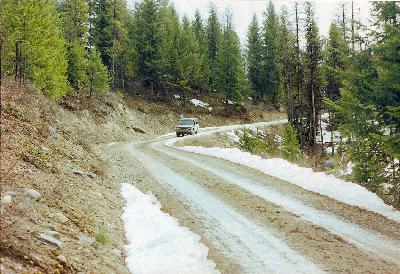
INTRODUCTION TO THE AREAYou may have heard of Montana. You may have seen movies featuring Montana. You may have been to Montana. You might even live in Montana. By now, there is not much context of where we situated. Like any other state, the regions within the state will vary. The eastern half is flat. A mere extension of North Dakota. Heading westward, the Rocky Mountains begin with fury. Being that we were in the northwestern part of the state, we were getting into some elevations on the other side of the continental divide, but still in a valley. Not as high as Colorado, but unmistakably hiked up from the sea levels.The cabin rested at an elevation of 3,600 ft. The property hugged some train tracks on the northern tip and comprised level ground that gave way to around two hundred acres of rolling hills. Apparently, the trees were planted back in the late 1960s/early 1970s after the land was clear cut, so the growth meant those trees competed for resources. The result was those trees were not as healthy as naturally occurring forest growth and required “thinning” to promote a proper balance. This health is a major factor in forest fires, which is why the state justified giving out a stipend to the property owner to thin a large section.The skeet shooting site in the southeast corner provided a nice overlook of the northern edge of the valley. There was an unobstructed view of the sky with minimal risk of shooting bystanders or wandering hikers with the short range of a shotgun. Going further up the two-track was a cleared hill with a width of nearly twenty yards that would later be used for skiing and tubing. At the top was another view, Kim’s Peak (named after the owner’s good friend); a field general’s view that revealed the entire property. With plenty of sprawling out to be done on two-hundred acres, that amount of room was amplified by the fact that just south was approximately sixteen square miles of Stillwater State Forest. There were primitive roads and two-tracks throughout that area, making most of the prominent lakes accessible during the non-winter seasons. This land was a potent mix of pine and tamarack, along with some deciduous trees.The town of Whitefish rested beyond the forest land to the south, squatting at the bottommost tip of a fairly sizable and serene lake, Whitefish Lake. The community would also be known as Stumptown because of its history of being clear cut and seemed to have all of your basic needs. The layout would be best described by five sections that mattered most to us. The southern end afforded a single entrance or exit to most of the rest of the world. This highway slows to a commercially zoned crawl once the pavement meets the city limits. A grocery store and bowling alley featured most saliently on this lay of the land. The bowling alley appeared noteworthy. Could it be more than just a bowling alley?The northern tip boasted the library, train station, and beach. A quaint downtown nestled close by showcasing a breathtaking view of the distant mountains. Yet the shops, restaurants, and bars were well beyond our budget to pay much attention to. A post office, bank, photo lab, and laundromat were clustered two blocks away, serving as perhaps the most utilized area. A remaining northwest section allowed the highway to speed back up and steer us homeward. Though we did not have much to do with the town itself, it was our lifeline to the outside world and seemed fixed to boom at the turn of the millennium.East of Whitefish Lake lay a vast mountain chain. The Whitefish Range. A few exposed peaks commanded attention from day one. Such views they must provide. To the right boasted Big Mountain, which hosted fairly world-class skiing. We had absolutely nothing to do with that. At that stage in my life, I had only tried skiing once. We did not have much money so, to be honest, it acted as just another spot on the map for us. Nothing more. Beyond those peaks was Glacier National Park, with less than an hour’s drive to get there. We had arrived in the autumn with a lot of work front-loaded, so traveling to the park while it remained accessible was never a plan either.To the north of the property, beyond the tracks, mixed intermittent private property and more undeveloped state land. Moving northeast, extending past the tip of Whitefish Lake, comprised more of the same. Marshy lands and more private property. Often problematic to discern between the two. About an hour’s drive up Highway 93 would have taken us to the border with British Columbia. West of Highway 93 possessed nothing that we would concern ourselves with much. There was the Stillwater River, where we would try fishing once or twice.The cabin itself revealed a beautiful one and a half story fixture with two bedrooms, a large living area, kitchen, huge porch, and a loft with stairs leading up to it. She housed many amenities; running water, electric, septic, baseboard heaters, and wood-burning stove. We were not straight out of the 1800s as my childhood envisioned, but we did not care. The loft covered almost half of the cabin, so the floor space had plenty more room for beds and a vantage point that looked down over the first floor. Such a location would also provide a porthole to Flathead valley out the large bay windows in front.There were bedrooms for each of us, with a blanket to provide some privacy and insulation. Buried within one bedroom, which would become Andy’s room, unearthed a crawl space for lightly used overflow items. The living area owned a couch and a lazy boy catered to surround the stove which became our beloved television set. The kitchen provided a dinner table, sink, and surface area that fit a hot plate for cooking. A half-height fridge/freezer cooled our perishables.What more do you really need? Well, if you want a yard area with a fire pit, then you have that too. Walking out the front door and past the beautiful porch, displays an open mixture of grass and rock, centered by a fire pit. Hunching underneath the porch revealed an empty space that would consume a large part of the fall months. What the space missed was firewood, save a couple of cords that the owner and family had already harvested and processed.Northwest Montana was to become my playground.WHAT WERE THE NEEDS OF THE CABIN?With a roof over our heads accounted for, the second-most item of importance was food. Most of the money saved accounted for food expenses. I tucked money aside at Glacier National Bank upon arrival. With a fuzzy sense of how long we would be staying, through part of winter appeared like a reasonable minimum estimation. The treachery of the back roads we relied on in wintertime were unknown. We had no snowmobile, so preparing for at least a month of self-sustenance fit the reality. Ideally, we would be supplied for much longer than that. We demanded a lot of non-perishable food such as powdered milk, canned foods, noodles, sugar, oatmeal, peanut butter, and powdered juice. I shopped for raw materials to make some foods from scratch. In anticipation of excessive amounts of time once winter hit, making homemade bread or even hunting seemed ideal and primordial.Should there be a desperate need to resupply, we soon discovered that there were neighbors a third of a mile away. By no stretch were we so remote that we would have to make life or death decisions. Yet, reaching out for help would be self-defeating. A failure in the experiment of self-reliance. Embracing the lifestyle meant avoiding reliance on others at almost all costs.With non-perishables quickly accounted for, we could focus on some more desired foods. Unsure of how stable the electric would be, we had to acknowledge the potentiality for food spoilage. Yet, once temperatures went below forty degrees, we could even buy perishable foods with no concern for that. We had a miniature fridge, but an option to keep food safely stored underground outside fell within reach should the need ever arrive. The cooler temperatures would hinder any spoiling.There was an ample supply of water stored, but this would never be much of a concern either. Before snowfall, we had a bounty of lakes that, once purified, could wet our whistles as necessary. Once those froze over, we would have the snow gift-wrapped right on our doorstep, requiring only some heat to make potable.We did not drink or do drugs, thus avoiding that expense to account for. We would not allow such an easy escape to the beautiful boredoms that we were soon up against. Only our minds, or absence of them, would entertain the slowest and most upturned moments of “cabin fever.”I did not know exactly how cold northwest Montana would be, but from experience in northern Ohio, the climate had to be at least considerably colder. Our heating situation provided baseboard heaters in the two bedrooms and probably elsewhere. Being that we were trying to be good denizens and minimizing the electric costs that someone else was paying for, we decided they only could be used sparingly at a baseline setting. Basically, to keep the cabin from getting close to freezing. The critical thing to consider about electric heat was that at any point, that option could be unavailable. We did not have a generator. Our principal source of reliable warmth came from a wood-burning stove. This was the only genuine sense of survival needs.Having never lived through a winter in Montana in a cabin, we had absolutely no idea how much wood we would burn through. If we ran out of wood and the electricity proved unreliable, we would potentially freeze to death. It might sound ridiculous to say that we could run out of wood while living among tall trees, but there was much work and preparation that must be considered. Gathering and chopping wood in deep snow is not for the faint at heart. That is also assuming that the wood is properly cured and free of moisture, which is tough to guarantee the further past summer we waited. We surmised with blind
WHERE EXACTLY IS WHITEFISH?1998 arrived, and I had just moved to Nashville not long before. Residing with those same two friends that I fled out west with in 1995. While they pursued careers in music, I was still struggling to figure out where I was going with my life. I picked up a job as a zookeeper at the Nashville Zoo, succeeding an internship that lasted for a few months. A relatively seamless next-step being that I had a place to live. An end goal looked for something wilder; a national park job, perhaps. But this sufficed in the interim. The job became fun and fulfilling, escorted by the freedom of being on my own. Serving as a zookeeper was not a lifelong ambition, but animals were often more interesting to me than many people. A rowdy zebra named “Sharpie” was no exception. What an illustrious name for a white stallion with an assortment of odd black markings all over it, by-the-way. Well done to whoever came up with that name. As fun as the job was while being part of a budding institution, to have a career meant moving the needle a little more to fill the rest of a meaningful work life. I had mixed feelings concerning the idea of animals in captivity while praising the importance that zoos play in conservation, endangered animal breeding, and education. To me, a perfect world comprises no demand for such a thing with nothing more gratifying than seeing wild animals, in the wild. We do not live in a perfect world, so we must make compromises.My friend Andy had come back from a vacation in Montana during the summer to visit his relatives and their property. We reviewed pictures. Some scenery. Some of whitewater adventures. Even a picture of a bear in a tree. They were elegant and looked exciting, yet made no deep impression other than reminding me of the first visit to Montana. Finally, there was mention of his Uncle’s cabin and the property he stayed at. The cabin itself looked grand and home to many modern amenities, though foreign to many others. It resided outside of the ski town of Whitefish, Montana, adjacent to Glacier National Park. Over two hours of driving north of Missoula, where Vice and I had been before cutting over to Idaho. The conversations led to revelations it stood vacated most of the year. I pondered endlessly about what such a life would be. Yet, that life was still quite out of reach.By the time 1999 came around, that bubble inside my head felt ready to pop. The self-assigned pressure to figure things out beat rapidly like an adrenalized heart. I needed to figure out my next move. Nashville entranced as a wonderful place, circled by even more beauty, but not for me. The atmosphere reflected far too city-centric a setting with a hefty dose of show business persona. It was not home.The internet, in large part, remained a work in progress and so networking opportunities were sporadic. Opportunities for research were scarce. Not enough information surfaced to make intelligent decisions (assuming I was capable of such). I lacked a small beachfront to make landfall out west. Thinking about the cabin in Montana came up more and more. That still was not possible. I did not know the landowner, and surely Andy would not be up for deferring his music aspirations to go hole up in a cabin in the woods for a while.Light conversations went on between us. To my surprise, he seemed very interested in the idea. This arose as a shock to me. Not only did he have his music to stand rooted with, but I did not see him exactly so fond of the outdoors that he would want to live it daily as a lifestyle. Was I overlooking something? The trip out west right after high school included many outdoor adventures, and we seemed to have the time of our lives. We took advantage of Nashville and the surrounding lake for cliff jumping and tiny islands to swim out to. A precedent bloomed into a revelation that a journey west could work.There existed no apprehension that Andy would find a wealth of hobbies to stay enriched by during the wintertime. He was an artist and musician, who would already stay up throughout the night to work on a drawing or mix songs, along with hundreds of other ways to stay busy. Such certain idleness, free of distraction, could serve him well in sharpening his skills in those musical endeavors. We were already great friends and shared an appreciation for weird humor, so there birthed not a doubt that we would have frequent bouts of ridiculous laughter living in a fairly isolated setting. He was, after all, one of the funniest people I had come across. Before ever knowing much of Andy, he had already made a name for himself by shaving his head to look like “Burns” from The Simpsons in our large high school. He had the lanky frame and towering nose that made the impression work brilliantly. Still better, he interrupted my “mock-karaoking” of Bust a Move during senior year After-Prom by shooting through a crowd and then up on stage. Just as soon as he arrived, he had vanished out of sight with the frenzied pace of a professional wrestler inciting the audience. He bore only his “tighty-red” undies to the horror and outrage of many high school girls. Bold move!He had an uncanny ability to recognize shock-humor. Immediately after high school at the age of eighteen, we visited Toys R’ Us and noted how expensive Legos had become. One such set on display hosted a disturbing price tag of $75. Space-tech Legos. We stood next to a mom and her prying son, desperately wanting that very same overpriced toy. In fact, our attention to it may have drawn the interest of the boy. The mother remained remarkably calm and patient. The child reminded me of myself at the volcanic age of eight; very much the same unreasonable brat. She spent nearly five minutes lovingly explaining to the boy why he could not have it, and her mannerisms worked to my amazement. Her voice had soothed her son and seemingly soothed me as well. My mother had many of those same moments, and after years of patience, I was proud of the mature man that I had become because of her. No longer a spaz begging for expensive toys. I felt at peace.Abruptly, Andy reached for the toy and said, “Hey Brad, let’s get this one.” The mother’s jaw dropped, and he bolted down the aisle to escape with a straight face. I tried to keep up with him, desperate to not make a sound or show the disbelief that consumed my soul. My heart raced. I could hear the child behind now pleading frantically for Spacetech Legos. The entire store could. His mother’s consolation was no match for Andy’s parental sabotage. The incident that unfolded in aisle 7 of the Toys R’ Us in Toledo became one of the biggest shocks I witnessed in my entire life. Of course, he did not purchase the Legos and left the box prominently by the single exit in hopes that the boy’s outrage would have an encore.I found the pulse that belonged to a migration out west. We had enough hope and interest to put the wheels in motion.GIVING A CRAZY IDEA LIFE IN JUNETo turn this wish into reality, a few things needed to happen. I needed more money, a better vehicle, to quit our jobs, and we needed a plan. Most notably, we needed permission from his Uncle to stay at that cabin. Something I worried a lot more about than Andy. As plans matured and evolved, the permission concern lingered. That simmering detail fixed entirely out of my control.The time came up hastily to let people know my stay in Nashville will soon end. With no expectation for staying in Tennessee as a long-term thing, almost two years had passed by quickly. Much longer than expected. Letting the zoo know of the departure felt awkward. Not to say I was overly valuable, but my coworkers and the many personalities of the animals had grown on me. With the uncertainty of whether we could actually live in the cabin of my friend’s uncle, telling everyone about the plan proved not a simple thing to do either. There remained a chance that I would never see the plan through.Telling family, friends, and coworkers passed smoothly and void of much backlash. By backlash, I mean folks openly expressing that they thought I was completely nuts. Completely off the deep end. They were most likely just being extremely tight-lipped and polite, Canadian style. I was nuts, and the plan was absolutely unorthodox. How can one possibly explain a move like that and not sound like they are hearing voices in an Iowa cornfield? A stark contrast to what normal city folk do in their early twenties. The status quo of prime bachelor years meant parties, promiscuity, drugs, and alcohol. To purposefully go stay in the woods showed an act of randomness so unprecedented by anyone I knew for that age. If that evidence fell short of inciting ridicule, then the poor publicity of cabin-living in Montana during the late 1990s surely closed the case.JULY’S PREPARATIONTo address the money situation, the last five weeks before departure meant getting rid of the duplex we lived in. Andy chose to move back in with his parents in Toledo to save money and work, but I stayed with my friends Ross, Matt, and Wayne. I finished out the time at the zoo and picked up a second job part-time with a company loading freight in cargo planes at the airport. The work was tough as we rolled pre-packaged freight weighing up to a ton onto a portable conveyor belt that hoisted the cargo up to the plane. From there we would push the freight as far back on the plane as possible before securing the load. Repeat that twenty times and call it quits for the night. They did not know I intended to stay only a month and my boss became a little peeved when I eventually told him, but we hugged it out. Not actually.My first time working seven days a week routinely required some pain tolerance, and I found no shortage of exhaustion on the three days that called for working both jobs consecutively. To make an insane move across the country attainable, short-term sacrifice required absolute homage. It helped to know that willf
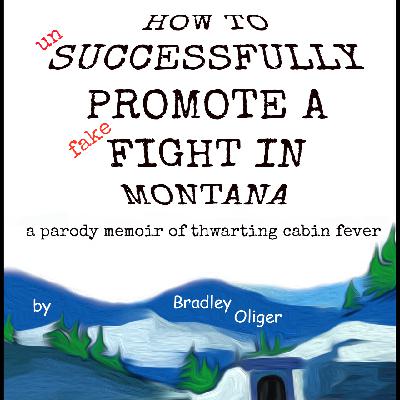
At the turn of the millennium, I was fortunate enough to take temporary residence in a beautiful cabin, fueled by cabin fever. This memoir rummages through that era and reassembles the elements that made the experience unique and meaningful for a goofy city boy from Ohio. There would be no action-packed agenda. We would not go see Glacier National Park or embark on any crazy rafting trips within close range. There was no horseback ride into the deep wilderness hunting moose and Bigfoot. At the age of twenty-two, skiing at the nearby top-notch resort was not even a soft consideration, with a perception that we would be amidst a circling swarm of the uppity. Just two guys trying to pass the time with little money, thriving off a curiosity of what the total experience would be like. A decision that would cause peers, most of whom were living out the prime of their lives at bars and parties, to scratch their heads and wonder, why would anyone ever go live in the woods in Montana? This memoir answers that question, though if you are reading this already wondering the same, the content might get worse for you. Much worse, in fact.Unfortunately, I have lost my activity journal from the fall/winter of 1999 that chronicled the majority of my wanderings in great detail. A missing link that would have made portraying a memoir much easier had it not been lost. There is a silver lining to that misfortune. Twenty years have passed and having to fully recall some hazy events at times paves a better trail for embellishment and sensationalism. Boring facts can be exonerated from their rusted-out cages of veracity. Those literary freedoms are kept in check by a second journal that detailed the second half of the stay; though, by that time, some journal fatigue had plagued the writing.This account will lean heavily on the published “Daily Letters to Myself” of Big Sky to Big City, by Andy Calmes, as a reference point to many murky details. My friend’s recap of his own experiences during that time with me in Montana, in journal format. Those journal entries, in many ways, are my journal entries and capture the individual moments much better than I can with a “twenty years later” memory rotten with fuzz. This became a major reason I chose to write about my Montana experience above all else. Someone else had already done most of the work. Just the way I prefer. Also, writing a memoir for others to read is less nerve-racking when it includes only a few people. Those people become characters, and those characters can be weird about how an all-powerful memoir author depicts them. I doubt anyone would like me writing about them either. Especially if those characters still owe me money, as those descriptions could get salty. “Joe Schmo (and the fifty bucks that he still owes me over the Browns/Bengals game) and I walked down the trail in search of moose.” The whole memoir might even turn into one giant smear campaign; whose sole aim is to get that money back or procure some other hidden vengeance. Contents would turn downright nasty to castigate those people I still owe money to. I would go after their credibility and reputation, full scale. Many disqualifying adjectives. Luckily, the time in Montana did not have an extravagant cast of characters. The only other human around me mostly already wrote about those times and represented me as a crazed madman in the woods, disappearing sporadically to feed on lost souls.The writings will desperately beg for an occasional chuckle, though not in response to humor. Instead, just some salvageable sympathy. A measure of merciful goodwill. Through careful analysis, I have estimated there will be a minimum of 76.5 eye rolls and nearly twice that amount in uncontrollable “What the hell?” outbursts while reading. Turning each page might feel like a rep at the gym with many burning sensations. Do not be alarmed by this, as the awfulness of the content is by design. It might burn, more and more, page after page, but you will feel much better once it is all over. The physiological response to pride in the reading the final pages of a book is exceptionally comparable to the sense of relief that you no longer have to endure any more misery. I have engineered 81 of the pages to hope that the next page might be where things finally get enjoyable. 93 of those next pages will make you wonder the exact same thing as the pages before. The additional 12 pages assume that you end up skipping some pages to aid in wading through the memoir towards the finish line at a quicker rate. Events will become dots connected to one another, after the fact that have no business ever being correlated. Timelines will be blurred and readjusted to fit the readability requirements. And why not? It is my account. Most actions end up as better memories than the real-time events they portray. If you find yourself at some point enjoying yourself or thinking the things we did were “good ideas”, then DO NOT CONTINUE. It is for your own safety and well-being. And please never lose sight that this memoir stretches back to dates from over twenty years ago. Who can be judged by their “twenty-years-ago” old self? Cabin fever bears a judgment-free statute of limitations, after all.Thanks for reading How to Unsuccessfully Promote a Fake Fight in Montana! Subscribe for free to receive new posts and support my work. This is a public episode. If you would like to discuss this with other subscribers or get access to bonus episodes, visit montanamemoirs.substack.com
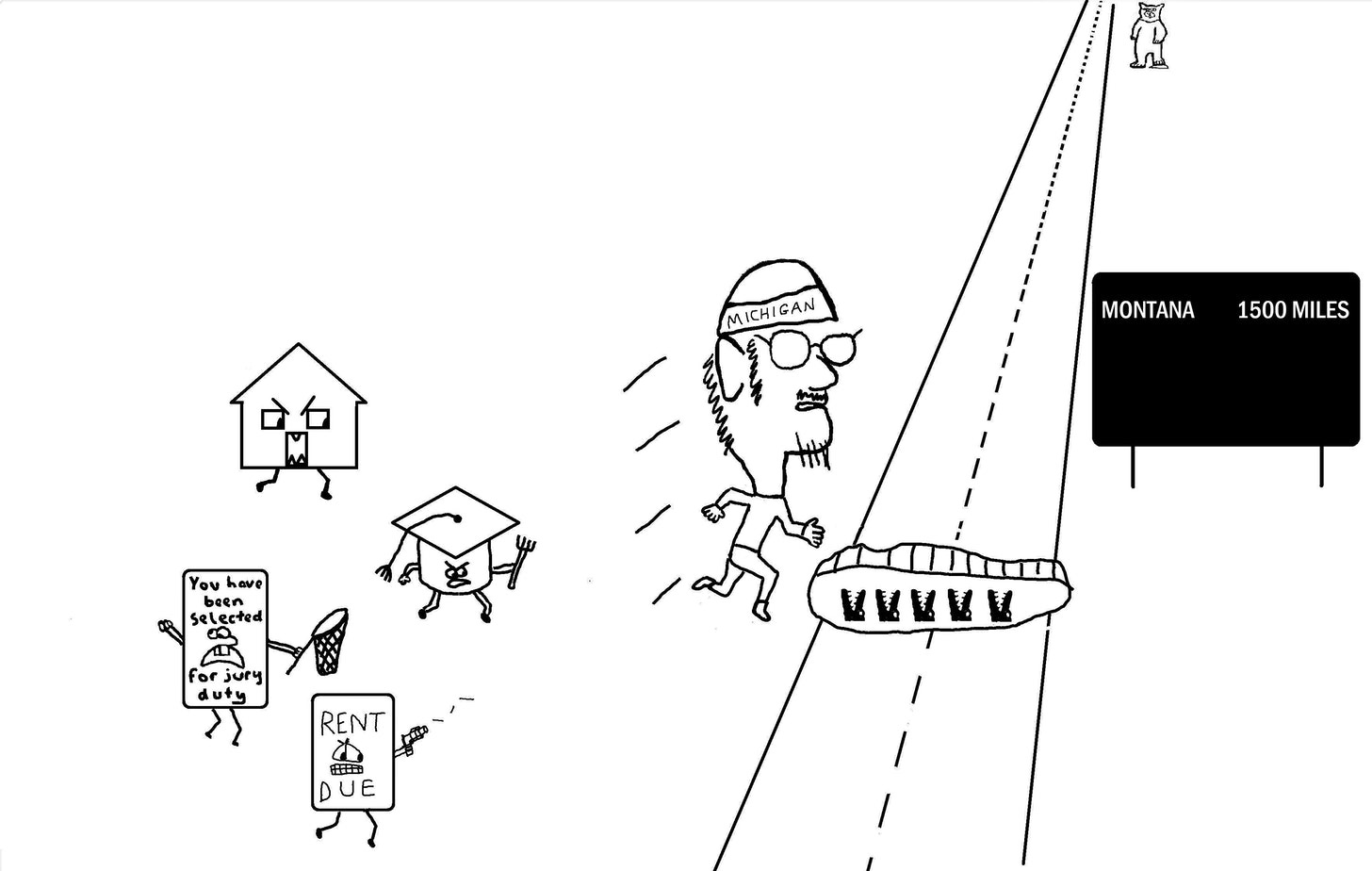
get the audiobook for freeA FEVER FOR CABIN FEVERI always wanted to live for an extended period of time in a cabin in the woods. Spending many days at Pokagon State Park where my family often camped or lodged revealed a shelter off of one of the trails I frequented. The structure was not much, and I am quite sure I would be disappointed by both the features and location if I visited it today (assuming it is still there). As a wandering kid, I felt like it was in the middle of nowhere; barely touched by the hustles of modern civilization. I could walk inside and stare mindlessly off into the woods. A “natural” spring flowed from the ground right past the cabin. Without hesitation, I would summon pioneer-like techniques of cupping the water with my hands, drinking straight from the source. That was probably a terrible idea, though to a young boy, that water had never flowed past another living soul. It surely had to have been clean. It appeared pure, and it made me feel wild. I would lie around the area imagining that I lived there for hours. This would be my first experience that brought about a desire to discover living beyond the confines of a city. There was always an urge to get out into the woods and explore, but growing up where I did, the pickings drew slim; slim and getting slimmer. So much so, that simply digging a hole in the ground with some wood around the base would have to do for brief periods to escape the city life. A make-shift fort. Small sections of woods remained adjacent to my neighborhood, but they were not without their own sets of problems. The older kids also enjoyed these territories, so I required caution and awareness. To them, it was just a means to get away from their parents, to smoke and drink with no one knowing. An ideal location to stash and safeguard their “nudey mags.” Those had extreme bartering value in those days. In the best-case scenario, wandering out in the woods and being discovered by troves of older kids would bring on ridicule. That was the best-case scenario. In other areas, the pollution and vivid rumors of “angry, salt-gun toting farmers” kept the adventures at bay. The ponds became a reservoir for the inbred to dump their chemicals, resulting in chemical burns to any youth that yearned for a habitable place to swim. Those problems eventually took care of themselves by the expansion of subdivisions and golf courses. The rustic stomping grounds that I had access to would become “developed.”In 1986, we stayed with friends of my parents in cabins out in Colorado. At the foothills of the Rockies. The property seemed to go on forever, but surely there were limits. Streams teamed with trout. Horses scattered throughout the open areas. To a nine-year-old boy, they were wild horses roaming free. Drifting up into the hills where the fields ended, and the forest began, I would explore and find all sorts of multi-colored rocks and fossils. The place illuminated as a piece of heaven and I did not want to leave. A place that set the tone of what I wanted for a few years to come. Until the memory faded in the teenage years. Some years later, immediately after my high school graduation, my friends Matt and Andy would take a trip out west with me. Many exciting details would transpire warranting perhaps another memoir, but skipping towards the tail-end of our journey, we hiked through the Pecos Mountain with my Uncle Dave in northern New Mexico. This hike morphed into a picturesque wilderness novel that required maniacal off-road driving just to get in and out of the trailhead. Part of which transpired through heavy rain. We moved through remote terrain; rolling hills or steep muddy climbs, over large streams, and through wild fields. At one point, we stopped for a break, allowing for a chance to gaze upon a field with a stream knifing right through. The setting was truly breathtaking and serene. Back when film photography was something more deliberate, I decided to take a picture of this scene to preserve a sense of how it cleansed my soul being there. A spot just fifty yards off the waterfront could sit a cabin with me living inside. Freshwater sources. Available fish and game to subsist on, to be sure. A powerful reminder of how much of my childhood was spent trying to capture that moment in the mountains. A resurrection to the desired endeavor that would not burn dry any time soon.The return home hosted an agonizing thirty-six-hour Greyhound ride from Albuquerque, New Mexico to Toledo, Ohio to reflect. Thirty-six straight hours unfettered by sleep because my seat positioned in the last row of the bus for a harrowing majority of the trip. A section that was meant only to seat two people. Instead, there were three of us. A mother and her child, speaking endlessly in Spanish. When enough “sheep” had been enumerated to drift into a slumber, I would be hastily awakened by nature... or nature calling rather. Sitting in the back meant sitting right next to the disinfectant-emanating bathroom. My legs partly blocked the door from opening so passengers, amidst their potty-dance, would need to wake me up. My legs blocked their ability to enter. The rest of the time, I sat next to unbathed hippies that smelled worse than the bathroom disinfectant on a contrasting spectrum of funk.I still had the most enjoyable experience between the three of us. Matt had a nearly fractured tailbone from falling while rock-climbing, and Andy had a lobster-like sunburn that he acquired at the waterpark the day before our departure. Steering back to the point meant thirty-six semi-delirious hours to reflect on the trip as well as where to be going with my life after high school.As a fresh graduate, I had no idea what I would do specifically. I wanted something rugged and fulfilling. Throughout high school, there emerged only one desired path forward after graduation. Trying out for special forces, traveling the world, and feeding on some wanderlust was all that I could see myself doing in that next phase. The catalyst to drive those endeavors no longer splayed out on the table. I had been rejected by the Army less than a year earlier because I could not pass the hearing tests. The rejection crushed me. For the first time, I was told that I could not do something. But what else is there for someone like me? I had no desires for wealth or a normal life by any stretch of the imagination. College seemed like a prison, as I generally did well in school when I wanted to, but at the opportunity cost of pursuing what my actual interests were. Those interests were always outside any classroom.MONTANA APPETIZER, 1997I knew very little of Montana, but more than many. Like others, it came on my map after watching the movie A River Runs Through It whereas I was curious about what a life such as that would look like. In 1997, I took a long road trip with my friend Vice. He was a blond-haired man nearly the same age as me, with a perpetually bitter frown on his face that reflected the bulk of his personality. It became my 5th extensive trip out west and the first in the northwest. Our mission was to investigate potential universities, as he was looking to go to school out west and I was tentatively considering education beyond the Associate’s Degree that I would soon have. We packed up his Dad’s blue minivan full of canned food, granola bars, cheese crackers, and a comically large barrel-o-pretzels.The first stop was just outside of Chicago to visit some relatives of his. We ended up learning how to play an obscure card game to which we deliberately sabotaged the integrity of the outcome. The reason? Because we were jerks. They were so passionate that it was the greatest game ever, and WE determined to prove to them of fundamental flaws in its design. Albeit manufactured flaws we invoked. Because we were jerks. It is important to understand that we were the type who would make use of our time by having fun at any cost. One such instance from the past consisted of meandering throughout the large music building of Bowling Green State University while we were waiting for friends to finish their band practice. After exploring EVERY room, a group of students summoned us to audition for the university play to which, somehow, we immediately earned some key roles. How that actually happened remains a mystery, as we were not even students there.Hours into the practice, we blazed through the script, saying our lines to get the rhythm of the play. Vice and I had decided that we needed to excuse ourselves before we got in too deep. As honorary gentlemen and guests of BGSU, we needed to show our kindness and consideration, to be sure. After some scheming during a quick break, we had a plan that included the same dramatics needed to flourish in the final showing of said play. The dramatics? While having another go of seated script rehearsals, I thickened the plot by standing up in front of everyone and protested both my lines and the role they selected me for; despite being the play’s frontman. Vice followed suit. Those lines, as I recall, cellared beneath me as a brilliant, aspiring Thespian and that Broadway could wait no longer. We then stormed out of that room, leaving behind a cast and crew of the confused. Because we were jerks.Back to the trip. From there we veered up to Duluth, Minnesota, for no other reason than to visit what supposed to be the safest city in the US. At least at the time. It also served to fill up gas en route to the actual destination; Chisholm, Minnesota. The location where the movie Field of Dreams’ Dr. Archibald Graham lived and later died. We soon discovered that they did not film there, which was disappointing, but it was a bucket list item to cross off for me. Mission accomplished.From there, a stop in North Dakota. Theodore Roosevelt National Park gave us a quick little hike to some vistas. That later took us to our first official destination, which was Bozeman, MT. Montana State University. We we
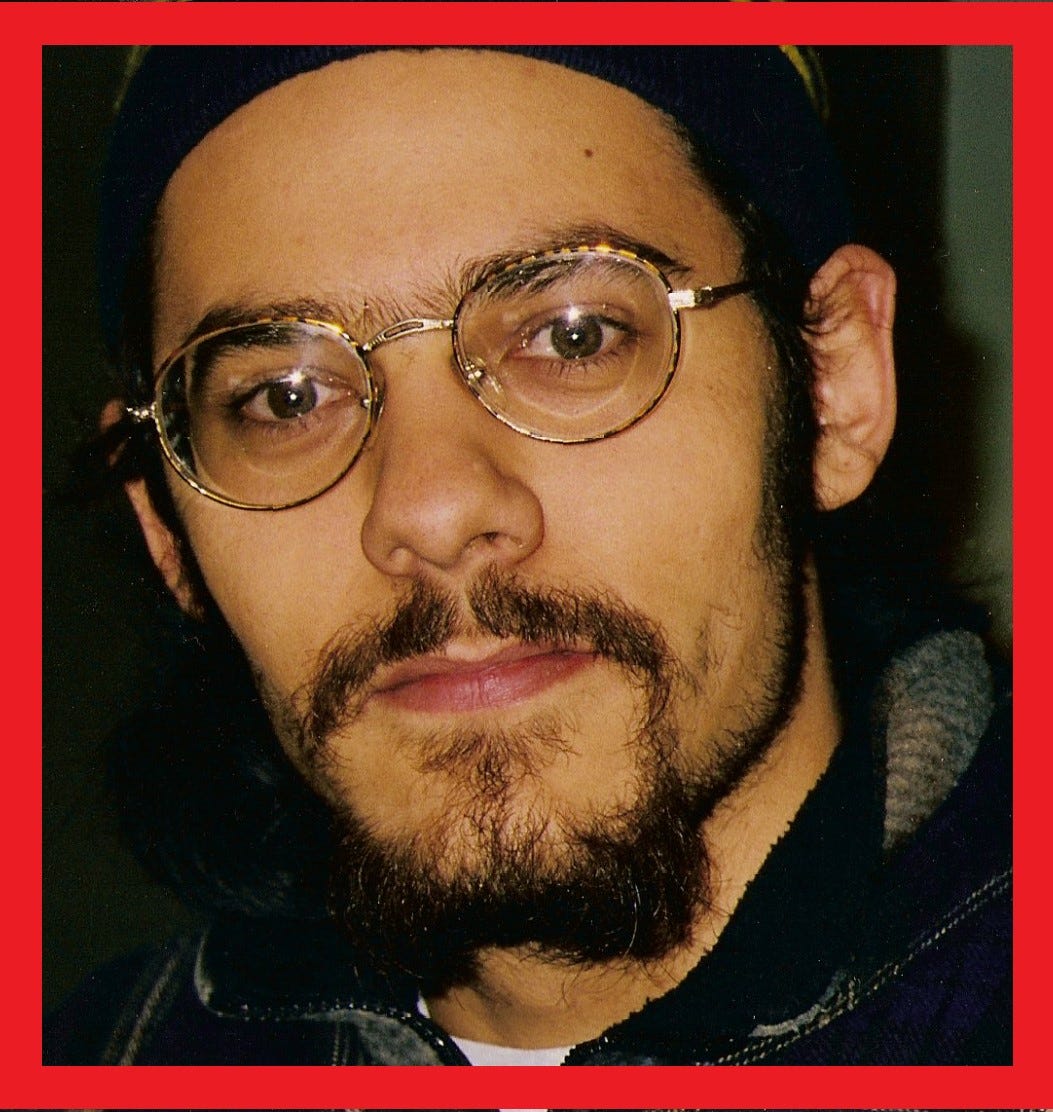
Chapter 5. Survival Dude AuditionGet the audiobook for freeA fun goal, while being out in Montana, was picking up some helpful survival skills. Not so much a situation of necessity as I rested in a welcoming cabin with many conveniences at my disposal. Yet, this perched a far better opportunity than any other stage in my life to try out techniques. Preparing for the unknowns simply made sense in our case. While “prepper” shops with overpriced solutions were popping up throughout the nation in anticipation of the threat of Y2K and the impending nuclear winter that would trail behind, I merely wanted a steady and simplistic self-reliance for any juncture of hardship heading my way. Becoming as adept as someone like Matt Graham would never happen, nor was that complete lifestyle ever desired. Only an appeal to become less clumsy and paralyzed in the wild with some practical tools to keep in the tool bag.Survival stories were always fascinating. Stories of overcoming adversity, perseverance, using ingenuity. With enough enthusiasm for enjoying wild places beyond the reaches of immediate help, it is an easy sell for one to have a firm base of skill to help oneself and others stay alive until aid arrives. I picked up a few survival manuals; Tom Brown’s The Tracker, Tom Brown Field Guide–Wilderness Survival, Nature Observation and Tracking, and the US Army Survival Guide.EAT LIKE A BEARI also picked up some books on wild edibles of Montana and the Rocky Mountains. I enjoyed eating. I loved picking wild berries and other munchies. Back in Ohio or Tennessee, there were some mulberries, raspberries, blackberries, wild strawberries, apple, persimmon, sumac, and wild onion. Sassafras tea and dandelion coffee were delightful beverage additions. I had even eaten stinging nettle after several changes of boiling water. Foraging is ancestral. There is some strange satisfaction in eating while wandering around. Similar to going over to a friend’s house as a kid and foraging through their cabinets and refrigerator without permission.In Montana, I wished to eat like a bear. Without so much of the hankering for dumpster diving or fear of cheese crackers. Being that we were already well into the fall, the wild edibles were speedily becoming unavailable. I scouted the fields almost daily. What I really sought after was the almighty huckleberry, but that window had passed, regrettably. The window had also passed for chokecherry, gooseberry, strawberry, blackberry, raspberry, salmonberry, thimbleberry, and mountain sorrel. Yet some remained. The two berries that I became most acquainted with were bunchberries and bearberries (Kinnikinnick). They were scattered all over the area, both on the property and surrounding state forest land. Neither of them tasted overly delicious, but their abundance made them a tough item to ignore. A popular property of bearberries is that the leaves are alleged to pass for a tobacco substitute. I did not smoke, though some try for the sake of naturalistic discovery. It is based on flavor, as there is no nicotine or other stimulants that I am aware of.Another concoction that filled my glass occasionally was pine needle tea. Not sought after for its taste either, but exceptionally healthy as an excellent source of Vitamin C. Within the same vitamin realm were rose hips. There were plenty of rose hips and juniper berries that persisted throughout the winter. Rose hips have been everywhere I roamed previously in the continental U.S. so that proved an easy find.Woods Lake provided some marshy sections, home to another common favorite. Cattail. While the down became a suitable filler for a stocking cap in the colder months, the real payoff nestled below. Digging into the muck, there is a pleasant tuber full of starch with shoots bearing the taste of cucumber. The chances to collect this quickly faded though as the water and mud became something to avoid after Halloween.FISHINGThe fish stocked in those waters were largemouth bass, cutthroat trout, rainbow trout, brown trout, bull trout, yellow perch, and northern pike. There were whitefish, but much too massive for our inexperienced, amateur endeavors. We devoted most of our time to Murray Lake. We tried shore-casting. We tested out the tubes. Ice fishing never really appealed much. Ice fishing sounds very frozen.Brad and I drove down to Murray Lake with the tubes and wet suits. I kicked out to the same spot that I had caught the fish last week, only this time I came back with less than I went out with. After some amazing 40-yard casts, I finally cast my hook off the line, and being that I didn’t take any tackle out with me I was done for the evening. Brad didn’t catch anything either at the opposite end of the lake, though fish were jumping all over the place just to mess with us. The sun had set by the time I got to shore, but the moon lit up the lake. Even though Brad and I were probably 200 yards apart, we could communicate simply by talking in regular tones. The voice just carries across the water, I guess. It’s pretty cool. (Calmes, 9/20/99)Several attempts were made at Beaver Lake; the largest lake in that area, aside from Whitefish Lake. Its shape was that of a wax “W” that had melted in the sun with stretches on each end extending almost a half-mile. The south section which was the base of the malformed letter, appeared the most accessible for parking and launching by raft, whereas the other side was marshy and had a gentle stream. This stream led to a lesser body of water; the Little Beaver Lake. Shaped like a human molar. The results of our fishing at Beaver Lake were terrible, but we had two divergent stories to tell.When we got to Beaver Lake, we were on the opposite end from Uncle Hal’s favorite spot, so I figured we could kick our way over there in the tubes… and we did! It took a long time but was very enjoyable. Once there, I loaded my weapon with a worm only to have it backfire… the dang pole was sticking again! I put a fake worm on, put the hook in the water, and manually extended the line as I kicked away. There were so many fish, but none were hungry. Well, at least they weren’t hungry for a plastic worm and I don’t blame them. I wouldn’t want a real worm either, but that is their preference I suppose. On the way back across the lake, my pole was casting fine. Moody, I guess. That journey ate up the daylight quickly. (Calmes, 9/21/99)This entry was incomplete. Though comprehensive in expressing the recurring failures of angling, the entry fell short of going in depth about the coffee and water that I had just consumed. His reflections failed to acknowledge my irresponsibility of not urinating before putting on waders for a journey through water and time. His words offered no mention of my bladder. Why would he write about my bladder? Because I damn near lost it in the line of fishing. I lived to tell the tale, and so I must take you back to where this fishing story began.It would be a delightful start to the young afternoon. The sun peeked through the windows of the cabin, spurring a revolution of motivation. A cold passing dawn meant a noble time for the second round of scalding water sifting through fresh coffee grounds and a white filter. Sounds of near-boiling temperatures percolated a coffee pot that would nearly seal one man’s fate.I opened the cabinets to find the right lure. Two pinches of sugar. Two drips of cream. I weighed in on cinnamon, but the sun was out molding a shadow already. No cinnamon. Nutmeg was needed for this time of day.I sat in the Lazy Boy with my steaming coffee. The coffee first cooled with a steady breath at its surface to a manageable 135 degrees Fahrenheit. Next, the contents poured down my throat in anticipation of repelling some surfacing tiredness. MMMHHHMM. Further down the coffee dropped through the esophagus. Though some absorption would occur, most of the liquids were not so fortuitous.Andy was now awake and fit for a dramatic day at the lake. We had counted on a showing at Beaver Lake for quite some time, and today would be that day. Armed with fishing poles and tubes, he remained ill-informed about the status of coffee racing through my body. He had no idea that I had even drunk coffee. The liquids were now in my stomach facing the doomsday, hell-like, acidy conditions reminiscent of the Tarawa invasion.We loaded up “The Aloha” with our gear and headed down the bumpy road. The vibrations seemed to expedite the fluid’s momentum like a jigged bait for attracting bass. I took several finishing drinks from my thermos, full of the second cup of coffee, followed by a liter of water to remain hydrated. There would now be two fronts of fluid processing inward.We arrived at a dirt parking spot at Beaver Lake and dressed in impermeable waders. Little did I realize I was putting on a casket tailored to the burial and preservation of any unplanned call to nature. The original wave of coffee had seen enough processing in the stomach and thus flowed through twenty feet of turbulence in the small intestines. The second wave of fluids had newly reached the stomach and jumped around like the fish at the surface, risking suffocation for thirsty insects.Getting far out on a lake with a tube, waders, and fins was amazing. To be in frigid water without being wet felt free and exciting, like a duck. Inaccessible spots from shore became prime targets. Sometimes, a tube can even go where boats cannot. Andy ventured off to his own location, just as some coffee trolled off to my large intestines. As for the majority of fluids, they would smile upon the kidneys with great relief. One ultimate chance for salvation.The drawback to fishing in a tube is that it takes an eternity to get where you want to be. And much longer to get back. But I wanted the big fish. By the time I reached a location of near perfection, I sensed another nibble. The digestive system had fully mined that first wave of consumed fluids. I felt the abrupt c
Comments


Download from Google Play

Download from App Store
 United States