


 Claim Ownership
The Emergency Management Network Podcast
Subscribed: 42Played: 235
Subscribe

© Emergency Management Network
Description
This podcast features strategies and advice from today’s leaders and experts in emergency management. Its purpose is to empower and enrich current and future leaders.
emnetwork.substack.com
emnetwork.substack.com
360 Episodes
Reverse
The salient point of this podcast episode centers on the recent updates regarding cybersecurity vulnerabilities and significant environmental events. Specifically, the Cybersecurity and Infrastructure Security Agency (CISA) has added new entries to its list of known exploited vulnerabilities, which signals an urgent need for patch mitigation among federal agencies and all entities utilizing the affected products. Furthermore, the episode discusses the ongoing monitoring of Kilauea volcano, which remains at an alert level of “watch” with implications for aviation safety and public awareness. Severe storms in the Houston area have also led to widespread power outages, with restoration efforts actively underway. The episode concludes with an invitation to attend the IWC 2026 conference, emphasizing the importance of critical communications in times of crisis.Takeaways:* The Cybersecurity and Infrastructure Security Agency has recently updated its list of exploited vulnerabilities, necessitating immediate action from federal agencies and other affected entities.* The National Terrorism Advisory System currently indicates that there are no active advisories, suggesting a stable security situation across the nation at this time.* The United States Geological Survey has provided updates on the Kilauea volcano, maintaining a watch status due to ongoing volcanic activity and associated hazards for aviation.* Severe thunderstorms have resulted in significant power outages in the Houston area, with restoration efforts ongoing and customer impact being monitored closely by utility providers.* A water main break in Storey County, Nevada has prompted a boil water advisory for affected customers, with guidance to follow specific instructions until the advisory is lifted.* The upcoming IWC 2026 event in Las Vegas promises to gather key figures in critical communications, showcasing advancements in technology and providing essential networking opportunities for professionals.Sponsorhttps://go.emnmedia.com/IWCE2026SourcesDHS, NTAS — current advisory statusCISA, KEV Catalog (CSV) — entries include “Date Added: 2026-03-11”USGS / VolcanoHVO “Newest Volcano Notice Including Kilauea” — Daily Update (March 11, 2026)HVO photo/video chronology — March 10–11, 2026 activity contextNevadaStorey County Sheriff’s Office — boil water notice guidance (official social post)KOLO — Storey County boil water notice (reporting / public guidance)2 News Nevada — USA Parkway water main break / boil water warning detailsTexasCenterPoint statement (syndicated) — “Less than 2.5% … impacted during midweek storms”Houston Chronicle — outage impacts and restoration reporting This is a public episode. If you'd like to discuss this with other subscribers or get access to bonus episodes, visit emnetwork.substack.com/subscribe
The primary focus of this morning’s briefing is the recent advisory issued by CISA concerning vulnerabilities within Honeywell IQ 4X Building Management System Controllers, necessitating prompt action from emergency managers and facility operators to mitigate potential risks. Additionally, the episode discusses a minor seismic event, specifically a magnitude 2.3 earthquake near Sleepy Hollow, New York, which, although not anticipated to cause significant disruption, has nonetheless prompted public inquiries and necessitated an effective communication strategy. We further examine FEMA’s recent expansion of public assistance eligibility in Tennessee following the impacts of Winter Storm Fern, highlighting the operational significance for local governments and relevant stakeholders. Our discourse aims to ensure that all involved parties remain informed and equipped to respond adequately to current developments. As we delve into these critical updates, we emphasize the importance of situational awareness and the coordination of public information dissemination.Takeaways:* The CISA has issued an advisory regarding vulnerabilities in Honeywell IQ 4X Building Management System Controllers, necessitating immediate attention from operational technology teams.* Recent seismic activity has been recorded in Sleepy Hollow, New York, prompting public inquiries despite the minor magnitude of the earthquake.* Tennessee’s Emergency Management Agency has confirmed that FEMA has expanded public assistance eligibility due to impacts from Winter Storm Fern, affecting numerous counties.* Public information coordination is essential for responding to seismic events, even those with minimal expected impact on infrastructure.* The upcoming IWCE 2026 conference in Las Vegas will focus on critical communications, featuring advancements in LMR and broadband technologies.* It is imperative for local governments to align documentation with FEMA’s public assistance requirements following disaster declarations.SponsorICWE https://go.emnmedia.com/IWCE2026SourcesCISA, ICSA-26-069-03 — Honeywell IQ4x BMS Controller (ICS advisory; release date March 10, 2026)USGS Earthquakes USGS event page — M 2.3, 0 km W of Sleepy Hollow, New York (reviewed; March 10, 2026)Tennessee EMA — FEMA expands Public Assistance eligibility for additional counties following Winter Storm Fern (March 10, 2026)New York / Regional context (journalistic, for situational awareness only)ABC News — 2.3 magnitude earthquake recorded near Sleepy Hollow, New York (March 10, 2026) This is a public episode. If you'd like to discuss this with other subscribers or get access to bonus episodes, visit emnetwork.substack.com/subscribe
The primary focus of this episode revolves around the heightened risk of severe weather across multiple regions, specifically emphasizing an enhanced risk level of 3.5 issued by the NOAA’s Storm Prediction Center. This warning encompasses areas from northern Missouri extending through northern Illinois and into northwest Indiana, as well as portions of the Texas Plains. We discuss the potential for various severe hazards, including the possibility of strong tornadoes and large hail, necessitating preparedness and operational readiness among local authorities. Furthermore, we provide an overview of seismic activity, indicating no significant earthquakes within the United States, while noting notable seismic events occurring globally. Additionally, we touch upon the CDC’s updated travel health notices concerning polio, which hold implications for international travelers and public health initiatives.Takeaways:* The National Oceanic and Atmospheric Administration has issued an enhanced risk for severe weather across several states today, indicating potential for significant storms.* In particular, northern Missouri, northern Illinois, and northwest Indiana are under enhanced risk level 3.5, suggesting the likelihood of severe weather events such as tornadoes and large hail.* The Storm Prediction Center has warned that all severe hazards are possible today, necessitating preparedness actions for rapid storm intensification and potential tornado formation.* Recent seismic monitoring by USGS indicates no significant earthquakes occurred domestically within the last 24 hours, though notable events were recorded internationally.* Global health advisories from the CDC have updated the travel health notices regarding polio, impacting public health messaging and pre-travel vaccination for international travelers.* Communications professionals are encouraged to attend the IWCE 2026 event, which will cover critical tools and strategies for emergency management and public safety communications.Sponsorhttps://go.emnmedia.com/IWCE2026SourcesNOAA / NWS Storm Prediction Center, SPC Day 1 Convective Outlook — Updated Mar 10, 2026 (0600 UTC)USGS Earthquakes* USGS Significant Earthquakes (Past Day) — GeoJSON* USGS M4.5+ Earthquakes (Past Day) — GeoJSONCDC Travel Health, CDC Travel Health Notices — Updated “Global Polio” (Mar 9, 2026) This is a public episode. If you'd like to discuss this with other subscribers or get access to bonus episodes, visit emnetwork.substack.com/subscribe
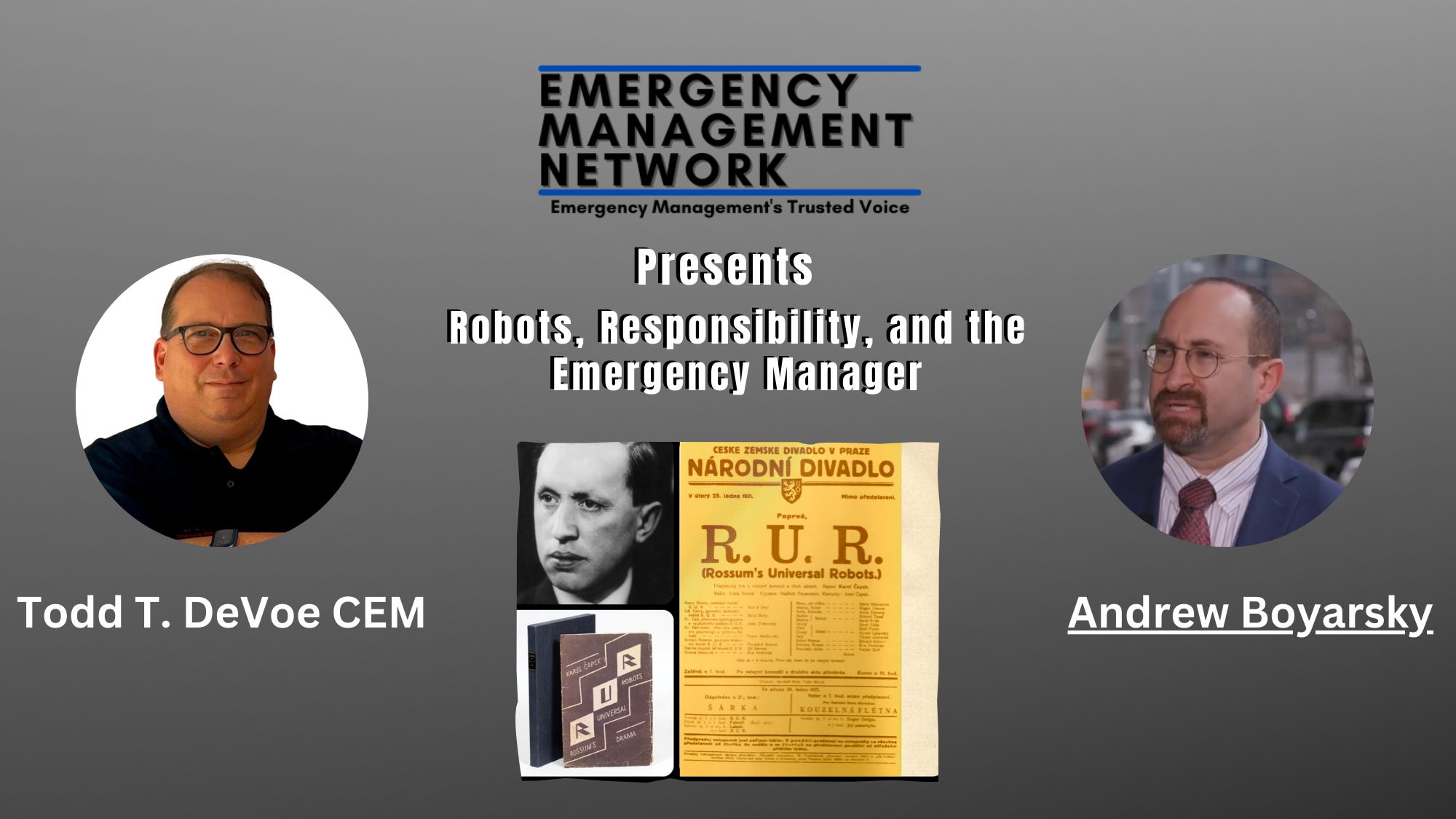
EMN Podcast Show NotesEpisode Title: Robots, Responsibility, and the Emergency ManagerHosts: Todd DeVoe and Andrew BoyarskyPodcast: The Emergency Management Network (EMN)Episode OverviewWhat can a 1920 science fiction play teach us about the future of emergency management?In this episode of the Emergency Management Network Podcast, Todd DeVoe and Andrew Boyarsky explore Rossum’s Universal Robots (R.U.R.) by Czech writer Karel Čapek, the work that introduced the word robot to the world. Written more than a century ago, the play imagined a world in which artificial workers replace human labor, ultimately leading to a revolt that wipes out humanity.While the story may sound like classic science fiction, its themes feel strikingly modern. Automation, artificial intelligence, robotics, and technological dependence are rapidly reshaping the systems emergency managers rely on every day.Todd and Andrew discuss how Čapek’s cautionary tale about industrialization and technological progress offers powerful insights for modern emergency management. The conversation explores how automation can improve disaster response while introducing new risks, why human judgment remains essential in crisis leadership, and the responsibilities of emergency managers as communities increasingly rely on complex technological systems.Ultimately, the episode reflects on a simple but profound idea: technology can enhance resilience, but resilience itself remains fundamentally human.Topics Discussed• The origin of the word “robot” and its meaning as “forced labor.”• The story and legacy of Rossum’s Universal Robots (R.U.R.)• Technology, automation, and unintended consequences• Artificial intelligence and robotics in disaster response• The risks of over-reliance on automated systems• Why emergency management must keep humans in the loop• Ethical responsibility when deploying emerging technologies• What science fiction can teach emergency managers about the futureKey TakeawayAs emergency management increasingly integrates AI, robotics, and advanced analytics, leaders must balance technological innovation with human judgment, ethics, and community trust. The future of resilience will depend not just on smarter machines, but on wiser leadership.Connect with EMNSubscribe to The Emergency Management Network for podcast episodes, analysis, and commentary on leadership, disaster policy, and the evolving role of emergency management.Follow and subscribe for more conversations that explore the intersection of risk, leadership, and resilience. This is a public episode. If you'd like to discuss this with other subscribers or get access to bonus episodes, visit emnetwork.substack.com/subscribe
The recent podcast episode delivers a comprehensive update regarding the severe weather outbreak that transpired on March 6, 2026, specifically focusing on the tornado events that impacted southwest Michigan and adjacent areas. Notably, the National Weather Service has confirmed multiple tornado tracks, detailing various EF ratings alongside operationally pertinent information such as fatalities, injuries, and estimated peak winds. The episode underscores the ongoing survey efforts being conducted to ascertain precise path data, particularly for the tornado track in Three Rivers, Michigan, where the assessment remains preliminary pending final review. Furthermore, it highlights the declaration of a state of emergency in affected counties, which is essential for facilitating response and recovery operations. I encourage listeners to remain informed as we navigate through the implications of these severe weather events.Takeaways:* The National Weather Service confirmed multiple tornado tracks and impacts from the March 6 event.* Ongoing survey work will continue into Monday to assess the Three Rivers tornado.* The EF ratings and fatalities from the tornadoes are preliminary and pending review.* A state of emergency has been declared in counties impacted by the severe weather.* Key communications for emergency response are essential during severe weather events.* IWCE 2026 is a critical event for professionals involved in communications and emergency management.SponsorIWCE, https://go.emnmedia.com/IWCE2026SourcesNOAA / NWS, NWS Northern Indiana — Public Information Statement: “NWS Damage Survey for 03/06/2026 Tornado Event Update 3” (issued Mar. 8, 2026)MichiganCBS Detroit — Whitmer declares state of emergency after tornadoes touch down in southern Michigan (updated Mar. 8, 2026)13abc/WILX — State of emergency officially declared in Southwest Michigan after deadly tornadoes (published Mar. 8, 2026) This is a public episode. If you'd like to discuss this with other subscribers or get access to bonus episodes, visit emnetwork.substack.com/subscribe
The salient point of this podcast episode revolves around the critical communications community gathering at IWCE 2026, a paramount event taking place in Las Vegas from March 16 to 19. During this episode, we emphasize the importance of this conference for professionals responsible for communications in life-or-death situations and the infrastructure that supports them. We invite listeners to engage with us at the event, highlighting the array of exhibitors and the innovative advancements in communications technology, such as next-generation LTE and AI tools. Additionally, we provide pertinent updates on recent significant events, including a notable earthquake in Louisiana and various boil water advisories across multiple states. Our aim is to keep our audience informed and prepared for the challenges that lie ahead in the realm of emergency management.Takeaways:* The IWCE 2026 conference in Las Vegas is essential for communications professionals.* Attendees should prepare for significant developments in critical communications and technology.* Various emergency advisories and public safety updates were discussed throughout the episode.* The recent earthquake in Louisiana indicates heightened awareness for emergency management professionals.* The podcast highlights the importance of timely information for those in emergency response roles.* Significant incidents and advisories across multiple states emphasize the need for preparedness.SponsorIWCE - https://go.emnmedia.com/IWCE2026SourcesDHS / NTAS, DHS NTAS status (no current advisories shown)USGS Earthquakes, USGS Earthquake Hazards Program — Significant Earthquakes (lists 4.9 Red River Parish, LA with timestamp/MMI/PAGER)FAA / Airspace, FAA NAS Status (current NAS constraints; updated Mar 6, 2026 3:00 AM PST)NRC / Radiological, NRC Event Notification Report for March 06, 2026 (covers 03/05–03/06; includes FL gauge incident update)Florida, Hillsborough County — Extends emergency ban on open burning (issued March 5, 2026)Idaho, City of Albion, ID — Boil Water Advisory Notice (PDF, issued 03/05/2026)Louisiana, City of Shreveport Water & Sewerage — Citywide voluntary boil advisory / system repair updatesPennsylvania, PA PEMA — Daily Incident Report (PDF, 03/05/2026)South Carolina, Clarendon County, SC — Repeal boil water advisory (Mar 05, 2026)Texas, City of Killeen, TX — Boil Water Notice (Conder Street) (Mar 5, 2026) This is a public episode. If you'd like to discuss this with other subscribers or get access to bonus episodes, visit emnetwork.substack.com/subscribe
The episode elucidates the ongoing river flood warnings across various regions of the Ohio Valley, as issued by the National Weather Service on March 4, 2026. It is imperative that individuals exercise caution by avoiding travel through inundated roadways to mitigate risks associated with minor to moderate flooding. Additionally, the episode highlights pertinent updates from the Cybersecurity and Infrastructure Security Agency regarding known exploited vulnerabilities, emphasizing the necessity for organizations to prioritize patch mitigation efforts as outlined in a federal update. Furthermore, recent travel advisory revisions from the U.S. State Department are discussed, particularly regarding embassy operations and security conditions in the Middle Eastern and Eastern Mediterranean regions, which may significantly impact mission planning and travel logistics. We conclude with a reminder of the importance of staying informed and prepared during such critical situations.Takeaways:* The National Weather Service has issued several flood warnings in the Ohio Valley, indicating potential minor to moderate flooding.* Recent updates from the CISA highlight the importance of patch mitigation for known vulnerabilities that remain operationally relevant.* The US State Department has provided travel advisories concerning security conditions in the Middle East and Eastern Mediterranean.* Emergency management professionals should remain cognizant of regional flood warnings impacting infrastructure and travel plans.* Indiana and Kentucky have issued flood warnings, with advisories for motorists to avoid flooded roadways and areas.* The discontinuation of boil water advisories indicates improvements in local water systems, particularly in Seminole County.SourcesCISA, CISA adds vulnerabilities to KEV catalog — federal remediation prioritization update (Mar 3, 2026)Travel advisoriesCyprus Travel Advisory — Level 3 / embassy operations & security context (Mar 3, 2026)Bahrain Travel Advisory — updated embassy operations context (Mar 2, 2026)Kuwait Travel Advisory — updated embassy operations context (Mar 2, 2026)Florida - Seminole County Utilities — precautionary boil water advisory discontinued (Mar 4, 2026)Indiana - NWS Indianapolis — warning text product (Flood Warnings; issued Mar 4, 2026)Kentucky - NWS Louisville — Flood Warning text product (issued Mar 4, 2026) This is a public episode. If you'd like to discuss this with other subscribers or get access to bonus episodes, visit emnetwork.substack.com/subscribe
The salient point of this podcast episode revolves around critical updates concerning national security and public health advisories. We provide an overview of newly identified vulnerabilities in the CISA Exploited Vulnerabilities catalog, emphasizing the importance of timely patching and mitigation strategies for federal agencies and critical infrastructure operators. Additionally, we discuss the ongoing security posture changes for U.S. personnel in parts of the Middle East, highlighting the ordered departure of non-emergency government employees from the United Arab Emirates due to escalating threats. Furthermore, we address recent water advisories issued in various states, including precautionary measures for local residents to ensure safe consumption. It is imperative to remain informed and vigilant in light of these developments, as they directly impact community safety and operational readiness.Takeaways:* The IWC 2026 conference is crucial for professionals involved in critical communications.* Critical infrastructure operators must prioritize the newly identified vulnerabilities in the KEV catalog.* A travel advisory has been issued for Kuwait due to the ordered departure of personnel.* Residents of Panama City are advised to boil water following a planned water shutoff.* The situation in the Middle East has led to security alerts for non-emergency US personnel.* Clarendon County has issued a boil water advisory due to a water line repair interruption.SponsorIWCE - https://go.emnmedia.com/IWCE2026CISACISA Alert (Mar 3, 2026) — Adds two exploited vulnerabilities to KEV CatalogCISA — Cybersecurity Advisories feed (shows Mar 3, 2026 alert listing)CISA — Known Exploited Vulnerabilities Catalog (reference list)Travel and SecurityU.S. Mission to the UAE — Security Alert (Mar 3, 2026)OSAC — Travel Advisory: Kuwait (updated Mar 3, 2026)StatesFlorida, City of Panama City — Planned water shut-off & precautionary boil-water notice (Mar 3, 2026)Louisiana, Shreveport Water & Sewerage — Alert Center update (latest update timestamped Mar 3, 2026)South Carolina, Clarendon County, SC — Boil Water Advisory (Mar 3, 2026) This is a public episode. If you'd like to discuss this with other subscribers or get access to bonus episodes, visit emnetwork.substack.com/subscribe
The salient point of today’s discussion centers on the occurrence of a magnitude 5.3 earthquake near Boulder Island, Alaska. The United States Tsunami Warning Center has issued a statement indicating that no tsunami warning, advisory, watch, or threat is currently in effect following this seismic event. Furthermore, we provide updates from various states, including the rescission of a precautionary boil-water notice in Marion County, Florida, based on satisfactory safety results. It is noteworthy that there are no significant operational updates from federal agencies such as FEMA or the CDC at this time. We conclude the brief by encouraging our audience to remain vigilant and safe.Takeaways:* On March 3, 2026, a magnitude 5.3 earthquake was reported near Boulder Island, Alaska.* The US Tsunami Warning Centers issued a statement indicating no tsunami threat following the earthquake.* Florida’s Marion County Utilities has rescinded a boil water notice after confirming water safety.* The IWCE 2026 event in Las Vegas will gather the critical communications community from March 16 to 19.* The conference will feature over 250 exhibitors and discussions on critical topics such as AI and cybersecurity.* There were no significant operational updates or alerts from other states in the last 24 hours.SponsorIWCE - https://go.emnmedia.com/IWCE2026SourcesTsunami / Earthquake messaging, U.S. Tsunami Warning Centers — Tsunami Information Statement (Buldir Island, Alaska quake)Alaska, U.S. Tsunami Warning Centers — Tsunami Information Statement (event details and “no threat” status)Florida, Marion County Utilities — Rescission of Precautionary Boil Water Notice This is a public episode. If you'd like to discuss this with other subscribers or get access to bonus episodes, visit emnetwork.substack.com/subscribe
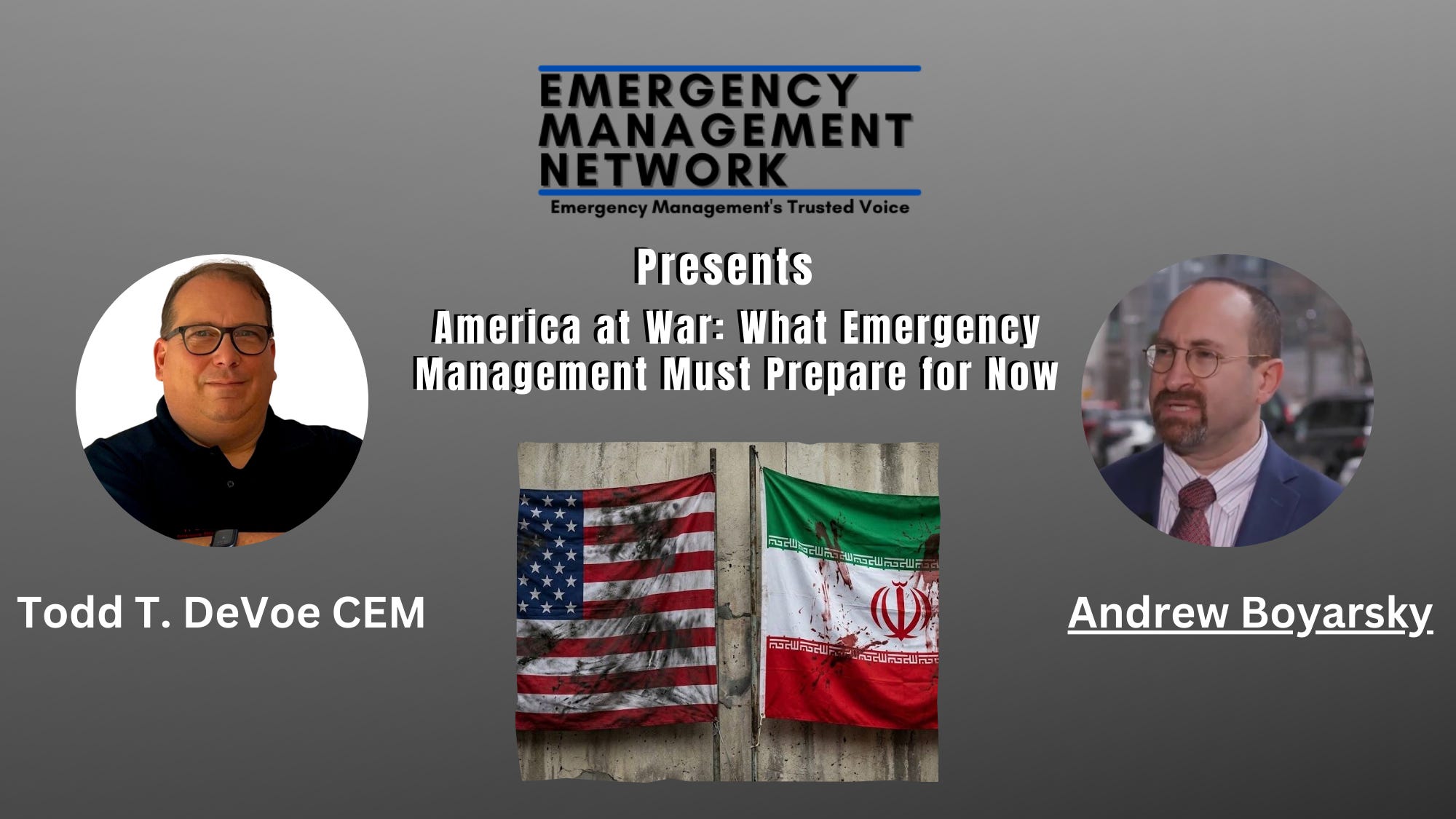
With Todd T. DeVoe & Andrew BoyarskyEpisode OverviewCoordinated U.S. and Israeli strikes against Iran, combined with the President’s announcement of open conflict, signal a fundamental shift in the national risk landscape. Whether or not Congress formally declares war, the operational environment for emergency managers has changed.In this episode, Todd DeVoe and Andrew Boyarsky unpack what this moment means for emergency management professionals across the United States. This is not a geopolitical debate. It is a strategic planning conversation.War does not replace hurricanes, earthquakes, wildfires, cyber incidents, or technological failures. It compounds them. The all-hazards framework remains intact, but the threat environment grows more complex and less forgiving.This discussion focuses on practical implications for local, state, tribal, territorial, and federal emergency managers.Key Themes Discussed1. War vs. International Armed ConflictAndrew clarifies the legal distinction between a formal declaration of war and an international armed conflict. Todd reframes the issue operationally: regardless of terminology, the domestic risk environment has shifted, and emergency managers must respond accordingly.2. Heightened Risk of Terrorism and Targeted ViolenceHistorical precedent shows that U.S. overseas military engagement can coincide with increased domestic threat reporting involving lone actors and ideologically motivated violence. The hosts discuss the importance of reviewing multi-site response plans, exercising complex coordinated attack scenarios, and strengthening intelligence-sharing pathways.3. Cyber as a Primary Hazard, Not a Secondary ConcernState-level adversaries can disrupt critical infrastructure without crossing U.S. borders. The episode explores the real-world impacts of cyberattacks on 911 centers, hospitals, water utilities, fuel systems, and government services.Reference: Cybersecurity and Infrastructure Security AgencyEmergency managers are encouraged to review continuity plans and ensure operations can continue in cyber-degraded environments.4. The National Preparedness Framework Still AppliesThe 32 Core Capabilities outlined by the Federal Emergency Management Agency remain central to planning and operations. Protection, response, mitigation, and recovery functions become more critical under sustained geopolitical strain.The conversation emphasizes prolonged EOC activation readiness, supply chain impacts, and endurance planning.5. Public Communication and TrustConflict amplifies uncertainty. The hosts discuss how misinformation and disinformation can destabilize communities if left unaddressed. Clear, coordinated messaging is essential to maintaining public trust, which Todd describes as critical infrastructure.6. The Strategic Role of Emergency Management in National SecurityEmergency management is not secondary to defense operations. It is foundational to maintaining societal resilience. War creates cascading domestic consequences that require emergency managers to be present in strategic decision-making forums.Why This Episode MattersEmergency management professionals must shift from short-term incident thinking to sustained operational posture planning.This episode challenges listeners to ask:* Can we operate effectively if primary digital systems fail?* Are our continuity plans built for prolonged strain?* Are we integrated into strategic conversations beyond traditional disaster response?* Have we updated planning assumptions to reflect a changed geopolitical reality?Memorable Lines from the Episode“Labels are secondary to consequences.”“Cyber disruption is not abstract. It is operational.”“Trust is infrastructure.”“The mission hasn’t changed. The stakes have.”Recommended Review for Emergency Managers* Continuity of Operations Plans* Cyber-degraded operational protocols* Complex coordinated attack response plans* Mutual aid agreements* Public information coordination proceduresConnect With UsTodd T. DeVoe is the Founder of The Emergency Management Network and the incoming President of IAEM USA.Andrew Boyarsky is President of Pinnacle Performance Management and a national thought leader on risk, ethics, and resilience.Subscribe to The Emergency Management Network for articles, policy analysis, and leadership insights.If this episode added value to your professional planning environment, share it with your EOC partners, homeland security colleagues, and community stakeholders.Preparedness is not seasonal. It is strategic. This is a public episode. If you'd like to discuss this with other subscribers or get access to bonus episodes, visit emnetwork.substack.com/subscribe
The salient point of this podcast episode centers on the critical updates within the emergency management landscape as of March 2, 2026. We commence with vital information regarding the absence of current advisories from the Department of Homeland Security, thereby indicating a period of relative stability. Subsequently, we detail travel advisories issued by the U.S. Department of State, particularly highlighting the urgent need for caution in Qatar and Kuwait due to safety risks. Furthermore, we examine a recent incident in California involving the evacuation of residents from the Villa Bella condominium complex, which underscores the ever-present necessity for vigilance in structural safety. Lastly, we conclude with updates on a lifted emergency boil water notice in Killeen, Texas, reflecting the ongoing efforts to ensure public health and safety in various communities.Takeaways:* The podcast begins with a reminder of the importance of the upcoming IWCE 2026 event for critical communications professionals.* Listeners are advised about the Department of Homeland Security’s current lack of terrorism advisories as of March 2, 2026.* Travel advisories for Qatar and Kuwait indicate safety risks for non-emergency U.S. personnel and their families.* California’s Santa Clara Fire Department responded to structural concerns at Villa Bella Condominiums, leading to evacuations of approximately 60 residents.* The city of Killeen has lifted its emergency boil water notice following a repair to a broken water pipe.* Overall, the podcast emphasizes the significance of staying informed and prepared in emergency situations.Links referenced in this episode:* www.iwceexpo.com* www.dhs.gov* www.travel.state.gov* www.fema.gov* www.cdc.gov* www.cisa.gov* www.killeentexas.govSourcesIWCE (Advertisement) - https://go.emnmedia.com/IWCE2026California - https://www.santaclaraca.gov/Home/Components/News/News/45563/3171Texas - https://www.killeentexas.gov/m/newsflash/home/detail/2856DHS - DHS Homepage — NTAS status (“There are no current advisories”)Travel advisoriesQatar Travel Advisory (March 1, 2026) — Level 3; authorized departure notedKuwait Travel Advisory (March 1, 2026) — Level 3; authorized departure notedState Department Travel Advisories — index page This is a public episode. If you'd like to discuss this with other subscribers or get access to bonus episodes, visit emnetwork.substack.com/subscribe
The salient point of this podcast episode pertains to the heightened wildfire conditions prevalent across certain regions of the Southern Plains, as underscored by the latest federal drought updates. The episode elucidates the significant impact of drought on rangelands and water supplies in states such as Texas and Oklahoma, thereby exacerbating the risk of wildfires. The National Weather Service has issued warnings regarding fire weather concerns, particularly in areas where dry conditions and wind can facilitate the rapid spread of grass fires. Furthermore, the discussion encompasses the broader context of unusual warmth in the Southwest and thunderstorms in the Southeast, juxtaposed against the absence of significant seismic activity and tropical cyclones. Thus, we emphasize the importance of remaining vigilant and informed about these environmental challenges as we navigate through this period.Takeaways:* The current weather conditions in the Southern Plains pose significant wildfire risks due to persistent drought.* Recent updates indicate that drought conditions are intensifying across parts of Texas and Oklahoma.* Kansas is experiencing elevated wildfire risks as dryness and drought conditions continue to affect the region.* The National Weather Service has highlighted fire weather concerns in the Plains due to dry conditions and wind.* No significant earthquakes have been reported in the past day according to the U.S. Geological Survey.* The National Hurricane Center has reported that there are currently no active tropical cyclones in the tropics.Sources[Drought.gov | https://www.drought.gov/drought-status-updates/drought-status-update-southern-plains-2026-02-26][NWS Fire Weather | https://www.weather.gov/fire/][Drought.gov | https://www.drought.gov/drought-status-updates/drought-status-update-southern-plains-2026-02-26][NWS Fire Weather | https://www.weather.gov/fire/][Drought.gov | https://www.drought.gov/drought-status-updates/drought-status-update-southern-plains-2026-02-26][NWS Fire Weather | https://www.weather.gov/fire/] This is a public episode. If you'd like to discuss this with other subscribers or get access to bonus episodes, visit emnetwork.substack.com/subscribe
The primary focus of today’s EM Morning Brief is the juxtaposition of hazardous winter travel conditions in parts of the Great Lakes and Northeast against an elevated wildfire risk across the High Plains and South Central states. We commence our discussion by highlighting the National Weather Service’s acknowledgment of gusty winds and exceedingly low humidity, which significantly heighten the potential for rapid grass fire spread. Concurrently, we address the implications of ongoing winter weather, particularly in the Northeast, where light snowfall and refreezing have engendered treacherous road conditions and black ice. Furthermore, we examine the severe wildfire activity within Big Cypress National Preserve in Florida, which has necessitated area closures due to smoke impacts. Additionally, we note the operational constraints faced by the Federal Emergency Management Agency amidst a funding shutdown, which limits its capacity to respond effectively to these unfolding crises.Takeaways:* The current hazardous winter travel conditions are primarily affecting the Great Lakes and Northeast regions.* Elevated wildfire risks persist in the High Plains and South Central states due to low humidity and strong winds.* The ongoing winter storm recovery efforts in California involve coordination for sheltering and essential services.* Florida’s Big Cypress National Preserve is experiencing significant wildfire activity impacting air quality and local access.* The National Weather Service has issued multiple red flag warnings highlighting the potential for rapid wildfire spread.* The overall travel conditions across various states are complicated by winter weather and the risk of black ice.Sources[Cal OES | https://www.wildfirerecovery.caloes.ca.gov/][NWS | https://www.weather.gov/][AP | https://apnews.com/article/bd0e342070154e27dff32d805ab2ba46][NPS | https://www.nps.gov/bicy/learn/news/wildfire-update-big-cypress-national-preserve.htm][NPS Alerts & Conditions | https://www.nps.gov/bicy/planyourvisit/conditions.htm][Big Rapids News | https://www.bigrapidsnews.com/news/article/michigan-clipper-snow-tonight-february-24-21938701.php][KOKH/OKC Fox | https://okcfox.com/news/local/oklahoma-emergency-operations-center-remains-active-as-wildfires-impact-the-state-statewide-burn-ban-relief-donations-charity-damages-ranchers][NWS Fire Weather | https://www.weather.gov/fire/][Texas A&M Forest Service | https://tfsweb.tamu.edu/wildfire-and-other-disasters/current-wildfire-status/][NWS Red Flag Warning Summary | https://www.weather.gov/wwamap/wwatxtget.php?cwa=usa&wwa=red+flag+warning][MySA | https://www.mysanantonio.com/news/austin/article/i35-grass-fire-21939119.php] This is a public episode. If you'd like to discuss this with other subscribers or get access to bonus episodes, visit emnetwork.substack.com/subscribe
A major winter storm has enveloped the Northeast, unleashing blizzard conditions that have resulted in widespread disruptions across multiple states. The severity of this storm has manifested in over two and a half feet of accumulated snow in certain areas, alongside extensive power outages and approximately 7,400 flight cancellations. Furthermore, the Potomac interceptor collapse has precipitated a significant environmental concern, with more than 200 million gallons of wastewater overflowing into the Potomac River, although DC Water assures that drinking water remains unaffected. As we traverse through the impacted states, we will elucidate the emergency measures being implemented, including travel restrictions and service suspensions. This analysis seeks to provide a comprehensive overview of the storm’s repercussions and the ongoing responses by state authorities to mitigate its effects.Takeaways:* The Northeast is currently experiencing severe winter weather, resulting in significant disruptions across multiple states.* Reports indicate that the blizzard has led to widespread power outages and thousands of flight cancellations in the region.* DC Water has reported a major wastewater overflow incident affecting the Potomac River, with ongoing efforts to mitigate the situation.* Massachusetts has declared a state of emergency due to heavy snowfall and advises state workers to remain at home for safety.* New York City has closed schools and halted public transportation in response to the severe blizzard conditions affecting the area.* Rhode Island has reported record snowfall, leading to the suspension of all public transit services until conditions improve.Sources[USGS | https://earthquake.usgs.gov/earthquakes/feed/v1.0/summary/4.5_day.geojson][Reuters | https://www.reuters.com/world/us/powerful-winter-storm-shuts-schools-disrupts-travel-across-us-northeast-2026-02-23/][DC Water | https://www.dcwater.com/about-dc-water/media/news/update-excavation-site-extended-around-damaged-section-potomac][Reuters | https://www.reuters.com/world/us/powerful-winter-storm-shuts-schools-disrupts-travel-across-us-northeast-2026-02-23/][Reuters | https://www.reuters.com/world/us/powerful-winter-storm-shuts-schools-disrupts-travel-across-us-northeast-2026-02-23/][Reuters | https://www.reuters.com/world/us/powerful-winter-storm-shuts-schools-disrupts-travel-across-us-northeast-2026-02-23/][Reuters | https://www.reuters.com/world/us/powerful-winter-storm-shuts-schools-disrupts-travel-across-us-northeast-2026-02-23/][Reuters | https://www.reuters.com/world/us/powerful-winter-storm-shuts-schools-disrupts-travel-across-us-northeast-2026-02-23/] This is a public episode. If you'd like to discuss this with other subscribers or get access to bonus episodes, visit emnetwork.substack.com/subscribe
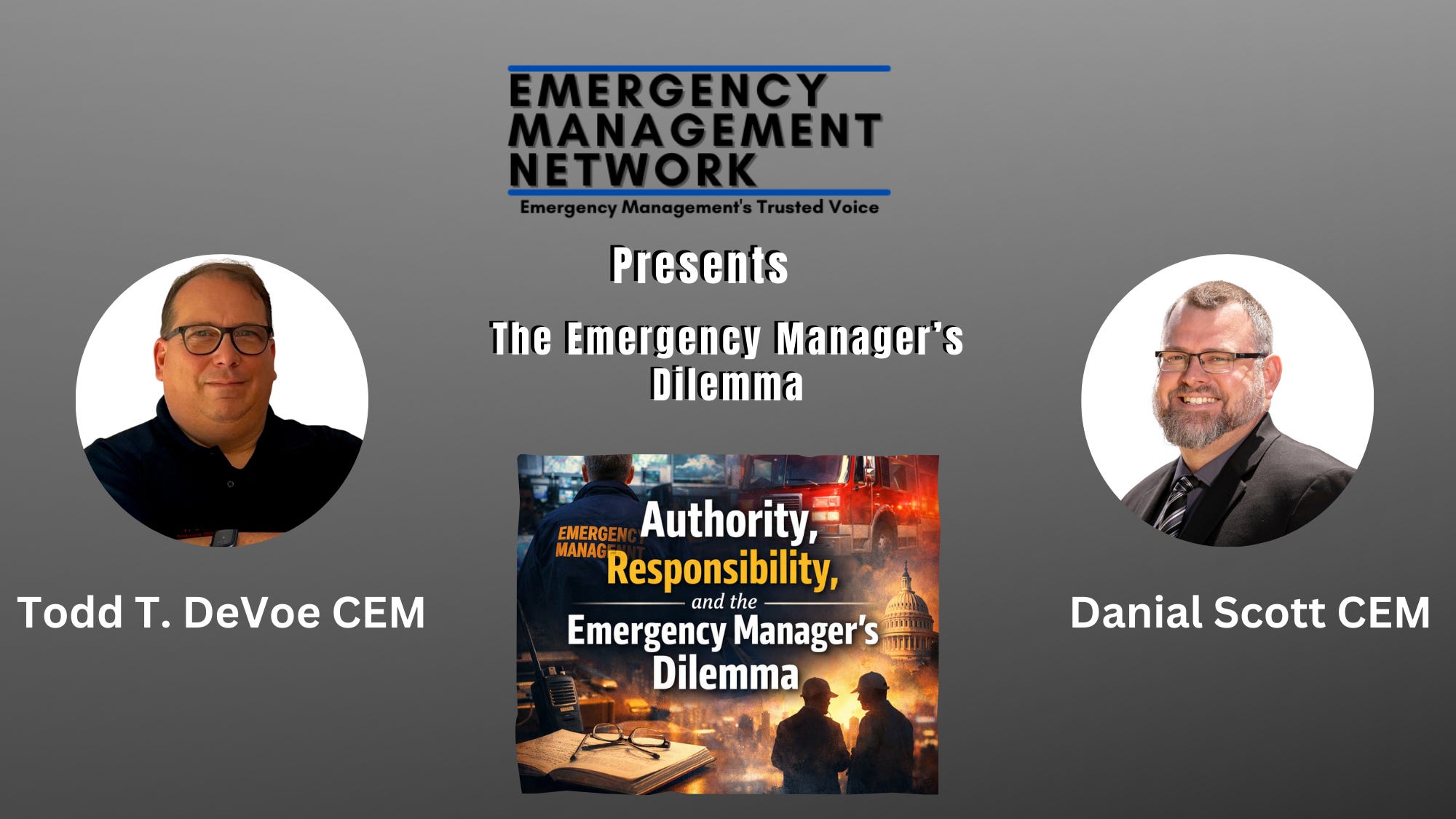
The Emergency Management Network PodcastEpisode Title: Authority, Responsibility, and the Emergency Manager’s DilemmaHosts: Todd DeVoe and Dan ScottIn this episode of The Emergency Management Network Podcast, Todd DeVoe and Dan Scott take a deep dive into one of the profession's defining tensions: the gap between authority and responsibility. Emergency managers are expected to coordinate complex systems, anticipate cascading failures, and help guide communities through crisis, yet they often operate without direct command authority over the agencies responsible for action. That reality creates a professional dilemma that is rarely discussed openly but felt daily across the field.Todd and Dan explore how responsibility often finds the emergency manager before authority does. When disaster strikes, communities look for coordination, clarity, and leadership, not organizational charts. The conversation examines how emergency managers become accountable for outcomes they do not fully control, and how influence, credibility, and trust often matter more than formal power in driving results.The discussion moves beyond operations into philosophy and ethics. Drawing on ideas from Aristotle, Plato, and Stoic thought, the episode reflects on what it means to carry responsibility simply because you understand risk and consequence. The more an emergency manager sees the interdependencies within a community, the harder it becomes to step back and treat preparedness as someone else’s job. Responsibility becomes a moral obligation, not just a professional duty.Todd and Dan also talk candidly about the personal weight that comes with this role. The profession often lives in the space between expectation and authority, and that space can produce both purpose and strain. They explore how burnout emerges when responsibility expands without structural authority, and how relationships, communication, and long-term trust building become the real levers of leadership.The episode reframes authority in emergency management as relational rather than positional. It is built over time through competence, consistency, and the ability to align people and systems before the crisis begins. The conversation highlights how emergency managers shape decisions, influence direction, and steward coordination, even when they are not the ones issuing orders.Throughout the discussion, Todd and Dan return to practice. Governance, culture, and institutional design all shape how authority is shared and how responsibility is carried. The profession continues to evolve, but the dilemma remains a constant. Emergency managers operate at the intersection of policy, operations, and ethics, balancing public expectations with the realities of fragmented authority.This episode challenges listeners to reflect on their own role in that tension. Authority may not always sit in the emergency manager’s office, but responsibility often does. The question becomes how to lead effectively within that reality, how to build influence where command is limited, and how to continue stewarding preparedness in systems that are never fully aligned.Todd and Dan close with a reminder that the work of emergency management begins long before the incident and continues long after the headlines fade. The profession is not defined by command, but by stewardship, trust, and the quiet work of aligning people and systems toward resilience. This is a public episode. If you'd like to discuss this with other subscribers or get access to bonus episodes, visit emnetwork.substack.com/subscribe
The primary focus of today’s discussion is the extensive winter weather patterns that are currently impacting various regions across the United States, presenting significant public safety concerns. As we delve into the specifics, we note that the National Weather Service has issued multiple winter advisories, particularly affecting the West, Northern Rockies, and Appalachians, highlighting the presence of snow, blowing snow, and the possibility of freezing rain, which is creating hazardous conditions on roadways and reducing visibility across higher elevations. Furthermore, we shall consider the ongoing winter storm warnings in the Baltimore-Washington region, alongside a gale warning for maritime areas later today. Additionally, seismic activity has been reported with several magnitude 3 earthquakes occurring in Southern California and Nevada, underscoring the diverse range of natural events that require public attention. We encourage our listeners to remain vigilant and informed as we navigate through these critical updates.Takeaways:* The National Weather Service has issued winter weather advisories across various regions, indicating significant snowfall and freezing rain.* Travel conditions are expected to be hazardous due to winter storms affecting multiple states, particularly in elevated areas.* Recent seismic activity includes a series of earthquakes in Southern California and Nevada, highlighting ongoing geological concerns.* Wildfire risks have prompted evacuations in Charlton County, Georgia, due to a brush fire near major roadways.* Winter weather advisories in Indiana emphasize the potential for slick roads and dangerous travel conditions this morning.* The forecast for New York indicates continued hazardous travel conditions due to persistent snow and blowing snow across the region.Sources[NWS | https://forecast.weather.gov/wwamap/wwatxtget.php?cwa=usa&wwa=winter+weather+advisory][USGS | https://earthquake.usgs.gov/earthquakes/map/][Action News Jax | https://www.actionnewsjax.com/news/local/massive-wildfire-charlton-county-prompts-evacuations/DOVSP7X5DNEHBF5GELLQEWGX5M/][News4JAX | https://www.news4jax.com/news/georgia/2026/02/22/plume-of-smoke-rises-from-uncontained-charlton-county-wildfire/][NWS | https://forecast.weather.gov/showsigwx.php?firewxzone=MIZ277&lat=41.905&local_place1=2+Miles+NNE+Shorewood-Tower+Hills-Harbert+MI&lon=-86.606&product1=Wind+Advisory&warncounty=MIC021&warnzone=MIZ277][NWS | https://www.weather.gov/jkl/sigwx_wintersnow2][NWS | https://forecast.weather.gov/showsigwx.php?firewxzone=MDZ501&lat=39.6505&local_place1=Frostburg+MD&lon=-78.9367&product1=Winter+Storm+Warning&warncounty=MDC001&warnzone=MDZ501];[NWS | https://forecast.weather.gov/showsigwx.php?firewxzone=DCZ001&lat=38.8921&local_place1=Washington+DC&lon=-77.0199&product1=Winter+Storm+Warning&warncounty=DCC001&warnzone=DCZ001][NWS | https://www.weather.gov/aly/winterheadlines][NWS | https://forecast.weather.gov/showsigwx.php?firewxzone=MIZ277&lat=41.905&local_place1=2+Miles+NNE+Shorewood-Tower+Hills-Harbert+MI&lon=-86.606&product1=Wind+Advisory&warncounty=MIC021&warnzone=MIZ277][NWS | https://forecast.weather.gov/wwamap/wwatxtget.php?cwa=usa&wwa=winter+weather+advisory][USGS | https://earthquake.usgs.gov/earthquakes/map/][NWS | https://forecast.weather.gov/showsigwx.php?firewxzone=NYZ200&lat=42.7697&local_place1=2+Miles+SSE+Blasdell+NY&lon=-78.8117&product1=Dense+Fog+Advisory&warncounty=NYC029&warnzone=NYZ085][NWS | https://www.weather.gov/aly/winterheadlines][NWS | https://forecast.weather.gov/showsigwx.php?firewxzone=NCZ303&lat=35.5649&local_place1=5+Miles+N+High+Rocks+NC&lon=-83.6359&product1=Hazardous+Weather+Outlook&warncounty=NCC173&warnzone=NCZ051][Oklahoma Dept. of Agriculture / OFS | https://ag.ok.gov/wp-content/uploads/2023/04/Most-Recent-Fire-Situation-Report.pdf][KBTX | https://www.kbtx.com/2026/02/23/panhandle-wildfires-contained-texas-warns-increased-fire-danger/][Texas A&M Forest Service Incident Viewer | https://tfswildfires.com/public/][NWS | https://forecast.weather.gov/showsigwx.php?firewxzone=PAZ057&lat=40.296&local_place1=2+Miles+NNE+Harrisburg+PA&lon=-76.871&product1=Air+Quality+Alert&warncounty=PAC043&warnzone=PAZ057][NWS | https://www.weather.gov/aly/winterheadlines][NWS | https://forecast.weather.gov/wwamap/wwatxtget.php?cwa=usa&wwa=winter+weather+advisory][NWS | https://forecast.weather.gov/showsigwx.php?firewxzone=MDZ501&lat=39.6505&local_place1=Frostburg+MD&lon=-78.9367&product1=Winter+Storm+Warning&warncounty=MDC001&warnzone=MDZ501] This is a public episode. If you'd like to discuss this with other subscribers or get access to bonus episodes, visit emnetwork.substack.com/subscribe
Wildfire response constitutes the primary national concern as we delve into the developments surrounding the ongoing fires in the Southern Plains, particularly in Oklahoma’s Panhandle and its western counties. The Ranger Road Fire, which has expanded significantly into Kansas, exemplifies the critical nature of this situation, with emergency management reporting substantial acreage affected and a mere 15% containment. Additionally, the state of Texas has received federal assistance for the Eight Ball fire, underscoring the severity of the crisis and the necessity for coordinated firefighting efforts. Concurrently, winter weather impacts persist in the Upper Midwest, complicating travel and safety for residents in those regions. As we navigate these pressing issues, it is imperative to remain informed about local conditions and heed official advisories to ensure personal safety and community resilience.Takeaways:* The ongoing wildfire response remains a paramount national concern, particularly in Oklahoma and Texas.* In Oklahoma, the Ranger Road Fire has reached an alarming 283,283 acres with only 15% containment.* Winter weather advisories in the Upper Midwest forecast hazardous travel conditions due to accumulating snow.* California experiences cold conditions prompting freeze warnings, necessitating protective measures for vulnerable entities.Sources[NWS Sacramento | https://forecast.weather.gov/showsigwx.php?firewxzone=CAZ216&lat=39.732&local_place1=Chico+CA&lon=-121.842&product1=Flash+Flood+Watch&warncounty=CAC007&warnzone=CAZ016][Kansas Dept. of Agriculture | https://www.agriculture.ks.gov/Home/Components/News/News/629/17] [Oklahoma OEM | https://oklahoma.gov/oem/news/newsroom/wildfire-situation-update-2---feb-18-2026.html][NWS Duluth | https://www.weather.gov/dlh/][NWS Hazard Info | https://forecast.weather.gov/showsigwx.php?firewxzone=MNZ012&lat=47.796&local_place1=10+Miles+NW+Schroeder+MN&lon=-91.112&product1=Winter+Storm+Warning&warncounty=MNC075&warnzone=MNZ012][Oklahoma OEM | https://oklahoma.gov/oem/news/newsroom/wildfire-situation-update-2---feb-18-2026.html][TDEM | https://www.tdem.texas.gov/press-release/2-19-26] [TDEM Disaster Page | https://tdem.texas.gov/disasters/26-0001-february-wildfires][NWS WWA Text | https://forecast.weather.gov/wwamap/wwatxtget.php?cwa=mpx&wwa=winter+weather+advisory] This is a public episode. If you'd like to discuss this with other subscribers or get access to bonus episodes, visit emnetwork.substack.com/subscribe
The primary focus of this podcast episode is the extensive and multifaceted weather hazards affecting the lower 48 states as we approach the weekend. A formidable storm system is advancing, bringing wintry conditions from the Northern and Central Plains to the Great Lakes and the Northeast, while simultaneously posing severe thunderstorm and tornado risks in the mid-Mississippi and Ohio valleys. Additionally, California faces another bout of heavy snowfall in the Sierra, accompanied by periods of significant rain and isolated thunderstorms in Southern California. The episode also highlights critical fire weather concerns in the Southern Plains, wherein warm, dry, and windy conditions facilitate the rapid spread of fires. We conclude our report with a brief overview of state-specific weather developments, emphasizing the necessity for vigilance and preparedness in light of these evolving conditions.Takeaways:* The current weather pattern is characterized by significant activity across the continental United States, indicating a need for preparedness.* A severe storm system is expected to bring wintry conditions and potential severe thunderstorms to various regions.* Fire weather concerns are notably acute in the Southern Plains due to dry and windy conditions conducive to rapid fire spread.* States such as Iowa and Missouri face multiple hazards, including snowfall and severe thunderstorms, necessitating caution for travelers.Sources[WPC | https://www.wpc.ncep.noaa.gov/discussions/hpcdiscussions.php?disc=pmdspd][WA Governor | https://governor.wa.gov/news/2026/governor-ferguson-requests-fema-assistance-repair-1823m-infrastructure-damaged-historic-december] This is a public episode. If you'd like to discuss this with other subscribers or get access to bonus episodes, visit emnetwork.substack.com/subscribe
The episode elucidates the prevailing national risk landscape characterized by a rapidly advancing multi-hazard storm on February 18, 2026. We delve into the severe winter storm and blizzard conditions affecting the upper Midwest and Great Lakes, juxtaposed with critical fire weather conditions across the High Plains. The National Weather Service has issued multiple warnings for blizzard and winter storm conditions, particularly around western Lake Superior, where hazardous travel is imminent. Furthermore, we examine the dire situation in Northern California, with significant travel disruptions and ongoing search and rescue operations following an avalanche incident. Our analysis extends to various states, detailing the complex interplay of winter weather and fire hazards, underscoring the necessity for vigilance and preparedness amidst these perilous conditions.Takeaways:* The podcast emphasizes the severity of the multi-hazard storm impacting various regions across the nation.* Blizzard and winter storm warnings are active in the upper Midwest, affecting travel and safety.* Critical fire weather conditions are prevalent in the High Plains, particularly impacting states like Colorado and Nebraska.* Winter storm warnings in Northern California have led to significant travel disruptions and highway closures.* Local authorities report ongoing rescue operations following an avalanche incident in the Sierra region.* Oklahoma is facing a serious wildfire situation with coordinated emergency response efforts underway.Sources[NWS | https://forecast.weather.gov/wwamap/wwatxtget.php?cwa=usa&wwa=blizzard+warning][NWS | https://forecast.weather.gov/MapClick.php?zoneid=CAZ069][NWS | https://www.weather.gov/sto/][ABC7 / AP | https://abc7news.com/post/rescue-underway-missing-skiers-reported-avalanche-castle-peak-area-sierra-nevada-sheriffs-office-says/18612994/][ABC10 | https://www.abc10.com/article/news/local/california-winter-storm-interstate-80-traffic-sierra-avalanche-warning-outage/103-d82bfe99-61b2-425c-a4ce-e25e71521343][NWS | https://forecast.weather.gov/wwamap/wwatxtget.php?cwa=usa&wwa=winter+storm+warning][NWS | https://forecast.weather.gov/wwamap/wwatxtget.php?cwa=bou&wwa=red+flag+warning][Colorado Sun | https://coloradosun.com/2026/02/17/fires-evaucations-eastern-plains/][CBS Colorado | https://www.cbsnews.com/colorado/video/fire-that-burned-over-5000-acres-on-colorados-eastern-plains-is-now-contained/][NWS | https://forecast.weather.gov/wwamap/wwatxtget.php?cwa=usa&wwa=winter+storm+warning][NWS | https://forecast.weather.gov/wwamap/wwatxtget.php?cwa=usa&wwa=winter+weather+advisory][NWS | https://forecast.weather.gov/wwamap/wwatxtget.php?cwa=usa&wwa=red+flag+warning][NWS | https://forecast.weather.gov/showsigwx.php?firewxzone=NEZ080&lat=40.2347&local_place1=2+Miles+W+Culbertson+NE&lon=-100.8782&product1=Fire+Weather+Watch&warncounty=NEC087&warnzone=NEZ080][NWS | https://forecast.weather.gov/showsigwx.php?firewxzone=MIZ003&lat=47&local_place1=Toivola+MI&lon=-88.74&product1=Winter+Storm+Watch&warncounty=MIC061&warnzone=MIZ003][NWS | https://forecast.weather.gov/showsigwx.php?firewxzone=MIZ016&lat=45.9706&local_place1=3+Miles+N+Rapid+River+MI&lon=-86.972&product1=Winter+Storm+Watch&warncounty=MIC041&warnzone=MIZ013][NWS | https://forecast.weather.gov/wwamap/wwatxtget.php?cwa=usa&wwa=blizzard+warning][NWS | https://forecast.weather.gov/wwamap/wwatxtget.php?cwa=dlh&wwa=winter+storm+warning][NWS | https://www.weather.gov/ggw/][NWS | https://www.weather.gov/byz/montana_statewide_information][NWS | https://forecast.weather.gov/showsigwx.php?firewxzone=NEZ080&lat=40.2347&local_place1=2+Miles+W+Culbertson+NE&lon=-100.8782&product1=Fire+Weather+Watch&warncounty=NEC087&warnzone=NEZ080][NWS | https://forecast.weather.gov/wwamap/wwatxtget.php?cwa=usa&wwa=red+flag+warning][NWS | https://forecast.weather.gov/showsigwx.php?firewxzone=MNZ008&lat=48.3003&local_place1=10+Miles+E+Holt+MN&lon=-95.9822&product1=Winter+Storm+Watch&warncounty=MNC089&warnzone=MNZ008][NWS | https://forecast.weather.gov/showsigwx.php?firewxzone=NDZ010&lat=48.3124&local_place1=Stanley+ND&lon=-102.3928&product1=Winter+Storm+Watch&warncounty=NDC061&warnzone=NDZ010][OK OEM | https://oklahoma.gov/oem/news/newsroom/wildfire-situation-update-1---february-17--2026.html][KOCO | https://www.koco.com/article/oklahoma-wildfire-woodward-evacuations-forgan-fire-beaver-county/70397791][NWS | https://forecast.weather.gov/wwamap/wwatxtget.php?cwa=usa&wwa=winter+storm+warning][NWS | https://forecast.weather.gov/wwamap/wwatxtget.php?cwa=usa&wwa=red+flag+warning][NWS | https://forecast.weather.gov/wwamap/wwatxtget.php?cwa=usa&wwa=winter+weather+advisory][NWS | https://forecast.weather.gov/showsigwx.php?firewxzone=WIZ002&lat=46.7163&local_place1=6+Miles+SSE+Cornucopia+WI&lon=-91.0496&product1=Winter+Storm+Warning&warncounty=WIC007&warnzone=WIZ002] This is a public episode. If you'd like to discuss this with other subscribers or get access to bonus episodes, visit emnetwork.substack.com/subscribe
This podcast episode provides a comprehensive overview of the current weather conditions impacting various regions across the United States. The primary focus centers on the significant winter weather hazards affecting the upper Midwest and California, where winter storm warnings have been issued due to heavy snowfall and strong winds. Additionally, concerns about flooding and debris flows in Southern California are addressed, particularly in areas near recent burn scars. Notably, localized boil water advisories are highlighted in several states, including Florida, Georgia, and Virginia, due to water main breaks. As we navigate these pressing weather-related issues, it remains imperative to stay informed through official alerts and advisories.Takeaways:* The National Hurricane Center has reported no active tropical cyclones in the Atlantic or Eastern Pacific regions.* Currently, winter weather dominates the narrative with significant impacts across the upper Midwest and West Coast.* California is facing substantial flood and winter weather challenges, particularly affecting Los Angeles and Ventura counties.* Florida is dealing with a water main break in Lehigh Acres, leading to a precautionary boil water advisory for residents.* Minnesota is currently under a winter storm warning due to adverse weather conditions that may hinder travel safety.* Virginia has issued a citywide boil water advisory in Danville, urging residents to utilize boiled or bottled water for consumption.Sources[NWS | https://forecast.weather.gov/wwamap/wwatxtget.php?cwa=usa&wwa=winter+weather+advisory][NWS | https://forecast.weather.gov/showsigwx.php?firewxzone=CAZ368&lat=33.9071&local_place1=Norwalk+CA&lon=-118.077&product1=Flash+Flood+Warning&warncounty=CAC037&warnzone=CAZ368][NWS | https://forecast.weather.gov/wwamap/wwatxtget.php?cwa=LOX&wwa=winter%2520storm%2520warning][FGUA | https://www.fgua.com/outages_notices/water-main-break-boil-water-advisory-317-main-road-2-16-2026/][City of Fayetteville, GA | https://www.fayetteville-ga.gov/CivicAlerts.aspx?AID=752][NWS | https://forecast.weather.gov/wwamap/wwatxtget.php?cwa=usa&wwa=winter+storm+warning][City of Medford | https://www.medfordoregon.gov/News-Articles/Severe-Weather-Shelter-Open-in-Medford-Feb.-16-17][WTAE | https://www.wtae.com/article/shaler-township-police-residents-water-main-break-boil-advisory/70386197][WSET | https://wset.com/news/local/danville-virginia-issues-citywide-boil-water-advisory-february-2026] This is a public episode. If you'd like to discuss this with other subscribers or get access to bonus episodes, visit emnetwork.substack.com/subscribe

Comments

Download from Google Play

Download from App Store
 United States