


 Claim Ownership
Hunting for Human Nature
Subscribed: 0Played: 0
Subscribe

© Bruce McGlenn
Description
Stories from Bruce's hunting journals exploring our connection to the web of life and what it means to be human.
humannaturehunting.substack.com
humannaturehunting.substack.com
2 Episodes
Reverse
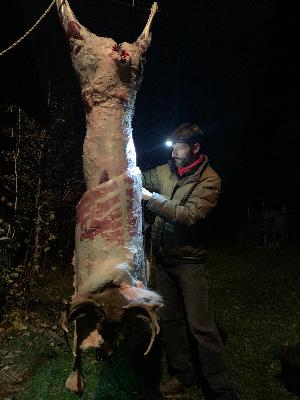
It’s been estimated that the star we call our sun fuses some 620 million metric tons of hydrogen into helium every second. The resulting intense heat and light that fuels life on earth has an ephemeral nature as it dissipates over time and space. Even the sun, as it converts its fuel, has a finite lifespan before it turns into a red giant and then a white dwarf. A state of constant flux.As a result of this nuclear reaction nearly 100 million miles away, fibrous plant matter grows on our planet that we humans cannot break down and digest (grasses, shrubs, and such). But ruminants can, using their specialized digestion systems, turn cellulose into muscle.Humans and our ancestors realized this and began hunting for food some two million years ago. We are descendants of those people, their hunting DNA honed for a hundred thousand generations and passed down to us. In modern times, if we have the opportunity to tap into this ancient wisdom it can awaken unknown parts of us.And so it was, on the eve of the last day of the season and nearing the hunters full moon in the foothills of the Selkirk Mountains in Northeast Washington as the sun began to set – or rather the horizon of mountains and firs and golden larches spun up to block out its light – that I crept along a trail, calling on all my senses to keep track of the wind direction and faint noises and intuitive hunches and slight movements in the distant twilight.At first, I saw a doe in a small clearing. And then a young buck that I’m quite certain I had been watching the last few years grow into an adult; the shape of their antlers sometimes offering a unique signature. And then a mature buck stepped out of the timber and in a fraction of an instant I was drawn deeper into the hunt. The overwhelming “yes” that I felt is a telltale sign that something feels right at the intuitive level – every cell in my body telling me that this could be the animal that feeds me and my family over the winter when the sun’s energy is too weak to grow lush vegetables in the wild.Light was fading fast as snow began to drift down. My immediate reaction was to start moving closer to get a shot before dark set in, and then I caught myself and just reasoned for a few moments and considered options. Looking around for a place to lay prone or rest on a tree to steady a long, 300+ yd shot was not an option due to the brush that obstructed a clear line of sight. I had to get closer. I backtracked to a fork in the trail that approached the clearing while keeping sparce timber between me and the animals for some cover. When I ran out of timber for cover, I found a spot I thought might work. I slowly and quietly slid off my pack and used it as a partial support for my rifle as I lay on the ground – knees and elbows pressing into the wet soil. I peered past my scope, down the barrel to make sure the bullet would have an unobstructed path through the low brush, shifted a little to find an opening, and settled into the rifle.At this point my primal focus, perhaps passed down over the generations of hunting, took over and helped calm my nerves. Practice and repetition made familiar my sight picture. When things felt right, no sooner and no later, a slight pressure on the trigger to burn the powder. Moments later I received a text message from Sarah who had hiked up into the area with Maya in her pack and then turned back as I approached the clearing so as not to make any unnecessary noise. “Was that your shot?” She inquired hopefully. “You can store the beans,” I replied. “We’ve got meat.”Before the two and a half-hour drag out of the woods and down the mountain in the damp snowy darkness and log-strewn timber I field dressed the beautiful animal, giving thanks for its life, its energy. That energy would fuel our bodies, flowing from the sun through the land through the deer and through us. I held up the heart in a fleeting patch of moonlight and noticed the ephemeral steam dissipating through time and space and knew that the flow of energy would not stop at me.It called me to reflect on the possibilities that lay before me to use my life energy. What will I do while my light burns bright, before turning into a red giant..? Get full access to Hunting for Human Nature at humannaturehunting.substack.com/subscribe
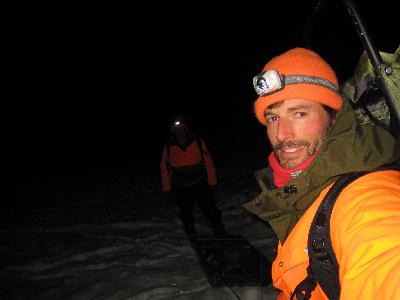
With a few final steps I pushed my way through the crystalline snow to the top of the ridge carrying a pack frame full of meat and pulling two elk quarters in the sled. Dad followed me in the moonlight – I could hear him breathing in and exhaling the negative 10 degree air when I stopped to catch my breath, and occasionally looked back to see a little point of light on his brow. I peered through the night sky with my headlamp across the snowy bowl hoping to catch a glimpse of the truck about a quarter mile away but the darkness and the cold ate up my faint beam of light before it had a chance to reach the reflectors on the rig. Navigating the sage brushed side slope across the bowl should have been foreboding, especially considering what had transpired to get to this point. But I stepped off the edge of the ridge with an unusual lightness, my heart thumping, my legs pumping, and kept going, wondering when my granola from ten hours earlier was going to wear off.After eavesdropping on a herd of elk earlier in the morning by staying hidden in the timber and glassing them through the snow-covered fir boughs – taking caution not to dislodge the snow above our heads sending it down the backs of our necks – Andrew and I set out to attempt a flank maneuver. The elk had headed up onto a timbered ridge and bedded down and we were going to see about stopping in for a visit. However, getting close proved challenging. I crept along a fence line toward the vigilant bunch, taking a slow step and then waiting and watching for a sign of orange or brown hair. By covering the ground painfully slowly (and it was painful as my toes were getting numb) I hoped to sneak across an opening without causing a stir. But when I was able to see elk through my binoculars I knew it was only a matter of time before they saw me. So I backed up in my steps, shuffling my feet backwards around sagebrush, following the path I had taken – slowly – and with my binoculars at my eyes for fear that raising and lowering them would attract too much attention. A much longer approach was necessary but it allowed me to get to the base of the ridge and the edge of the timber. Luckily the wind and the sun were in my favor. As I approached within 100 yards, I did everything I could to creep silently and motionlessly. I spent several hours approaching within 50 yards of them several times and had to back away because there was no clear shot through the trunks and branches. At times I would get close and then just sit and watch them, knowing that we were sharing the same patch of mountain and that they probably knew I was there. After the fifth or sixth attempt I found a path right along the rocky ridge top that appeared it might allow me to get to a place from which to shoot. As I snaked through the snow and rocks and around and under trees, I dropped my pack, and then my binoculars, in an attempt to be as small and quiet as possible. I finally got as close as I thought I could and while a few started to stir and stand up I fired a shot through what appeared to be a clear corridor at a cow. My .270 sounded like a cap gun going off and the elk thundered off the ridge and were gone. I expected to walk up and find an elk piled up but instead found only a broken limb about the size of my index finger in the fresh snow about 15 yards in front of where the elk stood. I gathered my stuff and was about to accept defeat but decided to follow the tracks to make sure I found no blood. After about 100 yards, I noticed a cow sitting in a clearing where the rest of the herd had run through. It looked as though she was injured and so I finished it with a swift shot to the neck. Apparently my earlier bullet deflected off the branch and hit her just behind the diaphragm in the gut. Not the cleanest of kills but it was meat. I figured the other two would have heard my shots and so I went to work. I gutted her to allow the meat to cool but still no sign of my partners. So I hiked the better part of a mile back to the truck, left a note, and moved it a little closer before heading back to the elk with a sled and my pack frame. Even though it was below freezing the clear skies allowed the sun to help warm anything that was standing in it. However, it wasn’t long until the fiery ball dropped below the horizon and the chill really started to settle in. I worked as fast as I could, removing the four quarters with the hide on and boning out the carcass. And it wasn’t until well after dark that I looked up and spotted the welcome sight of one of my hunting partners coming to help me. I knew it was only a matter of time. To my surprise (as I had heard no other shots), Andrew had shot a whitetail buck earlier and they just finished dragging it back to the spot where the truck used to be.Dad and I got the rest of the meat off the bones and loaded the pack and the sleds. By this time it was getting cold – cold enough that when I set my knife down for a minute it would freeze to my glove when I picked it up again. What little energy there was in the air was rapidly slipping away. And as we started up the hill with our 200+ pounds of cargo I turned back to look at the area where this life-and-death drama had just taken place. I caught the moonlight glistening off the frozen sagebrush and grass and the snow itself and at a point where I should have been dead tired, something strange happened. Suddenly I felt a rush of energy sweep into me as I noticed the beauty of the moonlit landscape and the nature of what had just transpired on it. Dimly lit trees and other features stood out clearly. I felt the accomplishment of connecting with and partaking in the ecosystem and realized I was completely at ease – as if this was what I was meant to do with my opposable thumbs and knowledge and use of tools. I felt myself getting lighter on my feet as I turned and climbed up the hill. I was drawing on some greater source of energy and could feel it flood into my body and down my legs. I stopped again to let the feeling sink in, not ever wanting to forget it. What if I could tap into this energy at other times by simply remembering this moment? It was not a completely foreign feeling as I had witnessed it before to lesser extents but always in similar situations in areas of nature that had not been disturbed in some time – as though the energy of the area had been accumulating over time, hundreds of years perhaps, and it hadn’t been stripped from the landscape in a feeble attempt to turn that energy into a commodity of some sort that was quickly used up and gone. Whatever it was, it was out there. And it made me aware of a source of energy that we have forgotten about – a source of energy that could potentially fill the greatest voids; even eliminate the need to strip it from our environment and the people around us. If energy is the fundamental building block of our universe it makes sense that the more we are connected to nature, the earth, in its most raw and undisturbed form, the more freely it will flow in our direction. After all, we are part of the natural world and merely recent participants in a long and drawn out drama – might it be easier than we think to find our place and fit in?Hunting for Human Nature is a reader-supported publication. To receive new posts and support our work, consider becoming a free or paid subscriber. Get full access to Hunting for Human Nature at humannaturehunting.substack.com/subscribe
Comments

Download from Google Play

Download from App Store
 United States