DiscoverLifeworlds
Lifeworlds
Claim Ownership

Lifeworlds

Author: Alexa Firmenich

Subscribed: 61Played: 1,470
Share

Description

Lifeworlds is an intimate dialogue with our planet’s ecologies and with those who are translators and bridges between the human and beyond-human.


Our guests are farmers, lawyers, scientists, investors, indigenous scholars, artists, and many more — with them, we explore the mindsets, skills and actions required to forge deep connections with nature and to enter into close relationship with the lifeworlds of other beings.


We begin to change the world when we change our ways of seeing and being. Lifeworlds points us towards a deeper reformulation of core human identities, asking who it is we share the Earth with and what our human role may be at this pivotal moment in time. It is through the doorway of inhabiting and understanding multiple perspectives that we can begin to heal a culture and psyche that is steeped in duality. We have lost our place as humans amongst all life. This is our call for healing, engagement and wonder.

www.lifeworld.earth


Hosted on Acast. See acast.com/privacy for more information.

79 Episodes
Reverse
This episode is a live interview with Dr. Suzanne Simard at the MOTH Festival of Ideas in London. Suzanne is the forest ecologist whose researched popularised notions of the Wood Wide Web and the Mother Trees, and revealed the living networks that wire a forest together to share carbon, water and resources. We talk about the courage it took to call a tree "mother," the grizzly encounters and burned-down research plots behind the tidy data, and the findings from her Mother Tree Project and luminous new book, When the Forest Breathes - chief among them, that a forest, given half a chance and a few elders left standing, knows exactly how to breathe its way back to life.Episode Website LinkLinks:Suzanne’s main websiteThe Mother Tree Project & ProgramBook: When the Forest BreathesBook: Finding the Mother TreeMOTH Festival of IdeasLook out for meditations, poems, readings, and other snippets of inspiration in between episodes.Music: Electric Ethnicity by Igor Dvorkin, Duncan Pittock & Ellie Kidd Hosted on Acast. See acast.com/privacy for more information.
Meditation | Deep Time

Meditation | Deep Time

2026-07-2420:05

[Republished with better quality audio] This is a meditation I wrote and recorded to plunge us through epochs of cosmic time, through the tremendous evolutionary processes that preceded us, became us, and are us. It grants us invaluable context on the great tales of life whose memories are held in our bones.This is our origin and lineage. I hope you find yourself nourished and moved by the experience. This script is inspired by and takes language from the deep time practices of Joanna Macy and the Deep Time Walk of Stephan Harding and colleagues, along with some of the evolutionary notions explored in Otherlands by John Halliday – to them I am deeply grateful. My script here. Please credit if used or shared.Music attribution: Take Off and Shoot a Zero. Stunt Island Album. Written, produced, and performed by Chris Zabriskie. Published by You've Been a Wonderful Laugh Track (ASCAP). © 2011 Chris Zabriskie.Art made with… You guessed it. Midjourney. Hosted on Acast. See acast.com/privacy for more information.
What does it actually mean to translate a language that has never been written down or spoken in air, whose holders are ancient ocean denizens, and may not even carry concepts we'd recognize as our own? That's the question sitting at the center of this episode, and those answering it have formed one of the more radical partnerships in science today: Project CETI and MOTH. CETI is a collective of fifty-plus scientists attempting to listen to and translate the communication of sperm whales. MOTH is a legal collective working to bring that science before courts, in the hope that whales might be granted something like legal standing and rights. In a barn in the English countryside, David Gruber and César Rodríguez-Garavito walk us through what it takes to listen this closely to another species, and whether this new convergence of human, animal, and machine intelligence could spark a watershed moment for conservation and consciousness. What we'll cover: The sperm whale's anatomy of perception, acoustic vision, and what it's like to navigate a world of inky darkness through soundThe deep evolutionary kinship between humans and whales, and what their convergent vowel-like sounds suggest about the origins of languageHow Project CETI uses machine learning to find phonetic structure and contextual meaning in whale codasThe legal arguments emerging from this research, from the right not to suffer to the right to a cultural lifeA remarkable multi-whale birth event — and what it reveals about coordination, kinship, and social roles among whalesThe ethical guardrails (NACT) proposed for AI-assisted animal communication technology, and the risks of getting this wrongWhether this new convergence of human, animal, and machine intelligence could spark a watershed moment for conservation and consciousness Episode Website Link Links: Project CETIMore-Than-Human Life (MOTH) Program at NYUNature: Description of a collaborative sperm whale birth and shifts in coda vocal styles during key eventsWhat if We Understood what Animals are Saying? The Legal Impact of AI-assisted Studies of Animal Communication.”He Whakaputanga Moana: The first Declaration recognizing whales as sentient beings with inherent rightsFrom Orbit to IntimacyThe Crimson: Are Whales Trying to Tell Us Something?Time: Researchers are Using AI to Understand what Animals are SayingLifeworlds Episode: The Sounds of Life: Bioacoustics, A.I. and Ethics – with Karen BakkerLewis Mumford: Tecnics and CivilisationFrom Orbit to IntimacyListening to whales: input requested!!Look out for meditations, poems, readings, and other snippets of inspiration in between episodes. Credits: Sperm Whale Sound (Project CETI)Music: Electric Ethnicity by Igor Dvorkin, Duncan Pittock & Ellie Kidd   Hosted on Acast. See acast.com/privacy for more information.
What if one of the most powerful tools for saving the Amazon rain-forest was a bee most people have never heard of?Enter the stingless bee – a 65 million year old resident of Earth that produces honeys teeming with medicinal molecules and has co-evolved with indigenous Amazonian communities across millennia. Today, these bees are at the keystone species at the heart of a pioneering conservation movement spanning science, law, economics and Indigenous rights: one that recently secured the world's first legal recognition of the rights of an insect.Dr. Rosa Vásquez Espinoza is the National Geographic Explorer and conservation scientist whose NGO Amazon Research Internacional is spearheading these initiatives. In this episode we explore the life world of the bees themselves, the pioneering science and bio-economies emerging around their extraordinary honey, the deep co-evolutionary bond between stingless bees and Amazonian communities, and how bridging indigenous and Western knowledge is proving essential for the forest, for the communities who steward the bees and the legal frameworks being built to protect them.Episode Website Link: https://www.lifeworld.earth/episodes-blog/stinglessbeesamazonfutureLinks:Amazon Research International: Main SiteDr Rosa Vasquez EspinosaBook: The Spirit of the RainforestYoutube: STINGLESS BEES AND THE BIODIVERSITY OF OUR AMAZONIn Peru, a Mission to Save the Stingless BeeNat Geo: Stingless bees make ‘miracle liquid.’Guardian: Stingless bees from the Amazon granted legal rights in world firstLook out for meditations, poems, readings, and other snippets of inspiration in between episodes.Music: Electric Ethnicity by Igor Dvorkin, Duncan Pittock, Ellie Kidd & The Rising by Tryad CCPL. Hosted on Acast. See acast.com/privacy for more information.
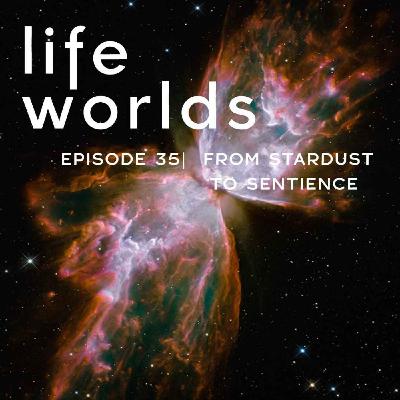
What is life, and are we alone in the universe?In this episode I sit down with Adam Frank, Professor of Astrophysics at the University of Rochester, prolific science communicator, and author of five books including The Blind Spot and The Little Book of Aliens. Adam is one of the most compelling voices working at the intersection of astrobiology, philosophy, and the human future.We journey from the stunning variety of exoplanets we're only beginning to map, to the deep questions on detecting life in space. Adam argues that the search for extraterrestrial life can't be separated from the question of what life means here on Earth. Astrobiology, it turns out, may be our most useful mirror for understanding our own civilisational moment.We also get into the hard problem of consciousness, the blind spot at the heart of modern science, and how cosmology like art and myth - can be a gateway to awe. A conversation that leaves you more at home in the strangeness of the universe and probably less certain about what “alive” even means.Episode Website LinkLinks:Adam’s WebsiteAdam’s Podcast: The Blind SpotAdam’s InstagramNoema Magazine: Why Science Hasn’t Solved Consciousness (Yet)The Atlantic: The Truth Physics Can No Longer Ignore5 Sci FI Aliens articleBeyond Center at ASU on astrobiology and SETISarah Walker’s Assembly Theory in the NYT: A Test for Life Versus Non-LifeNature paper on Assembly TheorySchrodinger: What is Life?Information TheoryBook: Human Cosmos by Jo Marchant"Semantic information, autonomous agency and non-equilibrium statistical physics" by Artemy Kolchinsky and David WolpertLook out for meditations, poems, readings, and other snippets of inspiration in between episodes.Music: Electric Ethnicity by Igor Dvorkin, Duncan Pittock & Ellie KiddPhoto Credit: Hubble Space Telescope Hosted on Acast. See acast.com/privacy for more information.
loading
Comments