


 Claim Ownership
Worthy for Thirty: Where stories of leaders doing good while doing well are told!
Subscribed: 0Played: 1
Subscribe

© Eric Tash
Description
Worthy for Thirty is a conversation series with founders, leaders, and creators who pair business success with purpose. Each week, host Eric Tash explores the choices, values, and hard-won lessons behind building something that actually lasts. www.worthyforthirty.com
109 Episodes
Reverse

What does it take to leave the tech startup world behind and build a consumer brand around something as simple as a lollipop?
And what if the secret to building a successful business isn't following the playbook, but trusting yourself to rewrite the rules.
I had an opportunity to sit down with Ben Hindman, co-founder of Le Lick, a functional candy startup reimagining what good for you candy can be.
Ben's entrepreneurial journey is anything but conventional. He co-founded Splash, an event marketing technology company, helped build Peel Insights before its acquisition by Shopify, and spent time working alongside Shopify CEO Tobi Lütke.
Now he's trading software for lollipops, building a consumer packaged goods (CPG) brand that combines great taste, functional ingredients, creativity, and a commitment to giving back.
But this conversation extends well beyond candy.
We get into what it really takes to build a startup, why trusting your gut and taste matters more than you think, how consumer feedback can completely change your marketing strategy, and why giving without expecting anything in return might actually be good business.
A few things we get into:
Trust your taste. Ben shares what he learned watching Shopify CEO Tobi Lütke make creative decisions based on instinct, even when thousands of employees were counting on him.
Building a CPG brand from scratch. Why Ben took the leap from B2B software to functional candy, and what he's learning about product development, customer acquisition, pricing, and brand differentiation.
Stop trying to please everyone. From launching more flavors than industry experts recommended to embracing unconventional marketing, Ben explains why standing out sometimes means ignoring conventional wisdom.
Let your customers tell you what matters. Le Lick first marketed its functional ingredients. Then customer feedback revealed something surprising: people kept coming back for the taste.
Can giving back actually grow a business? Ben explains why Le Lick gave away approximately 14,000 lollipops in a single month, how sampling fits into its growth strategy, and why generosity is part of the company's identity.
The reality of founder fear. Even after multiple successful ventures, Ben admits that fear remains one of his biggest challenges. We talk about optimism, uncertainty, and learning to trust yourself when you can't see what's around the corner.
The power of being weird. From creating a special lollipop to get Skrillex's attention to building a brand around humor and unexpected experiences, Ben makes the case for embracing what makes you different to help stand out both on shelf and in consumer's minds.
What resonated with me most?
Ben has built and sold businesses, worked alongside some incredibly successful entrepreneurs, and experienced the highs and lows of startup life.
Yet one of his biggest lessons is surprisingly simple: the things that worked were the things that allowed him to be himself.
There's something valuable in that for any founder, creator, or business leader.
We spend so much time looking at what competitors are doing, studying best practices, and trying to figure out what customers want that we sometimes forget the value of what we like and want.
Of course, you need to listen to customers. Of course, the economics need to work.
But building something people remember often requires the confidence to do things differently.
And Ben is putting that idea to the test, one lollipop at a time.
Whether you're launching a startup, building a consumer brand, exploring entrepreneurship, or simply trying to find the confidence to pursue your next big idea, there's plenty to take away from this conversation.
Because doing good and doing well aren't mutually exclusive. Sometimes the most meaningful businesses start with a little creativity, a lot of uncertainty, and the willingness to give something away.
Connect with Ben and Le Lick:
Website: enjoylelick.com
About Worthy for Thirty
Worthy for Thirty is an entrepreneurship and business podcast featuring candid conversations with founders, CEOs, creators, and changemakers who believe success should be measured by more than the bottom line.
We explore startup stories, business growth, leadership, innovation, social impact, and the real-world lessons behind building businesses that do good while doing well.
If this conversation resonated with you, follow Worthy for Thirty on Spotify or Apple Podcasts, leave a rating or review, and share this episode with someone building something meaningful.
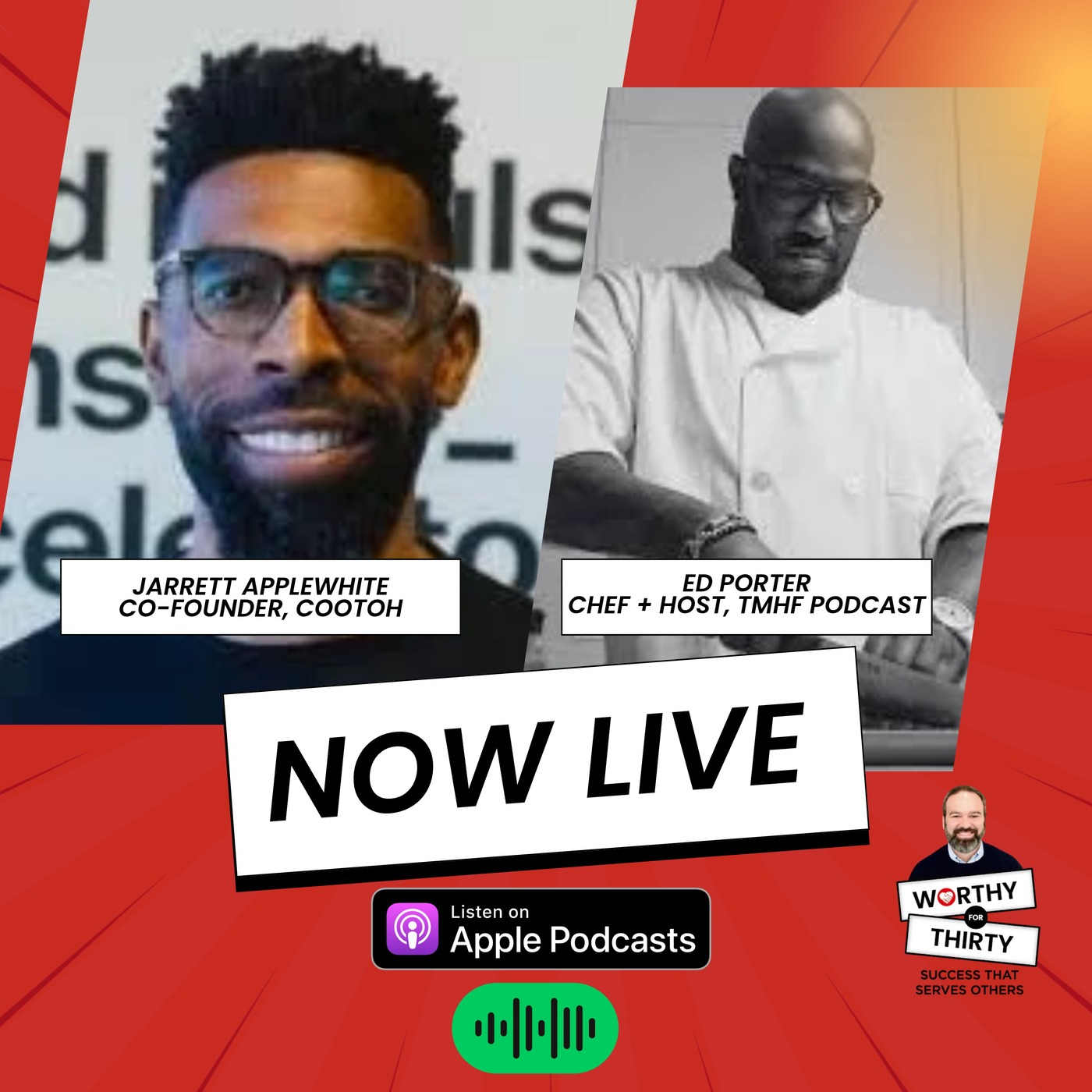
What if the biggest problem facing solopreneur chefs isn't finding customers, but rather not having the time to run the business operations?
For independent chefs, cooking is part of the job. They also have to find customers, create menus, manage bookings, send invoices, and chase payments. And somewhere along the way, the work that inspired them to become chefs gets buried beneath the demands of running a business.
Jarrett Applewhite, Co-Founder of Cootoh, believes there's a better way.
In this episode of Worthy for Thirty, I welcome Jarrett alongside returning guest and episode co-host Chef Ed Porter for a candid conversation about entrepreneurship, artificial intelligence, the future of hospitality, and what it really takes to build a mission-driven business.
Cootoh is a platform that connects customers with private chefs while giving culinary entrepreneurs the tools to run their own businesses. Its Chef OS technology uses AI and automation to streamline everything from menu creation and customer inquiries to proposals and bookings.
The goal? Turn a process that can take two weeks into something that happens in a day or less.
But this conversation goes well beyond food technology.
What happens when you give talented people the tools to own more of the value they create?
What You'll Learn
Solve the Problem Before Building the Product
Before developing Chef OS, Jarrett personally managed operations for roughly 10–12 chefs. His biggest discovery? They didn't necessarily need more customers. They needed help managing their existing book of business.
For startup founders and aspiring entrepreneurs, it's a reminder that the best business ideas often come from experiencing a problem firsthand, not simply identifying a market opportunity.
AI Is a Tool. Trust and Distribution Are the Advantage.
When everyone has access to tools like ChatGPT and Claude, what makes one AI startup different from another?
Jarrett argues that distribution, transparency, industry knowledge, and community matter more than simply having access to technology.
It's a timely conversation about creating a competitive advantage in the age of AI sameness.
Entrepreneurship Should Create More Ownership, Not Just More Work.
Cootoh's vision extends beyond helping chefs book private dining experiences. Jarrett wants independent chefs to build sustainable businesses, develop their personal brands, and potentially earn income wherever they travel.
He even explores the possibility of a cooperative ownership model where chefs could share in the value of the platform itself.
Build With Your Customers, Not Just for Them.
Jarrett regularly brings chefs together to provide feedback on the product. Chef Ed explains why that matters: tools only create value when they solve problems people actually experience.
For founders building SaaS platforms, marketplaces, or service businesses, there's a lesson here about customer discovery, product-market fit, and listening before scaling.
Scaling a Business Without Losing What Makes It Special
How do you grow a marketplace built around deeply personal experiences?
Jarrett and Chef Ed discuss chef vetting, hospitality standards, customer trust, and why community could become Cootoh's moat.
The Bigger Conversation: Doing Good While Doing Well
At its heart, this episode asks a question every mission-driven entrepreneur should consider:
Are you building a for-profit business that is purely transactional, or one that serves its consumers and community by helping them build wealth?
Cootoh offers an interesting case study in how technology, entrepreneurship, and community can work in sync to create economic opportunity without sacrificing the human experience. Life is greater when lived in abundance.
Whether you're a startup founder, small business owner, independent creator, hospitality professional, or someone interested in AI-powered business models, this conversation offers practical lessons on building something people genuinely need.
Listen to the full conversation on Worthy for Thirty, where founders, business leaders, and changemakers share how they're building successful businesses while making a meaningful difference.
Featuring: Jarrett Applewhite, Co-Founder of Cootoh
Co-Host: Chef Ed Porter

What happens when a successful company begins diluting, or worse, removing the very mission, culture, and values that made it successful?
Eric Ries, the New York Times' bestselling author of The Lean Startup and Incorruptible, joins me on Worthy for Thirty alongside guest co-host Kass Lazerow, entrepreneur, investor, and co-founder of Buddy Media, for a candid conversation about entrepreneurship, startup culture, business leadership, corporate governance, and building mission-driven companies that can survive growth and success.
The Lean Startup helped shape how a generation of entrepreneurs build companies. In Incorruptible, Eric tackles what could be a harrowing challenge: how do founders protect what they've built once money, investors, boards, growth targets, and shareholder expectations enter the equation?
Eric argues that too many entrepreneurs start businesses with a clear sense of purpose only to discover that the structures underneath their companies may eventually work against that mission. The problem isn't necessarily bad founders or bad investors. It's what he describes as the "financial gravity" pushing companies toward short-term ROI, cost-cutting, and shareholder primacy.
Kass brings the founder and investor perspective. She and her husband Mike Lazerow scaled Buddy Media from startup to its acquisition by Salesforce while deliberately investing in employees, company culture, and community even when those decisions ran counter to conventional startup wisdom.
Together, we pressure-test a provocative question:
Can a company maximize financial performance without sacrificing the people, principles, and purpose that made the company valuable in the first place?
We explore:
• Why Eric believes founders misunderstand what they're actually creating when they start a company
• How shareholder primacy can run counter to a company's stated mission
• Why mission-driven companies can create competitive advantage and long-term business value
• How founders can resist pressure from boards, investors, and short-term financial incentives
• Why Public Benefit Corporations (PBCs) may give entrepreneurs another way to protect company purpose
• What Costco's famous $1.50 hot dog teaches leaders about brand differentiation and keeping promises
• How Kass protected Buddy Media's culture while scaling rapidly and raising venture capital
• Why governance and culture should be treated as seriously as product, strategy and business models
• What Anthropic, OpenAI, Novo Nordisk, Costco and other companies can teach entrepreneurs about governance
• Why AI may make authentic company culture, purpose and organizational ethos even more important
• How founders can build businesses designed to remain true to their mission long after the founder leaves
One of Eric's most important ideas is deceptively simple, yet intentional: governance and culture have to be built from the ground up. They don't appear spontaneously.
That becomes increasingly important in the age of AI. When competitors have access to the same tools, technology, information, and resources, sustainable differentiation may come from something much harder to copy: what your company actually stands for and the decisions you're willing to make to protect it.
From venture capital and founder pressure to corporate governance, AI, leadership, and long-term business strategy, this conversation challenges one of modern capitalism's most deeply embedded assumptions: that maximizing shareholder value must be a company's primary purpose.
For entrepreneurs, CEOs, investors and business leaders, the question isn't simply: how do you build a successful company?
It's how do you build one worth protecting once it succeeds?
Worthy for Thirty explores the founders, executives, and changemakers proving that doing good and doing well don't have to be mutually exclusive.
What if giving back wasn't something your business did as an afterthought, but was an important piece of how you became successful?Kyle Gordon, Co-Founder & CEO of Dillas Quesadillas, https://dillas.com/, joins me on Worthy for Thirty to unpack how a mission-driven entrepreneur can build community impact directly into the DNA of a growing company. Sounds familiar? Hello, Mission Craft Cocktails!Well before Dillas became an 11.5 (listen to learn the why) location fast-casual restaurant brand Kyle had an idea: take the simplicity and scalability he saw emerging in fast casual restaurants and build an entire concept around the quesadilla.But he didn't jump straight from concept to founder.Kyle spent seven years at Raising Cane's learning the ropes: restaurant operations, leadership, culture, and scalability, including lessons from founder Todd Graves.This type of patience still shapes Kyle's approach to the business today.We talk about why Dillas considers itself a people-first company, why Kyle believes food quality and culture are non-negotiable, and why he refuses to grow faster than the talent and infrastructure supporting the business.Then we get into the heart of this show's premise: Can doing good actually help a company do well?For Dillas, giving back isn't an afterthought or a check written at the end of the year. Kyle shares the story of volunteering with Minnie's Food Pantry before opening his first restaurant, and spending $200 on two fundraising candles when he estimates the fledgling company had only about $1,000 left in its operating account.That decision became an inflection pointl: generosity would be part of the culture from day one.Today, Dillas' purpose is to “build community through Primo Quesadilla Meals.” Kyle explains how community involvement, charitable giving and cause marketing can create a virtuous cycle: as sales grow, giving grows; that investment strengthens the community; and stronger community relationships can help the business grow again.We also delve into:• Why aspiring founders should get experience in an industry before trying to disrupt it • The lessons Kyle learned working inside Raising Cane's growth story • Why Dillas chooses people over maximizing short-term profit • How to scale a restaurant franchise without diluting its culture • Why systems and consistency matter as much as the original idea • How Dillas evaluates potential franchise partners • Why community involvement can become a competitive advantage • The difference between authentic giving back and performative cause marketing • Why entrepreneurs don't need money to start making an impact • Kyle's advice to founders: Give time. Show up. Find a yes.” • Why mentorship, patience and a long-term mindset still matter even after you've built a successful companyKyle's story is a case study in mission-driven entrepreneurship, restaurant franchising, founder leadership, giving back, cause marketing and purpose-driven business and in what can happen when community impact isn't bolted onto a business model, but built into it.Because doing good while doing well doesn't have to be a tradeoff.Sometimes, each can make the other stronger.Follow Worthy for Thirty for more conversations with founders, entrepreneurs, executives, and nonprofit leaders building businesses where success serves others.
When did staying informed become a full-time job filled with frustration and outrage?We live in time with access to more information than at any point in history, yet separating news from commentary, facts from opinion, and signal from noise has arguably never been harder.On this episode of Worthy for Thirty, I sat down with Kira Shishkin, founder and CEO of informed.now, https://informed.now a minimalist news platform created upon a radically simple idea: provide people with most salient facts they need to know, then let them make up their own minds.Kira’s relationship with information is deeply personal. As a teenager, he survived a devastating car accident that resulted in years of memory challenges. That experience forced him to think differently about attention, learning and what information is actually worth remembering.Years later, after living across Ukraine, Israel and the United States, Kira began questioning another problem: we don't have an information shortage; we have information overload or obesity.That realization turned into informed.now. https://informed.nowInstead of an endless feed, informed.now delivers a concise daily news briefing via text. No ads. No clickbait. No outrage loops. And whenever possible, it points readers back to primary sources so they can see where the information originated.Kira and I dug into the business model behind that philosophy, and why it matters.We explore how the internet's shift toward ad-supported news changed the incentives of media companies; why Kira believes making the advertiser the customer fundamentally changed the relationship between news organizations and their readers; and what happens when a company intentionally chooses to make the reader, not their attention, the customer.We also discuss:• Why attention may be one of our most valuable resources• The difference between news and news commentary• How clickbait and rage bait became features of the attention economy• Why media literacy increasingly means finding and reading primary sources• How informed.now determines which stories are significant enough to make its daily briefing• Why Kira is intentionally building a product designed to take up less of your time• The decline of local journalism and the challenge of staying informed about our own communities• Why informed.now refuses advertising and instead aligns its business model directly with its readers• The opportunity to bring news minimalism into businesses and teamsWhat struck me most about this conversation is that Kira isn't trying to build another product competing for our attention.He's trying to build one that gives our attention back.And that feels especially relevant to the premise behind Worthy for Thirty: can you build a sustainable business where the mission isn't bolted onto the company, but embedded directly into the company's operation?For informed.now, protecting the reader's attention isn't separate from the business model.It is the business model.If you've ever opened your phone intending to check one headline and emerged 30 minutes later feeling more anxious, but not necessarily more informed, this conversation is worth(y) (of) your attention.🎙️ Worthy for Thirty is hosted by Eric Tash and features conversations with founders, executives and changemakers building businesses that prove doing good and doing well don't have to be mutually exclusive.Follow Worthy for Thirty on Apple Podcasts, Spotify, iHeart, or wherever you enjoy listening to podcasts.

Comments

Download from Google Play

Download from App Store
 United States