


 Claim Ownership
First Principles
Subscribed: 8,764Played: 35,164
Subscribe

© (c) 2022 The Ken
Description
First Principles is a weekly interview podcast comprising authentic, candid, and insightful conversations between some of India’s most accomplished founders and business leaders, and Rohin Dharmakumar, The Ken’s CEO & co-founder.
From personal philosophies, mental models and decision making frameworks, to reading habits, parenting styles or personal interests, each episode will delve into what makes each of these leaders unique.
95 Episodes
Reverse
1 · SummaryPart 1 ended with Rajiv Kaul leaving Microsoft and private equity, partnering Blackstone to buy CMS Info Systems, and deciding he didn't want to work for anyone again. Part 2 is about how a CEO who expected to stay five years ended up its largest individual shareholder. Kaul tells Rohin Dharmakumar how Baring, CMS's second private equity owner, wanted to sell after demonetisation, why he started putting his own money in, the walk in Austin during COVID that made him push for a listing, and the listing-day speech where he broke down. He explains why he calls CMS his karma bhumi and dharma bhumi. Then his rules: the market-leader test, the deals he walked away from after a colleague's own forensic checks, the AI camera business that started by accident, stretch targets, and the analyst he asked what he was smoking. It ends with the arts foundation he built with his wife, and the coaching call during demonetisation that taught him mindfulness.2 · Chapters0:00 Introduction1:42 Putting his own money in9:09 The listing day, and karma bhumi17:24 The market-leader rule20:51 About 100 companies looked at, two bought25:19 An AI business started by accident30:03 Hands-off but eyes-on32:29 Pricing against cost-plus35:12 Stretch targets, and "I would like to smoke that"39:52 Performance can wait, behaviour cannot41:58 Who doesn't last at CMS43:56 Art, a son, and STEM to STEAM50:01 Atoms, bits and AI53:33 "Mindfulness saved the company"57:15 Mornings, workouts and books1:00:43 Life, on a scale of 1 to 101:01:05 Closing note3 · Pull-quotes[8:44] "I work and operate like an owner."[≈14:18] "CMS is my karma bhumi and dharma bhumi." (time estimated; check)[39:20] "I don't know what you are smoking. I would like to smoke that."[41:08] "Performance can wait, but how you behave cannot."[54:06] "Mindfulness saved the company."4 · Frameworks & mental modelsMarket leader, or a profitable niche: enter only where there is a path to number one; otherwise the business must be a niche that makes good money, like CMS's card business, which is fourth or fifth in its market and profitable.Value, not cost-plus: price on the value delivered and the risk carried, and ask whether anyone else can do what you do.Stretch targets and the straight-line fallacy: he would rather set a target that pushes the company and miss it than set a safe one; he distrusts forecasts that extend the last three years in a straight line.Owner, not promoter: he runs CMS as though every rupee is his, without an heir to pass it to, which he describes as trusteeship.Performance can wait, behaviour cannot: he tolerates a weak year from someone going through a hard stage of life, but not bad conduct with colleagues.Let it be: the mindfulness practice he learned during demonetisation was to park a problem rather than solve it at once ("dekhi jayegi").5 · Credits & sharingThis episode was produced by Rohin Dharmakumar and mixed and mastered by Rajiv CN.Write to us at [email protected] with your feedback, suggestions, and guests you would want to see on First Principles.If you enjoyed this episode, please help us spread the word by sharing and gifting it to your friends and family.
1 · SummaryRajiv Kaul runs the company that fills about one in every two ATMs outside India's bank branches, and he says the business was never really about logistics. In Part 1 of 2, he walks Rohin Dharmakumar through a CMS cash van's day, explains why he thinks cash and UPI are growing side by side, and recalls the night demonetisation was announced, which he spent in a hospital where his father was due for surgery the next morning. He sets out the 2x2 he uses to decide when to act in a crisis and when to wait. Then the story goes back: a father who set up the National Highways Authority of India, a summer internship at Nestlé where his research killed two products and cost him a job offer, becoming Microsoft's India MD at 33 with imposter syndrome, and leaving Microsoft for private equity in London. Part 1 ends as he decides he doesn't want to work for anyone again. Part 2 picks up with how he came to own a large piece of CMS.2 · Chapters0:00 "You don't think of backups"0:15 Introduction3:16 Everyone was surprised except his family5:55 One van, 70,000 ATMs, one day9:03 A risk business, and "trust infrastructure"10:03 Who uses cash? Why cash isn't dying15:17 Rural ATMs, urban retail19:18 Demonetisation night, from a hospital24:29 A 2x2 for handling a crisis28:19 One price per ATM, and outspending rivals on tech31:50 What AGS Transact did that CMS refused to do33:43 "Don't look at P&Ls": the cash book36:01 AI cameras and lakhs of alerts a day39:49 A father who set up NHAI, and killing two Nestlé products43:51 Microsoft India MD at 33, and imposter syndrome48:20 Why Microsoft picked him51:39 Why he left India, then Microsoft55:20 Private equity in London, four risks at once57:16 Buying CMS with Blackstone3 · Memorable quotes[0:08] "You don't think of backups when you do this."[8:48] "We are not a cash logistics firm. We're a risk management company."[25:54] "I don't know what to do, so let's do something."[43:00] "Doing the right thing is going to cost you at times."[47:23] "You learned loneliness at a very young age."4 · Frameworks & mental modelsThe crisis 2x2: sort a crisis by whether you understand it and whether waiting costs you. The financial crisis: understood, act now. Demonetisation: not understood, act anyway. COVID: not understood, wait and survive. Acquisitions: understood, take your time.A risk business, not a logistics one: within a year of buying CMS, Kaul decided the company should be paid for the risk it carries, not for moving vans.Cash, not P&L: a mentor's advice before he bought CMS was to read the cash book every day. Earn what you spend and keep some for a rainy day.Scale, then tech, then the next category: chase market share, outspend competitors on technology to cut cost, reinvest the margin, and use the cash to enter a new category.5 · Credits & sharingThis episode was produced by Rohin Dharmakumar and mixed and mastered by Rajiv CN.Write to us at [email protected] with your feedback, suggestions, and guests you would want to see on First Principles.If you enjoyed this episode, please help us spread the word by sharing and gifting it to your friends and family.
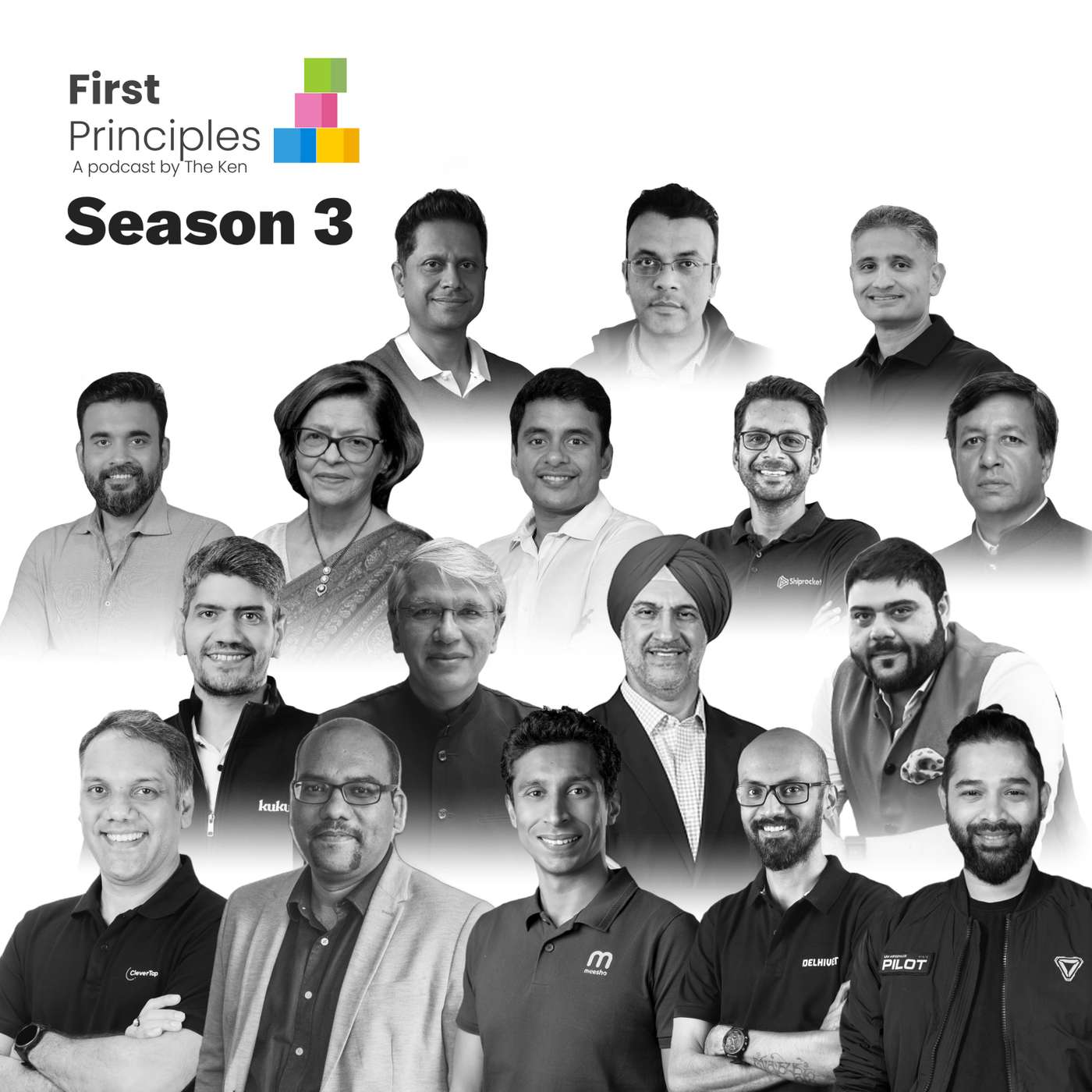
SummaryI have hosted First Principles for four years and 58 episodes, and I have never once stopped to look at it. This episode is me doing that. There is no guest. It runs about fourteen minutes, and it ends with something I need from you.Season 3 started with Vidit Aatrey of Meesho in April 2025 and ended with Mukesh Bansal in August 2026. A lawyer, a banker, a restaurateur and a venture capitalist were guests on a show I had built for founders. The businesses were trucks, fish, kitchens and bikes. And my questions moved away from fundraising and towards where a person came from and how they decide. Then I go back to seasons 1 and 2, from Kabeer Biswas in August 2022 to Manav Garg in May 2024, and show how the exceptions of season 2 became the categories of season 3.Season 4 widens the guest list on purpose: musicians, athletes, actors, writers and scientists, alongside the founders you come for. The founders were easy for me to find because they live in my world. The people I want next mostly don't. So I am asking you for help to find them. The survey below is how.The surveyhttps://theken.typeform.com/fp-season-4 · five minutes if you tap, eight if you writeI ask nine things, in this order. Describe First Principles to me in your own words. Pick the season 3 conversations you found most interesting (all seventeen are listed, so you don't have to remember). Tell me what you think the bar is for getting invited onto this show today, before I change it. Name who you want as a guest in season 4, and what you would want me to ask them. Tell me whether you would join a small closed group of listeners I can ask for feedback more often. How and where you listen. How much of the archive you have heard, and whether you go back. A question I should start asking every guest. And anything else that would make the show better.I read every answer. The season 4 guest list is being built from what you send, and I will share the names you mention most in a newsletter edition before the season starts.ChaptersNot a regular episode: no guest, and a look backSeason 3, April 2025 to August 2026: seventeen conversations, Vidit Aatrey to Mukesh BansalThe guests: a lawyer, a banker, a restaurateur, a VCTrucks, fish, kitchens and bikes: what the businesses were made ofI had it backwards: the warm-up questions were the real interviewThe thing I have to own: one woman guest in season 3, and she invited herselfSeason 1, August 2022 to July 2023: twenty-two episodes, never missed a fortnightSeason 2, August 2023 to May 2024: the exceptions that became season 3The eleven-month gap, and the two-hour formatSeason 4: what stays, and who else gets invitedWhy I can't find these people alone: the surveyThank you, and the archive is openThe seventeen conversations of season 3Ep 42 Vidit Aatrey, Meesho · Ep 43 Sahil Barua, Delhivery · Ep 44 Manish Sabharwal, Teamlease · Ep 45 Narayan Subramaniam, Ultraviolette · Ep 46 Anand Jain, CleverTap · Ep 47 Rahul Matthan, Trilegal · Ep 48 Deepak Abbot, Indiagold · Ep 49 Aloke Bajpai, Ixigo · Ep 50 Rohit Chennamaneni, Darwinbox · Ep 51 Kalpana Morparia · Ep 52 Utham Gowda, Captain Fresh · Ep 53 Ankit Nagori, Curefoods · Ep 54 Lal Chand Bisu, Kuku FM · Ep 55 Riyaaz Amlani, Impresario · Ep 56 Saahil Goel, Shiprocket · Ep 57 Kanwal Singh, Fireside Ventures · Ep 58 Mukesh BansalAll seventeen are in the archive. This episode was produced by Rohin Dharmakumar and mixed and mastered by Rajiv CN.Write to us at [email protected] with your feedback, suggestions, and guests you would want to see on First Principles.If you enjoyed this episode, please help us spread the word by sharing and gifting it to your friends and family.
Where Part 1 followed the companies, Part 2 is about the person behind them. Picking up from Mukesh Bansal's move from one venture to the next, this half gets into how he finds talent ("work with them for six months"), the mental models he runs his life by, and the beliefs underneath them. He explains why rationally no one should start a company, how he processes every rejection as "no means not now", why he writes three books by simply showing up to a blank page, and how he separated the longevity basics he trusts from the biohacking he no longer does. It ends close to home: loyalty as loyalty to a mission, what he wants for his two children, why parents' expectations matter less than they did, and a life he rates an 8 out of 10.Chapters0:00 Where we left off1:46 Finding talent: "work with them for six months"3:23 The one open-ended question he asks5:57 Winning vs looking good8:00 The compounding argument, revisited9:40 Learning vs winning: drawing the 2x211:17 Three books, and the annual look-back16:18 Making time to think in a full life18:45 What a chief of staff is actually for21:27 "No means not now" and other mental models25:57 How he writes a book28:30 How health became a throughline31:24 From ecosystem to the longevity basics34:29 Why strength training matters after 5038:08 Why he runs SparX, and the deep-tech turn44:05 Loyalty to a mission, and the number two50:35 The Apple teaching model52:52 Three adjectives, and being "scary" to juniors55:30 His kids' worldview57:54 Do parents' expectations still matter?1:00:12 Weekends, food, and reading now1:02:17 Rating his life an 8Quotes[8:44] "I don't know if this rocket thing will work. But if it works, it'll take at least ten years… they said, we are willing to work on it for the rest of our lives."[21:56] "I call this no means not now. That's how I process all the nos in my life."[24:59] "Zomato was started in 2007. They did not pivot into food delivery till 2017."[26:05] "Just show up and stare at a blank page for an hour. Sooner or later you'll start writing."[61:43] "I feel very privileged and very fortunate. So many lucky breaks have worked out for me."Frameworks & mental modelsNo means not now: process every rejection as timing, not a verdict; it protects the ego and the relationship.Long-term patient, short-term aggressive / product is marketing: charge hard daily, give the ten-year game room, and let a product people love do the selling.Horizontal compounding: compound entrepreneurial skill across ventures, not tenure in one sector.Loyalty to a mission: the durable teams are bound to an unfinished job, not to a person; build a number two and give people room.The longevity basics beat biohacking: sleep, eat less, move, strength-train after 50, tend emotional health; the exotic stuff is largely unproven.Credits & sharingThis episode was produced by Rohin Dharmakumar and mixed and mastered by Rajiv CN.Write to us at [email protected] with your feedback, suggestions, and guests you would want to see on First Principles.If you enjoyed this episode, please help us spread the word by sharing and gifting it to your friends and family.
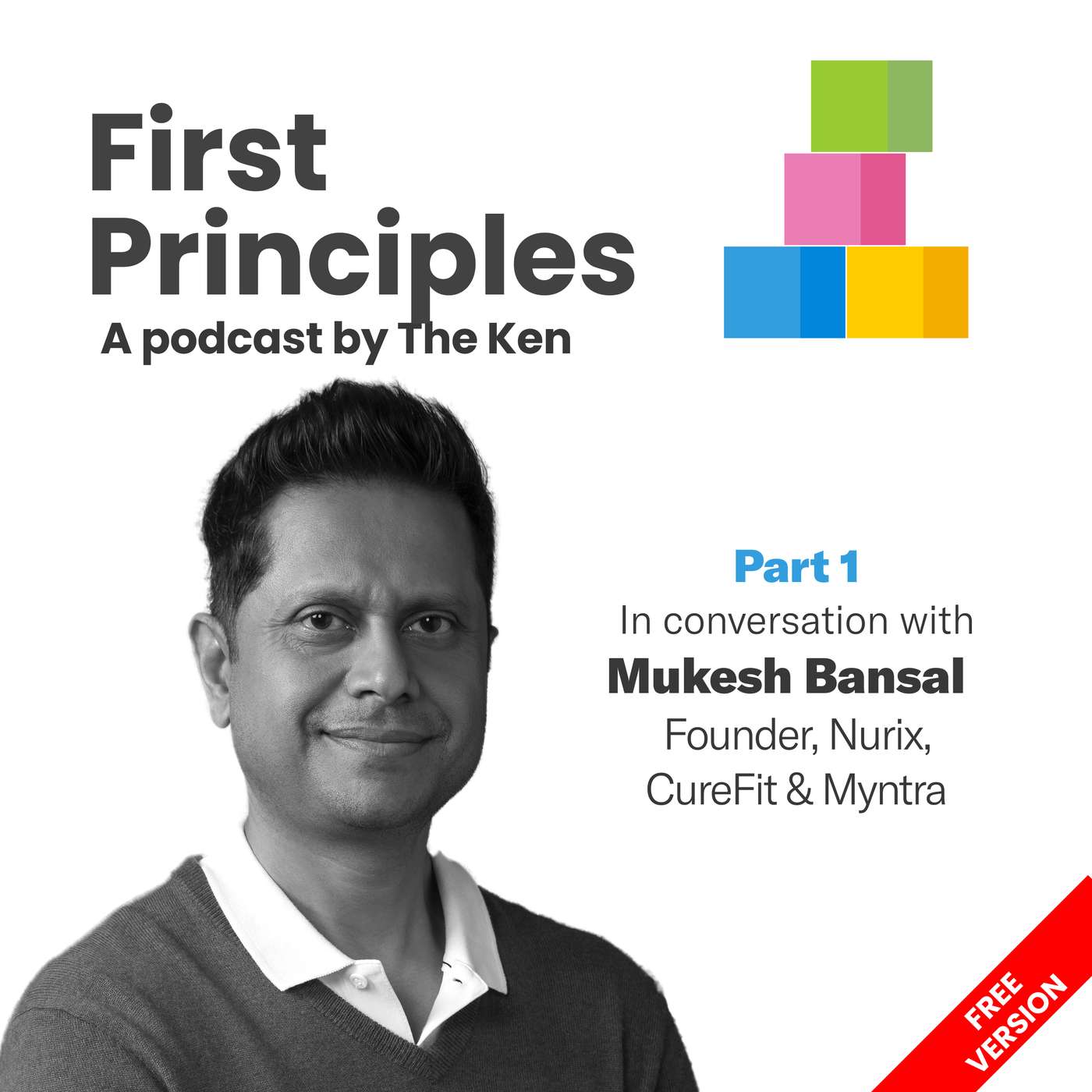
Mukesh Bansal has founded and left more companies than most people build in a lifetime, and in Part 1 he explains why. He founded Myntra and sold it to Flipkart; he co-founded Cult.fit and turned fitness into a category; and today he runs the AI company Nurix and the Meraki Labs studio. Asked what he is now, he says "a learner", and admits he gets bored the moment a company starts working. Part 1 traces the thesis and the companies: how he allocates his weeks, why he thinks the AI era rewards the hands-on operator over the people-manager, what Nurix and Fermi are, why Myntra's move into fashion was an "adjustment" not a pivot, and the small-town Haridwar upbringing and library habit that set him off. This is Part 1 of 2; Part 2 turns to the person, the mental models, and how he thinks about health, family and success.Chapters0:00 Welcome and who Mukesh Bansal is3:15 How First Principles is already connected to him4:21 "Do you see yourself as an operator, a founder, an investor?"5:27 Zero-to-one, and where learning stops9:11 Allocating time across companies10:34 Why an hour of his time isn't what it was12:59 The three kinds of professionals in the AI age14:52 His stack: Claude, Warp, agents overnight17:58 Founder mode, reversed by AI20:19 No more waiting for a tech co-founder23:02 How big Nurix is; and what Fermi is25:38 The Socratic tutor that won't answer27:18 Back to Myntra: the fashion category today31:30 Koyu, Lyskraft and the CRED hypothesis33:41 Why a venture studio, one company a year38:18 Rejecting the compounding path42:57 The near-death at Myntra, and raising with a short runway45:03 Haridwar, BHEL, and the books that lit the fire48:15 Pivots as chess "adjustments"50:48 Conviction vs discovery: betting the megatrend53:08 The Bay Area years and the return to IndiaQuotes[4:33] "I see myself as a learner… doing one company over a period of time, I get bored."[7:08] "Crisis always comes wrapped with a massive gift, if you are only willing to unpeel the onion."[17:12] "I'm making an even stronger point. If you're only a people manager, watch out."[18:58] "For the first time you can hire something equivalent to human cognition for cents an hour."[48:50] "I use the word adjustment rather than pivot. You come to work every day, you're playing chess."Frameworks & mental modelsLearner over operator: hand off once a company stops teaching you.Crisis and momentum: cut the bad, double down on the good.The three professionals in the AI age: the hands-on veteran is the one AI turns into a superpower.Adjustment, not pivot: the best move on the board each day; a true "wipe the slate" is just a new company.Bet the megatrend, stay loose on the path.Credits & sharingThis episode was produced by Rohin Dharmakumar and mixed and mastered by Rajiv CN.Write to us at [email protected] with your feedback, suggestions, and guests you would want to see on First Principles.If you enjoyed this episode, please help us spread the word by sharing and gifting it to your friends and family.

Comments

Download from Google Play

Download from App Store
 United States