


 Claim Ownership
Hesitation Media with Brian Nuckols
Subscribed: 2Played: 5
Subscribe

© Brian Nuckols
Description
About Hesitation Media
Inspired by Stanton Marlan’s Hesitation and Slowness: Gateway to Psyche's Depth, Hesitation Media is rooted in the belief that being right matters more than being first. Like the Slow Food and Slow Travel movements, we prioritize doing things properly. Instead of racing social media to breaking news, we focus on accuracy, depth, context, analysis, and expert opinion—the timeless values of quality journalism.
About Brian Nuckols
Brian Nuckols is a writer and empathic journalist whose work explores the intersection of empathy, mental health, and societal transformation. As one of the pioneers of empathic journalism, Brian combines the immersive storytelling of gonzo journalism with the depth and reflection of narrative non-fiction. His approach is informed by years of experience as a Jungian psychoanalyst working with heroin addiction, trauma, and the complexities of human connection.
Brian’s primary research project examines empathy as a weapon against self-hatred and social conformity. His writing invites readers to meet across divides—whether political, cultural, or personal—and to confront the parts of themselves they find ugly, difficult, or even hateful. By fostering self-acceptance, Brian advocates for deeper compassion toward others and a more connected world.
Research Interests
Mental Health and Addiction: Investigating systemic issues behind the overdose crisis and deaths of despair, blending policy insights with human stories and innovative solutions like psychedelics.
Psychedelics and Innovation: Writing about the intersection of culture, neuroscience, and geopolitics in the rapidly evolving psychedelics industry.
Philosophy and Society: Exploring the role of meaning, connection, and self-acceptance in the face of social pressures and cultural disconnection.
Media and Entertainment: Analyzing how media shapes empathy, polarization, and cultural values.
Geopolitics of Human Flourishing: Investigating how global systems influence mental health, addiction, and cultural shifts.
briannuckols.substack.com
Inspired by Stanton Marlan’s Hesitation and Slowness: Gateway to Psyche's Depth, Hesitation Media is rooted in the belief that being right matters more than being first. Like the Slow Food and Slow Travel movements, we prioritize doing things properly. Instead of racing social media to breaking news, we focus on accuracy, depth, context, analysis, and expert opinion—the timeless values of quality journalism.
About Brian Nuckols
Brian Nuckols is a writer and empathic journalist whose work explores the intersection of empathy, mental health, and societal transformation. As one of the pioneers of empathic journalism, Brian combines the immersive storytelling of gonzo journalism with the depth and reflection of narrative non-fiction. His approach is informed by years of experience as a Jungian psychoanalyst working with heroin addiction, trauma, and the complexities of human connection.
Brian’s primary research project examines empathy as a weapon against self-hatred and social conformity. His writing invites readers to meet across divides—whether political, cultural, or personal—and to confront the parts of themselves they find ugly, difficult, or even hateful. By fostering self-acceptance, Brian advocates for deeper compassion toward others and a more connected world.
Research Interests
Mental Health and Addiction: Investigating systemic issues behind the overdose crisis and deaths of despair, blending policy insights with human stories and innovative solutions like psychedelics.
Psychedelics and Innovation: Writing about the intersection of culture, neuroscience, and geopolitics in the rapidly evolving psychedelics industry.
Philosophy and Society: Exploring the role of meaning, connection, and self-acceptance in the face of social pressures and cultural disconnection.
Media and Entertainment: Analyzing how media shapes empathy, polarization, and cultural values.
Geopolitics of Human Flourishing: Investigating how global systems influence mental health, addiction, and cultural shifts.
briannuckols.substack.com
13 Episodes
Reverse

Fractal Consciousness, Clinical Intuition & the Dance of Healing with Dr. Terry Marks-TarlowHesitation Media Podcast: Season 2 Finale In this episode, I interview Dr. Terry Marks-Tarlow, whose groundbreaking work on nonlinear dynamics and clinical intuition represents a paradigm shift from reductive materialism toward consciousness-primary models of healing. Terry's integration of fractal geometry, cybernetics, and Jungian depth psychology offers a scientific framework for the very synchronicities and intuitive leaps that make empathic journalism possible.Our conversation weaves together quantum physics and psychotherapy, the telepathy tapes and the observer effect, Paul Meehl's statistical skepticism and the irreducible mystery of healing. We explore how genuine therapeutic transformation emerges not from algorithmic interventions but from the fractal depths of relational presence—a principle that applies equally to journalism, therapy, and any endeavor seeking to touch the soul.Dr. Terry generously shares her revolutionary understanding of time itself as fractal rather than linear, offering a pathway beyond the anxiety of "never enough time" toward the qualitative richness of kairos—the right time, felt in the body and attuned to the moment's deeper rhythms.Most importantly, we grapple with the central tension haunting modern psychology: Can we honor both empirical rigor and the lived reality of synchronicity, telepathy, and the healing magic that defies measurement?Hesitation Media with Brian Nuckols is the world's leading (and only) empathic journalism platform.Episode HighlightsThe Consciousness Paradigm ShiftDr. Terry reveals her evolving understanding of psyche, moving from information fields as primary toward consciousness itself as the fundamental substrate from which all phenomena emerge.Explores how fractal geometry provides a mathematical framework for bridging the material and spiritual dimensions of existence.Clinical Intuition vs. Algorithmic TherapyBrian and Terry examine why "cookie-cutter methods" fail in healing work, while moment-to-moment relational attunement creates transformation.Practical methods for cultivating intuition: embodiment, dream work, artistic practice, and the profound teaching of raising children or caring for animals.The Paul Meehl DilemmaBrian confesses his internal wrestling between statistical rigor (represented by Paul Meehl's empiricism) and the undeniable reality of clinical intuition and synchronicity.Dr. Terry positions herself as the "angel" to Meehl's "devil," advocating for right-brain, relational epistemology over purely left-brain, either/or logic.Observer Effect in TherapyUnlike studying Mercury through a telescope, therapeutic work involves mutual transformation—"we are both the observer, the observed, and the actor."Explores how brain synchrony, physiological attunement, and sometimes deliberate "anti-sync" create the container for healing.Fractal Time & the End of ScarcityDr. Terry's revolutionary approach to time management: adding "imaginary dimensions" to linear time creates infinite depth and possibility.Personal examples of how slowing down paradoxically increases productivity and eliminates the feeling of "never enough time."Pattern Matching & Higher DimensionsFrom the telepathy tapes to synesthesia to therapeutic synchrony—all manifestations of consciousness operating in fractal, multidimensional pattern recognition.Distinguishes between computational AI (limited to binary states) and consciousness (infinite dimensional meaning-making).Addiction as Feedback LoopBrian's cybernetic insight: recovery can become part of the addictive cycle itself, with AA meetings and 90-day sobriety chips functioning as negative feedback that stabilizes the system.Dr. Terry's complexity theory response: health requires variability, learning, and "a little bit of chaos"—not rigid repetition.Dance as Embodied HealingBoth Brian and Terry share how dance serves as a "joy factory" and laboratory for creativity, relationship, and somatic intelligence.Clinical applications: using contact improvisation to teach rigidity, ballet to provide structure for chaos, movement to unlock people "stuck in their heads."The Mystery of HealingDr. Terry's honest confession: "It feels like magic when people heal... I sure as hell can't tell you what's happening there."Her concept of therapists as "embedding spaces" providing fractal dimensionality for clients' consciousness to reorganize and transform.Key Concepts & Themes1. Fractal EpistemologyDefinition: A right-brain, relational way of knowing that honors the infinite depth between finite categories, using mathematical principles of self-similarity and recursive feedback loops.Episode Context: Dr. Marks-Tarlow proposes this as an alternative to Aristotelian either/or logic, better suited for understanding consciousness, healing, and the observer effect in therapy.2. Clinical Intuition (Local & Non-Local)Definition: The moment-to-moment felt sense that guides therapeutic interventions, ranging from in-the-room attunement to telepathic/precognitive awareness across space and time.Episode Context: Terry and her colleague Jacob Shapiro have modeled both forms using fractal cascade theory and quantum field concepts.3. The Observer Effect in HealingDefinition: Unlike physical sciences where observation doesn't change the system, therapy involves mutual transformation where both client and therapist are continuously altered by their interaction.Episode Context: This fundamental difference requires new methodologies that honor intentionality, learning, and the creative emergence that occurs in conscious relationship.4. Pattern Matching ConsciousnessDefinition: The brain's capacity to recognize self-similar patterns across different scales, dimensions, and sensory modalities—from synesthesia to therapeutic synchrony to psychic phenomena.Episode Context: Dr. Terry suggests this operates through the cerebellum and represents higher-dimensional consciousness rather than cortical computation.5. Fractal Time ManagementDefinition: Moving beyond linear "bucket" thinking about time by adding imaginary dimensions that create infinite depth and qualitative richness in each moment.Episode Context: Dr. Terry reports never feeling rushed and always having "enough time" by living according to these principles.6. Positive Feedback SystemsDefinition: In cybernetics, self-amplifying loops that destabilize existing patterns—which Brian uses therapeutically to break addiction cycles that have become rigidly homeostatic.Episode Context: Contrasts with negative feedback (which maintains stability) and offers a way to introduce necessary chaos into overly rigid psychological systems.7. Synchronicity as Natural PhenomenaDefinition: Meaningful coincidences that reveal the interconnected nature of consciousness and matter, treated as natural rather than supernatural occurrences worthy of scientific investigation.Episode Context: Both Brian and Terry share examples of how synchronicity becomes self-amplifying once you begin trusting its meaningfulness.Reflections & Takeaways* Science as Portal to Spirituality: Mathematical modeling of consciousness can deepen rather than diminish the mystery of healing and transformation.* Embodied Knowing: Clinical intuition emerges from body awareness, relational attunement, and willingness to be changed by our work.* The Healing Paradox: The more we acknowledge our subjective involvement, the more objective (and effective) our therapeutic work becomes.* Time as Quality: Moving from chronos (clock time) to kairos (felt timing) creates abundance rather than scarcity in both work and life.* Pattern Recognition: Whether in therapy, journalism, or daily life, learning to sense self-similar patterns across scales opens new dimensions of understanding.Call to ActionPractice Fractal Time: Choose one daily activity and deliberately slow it down. Notice if this creates more spaciousness rather than making you "behind schedule."Track Your Synchronicities: For one week, note meaningful coincidences without dismissing them. Observe if attention to synchronicity increases their frequency.Cultivate Clinical Intuition: Whether or not you're a therapist, practice moment-to-moment awareness of what your body knows about people and situations before your mind analyzes.Explore Your Meehl-Marks-Tarlow Tension: In your own field, where do you feel torn between measurable outcomes and qualitative depth? Can you honor both?Further Exploration:Dr. Marks-Tarlow’s Website: Access her complete repository of papers on nonlinear dynamics, clinical intuition, and fractal geometry applications to psychology.Pattern Practice: Spend time in nature or with music, letting yourself sense self-similarity across different scales—the branching of trees, the rhythm of waves, the fractals in your breathing.Dance Medicine: Find a movement practice that challenges your habitual patterns. Notice what your body teaches your mind about flexibility, structure, and creative emergence. Get full access to Hesitation Media with Brian Nuckols at briannuckols.substack.com/subscribe

In this episode, I interview Dr. Robert Romanyshyn. Robert’s work on wounded research and the embodied experience of technology are fundamental references for the school of empathic journalism. So… This conversations serves as a massive milestone in the development of the school. Our conversation weaves together the Greek myth of Orpheus, poetic epistemology, Rainer Maria Rilke, Jungian depth psychology, and the critical idea of the “wounded researcher.” Dr. Robert explains how genuine objectivity emerges only when we become aware of our personal biases and unconscious drives, rather than denying them. We also delve into why slowness, stillness, and surrender can open us to deeper truths—both in everyday life and in fields like therapy, journalism, and scholarship. Along the way, you’ll hear reflections on love and hate, the mystery of transference, and how nature can awaken us to the soul’s unspoken callings. Importantly, Robert generously gifted us a new archetypal equation (the 5 S’s) to ground our journalism in hesitation and slowness. Slowness invitesstillness allowssilence welcomes surrenderthat opens to Serenity. Thanks Robert! Hesitation Media with Brian Nuckols is the worlds leading (and only) empathic journalism platforms. Episode Highlights* Mythic Resonance of Orpheus* Dr. Robert shares why Orpheus—famed for losing Eurydice a second time—illustrates the limits of willpower and the urgency of listening to soul.* Explores Rilke’s retelling, focusing on the tragic moment Orpheus turns around in doubt, foreshadowing the human dilemma of pride vs. humility.* The Wounded Researcher* Brian and Robert discuss how personal hurts, dreams, and “unfinished business” fuel our curiosities. Far from a liability, these “wounds” can deepen our engagement if we face them consciously.* Examples from therapy and journalism show how acknowledging bias and transference can lead to more profound insights than simple “neutrality.”* Slowness, Stillness & Surrender* Robert elaborates on his “five S’s”—including silence and serenity—emphasizing how pausing invites us into a more authentic presence.* Anecdotes of sitting in gardens, listening to birds, and “becoming dawn” highlight the power of nature’s rhythms to restore perspective.* Transference Beyond the Clinic* Traditionally a psychoanalytic idea, transference can also describe how a journalist or scholar projects hopes/fears onto a chosen topic.* Recognizing these hidden emotional stakes helps avoid sensationalism or shallow reporting—enabling “deeper subjectivity” that paradoxically supports genuine objectivity.* Love, Hate & Creative Transformation* Brian recounts a controversial interview with supposed “satanic pedophiles,” revealing a more complex human story behind the inflammatory label.* Dr. Robert reflects on hatred as a possible projection of our own unacknowledged longings, and how “constructive anger” (or sublimation) can fuel creative, rather than destructive, work.* Ethics as Aesthetic Belonging* Drawing on etymology, Robert connects ethics to a sense of “fitting into one’s habitat”—much like animals find their burrow.* Ethical clarity, he argues, is a felt alignment with place, person, and moment; it arises from embodied presence, not abstract codes alone.* Nature as Teacher* From Antarctica’s sublime landscapes to a morning sunrise, Dr. Robert recounts moments of being “dawned upon” and realizing our embeddedness in the natural world.* Such encounters can dissolve the ego’s illusions of control, fostering reverence and humility—qualities that mirror mythic storytelling and soulful inquiry.Key Concepts & Themes1. Orpheus Myth & NarcissismDefinition:A Greek myth about the gifted musician Orpheus, who descends into the underworld to save Eurydice but fails due to his own doubt and pride.Episode Context:Robert uses this story to highlight our tendency to rely on will alone, missing the soul-level surrender needed for true transformation.2. Wounded ResearcherDefinition:A framework suggesting that every researcher—or any seeker of knowledge—carries personal “wounds” that shape their inquiries. Far from invalidating our work, these hidden motivations can become a source of depth and authenticity.Episode Context:Brian and Robert note how unconscious desires and projections often “choose” our topics for us, leading to richer studies if we dare admit it.3. Transference in ResearchDefinition:A psychoanalytic term describing how we project unresolved emotional patterns onto an external figure (originally, a therapist). In research or journalism, it means unconsciously transferring personal hopes, fears, or fantasies onto a subject or interviewee.Episode Context:Acknowledging transference in writing, reporting, or scholarship can deepen our understanding and prevent one-sided or reactive biases.4. Slowness, Stillness, Silence, Surrender, and Serenity. (Five S’s)Definition:Robert’s expanded view of “hesitation,” involving Slowness, Stillness, Silence, Surrender, and Serenity. These states invite receptivity to experiences beyond the ego’s compulsive control.Episode Context:By deliberately slowing down—whether walking, meditating, or journaling—we can sense subtler dimensions of ourselves and the world. Such hesitation guards against superficial “fast” solutions.5. Love, Hate & Constructive AngerDefinition:A recognition that love and hate are often two sides of deep engagement. Hatred can be a projection of unconscious motives, while “constructive anger” can lead to creative action if approached with honesty.Episode Context:Brian’s case study of interviewing people labeled as “satanic pedophiles” shows how peeling back layers of fear and sensationalism reveals more nuanced human stories beneath polarizing labels.6. Ethics as Embodied BelongingDefinition:A perspective on ethics that sees it as a form of “aesthetic fitting”—finding the right habitat or place for oneself, being “where you’re supposed to be.”Episode Context:Echoing an ecological view, Robert contends that we often know the ethical path by sensing alignment between our body, environment, and the demands of the moment.7. Nature as Teacher & Becoming DawnDefinition:Moments when we recognize ourselves in nature’s unfolding—e.g., “becoming dawn” rather than just observing it—can undo the illusion of human separateness or control.Episode Context:Robert describes powerful experiences of stillness in gardens or witnessing the Antarctic, where the ego yields to a more expansive, soulful awareness.Reflections & Takeaways* Objectivity is Born from Deep Subjectivity: True neutrality emerges after acknowledging the unconscious forces shaping our interests.* Soulful Inquiry: Whether in therapy, journalism, or academic research, it helps to see your project as a living “other” with whom you’re in relationship.* Hesitation & Pause: The five S’s of Slowness, Stillness, Silence, Surrender, and Serenity ground us in phenomena we might otherwise race past.* Beauty & Tragedy: Myths like Orpheus remind us that our greatest gifts can also be our downfall when pride eclipses humility.Call to Action (CTA)* Experiment with “Hesitation Rituals”: Take one everyday task—like walking, journaling, or even washing dishes—and slow it down. Notice if new feelings, memories, or insights surface.* Identify Your “Wound” or Bias: In your current project (be it research, art, or a personal pursuit), ask: What drew me here? Is there an unresolved story, dream, or longing fueling my interest?* Further Exploration:* Robert’s Writings: Dive into his reflections on the “wounded researcher,” ethics as aesthetic belonging, and how depth psychology informs everyday life.* Nature Journaling: Spend time in a garden or park. Instead of labeling flowers or birds, let yourself sense the “vibe” of the place. Notice shifts in mood or perspective.Listen & SubscribeHesitation Media with Brian Nuckols is a reader-supported publication. To receive new posts and support my work, consider becoming a free or paid subscriber.As Dr. Robert suggests, life’s richest insights often arrive when we relinquish rigid control. Like Orpheus, we can’t simply force our way into new knowledge or resurrect what’s lost. Instead, by slowing down, honoring hidden longings, and making space for nature’s subtle music, we might just find ourselves becoming the dawn—and in that becoming, realize an intimate belonging that neither pride nor fear can undo.Enjoy the episode, and remember to hesitate—deliberately! Get full access to Hesitation Media with Brian Nuckols at briannuckols.substack.com/subscribe

"It has been raining for as many hours as we have been married."That single line stopped me in my tracks. Today, you'll meet the person who wrote it and how her art opens up an entire universe of meaning about presence, promise-keeping, and the sacred nature of ordinary moments.I'm Brian Nuckols, and this is Season 3 of Hesitation Media, where we slow down with poets to explore how poetry actually gets made.What We ExploreThe craft behind the magic: We dive deep into Nkateko's theater-inspired approach to revision—"every word must audition for its place"—and how she uses strategic vulnerability and white space to create sacred intimacy on the page. You'll hear exactly how she layers time, builds contrapuntal structure, and transforms cultural traditions into universal poetry.Cultural bridge-building: Nkateko explains pula tsa mahlohonolo the South African tradition where wedding rain signals eternal blessing. This cultural context completely transforms how we read love poetry, showing how specificity enhances rather than limits accessibility.Poetry as healing: From her journey leaving medicine for poetry to processing intergenerational trauma through the "Daughter Wound" collection, we explore how art becomes a tool for understanding abandonment, family wounds, and the courage required for deep vulnerability.Key Moments* [15:30] The cultural explanation of rain as wedding blessing that changes everything* [34:45] "Every word must audition for its place" - the craft insight that will transform how you revise* [52:20] Why vulnerability requires safety first, and how that shows up in intimate poetry* [1:18:15] Strategic minimalism: how white space lets readers fill in what you're unwilling to say* [1:25:40] Creating conversation through poetry when real dialogue becomes impossiblePoems we analyze:* "portrait with stained bed sheets" - Close reading with cultural context* "my lover pulls me off the train tracks too late" - Exploring metaphysical trauma and dual consciousness* Selections from the "Daughter Wound" collectionAbout Nkateko MasingaNkateko is a South African writer, performance poet, and scholar whose work sits at the intersection of narrative medicine, life writing, and social justice. Her latest collection, Daughter Wound (Hazel Press, 2024), was Book of the Week at London Review Bookshop upon release.A 2018 Mandela Washington Fellow and 2019 Brittle Paper Anniversary Award winner, her poetry has been translated into French, Bengali, Tamil, Kannada, and Romanian. She was shortlisted for the 2024 Evaristo Prize for African Poetry and named one of South Africa's "100 Shining Stars" in Arts & Culture by The Inside Education Foundation.Beyond her writing, Nkateko founded NSUKU Publishing Consultancy, supporting emerging African writers, and teaches poetry workshops internationally through Lolwe Academy. Find Nkateko's WorkBooks:* Daughter Wound - Available at Hazel Press* The Heart is a Caged Animal - Digital chapbook via Praxis Magazine* Psalm for Chrysanthemums - African Poetry Book Fund collectionOnline:* Official website: nkatekomasinga.com* NSUKU Publishing Consultancy: nsukupublishing.wordpress.com* Poetry workshops: Lolwe Academy* Instagram: @nkateko_masinga Join the ConversationThis episode demonstrates what happens when we slow down to dig deeper into poetry that matters. Whether you write, teach, or simply love literature that helps you understand yourself and others, this conversation offers tools and insights you'll carry forward.Questions for reflection:* What does this episode make you think about your own capacity for presence?* How do you create sacred space in ordinary moments?* Where have you seen cultural specificity enhance universal understanding?About Hesitation Media: We reject the breakneck pace of social media-driven content and instead embrace thoughtful, empathic conversations that value depth over speed. Season 3 is dedicated entirely to poetry—not just talking about it, but doing close readings that reveal how the magic actually works.Subscribe wherever you get podcasts, and join us as we prove that slowing down reveals more than speeding up ever could. Get full access to Hesitation Media with Brian Nuckols at briannuckols.substack.com/subscribe

Welcome to another deep-dive episode of Hesitation Media Podcast! In this conversation, host Brian Nuckols sits down with Sarah Janes, a dream researcher and author of Initiation into Dreams, to explore the fascinating world of oracular dreams, ancient healing practices, and the intersection of dreams, mythology, and sensory perception.Sarah recounts her visit to the Oracle of Amphiaraus, an ancient Greek sanctuary dedicated to dream incubation and healing, where she experienced the sacred practice of enkóimesis—sleeping in the sanctuary with the intention of receiving divine guidance through dreams. Their discussion covers the power of belief, the role of memory in dreams, the synesthetic experience of dreaming, and Sarah’s vision for a modern-day dream incubation retreat in Epidavros, Greece. Key Themes & Takeaways🔮 The Oracle of Amphiaraus & Dream Incubation* Sarah describes her experience at the Oracle of Amphiaraus, where people in ancient Greece incubated dreams to receive divine guidance.* The sanctuary, syncretized with Asclepius, emphasized healing through dreams and sacred sleep.* The concept of enkóimesis (sacred sleep) allowed pilgrims to be visited by gods in their dreams for oracular insight and healing.🎭 Theater as Medicine* The theater in ancient sanctuaries was not just entertainment but a form of catharsis and emotional healing.* Dionysus, the god of ecstasy and transformation, played a key role in dreamwork and theatrical healing rituals.* Sarah shares how dramatic storytelling, from ancient tragedies to modern films, can help purge emotions in a therapeutic way.📖 Sarah’s Journey into Dreams & Lucid Dreaming* From childhood lucid dreams to sneaking into neuroscience lectures and studying the Greek Magical Papyri, Sarah’s path to dream research has been unconventional.* She discusses how the birth of her daughter temporarily changed her dreaming experience and how reconnecting with dreams renewed her sense of self.* Sarah’s self-directed studies led her to explore ancient dream incubation methods and collaborate with leading researchers in parapsychology and exceptional human experiences.🌿 Ancient Healing & The Role of Sensory Perception* Ancient dream sanctuaries like Epidavros took a holistic approach to healing, integrating mind, body, and spirit.* The placebo effect was likely understood and ritualized in dream healing, showing the power of belief in transformation.* Sensory perception in dreams—synesthesia, sound, and touch—plays a key role in shaping dream experiences.⏳ Memory, Mnemosyne & Dreaming as a Death-Rebirth Process* The Greek goddess Mnemosyne, mother of the Muses, is linked to lucid dreaming, memory, and divine inspiration.* Dreams were considered a bridge between life and death, a way to experience rebirth within consciousness.* Ancient mystery traditions (Orphic, Egyptian, and Greek) emphasized dreaming as a preparation for the afterlife.🌿 Sarah’s Vision for a Dream Garden* Sarah is creating a dream garden in Epidavros, inspired by ancient dream incubation practices.* The garden will feature sculpted klinai (treatment beds) surrounded by plants dedicated to different gods, designed to enhance dream experiences.* The goal is to create a multi-sensory dream incubation space, integrating scent, touch, and sacred symbolism to deepen dreamwork.⏳ Timestamps for Key Moments* [00:02] – Introduction & Sarah’s visit to the Oracle of Amphiaraus* [03:36] – The role of theater in healing & Dionysian catharsis* [06:04] – Sarah’s journey from music promotion to dream research* [12:19] – Synesthesia and sensory perception in dreams* [19:19] – Ancient dream healing and the power of belief* [34:20] – Mnemosyne, memory, and lucid dreaming* [49:48] – The impact of modern technology on dreaming* [53:22] – The Muses & divine inspiration in dreams* [1:08:51] – How to support Sarah’s dream garden project📚 Further Exploration & Resources* Sarah’s Website & Dream Garden Project: TheMysteries.org* Sarah’s Book: Initiation into Dreams: Mysteries and Drinking from the Pool of Mnemosyne* Recommended Reading:* The Greek Magical Papyri* The Shamanic Wisdom of the Pyramid Texts – Jeremy Nadler* Dreaming in the World’s Religions – Kelly Bulkeley* The Red Book – Carl Jung🌀 Glossary of Key Terms* Enkóimesis – The practice of sacred sleep in ancient dream incubation sanctuaries.* Oracle of Amphiaraus – An ancient Greek sanctuary where pilgrims sought divine dreams for healing and prophecy.* Asclepius – Greek god of healing and medicine, often appearing in dreams with sacred serpents.* Catharsis – The emotional purification experienced through theater, linked to ancient healing rituals.* Mnemosyne – The goddess of memory, mother of the Muses, associated with lucid dreaming and divine inspiration.* Lucid Dreaming – The state of being aware that one is dreaming and sometimes controlling the dream narrative.* Synesthesia – A multi-sensory experience where senses blend, such as seeing sounds or feeling colors.* Placebo Effect – The power of belief in healing, often linked to ritual and intentionality in dream practices.* Dream Incubation – A ritual practice in which people prepare to receive a meaningful dream for guidance or healing.* Shaktipat – A spiritual energy transmission, similar to divine inspiration or prophetic dreaming.📢 Join the ConversationIf this episode resonated with you, consider:✔️ Subscribing to Hesitation Media Podcast for future episodes.✔️ Supporting Sarah’s Dream Garden Project by visiting TheMysteries.org.✔️ Sharing this episode with fellow dreamers, artists, and seekers.Dream deeply, explore boldly, and let the Muses guide you! 🌙✨ Get full access to Hesitation Media with Brian Nuckols at briannuckols.substack.com/subscribe

Episode SummaryIn this episode, Brian sits down with Kat Woods—an advocate for ethical discourse and AI safety—to explore how we can transform polarized online interactions into opportunities for deeper understanding. They discuss the idea of Empathic Journalism, examine the Friend-Enemy Distinction, and delve into Creative Hatred, Loving Kindness and Apology Languages as tools for navigating moral dilemmas without simply “rage-baiting” or shutting down dissent. Kat also raises the urgency of AI Safety, explaining why our evolving digital landscape demands careful, value-aligned development. Throughout the conversation, ecological metaphors like the Man-Eating Bear and Tsunami reframe destructive behaviors as problems to be solved rather than enemies to hate. Together Brian and Kat develop the Trophic/Predation Distinction as a kind of Eco-Schmittian critique of political enemies. New here? Hesitation Media is the leading (and only?) empathic journalism platforms. It’s one of the least successful and worst perform slow news platforms. If you like failure, but with intimacy, see below.Episode Highlights* Kat’s ‘Rage Bait’ Regret* How one emotional Facebook post fueled conflict—and what Kat learned about apologizing when it truly violates personal ethics.* Empathic Journalism & Jungian Shadow Work* Brian’s passion for understanding hidden motivations aligns with the principle of exploring our own “shadow” before passing judgment on others.* Friend-Enemy Distinction vs. Problem-Solving* Referencing Carl Schmitt’s political theory, Kat suggests seeing destructive ideologies as “bears” or “tsunamis”—dangerous, but not inherently evil.* Channeling Anger Constructively* Avoiding absolute moral condemnations, Kat and Brian discuss “Creative Hatred” or “Sublimation” to redirect rage into productive outlets.* AI Safety & Medicalizing Evil* Shifting from interpersonal ethics to global concerns: Kat underlines how misaligned AI could pose catastrophic risks and why preventing “evil” actions may involve understanding psychological or structural roots.Key Excerpt“A friend reached out to me and said, ‘Wow, that was perfect rage bait.’ I realized I’d become what I hated—someone urging people to unfriend me if they disagreed. I still oppose what they believe, but threatening friendship breaks my own ethic of bridging divides.”— KatWhy It Stands Out* Illustrates how moral convictions can clash with the desire to maintain meaningful dialogue* Highlights the real-time tension between taking a stand and respecting dissentCurious about Kat’s perspectives on AI safety, empathy, and bridging cultural divides?* Visit her website for more on her work and insights: katwoods.org/start-here.html* Connect with Kat on Facebook to keep the conversation going: facebook.com/katxiowoodsHesitation Media Outrage RitualHow It Works* Preparation Phase: Create a calm environment before journaling or engaging in potentially hostile debates.* Centering Breath: Take three deep, slow breaths before you post or reply online.* Divination Process: If you notice yourself triggered by “rage bait,” imagine it as a challenge to practice empathy.* Journal Practice: Write down a recent moment of online anger or conflict. Ask: “What boundary did I feel was crossed? Was my reaction proportionate or fueled by something deeper?”Key Concepts & ThemesEmpathic JournalismDefinition: Going beyond mere facts to understand why people do what they do, psychologically and emotionally.Episode Context: Brian’s “hesitation” approach—slowing down to avoid knee-jerk moralizing.Friend-Enemy DistinctionDefinition: A concept from Carl Schmitt, suggesting society splits into allies vs. existential foes.Episode Context: Kat argues we can treat harmful behavior like a “tsunami” or “bear,” focusing on containing the danger rather than hating the doer.Constructive Anger (Sublimation)Definition: Channeling rage into productive or creative activities instead of aggression.Episode Context: Brian references psychoanalytic “sublimation” as a path to transform raw hatred into projects or art that advance understanding.Apology LanguagesDefinition: Frameworks for sincere apologies—acknowledging harm, promising to change, or offering restitution.Episode Context: Kat’s public apology included multiple “languages” (e.g., stating regret and committing not to repeat the mistake).AI SafetyDefinition: Ensuring advanced AI systems are aligned with human values and don’t pose existential threats.Episode Context: Kat highlights AI safety as her main cause area, calling for policy solutions and alignment research.Tsunami & Bear MetaphorsDefinition: Reframing harmful or extreme ideologies as natural forces that can’t be “hated” but must be carefully managed.Episode Context: Kat uses these metaphors to replace hatred with effective containment or prevention strategies.Medicalizing EvilDefinition: Viewing harmful behaviors through mental health or psychological frameworks rather than pure moral failure.Episode Context: Kat sees sociopathy, narcissism, and trauma as factors that may underlie extreme aggression or cruelty.Jungian Shadow WorkDefinition: A process of integrating disowned parts of ourselves—like anger or hatred—so we can handle them more consciously.Episode Context: Ties into Brian’s approach of empathic journalism, revealing hidden motives in ourselves as well as in our interviewees.Political Idealism vs. RealismDefinition: Idealism prescribes how politics ought to be; realism weighs actual power dynamics and potential conflicts.Episode Context: References to Machiavelli and Lenin highlight the tension between utopian visions and hard-nosed political strategy.Forgiveness & BoundariesDefinition: Extending compassion while protecting yourself from ongoing harm.Episode Context: Kat’s story of leaving a toxic relationship and later issuing a public apology online exemplifies balancing empathy with self-protection.Anger vs. Problem-SolvingDefinition: Anger signals a moral or personal boundary breach; problem-solving addresses the root cause without feeding polarization.Episode Context: Kat suggests checking if anger is accurate or proportionate, then choosing dialogue or containment rather than hate.Loving Kindness (Metta) PracticeDefinition: A mindfulness technique focusing on compassion for oneself, loved ones, strangers, and adversaries.Episode Context: Kat uses loving kindness to quell rising frustration and remain open to opposing views.Rage BaitDefinition: Content deliberately designed to provoke emotional outrage for clicks or social media engagement.Episode Context: Kat realizes her post effectively became “rage bait,” fueling the very polarization she seeks to reduce.Communism & LeninDefinition: Referenced as an example of political idealism clashing with ethical boundaries.Episode Context: Brian uses a “Lenin persona” to question how we handle ideologies that prioritize revolution over empathy or happiness.Eco-Schmittian PoliticsDefinition: A reinterpretation of Carl Schmitt’s friend-enemy distinction through an ecological lens, where political actors share a “habitat” rather than mere territory. Alliances and enmities shift based on resource flows, interdependencies, and environmental pressures—much like species in an ecosystem.Episode Context: In the conversation, Brian and Kat extend Schmitt’s ideas to highlight how conflicts may morph into collaborations (and vice versa) depending on changing conditions, rather than being fixed “us vs. them” standoffs.Trophic/Predation DistinctionDefinition: An ecology-inspired view of political relationships in which groups occupy “trophic levels” (e.g., grassroots vs. elites) and can become predators or prey over scarce resources (votes, funds, media attention). Today’s adversary might be tomorrow’s ally if external circumstances shift.Episode Context: This concept underscores how political actors might “feed” on each other’s support or block access to resources. Kat and Brian compare this to predator-prey dynamics in nature, emphasizing adaptation and survival strategies rather than absolute moral condemnation.Trophic Friendships & Predatory EnmitiesDefinition:* Trophic Friendships: Symbiotic or mutually beneficial alliances formed when groups exchange resources (visibility, support, credibility).* Predatory Enmities: High-stakes rivalries where one entity seeks to deplete, exploit, or dominate another group’s crucial resources, threatening its very survival.Episode Context: These notions build on Eco-Schmittian Politics, showing how alliances and rivalries may shift over time. What begins as a parasitic or predatory relationship can morph into a symbiotic arrangement if external threats emerge—or if both parties realize they stand to gain more by collaborating than by clashing.Reflections & Takeaways* Slowing Down to Reflect: Instant posts can spiral into harmful “rage bait,” while hesitation fosters deeper understanding.* When Apologies Help (and Hurt): Sincere apologies can rebuild trust if you actually violate your values; forced or hollow apologies just fuel backlash.* Empathy ≠ Weakness: Seeing adversaries as problems to solve doesn’t mean failing to act—it means acting with clarity rather than hostility.* AI’s Role in Ethics & Polarization: As technology evolves, aligning AI with human-centered values (instead of fueling digital tribalism) grows ever more urgent.What’s Coming This Season* AI Safety Deep Dive: Exploring the ethical, technical, and societal ramifications of emerging AI.* Synchronicity & Conspiracy Theories: A closer look at how narratives form—and why they catch on in polarized climates.* Dream Magic & Internet Trolling: Juxtaposing the realm of the subconscious with the raw aggression of digital spaces.* Further Explorations in Post-Activism: Asking, “What if our reactions to big problems are the problem?”How to Get Involved* Practice the Ritual* Try the divination or journaling steps next time you encounter an infuriating arti

"The Fragile Humans We Are: Poetry, Healing, and Empathic Journalism🎙️ Host: Brian Nuckols🎙️ Guest: V Walker, poet and author of The Fragile Humans We AreEpisode SummaryIn this episode of Hesitation Media Podcast, host Brian Nuckols speaks with poet V about their newly released poetry collection, The Fragile Humans We Are. The conversation explores themes of emotional resilience, healing through writing, the power of poetry to evoke empathy, and the digital landscape for modern poets.V’s work captures the fragility and strength of the human experience, navigating grief, childhood trauma, and the journey toward healing and connection. The discussion also touches on mental health, poetry as a vehicle for transformation, and the challenge of finding an audience as an indie writer.This episode is part of Hesitation Media’s mission to explore empathic journalism, using slow journalism to deeply engage with thinkers, artists, and cultural voices. V is the latest voice in a season-long discussion with leading thinkers on the American right, as well as creatives reshaping contemporary literature.Key Topics Discussed* The Emotional Core of Poetry: How poetry captures deep human truths, even when facts are mythologized.* Healing Through Writing: V shares their personal journey and how poetry became a tool for processing trauma and finding resilience.* Empathy and Accessibility in Poetry: The importance of making poetry understandable and emotionally engaging for readers.* Building a Creative Community: The power of platforms like Substack and Threads in helping indie poets connect with their audience.* Mental Health and Writing: How therapy and self-reflection shape V’s work and their evolving poetic voice.* Dark Humor and Gallows Wit: The surprising role of irony and humor in processing difficult emotions.* Art, Healing, and Mythic Themes: The unconscious influence of mythology in V’s work and the archetypal cycles in their poetry.* Advice for Aspiring Poets: Practical tips for overcoming imposter syndrome, building an audience, and getting work out into the world.Action Items for Listeners✅ Support V’s Work: Check out The Fragile Humans We Are and leave a review on Amazon, Goodreads, or Substack to help indie poets reach new readers.✅ Join the Community: Subscribe to V’s Substack and engage with a growing poetry community.✅ Discover and Read Indie Poets: Start reading poetry! ✅ Write Your Own Poetry: Inspired by V’s journey? Start writing and sharing your own experiences. She said she would message you about it! Guest Links🔗 V’s Poetry Collection: The Fragile Humans We Are – https://ko-fi.com/vwalkerauthor/shop 🔗 V’s Substack: 🔗 V on Threads: https://www.threads.net/@oxvictoriaxo * Empathic Journalism – A storytelling approach that prioritizes deep listening, emotional understanding, and rejecting premature judgment. It moves beyond objectivity to embrace subjective truths and lived experiences.* Slow Journalism – A deliberate, thoughtful approach to reporting that prioritizes depth and nuance over speed, seeking to provide a fuller, more complex understanding of stories rather than reacting to news cycles.* Romantic Poetry – A literary movement (late 18th – early 19th century) that emphasizes emotion, nature, individual experience, and the imagination. Romantic poets like William Blake, Lord Byron, Percy Bysshe Shelley, and John Keats saw poetry as a means of spiritual awakening, rebellion, and personal expression—themes echoed in V’s work.* Indie Author – A self-published writer or one who works with independent presses, building their audience through platforms like Substack, Threads, and social media. Indie authors often retain creative control but face challenges in visibility and distribution.* Substack – A newsletter-based platform where writers can publish and monetize their work, building direct relationships with readers. Many independent poets and journalists use Substack to share their writing outside traditional publishing structures.* Dream Incubation – An ancient practice where people sought divine or psychological guidance through dreams, often by sleeping in sacred spaces like temples. V’s poetry explores dreamlike imagery, making dream incubation a metaphor for poetic inspiration.* Gallows Humor – A form of dark, ironic humor used to cope with tragedy, pain, or existential despair. It allows people to acknowledge suffering while maintaining wit and emotional distance. V’s work incorporates humor as a tool for resilience.* Healing Through Art – The idea that creative expression helps process trauma, cultivate self-awareness, and foster emotional resilience. Poetry, like other art forms, can be a way to reconstruct meaning after loss or struggle.* Ekphrasis – A literary technique where poetry describes or responds to a visual work of art. Romantic poets frequently used ekphrastic poetry to reflect on beauty, transience, and the sublime.* The Lyric “I” – The poetic voice in first-person poetry, often seen as an intimate, confessional reflection of the poet’s emotions. V’s poetry aligns with the Romantic and confessional traditions that center deeply personal experiences.* Poetry as Spellcasting – The idea that poetry, through incantation, rhythm, and imagery, has a ritualistic, transformative power—a concept found in Romanticism, surrealism, and magical realism.* Muses in Poetry – In Greek mythology, the Nine Muses were divine figures of inspiration, guiding poets, musicians, and artists. In poetry, the muse is often seen as a source of creative power, whether in the form of a person, memory, emotion, or subconscious force. Romantic poets expanded this idea, treating nature, love, or dreams as muses. In modern poetry, the muse is often internalized, representing the personal and psychological forces that drive artistic creation. Get full access to Hesitation Media with Brian Nuckols at briannuckols.substack.com/subscribe

Show Notes: Hesitation Media, Season 2, Episode 2 – Featuring James ErwinIn this episode of Hesitation Media, we chat with writer and policy advocate James Erwin. Best known for his Substack, Bourgeois Apologist, James brings a wide-ranging perspective on conservative fusionism, local control vs. federal power, and how cultural production thrives under the right amount of constraint.Key Topics* Tensions Between Libertarianism and Social ConservatismJames discusses how these two factions historically found common ground by uniting against shared threats. He offers insights into why social conservatives sometimes feel left behind—and why a united front still matters.* Local Regulation & the “American Bargain”Using a personal anecdote about Utah’s Mormon community, James illustrates the longstanding idea that communities should be free to establish their own rules, as long as citizens can “vote with their feet” and relocate if they disagree.* Cultural Marxism & Institutional ControlJames argues that progressives have steadily gained influence in key institutions—like universities and K–12 education—and calls for conservatives to build viable alternatives, rather than trying to dismantle everything from the top down.* The Bannon vs. Musk “Coalitions”James compares the more revolutionary strain of conservatism (often associated with Steve Bannon) to the market-driven approach (exemplified by tech innovators like Elon Musk). He sees both currents as pushing back against centralized power, yet through very different means.* Art, Film, and the Power of ConstraintsIn a nod to the creative world, James references Dune adaptations and his own Substack essay, “Megalopolis Is Terrible And Everyone Should See It.” He explains why great art often arises from a dynamic interplay between visionary ambition and practical limitations.Post Episode Research Agenda * Dive into Dune: Explore the various Dune adaptations—particularly Denis Villeneuve’s recent films—and how collaboration with producers can elevate (rather than dilute) an auteur’s vision.* Revisit Fusionism: Consider how libertarians and social conservatives might cooperate to resist overreach in major cultural institutions.* Bannon vs. Musk: Investigate whether the conservative movement should adopt a reformist vs. revolutionary strategy for societal change.Where to Find James Erwin* Twitter: @erwin1854* Substack: Bourgeois Apologist* Recommended Read: “Megalopolis Is Terrible And Everyone Should See It”Final NoteJames’s conversation sheds light on how different strands of conservatism can work together despite cultural differences—and why building strong institutions (in both politics and art) demands balancing freedom with thoughtful constraints. Get full access to Hesitation Media with Brian Nuckols at briannuckols.substack.com/subscribe

🎙️ Hesitation Media Returns: Season 2 Premiere Friends,I'm thrilled to announce that Hesitation Media is back with Season 2! In our debut episode, I take a moment to reflect on our journey and share the core philosophy that will guide us through this new season.Intellectual Gem HuntingThis season, we're diving deeper into what makes our podcast unique: intellectual gem hunting. While many podcasts serve as background noise, Hesitation Media aims to provide meaningful stimulation that challenges your thinking and sparks conversations that linger in your mind for days.The Four Pillars of Season 2Our opening episode introduces four powerful concepts that will form the foundation of our upcoming episodes:* Empathic Journalism: Moving beyond traditional objectivity to truly understand diverse perspectives without judgment* Jungian Shadow Work: Exploring how confronting the parts of ourselves we reject might be crucial for healing cultural divisions* Post-Activism: Challenging ourselves with the provocative question: "What if the way we're responding to the problem is the problem?"* The Power of Hesitation: Embracing slowness as a deliberate practice that invites depth and avoids premature judgmentsHesitation Media Divination RitualI've created an interactive ritual experience for randomly selecting journal prompts from the four Hesitation Media concepts. This ritual combines mindfulness practices with the randomness of divination to help practitioners access deeper reflection.How the Ritual Works* Preparation Phase:* The ritual begins with instructions to create a sacred space for journaling* Participants are encouraged to light a candle, silence notifications, and gather writing materials* Centering Breath:* A guided breathing exercise helps participants enter a contemplative state* Three full breath cycles create mental space before receiving the prompt* Divination Process:* The ritual randomly selects one of the four concepts (Empathic Journalism, Jungian Shadow Work, Post-Activism, or Power of Hesitation)* Each concept has its own symbol and color to create visual meaning* After a concept is selected, participants can reveal a specific prompt from that category* Journal Practice:* Clear instructions guide the writing process after receiving the prompt* Suggestions for timed writing and reflection enhance the experienceWhat's Coming This SeasonGet ready for fascinating explorations into:* The evolving landscape of right-wing politics in America* The mysterious world of occultism and dream magic* The disturbing realm of internet trolling culture* Cutting-edge developments in artificial intelligence* Synchronicity and conspiracy theoriesEpisodes will be released every Sunday, with bonus content dropping on Wednesdays.Join me as we slow down together, look closer at what others miss, and discover intellectual treasures that make us feel alive and engaged with the world.Peace!Brian Get full access to Hesitation Media with Brian Nuckols at briannuckols.substack.com/subscribe
Hello Satan: Inside the Complex Psychology of a School ShooterHesitation Media | April 20, 2025Episode Show NotesHesitation Media with Brian Nuckols is a Slow Journalism Platform. Make Hesitation part of your media diet, consider becoming a free or paid subscriber. OverviewIn this livestream, recorded on Easter Sunday and 4/20—a date loaded with cultural and symbolic resonance—I reflect on a longform investigation that will be published in May in a major U.S. magazine. The story centers on Solomon Henderson, the young man responsible for the Antioch High School shooting in January 2025, and the disturbing online ecosystem that shaped his descent into violence.This episode explores the psychological, archetypal, and digital roots of extremism, as well as the ethical challenges of documenting these stories with care, clarity, and responsibility. If you care about shadow work, slow journalism, the edges of internet culture, or the warping of religious and mythic symbolism in modern violence, this is one to listen to all the way through.Topics CoveredThe Film That Opened a Portal* Background on Year to Kill, the short slasher film that sparked this deeper investigation.* Reflections on the archetypal intensity of school shooter narratives and the cursed production energy around the project.The Antioch Shooting and My Archival Process* How I began collecting materials and archiving Solomon’s online footprint immediately after the shooting.* A strange and deeply obscure reference to the Noctulians—and how it led to uncovering links to the Order of Nine Angles (O9A), a Nazi-Satanic group.Methodology: Empathic & Slow Journalism* Why I take months, not minutes, to understand events like these.* Influences from Delayed Gratification magazine and Jungian analyst Stanton Marlan.* The importance of shadow integration in both personal psychology and the collective psyche.Key Findings from the Investigation1. Saint Culture* A dangerous new trend: glorifying mass shooters as saints or martyrs in online subcultures.* Solomon actively sought—and received—this sainthood from corners of Gen Z and Gen A extremist communities.2. The Satanic Schism* True Believers: Ideologically committed Satanists (e.g., O9A members in Oxford-adjacent networks).* Chaos Trolls: Meme-fueled nihilists who use Satanism, gore, and taboo imagery to provoke reactions and perform stochastic terror.* Solomon appeared to be caught between these worlds.3. The Radicalization ProcessA four-stage breakdown of how Solomon—and potentially others—are groomed into acts of mass violence:* Identity Crisis and social alienation.* Online Initiation via troll boards and esoteric communities.* Escalation Feedback Loops encouraging increasingly extreme content/actions.* Aftermath and Mythologizing, including posthumous canonization by online peers.Challenges, Harassment and Online Blowback* After my reporting went viral, I was:* Doxxed on Kiwi Farms.* Harassed by right-wing influencers like Alex Rosen.* Targeted by false narratives claiming I was “defending pedophiles.”* I respond to those critiques, and defend the psychological nuance behind my work.Ethics, Journalism, and the Shadow* The legacy of Columbine and how we’ve gone from sensationalism to silence in media coverage.* The ethical dilemma: “Do no harm” (mental health) vs. “Inform the public” (journalism).* Why I believe empathic, slow reporting can help us prevent future violence, not just report it after the fact.What’s Next?* The full longform article will publish in May—details coming soon.* We’ll continue covering:* The April 2025 Wisconsin case (a potential “true believer”).* The intelligence infiltration of radical networks (FBI, Temple of Blood, entrapment discourse).* Stay tuned for future show notes, transcripts, and investigations here on Hesitation Media.Final Invitation“Whether someone is a troll or a true believer—respect is the starting point. Not mockery, not moral panic. If we’re going to confront radicalization, we have to understand what’s behind the mask.”If you care about this kind of work, please share this episode, subscribe to the Substack, and leave a comment with your thoughts. Your presence matters here.— Signing off. Going to the beach. Happy Easter or whatever you’re doing.Brian4/20/2025 Get full access to Hesitation Media with Brian Nuckols at briannuckols.substack.com/subscribe
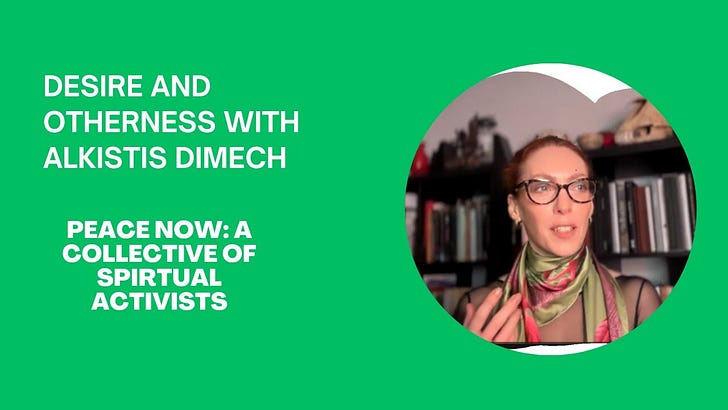
Join us in this captivating episode of the Peace Now Podcast, where we delve into the profound world of Alkistis Dimech, a dancer and choreographer who intertwines the realms of desire, working with the dance modality Butoh, and devotion to the Goddess Babalon. Video Version: Key Highlights of the Interview:* Contemplating Desire: Alkistis engages in a deep exploration of desire, drawing inspiration from Alexandre Kojeve's notion that "Desire is the presence of absence."* Dance as a Medium: She views dance as a means to experience and contact otherness, whether they be spiritual entities or energies, channeling them through her body for transformative purposes.* Exploring Ritual and Sexuality: Alkistis's works, "Visitation" and "The Decoration of Flowers," delve into themes of ritual, sexuality, and the revelation of the invisible, drawing from traditional narratives involving Venus, Coré (Persephone), and Salome.* A Multifaceted Conversation: The discussion traverses various frameworks, including psychoanalysis, occultism, yoga, religion, and philosophy, reflecting on making the unconscious conscious, connecting with higher selves, and the pursuit of knowledge.* Embodying Mythic Figures: Alkistis sees her engagement with mythic figures as an integral part of her dance practice, aiming to embody these archetypal energies in a transformational manner, utilizing dark senses beyond conventional perception.* Personal Transformative Experiences: She shares insights into her transformative ordeals through dance and profound encounters with ayahuasca in the Peruvian jungle, contributing to her artistic and spiritual journey.* Gender and Sexuality: Alkistis challenges common feminist conceptions and emphasizes the need to understand male and female sexualities in relation, exploring them in her work as expressions of life force.* The Art of Questioning: Advocating for continuous questioning in life and art, Alkistis emphasizes the importance of not adhering rigidly to ideologies but exploring experiences directly through the body.* Scarlet Imprint: As the co-founder of Scarlet Imprint, Alkistis supports her artistic freedom, enabling her to pursue dance independently and interact with others inspired by her ideas.Tune in to this episode of Peace Now Podcast for an enlightening journey with Alkistis Dimech, as she unveils the depths of her artistic and spiritual exploration through dance.Timestamps: 00:00 - Introduction to Alkistis Dimech 02:30 - Contemplating Desire and Absence 10:45 - Return to Dance and Exploring the Alien 18:20 - Dance as Contact with Otherness 25:40 - Ritual, Sexuality, and Invisible Realms in Dance 33:15 - Psychoanalysis, Occultism, and Philosophy in Dance 41:50 - Embodying Mythic Figures and Archetypes 49:30 - Transformative Experiences and Ayahuasca 57:10 - Exploring Gender and Sexuality in Dance 1:05:00 - The Importance of Questioning and Contestation 1:12:30 - Scarlet Imprint and Artistic FreedomSubscribe to Peace Now Podcast for more insightful conversations with artists, thinkers, and visionaries.#AlkistisDimech #Dance #Mysticism #PeaceNowPodcast Get full access to Hesitation Media with Brian Nuckols at briannuckols.substack.com/subscribe

Join us as we sit down with Tia Norman, a spiritual teacher and author, to discuss the power of Centering Prayer and its ability to bring healing to the mind, body, and soul. Tia shares her personal journey with Centering Prayer and how it has transformed her life, as well as practical tips and guidance on how to incorporate it into your own daily practice. Whether you're a seasoned practitioner or new to the concept, this episode offers deep insights and inspiration for anyone looking to connect with their inner self and find peace and healing Get full access to Hesitation Media with Brian Nuckols at briannuckols.substack.com/subscribe

Get full access to Hesitation Media with Brian Nuckols at briannuckols.substack.com/subscribe

Get full access to Hesitation Media with Brian Nuckols at briannuckols.substack.com/subscribe
Comments


Download from Google Play

Download from App Store
 United States