


 Claim Ownership
We Are, Marketing Happy - A Healthcare Marketing Podcast
Subscribed: 8Played: 66
Subscribe

© Hedy and Hopp
Description
Healthcare marketing is always evolving, and We Are, Marketing Happy is here to help you make sense of it. Hosted by Jenny Bristow, CEO and founder of the healthcare marketing agency Hedy & Hopp, this award-winning podcast explores the latest shifts, challenges, and innovations shaping the industry today. Follow along, share with your team, and let us know what topics you’d like us to explore next. Learn more about Hedy & Hopp at www.hedyandhopp.com.
133 Episodes
Reverse
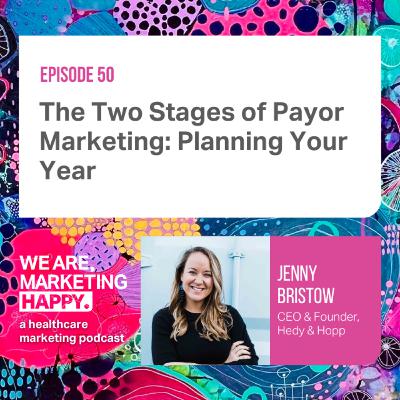
When it comes to payor marketing, or marketing for insurance companies, planning for the year falls into two primary periods of the year: your open enrollment/AEP period and the off-season.
In this week’s podcast, our CEO Jenny Bristow breaks down how to plan your marketing efforts for these two stages of the year to maximize marketing success:
Always On
During your slow time of year
Focus on brand awareness efforts for paid media, some acquisition (don’t go dark!)
Now is a great time to do website updates/redo
Ensure measurement plans and dashboards are in a good place (including patient privacy clean-up work)
Integrate new tools, like CRM, email marketing, etc.
Put some time toward persona development and user journey optimization
Roll out and test content marketing strategies
Open Enrollment & AEP
During your busiest season
Ramp up your conversion-oriented media programs
Limit website changes, testing and tracking programs only
Test persona-based messaging and optimize, optimize, optimize!
Implement the right marketing tactics at the appropriate time of year to leverage both stages of the payor marketing year.
Connect with Jenny:
https://www.linkedin.com/in/jennybristow/
https://calendly.com/jennybristow

Being the smartest person in the room doesn't mean much if you're not in the right room.Too many talented healthcare marketers are stuck in an order-taking trap: executing requests without strategy, reporting activity without outcomes, and watching from the sidelines while leadership makes the decisions. In this week's episode, Hedy & Hopp CEO & Founder Jenny Bristow discusses five concrete moves that can help you reposition marketing inside your health system.Move 1: Ladder Up to the Strategic RoadmapStop building your marketing plan in isolation. Get a copy of your organization's strategic plan and map every marketing objective to it line by line. For every initiative, be able to answer: which strategic pillar does this support?Move 2: Stop Reporting Activity. Start Reporting Outcomes."We published 12 posts this month" is not a business result. "Our orthopedics campaign was associated with a 14% lift in appointment requests" is. Pick 2-3 metrics you can confidently connect to actual patient volume (call tracking, appointment request form fills, new patient volume by specialty) and report on them consistently quarter over quarter.Move 3: Learn to Speak CFOMarketing has its own vocabulary. Leadership cares about revenue, margin, and acquisition cost. Before your next leadership meeting, take one campaign result and rewrite it twice: once in marketing language, once in finance language. The difference in how the room responds will tell you everything.Move 4: Pick One Winnable Proof PointYou don't have to prove marketing's value everywhere at once. Choose one high-margin service line, run one well-scoped, fully tracked campaign, and turn the results into an internal case study. One clear before and after. That's your proof of concept for everything that follows.Move 5: Get in the Room EarlierPerception shifts when you show up with market intelligence before anyone asks for it. Bring search trend data, patient sentiment themes, and competitor moves to strategy meetings proactively. When leadership starts seeing you as someone who knows the market, the invitation to the table follows naturally.Connect with Jenny:Email: [email protected]: https://www.linkedin.com/in/jennybristow/If you enjoyed this episode, we'd love to hear your feedback! Please consider leaving us a review on your preferred listening platform and sharing it with others.

We've had a lot of great guests on We Are, Marketing Happy, but this week's guest might be our most special yet. Hedy & Hopp CEO & Founder Jenny Bristow is joined by her 16-year-old son, Owen Dibble, who spent his summer interning at the agency and attending an AI-intensive camp. The result is one of the most honest, refreshing conversations we've had about marketing, AI, and what the next generation is actually thinking.What Owen Expected vs. What He Actually Found:Owen came into the internship thinking healthcare marketing was mostly client emails and creative strategy sessions. What he found was a complex, rigorously process-driven operation with more tools, quality control steps, and backend work than he ever imagined. The experience stuck. After spending the summer working alongside Hedy & Hopp's team, Owen went home and immediately applied what he learned to his own businesses. Within weeks of implementing SEO and GEO improvements, the phone started ringing from the exact geographies he had optimized for.The AI-Intensive Camp:Owen also attended a week-long AI camp this summer where he learned everything from Python to how AI models actually work under the hood. His biggest takeaway: AI is less mysterious than it sounds. At its core, it's a math problem predicting the most likely next word. He also learned firsthand why trying to "jailbreak" a model and remove its safety guardrails backfires.Gen Z & AI — The Real Story:Owen's take on his generation's relationship with AI is honest and nuanced. Most of his peers are using AI at the surface level — and many view it as a job threat rather than a tool to master. His perspective? AI is like the internet when it first came out. People were afraid of it then too. Now it's a baseline requirement for working. The students who learn how it actually works will have a significant advantage.His advice for students considering marketing or AI as a career path: stop watching and start playing. Sit down, explore the tools, and figure out how everything works. That hands-on curiosity is what separates the people who use AI from the people who understand it.Connect with Jenny:Email: [email protected]: https://www.linkedin.com/in/jennybristow/If you enjoyed this episode, we'd love to hear your feedback! Please consider leaving us a review on your preferred listening platform and sharing it with others.

Your patients aren't Googling you and landing on your website anymore. That foundation has shifted, and as healthcare marketers, the moment we've been nervously anticipating is officially here.In this week's episode, Hedy & Hopp’s CEO & Founder Jenny Bristow talksabout how patients are actually finding and trusting health information today,what that means for your content strategy, and what to do about it.The AI Search Shift:The numbers tell the story: ● 88% of healthcare-related queries now trigger an AI Overviewat the top of Google search results● Organic click-throughs drop more than 50% when one appears● Healthcare site referral traffic from Google is down about35% year over year● 1 in 4 adults are now using AI tools for health information● About 40% of patients use AI directly to research providersWhat Triggers an AI Overview:AI Overviews are most commonly triggered by longer, more specific,research-style queries — showing up 74% of the time for those, compared to 36%for short queries. A search like "dermatologist near me" may be unaffected for now. But "how can I tell if a mole on my arm is potentially cancerous?" is almost certain to trigger one. The goal shifts from ranking in the top three to being cited, and that's where Answer Engine Optimization(AEO), also called GEO, comes in.The EEAT Model:Google and AI tools evaluate health content through the lens of Experience,Expertise, Authoritativeness, and Trustworthiness (EEAT). Real clinician involvement, cited sources, and dated reviews are three of the most important signals for showing up in AI Overviews. The good news: educational content hasalways performed better with patients too. Educational posts historically get 2 to 3 times more engagement than promotional ones, and patients who engage witheducational content are 60% more likely to book and 40% more likely to referothers.What to Actually Do About It:Start with an audit of your last quarter of content and ask: what percentage is "why you should choose us" versus "here's something useful to know?" From there, build content structured around real patient questions,lead with the answer up top, add schema markup so AI can parse your content, get clinicians visibly credited with bylines and review stamps, and keep yourstats and clinical information current.Connect with Jenny:Email: [email protected]: https://www.linkedin.com/in/jennybristow/If you enjoyed this episode, we'd love to hear your feedback! Please consider leaving us a review on your preferred listening platform and sharing it with others.

If your organization runs on Epic, you may already have everything you need to prove ROI for your marketing campaigns.In this week's episode, Hedy & Hopp CEO & Founder Jenny Bristow talks about the analytics tools and reporting options built directly into Epic, and how healthcare marketers can use them to connect campaign spend to real patient outcomes and downstream revenue.The Tools Inside Epic Worth Knowing:Chronicles: Epic's real-time transactional database where live data lives. This is also where Reporting Workbench runs: the home of pre-built reports you can pull from any timeClarity: A relational database that runs nightly data extracts. It’s a reliable source for deeper historical reportingCaboodle: Epic's internal data warehouse, built for deep campaign analysis and connecting marketing data to clinical and financial outcomesLinkSource: Epic's native tool for campaign tracking. When a patient visits a landing page and schedules an appointment, the UTM parameter from your ad gets attached directly to their patient record, so you can pull downstream data on appointments attended and revenue generatedAnalytics Catalog: A search engine for existing reports already living inside Epic. This makes it easier to find what's already built before starting from scratchSlicerDicer: A flexible, self-service tool for pulling and slicing data out of Epic on your own termsThe big picture: when these tools work together, you can put UTM parameters on your ads, attach them to patient records at the point of scheduling, and pull through appointment attendance and downstream revenue, all within Epic. From there, you can build dashboards that show true campaign ROI and make smarter decisions about where to allocate your media budget.If this all sounds unfamiliar, but your organization is already using Epic, don't miss Hedy & Hopp's free webinar series, Summer School: Epic for Marketers! Although the series wrapped up this week, you can still access all sessions on-demand when you register. Connect with Jenny:Email: [email protected]: https://www.linkedin.com/in/jennybristow/If you enjoyed this episode, we'd love to hear your feedback! Please consider leaving us a review on your preferred listening platform and sharing it with others.

Comments

Download from Google Play

Download from App Store
 United States