


 Claim Ownership
The 1937 Flood Watch Podcast
Subscribed: 0Played: 1
Subscribe

© Charles Bowen
Description
Each week The 1937 Flood, West Virginia's most eclectic string band, offers a free tune from a recent rehearsal, show or jam session. Music styles range from blues and jazz to folk, hokum, ballad and old-time. All the podcasts, dating back to 2008, are archived on our website; you and use the archive for free at:
http://1937flood.com/pages/bb-podcastarchives.html
1937flood.substack.com
http://1937flood.com/pages/bb-podcastarchives.html
1937flood.substack.com
265 Episodes
Reverse
The Flood band room is usually a rather raucous place — rocking tunes, loud talk, lots of laughter — but often that mood can turn on a dime to something softer, even almost fragile. We hadn’t done this old Jackson Browne song for years, but something last week — about watching the beautiful spring evening come falling in, seeing those long shadows rolling down over the newly green leaves outside our windows — brought this song back to mind.About the Song“Jamaica Say You Will,” which Browne wrote in 1969 when he was just 20 years old, not only launched the singer/songwriter’s career, but also even helped found the record company that would bring his music to the world.The story goes that artist manager David Geffen signed Browne in 1970 after listening to a demo of this specific song. Right away, Geffen started searching for a record contact for his new artist.At one point, he pitched Browne to Atlantic Records president Ahmet Ertegun, saying, “You’ll make a lot of money.” To that, Ertegun reportedly replied, “You know what, David? I have a lot of money. Why don’t you start a record company and then you’ll have a lot of money.”A year later, Geffen partnered with his old friend Elliot Roberts to create Asylum Records with the help of Ertegun, who put up the initial funds. Atlantic Records distributed Asylum Records with the profits split 50/50.Jackson Browne was one of first artists whom Geffen and Roberts signed for Asylum, and “Jamaica Say She Will” was the opening track of Browne’s self-titled debut album when it was released in September 1972. Browne was quickly joined on the new label that same year by Linda Ronstadt, John David Souther, David Blue, Joni Mitchell, Glenn Frey and others.For more about the song’s back story, see our earlier Flood Watch article by clicking here.“Jamaica” is one of several Jackson Browne songs in The Flood’s repertoire. As reported elsewhere in Flood Watch, from its earliest days the band has played “These Days” from Browne’s second album, For Everyman. More Song History?Meanwhile, if these back stories about songs hit the spot, you might want to browse Flood Watch’s growing archive of articles that explore the history of tunes in the band’s eclectic repertoire by visiting the free “Song Stories” department.There you can browse songs by their titles or by the time periods in which they were written and/or discovered. This is a public episode. If you would like to discuss this with other subscribers or get access to bonus episodes, visit 1937flood.substack.com
This great late-‘60s Lovin’ Spoonful tune is the perfect opportunity to answer readers’ requests for another little sample from Danny Cox’s latest reunion with his old guitar-pickin’ buddy Bobby Murnahan. Just listen and at the end this track you’ll hear Dan and Bob trading choruses on “(Sittin’ Back) Lovin’ You.”As reported here last week, Danny and Bobby grew up together in Lawrence County, Ohio. It’s rare they can get together these days, but whenever Murnahan travels back this way from his Colorado home — as he did last month — we try to get him to join us in The Flood band room.About the SongThe vehicle for this Cox-Murnahan moment is John Sebastian’s 1966 composition, which was the opening track for Hums of the Lovin’ Spoonful, the third studio album by Greenwich Village’s own folk-rock mavens. Today the disc just barely makes the list of top 50 albums released in that stellar year of rock which saw Bob Dylan’s Blonde on Blonde, The Beatles’ Revolver, The Beach Boys’ Pet Sounds, The Rolling Stones’ Aftermath and so many more.Not that Hum was ho-hum. On the contrary, as reported here earlier, that one album spawned four (count ‘em, four) charting singles for the Lovin’ lads, including “Summer in the City,” “Rain on the Roof,” “Nashville Cats” and "Full Measure.”And while “Lovin’ You” was not among the disc’s hit singles for The Spoonful, a month after the album’s debut in November 1966, the song was covered by Bobby Darin who took it into the Top 40.After that, the tune also became a successful number for four different female artists, including Anne Murray (1969), Helen Reddy (1973), Dolly Parton (1977) and Mary Black (1983).For more on the history of the song — including a side note on The Flood’s early infatuation with it — see our earlier Flood Watch article by clicking here. This is a public episode. If you would like to discuss this with other subscribers or get access to bonus episodes, visit 1937flood.substack.com
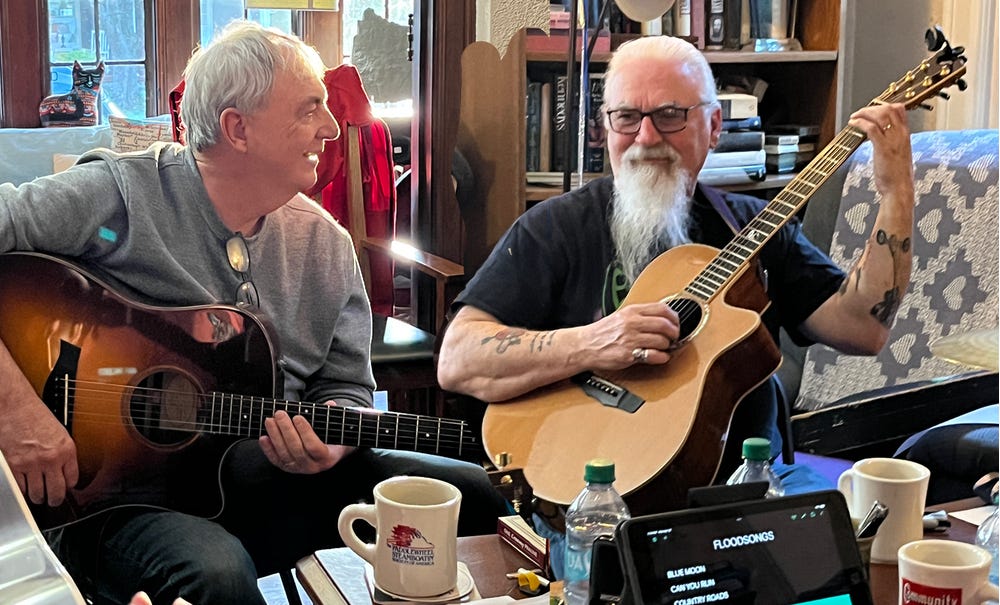
We knew the band room was going to rock last week as soon as we saw Danny Cox was bringing along his life-long buddy, guitarist Bobby Murnahan, who was visiting from Colorado.As noted here earlier, Danny and Bobby have known each other since before grade school. “Our parents attended the same church,” Danny has said, “and we got acquainted in Sunday school.”Almost immediately the youngsters were united by their interest in guitar innovator Chet Atkins. One day after church, Bobby showed up at the Cox house asking Danny to show him some Atkins-style picking.“I showed him what little I knew,” Dan remembers, and Bob took it from there. He and Dan purchased the Chet Atkins Goes to the Movies songbook and Bobby worked out the tunes. “I learned how to play Chet correctly because of his deciphering abilities,” Dan says. Dan and Bob have been good friends ever since. For more on the story of their friendship, see our earlier Flood Watch article by clicking here. About This Song from Last Week’s RehearsalAs we noted in an earlier Flood Watch article, “Deep Ellum Blues” — first recorded on Bluebird by The Shelton Brothers (under the pseudonym “The Lone Star Cowboys”) — is all about life in a notorious neighborhood of Dallas.While New Orleans had its French Quarter and Chicago its Bronzeville, in Dallas it was Deep Ellum with its equally sketchy, colorful résumé. In the 1920s, if you walked down the streets on Deep Ellum, you could easily have rubbed shoulders with Blind Lemon Jefferson and Huddie Ledbetter, with Robert Johnson and Bessie Smith (not to mention with gangsters Bonnie and Clyde and Pretty Boy Floyd).Other versions of the song that celebrated this darker side of the Big D were made between 1957 and 1958 by Jerry Lee Lewis for Sun Records, by Bobby Jackson for Gold Air Records, by Mary McCoy & The Cyclones for Jin Records and, later still, by The Grateful Dead, Levon Helm and Rory Gallagher.For more on the history of this terrific Texas tune — as well as about the district of Deep Ellum — see our earlier article by clicking here.More from Flood Guests?Over the years, many guests — visitors like Bob, as well as returning Flood alumni (whom we call “Floodster Emeriti”) — sit in with us at rehearsals, jam sessions and performances. The band’s web site devotes a page to a growing list of these guest appearances, with links to the audio and video of their visits. To use this registry, click here to reach the page, then scroll and click on an underlined date associated with a guest. On the subsequent page, click on the title of the song to hear the audio or on a video's start arrow to view it. This is a public episode. If you would like to discuss this with other subscribers or get access to bonus episodes, visit 1937flood.substack.com
A half dozen years after his death at beginning of the horrid Covid pandemic, songwriter John Prine is still very much on the minds of the folks in The Flood band room.In fact, every spring since the sad April 2020 day of his passing, John’s wonderful songs start popping up among the tunes that fill the weekly rehearsals, like this one, one of our favorites, which Prine wrote a few decades back.As reported earlier, “One Red Rose” is a song that an old band mate, the late Roger Samples, got enamored of as soon as he heard it on John’s then-new 1980 Storm Windows album. How the Song Got FloodifiedThe Eighties were a time of change for us. Rog was ending his time with The Flood, the band he helped form nearly a decade earlier. That’s because he and his new wife, Tammy, and their young family were moving from their native West Virginia to the green hills of Mount Sterling, Ky., a hundred miles to the west.But before he and the brood hit the trail, Rog taught the rest of the guys the tune and played it for the folks gathered for the last of the Bowen Bashes in September 1981, as heard in the video below:Back then, The Flood never worked out a full arrangement of the song, and honestly the rest of us soon forgot it. Or we thought we did. But then a few years ago, Charlie Bowen woke up from a sound sleep grinning at a dream he had just had in which he thought he heard Roger singing that old song again.Here’s brief audio of Charlie relating that very story at a gig a while back:Nowadays we do “One Red Rose” as a little three-minute reunion, both with Roger and with John.More Prine Music?Meanwhile, want to hear more Flood renditions of John Prine songs? Gotcha covered. Not long ago, we released a special John Prine Memorial Show. Click the image below to check it out. This is a public episode. If you would like to discuss this with other subscribers or get access to bonus episodes, visit 1937flood.substack.com
Our rendering of this ancient bittersweet song of love and loss dates back more than 45 years now. But each times the band plays it, it seems as new and fresh as a summer evening.According to Flood lore, our version of this classic Appalachian folk song hearkens back to a hot summer’s night at the Bowen House in the early 1980s.Over beers and sandwiches, Flood co-founders Roger Samples and Charlie Bowen sat at the kitchen table trading daydreams, lies and memories, interspersing them with songs, new and old.At some point Rog started playing a melody that he was working out for a possible original song. But right after he laid out his chord sequence, Charlie started singing the lyrics of “Come All Ye Fair and Tender Maidens” as he remembered them from an old Jean Ritchie album.“Huh!” Rog said with grin. “Who knew my new tune already had words!”For more on the back story of this wonderful old folk song, see our earlier Flood Watch article by clicking here.More Flood Yarns?A band that has been around as long as ours has many stories and yarns that form Flood lore and legends. Often between the tunes at jam sessions, rehearsals and public performances, someone in the group feels compelled to tell a tale, and if there’s a recorder running, it is saved for the ages. The “Stories” section of the band’s website contains a linked index to the stories we’ve saved this way, inviting you to click in and enjoy the ride. Some of the stories are about specific songs, and there are even dozens of jokes. Click here to check it all out. This is a public episode. If you would like to discuss this with other subscribers or get access to bonus episodes, visit 1937flood.substack.com
Tunes in The Flood repertoire are always subject to re-evaluation and rehabilitation. Perhaps a new key will freshen it up. Maybe there are new verses that can be sung. A new rhythm? A new chord or two?“Ready for the Times to Get Better,” the Allen Reynolds song that Randy Hamilton brought to the table a few years ago, is just such a song.About the SongAs reported here earlier, the tune already had very long journey to Floodlandia. The first time it was played in our band room was about 15 years ago on a mellow autumn night when Randy and his buddy Paul Martin dropped in to jam with us.Neither man was a member of The Flood yet — Randy would join the following year and Paul a few years after that — but their song was the hit of the evening (as reported in that week’s Flood podcast).However, “Ready for the Times to Get Better” didn’t work its way into our repertoire until a few years ago when Danny Cox happened to start picking it between songs on the night’s practice list.The jaunty melody really jingled in our memory and Dan and Randy got together to woodshed a little, working it out. And since then band had been honing its arrangement, Sam polishing his harmonica solo, Jack and Charlie smoothing out their respective drum and banjo rhythms.The Tommy Emmanuel-Doc Watson EffectThe song’s evolution in the band room took another turn last month when a Flood hero saluted another Flood hero with a special release from his first solo album in 10 years. Grammy-winning guitarist Tommy Emmanuel’s Living in the Light is a virtuosic blend of acoustic pop, jazz, classical and roots music.Most of the performances on Living in the Light were recorded in one or two takes, exuding the sense of joy and wonder in these sonic explorations.One track on the album — what he listed as “Waiting for the Times to Get Better” — has special meaning for Emmanuel, who in early March chose the 103rd anniversary of the late Doc Watson’s birth to release a video of the song he learned from Doc’s work.“When I heard Doc Watson sing this song,” he told Bluegrass Today, “I knew I should try to do the same. I love his voice and guitar playing so much — it’s so honest. If you look up the word ‘honesty’ in the dictionary, there’s a picture of Doc!“I wanted to do a tribute in my own way. ‘Ready for the Times to Get Better’ is my attempt at singing a message. It’s simple. We are all waiting for times to get better in our world, and singing seems to help me get through these tough times.”Meanwhile, when our Danny Cox listened to the track, he heard something else: a chord or two that were different from previous versions. Gently, Danny brought that Emmanuel effect to The Flood’s take on the tune, and that’s where its Floodifying stands today.For the back story of this great Allen Reynolds composition, see our earlier Flood Watch article by clicking here. This is a public episode. If you would like to discuss this with other subscribers or get access to bonus episodes, visit 1937flood.substack.com
The Flood started playing around with hokum music — those good old jug band tunes from the 1920s — about a half century ago, but it took another 20 years for us to feel confident enough to try to write one of those kind of songs ourselves.Charlie Bowen started putting this tune together back in the 1990s, but then it took another 30 years for us to feel like we could play it. In fact, the song didn’t really start coming together until Jack Nuckols joined the band. Who knew that the spark we were waiting for was Jack’s spectacular spoon playing to finally reach that jug band junction? See what you think.Night of the Broken SpoonsLong-time Flood Watch readers will recall that when Jack first sat in with the band nearly three years ago now, we passed him the house bongos to play, but then when a jug band tune came around, we put spoons in his hands.Jack was rocking it hard, and we were digging on those rhythmic riffs. But then, just as we were fixing to turn it over to him for a solo, darned if those poor spoons didn’t break in his hands. Now, Jack was apologetic, but — as you can hear here in that week’s podcast — the rest of us all thought it was a hoot! What better way to end a song called, “Tear It Down”?(By the way, now that Jack is a full-time Floodster, we got him a more industrial-strength set of spoons, ones that can take a pounding as you can hear this week.)About the SongFor more on the back story of “Lovin’ You Would be So Good for Me,” check out this earlier Flood Watch article.More Hokum, You Say?Meanwhile, if all this has put you in the mood for a little more juggery in your jaunty Friday, visit the Hokum channel of the band’s free Radio Floodango music streaming service. There you’ll find several dozen randomized tracks of the band playing those jolly jug band tunes that inspired this Bowen composition. Click here to give it a spin. This is a public episode. If you would like to discuss this with other subscribers or get access to bonus episodes, visit 1937flood.substack.com
Here’s a little festive Floodery to help you celebrate this first bright, sunny Saturday of Spring 2026. Pamela Bowen recorded these four minutes at this week’s rehearsal at the Bowen House with the band enjoying its newest favorite Tom Waits song. Waits wrote “Come On Up to the House” back in 1999 but, as reported here earlier, The Flood is late to the party on that one. We never heard the song until late last year when it was featured in the closing credits of the latest “Knives Out” movie, Wake Up Dead Man. But we’re making up for lost time, having a ball with its sorta post-apocalyptic gospel vibe. This is a public episode. If you would like to discuss this with other subscribers or get access to bonus episodes, visit 1937flood.substack.com

Most love songs are about young love, and of course that is special, but really it’s nothing compared to love that has aged like fine wine. Here’s a song to all those champion life-long lovers out there.About the SongCharlie Bowen wrote “The Answer Is You” while reflecting on the decades that he and Pamela have been “in each other’s care,” the lyrics say. Beyond that, the song also was inspired by all those couples who have passed in and out of the Bowen House over the years, scores of folks who are part of The Flood’s loving family.This song actually has been in the wings for some 15 years now, patiently waiting for its Flood debut. Only recently did we realize that what it needed was Jack’s tasty rhythm and Danny’s definitive guitar stylings. They’ve certainly made it worth the wait.More Charlie Tunes?Meanwhile, if you’d like more tunes from Br’er Bowen, check out the Charlie Channel on the band’s free Radio Floodango music streaming service.Click here to give it a spin. This is a public episode. If you would like to discuss this with other subscribers or get access to bonus episodes, visit 1937flood.substack.com

This tune — “July, You’re a Woman” — entered the Floodisphere in the first hours of The 1937 Flood’s half-century origin story.As reported earlier, this lovely John Stewart composition is one of the songs that Charlie Bowen brought to his very first jam session with the late David Peyton at the 1973 New Year’s Eve where The Flood was born.For that first year, the song limped along as just a duet by Dave and Charlie. It started coming into its own, though, as the Family Flood began to expand. First, Roger Samples returned to the Huntington area from the East and joined the band, bringing his formable guitar chops and vocals. A year later, fiddler Joe Dobbs came on board, and the rest is Flood history.Debut at the Bash”July, You’re a Woman” got its debut as a Flood feature that fall at the next edition of the Bowen Bashes, the semiannual music parties at which The Flood became the house band. Audio of that inaugural 1975 performance is captured in the video below:The song remained a Flood favorite throughout the Bash years, but when the band went into an extended hiatus in the 1980s, the song seemed to go with it. “July” ReduxIn fact, “July” completely disappeared from The Flood’s collective memory until three decades later.Only recently, in a bit of nostalgia for those halcyon days of the band’s birth, did Charlie start revisiting some of the group’s earliest tunes. Topping the list was one of his favorites, that old John Stewart song. It’s grin-worthy to imagine how much Dave, Roger and Joe would appreciate the latest generation of Floodsters and their kind treatment of this first tune, as heard at last week’s rehearsal.And Remember “These Boys”And speaking of origin stories, remember that the Huntington premiere of Randy Yohe’s award-winning film, “These Boys” — tracing The Flood’s 50-year story — happens March 20, 2026, at the Foundry Theatre at City Hall, 800 Fifth Avenue. In case you missed it earlier, click here to read Jim Casto’s Herald-Dispatch advance on the showing. This is a public episode. If you would like to discuss this with other subscribers or get access to bonus episodes, visit 1937flood.substack.com
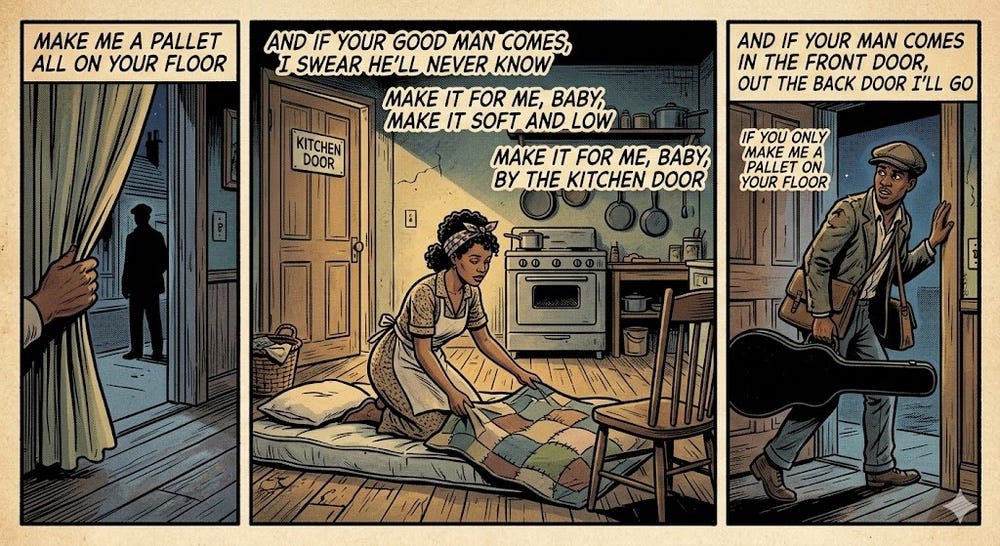
As we were packing up following our most recent gig at Bahnhof last month, an old friend stepped up with a question.“Say,” he said, “where’d’ya get that melody for ‘Pallet on the Floor’? I’ve been hearing that song for years, but I never heard it played the way you did it tonight. D’y’all write that?”“Well,” we said, thinking fast, “yes! Yes, we did! Do you want to buy it? You know, everything we’re wearin’ is for sale!”He took a step or two back. (We get that a lot.) Seriously, though. Did we come up with that melody? Damned if we know!Origin StoriesAs reported here earlier, The Flood drew inspiration for its version of “Make Me a Pallet on Your Floor” from Rolf Cahn’s singing of the song on a Folkways album that he made with Eric von Schmidt way back in 1961.In his liner notes for the disc, Cahn said he and Eric adapted their rendition from various performances of the song, including Jelly Roll Morton’s Library of Congress taping of it in 1938.When we first listened to Cahn and von Schmidt’s seminal Folkways album a half a century ago, we just took Rolf at his word. However, all these years later — with YouTube having so many of those classic old albums easily accessible online — we can check Cahn’s sources.And guess what? We can find no other early recording — not Morton’s, not Mississippi John Hurt’s 1928 version of the song, not Virginia Liston’s first waxing of it three years before that — that used Rolf’s imaginative rendering. And, of course, there is no one around anymore to ask — Rolf died in 1994, Eric in 2007 — but from our research we’re now prepared to conclude that the tune was their own creation (perhaps improvised on the spot on that night at Folkways when their record was made).And We’re Not Done YetMeanwhile, our band has — as usual — added its own touches to the tune. As Flood folks started doing “Pallet” a couple of decades ago, they steadily honed and noodled with the melody, in particular stirring in some of the classic jazz variations they had heard.Sidney Bechet’s 1940 recording comes to mind, as well as Louis Armstrong’s 1954 performance of “Atlanta Blues,” in which W.C. Handy famously borrowed from traditional bits and pieces of “Pallet on Your Floor.”So….?In the end then, the question remains: Did we write this tune? And the answer is still … uh…. damned if we know…. This is a public episode. If you would like to discuss this with other subscribers or get access to bonus episodes, visit 1937flood.substack.com
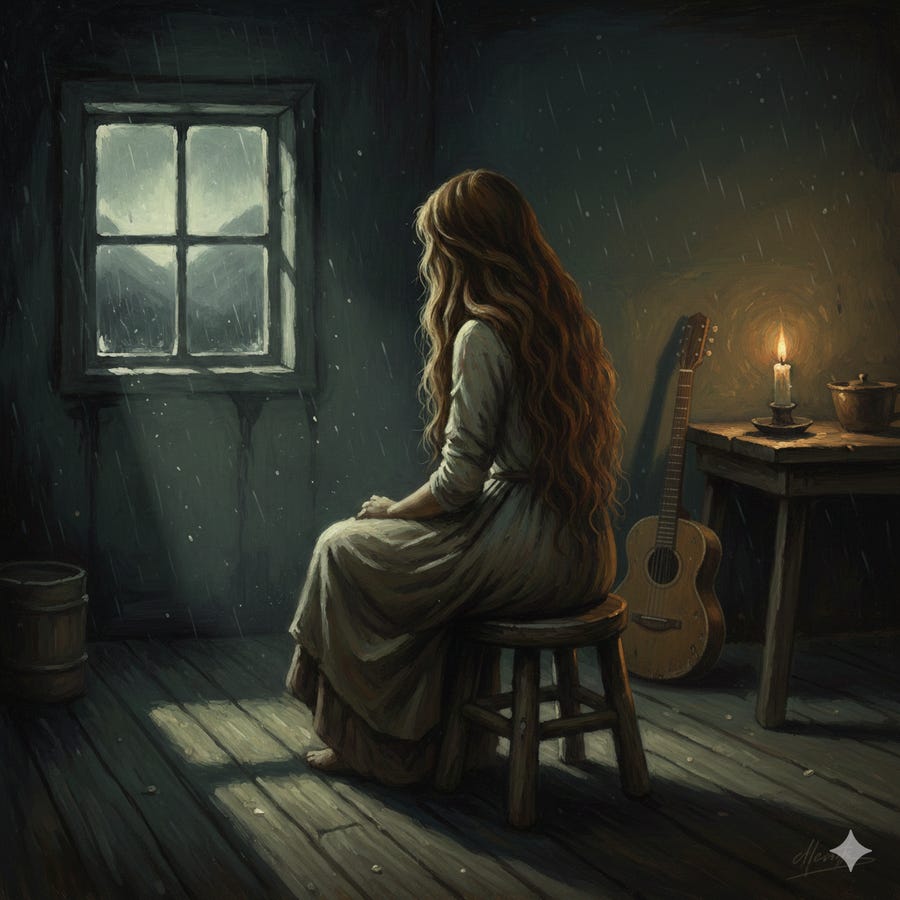
Here’s a song that we likely wouldn’t even know about were it not for the persistence and curiosity of a researcher who was far from an ordinary young woman of her time. Born in 1892 in Paducah, Ky., into the family of a prominent U.S. congressman, Mary Guthrie Wheeler was destined from the start for adventure.Rather than settling into a quiet, conventional life, she embraced the extraordinary, serving, for instance, as an American Red Cross nurse in France during World War I and earning a Medal of Gratitude. Song CatchingBut her most enduring adventure took place back home along the bustling Ohio and Tennessee rivers, doing work that would contribute to America’s understanding of its own music.As a little girl, Mary was often taken by her nanny, Susan Collins, down to the Paducah riverfront to watch the comings and goings of the majestic steamboats. As they walked, Collins, who had worked as a cook and chambermaid on the rivers, usually sang to the youngster, planting the seeds of what became a lifelong fascination. Decades later, Wheeler realized that the river culture of her youth was rapidly fading. By then armed with a music degree from the Cincinnati Conservatory, Mary set out on a bold mission: to preserve the songs and stories of the roustabouts of the packet boat era.Mary’s methods were as intrepid as she was. Venturing into the neighborhoods of former river workers, she refused modern audio equipment offered to her by famous folklorists like Alan Lomax. Instead, Wheeler embraced a deeply personal approach. She sat with singers in their homes, writing down their lyrics and committing the melodies to memory, then racing back to her desk to transcribe the musical notation.This Song’s StoryIt is because of her devotion to detail that we know songs like “Alberta, Let Your Hair Hang Low,” published in her 1944 book Steamboatin’ Days.As reported here earlier, Mary’s curiosity led her one late afternoon to the street of a former river worker named Gabriel Hester. Mary was welcomed by his wife to wait on their porch, and soon she was treated to Gabe singing the haunting melody of “Alberta.” Between verses, Hester also told stories. He recalled, for instance, how roustabouts usually sang while they worked. Sometimes, as the music drifted up, steamboat passengers would drop coins from the upper decks in appreciation.Here, from a recent Flood rehearsal, we offer our own appreciation of Gabe Hester’s song.More Back Stories?Flood Watch does a mess of song catching itself, of course. If you’d like to see and hear what we’ve learned about the history of other songs in the band’s eclectic repertoire, visit our free “Song Stories” department.There you can browse songs by their titles or by the time periods in which they were written and/or discovered. This is a public episode. If you would like to discuss this with other subscribers or get access to bonus episodes, visit 1937flood.substack.com
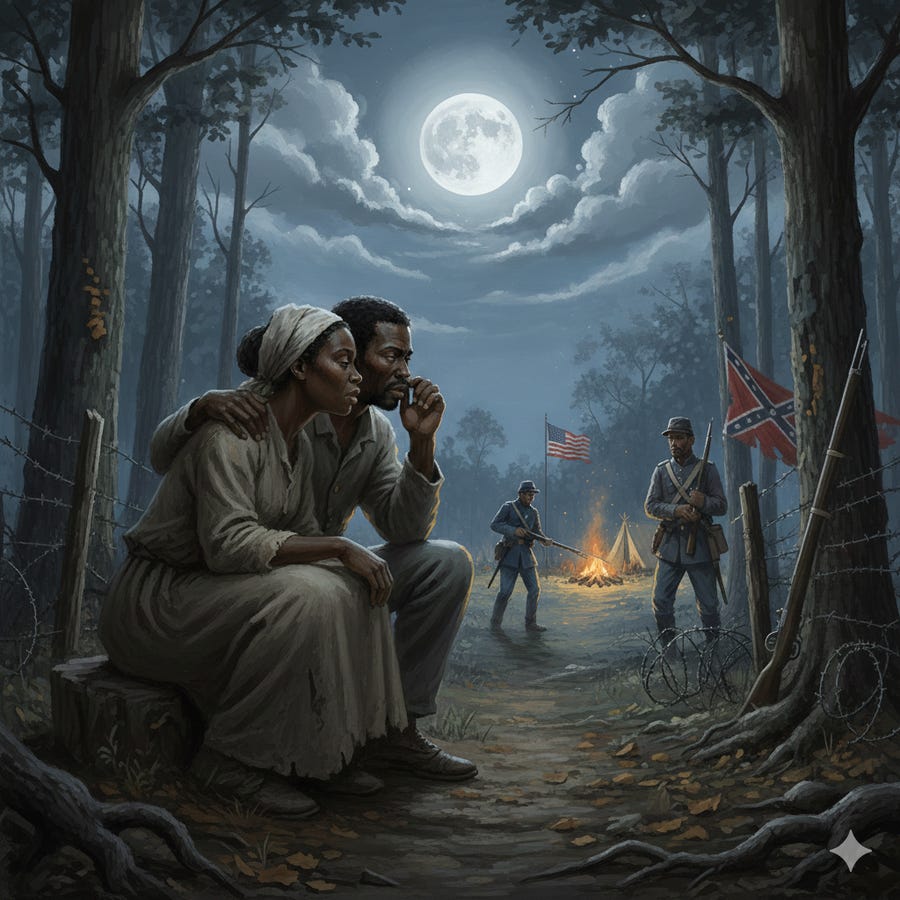
We love how this song, which Randy Hamilton brought the band nearly a decade ago now, continues to boldly represent a new direction in Appalachian music.Perspective, Then….For decades, bluegrass music played it safe when singing about the American Civil War. It generally stuck to well-worn tales of shared heartbreak, ruined farms and missing home, while conveniently ignoring the brutal realities of slavery. During the cultural upheavals of the 1960s and 1970s, the music even took a more startling detour into full-blown Confederate nostalgia, romanticizing the Old South. But “Can You Run?” is part of what scholar Carter W. Claiborne of North Carolina State University considers a brave new wave of songs that are finally shaking up that sanitized narrative. … NowWritten by Eastern Kentucky’s own Chris Stapleton, the song shatters the genre’s old boundaries. Instead of being just another wistful ballad about a homesick rebel soldier, “Can You Run” takes listeners down what Claiborne calls an “emancipationist path.” There's smoke down by the river Hear the cannon and the drum I've got one thing to ask you, honey — Can you run?Writing recently in Gettysburg College’s Journal of the Civil War Era, Claiborne calls Stapleton’s song a cultural reset for the entire genre by shining a spotlight on the lived experiences of enslaved people. You know I hate to ask so late But the moment's finally come And there won't be time to change your mind. Can you run?“Modern bluegrass,” Claiborne writes, “has taken up a more balanced approach to the Civil War, incorporating African American and Unionist perspectives, and finally corrected the reconciliationist view with the emergence of emancipationist music.”For more about the song and about its composer, Chris Stapleton, see our earlier Flood Watch article, by clicking here.More from Randy?And if all this has you in the mood for more music from Randy Hamilton, check out the Randy Channel on the band’s free Radio Floodango music streaming service. This is a public episode. If you would like to discuss this with other subscribers or get access to bonus episodes, visit 1937flood.substack.com
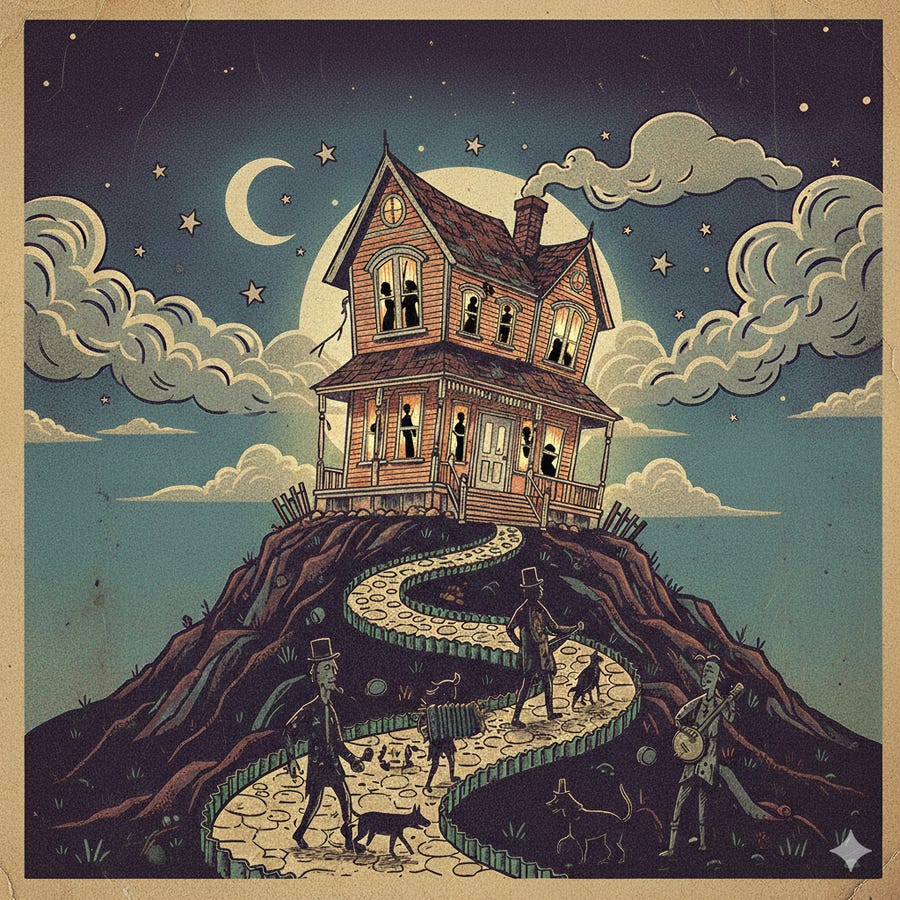
When this Tom Waits song turned up during the closing credits of the latest “Knives Out” movie, Wake Up Dead Man, we heard shouts from all around the Floodisphere: “Whoa! What a great tune that would be for The Flood!”We agree. We only wish we’d thought of it earlier. After all, “Come On Up to the House” has been around for more than a quarter of a century, appearing as the closing track on Waits’ 1999 Grammy-winning Mule Variations album. Oh, but how our late co-founder Dave Peyton would have loved to have had a piece of this goofy/gritty gospel groove!A Little Waitsian ExegesisTom Waits, one of the world’s smartest songwriters, created a tune chock full of literary and philosophical references, as well as clever cultural shout-outs.Country music lovers, for instance — at least those with long memories — will recognize a kiss being tossed in Tom’s repeated line in the chorus: “The world is not my home, I’m just passing through.” Don’t get it? Think all the way back to 1962 and to the great Jim Reeves crooning: This world is not my home, I’m just a-passin’ through My treasures are laid up somewhere beyond the blue. The angels beckon me from heaven’s open door And I can’t feel at home in this world anymore.But ”Come On Up to the House” has more on its agenda than simply quoting 60-year-old classics. Waits surely is the only songwriter in the house to zip from 20th century country cool to 17th century political philosophy.What? It’s true. By the second verse, the lyrics are reaching back to source material predating Jim Reeves by a good three centuries. Philosophy students perk up when “House” takes a moment to direct our attention to Thomas Hobbes’ famously dark assessment of human life: “Nasty, brutish and short.”A Peyton-Worthy Punch LineThe song’s funniest, sassiest lines — the ones Dave Peyton certainly would have relished — have the most obscure provenance. Who doesn’t smile when Waits’ lyrics get to this entreaty: Come down off the cross — We can use the wood!This bit of irreverent humor generally is attributed to the late comedian/satirist Bill Hicks, whom Waits once described as being “like a reverend waving a gun around.”While there’s no evidence that the “cross/wood” lines are original with Hicks — some think Lenny Bruce might have fashioned them a couple of decades earlier — it is for sure that Bill popularized the comment in his stand-up routines in the 1980s and early 1990s.And we do know that Tom Waits is a big Bill Hicks fan. In fact, a few years ago when someone asked him to compile a list of his all-time favorite albums, Tom put Hicks’ 1990s Rant in E Minor in his top 20.Waits on WaitsFinally, “Come On Up to the House” also has a sample of Tom Waits sampling Tom Waits.The song’s line “whipped by the forces that are inside of you” was used in another Waits’ song — “Spidey’s Wild Ride” — released on 2006’s Orphans, Brawlers, Bawlers & B******s album. (This album compiled outtakes that were recorded from 1984 to 2005, so it is possible that song was written before “Come on Up to the House.”)For certain we know that a variation on the line came up in a 2002 newspaper article. Austin Chronicle writer Margaret Moser, interviewing Tom over the phone, asked the songwriter where he was as they spoke. “I’m out on my own recognizance in the day room,” Waits replied, “gluing pieces of macaroni on cardboard and painting it gold. After that I get to make a belt that says, ‘Whipped by the forces within me’ on the back.”Ah, aren’t we all, Tom? Aren’t we all…?More Gospel from The Flood?If all this has you craving a little gospelizing by the boys in the band, remember The Gospel Hour playlist in The Flood’s free Radio Floodango music streaming service. To read all about it, click the link below. This is a public episode. If you would like to discuss this with other subscribers or get access to bonus episodes, visit 1937flood.substack.com

We’re setting the time machine back 20 years to a snowy Saturday night in Charleston.The Flood was on stage at the West Virginia Cultural Center for a FOOTMAD (“Friends of Old-Time Music and Dance”) concert, sharing the bill with another great band, Stewed Mulligan.As reported here earlier, it had been a fun evening of jug band songs and general silliness, blues and fiddle tunes and old-time string band music, so when Michelle Hoge started a classic 1940s jazz standard, a hush fell over the audience.In seconds, people were softly humming along, then they smiled so much during Doug Chaffin’s sweet mandolin solo that he had to take a second chorus. Finally, by the time Michelle got to the end of the number, people were on the feet to cheer her. What a sweet memory.About the SongA celebrated ballad that successfully bridged the gap between 1940s R&B and 1960s pop, “Since I Fell for You” evolved from a modest hit into a timeless standard.Pianist/bandleader Buddy Johnson in late 1945 wrote the song that his publisher categorized as a “jump blues.”Johnson famously had a passion for classical music but played to the tastes of his Southern audiences andc composed the song for his sister, Ella Johnson, to sing. While their original recording had some impact, it was Annie Laurie’s 1947 version — recorded with Paul Gayten — that attracted serious attention, reaching No. 3 on the Billboard “Race Records” chart.The song found its definitive voice, though, in 1963 thanks to singer Lenny Welch, who was familiar with the song through a 1954 doo-wop cover by The Harptones and suggested it to Archie Bleyer, the president of Cadence Records.When Bleyer bought the original sheet music, Welch was surprised to find a distinct piano introduction that had been omitted from the versions he had heard previously. This recovered intro became a highlight of Welch’s recording. Recorded on Aug. 13, 1963, Welch’s version broke out in California markets before sweeping across the U.S. It peaked at No. 4 on the Billboard Hot 100 and No. 3 on the Easy Listening chart, selling over a million copies.Welch’s smooth, middle-of-the-road vocals cemented the song’s status as a pop classic. Since then, the song has attracted covers across the genres, including jazz greats like Dinah Washington, country stars like Charlie Rich and Ronnie Milsap and contemporary icons like Bonnie Raitt.Further Floodifying the SongWhile the Feb. 11, 2006, show featured in the audio at the start of this report was The Flood’s first public performance of the song, “Since I Fell for You” stayed in the band’s repertoire for years. However, its title didn’t always come readily to mind. Click the button below for a funny exchange at a rehearsal a few years later:Meanwhile, a dozen years after the song’s Flood debut at FOOTMAD, the band was back in Charleston, this time at Taylor Books, where Pamela Bowen shot this video:Framing Michelle’s vocals were solos by Floodster Emeritus Paul Martin and guest artist Jim Rumbaugh. This is a public episode. If you would like to discuss this with other subscribers or get access to bonus episodes, visit 1937flood.substack.com

Our Randy Hamilton was born to sing songs like this. He and Danny Cox brought us “Spooky” last summer and we’ve been loving it ever since. Especially when we added Sam St. Clair’s funky harmonica and Jack Nuckols’ tasty percussion.About the SongAs reported here earlier, while The Classics IV made the lyrics famous with a chart-topper in the fall of 1967, the story of “Spooky” began several years earlier in an Atlanta club. Following a show sometimes in 1965, saxophonist Mike Sharpe (Shapiro) and his band mate pianist Harry Middlebrooks Jr. began riffing on the George Gershwin classic, “Summertime.”As they improvised, they realized they had stumbled upon something special. As they continued, the duo developed their own melody, to which Sharpe randomly assigned the name “Spooky.”The original version was recorded as a jazz instrumental featuring strange high voices to enhance the eerie vibe; it eventually peaked at No. 57 on the U.S. charts in January 1966.Sharpe and Middlebrooks initially thought the song’s life cycle ended there, but a year later, The Classics IV added those lyrics about that “spooky little girl like you,” propelling the track to No. 3 on the Billboard 100. Harry’s StoryMeanwhile, as “Spooky” was conquering the airwaves, co-writer Harry Middlebrooks was entering one of the most high-energy phases of his career: touring with Elvis Presley. It was the fall of 1970 when Middlebrooks received a call from Elvis’s producer, Felton Jarvis, inviting him to join The King’s first tour in 10 years.Middlebrooks served a unique dual role on the road: he performed as part of the opening act to warm up the crowd and sang tenor in the backup quartet, providing the vocal harmonies essential to Elvis’s ‘70s sound. In a moment of professional synergy, Elvis, who was fond of “Spooky,” actually performed a cover of the Sharpe-Middlebrooks’ hit during various live shows and rehearsals in 1970.Beyond his most famous composition, Middlebrooks established himself as a prolific figure in the entertainment industry. He composed for television and penned more 300 tunes recorded by such diverse artists as Tom Jones, Liberace and The Oak Ridge Boys.Middlebrooks recorded several albums for Reprise and Capitol Records and established himself on the club scene in Southern California, eventually singing at more 80 clubs. He became an in-demand session and backup singer for Neil Diamond, Anne Murray, Marty Robbins and others. In particular, he relished his seven-year run backing Glen Campbell for his Las Vegas and Lake Tahoe concerts.Another Helping of Randy Tunes?So, has today’s podcast got you hankering for more tunes from Randy Hamilton? Coming right up!Just drop by the free Radio Floodango music streaming service and click into the Randy Channel for a randomized playlist of Hamilton-centric songs from The Flood repertoire. Or just click here to take the express route! This is a public episode. If you would like to discuss this with other subscribers or get access to bonus episodes, visit 1937flood.substack.com

The fun of playing some songs is that we just never know what we’re going to hear. This George Gershwin piece has been like that ever since Danny Cox brought us better chords for it a year or so ago. Now the song is like a shiny little red convertible parked in the garage just waiting for the next sunny day. You and your buddies pile in, not knowing where you’re going, just enjoying the company and the sights and the sounds of each other’s laughter. Hop in! We’re going for a joy ride!About the SongAs reported earlier, “Lady Be Good” has been a perennial party favorite for more than a century now.Nineteen-Twenty-Four was a watershed year for Gershwin. After spending more than a decade pounding the pavement in New York’s Tin Pan Alley, he composed his landmark "Rhapsody in Blue." Then, alongside his brother Ira, George scored his first major Broadway hit, the musical comedy Lady Be Good, which ran for more than 300 performances.The enduring significance of the show’s title tune, "Lady Be Good," lies in its rare ability to transcend musical eras. A unique entry in the Great American Songbook, it beautifully bridged two distinct jazz ages, surviving the transition from the loose Dixieland style of the Roaring Twenties to the smooth swing sound of the 1930s.A favorite among jazz legends as diverse as Charlie Parker and Lester Young, the song’s rich history also includes interpretations by vocal icons like Ella Fitzgerald and Mel Tormé.For more on the back story of this song, see this earlier Flood Watch entry.More Floodifaction?And if this has you hungry for a little more of the band’s jazzier selections, drop by the free Radio Floodango music streaming feature and click on the “Swingin’” Channel.Click here to give it a spin. This is a public episode. If you would like to discuss this with other subscribers or get access to bonus episodes, visit 1937flood.substack.com
Some songs just seem to go right to the heart of what connects us all, especially when the subject is hard times.This song from a recent Flood rehearsal is often considered a classic example of the old notion of singing the blues to get rid of the blues. Historically the tune also represented liminal moments for two distinctively different musical artists.About the SongAs noted in an earlier Flood Watch article, Ray Charles wrote and recorded “Hard Times (Who Knows Better Than I?)” in the mid-1950s during a period of heavy creative output at Atlantic Records.But the song languished in the Atlantic vault until the September 1961 release of The Genius Sings The Blues, a highly praised compilation of some of Charles’s earlier singles along with some previously unreleased stuff.While Brother Ray rarely spoke at length about composing these tracks, the origin of “Hard Times” seems deeply rooted in his personal history, especially his relationship with his mother, Aretha Robinson, who died when he was still a teenager.The song also is another marker for those who follow the Ray Charles story. By the early 1960s, Charles had largely stopped writing his own material to focus on interpreting others’ work, making “Hard Times” one of his last significant original compositions.The Eric Clapton ConnectionThree decades later, “Hard Times” marks a period of transition for a great artist of the next generation.Eric Clapton, having recently overcome his battles with drug addiction, viewed his 1989 Journeyman recording sessions as a way to further master his craft, focusing on his love for blues.The lyrics of “Hard Times,” which deal with personal struggle and perseverance, resonated with that personal journey. The song has stayed in the Clapton repertoire. It was later featured on his 1991 live album 24 Nights, recorded at the Royal Albert Hall. More recently in 2025, he revisited it, playing on a cover for Nathan East’s collaborative album with his son Noah, titled Father Son. For more of the back story of ”Hard Times,” check out this earlier Flood Watch article. This is a public episode. If you would like to discuss this with other subscribers or get access to bonus episodes, visit 1937flood.substack.com
Sometimes the chemistry’s right, the stars align — however you want to say it — and the best song of the night is one you didn’t even plan to play.At a recent rehearsal, for instance, the band came in with a number of tunes to focus on. Among them were new songs the guys were just starting to work on. Others were old familiar numbers that they were polishing up to include in the next recording session for the new album.Progress was made in the first hour or so on each of these fronts. Then between songs, on an impulse, Charlie Bowen reached for his resonator guitar. As you’ll hear in this track, while the guys were chatting, he started noodling on the strings with his slide.Suddenly they found themselves playing a tune that hasn’t popped up for a while at the weekly rehearsals, and just like that they were sharing their favorite moment of the entire night.About the SongAs reported earlier, “Driving Wheel” was written by Canadian folksinger David Wiffen for his self-titled debut album on Fantasy Records back in 1970.Alas, the album received spotty promotion so the song was not widely known until it later appeared on Tom Rush’s own self-titled album, his first for Columbia Records.Since then, “Driving Wheel” has become something of a signature song for Rush, still today regularly making the set list for his shows around the country. Other artists also have covered the song over the years, notably David Bromberg (who 50 years ago played dobro on Rush’s classic rendition) as well as Roger McGuinn and The Cowboy Junkies.For more about the song’s back story, see this earlier Flood Watch article. This is a public episode. If you would like to discuss this with other subscribers or get access to bonus episodes, visit 1937flood.substack.com
Redbud trees and mockingbirds, honeysuckle and sassafras. For many a West Virginian, these are emblems of home.And pecan pie. You can’t forget pecan pie. But you gotta be careful how you say it. How you pronounce those words — PEE-con puh-aye, y’un’stan’ — tells us a lot. If you say, puhCAN … well, yeah, we’ll still know what you’re talking about, but we’ll also know you’re not one of us.How the Song Came to BeSuch Appalachian icons and shibboleths were much on Charlie Bowen’s mind as he wrote this song recently, though the real impetus for “Pecan Pie & Sassafras Tea” was a story that his grandma told him a lifetime ago.Grandma Bowen — “Hattie” to everybody on Tyler Mountain — grew up on Eighteen Mile Creek along the edge of West Virginia’s Mason and Putnam counties. Wise in the ways of the woods, she knew her weather signs and what roots to harvest for tonics in the spring and fall, what barks to brew for colds and headaches and other complaints.Hattie also knew her animals. She used to caution, for instance, about telling secrets around mockingbirds, because, well, those darn birds? why, they’d tell them!Tickled at the notion of a secret-telling mockingbird and imagining it making long-distance connections among different sets of lovers, Charlie set to writing this song.Melodic InspirationIts melody has Appalachian roots as well. As part of his current banjo quest, which now has been ongoing about 2 1/2 years, Bowen at one point came across the old tune called “Lazy John,” which comes from the playing of influential Monticello, Ky., fiddler Clyde Davenport.Davenport, who died in 2020 at age 98, once said that he in turn learned the tune from a radio broadcast in the mid-1940s, specifically a recording by Texas musician Johnny Lee Wills (brother of Bob Wills) and his western swing band.Now, Bowen has yet to bring that song into his repertoire (apparently John’s not the only lazy one in this story!), but twists and turns in Davenport’s playing inspired the melody that Charlie ultimately put together for “Pecan Pie & Sassafras Tea.” We hope you enjoy it.More from Charlie?If this little excursion has you thinking that a little more of Charlie’s tunes would further enhance your Flood Friday, remember there’s a randomized Bowen playlist in the band’s free Radio Floodango music streaming service.Click here to reach the Charlie Channel. This is a public episode. If you would like to discuss this with other subscribers or get access to bonus episodes, visit 1937flood.substack.com

Comments

Download from Google Play

Download from App Store
 United States