


 Claim Ownership
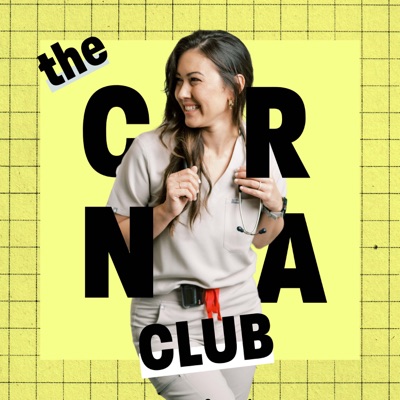
The CRNA Club Podcast
Subscribed: 17Played: 158
Subscribe

© Copyright 2026 Sachi Lord
Description
Wish you knew exactly what you needed to do to get into CRNA school? Need help coming up with a strategy to be a competitive applicant? You're in the right place! You'll get all of that and more when you tune into The CRNA Club Podcast with your host (and practicing CRNA) Sachi Lord. Her specialty? Breaking things down and turning them into bite-sized actionable steps and dishing the strategy you need to be a competitive applicant. Tune in, get inspired, and learn exactly what you need to do to check all the right boxes so you can get into CRNA school and join #thecrnaclub.
Here are a few topics we cover:
- Choosing the right CRNA program for YOU
- Figuring out what prerequisites you need
- What a typical day of a CRNA looks like
- How to pay for CRNA school
- Learning how to compare and contrast programs
- What makes a prepared applicant?
- Should you take the GRE?
- What certifications you NEED to get
- What not to do when submitting your application
- How to write a stand out resume
-How to calculate your GPA for CRNA school
- Personal essay Do's and Don'ts
- Shadowing a CRNA, how to find one
- Questions to ask the admissions committee
- Preparing for your CRNA school interview
- and more!
98 Episodes
Reverse

The oxygen hemoglobin dissociation curve shows how full hemoglobin is with oxygen at each oxygen pressure. We read the normal S-shaped curve, then see how heat, acid, CO2 and DPG slide it right, and how cold, alkalosis, low CO2, low DPG, fetal hemoglobin and carbon monoxide slide it left. From there we move to oxygen content and delivery, and finish with what a pulse ox reads and what it misses, including carbon monoxide and methemoglobin.
RESOURCES FOR THIS EPISODE:
Grab the free Oxygen Hemoglobin Dissociation Curve Study Guide
KEY POINTS:
Why the curve is an S: each hemoglobin carries up to four oxygen molecules, and binding the first makes the next easier
The flat top and steep middle: a PaO2 of 100 gives a sat near 97 or 98 percent, 60 gives about 90, and 40 gives about 75
Anchor points: a sat of 90 is about a PaO2 of 60, 75 is about 40, and 50 is about 27, the P50
Right shift causes: heat, acid, more CO2 and more 2,3 DPG, and the Bohr effect
Left shift causes: cold, alkalosis, low CO2, low DPG, fetal hemoglobin and carbon monoxide
Why the same sat of 90 sits on a different PaO2 in a hot, acidotic patient and a cold, alkalotic patient
Oxygen content: 1.34 times hemoglobin times the sat, plus 0.003 times the PaO2
A hemoglobin of 15 versus 7.5 at the same sat of 97 percent, and why delivery is cardiac output times content times 10
What the pulse ox measures, and why a sat of 100 on oxygen could be a PaO2 of 150 or 400
Hypoventilation on oxygen: the sat holds while the CO2 climbs
Carbon monoxide, co-oximetry and treatment with 100 percent oxygen
Methemoglobin, benzocaine, nitroglycerin and nitroprusside, and the pulse ox reading near 85 percent
FREE RESOURCES TO HELP YOU ON YOUR CRNA JOURNEY:
Transcript Analyzer - See your cumulative, science, and last-60-credit GPAs
9-Step Application Checklist - Work through the CRNA school application process in order
CRNA School Database - Search and compare CRNA programs
Certification Planner - Build a CCRN, CSC, or CMC study schedule around your shifts
Timeline Generator - Build a personalized CRNA application timeline
Try The CRNA Club free for seven days - Explore the all-in-one CRNA school application platform.
Follow The CRNA Club:
Instagram: @thecrnaclub
YouTube: The CRNA Club
Website: thecrnaclub.com
Share this episode with an ICU nurse preparing for CRNA school.
Sepsis and septic shock start with an infection and the body's dysregulated response to it. Sepsis is life-threatening organ dysfunction, a SOFA rise of 2 points or more from the patient's baseline. Septic shock is sepsis where the pressure and the cells both fail. Recognizing it early starts the one-hour bundle early. We follow sepsis down to the cellular level, then match each bundle step to the part of the blood pressure equation it treats.
RESOURCES FOR THIS EPISODE:
Grab the free Sepsis Study Cheat Sheet
KEY POINTS:
How sepsis is defined and how the SOFA score counts organ dysfunction
Septic shock: a pressor to hold a MAP of 65 or higher and a lactate above 2 millimoles per liter
The one-hour sepsis bundle, step by step
Why MAP equals cardiac output times SVR, and the three places sepsis lowers it
PAMPs, DAMPs, TLR4, nitric oxide, cyclic GMP and the glycocalyx
Venous pooling, capillary leak and septic cardiomyopathy
Microcirculation, mitochondria and why lactate rises
Cultures, antibiotics, source control and fluid resuscitation at 30 mL/kg
Norepinephrine, vasopressin, epinephrine, dobutamine and hydrocortisone
FREE RESOURCES TO HELP YOU ON YOUR CRNA JOURNEY:
Transcript Analyzer - See your cumulative, science, and last-60-credit GPAs
9-Step Application Checklist - Work through the CRNA school application process in order
CRNA School Database - Search and compare CRNA programs
Certification Planner - Build a CCRN, CSC, or CMC study schedule around your shifts
Timeline Generator - Build a personalized CRNA application timeline
Try The CRNA Club free for seven days - Explore the all-in-one CRNA school application platform.
Follow The CRNA Club:
Instagram: @thecrnaclub
YouTube: The CRNA Club
Website: thecrnaclub.com
Share this episode with an ICU nurse preparing for CRNA school.
The autonomic nervous system controls heart rate, blood pressure, airway size and secretions. It has two branches. The sympathetic branch is fight or flight and releases norepinephrine onto alpha and beta receptors at the organ. The parasympathetic branch is rest and digest and releases acetylcholine onto muscarinic receptors. Every ICU drip works at the transmitter, the receptor or the cell. We follow the signal from the brain to the organ, then tie each receptor to the drips you hang.
RESOURCES FOR THIS EPISODE:
Grab the free Autonomic Nervous System for ICU Pharmacology Study Guide
KEY POINTS:
How the sympathetic and parasympathetic branches differ
Transmitter, receptor, cell: the three steps behind every drip
Why one sympathetic signal reaches many organs while a parasympathetic signal stays local
Alpha 1, beta 1 and beta 2 in the vessels, heart and airways
M2 and M3, atropine, glycopyrrolate, albuterol and ipratropium
Phenylephrine, norepinephrine, epinephrine, dobutamine, dopamine, vasopressin and milrinone
Why the heart rate often drops on phenylephrine
Dexmedetomidine, beta blockers, diltiazem, adenosine and digoxin
FREE RESOURCES TO HELP YOU ON YOUR CRNA JOURNEY:
Transcript Analyzer - See your cumulative, science, and last-60-credit GPAs
9-Step Application Checklist - Work through the CRNA school application process in order
CRNA School Database - Search and compare CRNA programs
Certification Planner - Build a CCRN, CSC, or CMC study schedule around your shifts
Timeline Generator - Build a personalized CRNA application timeline
Try The CRNA Club free for seven days - Explore the all-in-one CRNA school application platform.
Follow The CRNA Club:
Instagram: @thecrnaclub
YouTube: The CRNA Club
Website: thecrnaclub.com
Share this episode with an ICU nurse preparing for CRNA school.
How to read an EKG comes down to five steps in the same order on every strip: rate, rhythm, intervals, axis, then ST segments and T waves. The first three steps read time. The last two read voltage and need a 12-lead. At 25 millimeters a second, one small box is 0.04 seconds. We finish by applying all five steps to one 12-lead EKG.
RESOURCES FOR THIS EPISODE:
Grab the free ECG and ICU Waveforms Cheat Sheet
KEY POINTS:
Rate: 300 divided by the big boxes between R waves, or 1500 divided by the small boxes when the rate is fast
Rhythm: find it by looking at the P waves
Spotting atrial fibrillation, atrial flutter, junctional rhythm, PACs and PVCs
Intervals: measure the PR, QRS and QT, and correct the QT to the QTc
Telling first-degree, Wenckebach, Mobitz II and third-degree block apart
Axis from lead I, aVF and lead II
Reading ST elevation, STEMI versus non-STEMI and T wave changes
A normal EKG: sinus rhythm at 60 to 100, PR 0.12 to 0.2 seconds, and an axis between negative 30 and positive 90 degrees
FREE RESOURCES TO HELP YOU ON YOUR CRNA JOURNEY:
Transcript Analyzer - See your cumulative, science, and last-60-credit GPAs
9-Step Application Checklist - Work through the CRNA school application process in order
CRNA School Database - Search and compare CRNA programs
Certification Planner - Build a CCRN, CSC, or CMC study schedule around your shifts
Timeline Generator - Build a personalized CRNA application timeline
Try The CRNA Club free for seven days - Explore the all-in-one CRNA school application platform.
Follow The CRNA Club:
Instagram: @thecrnaclub
YouTube: The CRNA Club
Website: thecrnaclub.com
Share this episode with an ICU nurse preparing for CRNA school.
The coagulation cascade is the chain of clotting factor steps which ends in thrombin. Thrombin cuts fibrinogen into fibrin, the mesh holding a clot together. The extrinsic and intrinsic pathways both meet at factor 10, and the PT and aPTT time how long fibrin takes to form after each pathway starts. We start with a question: why does a patient on Plavix bleed when the platelet count, PT and aPTT are all normal? Then we follow the cell-based model from injury to fibrin, and read each test and each drug against it.
RESOURCES FOR THIS EPISODE:
Grab the free Anticoagulation Cheat Sheet
KEY POINTS:
Extrinsic pathway: tissue factor plus factor 7 activates factor 10, and three plus seven equals ten
Intrinsic pathway: the order is 12, 11, 9 and 8, which also reaches factor 10
Common pathway: 10, 5, 2 and 1, with factor 13 cross linking the fibrin
Platelet adhesion, activation and aggregation, and how aspirin and clopidogrel block them for the 7 to 10 day life of a platelet
The cell-based model: initiation, amplification and propagation
Why missing factor 8 or 9 causes hemophilia bleeding
Antithrombin, protein C and plasmin as the brakes on clotting
How the PT, INR and aPTT work, with typical values of PT 9.5 to 12.5 seconds, INR 0.9 to 1.1 and aPTT 25 to 37 seconds
Heparin, enoxaparin, HIT and protamine reversal
Warfarin, vitamin K and four-factor PCC reversal
Direct oral anticoagulants, argatroban and Praxbind
FREE RESOURCES TO HELP YOU ON YOUR CRNA JOURNEY:
Transcript Analyzer - See your cumulative, science, and last-60-credit GPAs
9-Step Application Checklist - Work through the CRNA school application process in order
CRNA School Database - Search and compare CRNA programs
Certification Planner - Build a CCRN, CSC, or CMC study schedule around your shifts
Timeline Generator - Build a personalized CRNA application timeline
Try The CRNA Club free for seven days - Explore the all-in-one CRNA school application platform.
Follow The CRNA Club:
Instagram: @thecrnaclub
YouTube: The CRNA Club
Website: thecrnaclub.com
Share this episode with an ICU nurse preparing for CRNA school.

Comments

Download from Google Play

Download from App Store
 United States