


PODS by PEI
Subscribed: 37Played: 729
Subscribe


© Policy Entrepreneurs Inc.
Description
PODS by PEI is a podcast initiative of Policy Entrepreneurs Inc., a policy research center based in Kathmandu, that examines the state of Nepali politics, economy, and development and seeks to inform and enrich Nepal’s policy discourse. Every week, PODS by PEI brings to you thoughtful and in-depth discussions that will take you deep into the most pertinent issues in Nepal.
134 Episodes
Reverse
In this episode of PODS by PEI, Professor Alok Bohara joins PEI's Nirjan Rai and Saumitra Neupane to look past the March 5th polling numbers and examine the systemic decay of Nepal’s democratic guardrails.We dive deep into why Nepal’s institutions have collapsed three times since 1990 and how the current Gen Z movement is acting as a decentralized catalyst for institutional reform. From the "Extraction-Control Nexus" to the missing "Middle Corridor" of governance, this conversation is a masterclass in the structural reality of Nepali politics.In this episode, we discuss:(00:00) Intro: Beyond the Ballot Box(04:30) The "Extraction-Control Nexus" explained(12:15) Why Nepal’s institutions lack "memory"(22:45) Gen Z as an "Emergent" force in 2026(35:10) Building the Middle Corridor for future stability(45:00) Closing: Reform vs. ElectionsFollow Dr. Alok Bohara’s work:Read more on his Substack: Nepal UnpluggedStay Connected with PEI:Website: pei.centerTwitter/X: @Tweet2PEINewsletter: Of Policies and PoliticsLove the show? Rate us 5 stars on Spotify and hit the 'Follow' button to never miss a deep dive into Nepal's policy landscape.
Is the "Liberal World Order" officially over? 🌏In the season premiere of PODS by PEI, we dive deep into the seismic shifts of global geopolitics. As the "America First" doctrine evolves into what some call the "Donroe Doctrine," small states like Nepal find themselves navigating a "New World Disorder" where traditional safety nets are being dismantled.Our guest, Sagar Prasai, joins co-hosts Saumitra and Nirjan to dissect why the old masks of international law and human rights are peeling away, leaving behind a world of "naked interests." In this episode, we discuss:The End of Hegemony: Why a complete reversal of current U.S. political trends is no longer possible. Empires from Within: Understanding why empires collapse due to internal misalignment rather than external force. The "Donroe Doctrine": The pivot from global overextension to hemispheric dominance. Nepal’s Strategic Survival: How South Asian states must navigate the intensifying rivalry between a rising China and a flailing U.S. system. Multilateralism in Decline: What the dismantling of global institutions means for climate change, trade, and development finance. About the Guest:Sagar Prasai is a leading voice on regional geopolitics and a regular contributor to PEI’s research and discourse.Follow our work:Website: www.pei.centerYouTube: @peinepalTwitter: @Tweet2PEI
An introduction to PODS by PEI Season 3.
Ep#111
नेपालको संविधान जारी भएको नौ वर्ष पूरा भएको उपलक्ष्यमा पोड्स बाई पि.ई.आई.को आजको भागमा पी. ई. आई.का अविनाश कर्ण र तराई–मधेश लोकतान्त्रिक पार्टीका अध्यक्ष बृषेशचन्द्र लालबीच चैत्र २०, २०७९ मा कान्तिपुरमा प्रकाशित उहाँको लेख “नागरिकता विधेयकमा अनुचित अलमल” को सेरोफेरोमा रहेको संवाद पुन: प्रसारण गर्दै छौ| यस लेखमा अध्यक्ष लालले संविधानका शर्त पूरा गरी पारित भएको नेपाल नागरिकता (पहिलो संशोधन) विधेयक–२०७९ लाई कानुन बनिसकेको घोषणा गर्नुपर्ने र लोकतन्त्रवादी भनाउने राजनीतिक दलहरू, र समुहहरुले वर्षौंदेखि नागरिकतालाई राजनीतिक मुद्दाका रूपमा प्रयोग गर्दै सत्ता समीकरण बनाउने र नेतृत्वमा बसिरहन बिनाआधारको सिटबन्धन मात्र तिनका निमित्त पहिलो चासोको विषय रहेको भन्ने विचार र नागरिकता संग सम्बन्धित अन्तरवस्तुमा रहेर कुराकानी गरिएको छ|
If you liked the episode, hear more from us through our free newsletter services, PEI Substack: Of Policies and Politics ( https://policyentre.substack.com/welcome ), and click here ( https://patreon.com/podsbypei ) to support us on Patreon!!
Ep#110
Shuvangi Poudyal is a public policy researcher based in Kathmandu, with a focus on South Asia geo-economics, regional connectivity, and local governance. As the Program and Outreach Officer at PEI, she contributes to research projects like Infrastructure Diplomacy and RENT, while also coordinating programs and communicating findings through publications and an in-house host at PODS by PEI. Previously, she worked with Nepal-based think tanks such as CESIF and Governance Lab. Shuvangi holds a Master’s degree in International Relations from the University of Warwick, UK.
Khushi and Shuvangi delve into PEI’s latest publication Of Infrastructure Diplomacy and Development, a comprehensive study that examines the aid dynamics between Nepal and its key partners—India, China, and Japan, and others. A key contributor to the study, Suvangi provides insights into the geopolitical context shaping Nepal’s infrastructure landscape, the trends in aid and investment, and the public perceptions of different donors. We also exploresthe distinctions between DAC and non-DAC partners, their environmental and social impacts, and discuss recommendations for the Nepali government on navigating this complex terrain.
If you liked the episode, hear more from us through our free newsletter services, PEI Substack: Of Policies and Politics ( https://policyentre.substack.com/welcome ), and click here ( https://patreon.com/podsbypei ) to support us on Patreon!!
Ep#109
More than 15 years have passed since the end of the armed conflict between the Maoists and the Government of Nepal with the signing of the Comprehensive Peace Accord. While the country has done a remarkable job not recoiling back into the violent conflict with which it grappled for a decade, the years after have been slow and painful for the thousands of survivors who keep waiting for a justice that just won't show.
In this episode, PEI colleague Khushi sits with Jaya Luintel to highlight the harrowing stories of thousands of Nepali women who survived war atrocities and are still struggling to find justice and reparation for their losses. Recounting women's experiences during and after the conflict, the two explore gendered aspects of war and how the Nepali State has failed to cater to its female survivors.
Jaya is the co-founder of The Story Kitchen, where she works with women nationwide to empower them to share their stories by providing them with the skills and platforms to vocalize their issues and experiences to seek social justice. She has over two decades of working as a journalist and a development practitioner. She is currently pursuing her Ph.D. in Applied Conflict Transformation Studies.
The episode also features testimonies from some survivors themselves, which were retrieved from the archives of The Story Kicthen’s radio broadcasts.
Ep#108
Dr. Sameen A. Mohsin Ali is an Assistant Professor of International Development at the University of Birmingham. Her research focuses on the impact of bureaucratic politics on state capacity and service delivery. She is particularly interested in the dynamics of bureaucratic reform, the implementation and impact of donor programs, and the intersection of party politics, citizens’ interests, and bureaucratic incentives.
Exploring cases from Pakistan and Nepal, Sushav and Sameen delve into the dynamic relationships between politicians and bureaucrats. In doing so, they imagine bureaucracy in a decentralized context, discuss ways of navigating bureaucratic embeddedness, corruption, and efficiency, and explore how to plan bureaucratic reforms. The conversation offers a nuanced perspective on the complexities of governance and the critical forces that shape public administration in developing countries.
Like listening to PODS?
We’d love to hear your thoughts and reviews on Spotify, Apple Podcasts, YouTube, or wherever you listen to the show! You can also follow us on Twitter at Tweet2PEI, and on Facebook and Instagram at policyentrepreneursinc for updates on the latest episodes and share to help us reach more enthusiasts.
If you liked the episode, hear more from us through our free newsletter services, PEI Substack: Of Policies and Politics, and click here to support us on Patreon!!
#Ep.107
Purushottam Ojha is the former Commerce Secretary of Nepal and has extensive expertise in trade, transit, investment, private sector, and institutional development. Mr. Ojha has held key roles in public service since 1979 and has also served as a Trade Facilitation Consultant for The World Bank and Global Training Institute Development & Research, providing strategic advice on trade negotiations and capacity building.
Lasata and Purushottam’s discussion centers around the longstanding trade relationship between Nepal and India, guided by the 1950 Treaty of Peace and Friendship. Ojha shares his insights on how historical trade arrangements have shaped Nepal's economy and the ongoing challenges and opportunities in this bilateral relationship. From tariff regimes to non-tariff barriers, this episode offers a comprehensive look at Nepal-India trade dynamics and the future of this crucial partnership.
If you liked the episode, hear more from us through our free newsletter services, PEI Substack: Of Policies and Politics, and click here to support us on Patreon!!
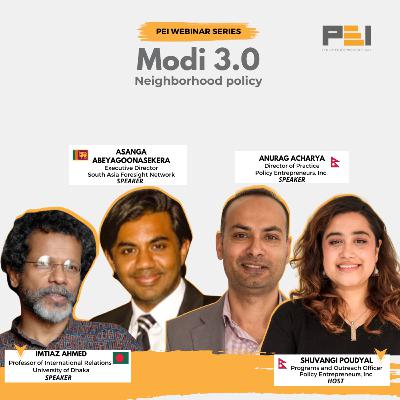
PEI- Modi 3.0: Is neighborhood still first?
Unpack the evolving India-South Asia dynamic as Modi enters his third term as Prime Minister.
PEI brings a curated panel of experts from India, Nepal, Sri Lanka, and Bangladesh to dissect the regional shifts for a can't-miss panel discussion.
The conversation is a part of the PEI Webinar Series on Managing India, China, and the US.
If you liked the episode, hear more from us through our free newsletter services, PEI Substack: Of Policies and Politics, and click here to support us on Patreon!!
Shradha is the Research Coordinator at the Centre for Social Change (CSC) focusing on Nepal's natural resources, climate governance, and environmental peacebuilding. Recently, she co-authored an article titled "Understanding the Interrelations Between Natural Resources and Development Governance in Federal Nepal." She has a Master’s in Humans and Natural Resources from Kathmandu University.
Khushi and Shradha discuss historical and contemporary conflicts concerning natural resource governance in Nepal. They focus on the significant shifts brought by Nepal's transition to a federal structure, the challenges of a centralized mindset, and the lack of clarity in roles among federal, provincial, and local levels. Shradha also explains key governance conflicts, environmental and human-wildlife security impacts, and her research on the Resource Curse theory.
If you liked the episode, hear more from us through our free newsletter services, PEI Substack: Of Policies and Politics, and click here to support us on Patreon!!
अब जारी: पि. ई. आईको गभर्नेन्स टिमका ३ जना सहकर्मीहरु - जनक पोख्रेल, अविनाश कर्ण र सुशभ निरौला, गत महिना फिल्ड भिजिटमा कोहि कर्णाली त कोहि लुम्बिनी पुग्नुभएको थियो | आजको भागमा उहाँहरुले नेपालको गभर्नेन्स स्पेसमा गरिरहनु भएको अध्ययन अनुसन्धान र त्यसै क्रममा देशका विभिन्न ठाउँमा पुगेर विभिन्न क्षेत्रका मान्छेसँग अन्तरक्रिया गरेर, सुनेर, सिकेर, बुझेर आएका कुराको छलफल र समिक्षा गर्नुभएको छ | उहाँहरुले नेपालमा संघियता कार्यन्वयन र त्यसमा पनि विशेषगरी प्रादेशिक सरकार र त्यस अनतर्गतका विभिन्न संरचनाहरुको कार्यसम्पादन र तिनलाई संघिय र स्थानीय सरकारले हेर्ने दृष्टिकोणका साथै, बृहत्तर जनसमुदाय र अन्य सरोकारवाला संस्थाको प्रदेश सरकारसंगको अनुभबका बारेमा समिक्क्षात्मक बिस्लेशन गर्नुभएको छ |
आजको भागका ३ जना सहकर्मीहरुमा जनक पोख्रेल Research Officer को रुपमा, अविनाश कर्ण Sub-National Programs Coordinator को रुपमा र सुशभ निरौला Researcher को रुपमा पि. ई. आईमा आबद्ध हुनुहुन्छ | उहाँहरुको अनुभव र काम बारे थप जान्न तपाइले हाम्रो वेबसाईट pei.center भिजिट गर्न सक्नु हुन्छ |
हामी आशा गर्दछौँ तपाईंलाई आजको संवाद फलदायी लाग्नेछ !
Namaste and Happy Pride Month!
The pursuit of marriage equality in Nepal has experienced both progress and setbacks over the last 15 years. In 2008, the Supreme Court ruled in favor of full rights for LGBT individuals. However, significant delays followed, with temporary registration of same-sex marriages only beginning in 2023. A year later, in April 2024, Nepal finally legalized same-sex marriage nationwide. Although this marks substantial progress, with lingering legal ambiguities and the urgent need for broader social acceptance, Nepal has a long way to go.
As we are at the end of Pride month, for today's episode, we are rebroadcasting a conversation between former PEI colleague Tsedon Kansakar and Sunil Babu Pant on marriage equality in Nepal. They discuss Pant's firsthand experience with the landmark 2007 case Sunil Babu Pant and Others V. GoN, which sought equal marriage rights. They also explore the broader significance of marriage equality for human rights, society, and the economy.
Sunil Babu Pant is the founder of the Blue Diamond Society, an LGBTQ rights organization in Nepal, and Asia's first openly gay national legislator. As a member of parliament, he championed equal justice, civil, and economic rights for the Queer community. He led the landmark Supreme Court case that decriminalized homosexuality and recognized a third gender in Nepali citizenship. Now, he continues to advocate for these causes as an activist.
We hope you enjoy the conversation!
If you liked the episode, hear more from us through our free newsletter services, PEI Substack: Of Policies and Politics, and click here to support us on Patreon!!
#Ep.102
Soni Thapa, a professor at Humber College in Toronto, holds a PhD in Sociology and an MA in Women's Studies. Her research focuses on gender equality, violence against women, race, ethnicity, and immigration. She recently published "The Nepalese Diaspora and Adaptation in the United States" in the Journal of Genealogy (2024). Soni is the executive director of a non-profit empowering rural women in Nepal and president of the Nepali Women's Global Network, USA.
Nirjan and Soni explore the history and current status of the Nepali diaspora in the U.S. They detail migration trends and community categories, examining cultural, structural, marital, identificational, and receptional adaptation. They highlight key findings from Soni’s study and discuss future research recommendations for better understanding and tapping into the potential of the Nepali diaspora.
If you liked the episode, hear more from us through our free newsletter services, PEI Substack: Of Policies and Politics, and click here to support us on Patreon!!
The practice of preparing an annual budget dates back to 1951, right after Nepal’s political transition that led to the end of the Rana regime in the country. Subarna Sumsher, the finance minister then, had publicly announced an outlay of NPR 50.25 million. The political context of the country then was such that the budget was not presented in the Nepali parliament but announced via Radio Nepal. It was only much later, in 1959, that a budget was first presented to the Nepali parliament.
Nepal’s budgetary practice has evolved over the years, but it continues to hold significance, and with some fanfare. What is the day like? Picture this: the Finance Minister walks to the podium with a document briefcase wrapped in a red ribbon. Anticipation and excitement fill the air as people eagerly await to hear what's included or excluded in the budget.
If you liked the episode, hear more from us through our free newsletter services, PEI Substack: Of Policies and Politics, and click here to support us on Patreon!!
#Ep.100
Sudeshna Thapa is a human rights lawyer and holds an LLM in International Human Rights Law from Lund University, Sweden. She is currently working as Research Coordinator at Social Science Baha, where she is involved in research on a range of issues including gender and social inclusion, minority rights and labour migration. She has previously worked as Research Assistant to the UN Special Rapporteur on Human Rights and Toxics.
Khushi and Sudeshna discuss majoritarianism in Nepal and recounting its historical and contemporary manifestations. They explore the illusive nature of Nepali majoritarianism as it persists and grows despite despite multiple efforts like electoral reforms. The conversation also explores effects on marginalized groups, and the role of social institutions in perpetuating it and considers future scenarios for creating a more inclusive society in Nepal.
If you liked the episode, hear more from us through our free newsletter services, PEI Substack: Of Policies and Politics, and click here to support us on Patreon!!
With: Host Deependra Chaulagain and guests Dipendra Jha and Khim Lal Devkota
Despite the significant achievement of federalism in Nepal's political transition, it faces criticism for its financial costs, perceived inefficiencies, and corruption. Reflecting on these challenges, Project Sambaad hosted Khim Lal Devkota and Dipendra Jha in a panel discussion moderated by Deependra Chaulagain. The session, which exceeded its allocated time, examined Nepal's commitment to federalism, considering both its triumphs and the ongoing criticisms. The conversation provided a platform for deep insights into the future of federalism in Nepal.
We hope you enjoy the conversation.
You can find the full conversation with audience interaction on YouTube at Policy Entrepreneurs.
To sound out your thoughts and reflections join the conversation on LinkedIn, Instagram, and Twitter, all @projectsambaad.
#Ep.098
Riya Sinha is an Associate Fellow at the Centre for Social and Economic Progress (CSEP) in New Delhi, where she coordinates the Sambandh Regional Connectivity Initiative and co-manages the Sambandh Policy Dialogue. Her research focuses on regional economic connectivity in South Asia, covering trade, logistics, infrastructure, and border management. In 2022, she was a Visiting Fellow at the Stimson Center in Washington DC and a Fellow at the Asian Forum on Global Governance. Previously, Riya worked at the Bureau of Research on Industry and Economic Fundamentals (BRIEF), conducting research on regional trade, supply chains, and trade facilitation.
Shuvangi and Riya reflect on a decade of India's 'Neighbourhood First' policy since its inception in 2014. They discuss India's initial focus, strategic adjustments in response to China's Belt and Road Initiative, and regional expectations for enhanced connectivity and cooperation, including the potential revival of SAARC. Riya highlights new connectivity projects with the Middle East and Europe, economic cooperation with Nepal, especially in the energy sector, and collaborative initiatives with the U.S. She advocates for prioritizing funds and manpower for India's neighbors to achieve its 'Vishwa Guru' ambitions and emphasizes incorporating a feminist dimension into the policy.
If you liked the episode, hear more from us through our free newsletter services, PEI Substack: Of Policies and Politics, and click here to support us on Patreon!!
#Ep.097
Shabda is the Investment Director and a partner at Dolma Impact Fund, the largest private equity fund focused on Nepal. He leads the investment team at Dolma, overseeing deal origination, transaction execution, regulatory approvals, and post-investment management. He is actively involved in sectors such as healthcare, renewable energy, and technology . He holds a B.A. in Economics from Colorado State University (CSU) and an MBA in Sustainable Entrepreneurship from the same institution.
Pragati and Shabda discuss Nepal’s investment sector with a special focus on the market for bonds. They observe the dominance of equity-based investments and explore alternative FDI mechanisms, and the potential of green bonds for financing renewable energy projects. Drawing from his observations, Shabda shares insights on the restrictiveness of Nepal's bond market and Nepal’s weak credibility in this scene.
If you liked the episode, hear more from us through our free newsletter services, PEI Substack: Of Policies and Politics, and click here to support us on Patreon!!
With: Host Anup Upreti and guests Samikshya Rai and Shabda Gyawali
The difficulties are endless for doing business in Nepal but every entrepreneur present in the session spoke of the untapped potential in Nepal. There are opportunities for growth and to take Nepali products to a global market. However, there are impediments for growth.
In this session moderated by Anup Upreti, corporate lawyer and managing partner at Pioneer Law Associates, the conversation highlights the joys and difficulties of doing business in Nepal. He is in discussion with Samiksha Rai, CEO of Pack My Lunch and Shabda Gyawali, the investment director of Dolma Impact Fund. In the audience, were several entrepreneurs who added to the conversation on the challenges of navigating Nepali society and bureaucracy while doing business in Nepal.
You can find the full conversation with audience interaction on YouTube at Policy Entrepreneurs.
To sound out your thoughts and reflections join the conversation on LinkedIn, Instagram, and Twitter, all @projectsambaad.
#Ep.095
Nirjan is a researcher with over 20 years of experience of designing, managing, and leading analytical studies in Nepal and the United States. He specializes in political economy analysis and has examined critical reforms in the electricity sector, water governance, and geopolitics. Nirjan is the primary author of the recent PEI report “Pen, Power, Politics: How China and India wield soft power through education diplomacy in South Asia.
Nirjan and Shuvangi discuss the strategic use of education diplomacy by China and India in the South Asia region, drawing insights from his research. They explore how both countries leverage educational initiatives as a tool of soft power to extend their influence, defining soft power and emphasizing the significance of "education diplomacy." We review India's evolving educational diplomacy, highlighting its "neighbor first" approach, and China's initiatives to internationalize its higher education system and the growing appeal of Chinese universities in the region. They also consider competing perceptions about Chinese and Indian education diplomacy, contrasting these with Western strategies, explore the future dynamics of geopolitical influence through education.
Find more about us on our official website and for more video related content, find us on Youtube .
If you liked the episode, hear more from us through our free newsletter services, PEI Substack: Of Policies and Politics, and click here to support us on Patreon!!

Comments

Download from Google Play

Download from App Store
 United States