DiscoverThe Story of London
The Story of London
Claim Ownership

The Story of London

Author: Saul

Subscribed: 79Played: 1,623
Share

Description

Welcome to The Story of London, a podcast dedicated to telling the history of London as a single narrative tale; from its birth until the present day.

Each episode takes us along that tale, a chronicle of the most fascinating and vibrant city on Earth.

There is a lot of content in here and each listener can enjoy it in a variety of ways. You can listen to an episode by itself for a slice of life from London’s past; or, if you have a favourite period of time you want to explore, find the era and follow the Chapters in that section.

Or maybe you want to join us on the grand journey, starting at the beginning and following along? Whatever option, welcome to the chronological tale of this amazing place.

The Story of London covers events as they happened, from the actions of the great and the good, down to those of the poor and marginalised. We try to be as historically precise as possible, sometimes stumbling upon little gems of history that change the way we see the past, and never take ourselves too seriously.

Feel free to join us… new episodes every week.
193 Episodes
Reverse
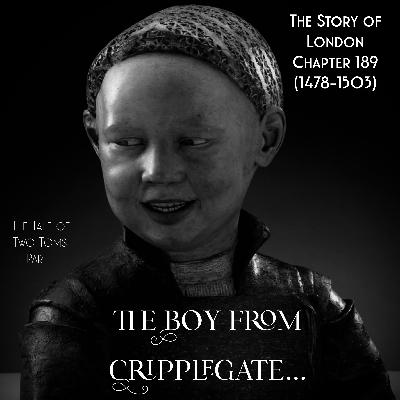
We take a pause in our narrative to go back a few years to look at the childhoods, and backgrounds of two men from London- both called Thomas, both growing up in and around London (even if their experiences were very different) and both would go onto have huge impacts into the story of the city and the politics of Henry VIII.This then is the story of Thomas More, and Thomas Cromwell, whose stories were to illuminate life in the city; its passions, its shadows, the smallness of it all, and also how experiencing it could shape a young mans life. This then is the tale of the two Toms…Cover shows ‘A laughing boy’, by Guido Mazzoni, c.1498.
The opening years of the reign of Henry VIII were quite paradoxical; for a king who would become known as a radical, a man who changed the nation so completely as he did, the first years of his reign represented something else- a return to more traditional ways of doing things. This week we examine why London would have felt that especially so, while also covering the first major policy decision of the young kings long reign- why he suddenly decided to marry Catherine of Aragon, when by all accounts he was under no obligation to do so.Cover includes detail from ‘Portrait of Lady Margaret Beaufort’
Henry VII was dying… but as the first Tudor monarch slowly drifted towards death, in London the city was stilled gripped by the terrible regime of his loyal lapdog, Edmund Dudley. As the kings health began to decline, the arrests continued, the terror remained, but around him, various figures, from the desperate Catherine of Aragon, to the kings elderly but wise mother, began to sense the growing anger towards the regime, and made careful moves to make sure the correct scapegoats were prepared.This week we follow the incredible transformation of young prince Henry, the intricate politics of the court, London surviving oppression and epidemic, and the final retribution inflicted upon those chosen to take the fall for the late King’s folly’s.Cover shows the terracotta portrait bust of Henry VII by Pietro Torrigiano.
In the second part of ‘The Spanish Gambit’ we start to draw together the diverse threads of this story- Henry VII’s changing foreign policy ambitions, the ambitions of the Hapsburgs, the desperation of Catherine of Aragon, the Pope’s fury at the Alum smuggling network, the power of the Italians in the capital and above all… Edmund Dudley’s onslaught against London itself. With elections being nullified, innocent men and women being locked up for no good reason, with a cohort of some of the seediest criminals now seemingly dominating everyone from the mayor down, the city was plunged into an era of darkness it had not seen for hundreds of years. The Spanish Gambit had dark implications for London…Cover art includes detail from “Portrait of Maximilian I, Holy Roman Emperor”
Towards the end of his reign, Henry VII really came into his own; he stood as a giant on the European stage, a player in THE most dynamic and profound change in European politics in decades, poised to strike down his enemies and ensure his dynasty was cemented into the high seat of European politics… but how did he do it?What follows is the opening part of a story involving corrupt popes, holy cartels, dodgy Italians living in London, dubious Spaniards, an eager but devout heir to the throne, and one of the most lucrative smuggling operations of the era, all of which has Henry VII right in the heart of it. Welcome to the first part… of The Spanish Gambit.Cover features portrait of Pope Julius II by Raphael.
In the dying years of the reign of Henry VII, some big changes happened, which London witnessed and had to cope with. This weeks chapter covers quite a lot- what happened to Catherine of Aragon when she was staying in London after her first husband died? How the city witnessed the growing power (and occasional ineptitude) of Henry VII’s spy networks? Why Catherine of Aragon and Prince Henry ended up getting engaged down on Fleet Street? What caused the King to briefly shut down the sex trade in the city? And how a London based lawyer, living near the London Stone, unleashed a new wave of terror in the name of the King?Cover contains a detail of a picture of Henry VII, Edmund Dudley and Richard Epsom.
The five years at the start of the 16th century are often overlooked, but contain elements in the city’s story that cannot be ignored- new rituals that last to this very day, new buildings and palaces that still stand, an epoch defining shift in the politics of London, and two royal deaths… an period defined by a river of light on a dark February afternoon.Welcome as the story completes the tale of a small man we first met seven chapters ago, and how unexpectedly the very future of the Tudor dynasty was briefly in the balance…Cover includes a detail from the portrait of Elizabeth of York, in the Royal Collection.
We return to the Story of London was a telling of the marriage celebrations of Catherine of Aragon and Arthur, Prince of Wales. The most glorious, elaborate, and expensive ever held during the reign of King Henry VII… and the most majestic celebration London had ever seen. An episode filled with pageantry, pomp, ornate theatrical street shows, wild jousts, and a man made mountain on wheels! Welcome to the explosion of the Volcano of love…Cover features an adjusted portrait of Catherine of Aragon by Michiel Sittow.
The Story of London takes a brief break from the usual narrative, to examine the sudden spate of cross-dressing women who appeared in the records of the early Tudor London courts. Who were these women who dressed as men? Why did they do this? What insights does it give us into the mindset (and the sex lives) of London and Londoners? A fascinating slice of Tudor London’s life…Cover art includes a section of ‘Portrait of a boy’ by Piero di Cosimo, painted sometime in the 1490’s.
In 1497 a veritable army of about 15,000 men from Cornwall turned up in south London, intent on bringing violence to the City. What follows is a grand tale of the queen deliberately remaining in the city, the Aldermen arming themselves to the teeth, and the campaign that followed. Along with this we examine three years where the King’s health took a sudden turn, the career of Perkin Warbeck came to a bloody end, trade CONTINUED to be a complicated mess for London’s merchants, and much more. From decaying public landmarks, to royal palaces burning to the ground, to the ritual of bloody executions, welcome to London here at the final years of the 15th Century.
The events and odd circumstances regarding the strange royal pretender to the throne of England, Perkin Warbeck, are often overlooked, and dismissed, rightfully, as a minor footnote in the grand saga of the Tudor dynasty. However at the time, it reveals a regime in crisis- a crisis that was to force London to have a front row seat, and which started many themes that are going to repeat themselves in the cities story to come… the rise of the use of spies, Tudor entanglement in Ireland, complicated trade situations and above all, the Tudors using their family for political purposes, all really begin now in these few years, as London continued to annoy King Henry VII.Cover shows detail of ‘Saint Sebastian’ by Lorenzo Costa, c.1490’s
In 1493 a young german found himself involved in what was a seemingly minor affair, caused by an incident with a young woman, and a slight sexual scandal. But this incident played out as London was seething with anti-German sentiment and anger; people were being laid off, wages were being cut, fortunes were suddenly being lost and because of the actions of a small bunch of powerful and great men 9and also the actions of a young con-man pretending to be the Duke of York), London was to find itself dealing with violent riots, armed men on the streets and an international incident on Thames Street!Join us as we discover how a small incident involving a rich German merchant, a young female servant and her employer illustrates the growing conflict between King Henry VII and the City of London…Cover includes a detail of ‘Portrait of a Man’ by Andrea Solari (c1490)
The story returns for a brief moment outside the normal timeline to ask ourselves some crucial questions- here, at the start of the Tudor age, what was the prevailing mindset of the Londoners of the period? How did they conceptualise themselves and a world that was brutal compared to our own conditions? How did they fundamentally differ from people living today? An important set of questions because it will hopefully help explain everything that is to come.A deep dive into attitudes towards health, diet, grief, alcohol, risk assessment and faith.Cover shows a detail of ‘Venus and Mars’ by Sandro Botticelli, c.1485
Welcome to the Age of the Tudors… and we begin with an busy episode filled with Henry VII’s immediate impact upon the city, a epidemic killing thousands and two Mayors, a marriage of a Mercer that reveals hidden insights into life in London, the formation of the Beefeaters, and why the merchants of The City and the new King, found themselves getting off on the wrong foot… all of this and more to be found in this weeks Chapter.Cover contains a detail of “A Young Man,” painted ca. 1490 by Andrea Solario.
Covering the reign of Henry VII, all the way to the death of his granddaughter, Elizabeth I, the 6th Book of the Story of London is an immense dive into the life of the city- its people, its events and its ever changing face. W wild and detailed account of life in London, where some of the residents were to embed themselves into our very national consciousness, and where the children of poor residents were to rise to the highest levels of society. A wild and fascinating journey lies ahead… welcome then to Book 6 of The Story of London- Glorianna!Cover features the ‘Whitehall Mural’ by van Leemput, after Hans Holbein the Younger, 1667
And this is it… a bumper Chapter as we focus on the event that was to change the history of London irrevocably; how the hell a complete non-entity like Henry Tudor was able to suddenly and dramatically take the throne of England; and along the way, have London witness an amazing local woman with impressive powers of reinvention; arguably the most awkward statement ever made by a king in the cities history, and the prototype of all future pushy showbiz mothers… Book 5 of The Story of London, concludes with the final twist in the Wars of the Roses.
The Wars of the Roses began their final spasm, and in this chapter we explore how Richard, Duke of Gloucester, Lord Protector of England, sitting in the mansion of a rich London Grocer near Bishopsgate, would, over a series of a few weeks, turn into Richard III, King of England. But more than the traditional narrative, it is an exploration of London in those weeks- what did they hear, what did they see, and above all, how did they respond. From mobs pouring into Westminster Abbey, to a significant moment of silence in the Guildhall, from crowds listening in stunned silence around St Paul’s Cross, to cheering the coronation, London witnessed and partook in all events. How loyal were they to this man? Were they indeed, as Shakespeare later called them, his ‘duteous citizens’? Cover contains a detail of The Princes in the Tower by John Everett Millais (1878).
A bumper episode that sees London suffering a fresh outbreak of the plague, Banks collapsing, cheeky church robbers, the sordid details of Edward IV’s lovers (including his London born mistress), and the sudden and dramatic shift in politics… the King dies, a coup is pulled off and then a counter coup, all done seemingly with the consent of London. But as Richard, Duke of Gloucester emerges as the main power in England, sat in a Grocers resplendent mansion over by Bishopsgate, he finds himself contemplating if he is about to commit the sins of father once again… Cover art ‘A Man and his Grandson’, ca. 1490 (Domenico Ghirlandaio) (1449-1494) Musée du Louvre, Paris
The events of the Wars of the Roses caused many changes in England, but the impact upon the economic and political landscape of London, is often overlooked. This episode, we take a short break from the nobles, the King, the intrigues of the Houses of York and Lancaster, to just look at what was happening in London and on its streets at the time… and also how forces beyond anyones control, changes in population, in wealth distribution, in social mobility, and wider forces of economic changes across Europe, saw that the most political powerful of all the Guilds of London to date, the Grocers Company, stumbled, and then fell from the dominant position they had once held. This then examines why we feel we are passing out of the medieval world and into something new- a new world being born before our very eyes.
The Roses of the Roses SEEMED to be over; and King Edward IV began to consolidate his rule over the land. What follows are 9 years where London begins to try and regain its equilibrium while Grocers and mercers fall out over who stands where in St Paul’s, where we examine the much overlooked ‘other’ duties of the cities Sargent-at-Arms; where suddenly the Hundred Years War seems to be starting again, and where the young and energetic Edward IV seems to turn from a eager young warlord, into a fat, vicious and dangerous spider… bringing order even at the cost of his close family.
loading
Comments 
loading