


 Claim Ownership
Good Disruption
Subscribed: 15Played: 59
Subscribe

© Copyright Rector and Visitors of the University of Virginia. All rights reserved.
Description
”Good Disruption” is a lively discussion between UVA Darden School of Business Professors Mike Lenox and Yael Grushka-Cockayne on cutting edge technologies and practices that are challenging the status quo. They then make their personal call on whether this is a good disruption, bad disruption, or actually no disruption.
34 Episodes
Reverse

The COVID pandemic forced people to work from home and left many questioning the value of going back into the office. Employee surveys suggest that most workers want to retain some form of remote work, either full-time or hybrid. In response to this shift, large companies like Twitter, Slack, and Salesforce have announced new hybrid work plans. It seems that fully working on-site is a thing of the past.
There are many emotional, societal, and environmental benefits to remote working. No longer are employees tied to city centers with higher costs of living and reduced travel will lower greenhouse gas emissions. There are also benefits to companies, with some research suggesting that remote workers are more productive. Yet, challenges like Zoom fatigue and team collaboration exist. How do organizations navigate this new normal?
Mike and Yael speak with Roshni Raveendhran, Assistant Professor of Business Administration at UVA Darden. Roshni's research focuses on understanding the future of work. She examines how technological advancements influence organizational actors, workplace practices and the management of employees. In doing so, she develops insights about how organizations can effectively integrate novel technologies into the workplace to manage their employees and address the changing nature of work.
Be sure to follow us on Twitter @TalkDisruption.
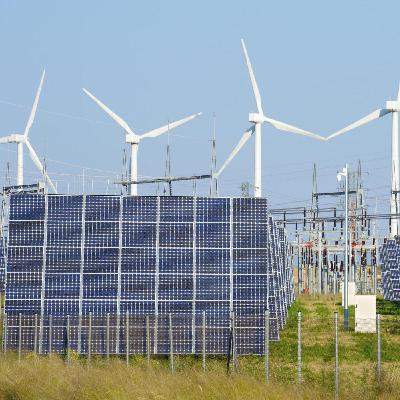
One quarter of greenhouse gas emissions in the US is attributed to electricity production. Greening the grid is critical to our ability to decarbonize the economy and after decades of investment and technology improvements we are finally at a tipping point with renewables. Utility-scale solar and wind power are cost-competitive with natural gas even without incentives. Renewable energy sources now account for more than 20% of electricity generation.
Yet, challenges exist to broader adoption, including the need for a massive build-out of energy storage on the grid. What policies and actions are underway to overcome these barriers? How might other clean technologies like green hydrogen and geothermal play a role in decarbonizing the US grid?
Mike and Yael speak with Sandy Reisky, Founder and Board Member for Apex Clean Energy.
Be sure to follow us on Twitter @TalkDisruption.

Twitter co-founder Jack Dorsey’s first tweet – "just setting up my twttr" – sold for more than $2.9 million. Bored Ape Yacht Club digital art pieces fetch just over $100,000. NBA Top Shot sells digital NBA moments for millions of dollars. Non-fungible tokens, or NFTs, are making this possible. But is it more hype than reality?
In previous episodes we explored the phenomenon of algorithms creating art and music and touched on the idea of NFTs representing personal data. In this episode we dig deeper into the growing NFT market. Will NFTs be more broadly adopted or limited to the wealthy? What are the potential negative externalities associated with using NFTs, such as energy consumption, malicious behavior, and equal access?
Mike and Yael speak with Dennie Kim, Associate Professor of Business Administration at UVA Darden. Dennie’s research examines the design and performance of whole organizational networks, and the emergence and evolution of new industries. His current work examines multiple contexts, including disparities in healthcare delivery, healthcare reform, whisky, and blockchain applications, including NFTs.
Be sure to follow us on Twitter @TalkDisruption.
Deepfakes once used purely for entertainment purposes are becoming more pervasive on social media and, in some alarming cases, more sinister. Take last year’s video of Ukrainian President Volodymyr Zelenskyy where he appeared to tell soldiers to surrender to Russia. The video underscores the potential damage that deepfakes could cause if there are not protections in place.
Yet, there are also benefits from automation in content generation. The use of deep learning algorithms like GPT-3 offer the ability handle, manage, release, and edit more content over time. But there is also a danger that comes with this automation. We could find ourselves in a world where most of the content being consumed on the internet daily is created by fewer and fewer people and companies. Do the benefits outweigh the risks? How do policymakers protect people from the dangers of misinformation?
Mike and Yael talk with Dr Tom Chatfield (@TomChatfield), a British author and tech philosopher. Tom’s non-fiction books explore digital culture, including How To Thrive in the Digital Age (Pan Macmillan).
Be sure to follow us on Twitter @TalkDisruption.

Here on the Good Disruption podcast we talk a lot about technologies, but what about the person behind the disruption? To tackle wicked problems like climate change, not only do we need innovative technologies but also, innovators who introduce solutions that benefit society more broadly. What makes a good disruptor? How can we move the needle on climate change? Mike and Yael talk with Chrissa Pagitsas (MBA ’09), Laure Katz (GEMBA ’16) and Chanceé Lundy Russell to discuss these and other questions around sustainability during UVA Darden’s 2022 Women in Leadership Summit.

Mike and Yael catch up with Darden Professor Tim Laseter following his trip to the Consumer Electronics Show in Las Vegas. From robots to beauty tech to smart glasses, the show features the latest in cutting edge new tech. What’s new, scalable, or hype?
Our fourth season kicks off with a mini course on disruptive innovation. What is it and what are the markers of a major technological shift? Mike and Yael give a brief Disruption 101 and explore whether disruptions are inherently good or bad, considering both the immediate negative effects and the long-term positive outcomes. They also discuss the role of government, venture capital, and other stakeholders in fostering innovation.

As we end our third season, Yael and Mike reflect on the disruptive technologies explored over the last year. It was an interesting mix of good, bad, and no disruption calls. Do they feel the same now about disruptive potential that they did when each episode first aired? What’s coming in 2026? Don’t miss this recap and send the Good Disruption team your ideas at duffr@darden.virginia.edu.

Large language models (LLMs) offer powerful opportunities for automation, creativity, and knowledge access. With 800 million people using ChatGPT alone, LLMs are drastically changing the way we interact and operate as a society. No question, this is one of the biggest disruptions of our lifetime; but is it a good one?
We’re LIVE from DC Tech Connect, Batten Institute’s flagship tech event that brings students and alumni together to talk about digital tools and career paths. In this episode Yael and Mike explore LLMs with Dr. Ronnie Chatterji, OpenAI’s first Chief Economist. Chatterji is also the Mark Burgess & Lisa Benson-Burgess Distinguished Professor of Business and Public Policy at Duke University and has held previous roles with the Biden and Obama Administrations.

Imagine ordering food from Door Dash and it’s delivered to your doorstep within minutes, not by a driver, but a drone. For residents in Dallas-Fort Worth suburbs, this became reality this past summer. And customer delivery isn’t the only industry being disrupted by drones. From precision agriculture to precision battlefield strikes, the use of unmanned aerial vehicles (UAVs) is changing the game.
Mike and Yael talk with Mark Hahn (MBA ’20) a career Naval Aviator and previous operations lead for drone start-up company Zipline about the UAV landscape and the pros and cons of using this technology.

Serena Williams recently made headlines for her promotion of GLP-1 medications. The tennis super star is one of a growing list of celebrities turning to GLP-1s, drugs originally developed to treat patients with Type II diabetes and obesity, to help with weight loss.
Off-label use of these medications is rapidly expanding, disrupting a fitness industry built on helping people lose weight. In May, Weight Watchers filed for bankruptcy. Questions also loom over any long-term disruptions to the human body.
Mike and Yael talk with Dr. Sandhya Chhabra (MBA’17) about the benefits, cautions, and unknowns surrounding the drug that is making headlines and changing lives. Dr. Chhabra led an endocrinology practice for 20 years and is currently a Senior Medical Advisor for Springbok Analytics.

AI requires data, lots of it. Tech companies are rapidly building new data centers to house it, which will require massive amounts of electricity. How do we power them and stay on track with our emission reduction goals?
An unlikely candidate is emerging – nuclear energy. But it’s not the reactor of the 60s that is being built. Small modular nuclear reactors are dispatchable, site-flexible, and safe but can they overcome the regulatory, financial, and public perception hurdles to more broadly scale?
Mike and Yael speak with Stephen Leff (MBA '20), a Project Manager at BWX Technologies and expert in nuclear energy sources about the promise and challenges of this clean tech solution.

If you ask Marvel Comics fans about quantum physics, they might reference time travel, multiverse, quantum realm, and Dr. Strange. Ideas of science fiction. Yet, for decades we have used quantum physics to power MRI machines, solar panels, and lasers. More recently, big tech companies have entered a race to quantum supremacy, where quantum computers surpass silicon-based super computers in speed and complex problem solving. But what is it?
You won’t want to miss this Quantum 101! Mike and Yael have a fascinating discussion about quantum computing with Joab Rosenberg, Founder and General Partner of QBeat Ventures, a venture capital fund that specializes in early-stage investments in quantum technologies.

Imagine testing a new medical device without putting someone on an operating table. Or experimenting with new autonomous capabilities without placing a car on the road.
Computer simulations have been used for decades to predict outcomes but now, digital twins create virtual environments that not only mirror their real-world counterparts but respond to real-time data to yield more confident decision making.
Yael and Mike discuss digital twins with UVA Darden Professor Sam Levy, Assistant Professor of Business Administration at Darden. Levy holds a Ph.D in Marketing from Carnegie Melon and his dissertation introduces a novel concept of “digital marketing twins” to better understand individual-level customer satisfaction.
Look for new episodes of Good Disruption on the first Monday of each month!

From Wall-E and the Iron Giant to I Robot and Terminator, Hollywood has portrayed robots as friendly and misunderstood but also a technology to be feared if left in the wrong hands. Society has been fascinated with the idea of robots, ever since the term was introduced in the 1920s science fiction play “Rossum’s Universal Robots”. Today, humanoid robots are being designed not only to carry out simple tasks but also, display a broad range of emotions and react to people in real-time. But just because we can build it, should we?
Yael and Mike are joined on this episode by Professor Frank Li, an Assistant Professor of Management Information Systems at the UBC Sauder School of Business, a digital fellow at Stanford University Institute for Human-Centered Artificial Intelligence Digital Economy Lab, and a visiting fellow at NYU Stern Center for the Future of Management. Professor Li’s research stands at the nexus of the economics of information technology, focusing on AI and robots, technical skills and future of work, and organizational changes.

In their end-of-year wrap-up, UVA Darden School of Business professors Yael Grushka-Cockayne and Mike Lenox discuss the impact of AI, and the rise of digital keys and AI in household use. They also discuss the future of cryptocurrency, the rapid adoption of autonomous vehicles, the increasing popularity of electric vehicles, and revisit the potential of digital fashion and vertical farming. The Good Disruption Podcast wishes all of our listeners a safe and happy holiday season!

From “hanging chads” to claims of “rigged” Dominion voting machines, the technological improvements to voting technology aimed at improving efficiency and securing trust in the electoral process have been marred in controversy.
Yet, more countries around the world are shifting to electronic voting. In the U.S., most votes will be counted using a touch screen or optical scanner on-site. In the United Arab Emirates and Estonia all votes are submitted online.
David Nemer, UVA Associate Professor in the Department of Media Studies, joins Yael and Mike for this special early edition of November's Good Disruption episode as we head into the U.S. Presidential Election. Together they discuss how culture and trust plays a critical role in the acceptance of electronic voting and the need to protect the entire electoral process from beginning to end.

For more than a century, utility-scale power plants have delivered electricity to millions of customers through a vast grid of connected substations, transmission lines, and distribution lines. This one-way generator-to-customer business model is shifting due to a rapid increase in DERs like rooftop solar and energy storage systems, capable of localized generation and transacting on the grid.
This is disruption in the purest sense, where poor planning and mismanagement of DERs can result in disruption to the current grid system. Yet, if done right, DERs can add cost-efficiency and resiliency to the grid.
Mike and Yael are joined by the Executive Director of the Dominion Energy Innovation Center, Adam Sledd, to discuss DERs and important considerations for a modernized electrical grid.

Social media is one of the biggest and most controversial disruptions in the last decade, arguably the last several decades. More than 5 billion people, or 62% percent of the world's population, have joined Facebook, Instagram, LinkedIn and other platforms. These platforms are providing marketers greater visibility into consumer needs and creating more opportunities to build brand loyalty. And, they give consumers greater access to shared interest forums, critical health information, and local communities. Yet, there are serious concerns. Last year, the U.S. Surgeon General issued an advisory on the negative effects of social media on teen mental health. Algorithms, meant to create a more personalized experience, are isolating users from diverse opinions and news sources.
Mike and Yael speak with UVA Darden alum Travis Nixon (MBA '16), Machine Learning Engineer with Meta, about how we might use AI and data to redefine the user experience on social media to achieve healthier outcomes.
The Merriam-Webster Dictionary defines companion as “one that accompanies another” and “one that keeps company with another”. From physical training and therapy to friendships and personal assistance, people are increasingly looking to AI companions for support.
Still, there is something missing. These AI companions are designed to support the individual but what is the impact on broader society? Don’t we as humans get something out of supporting each other?
Mike and Yael talk with Allison Pugh, author of The Last Human Job: The Work of Connecting in a Disconnected World, whose research suggests that people working in more empathetic jobs find purpose in motivating others and that two-way human connection creates social trust and feelings of belonging not easily replaced by AI.
Allison Pugh is a Professor of Sociology at Johns Hopkins University and the 2024-25 Vice President of the American Sociological Association. At the time of this recording, Allison was a Professor of Sociology and Chair of the Department of Women, Gender and Sexuality at the University of Virginia.

Comments

Download from Google Play

Download from App Store
 United States