


 Claim Ownership
4-Quarter Lives
Subscribed: 11Played: 597
Subscribe

© Avivah Wittenberg-Cox
Description
You are likely to live longer than you think. Are you ready? Science has gifted us ever longer, 100-year lives. This impacts… everything! From couples and careers - to companies and countries. We’ll interview the experts who are exploring the consequences – and the individuals applying it to their own lives and choices. Generational and gender expert Avivah Wittenberg-Cox talks with people designing new ways of living, working and loving at all ages – across life’s 4 quarters.
elderberries.substack.com
elderberries.substack.com
143 Episodes
Reverse
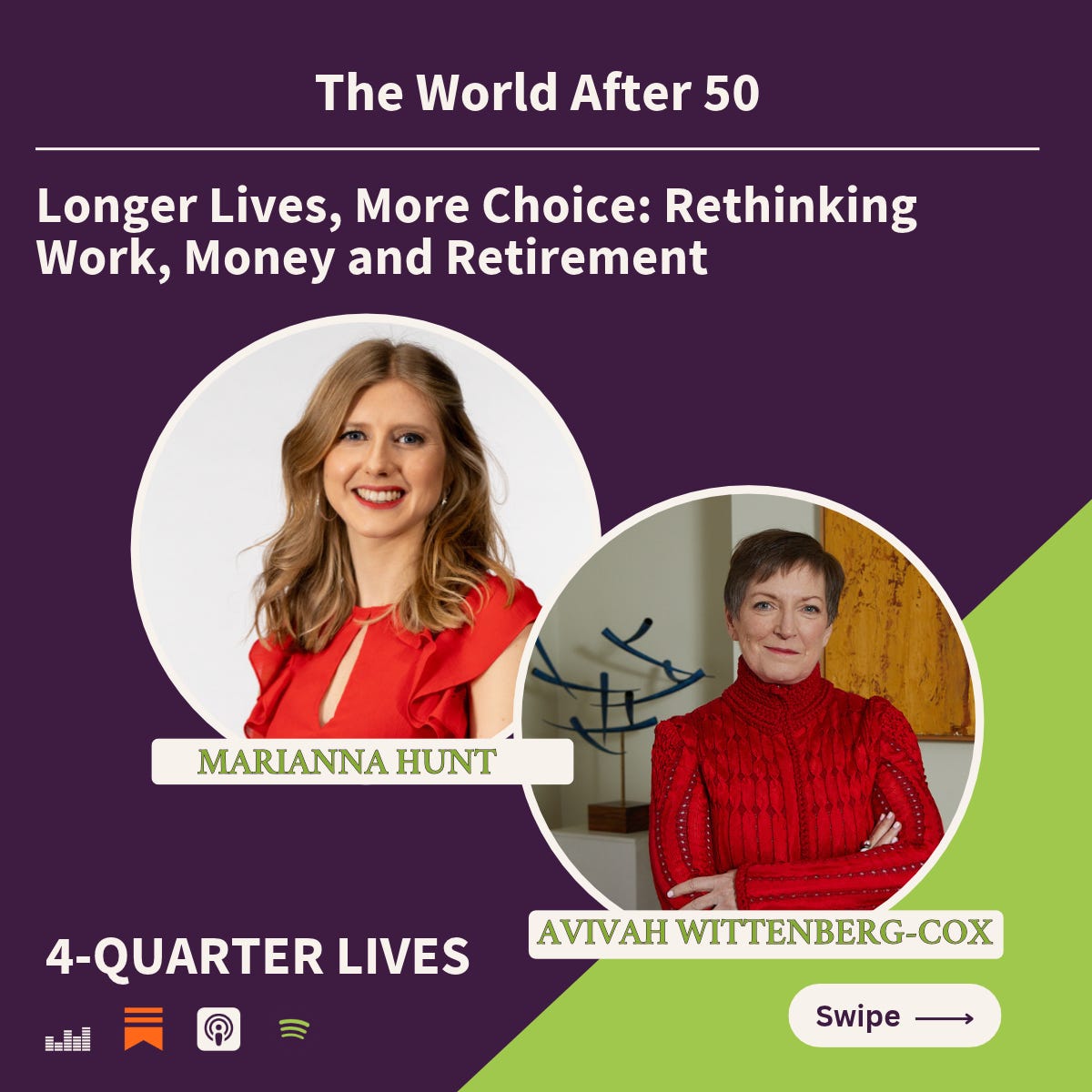
In this week’s 4-Quarter Lives Podcast, Avivah Wittenberg-Cox is joined by Marianna Hunt of Fidelity International to rethink retirement and how we finance a 100-year life. Marianna traces how pensions evolved from a means-tested safety net for the few into an expectation of 20 or 30 years of life after work, and explains why longevity literacy remains so low.She sets out the “triple shock” of leaving work early – fewer years saving, less time for investments to grow and more retirement to fund – and argues that investing in employability matters as much as investing in a pension. The two explore Fidelity’s Longer Working Lives Index, which asks whether people across the G7 can, want to and are enjoying working, and why Italy comes top and Britain last. The conversation closes on CHILL – Career Happiness Inspires Longer Lives – and on financing choice, not just retirement.Marianna Hunt is a Personal Finance Specialist at Fidelity International, the investment and pensions company. Her role spans research, campaigning, education and content. She started her career as a personal finance journalist at The Daily Telegraph, where she had her own column documenting her journey teaching herself how to invest to get onto the property ladder. She also volunteers with financial education charity City Pay it Forward.Useful Links:* Longer Working Lives Index report* The retirement risk most people never plan for Get full access to 4-Quarter Lives | Elderberries at elderberries.substack.com/subscribe
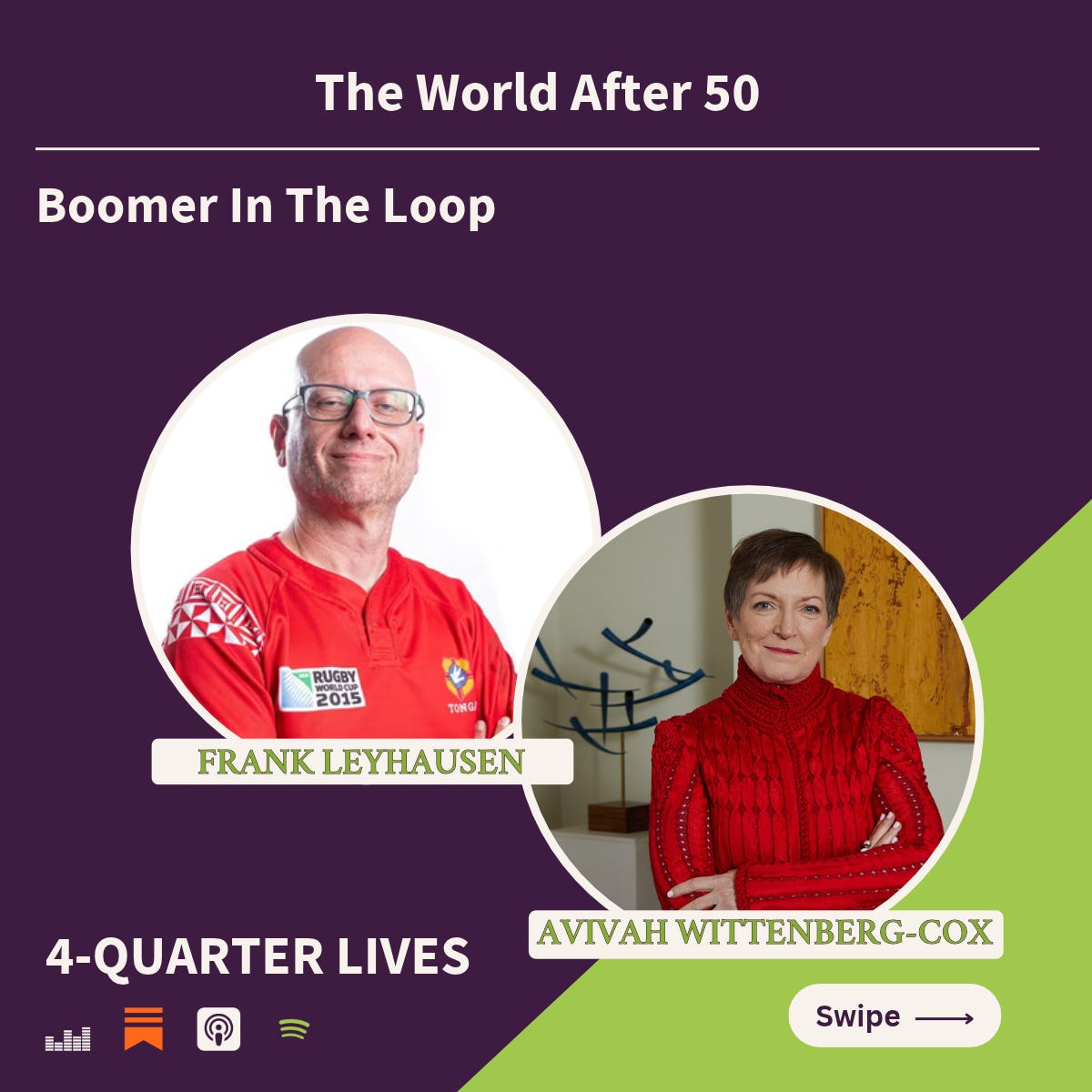
In this week’s 4-Quarter Lives Podcast, Avivah Wittenberg-Cox is joined by Frank Leyhausen, one of Germany’s leading voices on older consumers, to explore the “strategy gap”: every country knows it is ageing, yet almost none is acting like it. Frank contrasts companies that adapt on purpose, like Bosch’s consultancy of retired engineers, with those pushed by market pain, like Ford rehiring 300 retirees to fix AI quality problems. He introduces his idea of “boomer in the loop”, argues that “digital native” is simply ageism, and explains how German angst, a pay-as-you-go pension system and a fear of failure slow corporate action. The pair discuss looming succession gaps in Germany’s small businesses, why menopause has broken a taboo that ageing at work hasn’t, and why life stages beat age brackets. Frank’s ask to leaders: measure what ageing means for your business.Frank Leyhausen is the founder of Reifegrad4 and CEO of AgeForce1, based in Germany. For more than two decades he has been one of the country’s foremost experts on older consumers and the longevity economy, advising major brands, including Volkswagen, with research and insight into ageing customers. Through a long-running startup award, he has championed more than 500 age-tech and longevity startups. The co-author of the book Graues Gold statt altes Eisen (Grey Gold, Not Old Iron, he has spoken at international forums including the United Nations and SXSW, and coined the term “boomer in the loop” to describe the role experienced professionals play in checking the work of AI. Get full access to 4-Quarter Lives | Elderberries at elderberries.substack.com/subscribe
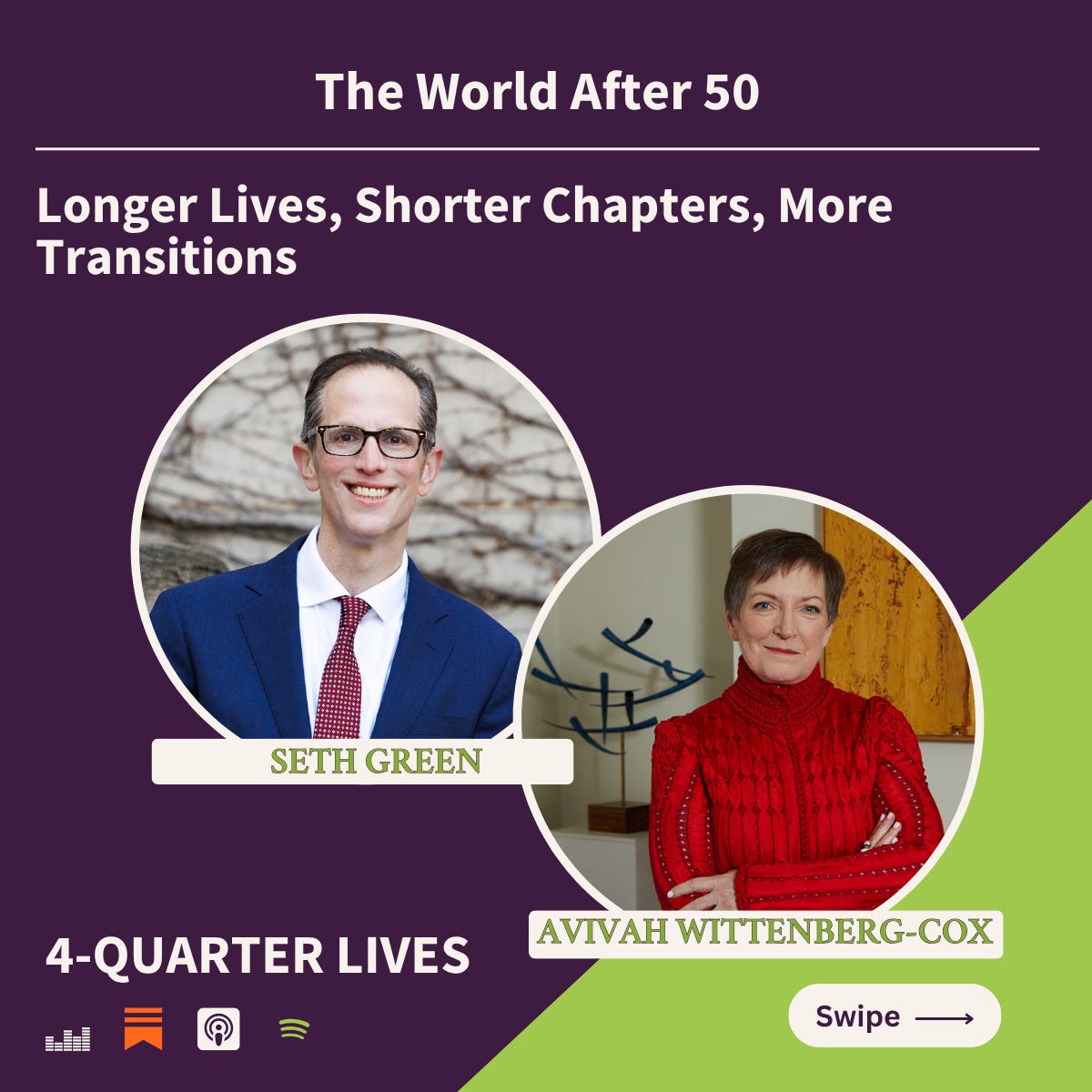
In this week’s 4-Quarter Lives Podcast, Avivah Wittenberg-Cox is joined again by Seth Green, Dean of the University of Chicago’s Graham School, to explore what happens when longer lives meet shorter chapters. Seth argues that the two forces together mean more transitions, and that adaptation, not stored knowledge, is now the skill that matters most. He makes the case for a midlife that stretches from 35 to 75, and walks through his group’s three overlapping modes: reorient, flourish and steward. The conversation then turns to how the Graham School has grown from one flagship programme, the Leadership and Society Initiative, into a portfolio built around life stage rather than age, serving archetypes from the ‘reassessor’ to the ‘encore chapter builder’. Seth closes with why the alumni community is becoming the real draw, and what universities worldwide must do to make midlife learning a core mission rather than a sideline.Seth Green is Dean of the University of Chicago’s Graham School of Continuing Liberal and Professional Studies, a role he has held since 2021, now in a second five-year term. Under his leadership, Graham launched the Leadership and Society Initiative and has grown into a portfolio of programmes supporting learners across midlife. He was previously Founding Director of the Baumhart Center for Social Enterprise and Responsibility at Loyola University Chicago. A Marshall Scholar, he holds a J.D. from Yale, master’s degrees from Oxford and the London School of Economics, and a bachelor’s degree from Princeton. Get full access to 4-Quarter Lives | Elderberries at elderberries.substack.com/subscribe
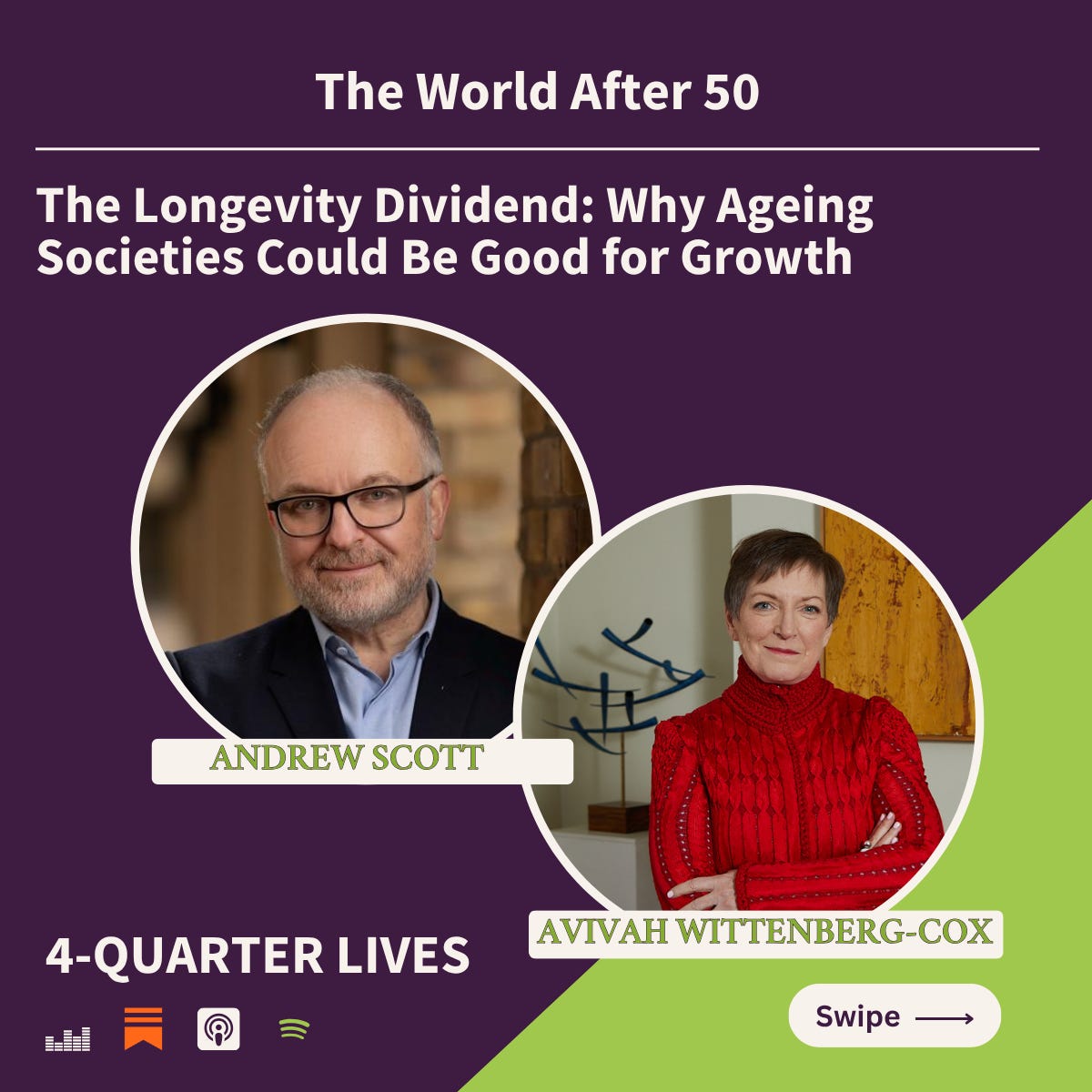
In this week’s 4-Quarter Lives Podcast, Avivah Wittenberg-Cox welcomes back economist Andrew Scott to challenge the idea that ageing societies are destined for economic decline. Drawing on his latest research, Andrew explains why falling birth rates have not triggered the collapse so often predicted, and how adaptation, technology and longer working lives could deliver a substantial longevity dividend.They discuss the striking contribution of over-50s, who account for more than all net employment growth in the EU over the period Andrew examined, and why investing in health and later-life work matters more than simply raising retirement ages. The conversation explores why a health system should measure health rather than just treat disease, and the emerging tension between AI and longer careers: experienced workers may become more valuable just as younger people struggle to gain experience. Andrew also shares his new chapter at Oxford and the Ellison Institute of Technology.Andrew Scott is Principal Scientist, Economics, at the Ellison Institute of Technology in Oxford, and Professor of Economics at the University of Oxford. After three decades at London Business School, his work now sits where economics, biology and AI meet. He is co-author, with Lynda Gratton, of The 100-Year Life, and author of The Longevity Imperative. Few people have done more to shape how we understand the economic and social consequences of longer lives, or to question whether an ageing society must also be a society in decline. Get full access to 4-Quarter Lives | Elderberries at elderberries.substack.com/subscribe
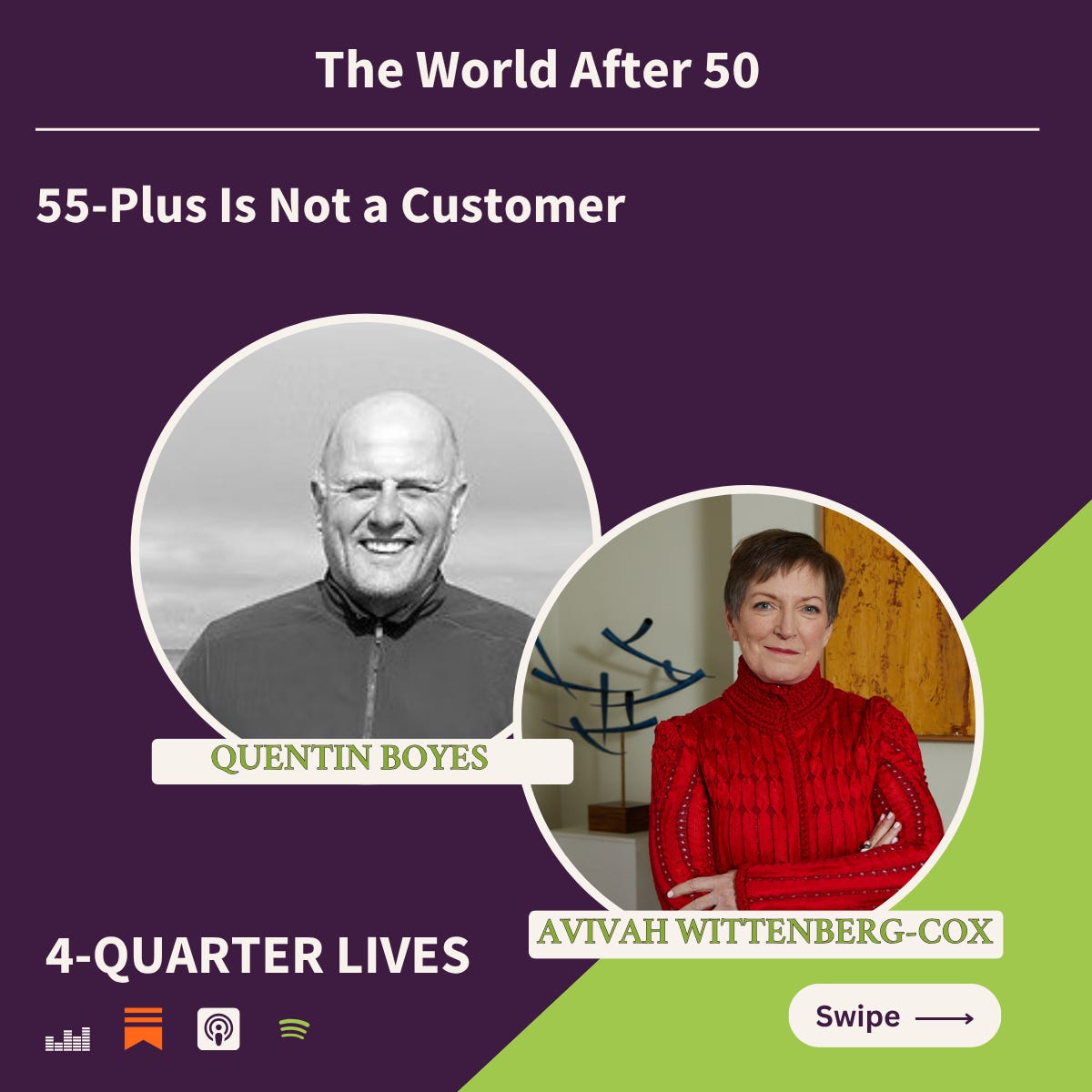
In this episode of 4-Quarter Lives, Avivah Wittenberg-Cox talks with Quentin Boyes, founder of Humbug, about the assumptions that sit behind the advertising older people see — and the customers businesses miss. Quentin has spent more than 35 years in brand and customer strategy. His current work, initially developed in partnership with Brunel University and supported by Innovate UK, demonstrates how brands can understand the mature consumer, known as the “Baby Boomer”,with greater precision using a set of new segmentation and mapping toolsQuentin’s objection to “55-plus” is straightforward: it does not tell you who you are talking to. We explore why marketing remains so attached to youth, how the rush into digital channels shaped that focus, and what happens when businesses carry an old picture of later life into a market of longer lives. His argument reaches beyond advertising. Understanding these customers involves product development, sales and customer service too.Humbug’s research identifies six consumer groups within the baby boomer generation. Quentin and Avivah look at two contrasting examples: an older group comfortable with multiple digital channels, and a younger group that places particular value on trusted sources and printed newsletters. The differences are a useful reminder that age alone tells us little about someone’s relationship with technology, advertising or change. Trust, values and relevance deserve a closer look.Adult children return home. Parents live longer. Caring responsibilities multiply. People inherit, move house, reduce their working hours or start another business. Quentin describes how these events can change both the money available and the priorities competing for it. The conversation then turns to travel, where the bucket list can obscure a desire for fresh ideas, and to Quentin’s own experience using AI to plan a family trip. For anyone navigating the New Q3 — or serving its consumers — this is a lively conversation about the lives hidden behind the labels.Quentin Boyes is the founder of Humbug, a consultancy helping brands understand and engage older consumers. A brand and customer relationship strategist with more than 35 years’ experience across travel, health, consumer goods, sustainability and the public sector, he explores how life events, values, and changes in the way we process information, shape buying decisions as we age.www.bahhumbugs.co.ukhttps://www.linkedin.com/company/bahhumbugshttps://www.linkedin.com/in/quentinboyes Get full access to 4-Quarter Lives | Elderberries at elderberries.substack.com/subscribe

Comments

Download from Google Play

Download from App Store
 United States