


 Claim Ownership
: lower black pain.
Subscribed: 0Played: 1
Subscribe

© Jd Michaels
Description
229 Episodes
Reverse
Calendars were not invented on “day 1”. That’s what I thought as a kid - that if you wanted to know how old “calendars” were, you just counted backward from, well, now until you were back at 1. Then I remembered about all that “B.C.” time, and then… I just looked it up. The Gregorian Calendar, which we purchase each year on sale in mid-January in the Barnes and Noble bargain section, was created in 1582. The Julian calendar that it replaced had begun in 45 B.C., and there is apparently a calendar in Africa from 8000 B.C.. Calendars are great, but they bother me. The human race celebrates specific holidays because of where they are on the calendar, not in alignment with the sun or the stars anymore. Our birthdays mark the beginning of our personal year. Thanksgiving is celebrated the third Thursday in November. Easter is a bit more organic, as it’s the first Sunday after the Spring Equinox, a specific scientific circumstance (once I did the experiment where you balance an egg on its end EXACTLY at the moment of the Spring Equinox - it stayed there for 90 seconds and then fell over - couldn’t get it to do it again - science is cool).So calendars define days, but do not dictate the seasons. I think this includes the Holiday seasons, as they are not tied to the calendar - “Christmastime” used to begin the day after Thanksgiving, or the moment that Santa waved from his sleigh in the Macy’s Parade, but is now shifting steadily backward - last year the first Netflix holiday princess movie was released well before Thanksgiving, though I was expressly forbidden by my daughter to watch it until the appropriate time. Folks are open to begin their Christmastime whenever they choose - defined by stores being decorated, holiday music being played on the radio, or Hans Gruber plummeting from Nakatomi Plaza.But we’re not quite there yet. Our first stop is Autumn (keeper of Spookytime™), which for me always begins with a mystery.Fall officially starts on the Autumn Equinox, but we all recognize that cinnamon, clove, nutmeg, ginger, and mace define summer’s end. “Pumpkin spice lattes” were introduced in 2003: those smart enough to invest in the odd new trend probably profited like crypto bandits, as millions of folks enthusiastically associated it with the shift of seasons. But similar to Christmastime, the official date that Pumpkin Spice Everything is introduced each year keeps getting pushed earlier and earlier, moving from mid-September back to mid-August. I mean, who doesn’t enjoy a gourd-based beverage, but I choose not to recognize this indicator. Autumn is my favorite season. I was born in Autumn. I love the Autumn weather. I’ve always looked best in sweaters, which have subtlety bulked up my scrawny “Steve Rogers Before The Super Serum” frame, annually allowing me well defined (although pillowy soft) shoulders. Autumn means a lot to me, and cannot be defined by corporate trend. I truly love the season, and the best part is, I never know exactly when it’s going to get here.…there’s a day every yearwhen the wind changesthe humidity dissipates entirelyreplaced by this wonderful snap in the airan exhale is not yet visiblebut inhaling becomes freshand the smell of leaves and the sound of them all on the streetssomehow insulates cars passing bythis is my beginning of Autumnand once THIS mysterious day happens afternoons don’t warm up anymoreso you really need that extra layer of clothesand you’re very glad you remembered your hatand to be honest you could actually appreciate a nice hot beveragein a paper cupwith a derivative of your name written on itthat day is the perfect timefor a nice, hot cup of coffeeembellished with the flavor of a seasonal gourd. Get full access to :lowerblackpain at lowerblackpain.substack.com/subscribe

Spring Cleaning: the opening of windows and freshening of linens and dusting off of bookshelves and vacuuming in the corners of ceilings, an annual frenzy of “getting ready” for the longer and warmer days of the year - which ironically are most frequently spent outside. ’Tis the season for that kind of thing in New Zealand right now, where Winter is just ending, which is odd (also, the water there twirls down their drains counter-clockwise? Utter madness.).But in our Northern Hemisphere it is time for Fall Cleaning, a necessary re-negotiation with living spaces many months neglected, passed over for picnics and hikes and visits to other people’s living spaces. O, but winter is coming, and the time has arrived to store away our short pants and prepare for when that throw blanket on the couch (which serves as decoration the rest of the year) at last becomes a treasured necessity.We are deep in the throes of Fall Cleaning at our home, along with our preliminary decorating for Spookytime™, which the family has agreed is not quite here yet but just around the corner - that corner, there, at the end of that long and dark alley, just a few steps beyond the dimly flickering street lamp. Fall Cleaning is always a bit of a refocus. We store away objects of leisure and comfort to make room for more items of practicality and utility, trading long sleeves for short sleeves, sweaters for swimsuits, and in our case cleaning up the various random items we’ve collected over the summer. For instance, I’ve been banned from ever purchasing those popsicle molds from Whole Foods once we found three layers of their various plastic pieces at the bottom of a drawer. To make things worse we found seven random regular popsicles hiding the back of the freezer. We're not even really a “popsicle family”, if there is such a thing. So all that had to go. We end up collecting a great deal of nature in the summer. Sticks. Rocks. Leaves. We’ve gone for a walk and seen something interesting and brought it home to share. Maybe we had a really great conversation on that walk, and that little stick represents it, or the sky was an incredible blue holding unbelievable clouds through which the sun shone on this particular rock on the shore of the lake.So we brought it home, like a photo we didn’t choose to take, but instead stored the moment in wood or mineral form instead of film or digital space.Trouble is, by the end of summer some of those sticks are just sticks again, since we can’t remember quite exactly where or when we found it. The meaning of these objects depends only on their time interacting with us. Random memories triggered by random objects hold varied permanence. We end up with a lot of that stuff by the end of the summer, and not just natural items, but tiny plastic models of frogs making oil paintings and collectible ICEE™ cups and kawaii hair clips. After we go through the house collecting them all, we place each item on the dinner table for analysis - if we no longer can remember its story, then we no longer keep it.There are other categories of summertime detritus (Books We Intended To Read, T-Shirts less Comfortable than Threadbare, Interesting Soda Cans): it takes about a weekend or two to pull everything together and reset the apartment. Then, of course, we cover the entire place with pumpkins and black cats and skeletons for the next month or so.In pursuit of even more extra space, I decided to clean the closet in our little office room, the one that hasn’t been re-negotiated since we moved into the apartment over eight years ago. There I found plastic bins containing precious oddities, including train tickets, foreign receipts and coins, dried rose petals, a glass fountain pen and a vintage yo-yo. Every one with a story (not that I actually remembered them all).I also discovered box after box of Old Writing, some of it from ten years ago. Then I found pages from twenty, thirty, forty, and even fifty years ago. Now technically, all this is just trash - either the ideas aren’t finished or the stories are dated. It’s just paper that matters to absolutely nobody else on the planet. Ream after ream of 90’s prose with 80’s plots and characters: certainly this can all be recycled and made into new notebooks for someone else to take their narrative shot.But I couldn’t just throw them all away. A few of the ideas weren’t that bad, and some stories had been in my head for so long that it was comforting to see how much work had been put into them - inspired me to even polish a few, if only to see them finished. And it was here, in this great pile of potential art, that I realized my Third Act goal: ALCHEMY.I don’t want to dwell in What Was, but I don’t want to just burn it like garbage. Instead, I’d like to upcycle the past, re-use and combine my previous art and experience to create something new.You see, if I can just make something good, and I mean REALLY good, then all these random papers would be transformed into museum worthy historical artifacts, like lead into gold. Each curious page would be a piece of the puzzle of my artistic journey, as we watch the young man from Kansas evolve into a unique talent reminiscent of a young Norman Lear. Or maybe, Aaron Spelling.It’s a good goal. And this year the Large Hadron Collider particle accelerator actually did make gold from lead (for a few milliseconds), proving that after centuries of attempts, alchemy is now possible, if not practical. That is scientific evidence in support of the longest of long shots. So, y’know… it could happen. Get full access to :lowerblackpain at lowerblackpain.substack.com/subscribe

just six weeks to 60and i’m feeling fine(’til then i’m gon’ party like i’m fifty-nine)there’s not all that much difference in how I speakbut when i move now there’s an audible creakand a slight subtle wincing that plays on my face‘cause the creaks never seem to come from the same placejust six weeks to 60and i’m feeling goodthough probably not sleeping s’much as i shouldmy Apple watch tells me more hours would be rightand to stop waking up at 3:30 each nightthe dread that its morning reporting would bringmade me just decide to stop wearing the thingjust six weeks to 60and i’m feeling greatthere’s plenty of nutritious food on my plateexcept for tomatoes, potatoes, and cherrieseggplants and mushrooms, bananas, strawberriesalong with milk, soy, most nuts, shellfish and wheatto which I’m allergic and no longer eatjust six weeks to 60and i’m feeling swellthough a bit overwhelmed. you can probably tell.it’s the blinking, this subconscious facial attackwhich makes me seem i’m always taken abackat the world that surrounds me - so loud, fast, and new.(come to think of it, that part is probably true)just six weeks to 60and i’m feeling jakesome credit is due to the vitamins i takeThere are five different numbers of vitamin Bsthen twice-daily well-buffered capsules of Csand a top probiotic drink guaranteed to please, whichunfortunately tastes like a blueberry cheesejust six weeks to 60and i’m feeling young(there’s so many k-pop songs i haven’t sung!)I’m not sure that i’ve lived enough to be wisethough i’ve seen 60 Easters and Fourths of Julysguess if i can keep navigating through all this hazeI’ll be all that much wiser in… 42 days. Get full access to :lowerblackpain at lowerblackpain.substack.com/subscribe

The beginning of fall marks an annual celebration of learning: Back to School Time again. I did buy a new cool metal lunchbox this summer, though I’m reticent to take it to work (a grown up place that does not seem to lean toward whimsy in any fashion). Instead I am engaging in the season by (again) dedicating myself to learning One New Thing.Last year it was “How To Play The Banjo”. I initially could not find online instruction that matched both my keen enthusiasm and complete lack of talent for the instrument. I finally found a great teacher who is kind, patient, and detail oriented - and I am now actually getting better. It is soothing to play the one tune I know. I am practicing holiday songs for December.This year’s One New Thing had to be different. And no more expensive subscriptions. Masterclass™ has become overwhelming, where talented people who are just naturally good at something try to tell us how to became good at that thing - it is often like having a tall person explain how to reach objects on high shelves. BBC Maestro™ hosts a much less esoteric collection of instructors (lacking Masterclass’s contingent of Kardashians), but holds the meta-flex of offering Agatha Christie (in resurrected digital form) as one of their teachers.Instead I turned to the Open Courses online series, a grand experiment in instruction. 20 years ago, a few top universities began to videotape entire semesters of certain classes and offer the recordings, FOR FREE, on the internet. No official college credit, but all the information was there for the learning. From the wide array of offerings available, one in particular caught my eye, as I had recently become very curious about its subject matter.It’s ECON 159 - Game Theory.We use game terms all the time: things are “stacked against us” because it’s not a “level playing field”, we have to “roll the dice” even if we are “dealt a bad hand” because we don’t want to just “throw in the towel” when it’s “time to play hardball”.The first thing I ever learned about games was how to lose. Not particularly with grace, but with unwavering consistency, as my mom won bouts of Chinese Checkers, and red and black checkers, again and again. With each loss we reviewed the game and analyzed what went wrong - what choices I could have made. until one night, YEARS later, I actually won. She had always said that it would feel better if I won fair and square, and she was absolutely correct…it was life changing.I enjoyed those face to face games. Two people sitting across from one another with a game board in between them, taking turns making choices that wouldn’t matter once they left that space, yet felt crucially important while they were there - a challenge of mind and spirit.Along came video games, where two people sat not facing, but side by side, looking at a television set. Choices and moves on the screen were a bit impersonal because players never looked at each other. The challenges and responses were pre-programmed and merely activated through controllers. Still, I had fun with my wife, who would augment her on-screen movements with elbow nudges and hip checks from the couch… it was like one of those 4D movie theaters.Then gaming systems required that each player have their own unit and internet access, so they couldn’t even be in the same house. Game choices and moves became nearly anonymous because even if others were in the game, you were playing alone, which I thought was weird.When games of adventure with endless choices and no single narrative path began to appear, I felt excited but a bit disappointed: I mean, that’s what life was already (minus all the Pokemon). And eventually these evolved into long form examples of imminent threat - survival games of war or monsters or zombies… which was (thankfully) WORSE than life was already, and I really couldn't get into.And now on my phone I am offered the chance to shoot constantly at a never ending horde of enemies until I am at last overwhelmed - a game that I will definitely lose - it’s only a question of when. And they want me to pay for it. It’s like therapy backwards - you’re having a pretty good day until you run out of ammo in the bleak hopelessness of your palm-held perdition.That’s a GAME? Isn’t a game a chosen risk where the odds are pretty even? Why would you play a game if you’re guaranteed to lose? How did games progress from challenge, to adventure, to survival, to despair?Thus, ECON 159.So far I have learned about The Prisoner’s Dilemma, which goes like this:A pair of criminals is captured by the police, and each given the same deal - if they inform on their partner and their partner does not inform on them, they will be set free and their partner will get a five year sentence. if they inform on their partner, and their partner DOES also inform on them, they will each get a 3 year sentence. if they both stay silent, they each get 1 year.I won’t go into all the head-spinning calculations, but it’s statically better to inform than not because the most you’ll get is three years and maybe none at all - but the question is ultimately moral, because it’s less about the odds than if you trust your partner. The “game” reflects not what the criminals did, but who they are.We’re all tested everyday; we make it out of bed, face the outside world, and triumphantly recognize traffic lights, crosswalks, and bicycles in those online security tests to prove we’re human. Sure, that’s a pretty low bar, but these are tough times. We live in a reality where our tools are becoming so fast and efficient that we feel like we’re becoming their tools. And the ridiculous fact about that all those tools and technologies are made by human beings… ironically rushing to prove just how clever they are. But life isn’t just a race against impossible odds. If that were true then all that would matter was speed and efficiency and volume and output, and we’d all be that little character with the ammo on the bridge, endlessly shooting until they’re overwhelmed. Ok, I can see how that metaphorically appeals to folks because the situation does speak to bravery in desperate circumstances - but how did that little guy get on that bridge in the first place? The premise seems to speak of previous poor choices on his part.We, unlike that fellow, can choose which games to play, which adventures we want to set out on, which prizes are worth our risk. In this blinding cacophony of NOW NOW NOW it’s important to remember that games are supposed to be relaxing. Fun. Parker Brothers and Uno and Frisbees and hide and seek and chess were not invented to be stark metaphors as to the state of human existence, but amusing ways to spend face time with friends, where how one wins speaks much less to one’s character than how one plays. Get full access to :lowerblackpain at lowerblackpain.substack.com/subscribe
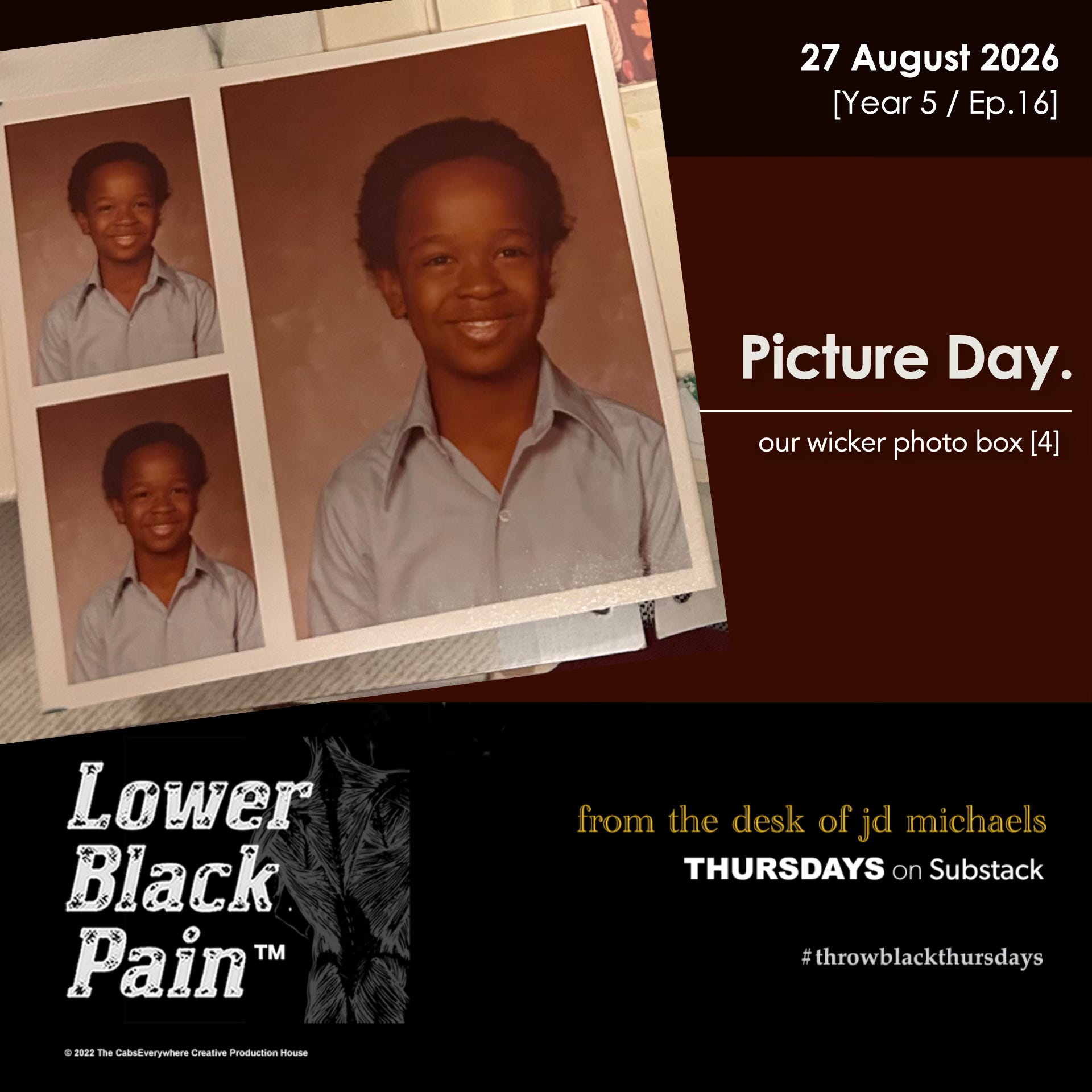
[1 - 8x10]My most consistent historical visual record was compiled through time capsules delivered in paper envelopes with cellophane windows: my annual school photo. The Mondrian-like layout of large, medium and impractically small shots were all on one page, which (because I did not grow up in a fancy X-Acto knife house) we could never quite cut out perfectly. The assortment was designed to satisfy relative demand, or more specifically, the demands of relatives: one BIG one for the grandparents, a couple of decent sized portraits for parents (one for home and one for an office), several to share with interested parties (say aunts and uncles or very close family friends), and then teensy ones to pass out among classmates. There were always some left over, as the individual social popularity of each and every student could not, scientifically, match the (too) generous image supply. The most one could hope is to watch your grandparents place this year’s photo in front of last year’s in the frame that they kept on the mantlepiece, so you could get a “Wow, you’re growing up so fast!” affirmation before they close the weary metal latch on the back that bows a bit more each year against the expanding stack of glossy prints.[2 - 5x7]Picture day was always exciting, but a bit stressful. Whatever you looked like on that day would be what you would look like in the yearbook, which means you’d look that way forever, so there were lots of combs about. The photo sessions were always scheduled before lunch and recess, the two periods most likely to muss and stain us. As we stood in line patiently waiting our turn, we could watch the folks alphabetically before us being coached by staff as they moved us steadily along their assembly line.Although we weren’t Catholic, my mother enrolled me in a grade school that was - in addition, they had just opened their doors to admit young men as well as women, and initiated a program to support more financially challenged families. As a result, I was in the first class with African-American students. The nuns and other teachers worked hard to include us evenly, but after our first picture day it was discovered that the photographer had not adjusted their cameras for our skin tone and we all came out as shadows - so they scheduled a secret second day and had us all re-take our shots. After that first year, things went fine.[4 - 3x5]My forehead is the most prominent thing in my school photos. I grew up, sure, and my body changed its size over the years, but my forehead is a clearly established constant, maintaining the exact ratio through all my developmental stages.My smile is the most consistent thing in my school photos. It was my honest reaction to the command from an adult stranger to “smile”. I couldn’t re-create it now; back then, I didn’t need anything to smile about, whereas today I require pretty significant reasons.My hair is the most unpredictable thing in my school photos. It’s not great. It is on my head, but seems surprised from year to year, as if it didn’t know this was happening TODAY and would have done something completely different had it been properly warned.My clothing is the most odd thing in my school photos, because for grade school we had blue uniforms, but in high school I had no idea how to put clothes together and ended up wearing outfits that made me look like a hillbilly in a Broadway musical.[6 - wallet size]kids today have cameras in their pockets all the timeto them, time is not merely captured, but fully domesticatedbut those photos, endless and instantaneous, prove wholly ephemeralwhereas we curated tiny analog galleries, compiled through decadespriceless moments of light and time reflected stored in wicker boxes behind the couch - as fragile and steadfast as paper Get full access to :lowerblackpain at lowerblackpain.substack.com/subscribe

Comments

Download from Google Play

Download from App Store
 United States