


 Claim Ownership
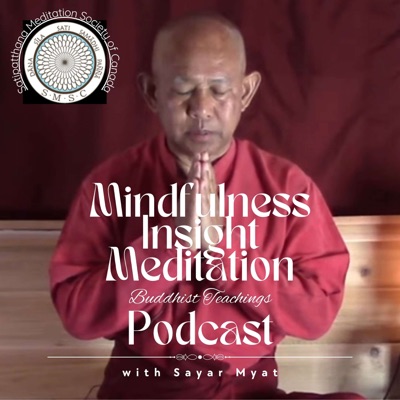
Mindfulness Insight Meditation - Buddhist Teachings
Subscribed: 128Played: 1,618
Subscribe

© 2026 Mindfulness Insight Meditation - Buddhist Teachings
Description
Mindfulness Insight meditation (Satipatthana Vipassana) and Buddhist teachings/Dhamma Talks as taught through the Theravada Buddhism tradition. Sayar Myat gives Dhamma talks on teachings of the Buddha as well as instructions on Pure Vipassana meditation as prescribed by the Venerable Mahasi Sayadaw.
Visit the YouTube Channel at:
https://www.youtube.com/channel/UCJ5tPybGb9wm03HdeLIjARA
Website:
www.satipatthana.ca
For Donations and Memberships visit:
https://satipatthana.ca/donation/
223 Episodes
Reverse
We return to the foundations of Buddhist practice by exploring the Five Aggregates — material form (rupa), feeling (vedana), perception (sanna), mental formations (sankhara), and consciousness (vinnana) — the components that make up what we call the “self.” From this understanding, we examine how the Four Foundations of Mindfulness arise: mindfulness of body, feeling, mind, and Dhamma. The talk emphasizes that whichever object becomes most prominent — body, feeling, or mind — can serve as the...
In this episode, we explore the Mahanama Sutta, where King Mahanama asks the Buddha how laypeople can find stability and peace in the midst of a chaotic, worry-filled world. The Buddha responds by teaching the importance of cultivating the Five Spiritual Faculties: faith, effort, mindfulness, concentration, and wisdom. With these as a foundation, one can practice the Six Recollections — reflecting on the qualities of the Buddha, Dhamma, Sangha, morality, generosity, and the virtues of celesti...
In this talk, we explore Vedana (feeling) as a key mental factor in Buddhist meditation and daily life. The teacher explains how feelings arise as pleasant, unpleasant, neutral, and how they are classified in different ways in the teachings of the Buddha. By learning to observe feelings with mindfulness, listeners discover how to prevent craving and aversion, understand impermanence, and break the cycle of suffering through Satipatthana Vipassana practice. YouTube Video Link YouTube Ch...
In this talk, we explore the Buddhist teaching of Anattā (non-self) as it appears in everyday life. Through simple examples like eating, seeing, aging, and thinking, the speaker explains how mind and body function through cause and effect rather than a permanent “self” or soul. Listeners are encouraged to observe daily experiences mindfully to develop a direct, experiential understanding of non-self and deepen their meditation practice. YouTube Video Link YouTube Channel Link Web...
In this talk, we explore the forty types of supramundane (lokuttara) consciousness and how they arise through insight meditation. The teacher explains the relationship between jhāna, path consciousness, and fruition consciousness, showing how different meditation approaches can lead to the same stages of awakening. By understanding these mental processes, listeners gain insight into non-self (anattā) and learn how Buddhist psychology supports deep mindfulness and spiritual development.&...
In this talk, we explore the relationship between Noble Persons (Ariya) and Mental Defilements (Kilesa) in Theravāda Buddhism. Using the framework of the ten fetters, the teaching explains how each of the four stages of enlightenment—Stream-Enterer, Once-Returner, Non-Returner, and Arahant—progressively eradicates or weakens specific defilements. The episode clarifies which fetters are abandoned at each stage, how moral purity and insight deepen, and why only the Arahant fully uproots all unw...
Supramundane Consciousness (Lokuttara Citta)—the consciousness that transcends the conditioned world and leads directly to Nibbāna. It introduces Path (Magga) and Fruition (Phala) consciousness, clarifying how they function to eradicate mental defilements at each of the four stages of enlightenment: Stream-Enterer, Once-Returner, Non-Returner, and Arahant. The talk highlights the eight noble persons, the immediate nature of fruition consciousness, and how each path consciousness arises only o...
YouTube Channel Link Website: www.satipatthana.ca Donations and Memberships
This episode introduces Formless Sphere Consciousness (Arūpāvacara Citta) and the four formless jhānas: infinite space, infinite consciousness, nothingness, and neither-perception-nor-non-perception. It explains how these refined states arise after mastering the fifth form-sphere jhāna and how they relate to the formless Brahma realms. The talk also outlines the twelve types of formless consciousness—wholesome, resultant, and functional—and clarifies their role in meditation and rebirth. Whil...
In this episode, we explore Form Sphere Consciousness (Rūpāvacara Citta)—the refined states of mind that arise through deep concentration meditation. The talk explains how practicing one of the forty subjects of samatha (tranquility) meditation leads to the development of jhana and rebirth in the form-sphere Brahma realms. You will learn about the fifteen types of form-sphere consciousness—five wholesome, five resultant, and five functional—and how each relates to jhana attainment. The episod...
In this episode, we explore jhana, the higher states of concentration. Moving beyond ordinary beautiful consciousness, jhana represents deeply refined, purified states of mind that arise only through dedicated meditation. We break down what jhana truly means, why it cannot be captured by English words like “ecstasy” or “absorption,” and how it functions by burning away the five mental hindrances. The talk explains the two types of jhana—samatha-based concentration and vipassana-based insight—...
In this episode, “Practices of Guaranteed Result,” we explore the Buddha’s three essential techniques—known as Apaṇṇakapaṭipadā—that promise undeniable progress on the path when practiced diligently. These three techniques are simple but profound: restraining the six sense doors, eating sensibly, and maintaining continuous mindfulness. Through practical examples and step-by-step guidance, the episode explains how to guard the mind at each sense contact, how wise eating supports clarity,...
“Causes of Beautiful Consciousness” explores how our inner world is shaped by three powerful factors—feeling, prompting, and knowledge. This episode explains how pleasant, neutral, and unpleasant feelings influence our habits and reactions; how our health, discipline, and environment affect whether our actions arise spontaneously or need deliberate prompting; and how past actions, learning, and meditation nurture wisdom. Through relatable examples—like the taste of blue cheese, th...
Sayar Myat presents the twenty-four beautiful consciousnesses (sobhana citta) of the sensuous realm, divided into wholesome, resultant, and functional groups. Through simple storylines, he explains how wholesome consciousness arises with joy, wisdom, spontaneity, or prompting, and how these moments are free from unwholesome states. He then describes how beautiful resultant consciousness appears as the fruit of past wholesome actions, and how beautiful functional consciousness operates i...
In this Dhamma talk, Sayadaw introduces Sobhana Citta, the Beautiful Consciousness. “Sobhana” means beautiful, graceful, or pure; “Citta” means consciousness. Together they describe the states of mind rooted in non-greed (alobha), non-anger (adosa), and non-delusion (amoha) — the three wholesome roots. Sayadaw explains how consciousness with two or three of these roots becomes truly beautiful, arising mainly in the sensuous realm (kāmāvacara). The talk explores the three subgroups of beautifu...
This talk explores the true meaning of chanda — not as craving, but as the neutral, wholesome intention to act. Learn how understanding and observing this “wanting consciousness” in daily life can lead from desire to wisdom. YouTube Video Link YouTube Channel Link Website: www.satipatthana.ca Donations and Memberships
In this episode, we continue exploring rootless consciousness—states of awareness that arise without mental roots of greed, hatred, or delusion. Building on Part One, we dive deeper into the 18 types of rootless consciousness, grouped as unwholesome, wholesome, and functional. Each is shaped by three factors: its nature, feeling (pleasant, unpleasant, or neutral), and kind of consciousness. This talk shows how our sensory experiences—seeing, hearing, tasting, touching, and thinking—reflect pa...
This episode explores the Buddhist concept of bhavaṅga, or the “life continuum” — the stream of consciousness that connects one moment to the next, and even one life to another. It explains how our unique personalities at birth may arise from past lives, carried through this subtle flow of awareness. We also look at how consciousness operates between wakefulness and deep sleep, and how every perception — seeing, hearing, thinking — unfolds through a rapid series of thought moments. Using the ...
This talk describes to how past karma patterns present experience—and how mindful attention stops old patterns from creating new ones. We explore the meaning of rootless consciousness (ahituka) in Buddhist teaching — the states of mind that arise without the “roots” of greed, hatred, or delusion, but also without the wholesome roots of generosity or wisdom. These moments of awareness don’t create new karma; instead, they’re the results of our past actions unfolding in the present...
Over 2,600 years ago, on a full moon night at Jīvaka’s mango grove near Rājagaha, King Ajātasattu—haunted by guilt for killing his father—approached the Buddha with a simple but profound question: What are the benefits, in this life, of being a monk? The Buddha’s response, later known as the Sāmaññaphala Sutta, unfolded into one of the most comprehensive teachings on the spiritual path. In this episode, we explore how the Buddha skillfully led the king from worldly examples of freedom and sim...

Comments

Download from Google Play

Download from App Store
 United States