


 Claim Ownership
The Love Theorist
Subscribed: 3Played: 5
Subscribe

© Dyann Ross
Description
Join Dr Dyann Ross as she explores love as a force for revolutionary change.
Subscribe to her newsletter - www.thelovetheorist.substack.com
Brought to you by Revolutionaries
thelovetheorist.substack.com
Subscribe to her newsletter - www.thelovetheorist.substack.com
Brought to you by Revolutionaries
thelovetheorist.substack.com
58 Episodes
Reverse
After a lecture on power, human rights and ethics, a social work student said: “social workers have no power!” He said it as an unequivocal truth and many other students agreed with him. This came as a surprise to me and we had a discussion about it then and there in class. This podcast explores power as an idea and practice, mainly in a professional context.It identifies the various ways social workers and other helping professionals can feel powerless, in their personal lives and in their professional roles. For example, a workplace culture that is toxic, unsupportive and possibly where social workers are subjected to bullying, can undercut their resilience and ability to exercise their power as is required in fulfilling their role. Power tends to be thought of as “someone has all the power and I have none!” and variations on this theme. And this way of thinking in itself can make a lot of sense when someone is feeling powerless.At the same time if we think of power as being constituted in a myriad of ways along a continuum this can give us more room to move and seek ways of being empowered. On one end of the power continuum is love as power – eg acts of gentle loving kindness as a type of power at the heart of all helping professions’ caring mandate. At the other end of the continuum is violence as power – eg assault, wars, harassment, coercive control. Legal use of power as per legislation such as the Mental Health Act, falls on the continuum along the violence end of the continuum. This is the case even though it is professionally and legally sanctioned to force a person to have a mental health assessment and possibly treatment against their will, in some very specific circumstances.These kinds of reflections bring the conversation to the main point that no matter how dire the situation, or how powerless we can feel in our professional work, we can always act (ie use power) to be kind, respectful and caring. This always matters and is perhaps even the most important aspect of professional use of power that isn’t given enough credence. We may not be able to help in the way the person wants for a range of reasons, but we can always validate, acknowledge, listen, and be kind. This is love as power at work. At the same time we shouldn’t use acts of kindness to avoid our responsibility to be competent and of substance in what we offer to people.You can read more on this topic in my book, Broken-heartedness: towards love in professional practice, published by Revolutionaries.Let me know what you think and thank you for supporting my work, Dyann This is a public episode. If you would like to discuss this with other subscribers or get access to bonus episodes, visit thelovetheorist.substack.com
The podcast is a response to contemporary media representations of people who are treated as less than human due to being seen as outsiders to mainstream society. A recent comment by an Australian politician that ‘there are no good Muslims’ is indicative of an us-versus-them dangerous dichotomy. The language that is full of untruths and unfounded generalisations is a key step in social processes of dehumanization marginalisation.I explore my own stranger within as a way of showing how I have to grapple with not accepting aspects of myself. This can make me more reactive and less respectful of people who are strange to me. I cross link this to cultural/political commentaries from several leaders who speak from different religious and political stances. These leaders provide a vital moral boundary to vitriolic and harmful political and other public statements.For example, Stan Grant who is a First Nation social commentator and practicing Christian writes that we need to heed the way we talk about human beings. Derogatory language can position people as things/ objects, somehow not fully human and thereby not deserving of respect, protection and human rights.By welcoming strangers into Australian society – migrants, refugees and asylum seekers - we can provide an active resistance against fear, misinformation, self-centredness and prejudices such Xenophobia. I suggest that recognising and accepting the stranger within is one way to become more compassionate towards other people who embody that stranger in society.Your view on this topic is welcome and in closing, I wish to acknowledge anyone who feels they are treated disrespectfully because they are a stranger. This is a public episode. If you would like to discuss this with other subscribers or get access to bonus episodes, visit thelovetheorist.substack.com
The podcast focuses on our individual experience of eco-guilt that occurs from recognising our part in the unsustainability of the planet. Guilt is defined as both an individual awareness of causing harm, usually to another person. And inter-related to this is eco-guilt which is the recognition of causing harm to Nature and as such being part of the global problem.The causes of unsustainability and exploitation of the planet are multi-faceted with different levels of responsibility for harm done. The concern about global warming is indicative of the broad impacts of unsustainable use of Nature where human consumption of farmed animals highlights the interconnected issues.Individuals can experience eco-guilt even though each person has a miniscule impact on the global dimensions of the issue. But the collective of human individuals is having undeniable impacts that threaten the very survival of life on the planet. But not to forget that some businesses, governments and organisations hold a greater level of responsibility for harm done to Nature. There is a link between multi-national mining companies destroying large tracts of forest and waterways to mine bauxite, the raw material for aluminium, and individuals buying cars made of aluminium.This kind of interlinked awareness is the basis for eco-guilt and can result in individuals feeling a disproportionate amount of responsibility for the collective harm occurring to Nature. I offer a self-audit of how I use Nature in ways that are not sustainable and go on to suggest how guilt implies care and care is the motivating factor in acting in small ways to make amends for harm done to Nature.This is all about making sure we don’t become overwhelmed and fatalistic and stop caring as the challenges seem so insurmountable. The invitation is to reach out and share our experiences and together to go forward to make a loving contribution to the ecosystems we live in. This is a public episode. If you would like to discuss this with other subscribers or get access to bonus episodes, visit thelovetheorist.substack.com
Eco-anxiety describes the deep worry we can feel when we see very distressing things happening in the world. In particular, when so called natural disasters are wreaking havoc it is a level of anxiety that seems to have no end. Eco-anxiety gives a name to this distress and the powerlessness that often comes with it. It is caused by witnessing catastrophic events such as floods, fires, landslides, cyclones and droughts. In Australia is it not unusual to have severe floods in one part of the country and out of control wild fires in another part at the same time. You know it is something impacting you when watching or listening to a disaster unfolding and you feel the heightened unease, maybe panic and often deep dread, fear and distress. Sometimes we can’t get images out of our minds of suffering animals or people crying when they have just lost everything. This is of course, understandable.I would suggest that eco-anxiety is the proper response to what we see, hear and sometimes directly experience ourselves. However, we can become over-exposed to disasters and suffering such that our bodies become highly sensitised and we may be unable to calm our nervous system and function with some sense of personal control in our lives. Behind the eco-anxiety sits the risk of losing hope that the world will be OK, that nature will recover, that people will recover and that we can still be sure the world will be liveable for us all.Doing what we can to hold hope for ourselves and sometimes for others, is something we can do on a day by day basis. It is not easy and it is not a skill that is taught. There are though, many ways to foster hope and pay it forward in acts of kindness. For example, keeping our focus on people who are making positive contributions in the world can really help us. Jane Goodall has inspired people all over the world and one of her key messages is that in the face of hopelessness, do something! She says the smallest acts of care and kindness matter. It means we are not giving up in our distress, that we still want to make a contribution in the world. That we know what we do matters.The podcast shares my thoughts about how to transform deep worry about the world by practising hope each day, in little ways, and noting here that when called upon that we stand up to be counted more substantially. I dedicate this podcast to the incredible people - volunteers, neighbours, government workers and everyday people who step up - who respond to natural disasters, often putting their own lives at risk, to help others. That we continue to care gives me hope for our world, for to not care means we lose more than we need to. This is a public episode. If you would like to discuss this with other subscribers or get access to bonus episodes, visit thelovetheorist.substack.com
For some time I’ve been pondering where I stand in relation to the largely cautionary media reports and research about the use of AI, such as ChatGPT. At the same time it is apparent that no amount of caution will turn back to rising tide of people needing helping who are resorting to AI. As a social worker it is important to educate myself about this development and to explore how to contribute to its discerning and safe use. It also causes me to reflect on how the traditional helping professions may be impacted, but more interestingly, what might need to change in how we offer help which so often is stigmatising and in other ways can hurt rather than help.I outline some of the pros and cons for using AI as a form of self help and self care. Some cons are: it is a pseudo connection, it is not confidential and if distressed a person may not be asking the questions that can elicit the kind of help they need. Some pros are: it’s accessible, relatively cheap, it is non-stigmatising, and the person is proactive in seeking help.I conclude with some implications for how traditional helping professions can form a partnership with people which embraces the use of AI in ways that serve them and give them the best of both ways of seeking help - both the human and non-human.You can support my work by following me on Substack, or on TikTok or Instagram. My book - Broken-heartedness: Towards love in professional practice - provides more in depth analysis of what helps and why so much helping is harmful, as well as ways to address this issue. You can email me on dyann@dyannross.com if you would like to create a podcast around today’s topic or other topics offered in this podcast series. This is a public episode. If you would like to discuss this with other subscribers or get access to bonus episodes, visit thelovetheorist.substack.com
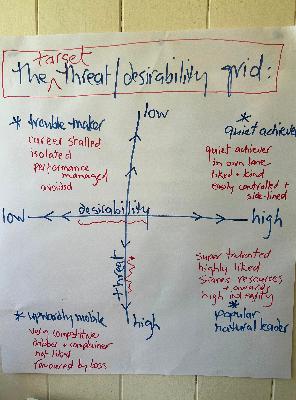
This podcast shines some light onto the troubling issue of workplace violence which can take many forms, and for our purpose today, I call bullying. The continuing harm caused by workplace bullying suggests it is a complex phenomenon that is multi-causal, involves multiple actors and targets, can be direct or indirect and not recognised as occurring or proactively addressed in trauma organised and trauma causing workplaces. I outline my early theorising about bullying by identifying the two key factors of desirability and threat. These factors exist on a continuum from high to low levels that intersect and create a grid whereby we can map the kinds of characteristics that workers who might get bullied have in each grid. [See the map map below]. The grid quadrant occupied by the classic target of bullies is described and alongside that the 3 other grid quadrants identify other potential targets.While the Grid describes workers’ behaviours and characteristics it is important to note that the issue of bullying is about power and abuse of power by the person who is acting in bullying ways or failing to stop it occurring. The Grid does not show the characteristics and behaviours of people who bully as it deserves its own attention. At the same time I would suggest that a focus on individuals’ behaviours can belie how authoritarian management and toxic workplace cultures are not only about individuals. The Target Threat/Desirability Grid is best considered a partial explanation of the reasons why bullying happens. In short, the Claras, Veras, Cathys and Sams of the workplace are not the reasons why bullying happens. But to the extent that their experiences holds a mirror to the causes, the Grid has some value. A draft mud map of the Grid:Do let me know what you think.I explore the issue of workplace violence on TikTok and Instagram and expand on it and the need for a love ethic informed approach in my book - Broken-heartedness: Towards love in professional practice published by Revolutionaries. This is a public episode. If you would like to discuss this with other subscribers or get access to bonus episodes, visit thelovetheorist.substack.com
Love is an action and in professional helping, or when helping a friend or family member, it involves a range of capacities and values. This podcast focusses on the key ability of the non-judgmental attitude. In social work, a seminal text on the casework relationship by Felix Biestek (1957) was where I learnt about this professional attitude. However, lately I’ve been pondering whether I have actually helped anyone during my career and how hard it is to even bear this thought. I went back to Biestek’s ideas to clarify a long held belief in this idea of the non-judgmental attitude to see if I could improve my understanding of its relevance all these years later. It has remained puzzling to me how we do a lot of judging and evaluating in helping yet are meant to be non-judgmental.The podcast refers to relevant parts of Biestek’s book which provides a still useful definition and some insights into why it matters and how it is similar to acceptance. Interestingly, he defines acceptance in turn as a ‘special kind of love’ and thereby makes the link for me between the non-judgmental attitude and acceptance as love informed skills. I outline some ways to practice from a non-judging approach such as non-judgmental listening; self and societal awareness to ensure biases and prejudices don’t unwittingly seep into our interactions, and; understanding the socio-political and economic factors. These factors can create circumstances not of a person’s choosing and not under their full control to change. Thus, to judge the person by blaming or shaming them can cause a lot of harm and detract from our intentions of helping. This is a public episode. If you would like to discuss this with other subscribers or get access to bonus episodes, visit thelovetheorist.substack.com
If you are a fan of BTS this podcast is for you. If you have never heard of BTS - check it out to find what a BTS scholar and social worker have in common. We trace the ways we have influenced each other and our respective understandings of love from quite different antecedents and influences. Both of us sharing a passion and enjoyment of BTS as fans has enriched our writing and social media pieces and our understanding of love in a capitalist world where celebrity is mass produced but it can still provide messages of hope and the importance of self love.Many new subscribers have come to this podcast on the recommendation of The BTS Theorist. So it seems timely to make the links more explicit and perhaps to inspire some of my longer term subscribers to check out BTS - especially their music from the ‘love yourself era’. We discuss social work and BTS, and explain how BTS showed me how to speak up about the importance of love in social work in ways I had previously been reluctant to do. A big shout out to all ARMY’s today as it is ARMY day - BTS is lucky to have you all as their fans! You can find Wallea’s essays and other posts by googling The BTS Theorist, or accessing it via Substack, and by following her on Instagram. Thank you so much Wallea for your time and ideas today!! This is a public episode. If you would like to discuss this with other subscribers or get access to bonus episodes, visit thelovetheorist.substack.com
My co-author, Dilip Karki, and I are excited to share our recent published research article with you. In many ways it distils evidence of why love matters in social work and how love is needed for justice to matter. I introduce the publication by sharing some of my backstory to how love became such a big focus of my research and teaching for more than two decades. Early on the idea of a love ethic in social work education was recognised when I gained the award of a Doctor of Philosophy from Edith Cowan University in 2002. Since that time I’ve adapted the idea in applied research of various kinds and in turn this has inspired me in my current efforts to build a theory of love. These podcasts record my thinking, who inspires me and why love is both an ethic and set of actions needed when it is absent in situations of violence and injustice.I detail the main points of the article and share how a systematic literature review was undertaken to find 16 articles in social work journals that explored love in practice and in theory development. Dilip and I wanted to know what the current state of argument and research is on love in social work and whether it could inform an anti-oppressive (pro-justice) ethical positionality. While it is an emerging field of scholarship, the selected articles show how important love was in their work. In one article, their country’s government (Norway) has legislated for love to be used in working with young vulnerable people. In another, it was found that the young research participants were asking for love from the social workers as they had so little experience of it in their lives. Cautions were also offered regarding the risk of an overly emotional interpretation of love devoid of its broader promise of enabling a power analysis underpinning discrimination and oppression.We argue that with all the viewpoints considered it could be useful to think of love as an ethic, in the tradition of bell hooks’s seminal writing, providing a guide for further dialogue and scholarship.If you would like to access a copy of the published article, please use this link:https://academic.oup.com/bjsw/advance-article/doi/10.1093/bjsw/bcaf113/8166617Let us know what you think or drop us a note if you have questions or would like me to elaborate more on any points or the overall research project.Thank you for your time and interest. This is a public episode. If you would like to discuss this with other subscribers or get access to bonus episodes, visit thelovetheorist.substack.com

The real cause of burnout in the workplace can be summarised as failures of responsibility in the human services. These failures of responsibility by many actors in positions of authority in a hierarchy of service delivery have multiple unintended, and nevertheless seriously harmful, consequences. Burnout of front line workers is the most concerning symptom of systems’ failures. A system fails when the collectivity of all responsible actors are either acting in inadequate ways or failing to act when it is their responsibility to do so. Failures of responsibility create a cascading series of losses and harms down the hierarchy such that people can be situated as the weakest link and the problem. I’m using the words ‘weakest link’ from Sandra Bloom’s important writing on trauma-causing workplaces, and here caution us not to interpret it as us being weak. Rather it is a systemic manifestation of problems largely beyond our control. The weakest link can get located in our person because we might be least desirable to the powers that be, or the least important, or the least agreeable, one way or another we will be at the bottom of the pecking order, where it is ultra hard to be safe and to be heard.The podcast outlines a number of ways to resist burnout in these kinds of workplaces. For example - get support; monitor your self talk; support others (behind the scenes); stand your ground; trust your senses; recognise patterns in the workplace and be cautious in trusting smiling faces. All these resistance strategies have some cautionary notes so do check out the podcast for more details.Burnout is experienced personally but it is in a workplace which makes it professional ie work related, legal, organisational ie occupational health and safety, and ultimately a societal issue.You can read more about organisational violence and other issues that can cause us to feel burnout and morally injured in my book - Broken-heartedness: Towards love in professional practice. Available form the publisher - https://www.revolutionaries.com.au/books/p/bhAnd by following me on TikTok and Instagram.Thank you for your support and interest. This is a public episode. If you would like to discuss this with other subscribers or get access to bonus episodes, visit thelovetheorist.substack.com

There is a common misunderstanding that if you are burnt out you can’t cope, that you are weak, that you can’t do your job. Burnout needs to be re-defined so we don’t keep blaming ourselves when our workplace has betrayed us. In fact signs of burnout are not the end of your strength rather that you are needing all your resources to do your job in taxing circumstances. Burnout can be thought of as our bodies protesting when our hearts have been over-ruled or hurt too many times.In this podcast I suggest that by recognising several key feelings, namely, anguish, hopelessness, despair and shame that we can then trace the source of those exhausting and confidence depleting experiences. Drawing on Brene Brown’s idea of institutional betrayal, I suggest our heart-of-heart feelings are warning signs that the workplace is hurting us by unfair and unkind actions, perhaps also sometimes by failures to act to show care and regard for us. Our values can be betrayed when we can’t act to uphold them due to workplace toxicity or extreme demands. There can also be a betrayal in not recognising our effort and contribution. And the betrayal of the broken promise that our caring work of others would be held, supported and honored.When institutional betrayal is rampant, this is not about individual failings to do our job well or to cope better, this is about a culture of complicity and shame (Brown 2021). The purpose, whether intentional or not, is to control workers through fear and undermining through blaming people for workplace short-comings. Burnout is experienced in our bodies and is thus very personal. Burnout is not a personal experience only though as it occurs through relationships and the patterns inherent in the workplace culture. It is an act of strength to survive or flourish in workplaces when feeling burnout and being impacted daily by betrayals. Thank you for listening to my podcast and for supporting my work. You can follow me on TikTok and Instagram. You might find my book - Broken-heartedness: Towards love in professional practice - interesting for ideas and skills to resist harmful people and places, by being guided by the love ethic. Available at https://www.revolutionaries.com.au/books/p/bhCited reference:Brown, B. (2021). Atlas of the heart. London: Penguin Random House.Do feel free to drop me a comment here or I can be contacted directly at dyann@dyannross.com This is a public episode. If you would like to discuss this with other subscribers or get access to bonus episodes, visit thelovetheorist.substack.com

These last months I have had the privilege of tutoring in two counselling courses which are about the nature of helping and the kinds of experience which cause people to seek out a counsellor, social worker or psychologist … and many other professions in the human services sector. We spent a lot of time looking at theories, models, techniques and resources to help people. I had an uneasy sense for most of the time that we weren’t considering the whole picture of what helping is about. I stood in front of my bookshelf one night puzzling over what was bothering me. I picked up the beautiful book by David Brandon - Zen in the art of helping - which he wrote in 1976. That’s how long I’ve been inspired by his writing.Brandon is a social worker and a practising Zen Buddhist monk. He explores the nature of helping from both these viewpoints and in so doing gives us an appreciation of what the idea of Zen - about nowness (and more) - can bring to our practice and lives. This podcast belongs in my set of podcasts in this collection of From my bookshelf, where I read excerpts from the book and make some additional comments of relevance to me and hopefully you, the listener.I find the idea of Zen - the presence that is shared between people who are of equal intrinsic worth - as being about love, really interesting. I hadn’t made that connection in my earlier re-readings of Brandon’s book. The place of compassion is an integral dimension of love in this Zen space and is where healing and connection can happen. Much of Brandon’s book recounts what gets in the way of helping that really helps. In particular, he uses his own experiences to caution about our own internal motivations, judgements, biases and vulnerabilities that can undermine the best of intentions. I also appreciate that he recognises the societal factors that make it so hard to really help another person.From this reading, I now aim to include the idea of Zen into my theory of love with its call to be aware, to be willing to keep learning, especially with and from the person we might be seeking to help. And to also always be alert to power inequalities both interpersonally in our work and home places … and to act to cause no harm arises due to these inequalities.Drop me a note in comments and tell me what you think. Thanks for your support.Information about the source book for this podcast:Brandon, D. (1976). Zen in the art of helping. England: Arkana Penguin Books.My theory of love is presented in my book:Ross, D. (2023). Broken-heartedness: Towards love in professional practice. Brisbane: Revolutionaries.Contact me:dyann@dyannross.com This is a public episode. If you would like to discuss this with other subscribers or get access to bonus episodes, visit thelovetheorist.substack.com

I’ve had the beautiful book, Atlas of the heart by Brene Brown, sitting on my bookshelf for ages. I pick it up at times and find myself reading a section in depth or a quote in big print or just looking at the thoughtful pictures and diagrams. This is an inspiring book about the importance of connection through increasing our emotional language and building bridges with each other to know love. Lately I’ve been thinking about Brown’s book in relation to my work on building a theory of love to address issues of lovelessness caused by violence and injustice. I found some of the feelings Brown writes about - eg love, lovelessness, heartbreak - are directly ones I have used in a more socio-political way and in so doing I have understated the power of emotions in experiences of broken-heartedness.In this podcast I share some examples of Brown’s work about emotions and focus on several that are directly related to broken-heartedness - such as anguish, betrayal and hopelessness. In so doing I am beginning the task of placing our emotions at the centre of my theory of love instead of our emotional internal world being largely absent. Do let me know what you think! Thanks for listening!You can support my work by grabbing a copy of Broken-heartedness: Towards love in professional practice via the publisher’s website - https://www.revolutionaries.com.au/booksYou can also follow me on Instagram or TikTok.If you would like to be interviewed for a podcast on what love means to you, please reach out to me on dyannross@dyannross.com This is a public episode. If you would like to discuss this with other subscribers or get access to bonus episodes, visit thelovetheorist.substack.com

Tropical Cyclone Alfred provides an opportunity, albeit unwelcome, to make some comments on my experience and gives me a chance to also comment on a concern I think needs some attention. As one of 4 1/2 million people in the direct line of threat as the cyclone approached the south east area of Queensland, my own experience is perhaps indicative of others, even though the impact directly on me and my home was limited to heavy rain. My main concern is that there is perhaps not enough credence given to the extreme, intense emotions people went through in the mainstream media. The reporting was very comprehensive in terms of the weather system and how it was impacting the built and natural environments. Yet I had trouble finding a sufficient acknowledgement of the extreme threat, profound unsettling and deeply exhausting emotions many people would be experiencing. This can lead to a misfit between what we are feeling and what is being acknowledged in public. As a result we can underestimate the stress, emotional strain and even trauma we are experiencing that more than likely needs us to take extra care of ourselves and each other at this time.I share some of my emotional intensity and challenges as an example of what I have not communicated yet to anyone, in the days after the cyclone reaching landfall. Not to take away from many people wishing me safety during this time. That matters but it is probably the case that thousands if not millions of people are still grappling with the trauma, if not from their own circumstances, then because of what we have witnessed happening to others.Disaster upon disaster can take its toll and erode our resilience. Enquiring how others are and being willing to acknowledge the depth and severity of their experience is something we can all do going forward.You can support my work by following me on TikTok and Instagram and my book, Broken-heartedness, gives other examples of harm and trauma that causes our hearts to break, and what we can do about this. This is a public episode. If you would like to discuss this with other subscribers or get access to bonus episodes, visit thelovetheorist.substack.com

I am interested in exploring the ethics and skills that should comprise a theory of love that can help us address all types of lovelessness and violence. I keep coming back to empathy as perhaps the most central skill for all of us. It was a skill I learnt about in my first year of undergraduate study as a social worker - then as now it was presented as a core communication skill in helping others. The word love wasn’t mentioned alongside empathy back then but I do think it is not possible to express love in safe and respectful ways without the skill of empathy. At the same time empathy is not sufficient on its own to respond to complexities such as interpersonal violence, trauma and crisis. But without it we may be missing the opportunity to value the person and our relationship with them, and be rushing to give advice or to pass judgements, or control and inadvertently offend and harm the other person.This podcast introduces empathy, suggests when to use it and not to use it, and outlines what makes it hard and what makes it easy to empathise. I then extend on the idea of empathy to encompass Jan Fook’s (1993) idea of social empathy. The issue of empathy deficit is identified (Bradley Nelson, 2019) and the vision of an Empathy Charter is outlined (Bazalgette, 2017).Email me on dyann@dyannross.com if you would like any of the cited authors’ details. You can support my work by following me on TikTok or instagram and can purchase my books from Revolutionaries - see the link on my webpage dyannross.comThank you and do let me know what you think! This is a public episode. If you would like to discuss this with other subscribers or get access to bonus episodes, visit thelovetheorist.substack.com
In this podcast I want to share with you another dimension of my evolving theory of love which seeks to guide us in how to respond to peoples’ experiences of broken-heartedness. I proceed by sharing some ideas from Peter Marris’s 1974 book - Loss and change. His main argument is that the meaning we make of loss deeply affects how we negotiate bereavement. He suggests that for some of us we might not be able to make sense of what has happened to the extent our own ability to keep going is compromised. Marris refers to loss and change in our personal relationships and also in our community and the world. The meaning making process we each undertake is influenced by socio-cultural factors as well as our own life experiences, including how secure we feel in our relationships (attachments) with others.I find these ideas help me understand why some types of loss - eg. where there has been unfairness and/or violence - cause deep wounds in our hearts. Further, our personal experiences of unfairness and how we try to grieve and address that treatment can be compounded by our awareness of, or direct involvement in, social issues and events where there is unfairness and violence. For individuals, whole groups and communities where injustice is rife, there can be a collapse of ability to make meaning of what is happening, sufficient to maintain hope and a sense of fairness being possible. An implication is that seeking to understand the meaning people attribute to their experience can help us be more relevant in how we might seek to support them. Additionally, where people are experiencing compounding loss and change their grief is likely to be complex and deepen into broken-heartedness.Thank you for your interest, do let me know what you think of this post. You can follow me on instagram - @drdyannross - and TikTok - @drdyannross. My book, Broken-heartedness, provides more details on the causes of broken-heartedness and how love practices can be drawn upon to address lovelessness. This is a public episode. If you would like to discuss this with other subscribers or get access to bonus episodes, visit thelovetheorist.substack.com

As 2024 draws to a close I wanted to share with you my current reading as it encapsulates so much about what love is and isn’t and how everyone has a love story to tell if we would only listen. The author, Trent Dalton, creates an inviting space for passer-bys on a street corner in Brisbane city. He sits at a little table with an old fashioned type writer and a spare seat beside him, the sign propped against the table says “Sentimental writer collecting love stories”. As someone passes or spontaneously sits down beside him, he asks “do you have a love story?” Then he listens (and types). He crafts together a tapestry of love stories weaving in fragments of his own life and loves without taking away from the story teller. There is no one answer. There is no prize winning story, better than all the others. The collection of love stories from people from all walks of life is inspiring and sometimes heart breaking. Dalton shows how listening and being with a stranger is an opportunity to give love and he notes that the passer by usually gives far more love to him than he offers in return.I read just one chapter, “Buried treasure”, to convey the beauty of peoples’ stories or in one instance - Crew cut man (they didn’t get to exchange names) - his not following through with a threat to smash Trent’s head into the concrete.It is not a theory of love that matters most. It is each person’s way of expressing love and making sense of their lives in terms of what it says about love, that matters always. At the same time Dalton’s book reminds me of how we are all theorists of love.Full details of the book are:Dalton, T. (2021). Love stories. Sydney: Fourth Estate.Do share your thoughts in the comments section. It would be good to hear from you.You can follow me on TikTok https://www.tiktok.com/@drdyannrossand Instagram https://www.instagram.com/drdyannross This is a public episode. If you would like to discuss this with other subscribers or get access to bonus episodes, visit thelovetheorist.substack.com

You might be surprised to know that love is not part of social work as shown by its absence in official documents about social work’s values and social justice mission. This is not to say it is not integral to how some social workers practice but there is little research-based evidence of love in social work. This podcast puts the argument that love is needed for social justice to matter. Further, that social workers’ professional integrity can be enabled by adopting a love informed ethical positionality to address oppression (injustice) of all kinds.I conducted a systematic literature review with Dilip Karki, a colleague of mine, to ascertain if other social workers were researching and writing about love in social work. We found 16 articles met the search criteria of English language, using the words love and social work that were published in the last ten years. I provide a summary of many of these articles to show the diversity of ways love is thought about and practiced. For example, in Norway, the national government has passed legislation whereby social workers need to use love in how they engage with young people. A Catholic University mandates that all its programs are premised on caritas which is the Latin word for love. This article explores how students in a Master of Social Work program understand caritas in a case study as part of their assessment. Articles by social work educators, a social work student, community development practitioners, child safety workers, criminal justice lived experience co-researchers provide just some of the diversity of ways love is used in social work.Potential challenges in adopting love are identified such as the risk of blurring professional boundaries, the extra pressure on already over stretched practitioners and the potential for misunderstanding of how to practice with love in unequal relationships.If you are interested in any of the mentioned articles, please drop me a note in comments and include a contact email address.You can follow me on Tik Tok @drdyannross and Instagram @drdyannross This is a public episode. If you would like to discuss this with other subscribers or get access to bonus episodes, visit thelovetheorist.substack.com

The podcast brings a focus to indications that a workplace culture may be creating conditions of unsafety and unfair behaviours. The example of scapegoating is about one worker being targeted in the team at any point in time. They will be bullied by usually the supervisor or manager, and this builds into a pattern of other workers mobbing with persistent micro-aggressions until the person is sacked or resigns or goes on sick leave. If this is happening it is a serious indication that the workplace is not working. Typically once one person has been bullied out of the team, another person becomes the target and thus the pattern can repeat.By recognising this issue we can be proactive to avoid actions and words that add to the problem. Further, we can enable collective, team efforts to understand the underlying factors creating these unsafe work conditions. Part of this involves identifying who is responsible for occupational health and safety matters, down the hierarchy of roles and responsibilities. Failures of responsibility can be spread across many workers and lead to a compounding lack of actions to ensure the workplace is safe and any issues are addressed respectfully and adequately. Once we understand the nature of our workplace culture we can find positive ways to contribute to any needed changes. This culture building work must not just be left to the person being bullied, it needs to be a shared and a team effort to be most effective.My web site is https://www.dyannross.com/You can also follow me on instagram - @drdyannross and Tik Tok - @dr.dyann.ross This is a public episode. If you would like to discuss this with other subscribers or get access to bonus episodes, visit thelovetheorist.substack.com

An interest in love and nonviolence brings me to the focus in this podcast on the issue of bullying in the workplace. Whatever form bullying takes it is violence and most workplaces have policies backed up by occupational health and safety legislation that makes it unacceptable behaviour. It is about lovelessness as a power strategy to gain favors with the boss, survive in an unsafe workplace and so on. The example of gossiping or back-biting involves often hidden micro-aggressions against an absent colleague. While commonplace, the harm cannot be over stated. For example, reputational harm occurs when a person is repeatedly talked about in negative ways behind their backs. This behaviour is hard to confront but is felt by the absent person when they are typically not included in key events and opportunities. The exclusionary behaviour and judgemental attitudes can cause heartache and serious health impacts for the person. The podcast brings a lens as well to myself, and you the listener, and asks us to carefully reflect on whether we are complicit in these micro aggressions against another colleague. Good people can bully and be bullied - which is not to say that bullying is ever ok even if you think you are a good person - and this complexity can be further compounded by an unsafe workplace culture. It can be unsafe to call out the back-biting in such situations. A negative halo is created not only around the target of the back-biting, but also around the person doing it. Our professional integrity can be seriously compromised by how we act and also by the reality of having to work in a workplace that is not proactively addressing the issue. Getting safe, preferably external, supervision and in its absence, keeping our own counsel if we need to support others are two ways to begin to resist the harm caused by back-biting.The YouTube videos I refer to are:Jordan Petersen (2023) The power of gossip and the cost of reputational damage;Galen Emannele (2022) How to shut down toxic talk and gossip at work; andGlenn Rolfsen (2016) How to start changing an unhealthy work environment.You can follow me on instagram - https://www.instagram.com/drdyannrossand TikTok - https://www.tiktok.com/@dr.dyann.rossMy book Broken-heartedness: Towards love in professional practice (2023) provides more details on how love and nonviolence can be practised in unsafe contexts and places. This is a public episode. If you would like to discuss this with other subscribers or get access to bonus episodes, visit thelovetheorist.substack.com

Comments

Download from Google Play

Download from App Store
 United States