


Not-So-Common Common Sense
Subscribed: 1Played: 14
Subscribe

© Exitfund
Description
We welcome you to the Exitfund Podcast. Through this podcast series, we explore everything associated with building and growing companies. You will learn to avoid common investment pitfalls, uncommon strategies, and tips from the makers of the startup ecosystem. The podcast episodes belong to three clusters: startups stories, controversial topics of discussion, and conversations with guests. Every episode is a deep dive into gathering insights and gaining knowledge, giving you valuable takeaways for your startup journey. Tune in and learn something new every week!
232 Episodes
Reverse
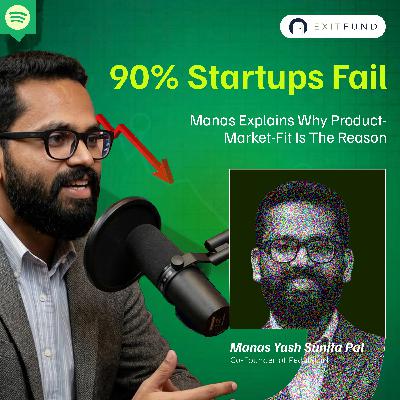
Most startup conversations focus on funding rounds, valuations, and success stories—but very few talk about the hardest phase: the journey from idea to product-market fit.In this episode of the ExitFund Podcast, Manas Yash Sunita Pal, Co-Founder of PedalStart, breaks down why the pre-seed stage is where most startups struggle—and often fail. From finding the right co-founder and validating the problem to getting the first customers and raising early capital, this phase is filled with uncertainty and critical decisions. PedalStart is building a founder-first ecosystem that supports startups in this exact phase, helping them move from ideation to early traction with hands-on guidance across product, growth, hiring, and fundraising.Why the pre-seed to seed journey is the hardest phase for foundersThe real reason 90% of startups fail globallyWhy product-market fit matters more than fundingWhy execution is more important than pitch decksThe difference between India and US startup ecosystemsWhether AI funding today is hype or real opportunityWhy India 2 and India 3 will drive the next wave of startupsHow investors should think about diversification and exitsFollow the ExitFund Podcast for more insights on startups, AI, and investing.In this episode, we cover:
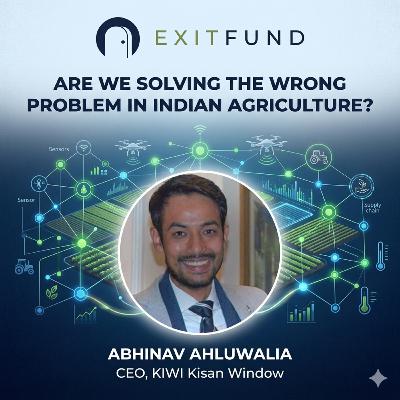
India’s agriculture sector supports over 50% of the workforce, yet most farmers still struggle with one core issue: getting fair prices and reliable market access. Despite decades of reforms and rising startup activity, these problems remain largely unsolved.In this episode of the ExitFund Podcast, Abhinav Ahluwalia, founder of Kiwi Kisan Window, shares how his venture is addressing these long-standing challenges by building a farm-to-consumer model that focuses on value addition at the source. We explore why simply increasing production has not improved farmer incomes, how supply chain inefficiencies impact pricing, and why quality-driven agriculture may be the future.Kiwi Kisan Window works closely with farmers across India to improve market linkage, ensure better pricing, and rediscover indigenous food products, creating a more sustainable and transparent agricultural ecosystem.In this episode, we cover:Why many farmers still struggle to sell at the right priceHow improving products at the farm can increase farmer incomeThe difference between growing more vs growing better qualityHow farm-to-consumer startups are changing how food reaches peopleWhy India’s strength is in quality and traditional food systemsWhat really happens after getting exposure on Shark TankFollow the ExitFund Podcast for more conversations on startups, AI, investing, and building impactful companies.
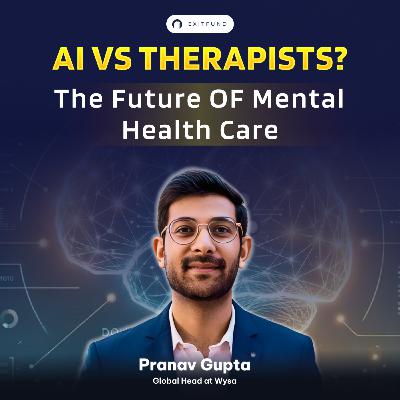
Mental health support is one of the largest unmet healthcare needs globally. As awareness grows, millions seek help for anxiety and stress, yet access to qualified therapists remains limited and expensive.In this episode of the ExitFund Podcast, Pranav Gupta, Global Head at Wysa, explains how AI-powered platforms expand access to emotional support while maintaining clinical safety by combining AI with human therapists. We discuss how Wysa uses CBT-based frameworks, why enterprises are becoming the main distribution channel, and why guardrails and risk detection are critical for AI in mental healthcare.Wysa has already supported millions of users across more than 95 countries, demonstrating how AI can democratize access to mental health support while complementing, rather than replacing, professional therapy.
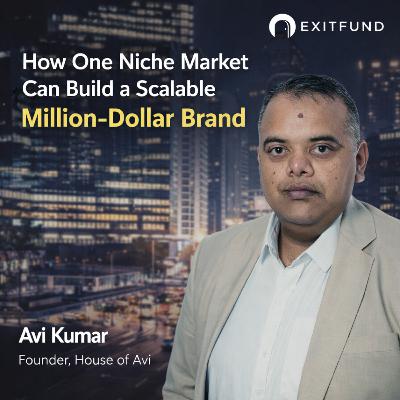
Entrepreneurship is often glamorized as scale, funding, and hype. In reality, sustainable businesses are built on focus, operational discipline, and clear market positioning. In a global footwear market projected to surpass $750 billion by 2030, even large industries leave profitable niche segments underserved.In this episode of the ExitFund Podcast, Avi Kumar, Founder of House of Avi, explains how identifying a specific gap extended and wider footwear sizes led to building an international, bootstrapped brand. By controlling manufacturing in India, maintaining fair pricing, and focusing on durability over trend cycles, House of Avi competes globally without venture capital backing. Alongside entrepreneurship, Avi also shares insights from his industrial relations and HR consulting work in Australia, emphasizing productivity, accountability, and disciplined workforce management.The conversation breaks down how niche dominance, supply chain control, pricing strategy, and strong people management can turn a focused idea into a scalable, million-dollar business.Follow the ExitFund Podcast for more conversations on startups, operators, and founders building real businesses under real-world constraints.

The cloud is no longer just infrastructure. It's a national strategy. With India pushing data localization mandates, healthcare compliance frameworks like DISHA, government-hosted cloud requirements, and tax incentives for foreign cloud providers entering the market, the country is entering a decisive phase in its cloud evolution.In this episode of the ExitFund Podcast, Chandni Jagga, Founder of Cloud Minister Technologies, breaks down:• Why data sovereignty is driving hyperscaler expansion in India• How Indian cloud providers compete and collaborate with global giants like AWS and Google Cloud• Why healthcare and fintech are leading cloud adoption• The real cost difference between on-premise infrastructure and scalable cloud services• Why Cloud Minister chose to stay bootstrapped in a capital-intensive industryShe also breaks down how small and mid-sized businesses should choose between owning hardware and using cloud providers and why scalable flexibility often beats ownership. As India accelerates toward a compliance-driven, GPU-powered hybrid cloud future, this conversation highlights where the real opportunity lies.Follow the ExitFund Podcast for more conversations on startups, infrastructure, and the systems shaping India’s economic future.

Video dominates digital consumption, yet most of it remains passive. Businesses invest heavily in driving traffic, but users watch, scroll, and leave without taking action. As the Agentic AI market moves toward $50 billion by 2030, the shift from static content to intelligent, action-driven systems is accelerating.In this episode of the ExitFund Podcast, Uday Bhadkar, Founder of Cliperact, shares how his platform transforms ordinary videos into interactive experiences where users can explore products, simulate journeys, and convert directly within the video. From landing large enterprise clients early and streaming billions of minutes annually to expanding into mid-sized and smaller businesses, this conversation explores how interactive video bridges the gap between engagement and revenue.Follow the ExitFund Podcast for more insights on startups, technology, and scalable growth.
Cybersecurity has moved from an IT function to a core business risk. With attacks increasing in frequency and impact, and cybercrime projected to cost $15.6 trillion globally by 2029, organizations can no longer rely on traditional, in-house security teams alone to protect growing digital assets.In this episode of the ExitFund Podcast, Abhinav Bangia, Founder of Com Olho, explains how their platform works by paying verified ethical hackers to legally test company websites and applications, identify real vulnerabilities, and report only issues with proven impact. These findings are filtered using AI-assisted triage and validated by human security analysts before being shared with organizations for remediation.The conversation breaks down how this incentive-driven model helps companies fix critical security gaps faster, reduce security costs, and prevent attackers from exploiting weaknesses before real damage occurs.Follow the ExitFund Podcast for more conversations on startups, deep technology, and how real businesses are built under real-world constraints.
India hosts massive public gatherings, but the systems that support crowd safety, storage, and movement still struggle to keep up. In this episode of the ExitFund Podcast, Manjunath Jakkur Munigowda, Founder of SafeCloak, shares how smart locker infrastructure is built and scaled across railways, temples, pilgrimages, and large events. Drawing from work across 26+ cities, he explains why peak demand can’t be planned using averages, why buffer capacity matters, and why trust and uptime matter more than speed.The conversation explores real challenges of IoT-backed public infrastructure in India, from demand swings and network failures to pricing differences and scaling hardware safely.In this episode, we cover:Why crowd infrastructure and short-term storage are often overlooked business opportunitiesHow pilgrimages and large events influence product design and capacity planningWhy planning extra capacity is critical for businesses that face peak demandHow IoT, cloud systems, and security help build trust at scaleWhy pricing and usage change across different locations and user groupsWhat founders need to standardize before scaling a physical infrastructure businessFollow ExitFund for more conversations on how real businesses are built in complex, capital-intensive markets.IntroIndia’s ₹20 lakh crore tourism sector moves billions annually across railways, airports, and tourist hubs, yet safety, storage, and crowd-flow infrastructure struggles to keep up. SafeCloak, built by Manjunath Jakkur Munigowda, closes this gap with IoT-enabled short-term storage across 26+ cities, 60+ locations, serving 360K+ customers.
India carries one of the world’s largest unmet cognitive and mental health needs, yet commercial adoption of mental health technology remains slow, fragmented, and capital-intensive.In this episode of the ExitFund Podcast, Arshad Koya, Founder and CEO of Coexin Technologies Healthcare Private Limited, breaks down what it actually takes to build and commercialize cognitive health devices in India. Drawing from a ten-year journey, he explains why hospital sales cycles are long, why D2C often fails in healthcare hardware, and how clinical validation creates defensibility that marketing cannot.The conversation offers a ground-level view of healthtech realities: pricing pressure, institutional inertia, grant-led funding, and the trade-offs between speed and credibility, while highlighting why cognitive health may be one of India’s most undervalued long-term healthcare opportunities.In this episode, we cover:Why mental health and cognitive health remain structurally underfunded marketsThe economics of selling healthcare hardware to hospitals and institutionsWhy B2B adoption creates stronger moats than consumer-led growthHow clinical validation replaces marketing spend as a growth leverWhat investors often misunderstand about healthtech timelines in IndiaA candid conversation for founders, operators, and investors looking to understand how real healthcare businesses are built, slowly, rigorously, and with lasting impact.
AI adoption is accelerating across India, but most enterprises still struggle to convert pilots into measurable business impact. While startups rush to label everything as “AI-powered,” decision-makers increasingly demand clarity, specificity, and return on investment.In this episode of the ExitFund Podcast, Yugraj Dagur, Founder of Cleverr AI, breaks down what it really takes to build AI startups that enterprises adopt, trust, and scale with. Drawing from his experience building an AI co-pilot for D2C brands, Yugraj explains why most AI pilots fail, how ROI-driven positioning changes adoption, and why maturity, not novelty, defines winning AI companies.The conversation explores how Cleverr AI helps brands move beyond dashboards by consolidating fragmented data into a single source of truth, enabling AI-driven decisions that directly save time, save revenue, or generate growth.In this episode, we cover:How AI adoption is shifting from experimentation to ROI accountabilityWhy most enterprise AI pilots fail to convertThe difference between AI hype and AI that drives business outcomesWhy specificity beats “AI for everything” positioningHow design partnerships accelerate real product-market fitWhy small, focused teams may outperform large organizations in AI adoptionFollow the ExitFund Podcast for more conversations on startups, AI, investing, and building durable businesses in emerging markets.

90 percent of India’s urban population is exposed daily to polluted air, contaminated water, and high digital screen exposure.This environmental reality is reshaping consumer expectations and creating new demand in the skincare and haircare market.In this episode of the ExitFund Podcast, Tushar Bansal, Founder of Bonji, explains how pollution-driven oxidative stress is influencing consumer behavior and why science-led, India-specific formulations create stronger, more defensible businesses than marketing-first beauty brands.The conversation explores how Bonji applies pharmaceutical research, nanotechnology, and regulatory discipline to build products designed for Indian climate conditions rather than global white-label templates.In this episode, we cover:How environmental exposure is changing skincare and haircare demandWhy oxidative stress is becoming a consumer decision factorThe limits of white-label and trend-driven formulationsHow research-led development builds long-term brand advantageWhy direct consumer insight outperforms influencer-led growthFollow the ExitFund Podcast for more conversations on startups, consumer businesses, investment strategy, and sustainable brand building.

Foreign direct investment is driven by fundamentals, not headlines. In this episode, Axel Guyon from Choose Paris Region joins our podcast to explain why Paris Region continues to attract global capital even amid political debate and economic uncertainty. The discussion focuses on what investors actually evaluate when expanding into Europe and why Paris Region remains a competitive, long-term business destination for global founders and enterprises.What keeps foreign direct investment flowing into Paris Region year after year?Does political uncertainty in France actually impact investor confidence?How do global businesses assess risk when entering European markets?Why are Indian companies increasingly considering Paris Region for expansion?How do talent shortages and demographics shape investment strategy?What fundamentals matter most when choosing a European base of operations?If you found this conversation valuable, follow our podcast for more insights on global business, investment strategy, startups, and leadership. Share this episode with founders, operators, and investors navigating international expansion.Here is what you will get to know:
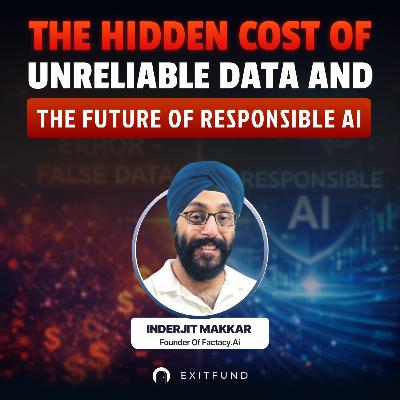
Over 70 percent of enterprise data goes unused because organizations struggle to verify, structure, and trust it at scale. Inderjit Makkar, Founder of Factacy.ai, joins ExitFund to explain why data accuracy and factual validation are now the real bottlenecks in AI adoption. He shares how Factacy.ai is helping enterprises turn chaotic data into trusted intelligence they can rely on for critical decisions.This episode goes beyond AI buzzwords to explore what it takes to build dependable systems, why trust is harder than innovation, and how founders can create meaningful impact by solving foundational problems.What you’ll learnWhy unstructured data is the biggest bottleneck in enterprise AIHow Factacy.ai improves data accuracy and decision confidenceThe difference between building AI demos and production-ready systemsWhy trust and explainability are essential for AI adoptionCommon mistakes companies make when scaling AI solutionsFounder lessons from building in deep-tech and enterprise marketsHow to think long-term while building AI products responsiblyIf you found this conversation valuable, follow our podcast for more insights at the intersection of startups, AI, leadership, and global innovation. Don’t forget to share this episode with builders, operators, and anyone interested in the future of trustworthy AI.

Rishendra Nihon, CEO and Founder of “Work in Nihon” joins ExitFund to share how he’s building a trusted cross-border recruitment platform connecting talent from South Asia to opportunities in Japan and beyond. With over 16 years of experience in international business development, remittance, and hospitality, Rishendra reflects on leadership, honesty in global business, and what it takes to create ethical, people-first companies across cultures.This episode dives into real-world challenges of cross-border hiring, cultural differences in decision-making, and how entrepreneurs can think globally while starting small.How Nihon is simplifying cross-border recruitment between South Asia and JapanWhy honesty and transparency are critical in international businessKey differences between Indian subcontinent and Japanese business culturesLessons from 16+ years in leadership across multiple industriesHow to spot opportunities in complex global marketsWhy ethical hiring and trust are the future of global recruitmentDaily habits and mindset shifts for aspiring entrepreneurs and leadersWhat you’ll learnIf you found this conversation valuable, follow ExitFund for more insights at the intersection of startups, global business, leadership, and long-term impact.Don’t forget to share this episode with someone dreaming of building a global career or company.

Monica Taparia from AssetVault explains how AI-powered legal-tech is changing the way estate planning works in India, making complex legal processes easier to understand, faster to execute, and more reliable for families. This podcast focuses on practical challenges, real-world outcomes, and how technology can prevent legal uncertainty before it begins.What you’ll learn-How AI and legal-tech simplify will creation and estate planningWhat happens to assets when legal planning is delayed or unclearHow technology reduces dependence on lengthy court processesThe role of legal-tech in managing cross-border assets securelyWhy estate planning should be proactive, not reactiveIf you found this conversation valuable, follow ExitFund for more insights at the intersection of startups, AI, legal-tech, and long-term impact.Don’t forget to share this episode with someone who could benefit from clearer legal planning.
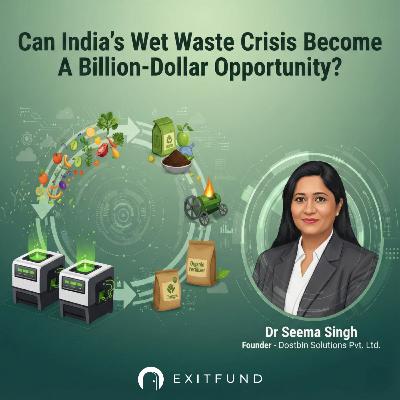
India’s wet-waste challenge is far larger than most people realize, and solving it requires practical solutions at the household level.In this episode, Dr. Seema Singh, founder of Dostbin Solutions, breaks down how her patented, IoT-enabled composting system makes home composting simple, odorless, and reliable. Dostbin integrates smart shredding, moisture control, optimized aeration, and app-based monitoring to enable true aerobic composting and convert daily waste into nutrient-rich compost for organic farming.More than a device, Dostbin offers a decentralized, climate-resilient model that empowers households, supports farmers, and helps build cleaner Indian cities.What You’ll LearnWhy centralized waste systems fail to manage India’s daily wet-waste loadHow Dostbin’s patented design solves moisture, odor, and microbial challengesThe role of IoT and data in building a decentralized compost supply chainWhy true aerobic composting matters for soil health and organic farmingHow household-level waste solutions can drive climate and community impactListen to the full episode to understand how household innovation can reshape India’s waste and farming systems. Follow ExitFund for more conversations at the intersection of startups, funding, and impact-driven entrepreneurship.
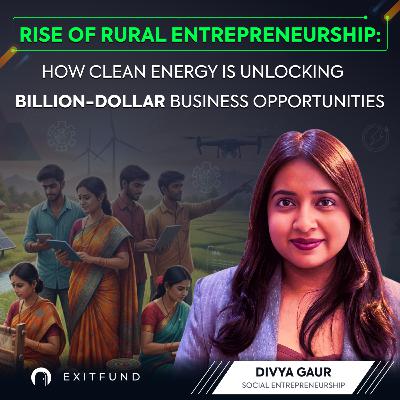
Most conversations about technology focus on startups, capital, and scaling, but Divya Gaur of CEEW believes India’s biggest opportunity lies in clean energy, rural entrepreneurship, and women-led economic growth.CEEW goes beyond research by turning evidence into real action. Through the Powering Livelihoods program, they help clean-energy startups scale, support rural micro-entrepreneurs, and promote sustainable technologies that raise incomes and protect the environment.In this episode, Divya explains the $50B rural opportunity, how decentralized renewable energy can transform 37 million livelihoods, and why women are becoming key drivers of grassroots innovation.We discuss:• How CEEW moves research into on-ground deployment• The economic impact of empowering rural women• Why solar pumps, cold storage, dryers, and biomass systems change livelihoods• Barriers women face when accessing credit• How DRE reduces drudgery, boosts income, and cuts diesel use• Why sustainability and economic growth work together• How policy, finance, startups, and research shape India’s next economy• What PM-KUSUM and PM-FME get right and where they must improve• What it takes to scale livelihood solutions across IndiaIf you want to understand how sustainability can be profitable or how rural India is becoming an innovation hub, this episode is for you.Follow ExitFund for more conversations at the intersection of funding, startups, and investment.
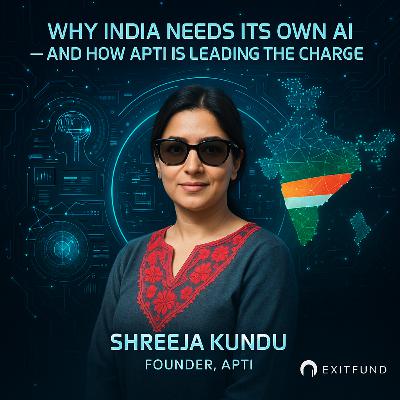
Across India, millions of small and medium businesses are racing to stay competitive, yet most still lack the technology, data intelligence, and clarity needed to scale. In this episode, Shreeja Kundu of APTI Bharat shares how their homegrown AI is transforming this landscape, helping SMEs cut acquisition costs, decode real customer behavior, and grow smarter. With India-first engineering, APTI is empowering solid vision incorporating digital strategies for business scalability at the grassroots level.Here’s what you’ll learn in this episode:How Indian SMEs are overspending on customer acquisition and how AI fixes itWhy generic dashboards fail, and what “Indianized AI models” really unlockHow data privacy, compliance, and fairness shape the future of business techWhat APTI’s deep analytics reveal about real marketing ROIShreeja’s insights for founders building zero-to-one in India’s AI spaceIf you enjoyed this conversation, like, share, and follow Exit Fund for more founder stories and real-world business breakthroughs.
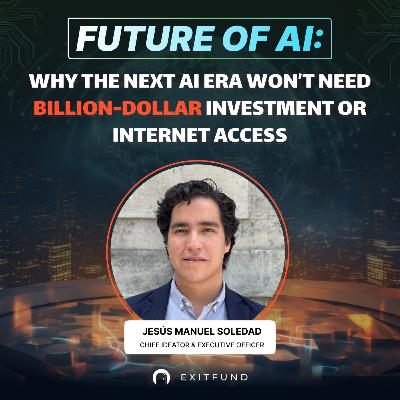
Real breakthroughs don’t always come from following the standard rules, they come from questioning it.While AI giants battle to build bigger models, consume more data, and scale GPU farms, Jesús Manuel Soledad believes the world needs the opposite: smaller, more efficient, more private AI that doesn’t depend on massive infrastructure.In this episode, Jesús shares how he went from a lawyer in Chihuahua, Mexico to the founder of Marté AI, a company daring to challenge the foundational assumptions of modern AI. By asking the questions no one else is asking—Do we actually need massive datasets? Why must AI depend on GPUs? What if intelligence can run fully offline?—Marté AI is reinventing how AI is built.We dive into:Why Jesús left law to self-learn AI during the pandemicHow challenging the “more data, bigger models” mantra unlocked new discoveriesThe surprising insights found by training a single neuron from scratchWhy Marté AI believes the AI industry took a wrong turn years agoHow offline AI can protect privacy—and why centralizing intelligence is dangerousThe hybrid symbolic + neural approach enabling models under 5 MBWhy efficient AI could save massive energy, water, and compute globallyThe philosophical question: Are we discovering intelligence… or reverse-engineering a happy accident?Follow ExitFund for more founder stories from the frontier of technology. Share this episode with someone who believes true innovation starts by asking, “Says who?”
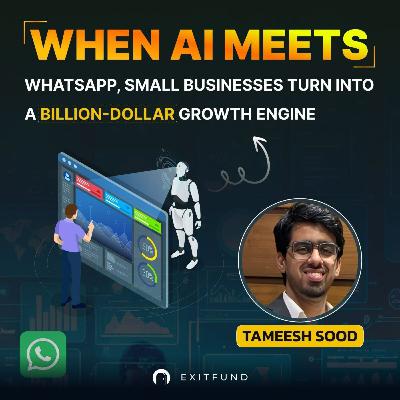
True innovation isn’t about building for the elite, it’s about empowering the everyday entrepreneur.While technology has revolutionized consumers and large enterprises, India’s 73 million small businesses still run on manual workflows, their most advanced tool often being WhatsApp. Fixit is changing that by creating AI employees that automate sales, qualify leads, and manage operations directly through simple chat.In this episode, Themesh, founder of Fixit, shares how conversational AI is transforming India’s SMB landscape from manual to intelligent and unlocking the country’s next big productivity revolution:Why small businesses are India’s most overlooked yet high-potential marketHow Fixit built AI employees on WhatsApp, where every SMB already works and sellsThe inside story of qualifying 100,000 leads in just one day using AIWhy the future isn’t AI vs humans, it’s humans with AIThe leadership principles driving Fixit’s growth: work ethic, persistence, and design thinkingFollow Exit Fund for more founder stories where technology meets purpose. Share this episode with someone building the future of small business tech.

Comments

Download from Google Play

Download from App Store
 United States