


 Claim Ownership
Greenhouse Environmental Humanities Book Talks
Subscribed: 2Played: 87
Subscribe

© 2025 The Greenhouse
Description
The Greenhouse Environmental Humanities Book Talk has become the go-to resource for the latest in environmental humanities scholarship. Each episode features an author discussing their new book (within the last two years) in the broad field of environmental humanities, which includes environmental history, philosophy, literary criticism, anthropology, and more. The author introduces the book and then the hosts Dolly and Finn Arne Jørgensen have a conversation with the author about the book. Live audience members are also invited to ask their own questions. Live talks are sometimes streamed with video, so some speakers may reference things that the audience saw visually during the talk. The talks are organized by the Greenhouse Center for Environmental Humanities at the University of Stavanger, Norway.
188 Episodes
Reverse
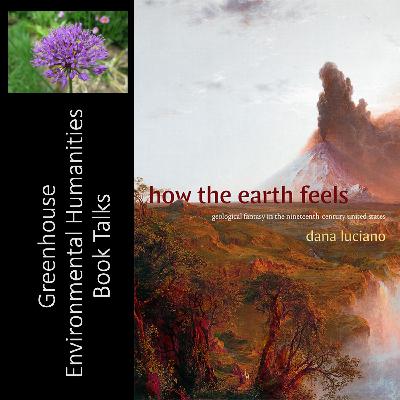
Dana Luciano, Associate Professor of English and Women’s, Gender, and Sexuality Studies at Rutgers University, discussed her book How the Earth Feels: Geological Fantasy in the Nineteenth-Century United States (Duke University Press, 2024) in the Greenhouse environmental humanities book talk series on Monday, 22 April 2024.
In How the Earth Feels Dana Luciano examines the impacts of the new science of geology on nineteenth-century US culture. Drawing on early geological writings, Indigenous and settler accounts of earthquakes, African American antislavery literature, and other works, Luciano reveals how geology catalyzed transformative conversations regarding the intersections between humans and the nonhuman world. She shows that understanding the earth’s history geologically involved confronting the dynamic nature of inorganic matter over vast spans of time, challenging preconceived notions of human agency. Nineteenth-century Americans came to terms with these changes through a fusion of fact and imagination that Luciano calls geological fantasy. Geological fantasy transformed the science into a sensory experience, sponsoring affective and even erotic connections to the matter of the earth. At the same time, it was often used to justify accounts of evolution that posited a modern, civilized, and Anglo-American whiteness as the pinnacle of human development. By tracing geology’s relationship with biopower, Luciano illuminates how imagined connections with the earth shaped American dynamics of power, race, and colonization.

Nathan K. Hensley, Professor of English at Georgetown University (USA), discussed his book Action Without Hope: Victorian Literature After Climate Collapse (University of Chicago Press, 2025) in the Greenhouse environmental humanities book talk series on Monday, 8 December 2025.
What does it feel like to live helplessly in a world that is coming undone? Nathan Hensley turns to Victorian literature to uncover a prehistory of this deeply contemporary sense of powerlessness. For many in nineteenth-century Britain, their world seemed so scarred by human rapacity that restoring it seemed beyond the powers of any one individual. Like George Eliot’s characters in Middlemarch or the doomed lovers of Wuthering Heights, observers of the gathering carbon economy felt themselves ensnared by interlocked and broken systems. In the face of damage so vast and apparently irreversible, what could possibly be done?
To answer this question, Hensley shows that nineteenth-century writers and artists devised new ways to understand action—and hope. They rescaled action away from the grandly heroic and toward minor adjustments and collaborative interventions. They turned away from logical proofs and direct argumentation and instead called on aesthetic technologies like sonnets and fractured lyrics, watercolor sketches, and vast, multiplot novels, finding scope for action not at the level of the theme or the thesis but in gestures and details. Ranging from J. M. W. Turner’s painterly technique to Emily Brontë’s dreamlike fragments (and reading along the way works by Alfred, Lord Tennyson, H. G. Wells, Lewis Carroll, Gerard Manley Hopkins, William Berryman, Charlotte Brontë, George Eliot, and Christina Rossetti), Hensley’s study makes an important contribution to Victorian studies and the environmental humanities.

Joanna Allan, Associate Professor in global development at Northumbria University, UK, discussed her book Saharan Winds: Energy Systems and Aeolian Imaginaries in Western Sahara (West Virginia University Press, 2024) in the Greenhouse environmental humanities book talk series on Monday, 1 December 2025.
As climate crisis ensues, a transition away from fossil fuels becomes urgent. However, some renewable energy developments are propagating injustices such as landgrabs, colonial dispossession, and environmentally destructive practices. Changing the way we imagine and understand wind will help us ensure a globally just wind energy future.
Saharan Winds contributes to a fairer energy horizon by illuminating the role of imaginaries—how we understand energy sources such as wind and the meanings we attach to wind—in determining the wider politics, whether oppressive or just, associated with energy systems. This book turns to various cultures and communities across different time periods in Western Sahara to explore how wind imaginaries affect the development, management, and promotion of wind farms; the distribution of energy that wind farms produce; and, vitally, the type of politics mediated by all these elements combined. Highlighting the wind-fueled oppression of colonial energy systems, the book shows the potential offered by nomadic, Indigenous wind imaginaries for contributing to a fairer energy future.

Dominic Hinde, Lecturer in Sociology at the University of Glasgow, discussed his book Drifting North: Finding a sustainable future in Scotland’s past (Manchester University Press, 2025) in the Greenhouse environmental humanities book talk series on Monday, 17 November 2025.
Past and future collide in this engaging journey through climate change, fossil capitalism and the struggle for a sustainable world.
Scotland’s history and future are entangled with climate change and the story of the modern world. This small country on the fringes of northern Europe pioneered fossil capitalism and played a key role in its spread across the planet. It is a living museum of the crisis of the west, of deindustrialisation, stagnation and the struggle to build a better future from the ashes.
Journalist and sociologist Dominic Hinde travels from the treeless Highlands to the lowland cities, struggling to balance memories with aspiration. Through this journey he finds that his own sensory turmoil, shaped by recovery from a near fatal accident, mirrors the disarray of the fossil fuel transition – an uncertain passage between what was and what must be.
Part memoir, part environmental history, part travelogue, this is a compelling narrative of connections – to place, energy and the possibility of renewal. Through the lens of one country, it asks a vital question: can the lessons of the past help us build a more sustainable future?

Dolly Jørgensen, Professor of History at University of Stavanger (Norway) and co-host of the Greenhouse Environmental Humanities Book Talks, presented her own book Ghosts Behind Glass: Encountering Extinction in Museums (University of Chicago Press, 2025) in conversation with co-host Finn Arne Jørgensen and special co-host Ellen Arnold on Monday, 10 November 2025.
While it’s no longer possible to encounter a dodo in the wild, we can still come face-to-face with them in museums. The remains of extinct species—whether taxidermied, skeletal, drawn, or sculpted—stare back at us from display cases.
In this moving meditation on what’s lost and what endures, environmental historian Dolly Jørgensen visits natural history collections worldwide—from Shanghai to Philadelphia, from Edinburgh to Hobart, Australia—to understand the many ways that museums tell stories about extinction. She encounters extinct animals that are framed as cultural artifacts and as rare valuables, that are memorialized with lists, and that are brought to life through augmented reality. She draws our attention to creatures with prominent afterlives—passenger pigeons, giant moas, thylacines—as well as those that are less likely to be discussed or displayed. Throughout, Jørgensen examines the relationship between museums and the natural world, so readers can look more closely at exhibits about extinction, studying the displays for what is there, as well as what is missing. During a period of rapid species loss driven by humanity’s environmental impact, Ghosts Behind Glass asks what we can learn about our world from the presence of the extinct.

Micah Muscolino, professor and Paul G. Pickowicz Endowed Chair in Modern Chinese History at the University of California San Diego (USA), discussed his book Remaking the Earth, Exhausting the People: The Burden of Conservation in Modern China (University of Washington Press, 2025) in the Greenhouse environmental humanities book talk series on Monday, 27 October 2025.
From the 1940s to the 1960s, soil and water conservation measures transformed both the arid, erosion-prone environment of China’s Loess Plateau and the lives of rural people. Remaking the Earth, Exhausting the People explores how the Chinese state imposed the burden of conservation on rural communities and how the communities navigated those demands. Weaving together archival research and oral history interviews, Micah S. Muscolino demonstrates that for the inhabitants of China’s countryside, conservation programs became part of an extractive mode of accumulation that intensified labor demands and entailed loss of control over resources.
Muscolino recounts how changes to the physical environment played out in villages, on farms, and within households. His multitiered investigation uncovers the relationship between the forces of nature, Chinese state policies, and the embodied experiences of rural men and women. The book also highlights the contestations and compromises that the state’s environmental interventions triggered in rural society. By illustrating how state-building and revolution in modern China altered human relationships with the natural world, Muscolino shows that examining everyday interactions with the environment is integral to understanding history from the perspectives of China’s common people. He offers a timely reminder that environmental protection cannot come at the cost of marginalized communities’ dignity, interests, or aspirations.

Marianna Dudley, Senior Lecturer in Environmental Humanties at University of Bristol (UK), discussed her book Electric Wind: An Energy History of Modern Britain (Manchester University Press, 2025) in the Greenhouse environmental humanities book talk series on Monday, 20 October 2025.
There are turbines on the horizon. The blades whirl with metronomic rhythm. With each rotation, wind is transformed into electricity. An energy revolution is underway.
Electric wind rewinds to the beginning to explore the rise of wind energy in modern Britain. From the industrial revolution to the aftermath of war, through energy crises and the changing politics of the late twentieth century, we see how energy has shaped a nation – and how a nation is reflected and refracted through energy. Boldly charting Britain through its wildest, windiest places, this book takes us to the edges of land and beyond to think deeply about the role of nature in politics, science and technology. Visionaries and hippies join engineers and entrepreneurs. Traditions and local cultures meet infrastructure and industry in this captivating history.
At a time when action on carbon emissions is urgent, Electric wind offers examples, ideas and stories to fuel change going forwards. This book is an essential read for anyone interested in nature, climate change, landscape and the making of modern Britain.

Roy Scranton, Associate Professor and Director of the Environmental Humanities Initiative (EHUM) at University of Notre Dame (USA), discussed his book Impasse: Climate Change and the Limits of Progress (Stanford University Press, 2025) in the Greenhouse environmental humanities book talk series on Monday, 6 October 2025.
Extreme heat, fires, floods, and storms are transforming our planet. Yet instead of serious responses from world leaders, we get increasing emissions, divisive politics, and ersatz solutions that offer more of the same: more capitalism, more complexity, more “progress.”
The impasse we face is not only political and institutional, but cognitive, existential, and narrative. We’re incapable of grasping the scale, speed, and impact of global warming. Our brains can’t make sense of how radically our world is changing. And we optimistically cling to a civilizational narrative that promises a better tomorrow if we just keep doing what we’re doing.
It’s well past time, Roy Scranton argues, to free ourselves from our dangerous and dogmatic faith in progress. Such unwarranted optimism will only accelerate our collective disintegration. If we want to have any hope at all for the future, it must be grounded in a recognition of human limits—a view Scranton calls ethical pessimism.
Drawing from psychology, philosophy, history, and politics, as well as film, literature, and personal experience, Scranton describes the challenges we face in making sense of our predicament, from problems in communication to questions of justice, from the inherent biases in human perception to the difficulties of empirical knowledge. What emerges is a challenging but ultimately hopeful proposition: if we have the courage to accept our limits, we may find a way to embrace our unknowable future.

Brad Bolman, Assistant Professor of History at Tulane University (USA), discussed his book Lab Dog: What Global Science Owes American Beagles (University of Chicago Press, 2025) in the Greenhouse environmental humanities book talk series on Monday, 29 September 2025.
Intrepid, docile, and cloaked in coats of white, black, and tan, beagles were one of the most popular breeds in the United States in the twentieth century. From Snoopy to dog shows, many Americans loved and identified with beagles. But during the same period, as scientists searched for a standard research dog, beagles emerged as something else: an ideal animal for laboratory experimentation.
In Lab Dog, historian Brad Bolman explains how the laboratory dog became a subject of intense focus for twentieth-century scientists and charts the beagle’s surprising trajectory through global science. Following beagles as they moved from eugenics to radiobiology, pharmaceutical testing to Alzheimer’s studies, Lab Dog sheds new light on pivotal stories of twentieth-century science, including the Manhattan Project, tobacco controversies, contraceptive testing, and behavioral genetics research. Bolman shows how these experiments shaped our understanding of dogs as intelligent companions who deserve moral protection and socialization—and in some cases, daily medication. Compelling and accessible, Lab Dog tells the thorny story of the participation of beagles in science, including both their sacrifices and their contributions, and offers a glimpse into the future of animal experimentation.

Jules Skotnes-Brown, Research Fellow at the University of St. Andrews (UK), discussed his book Segregated Species: Pests, Knowledge, and Boundaries in South Africa, 1910–1948 (Johns Hopkins University Press, 2024) in the Greenhouse environmental humanities book talk series on Monday, 15 September 2025.
Throughout the twentieth century, rural South Africa was dominated by systems of racial segregation and apartheid that brutally oppressed its Black population. At the same time, the countryside was defined by a related settler obsession: the control of animals that farmers, scientists, and state officials considered pests. Elephants rampaged on farmlands, trampling fences, crops, and occasionally humans. Grain-eating birds flocked on plantations, devouring harvests. Bubonic plague crept across the veld in the bodies of burrowing and crop-devouring rodents.
In Segregated Species, Jules Skotnes-Brown argues that racial segregation and pest control were closely connected in early twentieth-century South Africa. Strategies for the containment of pests were redeployed for the management of humans and vice versa. Settlers blamed racialized populations for the abundance of pests and mobilized metaphors of pestilence to dehumanize them. Even knowledge produced about pests was segregated into the binary categories of “native” and “scientific.” Black South Africans critiqued such injustices, and some circulated revolutionary rhetoric through images and metaphors of locusts.
Ultimately, pest-control practices played an important role in shaping colonial hierarchies of race and species and in mediating relationships among human groups. Skotnes-Brown demonstrates that the history of South Africa—and colonial history generally—cannot be fully understood without analyzing the treatment of both animals and humans.

Tina Adcock, assistant professor of history at Simon Fraser University (Canada), discussed her book A Cold Colonialism: Modern Exploration and the Canadian North (University of British Columbia Press, 2025) in the Greenhouse environmental humanities book talk series on Monday, 8 September 2025.
Exploration has long been pivotal to southern engagements with northern Canada, but it is most often associated with the nineteenth century or earlier. A Cold Colonialism offers the first extended examination of twentieth-century exploration in the Canadian North. Modern exploration helped southerners establish and maintain distinctive kinds of colonial and settler colonial power over northern Indigenous homelands.
Who explored the North between 1918 and 1965? What forms did exploration take? What did it mean to explorers and others affected by it? Tina Adcock focuses on four representative explorers with richly documented careers: mining engineer George Douglas, surveyor Guy Blanchet, ethnologist Vilhjalmur Stefansson, and filmmaker Richard Finnie. Each used exploration to grapple with key, often discomfiting aspects of modernity, including industrialization, urbanization, and the specialization of knowledge.
Despite limited experience in and knowledge of the Canadian North, these explorers helped southern militaries, industries, and governments exert control over northern peoples and lands. Each also claimed belonging in and authority over the North, speaking over people who had long resided there and better understood the region. The ways that explorers felt about, thought about, and moved through the North still resonate among southern settlers in Canada today.

Richard Fallon, KE Fellow at University of Nottingham and Postdoctoral Researcher in Collections and Culture at the Natural History Museum (UK), discussed his book Contesting Earth’s History in Transatlantic Literary Culture, 1860-1935: Believers and Visionaries on the Borderlines of Geology and Palaeontology (Oxford University Press, 2025) in the Greenhouse environmental humanities book talk series on Monday, 1 September 2025.
By the mid-nineteenth century, geologists and palaeontologists had reconstructed an authoritative narrative of Earth’s deep history, from the planet’s molten origins to the rise of humanity. Many figures in transatlantic science across subsequent decades, however, had problems with this narrative: it was too secular, inhuman, and evolutionary, or controlled too exclusively by elite scientists. Speaking from palaeoscience’s unevenly professionalized and controversy-racked borderlines, Christian fundamentalists, charismatic psychics, and respected scholars alike voiced their objections. Until now, no study has brought their work together for detailed comparative analysis. Spanning from the 1860s to the interwar decades, Contesting Earth’s History examines the fascinating history of five significant examples of fringe or ‘borderline’ palaeoscience: old- and young-earth creationism, hollow-earth theory, clairvoyant time travel, and sunken-continent catastrophism. Innovatively combining methods from literature and science studies with the history of science, this book attends not just to the conceptual content of these strange sciences, but also to their proponents’ communication of truth claims through diverse genres ranging from the scientific textbook to the epic poem. Close attention to the hitherto overlooked textual forms and literary strategies of ‘pseudoscience’ throws into relief competing conceptions of science’s audiences, methods, and forms of evidence. The authors examined in this book attempted to shift the balance of scientific power, creating textual spaces where exclusive hierarchies of expertise could be levelled away. Hijacking geologists’ and palaeontologists’ long-standing efforts at making the prehistoric past visible, these authors encouraged readers to gaze into time’s abyss with bold new eyes.

Rebecca K. Wright, Assistant Professor in History at Northumbria University (UK), discussed her book Moral Energy in America: From the Progressive Era to the Atomic Bomb (Johns Hopkins University Press, 2025) in the Greenhouse environmental humanities book talk series on Monday, 12 May 2025.
In Moral Energy in America, Rebecca K. Wright offers an illuminating exploration of how the concept of energy shaped American thought, culture, and politics throughout the first half of the twentieth century. This essential history traces how politicians, sociologists, geographers, urban planners, economists, and intellectuals adopted the idea of energy to bolster their social programs and visions of the future through distinctive energy imaginaries.
Energy was not a stable concept in the period, and it appealed to writers and advocates across the political and cultural spectrum. While medical practitioners and social workers interwove energy into discussions of race, immigration, youth, and crime, mainstream political campaigns appealed to the public by drawing energy into political rhetoric. Wright positions energy at the heart of key intellectual debates of the period, such as the Bourne-Dewey confrontation over America’s role in World War I and the rise of technocratic ideas that envisioned energy as a new metric for societal progress.
In a thirty-year era that shook the foundations of American democracy—a period punctuated by the Great Depression, the rise of communism and fascism abroad, two world wars, and the atomic bomb—energy became a key metaphor through which to understand major transformations in American society. Wright demonstrates how energy’s many meanings transcended material and scientific definitions to influence everything from racial theories to economic policies, and ultimately played a pivotal role in molding the American moral landscape.

John Kinder, director of American Studies and professor of history at Oklahoma State University (USA), discussed his book World War Zoos: Humans and Other Animals in the Deadliest Conflict of the Modern Age (University of Chicago Press, 2025) in the Greenhouse environmental humanities book talk series on Monday, 5 May 2025.
As Europe lurched into war in 1939, zookeepers started killing their animals. On September 1, as German forces invaded Poland, Warsaw began with its reptiles. Two days later, workers at the London Zoo launched a similar spree, dispatching six alligators, seven iguanas, sixteen southern anacondas, six Indian fruit bats, a fishing cat, a binturong, a Siberian tiger, five magpies, an Alexandrine parakeet, two bullfrogs, three lion cubs, a cheetah, four wolves, and a manatee over the next few months. Zoos worldwide did the same. The reasons were many, but the pattern was clear: The war that was about to kill so many people started by killing so many animals. Why? And how did zoos, nevertheless, not just survive the war but play a key role in how people did, too?
A harrowing yet surprisingly uplifting chronicle, Kinder’s World War Zoos traces how zoos survived the deadliest decades of global history, from the Great Depression, through the terrors of World War II, to the dawn of the Cold War. More than anything before or since, World War II represented an existential threat to the world’s zoological institutions. Some zoos were bombed; others bore the indignities of foreign occupation. Even zoos that were spared had to wrestle with questions rarely asked in public: What should they do when supplies ran low? Which animals should be killed to protect the lives of others? And how could zoos justify keeping dangerous animals that might escape and run wild during an aerial attack?
Zoos in wartime reveal the shared vulnerabilities of humans and animals during periods of social unrest and environmental peril. World War II–era zoos offered people ways to think about and grapple with imprisonment, powerlessness, and degradation. Viewed today, the story of zoos during World War II can be read as an allegory of twenty-first-century crises, as the effects of climate change threaten all life across the planet.
A one-of-a-kind history, World War Zoos is the story of how the world’s zoos survived the deadliest conflict of the twentieth century—and what was lost along the way.

Pollyanna Rhee, assistant professor of landscape architecture at the University of Illinois, Urbana-Champaign (USA), discussed her book Natural Attachments: The Domestication of American Environmentalism, 1920–1970 (University of Chicago Press, 2025) in the Greenhouse environmental humanities book talk series on Monday, 28 April 2025.
A massive oil spill in the Pacific Ocean near Santa Barbara, California, in 1969 quickly became a landmark in the history of American environmentalism, helping to inspire the creation of both the Environmental Protection Agency and Earth Day. But what role did the history of Santa Barbara itself play in this? As Pollyanna Rhee shows, the city’s past and demographics were essential to the portrayal of the oil spill as momentous. Moreover, well-off and influential Santa Barbarans were positioned to “domesticate” the larger environmental movement by embodying the argument that individual homes and families—not society as a whole—needed protection from environmental abuses. This soon would put environmental rhetoric and power to fundamentally conservative—not radical—ends.

Josh Nygren, Associate Professor of history at the University of Central Missouri (USA), discussed his book The State of Conservation: Rural America and the Conservation-Industrial Complex since 1920 (University of North Carolina Press, 2025) in the Greenhouse environmental humanities book talk series on Monday, 7 April 2025.
In the twentieth century, natural resource conservation emerged as a vital force in US politics, laying the groundwork for present-day sustainability. Merging environmental, agricultural, and political history, Joshua Nygren examines the political economy and ecology of agricultural conservation through the lens of the “conservation-industrial complex.” This evolving public-private network—which united the US Department of Agriculture, Congress, local and national organizations, and the agricultural industry—guided soil and water conservation in rural America for much of the century. Contrary to the classic tales of US environmental politics and the rise and fall of the New Deal Order, this book emphasizes continuity. Nygren demonstrates how the conservation policies, programs, and partnerships of the 1930s and 1940s persisted through the age of environmentalism, and how their defining traits anticipated those typically associated with late twentieth-century political culture.
The conservation-industrial complex promoted a development-oriented brand of conservation that aided the rise of large-scale, capital-intensive agriculture which continues today. It also reshaped the physical and political landscapes of the country, leading to impressive conservation victories and spectacular failures by privileging some environments, degrading others, and intensifying farm depopulation. In the name of environmental protection, agricultural conservation made rural America less equal.

Christian Long, media studies scholar at University of Queensland (Australia), discussed his book Infrastructure in Dystopian and Post-apocalyptic Film, 1968–2021 (University of Chicago Press, 2024) in the Greenhouse environmental humanities book talk series on Monday, 31 March 2025, at the special start time of 11am Central European time (7pm AEST in Queensland).
Dystopian and post-apocalyptic movies from 1968 to 2021 usually conclude with optimism, giving the audience a window into what is possible in the face of social dysfunction. The infrastructure that peeks through at the edges of the frame surfaces some of the concrete ways in which dystopian and post-apocalyptic survivors have made do with their damaged and destroyed worlds. In this book, Christian B. Long argues that if the happy endings so common to mass-audience films do not provide an all-encompassing vision of a better world, the presence of infrastructure, whether old or retrofitted or new, offers a starting point for the continued work of building toward the future.
Film imaginings of energy, transportation, water, waste, and their combination in the food system reveal what might be essential infrastructure on which to build the new post-dystopian and post-apocalyptic communities. We can look to dystopian and post-apocalyptic movies for a sense of where we might begin.

Sasha Gora, cultural historian and Project Director of “Off the Menu” at University of Augsburg (Germany), discussed her book Culinary Claims: Indigenous Restaurant Politics in Canada (University of Toronto Press, 2025) in the Greenhouse environmental humanities book talk series on Monday, 24 March 2025.
Culinary Claims explores the complex relationships between wild plants and introduced animals, Indigenous foodways, and Canadian regulations. Blending food studies with environmental history, the book examines how cuisines reflect social and political issues related to cultural representation, restaurants, and food sovereignty.
L. Sasha Gora chronicles the rise of Indigenous restaurants and their influence on Canadian food culture, engaging with questions about how shifts in appetite reflect broader shifts in imaginations of local environments and identities. Drawing on a diverse range of sources – from recipes and menus to artworks and television shows – the book discusses both historical and contemporary representations of Indigenous foodways and how they are changing amid the relocalization of food systems.
Culinary Claims tells a new story of settler colonialism and Indigenous resistance, emphasizing the critical role that restaurants play in Canada’s cultural landscape. It investigates how food shapes our understanding of place and the politics that underpin this relationship. Ultimately, the book asks, What insights can historians gain from restaurants – and their legacies – as reflections of Indigenous and settler negotiations over cultural claims to land?

Gina Caison, Associate Professor of Southern Literature at Georgia State University (USA), presented Erosion: American Environments and the Anxiety of Disappearance (Duke University Press, 2024) in the Greenhouse environmental humanities book talk series on Monday, 17 March 2025.
In Erosion, Gina Caison traces how American authors and photographers have grappled with soil erosion as a material reality that shapes narratives of identity, belonging, and environment. Examining canonical American texts and photography, including John Steinbeck’s The Grapes of Wrath, Octavia Butler’s Parable series, John Audubon’s Louisiana writings, and Dorothea Lange’s Migrant Mother, Caison shows how concerns over erosion reveal anxieties of disappearance that are based in the legacies of settler colonialism. Soil loss not only occupies a complex metaphorical place in the narrative of American identity; it becomes central to preserving the white settler colonial state through Indigenous dispossession and erasure. At the same time, Caison examines how Indigenous texts and art such as Lynn Riggs’s play Green Grow the Lilacs, Karenne Wood’s poetry, and Monique Verdin’s photography challenge colonial narratives of the continent by outlining the material stakes of soil loss for their own communities. From California to Oklahoma to North Carolina’s Outer Banks, Caison ultimately demonstrates that concerns over erosion reverberate into issues of climate change, land ownership, Indigenous sovereignty, race, and cultural and national identity.

Kylie Crane, Professor of British and American Cultural Studies at University of Rostock (Germany), will discuss her book Concrete and Plastic: Thinking Through Materiality (Bloomsbury Academic, 2024) in the Greenhouse environmental humanities book talk series on Monday, 3 March 2025.
Plastic and concrete are two of the most ubiquitous materials of the modern age. This open access book traces inventions, inventories and interventions of these materials as they pervade our day-to-day lives across various forms.
By proposing we think of the ways materials configure ‘future artefacts’, and by recognizing the various ways in which materials shape our encounters with the world, the book explores the productive tensions implicit in, and between, concrete and plastic. Drawing ona wide range of sources, including novels, essays, travel and nature writings, films, poems, souvenirs, advertisements, policy documents, environmental art, wrapping,and (popular) science writing, the book attends to all kinds of cultural artefacts to trace imaginative entanglements with disparate others in the Anthropocene.

Comments

Download from Google Play

Download from App Store
 United States