


 Claim Ownership
Geographers without Borders
Subscribed: 16Played: 127
Subscribe

© Women in GIS
Description
Women in GIS presents "Geographers without Borders". This interview-style podcast brings you guests from around the world to share about their niche in geography. From GIS to Urban Planning to Marine Biology, scientists and professionals around the world use the science of geography to solve problems critical to humanity every day.
With Host, Shannon Foxx-Day, and Producer, Caitlin Hagar-Kuhn.
With Host, Shannon Foxx-Day, and Producer, Caitlin Hagar-Kuhn.
45 Episodes
Reverse
Dr. Alameh is an award-winning industry-recognized geospatial leader and visionary withproven business building and scaling experience in industry and nonprofits. She focuses in bridging technology and policy at a national and global scale. She has an extensive global network across industry, government, academia, and non profit sectors, spanning geospatial, earth observations, data science, AI, and climate. Dr. Alameh is a seasoned board member, startup advisor, and young professional mentor. She has an PhD in Geographic Information Systems from MID, a Masters of Science in Civil and Environmental Engineering, and a Master in City Planning.
In our third episode of the Award Series, I speak with Devika Jain, the recipient of the Distinguished Contributions Award from Women in GIS for 2025. Devika tells me about why she came to GIS and how her interest in systems to address real world problems drove her pursuit of knowledge in the geospatial realm. We also discuss her work applying Machine Learning to millions of tweets and what the data showed her team about sentiments in different locations. Listen to hear her concerns about big data, when not to scale up, and how to approach big data biases. If you're interested in learning more about grant and scholarship opportunities from Women in GIS, check us out always at womeningis.org.
 1
1Kris Manske is an emerging GIS Professional, with extensive experience in data management and communications. She discusses with us the challenges faced when laid off from a job, how jiu jitsu has helped her job hunt, and what advice she has for those who might be interested in changing their career trajectory.
In our second episode of the Award Series, I speak with Dolphine Mogina and Hannah Permaul Flores, who were both selected for the Young Professionals Award from Women in GIS in 2025. Together we discuss Hannah's lifelong fascination with maps and how Dolphine's grandmother affected her decision to pursue GIS as a tool. We also talk about tools they use to share their results, the impact of their continuing work, and what their plans are next!Listen to hear how Dolphine is planning to bring 100% electrification to all of Africa and Hannah's thoughts on Nature as healthcare. If you're interested in learning more about grant and scholarship opportunities from Women in GIS, check us out always at womeningis.org.Hannah Permaul Flores is a published researcher and environmentalist whose work bridges geography, resilience, and the arts. She is currently pursuing her MSc in Geography at the University of Toronto, where she explores environmental determinants of health through a spatial lens. She holds an Honours Bachelor of Science degree from the U of T with a double major in Biology and Forest Conservation Science, and was named one of Canada’s Top 25 Environmentalists Under 25. Hannah has worked for leading organizations, including National Geographic and The Nature Conservancy, on climate-focused projects, and presented her undergraduate thesis on mapping wildfire smoke and cardiorespiratory health outcomes in the Amazon at the 2024 Esri User Conference. Her work combines field studies, spatial analysis, and storytelling to deepen our understanding of human–environment interactions and climate justice. She also serves on the University of Toronto President’s Advisory Committee on the Environment, Climate Change, and Sustainability, where she creates opportunities for students to become leaders in sustainability. Hannah will travel to the Amazon in 2026 to conduct her master's thesis fieldwork on the spatial patterns of access to clean drinking water in Peru.Beyond her academic accolades, she is a celebrated spoken word poet and TEDx speaker who has collaborated with global brands such as NIKE, the Toronto Raptors, and FIFA, using her artistry to champion equity, inclusivity, and environmental awareness. As a proud Black and Latina scholar and artist, Hannah’s practice is grounded in amplifying underrepresented voices and creating barrier-free opportunities for communities to connect with the land, and each other.Dolphine Mongina is a Geospatial Data Scientist at VIDA, a company focused on accelerating electrification across Africa while assessing climate risks to critical infrastructure. In her current role, she provides high-quality geospatial data and analysis that underpin VIDA’s impact-driven work in energy access and climate resilience.Previously, Dolphine worked at Dalberg Research on a Climate Action Project aimed at advancing a climate-positive growth agenda in Africa. She led and supported key workstreams, including assessing renewable energy and green hydrogen potential across the continent, as well as strategies for decarbonizing the steel and aluminum sectors. Insights from this work were featured at the Africa Climate Summit in Nairobi.Dolphine is particularly interested in leveraging cutting-edge geospatial technologies, machine learning, and primary research to mitigate the impacts of climate change in developing countries. She recently led a project focused on boosting economic growth and shaping livelihoods in the agricultural sector using machine learning in Kenya and Malawi, which was presented at the 2023 ESOMAR Annual Congress in Amsterdam. Her contributions to renewable energy research have also earned her recognition as a Global 30 Under 30 honorees by Significant Insights.Outside of work, Dolphine enjoys watching and participating in theatre productions and finds listening to poetry a simple and relaxing way to unwind.
In this special episode I am speaking with Rakhat Zhanuzakova and Siqin 'Sisi' Wang, recipients of grants for their geospatial work from Women in GIS in 2025. Rakhats work focuses on using GIS to help rural communities make decisions and to measure the effectiveness of projects and their implementation. Sisi's work focuses on leveraging AI in rural communities in Tanzania to teach GIS to students, comparing success rates between human teachers and computer teachers. Listen to see which is better at teaching students, how their work will be supported by the Grants awarded from Women in GIS and where their projects are at now.
Veronica Nixon, GISP, is a GIS professional in Phoenix, Arizona, whose work sits at the intersection of Geographic InformationScience, citizen science, and human-centered tech innovation. She holds a Master’s degree in Geography from the University of Iowa, where she focused on qualitative spatio-temporal reasoning. As a grad student craving practical applications, she once described her GIScience research as pure “GIS sci-fi”. Happily, that topic resurfaced in many unexpected ways throughout her 15-year GIS career and she has developed a strong appreciation for qualitative reasoning in many domains and for the ways in which GIS software has begun to support time and change.Veronica began her professional GIS journey in the research department of a major botanical garden, where she and a team of volunteers and interns built a small geographic information system to support daily garden operations, botanical research, conservation work, and plant-collecting expeditions across the Southwest.Most recently, Veronica spent nearly five years supporting enterprise GIS infrastructure for Arizona’s water-resourcescommunity. She recently stepped back from the traditional 9–5 to take a GIS Sabbatical, update her technical skills, and explore wide-ranging geospatial interests before choosing her next professional chapter.Outside of her formal career, Veronica organizes PHXGeo, an highly inclusive and dynamic GIS meetup community for thePhoenix Valley. PHXGeo welcomes anyone—from seasoned GIS practitioners to curious students—and has hosted everything from saguaro surveys to drone best-practice sessions, GIS trivia nights, insider industry tours, GIS softwareshowdowns, and orienteering adventures in the Sonoran Desert. Veronica and her PHXGeo collaborators aim to provide a space where over 500 past and present members can kick back and enjoy sharing their highly diverse geospatialinterests with each other.Beyond GIS, Veronica describes herself as a “language hobbyist”, with a particular interest in French language and culture. With her European heritage, love of travel, and a degree in international studies, Veronica tentatively hopes to have the opportunity at some point in her career to merge her GIS expertise with her international interests. And inthe meantime, she is thoroughly enjoying using her GIS Sabbatical time to pursue these interests - including coming on the Geography Without Borders Podcast.
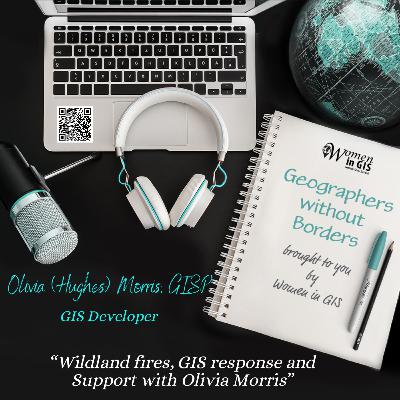
Olivia (Hughes) Morris, GISP, is a GIS Developer and GISS at the Washington State Department of Natural Resources. She specializes in environmental GIS and volunteers as a responder to wildland fire emergencies with the National Wildfire Coordinating Group. Olivia has a Bachelors of Science in Biology with a Chemistry minor from Washington College, and a Certificate of Data Science and Visualization from UC Berkeley.
Aisha Jenkins, PMP, CTT is a tech equity consultant, specializing in GIS & Digital Strategy, Academic and Workforce development, podcasting, and more. Aisha is guided by a need to be part of the solution, rather than stay comfortable or silent. GIS has been her tool for truth-telling, innovation, and equity. Aisha believes when we center Black and marginalized voices, we open the door for true diversity.Aisha has a Bachelor of Science in Biology/ Chemistry from Pennsylvania State University and a Master of Science in Information Science from the University of Pittsburgh.
Mamata is Head of Cartography at Felt. With over 15 yearsin the geosciences, Mamata has experience in cartographic systems, design, developing cartographic tools and products, and started her career in basemaps, and transitioned into thematic cartography and building cartographic thinking into tools. You may have seen her work if you’ve used ESRI’s dark basemaps or are familiar with the web maps produced for the National Park Service. Mamatahas a BA in Geography from UC Santa Barbara and an MS in Geography from Penn State. Mamata was also named as one of the 40 under 40 of remarkable geospatial professionals in 2017.
Catherine DuBreck, GISP, is an experienced change designer, facilitator, manager, and guru. She has a passion for GIS and it’s more people-y as a board member, teacher, volunteer, author, and consultant. Catherine is especially devoted to connecting with young people through teaching, presenting at conferences, and sharing her story. As a GIS change manager for TRC Companies, Catherine helps clients navigate their business needs as they modernize and update their systems and processes. Catherine also volunteers her skills and capabilities as a member of the Board of Directors of the New York State GIS Association. She has a Bachelor’s Degree in Geography from SUNY Geneseo, a Master’s Degree in Geography from Western University, and an array of GIS certificates and microcredentials. Catherine is also one of Geospatial World’s 50 Rising Stars for 2025.
Raquel’s unique blend of strategic marketing, community engagement, and commitment to servant leadership makes her a standout in the GIS and geospatial field with a passion for elevating the next generation in GIS.Raquel Pérez is a marketing leader with over 13 years at Esri, where she currently serves as Senior Industry Marketing Manager for the National Government - developing high-impact marketing strategies.A staunch advocate for servant leadership and community engagement, Raquel founded and continues to lead the Esri Young Professionals Network (YPN), a global initiative aimed at empowering early-career GIS professionals through networking, mentoring, and career development. She’s also the driving force behind Esri’s annual GIS Day celebrations; serves on the Women in GIS Mentor Committee; is a proud member of Latinas in Tech, and LatinaGeeks.Raquel holds an M.A. in Management from the University of Redlands and a certificate in Crime & Intelligence Analysis from UC Riverside—credentials that reflect her early work as a crime analyst and her enduring interest in data-driven solutions.Her impact is recognized both internally and across the geospatial community. Colleagues applaud her dedication and recently Jack Dangermond, owner and CEO of Esri personally acknowledged her on the 10th anniversary of YPN and making it a success!Outside of work, Raquel channels her creativity into gardening, event planning, home décor, and spending time with her kiddos. She’s an avid traveler—particularly drawn to Iceland, Peru, and Switzerland—and finds balance in exploring cultures and landscapes.
Join us to talk with Women in GIS outgoing President Sam Dinning about what WiGIS accomplished in 2024 and what's in store for 2025!
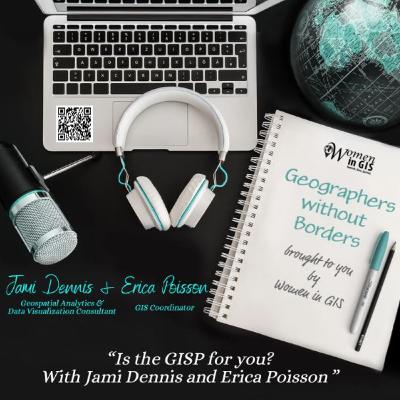
Jami Dennis has over thirty years of experience in GIS, socio-economic research, data analytics, and data visualization. She has been a GISP for 20 years and currently serves on the Board of Directors for the GIS Certification Institute. She has worked in both state and regional government. She now owns her own small consulting firm where she works on GIS, data analysis, and data visualization projects. Her currentpassion is using data visualization techniques to communicate complicated subjects. Outside of work, Jami is an avid camper, hiker, and occasionally good mountain biker.Erica Poisson has 10+ years of experience in GIS, data management, project ideation and management. She currently serves as secretary on the Northeast Arc User Group board of directors, and has been heavily involved in that community since her election to the board in 2020. In her current position as the GIS Coordinator for Massachusetts Department of Conservation and Recreation's Division of Water Supply Protection, she leads a small team of GIS analysts and helps further GIS within both the agency and the broader Executive Office of Energy and Environmental Affairs secretariat. Her current focus is accessibility in GIS and helping to lay the groundwork for ensuring the secretariat is able to meet new ADA Title II and WCAG 2.1 AA requirements by April 2026. Outside of work,Erica loves to garden, read, hike and spend time on her Peloton bike.
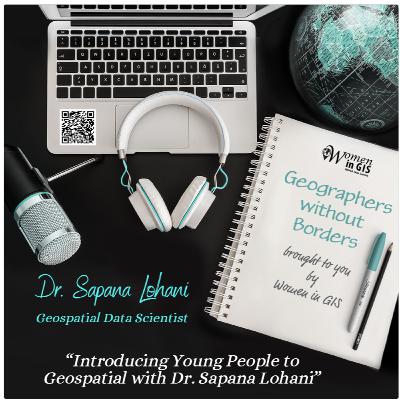
Dr. Sapana Lohani is a geospatial data scientist at the Institute for Integrative Conservation at the College of William and Mary. Sapana started her work in Nepal, helping to publish The Earth Preservation, and supported the Asia Pacific Mountain Network through engaging content generation. Sapana’s current endeavors have led her to connect with local elementary schools to help young students and women reconnect with nature and explore interdisciplinary careers centered around the environment. Her program is exclusively taught by women, and while she manages and facilitates, she is also responsible for the geospatial portion. Sapana is passionate about conservation and using geospatial technologies to illustrate the need for support as well as to illustrate successful changes made. Sapana has Bachelor and Master Degrees in Environmental Science from Tribhuvan University, a Masters Degree in Natural Resource Management from Asian Institute of Technology, and a PhD in Natural Resources from the University of Arizona.
Claire is an OG photogrammetrist, passionate about geospatial technology and digital mapping. She founded KAPPA Mapping in 2003, and currently leads CornerstoneEnergy Services to new markets with her expertise and breadth of knowledge and skills. Claire is an American Society of Photogrammetry and Remote Sensing certified photogrammetrist, which is taking photographs and very precise measurements to create 3D models of objects and environments. Claire started in surveying and engineering and will talk about her journey as the technology advances came faster and faster since her beginning. Claire has a Bachelor of Science in Surveying Engineering from the University of Maine and currently resides in Bangor, ME.
Carley has more than 15 years experience in the geosciences and specializes in emergency management. She leads the management of a county-wide enterprise GIS system, providing crucial support during emergencies such as Hurricane Dorian (2019), the COVID-19 pandemic, Hurricane Ian (2022), Hurricane Nicole (2022), and most recently Hurricane Milton. Carley facilitates important information dissemination to her county using GIS, creating dashboards and using tools like Survey123 to capture citizen damage assessments after storm events. She is a strong advocate for direct GIS involvement in emergency management as a mitigation to data gaps and information silos. Carley is a GISP and has a Bachelor of Science in Geography from Florida Atlantic University.
Carley has more than 15 years experience in the geosciences and specializes in emergency management. She leads the management of a county-wide enterprise GIS system, providing crucial support during emergencies such as Hurricane Dorian (2019), the COVID-19 pandemic, Hurricane Ian (2022), Hurricane Nicole (2022), and most recently Hurricane Milton. Carley facilitates important information dissemination to her county using GIS, creating dashboards and using tools like Survey123 to capture citizen damage assessments after storm events. She is a strong advocate for direct GIS involvement in emergency management as a mitigation to data gaps and information silos. Carley is a GISP and has a Bachelor of Science in Geography from Florida Atlantic University.
Kat James is the founder of Four Hundred Feet, a social enterprise that helps individuals and organizations leverage drone technology to amplify impact in the global health,
environmental, and humanitarian sectors through consulting, one-on-one coaching, and educational resources. As a consultant, she helps organizations navigate the local regulatory environment, identify technical solutions and
partners, design & implement projects, and scale for impact.
Previously, Kat was a GIS specialist working on global health projects, which ranged from designing a maternal health data dashboard for the Ministry of Health in Ghana to mapping thousands of villages in Liberia and Zambia to see how far women must travel to access reproductive healthcare services.
Kat has a Bachelors of Art in Geography and Global Health from Middlebury College and a Masters in Public Health and Information Science from the University of Michigan. Kat is also a Kenya Civil Aviation Authority Certified Remote Pilot and Certified Part 107 Remote Pilot, and serves on the advisory boards of the Commercial UAV Expo’s Path the Leadership Scholarship Program and DroneDeploy’s Resilient Futures Grant Program.
Swati is a professor, consultant, founder, and leader
driving change in the geospatial sciences. Swati has over 24 years experience Internationally using geospatial technologies to answer social, economic, and environmental problems. Swati is passionate about sharing the world of GIS with young people and is known for creative solutions and a positive outlook. Swati founded Anudras Geosolutions in 2016 and has a BS and MS in Geology from the University of Delhi, an MPhil in GIS and Remote Sensing from the University of Cambridge, UK.
Brandi is a Senior Product Engineer at ESRI, where she has worked for the last nearly 3 years on developing robust solutions for stormwater and other customers. Prior, Brandi spent over 2 decades as a public servant working in local government in the Denver Metro area helping the organizations improve service development and streamline processes with GIS. Brandi most recently worked on the GIS Request Management Solution with a group of end users to tackle the challenge of tracking GIS tasks and project management activities natively within the ESRI ecosystem. The solution was released at this year’s UC in July. Brandi lives in Colorado and has a Bachelor of Science in Earth and Geographic Sciences from University of Massachusetts, Boston.

Comments

Download from Google Play

Download from App Store
 United States