Discover
This Week in Fintech's Podcast
Author: This Week In Fintech
Subscribed: 12Played: 308Subscribe
Share
© This Week In Fintech
Description
⭐Top 40 Best Financial News Podcasts! ⭐ according to https://blog.feedspot.com/financ
If you’re looking to expand your network and knowledge of fintech, look no further than the This Week In Fintech podcast. This engaging show brings together thought leaders from finance and technology sectors who share their experiences, insights, and innovative approaches.
141 Episodes
Reverse
In this episode, Nik Milanovic interviews Ram Palanappian, the CEO and Founder of Earnin, a fintech company that is revolutionizing how employees access their wages. Ram shares the origin story of Earnin, which began when he realized that many employees were struggling with cash flow issues, leading to late fees and overdraft charges. He discusses how he initially provided employees with early access to their earned wages, which evolved into a full-fledged product that allows users to access their pay in real-time, thereby reducing financial stress and improving overall financial health. Ram emphasizes the importance of shifting payroll systems from being employer-centric to employee-centric, allowing workers more control over their earnings.Chapters00:00 Introduction and Setup00:39 Multitasking in Conversations00:44 Introduction to FinTech Trends00:44 The Future of Digital Banking00:47 Introduction to Earnin and Its Mission04:10 Revolutionizing Payroll: Employee-Centric Solutions10:36 Adoption Across Industries: Who Benefits Most?11:50 The Small Business Perspective: Benefits of Earned Wage Access12:59 How Earnin Works: A User's Journey14:03 Monetization Strategies: How Earnin Generates Revenue17:06 Consumer Risks and Mitigation Strategies20:18 Ensuring Data Accuracy: The Source of Truth21:54 Employer Customization: Tailoring Earnin to Specific Needs22:46 Insights from Data: Understanding Consumer Financial Health23:58 Collaborations and Studies: Researching Labor Dynamics25:52 Looking Ahead: The Future of Earnin and Payroll26:36 Cross-Border Challenges in Business Growth29:57 Future Product Development and Innovations31:48 Inspiration from Other Industries34:49 Leveraging AI for Financial Products37:13 The Role of Stablecoins in Transactions39:28 Wage Growth vs. Inflation Dynamics42:32 The Future of Payroll: Continuous Pay43:44 Team Growth and Hiring Opportunities
An agentic future of commerce is coming faster than merchants think—and PayPal wants to make sure small businesses don’t get left behind. In this live Money20/20 2025 episode of This Week in Fintech, hosts Nik Milanović and Jillian Williams sit down with PayPal’s Michelle Gill, EVP and General Manager of Small Business Financial Services, for a deep dive into how AI agents will transform shopping, loyalty, and merchant discovery.They talk about the next phase shift in commerce: a world where over 40% of shopping journeys may start in chat surfaces, and agents—not humans—do the heavy lifting on search, comparison, and even checkout. Michelle explains why this upends traditional ideas about websites, SEO, and brand, and why “discoverability” and rich product descriptions become the new battleground for merchants of all sizes.The trio dig into big questions shaping this new landscape:- How will small businesses compete when shopping begins in agent interfaces instead of on their storefronts? - What new infrastructure and open protocols are needed so merchants can “integrate once and propagate everywhere” across AI surfaces? - Where does loyalty live when consumers no longer visit your website—but still expect rewards, points, and personalized offers to “just work” in their wallet? - How far are consumers willing to let agents spend on their behalf, and what new trust markers will replace today’s checkout experiences?Michelle also offers a small-business lens on AI: where it can save time first (customer service, email, hiring), where it could power new B2B flows like inventory and reordering, and why AI might both compress margins and lower barriers to becoming a proprietor. She argues that the real opportunity is in turning wasted browsing time into higher-value, more delightful discovery and post-purchase experiences.Stay to the end for a rapid-fire round on Michelle’s recent favorite book, her current AI toolkit, and what she thinks the payments and e-commerce landscape could look like a decade from now. If you care about the future of agentic commerce, small business resilience, or how PayPal is positioning itself for the next era of the internet, this is an episode you won’t want to miss.
We sit down with Nubank co-founder Cristina Junqueira for a candid look at how frustration with fee-first banking led to a product people loved, and how that vision scaled across Brazil. We explore hard-won lessons on leadership, communication, regulation, and why AI plus open finance will reshape money.• leaving an incumbent bank to build customer-first products• forming the founding team and starting with nothing• operating through credit cycles, fraud pressure and regulation• leadership growth, emotional intelligence and storytelling• selling the vision internally and externally• customer impact from fair credit and savings features• Brazil’s policy tailwinds with PIX and open finance• AI as a financial co-pilot and US expansion plans
In this conversation, Nik Milanović discusses the evolving landscape of stablecoins and digital payments with Dan Mottice and Matt Marcus from Modern Treasury. They delve into the recent acquisition of Beam by Modern Treasury, the implications for the payments industry, and the potential of stablecoins to enhance financial operations. The discussion highlights the importance of regulatory clarity, the future of payment systems in the U.S., and the innovative capabilities that stablecoins can bring to money movement.
In today’s episode, Ryan Zauk sits down with Bret Taylor, Co-Founder & CEO of Sierra and Chairman of the Board at OpenAI. Bret’s career is the stuff of valley legend…he is the former Co-CEO of Salesforce, former CTO of Facebook, and has been credited with building products like Google Maps and Facebook's 'Like' button. There may not be anyone closer to AI, spanning the app layer all the way down to its core foundation.In this episode, Bret and Ryan explore several topics including how Sierra has transformed customer service, the agentic era and its consequences for software, why we ‘might’ be in an AI bubble, how Sierra differentiates to win customers like Ramp, Rocket, and Brex, where AI moats will accrue, the 3 AI megatrends he’s leaning into, and much more.Key Takeaways“Every company’s AI agent will be as important as their mobile app or their website.” Bret sees a future where AI agents replace apps and websites as the first point of contact for customers. Agents will handle workflows end to end (fraud reports, mortgage refis, account changes) across all channels, languages, and modalities.CS agents are showing immediate ROI on both the top and bottom line…For example, Rocket’s customers who engage with a Sierra agent are 3x as likely to complete a transaction vs. traditional service. At Ramp, their self-service resolution rate with Sierra’s agents is >90%. Healthcare giant Cigna is replatforming its IVR with Sierra…using AI will help businesses rethink their operating model.Outcome pricing raises the stakes for software, morphing them into true business partners. Outcome pricing will create accountability, transparency, and measurable ROI in an era of vague productivity claims.The Future of AI is 3 things. 1) Multimodal - seamless voice experience. 2) Personalized - knowing your context, preferences, and intent. 3) Proactive - solving a problem before it arises or before the customer knows it has occurred. It’s an AI bubble, but a healthy one. The fundraising hype is alarming, but the underlying transformation is real. Similar to 1999, many firms will fail, but some will become generational winners. If you bought pets.com you lost your money. If you bought Amazon, you made history.
In this episode, Nik Milanović hosts Natalie Wexler from Adyen and Jamey Kennedy from Jackrabbit Technologies to discuss the untapped opportunities in embedded finance, particularly for small and medium-sized businesses. They explore how SaaS platforms can leverage embedded finance to enhance customer experiences, the importance of capital products, and the evolving landscape of funding for small businesses. The conversation also touches on the future of payments, including the potential of AI and stablecoins.
In this conversation, Georgina Merhom, founder of SOLO, discusses the transformative potential of collaborative data sharing in the financial sector. She shares her journey from cybersecurity to fintech, emphasizing the importance of incentives, consumer experience, and the evolving regulatory landscape. Georgina highlights the need for a decentralized approach to data sharing, which fosters trust and efficiency, ultimately aiming to revolutionize open banking and expand beyond financial services.
In this episode, Nik Milanović interviews George Kurdin, co-founder of Monk, a company focused on automating accounts receivable processes using AI. George shares his unique career journey from professional poker player to fintech entrepreneur, discussing the lessons learned along the way. He highlights the significant problem of accounts receivable, valued at $3 trillion, and explains how Monk aims to address this issue. The conversation delves into the role of AI in automating the contract to cash workflow, the challenges faced in current AR processes, and the key metrics that define success in this space. In this conversation, George discusses the evolving landscape of finance solutions, emphasizing the need for financial rigor among founders and VCs. He highlights the challenges posed by fragmented systems in accounts receivable and the importance of leveraging agents for collections and reporting. George also shares insights on customer needs as businesses grow, the significance of effective reporting, and the company's future roadmap, including cash flow predictability and contract intelligence. He reflects on the early days of customer acquisition and the importance of adapting pitches for different business sizes. The conversation concludes with a focus on hiring for growth and the vision for a more efficient accounts receivable process.Check out Monk.com to save time on accounts receivables and get paid faster
"Buckle up because...the cuffs are off."In this conversation, Nik Milanović interviews Mike Cagney, co-founder and CEO of Figure, discussing the company's recent IPO, its innovative product Democratized Prime, and the implications of the Genius Act on capital markets. Cagney shares insights on the evolution of Figure, the role of blockchain in financial services, and the potential for decentralized finance (DeFi) to disrupt traditional banking models. The discussion highlights the importance of regulatory changes and the future landscape of financial markets as they adapt to new technologies.00:00 Introduction to Figure and Mike Cagney04:23 Understanding Figure's Corporate Structure05:57 Inspiration Behind Figure's Founding11:37 The Value of Decentralized Finance (DeFi)14:31 The Genius Act and Its Implications26:27 The Future of Banking and Capital Markets31:55 Democratized Prime: A New Lending Paradigm46:16 The Role of Blockchain in Future Financial SystemsThis podcast is brought to you by Figure, the platform to Earn and Borrow.Need liquidity without selling your crypto? Figure offers Crypto-Backed Loans, allowing you to borrow against your Bitcoin or Ethereum with 12-month terms and no prepayment penalties. They have the lowest rates in the industry at 8.91%, allowing you to access instant cash or buy more Bitcoin without triggering a tax event. Your BTC collateral is protected by decentralized MPC custody. You can always see your BTC ownership in your FM account and verify holdings in your personal BTC vault on chain.Unlock your crypto’s potential today. Visit their app to apply for a Crypto Backed Loan today! DisclaimerFigure Lending LLC dba Figure. Equal Opportunity Lender. NMLS 1717824. Terms and conditions apply. Visit figure.com for more information. Figure Markets Credit LLC. 650 S. Tryon Street, 8th Floor, Charlotte, NC 28202. (888) 926-6259. NMLS ID 2559612. Terms and conditions apply. Visit figuremarkets.com/borrow for more information.
In today’s episode, Ryan Zauk sits down with Kate Earle Jensen, Head of Americas for Anthropic. Kate joined Anthropic in 2023 after 8 years helping scale GTM at Stripe. Over the last 2 years, she has had a front row seat to the AI revolution at one of the fastest-growing companies in history. In this episode, Kate dives into how Claude is being used by major enterprises to revolutionize their businesses, the state of Anthropic’s products and MCP, why they built in the application layer for financial services, what key blockers remain for enterprise adoption, why AI’s market size allows them to approach partnerships in a unique way, transitioning from Stripe to Anthropic, why siblings make great leadership teams, and much more.Takeaways: The AI market is unquantifiably large, which helps you play non-zero sum games in GTM, partnerships, and product. It helps breed greater collaboration because you know there is more than enough revenue opportunity to share. Hackathons, though not new, have proven to be one of the best sources of discovering novel AI applications in the enterprise. We host them internally and encourage our clients to do host them to get employees experimenting and uncover the art of the possible.Financial Services + Healthcare are proving to be the best industries for AI. They have huge data sets, antiquated technology systems, and manual workflows that make them prime candidates. AI is only as good as the quality of data and context that you feed it. It is as important as anything you choose, which is why MCP became so popular. Siblings often make the best cofounding teams. The Collisons and Amodeis both have very strong working styles that allow them to be brutally honest with each other while not breaking relationships.
Hello fintech friends,Last week, I sat down with Doug Rickett, the founder and CEO of Payjoy.If you work in fintech and you don't know Payjoy, well, you should. The company's tagline is "finance for the next billion." And they're well on their way: As of 2025 they have brought 3 billion dollars in credit to 16 million customers, doubling in the last two years while remaining strongly profitable and sustainable for the long term.PayJoy is a mission-first financial service provider dedicated to helping under-served customers in emerging markets to achieve financial stability and success. They lend through their patented technology that turns a smartphone into digital collateral. Their cutting-edge machine learning, data science, and anti-fraud AI allow them to offer the lowest cost and qualify the most customers in the industry. This year, the company celebrates its 10th anniversary, with projected 2025 revenue of over $650 million and $110 million in profit.Doug and I discussed how his time at Stanford Business School led him to Africa to manage logistics – an area he admits he knew nothing about – for solar lighting company D.light, and how that in-turn inspired him to found Payjoy in 2015. It's one of the most fascinating CEO stories that I've heard in fintech. Well worth listening to his whole journey from start to finish.Enjoy!
This episode dives deep into the evolution of blockchain-powered lending and marketplaces in the FinTech sector, with guest Michael Tannenbaum, whose career has spanned senior roles at SoFi, Brex, and now Figure. Host Julie Verhage-Greenberg and Michael discuss how Figure’s vision—originally designed as one company with a strong blockchain backbone—has matured amidst regulatory and market shifts.Check out Figure Markets here: figuremarkets.onelink.me/Plnq/TWIFThis episode is brought to you by Figure Markets, the platform to Earn and Borrow.Democratized Prime lets you earn 9% by lending your money against real-world assets like home equity lines of credit (HELOCs) which only banks were able to do prior. Lend like a bank!Need liquidity without selling your crypto? Figure offers Crypto-Backed Loans, allowing you to borrow against your Bitcoin or Ethereum with 12-month terms and no prepayment penalties. They have the lowest rates in the industry at 8.91%, allowing you to access instant cash or buy more Bitcoin without triggering a tax event.Unlock your crypto’s potential today. Download their app and start earning your 9% today or taking out your Bitcoin-backed loan at industry low rates!DISCLOSURES: The 9% rate referenced is not guaranteed and subject to change as new offers are placed. Democratized Prime uses a Dutch auction method for its borrowers/lenders. There is an inherent risk due to interest rate volatility in a Dutch auction interest rates in the auction may rise rapidly. At the time of acceptance, your loan may be filled with a different or higher interest rate than offered at the time of selection. The interest rate is only fixed at the time of loan approval and not at the time of loan acceptance.Figure Lending LLC dba Figure. Equal Opportunity Lender.NMLS 1717824. Terms and conditions apply. Visit figure.com for more information.Figure Markets Credit LLC. 650 S. Tryon Street, 8th Floor, Charlotte, NC 28202. (888) 926-6259. NMLS ID 2559612. Terms and conditions apply. Visit figuremarkets.com/borrow for more information.
This week, Nik Milanovic sits down with Sandeep Pyapali, Founder and CEO of Mesta, a global cross-border payment network combining traditional rails with stablecoin systems.Mesta allows sending USD and stablecoins in over 50 currencies, cutting international payment costs by over 50%. Pyapali, with 17 years in payments – including Uber's $100 billion payment network – founded Mesta in 2024.Pyapali emphasized the importance of stablecoins for efficient international payments and predicts the growth of non-USD stablecoins. Mesta aims to disrupt traditional Fiat-to-Fiat payments with blockchain technology. Pyapali's vision for Mesta was informed not only by his time building payments systems at Uber but also by his international travel on a sabbatical afterwards, and the difficulty of converting currencies for international payments.You can learn more about what they're building at mesta.xyz----While stablecoins are one of our favorite topics to discuss, it's important to note that this episode was sponsored by Mesta.
Welcome back to This Week in Fintech and another episode of the Fintech OGs! Today, I’m joined by two incredible voices who have helped shape the future of financial technology from both the founder and investor perspective.First up, Jillian Williams, co-founder of Field Ventures, a new seed-stage fund focused on vertical software and fintech. Jillian has spent her career investing in the sector, from Anthemis to Cowboy Ventures, and now building her own firm.Joining her is Dimitri Dadiomov, co-founder of Modern Treasury. After serving as CEO for the first seven years, Dimitri recently shifted into the President role to focus on product innovation while continuing to drive one of the most important infrastructure companies in fintech.Together, we cover how fintech has evolved from the early days of Lending Club and marketplace lending, to today’s rebundling wave and AI-driven change. We talk about the future of money movement, risk and compliance, embedded financial products, and where they see the biggest opportunities ahead.Huge thanks to Persona for sponsoring today's episode! Persona is the adaptable identity platform helping businesses fight fraud, meet compliance requirements, and build trust from the very first interaction. Check them out at withpersona.com/thisweekinfintech.
This week, I sat down with Eli Wachs, the Co-Founder and CEO of Footprint, a company building the identity infrastructure of the internet.It was a far-reaching conversation – Eli's an interesting guy – and we touched on everything from his deep-dives into identity in the Stanford library to working with economist Raj Chetty to philosophy and what it means to be authentic to yourself.Footprint provides automated onboarding that solves identity, security, fraud, and auth in 5 lines of code, building the identity layer to the internet.The company offers end-to-end onboarding solutions, including verification, storage, and re-authentication, aiming to create a centralized database of good actors. They emphasize reducing false negatives and improving conversion and compliance. Eli talked with me a bit about Footprint's unique approach using device fingerprinting and vaulting to enhance security and portability.We covered some recent product launches, including bank-linking and their new decision engine. Eli also discussed the company's evolution from a KYC point solution to a broader identity network built around preventing identity theft and fraud in any online situation, from buying a house to joining a community.You can find Footprint online at onefootprint.com
Welcome back to another episode of Fintech OGs with This Week In Fintech!Today, I’m joined by two incredible founders who have each redefined their corner of the financial world:Jack Zhang, Co-founder & CEO of Airwallex, the global payments and banking platform powering 150,000+ businessesLeif Abraham, Co-founder & Co-CEO of Public, the next-gen investing platform helping the top 20% of millennials build long-term wealthIn this episode, we explore their journeys from coffee shops and olive oil to building billion-dollar fintechs, why they both value first principles thinking over traditional industry experience, and their candid takes on hot topics like stablecoins, AI in finance, and tokenized assets.They share career highs, the lows of early struggles, and the unconventional advice they’d give to anyone starting in fintech today.Huge thanks to Persona for sponsoring today's episode! Persona is the adaptable identity platform helping businesses fight fraud, meet compliance requirements, and build trust from the very first interaction. Check them out at withpersona.com/thisweekinfintech.
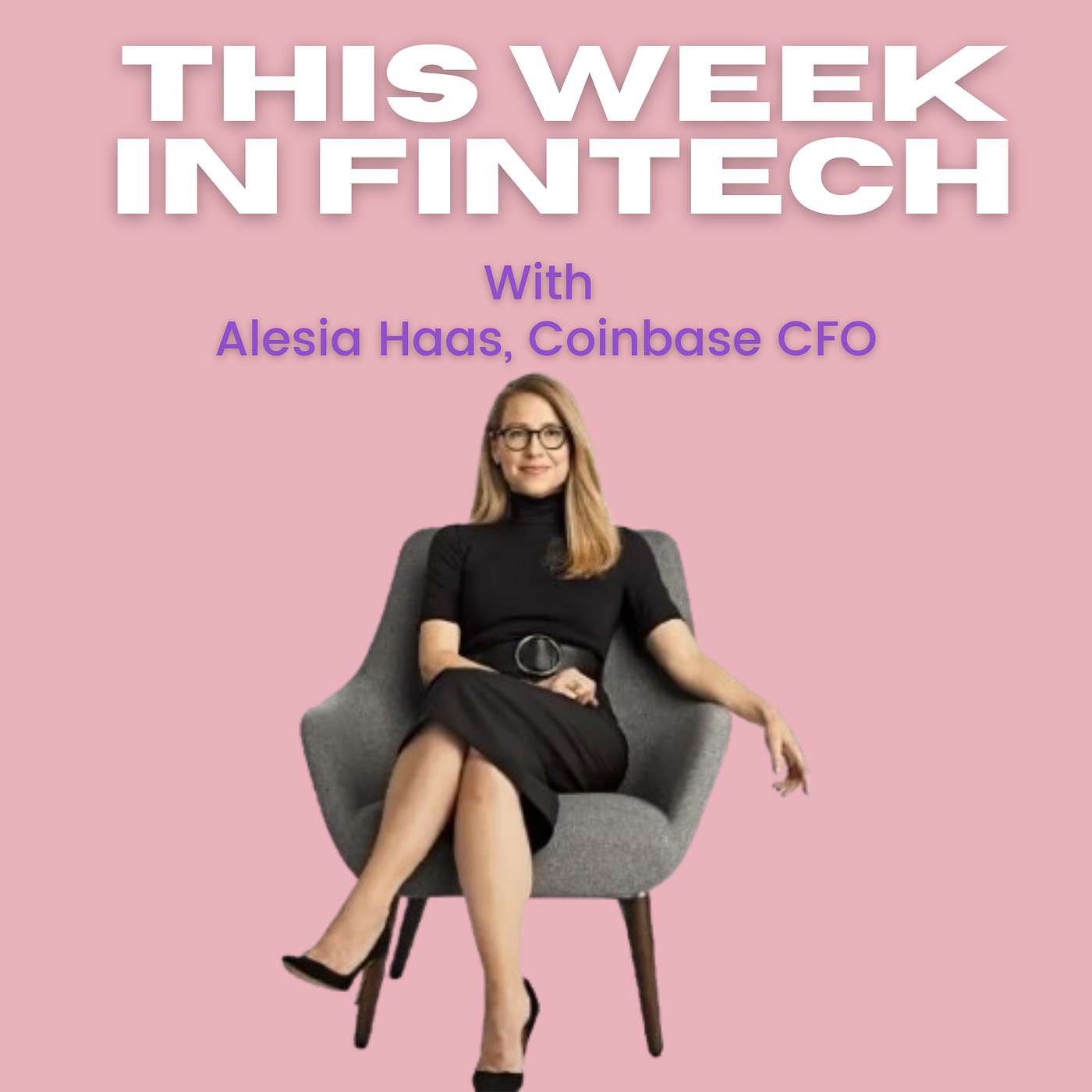
Nik sits down for 10 minutes with Coinbase CFO Alesia Haas to talk about the company's 2025 performance and where they are headed.OverviewCoinbase is at inflection point, with strong Q2 performance including custody volumes and derivatives trading hitting all-time highs, and the USDC market cap exceeding $60 billion.Stablecoin revenue of $332 million in Q2 represents 12% growth quarter-over-quarter, driven by market cap expansion via Circle collaboration.GENIUS Act signed into law enables Coinbase to lead the $30 trillion B2B cross-border payments market, targeting financial revolution in the US.Payment APIs launched with Shopify; Coinbase business account product in development with a waitlist of thousands of businesses.Acquisition of Deribit for $2.9 billion positions Coinbase to enter the options trading market, capturing a significant share of global derivatives trading.Newly launched perpetual futures contracts have seen week-over-week volume doubling, aligning trading hours with crypto spot market.User base expanding beyond retail to include payment-focused users and institutional traders seeking hedging and leveraged exposure.New Base app in beta testing, alongside the launch of Coinbase One Basic service tier to enhance user offerings.USDC payments integration with Shopify completed, with additional partnerships on the horizon and increased service offerings planned.10x intraday leverage available on newly introduced 24/7 futures products, enhancing trading capabilities for users.
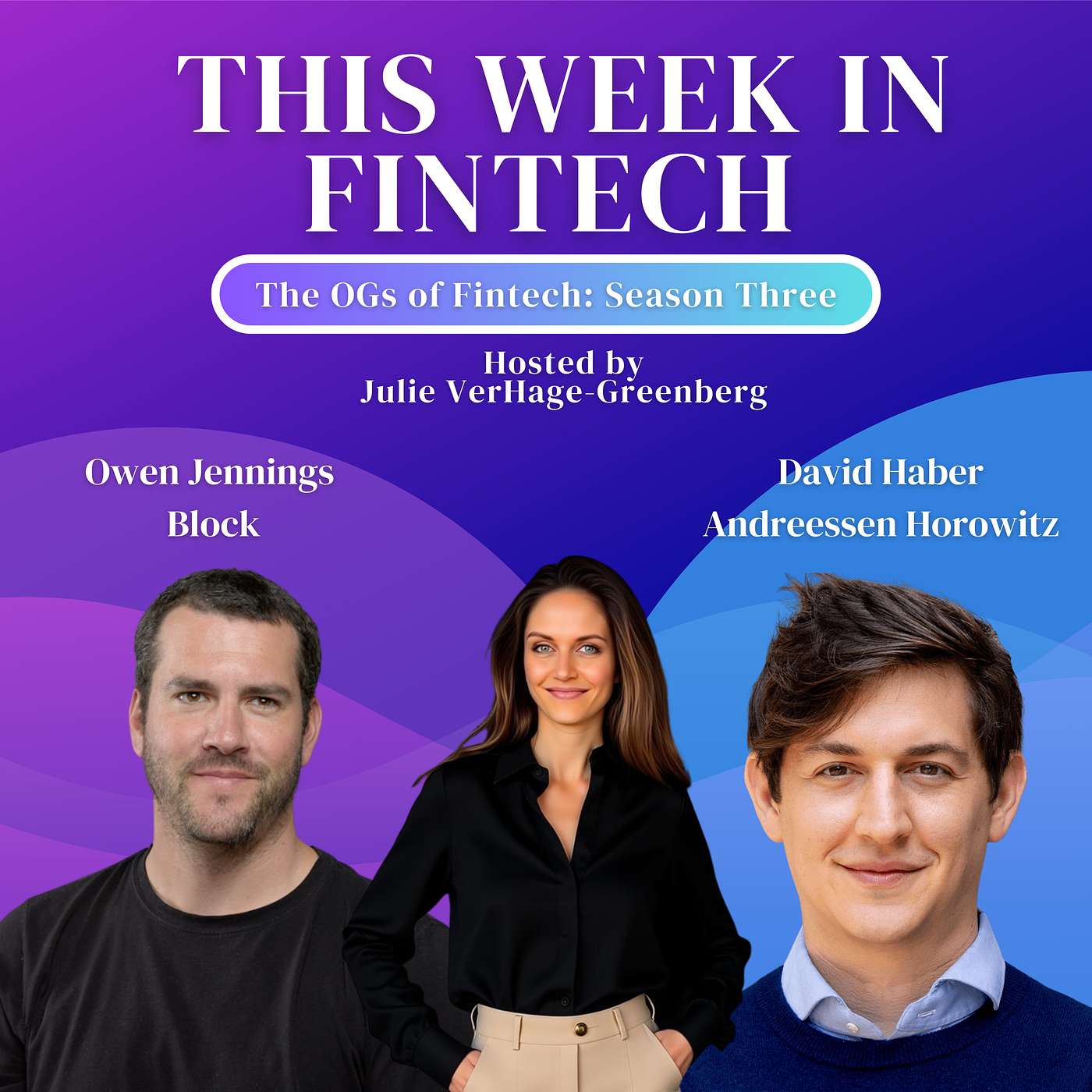
Welcome back to FinTech OGs! This week, I’m joined by two leaders whose careers have shaped the evolution of modern financial technology: David Haber, General Partner at Andreessen Horowitz and co-lead of their AI Apps Fund, and Owen Jennings, an executive officer and Block’s Business Lead. From early ventures like Bond Street and the first days of Cash App to today’s frontier of AI in finance, David and Owen share how FinTech continues to evolve—what’s working, what hasn’t changed fast enough, and the massive opportunities they see ahead. We cover everything from consumer financial health to small business challenges, AI-driven automation, and the next wave of credit innovation. This is a masterclass in FinTech past, present, and future.
In today's episode, Ryan Zauk sits down with PayPal President & CEO Alex Chriss.Alex took over as PayPal CEO in September 2023 after a nearly 20-year run at Intuit. Today, Alex (and PayPal) are at the epicenter of some of the most disruptive trends in global technology & commerce.Since joining PayPal less than two years ago, his tenure has turned several heads in the industry. PayPal seems reinvigorated and on the offensive, working to take advantage of the several platform shifts we're seeing in global technology and commerce. We've seen new hires, a company reorganization, startup-like release cycles, Will Ferrell branding campaigns, and so much more.Alex comes on the show at the perfect time as he approaches the 2-year mark in his tenure and bold vision for PayPal is turning into reality. Highlights01:58 Alex's rallying cry 'Customer Back' and how he's reorganized the company to think customer-first06:28 Tactical advice for implementing transformative change at a major global enterprise09:15 His and PayPal's Top 5 strategic priorities for the coming years11:42 How agentic commerce will disrupt global commerce (especially merchant data) and how PayPal is positioned to help serve consumers and merchants17:25 A deeper look at initiatives like Quantum Leap, PayPayl's Remote MCP, and Agent Toolkit20:47 PayPal's build / buy / partner approach in agentic commerce to date22:41 The most successful AI initiatives at PayPal, including payment method recommendation, multi-modal customer service, next-gen fraud detection, and 'EVA'27:55 Why orgs need to get flatter and empower smaller + leaner teams to run farther with AI29:40 Where PayPal is focusing on crypto/stablecoins on the consumer and merchant side32:44 His aggressive approach to PayPal's innovator's dilemma and why 'innovator's dilemma is a mindset'35:30 Regulatory changes and what it has unlocked for PayPal37:28 Why Intuit has become a breeding ground for so many top executives 39:30 Making the leap to join PayPal from Intuit40:39 A fun rapid-fire round including his most important criteria for executive interviews, hanging with Will Ferrell, his workouts, his dream guest on the pod, and moreEnjoy the show.--Alex Chriss has spent more than two decades harnessing the power of technology to help individuals and small businesses solve their greatest financial challenges. Having successfully founded and sold two start-ups and led a fast-growing division of financial software company Intuit, he is committed to helping customers compete and thrive in a rapidly changing world. Alex brings deep expertise in leading high-growth businesses, global product strategy, and customer-driven innovation to his role as PayPal’s President and CEO.Prior to joining PayPal, Alex held various roles of increasing responsibility at Intuit. He most recently served on Intuit’s executive leadership team as the Executive Vice President and General Manager of Intuit’s Small Business and Self-Employed Group where he led a global organization responsible for delivering QuickBooks and Mailchimp to millions of customers. Throughout his 20-year tenure with the company, Alex also served as Senior Vice President and Chief Product Officer of Intuit’s Small Business organization, managing the full suite of QuickBooks products, including payroll and payments platform segments.He holds a Bachelor of Arts in Economics from Tufts University.Ryan Zauk is the Host of the This Month in Fintech Podcast and Bay Area lead for the broader This Week in Fintech platform. In his day job, Ryan is a private markets investor at OMERS Ventures, the investing arm of one of the world’s largest pension plans with $130Bn+ in net assets. Prior to OMERS, he worked in Morgan Stanley’s Tech Investment Banking team focused on M&A and capital markets. He is based in the Bay Area. You can find him on Linkedin or Twitter.
Welcome back to this week in FinTech and another episode of the FinTech OGs. This week I'm joined by two guests whose careers have helped shape. The evolution of modern wealth management. We have Charles Birnbaum partner at Bessemer Venture Partners, and Cynthia Loh, who is a senior vice president at Capital One.Charles and Cynthia first crossed paths in the early days of Betterment. This is back when robo-advisors were just starting to redefine how everyday consumers invest and have spent, over a decade building in, investing in and advising some of the most influential FinTech companies out there. It's a great conversation and I'm excited for you to dive in!I also want to take a moment to send out a special thanks to our sponsors this week. 100% of what we got in ads for this episode is going towards Texas Flood Relief. Those of you that know me know that I am based in Austin, Texas, and while thankfully my daughter is too young to go to a sleep away camp, it hits close to home with friends having kids that go to camps that were hit along the river. The two guests this week, Charles and Cynthia, also both have kids, and it's just unimaginable what these parents are going through. I ask all of you to keep these families in your prayers. With that, I'll also tell you a little bit more about our sponsors. I have a feeling you guys are very familiar with all of them but just in case you're not. First up is Lithic, who is a modern payments infrastructure provider that enables technically ambitious teams to build better payments products. Lithic's cutting edge technologies cover issuing and processing, end-to-end fraud prevention, dispute management, and cardholder support implemented as either fully managed offerings or self-service tools.Learn more at lithic.com.Next up we have Rho, which is the all-in-one banking platform for startups and the accountants who support them. Thousands of startups switching to Rho because they don't have time to wait days to open an account or the patience for email support queues when they just need real help.Rho is building a new standard for business banking. With Rho, you get fast banking setup, up to 2% cash back on cards and yield on idle cash. Everything you need all in one platform from day one. Every client gets real dedicated support from a team that goes to the end of the earth to help you win. Head to rho.co/startups to learn more. That's rho.co/startups. Rho is a FinTech company, not a bank or an FDIC. Insured depository institution checking account and card services are provided by Webster Bank NA member FDIC. See rewards terms for complete cash back details.Last but not least, we have Spade. It’s 2025 and fintechs can spin up cards in minutes and move money in real time. But we still can’t decipher the transactions on a bank statement. Most still show up as a jumble of letters and numbers — no clear name, no location. Just noise and guesswork. That’s why so many fintechs and banks are turning to Spade. Spade’s API maps messy transaction strings to verified businesses — returning real merchant names, categories, and store locations in real time. So if you want reliable transaction data across cards, ACH, and more, head to spade.com.