


 Claim Ownership
Latent Space: The AI Engineer Podcast
Subscribed: 950Played: 28,099
Subscribe

© Latent.Space
Description
The podcast by and for AI Engineers! In 2025, over 10 million readers and listeners came to Latent Space to hear about news, papers and interviews in Software 3.0.
We cover Foundation Models changing every domain in Code Generation, Multimodality, AI Agents, GPU Infra and more, directly from the founders, builders, and thinkers involved in pushing the cutting edge. Striving to give you both the definitive take on the Current Thing down to the first introduction to the tech you'll be using in the next 3 months! We break news and exclusive interviews from OpenAI, Anthropic, Gemini, Meta (Soumith Chintala), Sierra (Bret Taylor), tiny (George Hotz), Databricks/MosaicML (Jon Frankle), Modular (Chris Lattner), Answer.ai (Jeremy Howard), et al.
Full show notes always on https://latent.space
www.latent.space
We cover Foundation Models changing every domain in Code Generation, Multimodality, AI Agents, GPU Infra and more, directly from the founders, builders, and thinkers involved in pushing the cutting edge. Striving to give you both the definitive take on the Current Thing down to the first introduction to the tech you'll be using in the next 3 months! We break news and exclusive interviews from OpenAI, Anthropic, Gemini, Meta (Soumith Chintala), Sierra (Bret Taylor), tiny (George Hotz), Databricks/MosaicML (Jon Frankle), Modular (Chris Lattner), Answer.ai (Jeremy Howard), et al.
Full show notes always on https://latent.space
www.latent.space
184 Episodes
Reverse

Claude Cowork came out of an accident.Felix and the Anthropic team noticed something interesting with Claude Code: many users were using it primarily for all kinds of messy knowledge work instead of coding. Even technical builders would use it for lots of non-technical work.Even more shocking, Claude cowork wrote itself. With a team of humans simply orchestrating multiple claude code instances, the tool was ready after a brief week and a half.This isn’t Felix’s first rodeo with impactful and playful desktop apps. He’s helped ship the Slack desktop app and is a core maintainer of Electron the open-source software framework used for building cross-platform desktop applications, even putting Windows 95 into an Electron app that runs on macOS, Windows, and Linux.In this episode, Felix joins us to unpack why execution has suddenly become cheap enough that teams can “just build all the candidates” and why the real frontier in AI products is no longer better chat, but trusted task execution.He also shares why Anthropic is betting on local-first agent workflows, why skills may matter more than most people realize, and how the hardest questions ahead are about autonomy, safety, portability, and the changing shape of knowledge work itself.We discuss* Felix’s path: Slack desktop app, Electron, Windows 95 in JavaScript, and now building Claude Cowork at Anthropic* What Claude Cowork actually is: a more user-friendly, VM-based version of Claude Code designed to bring agentic workflows to non-terminal-native users* Why “user-friendly” does not mean “less powerful”: Cowork as a superset product, much like how VS Code initially looked simpler than Visual Studio but became more hackable and extensible* Anthropic’s prototype-first culture: why Cowork was built in 10 days using many pre-existing internal pieces, and how internal prototypes shaped the final product* Why execution is getting cheap: the shift from long memos, specs, and debate toward rapidly building multiple candidates and choosing based on reality instead of theory* The local debate: why Felix thinks Silicon Valley is undervaluing the local computer, and why putting Claude “where you work” is often more powerful* Why Claude gets its own computer: the VM as both a safety boundary and a capability unlock, letting Claude install tools, run scripts, and work more independently without constant approval* Safety through sandboxing: why “approve every command” is not a real long-term UX, and how virtual machines create a middle ground between uselessly safe and dangerously autonomous* How Cowork differs from Claude Code: coding evals vs. knowledge-work evals, different system-prompt tradeoffs, longer planning horizons, and heavier use of planning and clarification tools* Why skills matter: simple markdown-based instructions as a lightweight abstraction layer for reusable workflows, personalized automation, and portable agent behavior* Skills vs. MCPs: why Felix is increasingly interested in file-based, text-native interfaces that tell the model what to do, rather than forcing everything through rigid tool schemas* The portability problem: why personal skills should move across agent products, and the unresolved tension between public reusable workflows and private user-specific context* Real use cases already happening today: uploading videos, organizing files, handling taxes, managing calendars, debugging internal crashes, analyzing finances, and automating repetitive browser workflows* Why AI products should work with your existing stack: Anthropic’s bias toward integrating with Chrome, Office, and existing workflows instead of rebuilding every app from scratch* Computer use one year later: how much better it has gotten, why vision plus browser context is such a superpower, and why letting Claude see the thing it is working on changes everything* Why many “AI verticals” may get compressed: specialized wrappers may matter in the short term, but better general models and stronger primitives could absorb a lot of narrow use cases* The future of junior work: Felix’s concerns about entry-level roles, labor-market disruption, and whether AI can compress early-career learning into denser simulated experience* Why Waterloo grads stand out: internships, shipping experience, and learning how real teams build products versus purely theoretical academic preparation* The agentic future of the desktop: what it means for Claude to have its own computer, whether AI should act on your machine or a remote one, and how intimacy with personal data changes the product design space* Why Electron still mattered: shipping Chromium as a controlled rendering stack, the limits of OS-native webviews, and why browser engines remain one of the great software abstractions* Anthropic’s Labs mentality: wild internal experiments, half-broken future-looking prototypes, and the broader effort to move users from asking questions to delegating increasingly long and valuable tasks* Why the endgame is not just more capability, but more independence: teaching users to trust AI with bigger scopes of work, for longer durations, with fewer interventionsFelix Rieseberg* X: https://x.com/felixrieseberg* LinkedIn: https://www.linkedin.com/in/felixrieseberg* Website: https://felixrieseberg.com/Anthropic* Website: http://anthropic.comFull Video PodTimestamps00:00 — Cheap execution and building all the candidates00:44 — Intro in the new Kernel studio02:47 — What Claude Cowork is04:18 — Why user-friendly can be more powerful05:33 — How Anthropic built Cowork07:09 — Prototype-first product development08:00 — Why local computers still matter09:20 — Skills, primitives, and platform leverage12:13 — Cowork’s architecture: VM + Chrome + system prompt15:38 — Felix’s own bug-fixing Cowork workflows17:38 — Local-first agents20:16 — Evals, planning, and knowledge-work optimization23:14 — What Anthropic means by evals24:21 — Scaffolding, tools, and why skills matter27:44 — Demo: YouTube uploads and self-generated skills31:03 — Calendar automation and cleaning your desktop34:47 — Browser context and why DOM access matters37:47 — Skills portability and plugins44:36 — Which AI categories survive?46:19 — Junior jobs, simulated work, and labor disruption52:00 — Gradual takeoff vs big-bang takeoff53:42 — Finance, taxes, and enterprise verticals56:24 — Vision and the improvement in computer use57:31 — Why Claude writes its own scripts58:06 — Should Claude have its own computer?1:01:26 — Windows 95 in JavaScript1:03:19 — VM tradeoffs and sandbox design1:07:23 — Approval fatigue and safe delegation1:11:18 — The future of Cowork1:12:27 — What comes next for agentic knowledge work1:15:13 — Electron, Chromium, and desktop software lessons1:22:16 — Multiplayer agents and coworker-to-coworker workflows1:26:05 — Anthropic Labs and closing thoughtsTranscriptAlessio: Hey everyone. Welcome to the Latent Space Podcast, our first one in the new studio. This is Alessio, founder of Kernel Labs, and I’m joined by swyx, editor of Latent Space.swyx: Yeah, so nice to be here. Thanks to, uh, TJ, Alessio, Allen helping to set everything up. It looks beautiful. We even have the logo outside.Yeah, kind.Felix: It’s like really nice, right? When you walk in here as a guest, you’re like, ah, this is a serious production. You’re like, feel it immediately.swyx: Yeah. Felix, you’ve been, you’re, you’re currently a product manager of Cowork or,Felix: uh, really Technicswyx: Eng. Yeah. The, the identities are kind of vague member technical staff.Felix: I know member staff is like, the official title will carry around forever.swyx: Yeah. I basically kind of wanted, like we’ve been. Kinda obsessed. I, I’ve been using it a lot, even for managing latent space. Like, uh, cowork helps me upload videos and like title things and like edit and everything. It’s, it’s like really amazing.Alessio: Cool. He said multiple times Cowork has said gi in the group track.swyx: Yeah, yeah, yeah. So, so we have a second, uh, we have a second channel, uh, for latent space tv. Uh, and I, uh, and uh, we basically, this is our Discord meetup. Um, and I I, we have like Claude Coworks, it might be a GI, I don’t know if we, we have, uh, uploaded it yet, but one of the sessions was like a, like a Claude cowork thing.Felix: I, you have to see, I would love to see it. Like, I’m so curious, like one of the most fun parts of my job is like constantly see the weird things people use Cowork for because it’s obviously like very hard for us to actually design for specific use cases we do. But like every single person who’s like most amazed is usually amazed about a thing that I didn’t even expect cowork would be good at.Um, we have a new designer and it’s one of the first small tasks. I was like, Hey, we need like a new emoji for cowork for our internal stock. It’s like a pretty small thing. I like, can you please do it? And he drew an SVG and just gave it to coworker was like, can you animate this emoji? And now it has like this beautiful loopy animation.Um, and I mean, I think obviously this goes down to like, it turns out you can do more things with code than you expected, but it, it’s like that kind of stuff that is really fun to me. So, long story short, I would love to see like, the kind of things you’re doing.swyx: I’ll pull it up. I’ll pull it up.Felix: Yeah. Yeah.swyx: Uh, but before we get into it, I, I think always wanna start with like a top level. What is Claude Cowork for people who haven’t heard of it? Haven’t tried it out.Felix: Okay. Uh, real quick, Claude Cowork is a user friendly version of Claude Code. So the way it basically works is we have Claude Code and for us, fairly impressive agent harness that over December we noticed more and more people are using either, even though they’re not technical, they, they’re not at home in the terminal or they are at home in the terminal, but they started using Claude Code for non-coding workloads, right?Like managing expenses or like filling o
Turbopuffer came out of a reading app.In 2022, Simon was helping his friends at Readwise scale their infra for a highly requested feature: article recommendations and semantic search. Readwise was paying ~$5k/month for their relational database and vector search would cost ~$20k/month making the feature too expensive to ship. In 2023 after mulling over the problem from Readwise, Simon decided he wanted to “build a search engine” which became Turbopuffer.We discuss:• Simon’s path: Denmark → Shopify infra for nearly a decade → “angel engineering” across startups like Readwise, Replicate, and Causal → turbopuffer almost accidentally becoming a company • The Readwise origin story: building an early recommendation engine right after the ChatGPT moment, seeing it work, then realizing it would cost ~$30k/month for a company spending ~$5k/month total on infra and getting obsessed with fixing that cost structure • Why turbopuffer is “a search engine for unstructured data”: Simon’s belief that models can learn to reason, but can’t compress the world’s knowledge into a few terabytes of weights, so they need to connect to systems that hold truth in full fidelity • The three ingredients for building a great database company: a new workload, a new storage architecture, and the ability to eventually support every query plan customers will want on their data • The architecture bet behind turbopuffer: going all in on object storage and NVMe, avoiding a traditional consensus layer, and building around the cloud primitives that only became possible in the last few years • Why Simon hated operating Elasticsearch at Shopify: years of painful on-call experience shaped his obsession with simplicity, performance, and eliminating state spread across multiple systems • The Cursor story: launching turbopuffer as a scrappy side project, getting an email from Cursor the next day, flying out after a 4am call, and helping cut Cursor’s costs by 95% while fixing their per-user economics • The Notion story: buying dark fiber, tuning TCP windows, and eating cross-cloud costs because Simon refused to compromise on architecture just to close a deal faster • Why AI changes the build-vs-buy equation: it’s less about whether a company can build search infra internally, and more about whether they have time especially if an external team can feel like an extension of their own • Why RAG isn’t dead: coding companies still rely heavily on search, and Simon sees hybrid retrieval semantic, text, regex, SQL-style patterns becoming more important, not less • How agentic workloads are changing search: the old pattern was one retrieval call up front; the new pattern is one agent firing many parallel queries at once, turning search into a highly concurrent tool call • Why turbopuffer is reducing query pricing: agentic systems are dramatically increasing query volume, and Simon expects retrieval infra to adapt to huge bursts of concurrent search rather than a small number of carefully chosen calls • The philosophy of “playing with open cards”: Simon’s habit of being radically honest with investors, including telling Lachy Groom he’d return the money if turbopuffer didn’t hit PMF by year-end • The “P99 engineer”: Simon’s framework for building a talent-dense company, rejecting by default unless someone on the team feels strongly enough to fight for the candidate —Simon Hørup Eskildsen• LinkedIn: https://www.linkedin.com/in/sirupsen• X: https://x.com/Sirupsen• https://sirupsen.com/aboutturbopuffer• https://turbopuffer.com/Full Video PodTimestamps00:00:00 The PMF promise to Lachy Groom00:00:25 Intro and Simon's background00:02:19 What turbopuffer actually is00:06:26 Shopify, Elasticsearch, and the pain behind the company00:10:07 The Readwise experiment that sparked turbopuffer00:12:00 The insight Simon couldn’t stop thinking about00:17:00 S3 consistency, NVMe, and the architecture bet00:20:12 The Notion story: latency, dark fiber, and conviction00:25:03 Build vs. buy in the age of AI00:26:00 The Cursor story: early launch to breakout customer00:29:00 Why code search still matters00:32:00 Search in the age of agents00:34:22 Pricing turbopuffer in the AI era00:38:17 Why Simon chose Lachy Groom00:41:28 Becoming a founder on purpose00:44:00 The “P99 engineer” philosophy00:49:30 Bending software to your will00:51:13 The future of turbopuffer00:57:05 Simon’s tea obsession00:59:03 Tea kits, X Live, and P99 LiveTranscriptSimon Hørup Eskildsen: I don’t think I’ve said this publicly before, but I just called Lockey and was like, local Lockie. Like if this doesn’t have PMF by the end of the year, like we’ll just like return all the money to you. But it’s just like, I don’t really, we, Justine and I don’t wanna work on this unless it’s really working.So we want to give it the best shot this year and like we’re really gonna go for it. We’re gonna hire a bunch of people. We’re just gonna be honest with everyone. Like when I don’t know how to play a game, I just play with open cards. Lockey was the only person that didn’t, that didn’t freak out. He was like, I’ve never heard anyone say that before.Alessio: Hey everyone, welcome to the Leading Space podcast. This is Celesio Pando, Colonel Laz, and I’m joined by Swix, editor of Leading Space.swyx: Hello. Hello, uh, we’re still, uh, recording in the Ker studio for the first time. Very excited. And today we are joined by Simon Eski. Of Turbo Farer welcome.Simon Hørup Eskildsen: Thank you so much for having me.swyx: Turbo Farer has like really gone on a huge tear, and I, I do have to mention that like you’re one of, you’re not my newest member of the Danish AHU Mafia, where like there’s a lot of legendary programmers that have come out of it, like, uh, beyond Trotro, Rasmus, lado Berg and the V eight team and, and Google Maps team.Uh, you’re mostly a Canadian now, but isn’t that interesting? There’s so many, so much like strong Danish presence.Simon Hørup Eskildsen: Yeah, I was writing a post, um, not that long ago about sort of the influences. So I grew up in Denmark, right? I left, I left when, when I was 18 to go to Canada to, to work at Shopify. Um, and so I, like, I’ve, I would still say that I feel more Danish than, than Canadian.This is also the weird accent. I can’t say th because it, this is like, I don’t, you know, my wife is also Canadian, um, and I think. I think like one of the things in, in Denmark is just like, there’s just such a ruthless pragmatism and there’s also a big focus on just aesthetics. Like, they’re like very, people really care about like where, what things look like.Um, and like Canada has a lot of attributes, US has, has a lot of attributes, but I think there’s been lots of the great things to carry. I don’t know what’s in the water in Ahu though. Um, and I don’t know that I could be considered part of the Mafi mafia quite yet, uh, compared to the phenomenal individuals we just mentioned.Barra OV is also, uh, Danish Canadian. Okay. Yeah. I don’t know where he lives now, but, and he’s the PHP.swyx: Yeah. And obviously Toby German, but moved to Canada as well. Yes. Like this is like import that, uh, that, that is an interesting, um, talent move.Alessio: I think. I would love to get from you. Definition of Turbo puffer, because I think you could be a Vector db, which is maybe a bad word now in some circles, you could be a search engine.It’s like, let, let’s just start there and then we’ll maybe run through the history of how you got to this point.Simon Hørup Eskildsen: For sure. Yeah. So Turbo Puffer is at this point in time, a search engine, right? We do full text search and we do vector search, and that’s really what we’re specialized in. If you’re trying to do much more than that, like then this might not be the right place yet, but Turbo Buffer is all about search.The other way that I think about it is that we can take all of the world’s knowledge, all of the exabytes and exabytes of data that there is, and we can use those tokens to train a model, but we can’t compress all of that into a few terabytes of weights, right? Compress into a few terabytes of weights, how to reason with the world, how to make sense of the knowledge.But we have to somehow connect it to something externally that actually holds that like in full fidelity and truth. Um, and that’s the thing that we intend to become. Right? That’s like a very holier than now kind of phrasing, right? But being the search engine for unstructured, unstructured data is the focus of turbo puffer at this point in time.Alessio: And let’s break down. So people might say, well, didn’t Elasticsearch already do this? And then some other people might say, is this search on my data, is this like closer to rag than to like a xr, like a public search thing? Like how, how do you segment like the different types of search?Simon Hørup Eskildsen: The way that I generally think about this is like, there’s a lot of database companies and I think if you wanna build a really big database company, sort of, you need a couple of ingredients to be in the air.We don’t, which only happens roughly every 15 years. You need a new workload. You basically need the ambition that every single company on earth is gonna have data in your database. Multiple times you look at a company like Oracle, right? You will, like, I don’t think you can find a company on earth with a digital presence that it not, doesn’t somehow have some data in an Oracle database.Right? And I think at this point, that’s also true for Snowflake and Databricks, right? 15 years later it’s, or even more than that, there’s not a company on earth that doesn’t, in. Or directly is consuming Snowflake or, or Databricks or any of the big analytics databases. Um, and I think we’re in that kind of moment now, right?I don’t think you’re gonna find a company over the next few years that doesn’t directly or indirectly, um, have all their data available for, for search and connect it to ai. So you need that new workload, lik
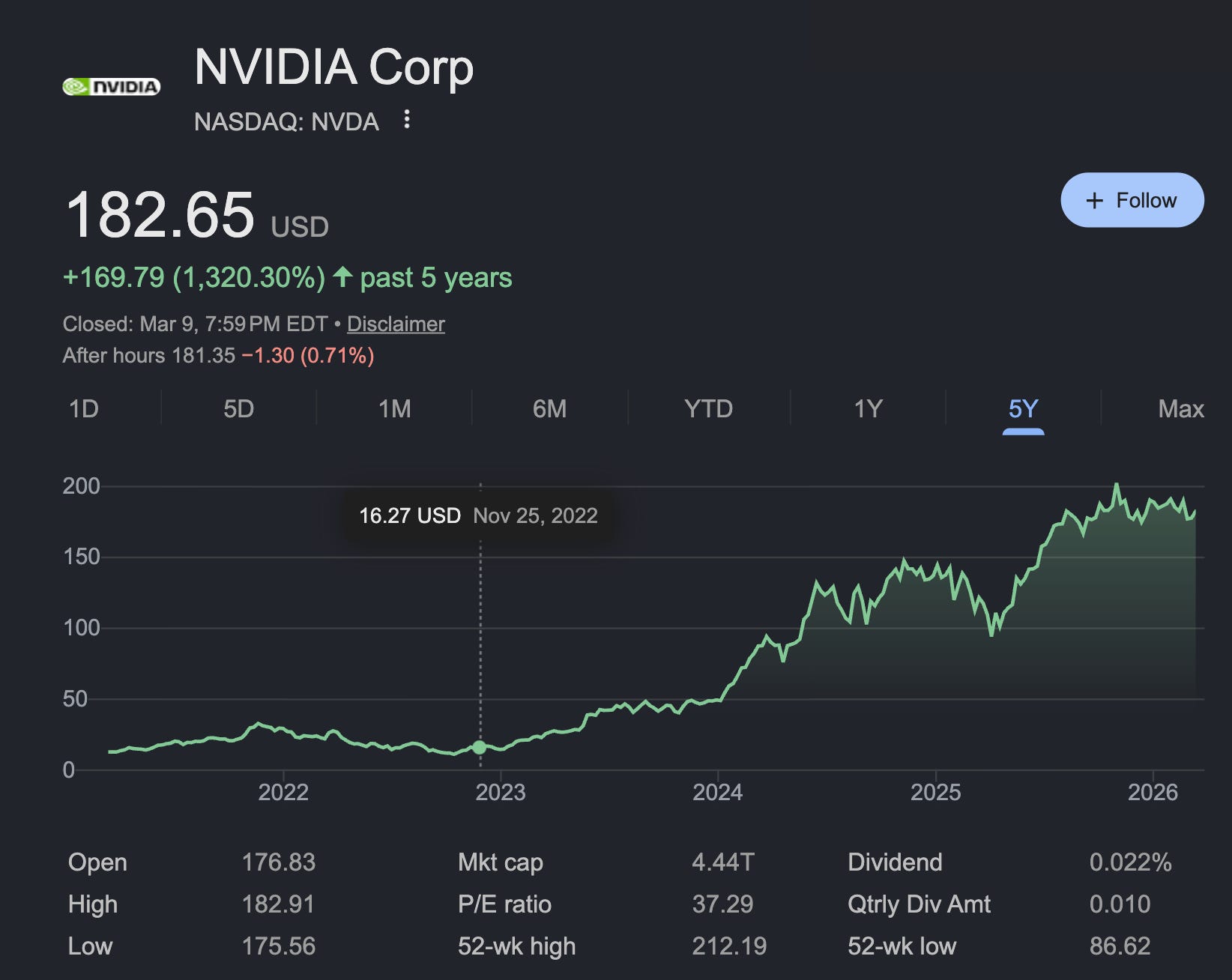
Join Kyle, Nader, Vibhu, and swyx live at NVIDIA GTC next week!Now that AIE Europe tix are ~sold out, our attention turns to Miami and World’s Fair!The definitive AI Accelerator chip company has more than 10xed this AI Summer:And is now a $4.4 trillion megacorp… that is somehow still moving like a startup. We are blessed to have a unique relationship with our first ever NVIDIA guests: Kyle Kranen who gave a great inference keynote at the first World’s Fair and is one of the leading architects of NVIDIA Dynamo (a Datacenter scale inference framework supporting SGLang, TRT-LLM, vLLM), and Nader Khalil, a friend of swyx from our days in Celo in The Arena, who has been drawing developers at GTC since before they were even a glimmer in the eye of NVIDIA:Nader discusses how NVIDIA Brev has drastically reduced the barriers to entry for developers to get a top of the line GPU up and running, and Kyle explains NVIDIA Dynamo as a data center scale inference engine that optimizes serving by scaling out, leveraging techniques like prefill/decode disaggregation, scheduling, and Kubernetes-based orchestration, framed around cost, latency, and quality tradeoffs. We also dive into Jensen’s “SOL” (Speed of Light) first-principles urgency concept, long-context limits and model/hardware co-design, internal model APIs (https://build.nvidia.com), and upcoming Dynamo and agent sessions at GTC.Full Video pod on YouTubeTimestamps00:00 Agent Security Basics00:39 Podcast Welcome and Guests07:19 Acquisition and DevEx Shift13:48 SOL Culture and Dynamo Setup27:38 Why Scale Out Wins29:02 Scale Up Limits Explained30:24 From Laptop to Multi Node33:07 Cost Quality Latency Tradeoffs38:42 Disaggregation Prefill vs Decode41:05 Kubernetes Scaling with Grove43:20 Context Length and Co Design57:34 Security Meets Agents58:01 Agent Permissions Model59:10 Build Nvidia Inference Gateway01:01:52 Hackathons And Autonomy Dreams01:10:26 Local GPUs And Scaling Inference01:15:31 Long Running Agents And SF ReflectionsTranscriptAgent Security BasicsNader: Agents can do three things. They can access your files, they can access the internet, and then now they can write custom code and execute it. You literally only let an agent do two of those three things. If you can access your files and you can write custom code, you don’t want internet access because that’s one to see full vulnerability, right?If you have access to internet and your file system, you should know the full scope of what that agent’s capable of doing. Otherwise, now we can get injected or something that can happen. And so that’s a lot of what we’ve been thinking about is like, you know, how do we both enable this because it’s clearly the future.But then also, you know, what, what are these enforcement points that we can start to like protect?swyx: All right.Podcast Welcome and Guestsswyx: Welcome to the Lean Space podcast in the Chromo studio. Welcome to all the guests here. Uh, we are back with our guest host Viu. Welcome. Good to have you back. And our friends, uh, Netter and Kyle from Nvidia. Welcome.Kyle: Yeah, thanks for having us.swyx: Yeah, thank you. Actually, I don’t even know your titles.Uh, I know you’re like architect something of Dynamo.Kyle: Yeah. I, I’m one of the engineering leaders [00:01:00] and a architects of Dynamo.swyx: And you’re director of something and developers, developer tech.Nader: Yeah.swyx: You’re the developers, developers, developers guy at nvidia,Nader: open source agent marketing, brev,swyx: and likeNader: Devrel tools and stuff.swyx: Yeah. BeenNader: the focus.swyx: And we’re, we’re kind of recording this ahead of Nvidia, GTC, which is coming to town, uh, again, uh, or taking over town, uh, which, uh, which we’ll all be at. Um, and we’ll talk a little bit about your sessions and stuff. Yeah.Nader: We’re super excited for it.GTC Booth Stunt Storiesswyx: One of my favorite memories for Nader, like you always do like marketing stunts and like while you were at Rev, you like had this surfboard that you like, went down to GTC with and like, NA Nvidia apparently, like did so much that they bought you.Like what, what was that like? What was that?Nader: Yeah. Yeah, we, we, um. Our logo was a chaka. We, we, uh, we were always just kind of like trying to keep true to who we were. I think, you know, some stuff, startups, you’re like trying to pretend that you’re a bigger, more mature company than you are. And it was actually Evan Conrad from SF Compute who was just like, you guys are like previousswyx: guest.Yeah.Nader: Amazing. Oh, really? Amazing. Yeah. He was just like, guys, you’re two dudes in the room. Why are you [00:02:00] pretending that you’re not? Uh, and so then we were like, okay, let’s make the logo a shaka. We brought surfboards to our booth to GTC and the energy was great. Yeah. Some palm trees too. They,Kyle: they actually poked out over like the, the walls so you could, you could see the bread booth.Oh, that’s so funny. AndNader: no one else,Kyle: just from very far away.Nader: Oh, so you remember it backKyle: then? Yeah I remember it pre-acquisition. I was like, oh, those guys look cool,Nader: dude. That makes sense. ‘cause uh, we, so we signed up really last minute, and so we had the last booth. It was all the way in the corner. And so I was, I was worried that no one was gonna come.So that’s why we had like the palm trees. We really came in with the surfboards. We even had one of our investors bring her dog and then she was just like walking the dog around to try to like, bring energy towards our booth. Yeah.swyx: Steph.Kyle: Yeah. Yeah, she’s the best,swyx: you know, as a conference organizer, I love that.Right? Like, it’s like everyone who sponsors a conference comes, does their booth. They’re like, we are changing the future of ai or something, some generic b******t and like, no, like actually try to stand out, make it fun, right? And people still remember it after three years.Nader: Yeah. Yeah. You know what’s so funny?I’ll, I’ll send, I’ll give you this clip if you wanna, if you wanna add it [00:03:00] in, but, uh, my wife was at the time fiance, she was in medical school and she came to help us. ‘cause it was like a big moment for us. And so we, we bought this cricket, it’s like a vinyl, like a vinyl, uh, printer. ‘cause like, how else are we gonna label the surfboard?So, we got a surfboard, luckily was able to purchase that on the company card. We got a cricket and it was just like fine tuning for enterprises or something like that, that we put on the. On the surfboard and it’s 1:00 AM the day before we go to GTC. She’s helping me put these like vinyl stickers on.And she goes, you son of, she’s like, if you pull this off, you son of a b***h. And so, uh, right. Pretty much after the acquisition, I stitched that with the mag music acquisition. I sent it to our family group chat. Ohswyx: Yeah. No, well, she, she made a good choice there. Was that like basically the origin story for Launchable is that we, it was, and maybe we should explain what Brev is andNader: Yeah.Yeah. Uh, I mean, brev is just, it’s a developer tool that makes it really easy to get a GPU. So we connect a bunch of different GPU sources. So the basics of it is like, how quickly can we SSH you into a G, into a GPU and whenever we would talk to users, they wanted A GPU. They wanted an A 100. And if you go to like any cloud [00:04:00] provisioning page, usually it’s like three pages of forms or in the forms somewhere there’s a dropdown.And in the dropdown there’s some weird code that you know to translate to an A 100. And I remember just thinking like. Every time someone says they want an A 100, like the piece of text that they’re telling me that they want is like, stuffed away in the corner. Yeah. And so we were like, what if the biggest piece of text was what the user’s asking for?And so when you go to Brev, it’s just big GPU chips with the type that you want withswyx: beautiful animations that you worked on pre, like pre you can, like, now you can just prompt it. But back in the day. Yeah. Yeah. Those were handcraft, handcrafted artisanal code.Nader: Yeah. I was actually really proud of that because, uh, it was an, i I made it in Figma.Yeah. And then I found, I was like really struggling to figure out how to turn it from like Figma to react. So what it actually is, is just an SVG and I, I have all the styles and so when you change the chip, whether it’s like active or not it changes the SVG code and that somehow like renders like, looks like it’s animating, but it, we just had the transition slow, but it’s just like the, a JavaScript function to change the like underlying SVG.Yeah. And that was how I ended up like figuring out how to move it from from Figma. But yeah, that’s Art Artisan. [00:05:00]Kyle: Speaking of marketing stunts though, he actually used those SVGs. Or kind of use those SVGs to make these cards.Nader: Oh yeah. LikeKyle: a GPU gift card Yes. That he handed out everywhere. That was actually my first impression of thatNader: one.Yeah,swyx: yeah, yeah.Nader: Yeah.swyx: I think I still have one of them.Nader: They look great.Kyle: Yeah.Nader: I have a ton of them still actually in our garage, which just, they don’t have labels. We should honestly like bring, bring them back. But, um, I found this old printing press here, actually just around the corner on Ven ness. And it’s a third generation San Francisco shop.And so I come in an excited startup founder trying to like, and they just have this crazy old machinery and I’m in awe. ‘cause the the whole building is so physical. Like you’re seeing these machines, they have like pedals to like move these saws and whatever. I don’t know what this machinery is, but I saw all three generations.Like there’s like the grandpa, the father and the son, and the son was like, around my age. Well,swyx: it’s like a holy, holy trinity.Nader: It’s funny because we, so I just took the same SVG and we just like printed it and it’s fo
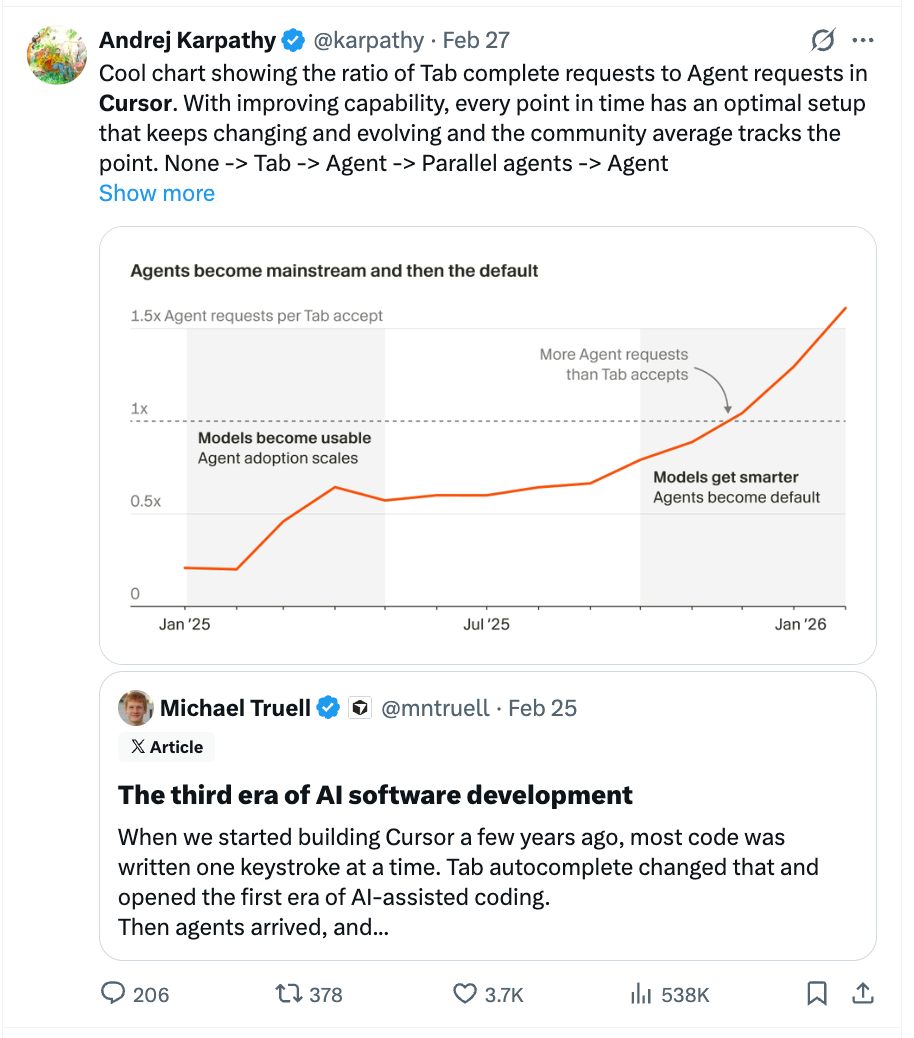
All speakers are announced at AIE EU, schedule coming soon. Join us there or in Miami with the renowned organizers of React Miami! Singapore CFP also open!We’ve called this out a few times over in AINews, but the overwhelming consensus in the Valley is that “the IDE is Dead”. In November it was just a gut feeling, but now we actually have data: even at the canonical “VSCode Fork” company, people are officially using more agents than tab autocomplete (the first wave of AI coding):Cursor has launched cloud agents for a few months now, and this specific launch is around Computer Use, which has come a long way since we first talked with Anthropic about it in 2024, and which Jonas productized as Autotab:We also take the opportunity to do a live demo, talk about slash commands and subagents, and the future of continual learning and personalized coding models, something that Sam previously worked on at New Computer. (The fact that both of these folks are top tier CEOs of their own startups that have now joined the insane talent density gathering at Cursor should also not be overlooked).Full Episode on YouTube!please like and subscribe!Timestamps00:00 Agentic Code Experiments00:53 Why Cloud Agents Matter02:08 Testing First Pillar03:36 Video Reviews Second Pillar04:29 Remote Control Third Pillar06:17 Meta Demos and Bug Repro13:36 Slash Commands and MCPs18:19 From Tab to Team Workflow31:41 Minimal Web UI Philosophy32:40 Why No File Editor34:38 Full Stack Cursor Debate36:34 Model Choice and Auto Routing38:34 Parallel Agents and Best Of N41:41 Subagents and Context Management44:48 Grind Mode and Throughput Future01:00:24 Cloud Agent Onboarding and MemoryTranscriptEP 77 - CURSOR - Audio version[00:00:00]Agentic Code ExperimentsSamantha: This is another experiment that we ran last year and didn’t decide to ship at that time, but may come back to LM Judge, but one that was also agentic and could write code. So it wasn’t just picking but also taking the learnings from two models or and models that it was looking at and writing a new diff.And what we found was that there were strengths to using models from different model providers as the base level of this process. Basically you could get almost like a synergistic output that was better than having a very unified like bottom model tier.Jonas: We think that over the coming months, the big unlock is not going to be one person with a model getting more done, like the water flowing faster and we’ll be making the pipe much wider and so paralyzing more, whether that’s swarms of agents or parallel agents, both of those are things that contribute to getting much more done in the same amount of time.Why Cloud Agents Matterswyx: This week, one of the biggest launches that Cursor’s ever done is cloud agents. I think you, you had [00:01:00] cloud agents before, but this was like, you give cursor a computer, right? Yeah. So it’s just basically they bought auto tab and then they repackaged it. Is that what’s going on, or,Jonas: that’s a big part of it.Yeah. Cloud agents already ran in their own computers, but they were sort of site reading code. Yeah. And those computers were not, they were like blank VMs typically that were not set up for the Devrel X for whatever repo the agents working on. One of the things that we talk about is if you put yourself in the model shoes and you were seeing tokens stream by and all you could do was cite read code and spit out tokens and hope that you had done the right thing,swyx: no chanceJonas: I’d be so bad.Like you obviously you need to run the code. And so that I think also is probably not that contrarian of a take, but no one has done that yet. And so giving the model the tools to onboard itself and then use full computer use end-to-end pixels in coordinates out and have the cloud computer with different apps in it is the big unlock that we’ve seen internally in terms of use usage of this going from, oh, we use it for little copy changes [00:02:00] to no.We’re really like driving new features with this kind of new type of entech workflow. Alright, let’s see it. Cool.Live Demo TourJonas: So this is what it looks like in cursor.com/agents. So this is one I kicked off a while ago. So on the left hand side is the chat. Very classic sort of agentic thing. The big new thing here is that the agent will test its changes.So you can see here it worked for half an hour. That is because it not only took time to write the tokens of code, it also took time to test them end to end. So it started Devrel servers iterate when needed. And so that’s one part of it is like model works for longer and doesn’t come back with a, I tried some things pr, but a I tested at pr that’s ready for your review.One of the other intuition pumps we use there is if a human gave you a PR asked you to review it and you hadn’t, they hadn’t tested it, you’d also be annoyed because you’d be like, only ask me for a review once it’s actually ready. So that’s what we’ve done withTesting Defaults and Controlsswyx: simple question I wanted to gather out front.Some prs are way smaller, [00:03:00] like just copy change. Does it always do the video or is it sometimes,Jonas: Sometimes.swyx: Okay. So what’s the judgment?Jonas: The model does it? So we we do some default prompting with sort. What types of changes to test? There’s a slash command that people can do called slash no test, where if you do that, the model will not test,swyx: but the default is test.Jonas: The default is to be calibrated. So we tell it don’t test, very simple copy changes, but test like more complex things. And then users can also write their agents.md and specify like this type of, if you’re editing this subpart of my mono repo, never tested ‘cause that won’t work or whatever.Videos and Remote ControlJonas: So pillar one is the model actually testing Pillar two is the model coming back with a video of what it did.We have found that in this new world where agents can end-to-end, write much more code, reviewing the code is one of these new bottlenecks that crop up. And so reviewing a video is not a substitute for reviewing code, but it is an entry point that is much, much easier to start with than glancing at [00:04:00] some giant diff.And so typically you kick one off you, it’s done you come back and the first thing that you would do is watch this video. So this is a, video of it. In this case I wanted a tool tip over this button. And so it went and showed me what that looks like in, in this video that I think here, it actually used a gallery.So sometimes it will build storybook type galleries where you can see like that component in action. And so that’s pillar two is like these demo videos of what it built. And then pillar number three is I have full remote control access to this vm. So I can go heat in here. I can hover things, I can type, I have full control.And same thing for the terminal. I have full access. And so that is also really useful because sometimes the video is like all you need to see. And oftentimes by the way, the video’s not perfect, the video will show you, is this worth either merging immediately or oftentimes is this worth iterating with to get it to that final stage where I am ready to merge in.So I can go through some other examples where the first video [00:05:00] wasn’t perfect, but it gave me confidence that we were on the right track and two or three follow-ups later, it was good to go. And then I also have full access here where some things you just wanna play around with. You wanna get a feel for what is this and there’s no substitute to a live preview.And the VNC kind of VM remote access gives you that.swyx: Amazing What, sorry? What is VN. AndJonas: just the remote desktop. Remote desktop. Yeah.swyx: Sam, any other details that you always wanna call out?Samantha: Yeah, for me the videos have been super helpful. I would say, especially in cases where a common problem for me with agents and cloud agents beforehand was almost like under specification in my requests where our plan mode and going really back and forth and getting detailed implementation spec is a way to reduce the risk of under specification, but then similar to how human communication breaks down over time, I feel like you have this risk where it’s okay, when I pull down, go to the triple of pulling down and like running this branch locally, I’m gonna see that, like I said, this should be a toggle and you have a checkbox and like, why didn’t you get that detail?And having the video up front just [00:06:00] has that makes that alignment like you’re talking about a shared artifact with the agent. Very clear, which has been just super helpful for me.Jonas: I can quickly run through some other Yes. Examples.Meta Agents and More DemosJonas: So this is a very front end heavy one. So one question I wasswyx: gonna say, is this only for frontJonas: end?Exactly. One question you might have is this only for front end? So this is another example where the thing I wanted it to implement was a better error message for saving secrets. So the cloud agents support adding secrets, that’s part of what it needs to access certain systems. Part of onboarding that is giving access.This is cloud is working onswyx: cloud agents. Yes.Jonas: So this is a fun thing isSamantha: it can get super meta. ItJonas: can get super meta, it can start its own cloud agents, it can talk to its own cloud agents. Sometimes it’s hard to wrap your mind around that. We have disabled, it’s cloud agents starting more cloud agents. So we currently disallow that.Someday you might. Someday we might. Someday we might. So this actually was mostly a backend change in terms of the error handling here, where if the [00:07:00] secret is far too large, it would oh, this is actually really cool. Wow. That’s the Devrel tools. That’s the Devrel tools. So if the secret is far too large, we.Allow secrets above a certain size. We have a size limit on them. And the error message there was real
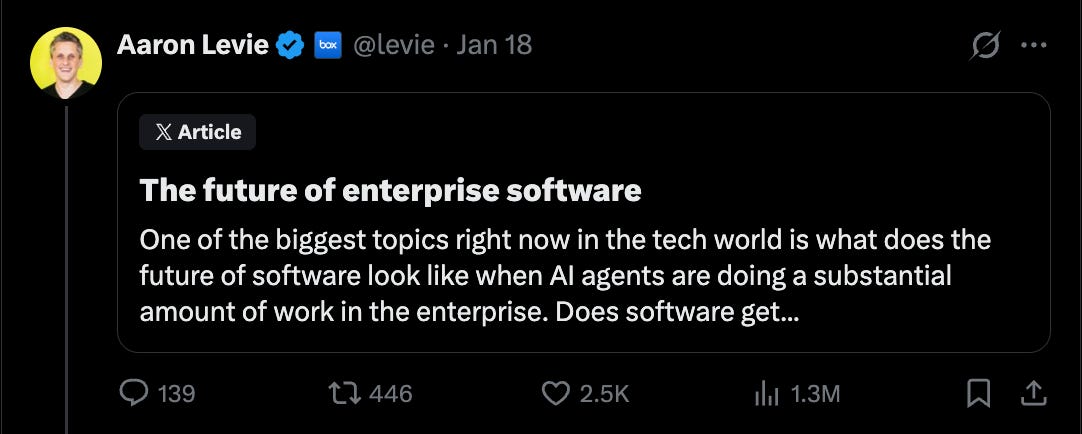
The reception to our recent post on Code Reviews has been strong. Catch up!Amid a maelstrom of discussion on whether or not AI is killing SaaS, one of the top publicly listed SaaS companies in the world has just reported record revenues, clearing well over $1.1B in ARR for the first time with a 28% margin. As we comment on the pod, Aaron Levie is the rare public company CEO equally at home in both worlds of Silicon Valley and Wall Street/Main Street, by day helping 70% of the Fortune 500 with their Enterprise Advanced Suite, and yet by night is often found in the basements of early startups and tweeting viral insights about the future of agents.Now that both Cursor, Cloudflare, Perplexity, Anthropic and more have made Filesystems and Sandboxes and various forms of “Just Give the Agent a Box” cool (not just cool; it is now one of the single hottest areas in AI infrastructure growing 100% MoM), we find it a delightfully appropriate time to do the episode with the OG CEO who has been giving humans and computers Boxes since he was a college dropout pitching VCs at a Michael Arrington house party.Enjoy our special pod, with fan favorite returning guest/guest cohost Jeff Huber!Note: We didn’t directly discuss the AI vs SaaS debate - Aaron has done many, many, many other podcasts on that, and you should read his definitive essay on it. Most commentators do not understand SaaS businesses because they have never scaled one themselves, and deeply reflected on what the true value proposition of SaaS is.We also discuss Your Company is a Filesystem:We also shoutout CTO Ben Kus’ and the AI team, who talked about the technical architecture and will return for AIE WF 2026.Full Video EpisodeTimestamps* 00:00 Adapting Work for Agents* 01:29 Why Every Agent Needs a Box* 04:38 Agent Governance and Identity* 11:28 Why Coding Agents Took Off First* 21:42 Context Engineering and Search Limits* 31:29 Inside Agent Evals* 33:23 Industries and Datasets* 35:22 Building the Agent Team* 38:50 Read Write Agent Workflows* 41:54 Docs Graphs and Founder Mode* 55:38 Token FOMO Culture* 56:31 Production Function Secrets* 01:01:08 Film Roots to Box* 01:03:38 AI Future of Movies* 01:06:47 Media DevRel and EngineeringTranscriptAdapting Work for AgentsAaron Levie: Like you don’t write code, you talk to an agent and it goes and does it for you, and you may be at best review it. That’s even probably like, like largely not even what you’re doing. What’s happening is we are changing our work to make the agents effective. In that model, the agent didn’t really adapt to how we work.We basically adapted to how the agent works. All of the economy has to go through that exact same evolution. Right now, it’s a huge asset and an advantage for the teams that do it early and that are kinda wired into doing this ‘cause you’ll see compounding returns. But that’s just gonna take a while for most companies to actually go and get this deployed.swyx: Welcome to the Lane Space Pod. We’re back in the chroma studio with uh, chroma, CEO, Jeff Hoover. Welcome returning guest now guest host.Aaron Levie: It’s a pleasure. Wow. How’d you get upgraded to, uh, to that?swyx: Because he’s like the perfect guy to be guest those for you.Aaron Levie: That makes sense actually, for We love context. We, we both really love context le we really do.We really do.swyx: Uh, and we’re here with, uh, Aaron Levy. Welcome.Aaron Levie: Thank you. Good to, uh, good to be [00:01:00] here.swyx: Uh, yeah. So we’ve all met offline and like chatted a little bit, but like, it’s always nice to get these things in person and conversation. Yeah. You just started off with so much energy. You’re, you’re super excited about agents.I loveAaron Levie: agents.swyx: Yeah. Open claw. Just got by, got bought by OpenAI. No, not bought, but you know, you know what I mean?Aaron Levie: Some, some, you know, acquihire. Executiveswyx: hire.Aaron Levie: Executive hire. Okay. Executive hire. Say,swyx: hey, that’s my term. Okay. Um, what are you pounding the table on on agents? You have so many insightful tweets.Why Every Agent Needs a BoxAaron Levie: Well, the thing that, that we get super excited by that I think is probably, you know, should be relatively obvious is we’ve, we’ve built a platform to help enterprises manage their files and their, their corporate files and the permissions of who has access to those files and the sharing collaboration of those files.All of those files contain really, really important information for the enterprise. It might have your contracts, it might have your research materials, it might have marketing information, it might have your memos. All that data obviously has, you know, predominantly been used by humans. [00:02:00] But there’s been one really interesting problem, which is that, you know, humans only really work with their files during an active engagement with them, and they kind of go away and you don’t really see them for a long time.And all of a sudden, uh, with the power of AI and AI agents, all of that data becomes extremely relevant as this ongoing source of, of answers to new questions of data that will transform into, into something else that, that produces value in your organization. It, it contains the answer to the new employee that’s onboarding, that needs to ramp up on a project.Um, it contains the answer to the right thing to sell a customer when you’re having a conversation to them, with them contains the roadmap information that’s gonna produce the next feature. So all that data. That previously we’ve been just sort of storing and, and you know, occasionally forgetting about, ‘cause we’re only working on the new active stuff.All of that information becomes valuable to the enterprise and it’s gonna become extremely valuable to end users because now they can have agents go find what they’re looking for and produce new, new [00:03:00] value and new data on that information. And it’s gonna become incredibly valuable to agents because agents can roam around and do a bunch of work and they’re gonna need access to that data as well.And um, and you know, sometimes that will be an agent that is sort of working on behalf of, of, of you and, and effectively as you as and, and they are kind of accessing all of the same information that you have access to and, and operating as you in the system. And then sometimes there’s gonna be agents that are just.Effectively autonomous and kind of run on their own and, and you’re gonna collaborate and work with them kind of like you did another person. Open Claw being the most recent and maybe first real sort of, you know, kind of, you know, up updating everybody’s, you know, views of this landscape version of, of what that could look like, which is, okay, I have an agent.It’s on its own system, it’s on its own computer, it has access to its own tools. I probably don’t give it access to my entire life. I probably communicate with it like I would an assistant or a colleague and then it, it sort of has this sandbox environment. So all of that has massive implications for a platform that manage that [00:04:00] enterprise data.We think it’s gonna just transform how we work with all of the enterprise content that we work with, and we just have to make sure we’re building the right platform to support that.swyx: The sort of shorthand I put it is as people build agents, everybody’s just realizing that every agent needs a box. Yes.And it’s nice to be called box and just give everyone a box.Aaron Levie: Hey, I if I, you know, if we can make that go viral, uh, like I, I think that that terminology, I, that’s theswyx: tagline. Every agentAaron Levie: needs a box. Every agent needs a box. If we can make that the headline of this, I’m fine with this. And that’s the billboard I wanna like Yeah, exactly.Every agent needs a box. Um, I like it. Can we ship this? Like,swyx: okay, let’s do it. Yeah.Aaron Levie: Uh, my work here is done and I got the value I needed outta this podcast Drinks.swyx: Yeah.Agent Governance and IdentityAaron Levie: But, but, um, but, but, you know, so the thing that we, we kind of think about is, um, is, you know, whether you think the number 10 x or a hundred x or whatever the number is, we’re gonna have some order of magnitude more agents than people.That’s inevitable. It has to happen. So then the question is, what is the infrastructure that’s needed to make all those agents effective in the enterprise? Make sure that they are well governed. Make sure they’re only doing [00:05:00] safe things on your information. Make sure that they’re not getting exposed. The data that they shouldn’t have access to.There’s gonna be just incredibly spectacularly crazy security incidents that will happen with agents because you’ll prompt, inject an agent and sort of find your way through the CRM system and pull out data that you shouldn’t have access to. Oh, weJeff Huber: have God,Aaron Levie: right? I mean, that’s just gonna happen all over the place, right?So, so then the thing is, is how do you make sure you have the right security, the permissions, the access controls, the data governance. Um, we actually don’t yet exactly know in many cases how we’re gonna regulate some of these agents, right? If you think about an agent in financial services, does it have the exact same financial sort of, uh, requirements that a human did?Or is it, is the risk fully on the human that was interacting or created the agent? All open questions, but no matter what, there’s gonna need to be a layer that manages the, the data they have access to, the workflows that they’re involved in, pulling up data from multiple systems. This is the new infrastructure opportunity in the era of agents.swyx: You have a piece on agent identities, [00:06:00] which I think was today, um, which I think a lot of breaking news, the security, security people are talking about, right? Like you basically, I, I always think of this as like, well you need the human you and then there you
This is a free preview of a paid episode. To hear more, visit www.latent.spaceAIE Europe CFP and AIE World’s Fair paper submissions for CAIS peer review are due TODAY - do not delay! Last call ever.We’re excited to welcome METR for their first LS Pod, hopefully the first of many:METR are keepers of currently the single most infamous chart in AI:But every Latent Space reader should be sophisticated enough to know that the details matter and that hype and hyperbole go hand in hand in AI social media, because the millions of impressions that got, by people who don’t understand or care about the nuances, disclaimers, and error bars, far outreaches the 69k views on the corrections by the people who actually made the chart:There’s a lot of nuance both in making benchmarks (as we discovered with OpenAI on our SWE-Bench Verified podcast) and in extrapolating results from them, especially where exponentials and sigmoids are concerned. METR’s Long Horizons work itself has known biases that the authors have responsibly disclosed, but go far too underappreciated in the pursuit of doomer chart porn.If you’re interested in a short, sharable TED talk version of this pod, over at AIE CODE we were blessed to feature Joel twice, as a stage talk and with a longer form small workshop with Q&A:We also make sure cover some of METR’s lesser known work on Threat Evaluation but also Developer Productivity, where 2x friend of the pod and now Zyphra founder Quentin Anthony was the ONLY productive participant!Finally, if you’re the sort to read these show notes to the end, then you definitely deserve some pictures of Joel shredding the guitar at Love Band Karaoke which we mention at the end: Full Video PodTimestamps00:00 What METR Means00:39 Podcast Intro With Joel01:39 ME vs TR03:33 Time Horizon Origin Story04:56 Picking Tasks And Biases09:13 Time Horizon Misconceptions11:37 Opus 4.5 And Trendlines14:27 Productivity Studies And Explosions29:50 Compute Slows Progress30:47 Algorithms Need Compute32:45 Industry Spend and Data34:57 Clusters and Shipping Timelines36:44 Prediction Markets for Models38:10 Manifold Alpha Story43:04 Beyond Benchmarks Evals51:39 METR Roadmap and FarewellTranscript
![[LIVE] Anthropic Distillation & How Models Cheat (SWE-Bench Dead) | Nathan Lambert & Sebastian Raschka](https://substackcdn.com/feed/podcast/1084089/post/189277598/ca7468da5614a246d2906ee8926f6de7.jpg "[LIVE] Anthropic Distillation & How Models Cheat (SWE-Bench Dead) | Nathan Lambert & Sebastian Raschka")
Swyx joined SAIL! Thank you SAIL Media, Prof. Tom Yeh, 8Lee, Hamid Bagheri, c9n, and many others for tuning into SAIL Live #6 with Nathan Lambert and Sebastian Raschka, PhD. Sharing here for the LS paid subscribers.We covered: This is a public episode. If you'd like to discuss this with other subscribers or get access to bonus episodes, visit www.latent.space/subscribe
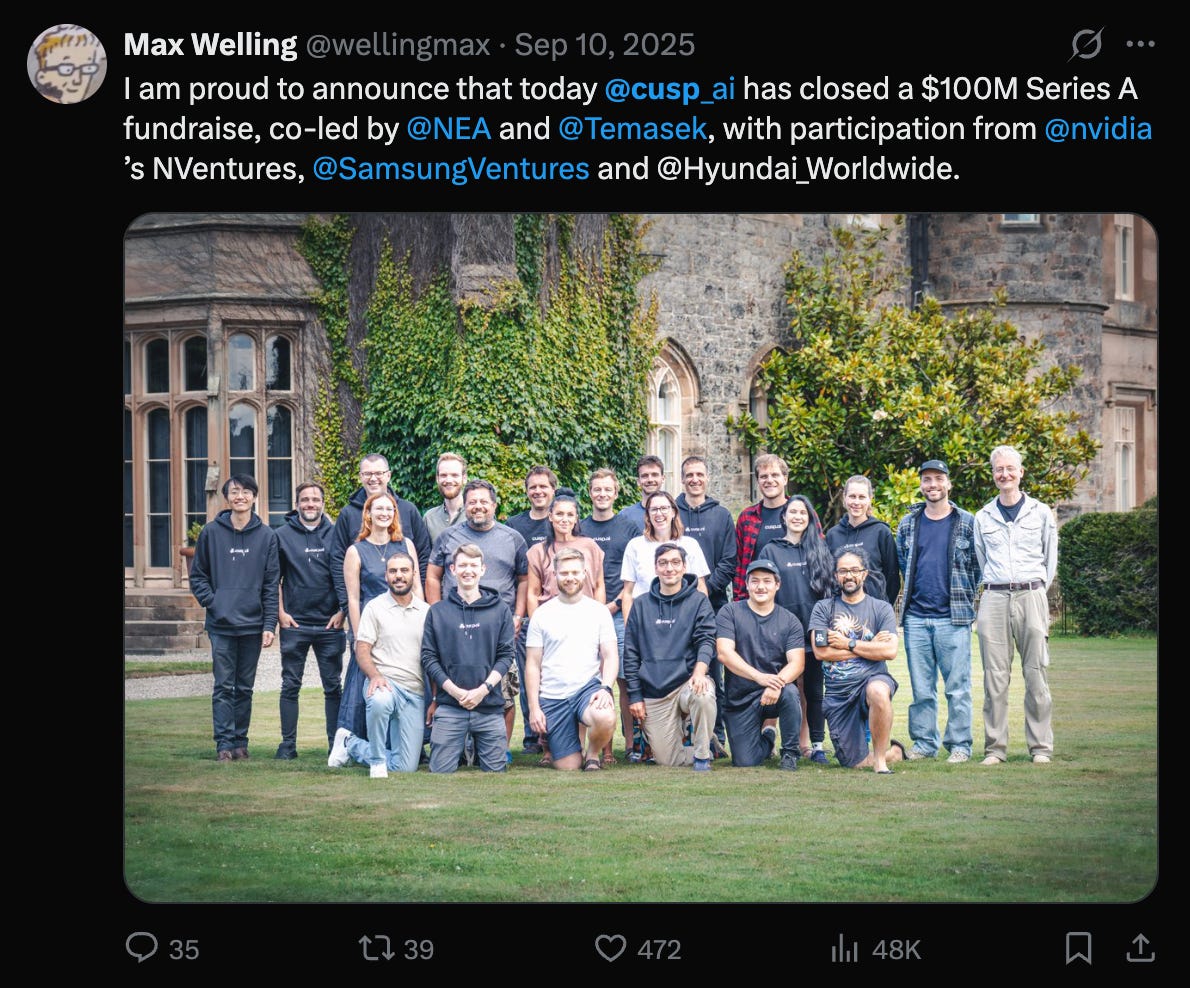
Editor’s note: CuspAI raised a $100m Series A in September and is rumored to have reached a unicorn valuation. They have all-star advisors from Geoff Hinton to Yann Lecun and team of deep domain experts to tackle this next frontier in AI applications.In this episode, Max Welling traces the thread connecting quantum gravity, equivariant neural networks, diffusion models, and climate-focused materials discovery (yes, there is one!!!).We begin with a provocative framing: experiments as computation. Welling describes the idea of a “physics processing unit”—a world in which digital models and physical experiments work together, with nature itself acting as a kind of processor. It’s a grounded but ambitious vision of AI for science: not replacing chemists, but accelerating them.Along the way, we discuss:* Why symmetry and equivariance matter in deep learning* The tradeoff between scale and inductive bias* The deep mathematical links between diffusion models and stochastic thermodynamics* Why materials—not software—may be the real bottleneck for AI and the energy transition* What it actually takes to build an AI-driven materials platformMax reflects on moving from curiosity-driven theoretical physics (including work with Gerard ‘t Hooft) toward impact-driven research in climate and energy. The result is a conversation about convergence: physics and machine learning, digital models and laboratory experiments, long-term ambition and incremental progress.Full Video EpisodeTimestamps* 00:00:00 – The Physics Processing Unit (PPU): Nature as the Ultimate Computer* Max introduces the idea of a Physics Processing Unit — using real-world experiments as computation.* 00:00:44 – From Quantum Gravity to AI for Materials* Brandon frames Max’s career arc: VAE pioneer → equivariant GNNs → materials startup founder.* 00:01:34 – Curiosity vs Impact: How His Motivation Evolved* Max explains the shift from pure theoretical curiosity to climate-driven impact.* 00:02:43 – Why CaspAI Exists: Technology as Climate Strategy* Politics struggles; technology scales. Why materials innovation became the focus.* 00:03:39 – The Thread: Physics → Symmetry → Machine Learning* How gauge symmetry, group theory, and relativity informed equivariant neural networks.* 00:06:52 – AI for Science Is Exploding (Not Emerging)* The funding surge and why AI-for-Science feels like a new industrial era.* 00:07:53 – Why Now? The Two Catalysts Behind AI for Science* Protein folding, ML force fields, and the tipping point moment.* 00:10:12 – How Engineers Can Enter AI for Science* Practical pathways: curriculum, workshops, cross-disciplinary training.* 00:11:28 – Why Materials Matter More Than Software* The argument that everything—LLMs included—rests on materials innovation.* 00:13:02 – Materials as a Search Engine* The vision: automated exploration of chemical space like querying Google.* 01:14:48 – Inside CuspAI: The Platform Architecture* Generative models + multi-scale digital twin + experiment loop.* 00:21:17 – Automating Chemistry: Human-in-the-Loop First* Start manual → modular tools → agents → increasing autonomy.* 00:25:04 – Moonshots vs Incremental Wins* Balancing lighthouse materials with paid partnerships.* 00:26:22 – Why Breakthroughs Will Still Require Humans* Automation is vertical-specific and iterative.* 00:29:01 – What Is Equivariance (In Plain English)?* Symmetry in neural networks explained with the bottle example.* 00:30:01 – Why Not Just Use Data Augmentation?* The optimization trade-off between inductive bias and data scale.* 00:31:55 – Generative AI Meets Stochastic Thermodynamics* His upcoming book and the unification of diffusion models and physics.* 00:33:44 – When the Book Drops (ICLR?)TranscriptMax: I want to think of it as what I would call a physics processing unit, like a PPU, right? Which is you have digital processing units and then you have physics processing units. So it’s basically nature doing computations for you. It’s the fastest computer known, as possible even. It’s a bit hard to program because you have to do all these experiments. Those are quite bulky, it’s like a very large thing you have to do. But in a way it is a computation and that’s the way I want to see it. You can do computations in a data center and then you can ask nature to do some computations. Your interface with nature is a bit more complicated. But then these things will have to seamlessly work together to get to a new material that you’re interested in.[01:00:44:14 - 01:01:34:08]Brandon: Yeah, it’s a pleasure to have Max Woehling as a guest today. Max has done so much over his career that I’ve been so excited about. If you’re in the deep learning community, you probably know Max for his work on variational autocoders, which has literally stood the test of prime or officially stood the test of prime. If you are a scientist, you probably know him for his like, binary work on graph neural networks on equivariance. And if you’re a material science, you probably know him about his new startup, CASPAI. Max has a long history doing lots of cool problems. You started in quantum gravity, which is I think very different than all of these other things you worked on. The first question for AI engineers and for scientists, what is the thread in how you think about problems? What is the thread in the type of things which excite you? And how do you decide what is the next big thing you want to work on?[01:01:34:08 - 01:02:41:13]Max: So it has actually evolved a lot. In my young days, let’s breathe, I would just follow what I would find super interesting. I have kind of this sensor. I think many people have, but maybe not really sort of use very much, which is like, you get this feeling about getting very excited about some problem. Like it could be, what’s inside of a black hole or what’s at the boundary of the universe or what are quantum mechanics actually all about. And so I follow that basically throughout my career. But I have to say that as you get older, this changes a little bit in the sense that there’s a new dimension coming to it and there’s this impact. Going in two-dimensional quantum gravity, you pretty much guaranteed there’s going to be no impact on what you do relative, maybe a few papers, but not in this world, this energy scale. As I get closer to retirement, which is fortunately still 10 years away or so, I do want to kind of make a positive impact in the world. And I got pretty worried about climate change.[01:02:43:15 - 01:03:19:11]Max: I think politics seems to have a hard time solving it, especially these days. And so I thought better work on it from the technology side. And that’s why we started CaspAI. But there’s also a lot of really interesting science problems in material science. And so it’s kind of combining both the impact you can make with it as well as the interesting science. So it’s sort of these two dimensions, like working on things which you feel there’s like, well, there’s something very deep going on here. And on the other hand, trying to build tools that can actually make a real impact in the world.[01:03:19:11 - 01:03:39:23]RJ: So the thread that when I look back, look at the different things that you worked out, some of them seem pretty connected, like the physics to equivariance and, yeah, and, uh, gravitational networks, maybe. And that seems to be somewhat related to Casp. Do you have a thread through there?[01:03:39:23 - 01:06:52:16]Max: Yeah. So physics is the thread. So having done, you know, spent a lot of time in theoretical physics, I think there is first very fundamental and exciting questions, like things that haven’t actually been figured out in quantum gravity. So that is really the frontier. There’s also a lot of mathematical tools that you can use, right? In, for instance, in particle physics, but also in general relativity, sort of symmetry space to play an enormously important role. And this goes all the way to gauge symmetries as well. And so applying these kinds of symmetries to, uh, machine learning was actually, you know, I thought of it as a very deep and interesting mathematical problem. I did this with Taco Cohen and Taco was the main driver behind this, went all the way from just simple, like rotational symmetries all the way to gauge symmetries on spheres and stuff like that. So, and, uh, Maurice Weiler, who’s also here, um, when he was a PhD student, he was a very good student with me, you know, he wrote an entire book, which I can really recommend about the role of symmetries in AI and machine learning. So I find this a very deep and interesting problem. So more recently, so I’ve taken a sort of different path, which is the relationship between diffusion models and that field called stochastic thermodynamics. This is basically the thermodynamics, which is a theory of equilibrium. So but then formulated for out of equilibrium systems. And it turns out that the mathematics that we use for diffusion models, but even for reinforcement learning for Schrodinger bridges for MCMC sampling has the same mathematics as this theoretical, this physical theory of non-equilibrium systems. And that got me very excited. And actually, uh, when I taught a course in, um, Mauschenberg, uh, it is South Africa, close to Cape Town at the African Institute for Mathematical Sciences Ames. And I turned that into a book site. Two years later, the book was finished. I’ve sent it to the publisher. And this is about the deep relationship between free energy, diffusion models, basically generative AI and stochastic thermodynamics. So it’s always some kind of, I don’t know, I find physics very deep. I also think a lot about quantum mechanics and it’s, it’s, it’s a completely weird theory that actually nobody really understands. And there’s a very interesting story, which is maybe good to tell to connect sort of my PZ back to where I’m now. So I did my PZ with a Nobel Laureate, Gerard the toft. He says the most brilliant man I’ve e
This is a free preview of a paid episode. To hear more, visit www.latent.spaceFirst speakers for AIE Europe and AIEi Miami have been announced. If you’re in Asia/Aus, come by Singapore and Melbourne. AI Engineering is going global!One year ago today, Anthropic launched Claude Code, to not much fanfare:The word of mouth was incredibly strong however, and so we were glad to be one of the first podcasts to invite Boris and Cat on in early May:As we discussed on the pod, all CC usage was API-based and therefore it was ridiculously expensive to do anything. This was then fixed by the team including Claude Code in the Claude Pro plan in early June, and then the virality caused us to make a rare trend call in late June:Now, 6 months on, Doug has just calculated that around 4% of GitHub is written by Claude Code:We talk about how Doug uses Claude Code to do SemiAnalysis work.Memory ManiaIn the second part of this episode, we also check in on Memory Mania, which is going to affect you (yes, you) at home if it hasn’t already:Full Episode on YouTubeTimestamps00:00 AI as Junior Analyst00:59 Meet Swyx and Doug03:30 From Value Mule to Semis06:28 Moore’s Law Ends Thesis12:02 Claude Code Awakening32:02 Agent Swarms Reality Check32:53 Kimi Swarm Benchmarks37:31 Bots vs Zapier Automation39:44 Claude Code Workflow Setup57:54 AGI Metrics and GDP01:04:48 Railroad CapEx Analogy01:06:00 Funding Bubbles and Demand01:08:11 Agents Replace Work Tools01:13:56 Codex vs Claude Race01:21:15 Microsoft and TPU Strategy01:34:13 TPU Window vs Nvidia01:36:30 HBM Supply Chain Squeeze01:39:41 Memory Shock and CXL01:45:20 Context Rationing Future01:54:37 Writing and Trail LessonsTranscript[00:00:00] AI as Junior Analyst[00:00:00] Doug: This crap makes mistakes all the time. All the time. It is still just like a, like I think of it once again as like a junior analyst, right? The analyst goes and does all this like really pain in the ass information and you bring it all together to make a good decision at the top. Historically what happens is that junior analyst, who I once was, went and gathered all that information, and after doing this enough times, there’s a meta level thinking that’s happening where it’s like, okay, here’s what I really understand and how this type of analysis, I’m an expert in, actually I’m very good at, I consistently have a hit rate.[00:00:28] Now I’m the expert, right? I don’t think that meta level learning is there yet. We’ll see if l ones do it, right? Everyone who’s spending one quadrillion dollars in the world thinks it will, it better, it better happen by if you’re spending, you know, a trillion dollars and there’s not meta level learning.[00:00:44] But for me, in our firm, that massively amplifies everyone who is an expert. ‘cause like you have to still do something that you can just like lop it up. It’s very obvious to me. What It’s slop.[00:00:59] Meet Swyx and Doug
Olivia Watkins (Frontier Evals team) and Mia Glaese (VP of Research at OpenAI, leading the Codex, human data, and alignment teams) discuss a new blog post (https://openai.com/index/why-we-no-longer-evaluate-swe-bench-verified/) arguing that SWE-Bench Verified—long treated as a key “North Star” coding benchmark—has become saturated and highly contaminated, making it less useful for measuring real coding progress. SWE-Bench Verified originated as a major OpenAI-led cleanup of the original Princeton SWE-Bench benchmark, including a large human review effort with nearly 100 software engineers and multiple independent reviews to curate ~500 higher-quality tasks. But recent findings show that many remaining failures can reflect unfair or overly narrow tests (e.g., requiring specific naming or unspecified implementation details) rather than true model inability, and cite examples suggesting contamination such as models recalling repository-specific implementation details or task identifiers. From now on, OpenAI plans to stop reporting SWE-Bench Verified and instead focus on SWE-Bench Pro (from Scale), which is harder, more diverse (more repos and languages), includes longer tasks (1–4 hours and 4+ hours), and shows substantially less evidence of contamination under their “contamination auditor agent” analysis. We also discuss what future coding/agent benchmarks should measure beyond pass/fail tests—longer-horizon tasks, open-ended design decisions, code quality/maintainability, and real-world product-building—along with the tradeoffs between fast automated grading and human-intensive evaluation. 00:00 Meet the Frontier Evals Team00:56 Why SWE Bench Stalled01:47 How Verified Was Built04:32 Contamination In The Wild06:16 Unfair Tests And Narrow Specs08:40 When Benchmarks Saturate10:28 Switching To SWE Bench Pro12:31 What Great Coding Evals Measure18:17 Beyond Tests Dollars And Autonomy21:49 Preparedness And Future Directions This is a public episode. If you'd like to discuss this with other subscribers or get access to bonus episodes, visit www.latent.space/subscribe
Tickets for AIEi Miami and AIE Europe are live, with first wave speakers announced!From pioneering software-defined networking to backing many of the most aggressive AI model companies of this cycle, Martin Casado and Sarah Wang sit at the center of the capital, compute, and talent arms race reshaping the tech industry. As partners at a16z investing across infrastructure and growth, they’ve watched venture and growth blur, model labs turn dollars into capability at unprecedented speed, and startups raise nine-figure rounds before monetization.Martin and Sarah join us to unpack the new financing playbook for AI: why today’s rounds are really compute contracts in disguise, how the “raise → train → ship → raise bigger” flywheel works, and whether foundation model companies can outspend the entire app ecosystem built on top of them. They also share what’s underhyped (boring enterprise software), what’s overheated (talent wars and compensation spirals), and the two radically different futures they see for AI’s market structure.We discuss:* Martin’s “two futures” fork: infinite fragmentation and new software categories vs. a small oligopoly of general models that consume everything above them* The capital flywheel: how model labs translate funding directly into capability gains, then into revenue growth measured in weeks, not years* Why venture and growth have merged: $100M–$1B hybrid rounds, strategic investors, compute negotiations, and complex deal structures* The AGI vs. product tension: allocating scarce GPUs between long-term research and near-term revenue flywheels* Whether frontier labs can out-raise and outspend the entire app ecosystem built on top of their APIs* Why today’s talent wars ($10M+ comp packages, $B acqui-hires) are breaking early-stage founder math* Cursor as a case study: building up from the app layer while training down into your own models* Why “boring” enterprise software may be the most underinvested opportunity in the AI mania* Hardware and robotics: why the ChatGPT moment hasn’t yet arrived for robots and what would need to change* World Labs and generative 3D: bringing the marginal cost of 3D scene creation down by orders of magnitude* Why public AI discourse is often wildly disconnected from boardroom reality and how founders should navigate the noiseShow Notes:* “Where Value Will Accrue in AI: Martin Casado & Sarah Wang” - a16z show* “Jack Altman & Martin Casado on the Future of Venture Capital”* World Labs—Martin Casado• LinkedIn: https://www.linkedin.com/in/martincasado/• X: https://x.com/martin_casadoSarah Wang• LinkedIn: https://www.linkedin.com/in/sarah-wang-59b96a7• X: https://x.com/sarahdingwanga16z• https://a16z.com/Timestamps00:00:00 – Intro: Live from a16z00:01:20 – The New AI Funding Model: Venture + Growth Collide00:03:19 – Circular Funding, Demand & “No Dark GPUs”00:05:24 – Infrastructure vs Apps: The Lines Blur00:06:24 – The Capital Flywheel: Raise → Train → Ship → Raise Bigger00:09:39 – Can Frontier Labs Outspend the Entire App Ecosystem?00:11:24 – Character AI & The AGI vs Product Dilemma00:14:39 – Talent Wars, $10M Engineers & Founder Anxiety00:17:33 – What’s Underinvested? The Case for “Boring” Software00:19:29 – Robotics, Hardware & Why It’s Hard to Win00:22:42 – Custom ASICs & The $1B Training Run Economics00:24:23 – American Dynamism, Geography & AI Power Centers00:26:48 – How AI Is Changing the Investor Workflow (Claude Cowork)00:29:12 – Two Futures of AI: Infinite Expansion or Oligopoly?00:32:48 – If You Can Raise More Than Your Ecosystem, You Win00:34:27 – Are All Tasks AGI-Complete? Coding as the Test Case00:38:55 – Cursor & The Power of the App Layer00:44:05 – World Labs, Spatial Intelligence & 3D Foundation Models00:47:20 – Thinking Machines, Founder Drama & Media Narratives00:52:30 – Where Long-Term Power Accrues in the AI StackTranscriptLatent.Space - Inside AI’s $10B+ Capital Flywheel — Martin Casado & Sarah Wang of a16z[00:00:00] Welcome to Latent Space (Live from a16z) + Meet the Guests[00:00:00] Alessio: Hey everyone. Welcome to the Latent Space podcast, live from a 16 z. Uh, this is Alessio founder Kernel Lance, and I’m joined by Twix, editor of Latent Space.[00:00:08] swyx: Hey, hey, hey. Uh, and we’re so glad to be on with you guys. Also a top AI podcast, uh, Martin Cado and Sarah Wang. Welcome, very[00:00:16] Martin Casado: happy to be here and welcome.[00:00:17] swyx: Yes, uh, we love this office. We love what you’ve done with the place. Uh, the new logo is everywhere now. It’s, it’s still getting, takes a while to get used to, but it reminds me of like sort of a callback to a more ambitious age, which I think is kind of[00:00:31] Martin Casado: definitely makes a statement.[00:00:33] swyx: Yeah.[00:00:34] Martin Casado: Not quite sure what that statement is, but it makes a statement.[00:00:37] swyx: Uh, Martin, I go back with you to Netlify.[00:00:40] Martin Casado: Yep.[00:00:40] swyx: Uh, and, uh, you know, you create a software defined networking and all, all that stuff people can read up on your background. Yep. Sarah, I’m newer to you. Uh, you, you sort of started working together on AI infrastructure stuff.[00:00:51] Sarah Wang: That’s right. Yeah. Seven, seven years ago now.[00:00:53] Martin Casado: Best growth investor in the entire industry.[00:00:55] swyx: Oh, say[00:00:56] Martin Casado: more hands down there is, there is. [00:01:00] I mean, when it comes to AI companies, Sarah, I think has done the most kind of aggressive, um, investment thesis around AI models, right? So, worked for Nom Ja, Mira Ia, FEI Fey, and so just these frontier, kind of like large AI models.[00:01:15] I think, you know, Sarah’s been the, the broadest investor. Is that fair?[00:01:20] Venture vs. Growth in the Frontier Model Era[00:01:20] Sarah Wang: No, I, well, I was gonna say, I think it’s been a really interesting tag, tag team actually just ‘cause the, a lot of these big C deals, not only are they raising a lot of money, um, it’s still a tech founder bet, which obviously is inherently early stage.[00:01:33] But the resources,[00:01:36] Martin Casado: so many, I[00:01:36] Sarah Wang: was gonna say the resources one, they just grow really quickly. But then two, the resources that they need day one are kind of growth scale. So I, the hybrid tag team that we have is. Quite effective, I think,[00:01:46] Martin Casado: what is growth these days? You know, you don’t wake up if it’s less than a billion or like, it’s, it’s actually, it’s actually very like, like no, it’s a very interesting time in investing because like, you know, take like the character around, right?[00:01:59] These tend to [00:02:00] be like pre monetization, but the dollars are large enough that you need to have a larger fund and the analysis. You know, because you’ve got lots of users. ‘cause this stuff has such high demand requires, you know, more of a number sophistication. And so most of these deals, whether it’s US or other firms on these large model companies, are like this hybrid between venture growth.[00:02:18] Sarah Wang: Yeah. Total. And I think, you know, stuff like BD for example, you wouldn’t usually need BD when you were seed stage trying to get market biz Devrel. Biz Devrel, exactly. Okay. But like now, sorry, I’m,[00:02:27] swyx: I’m not familiar. What, what, what does biz Devrel mean for a venture fund? Because I know what biz Devrel means for a company.[00:02:31] Sarah Wang: Yeah.[00:02:32] Compute Deals, Strategics, and the ‘Circular Funding’ Question[00:02:32] Sarah Wang: You know, so a, a good example is, I mean, we talk about buying compute, but there’s a huge negotiation involved there in terms of, okay, do you get equity for the compute? What, what sort of partner are you looking at? Is there a go-to market arm to that? Um, and these are just things on this scale, hundreds of millions, you know, maybe.[00:02:50] Six months into the inception of a company, you just wouldn’t have to negotiate these deals before.[00:02:54] Martin Casado: Yeah. These large rounds are very complex now. Like in the past, if you did a series A [00:03:00] or a series B, like whatever, you’re writing a 20 to a $60 million check and you call it a day. Now you normally have financial investors and strategic investors, and then the strategic portion always still goes with like these kind of large compute contracts, which can take months to do.[00:03:13] And so it’s, it’s very different ties. I’ve been doing this for 10 years. It’s the, I’ve never seen anything like this.[00:03:19] swyx: Yeah. Do you have worries about the circular funding from so disease strategics?[00:03:24] Martin Casado: I mean, listen, as long as the demand is there, like the demand is there. Like the problem with the internet is the demand wasn’t there.[00:03:29] swyx: Exactly. All right. This, this is like the, the whole pyramid scheme bubble thing, where like, as long as you mark to market on like the notional value of like, these deals, fine, but like once it starts to chip away, it really Well[00:03:41] Martin Casado: no, like as, as, as, as long as there’s demand. I mean, you know, this, this is like a lot of these sound bites have already become kind of cliches, but they’re worth saying it.[00:03:47] Right? Like during the internet days, like we were. Um, raising money to put fiber in the ground that wasn’t used. And that’s a problem, right? Because now you actually have a supply overhang.[00:03:58] swyx: Mm-hmm.[00:03:59] Martin Casado: And even in the, [00:04:00] the time of the, the internet, like the supply and, and bandwidth overhang, even as massive as it was in, as massive as the crash was only lasted about four years.[00:04:09] But we don’t have a supply overhang. Like there’s no dark GPUs, right? I mean, and so, you know, circular or not, I mean, you know, if, if someone invests in a company that, um. You know, they’ll actually use the GPUs. And on the other side of it is the, is the ask for customer. So I I,
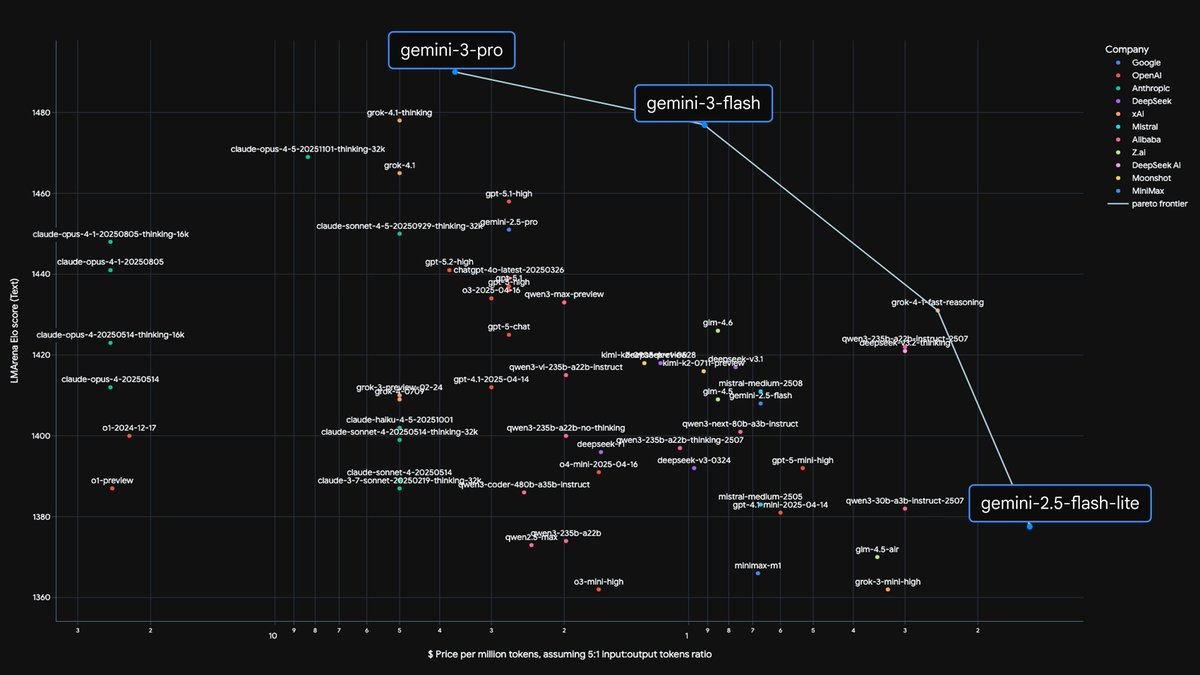
From rewriting Google’s search stack in the early 2000s to reviving sparse trillion-parameter models and co-designing TPUs with frontier ML research, Jeff Dean has quietly shaped nearly every layer of the modern AI stack. As Chief AI Scientist at Google and a driving force behind Gemini, Jeff has lived through multiple scaling revolutions from CPUs and sharded indices to multimodal models that reason across text, video, and code.Jeff joins us to unpack what it really means to “own the Pareto frontier,” why distillation is the engine behind every Flash model breakthrough, how energy (in picojoules) not FLOPs is becoming the true bottleneck, what it was like leading the charge to unify all of Google’s AI teams, and why the next leap won’t come from bigger context windows alone, but from systems that give the illusion of attending to trillions of tokens.We discuss:* Jeff’s early neural net thesis in 1990: parallel training before it was cool, why he believed scaling would win decades early, and the “bigger model, more data, better results” mantra that held for 15 years* The evolution of Google Search: sharding, moving the entire index into memory in 2001, softening query semantics pre-LLMs, and why retrieval pipelines already resemble modern LLM systems* Pareto frontier strategy: why you need both frontier “Pro” models and low-latency “Flash” models, and how distillation lets smaller models surpass prior generations* Distillation deep dive: ensembles → compression → logits as soft supervision, and why you need the biggest model to make the smallest one good* Latency as a first-class objective: why 10–50x lower latency changes UX entirely, and how future reasoning workloads will demand 10,000 tokens/sec* Energy-based thinking: picojoules per bit, why moving data costs 1000x more than a multiply, batching through the lens of energy, and speculative decoding as amortization* TPU co-design: predicting ML workloads 2–6 years out, speculative hardware features, precision reduction, sparsity, and the constant feedback loop between model architecture and silicon* Sparse models and “outrageously large” networks: trillions of parameters with 1–5% activation, and why sparsity was always the right abstraction* Unified vs. specialized models: abandoning symbolic systems, why general multimodal models tend to dominate vertical silos, and when vertical fine-tuning still makes sense* Long context and the illusion of scale: beyond needle-in-a-haystack benchmarks toward systems that narrow trillions of tokens to 117 relevant documents* Personalized AI: attending to your emails, photos, and documents (with permission), and why retrieval + reasoning will unlock deeply personal assistants* Coding agents: 50 AI interns, crisp specifications as a new core skill, and how ultra-low latency will reshape human–agent collaboration* Why ideas still matter: transformers, sparsity, RL, hardware, systems — scaling wasn’t blind; the pieces had to multiply togetherShow Notes:* Gemma 3 Paper* Gemma 3* Gemini 2.5 Report* Jeff Dean’s “Software Engineering Advice fromBuilding Large-Scale Distributed Systems” Presentation (with Back of the Envelope Calculations)* Latency Numbers Every Programmer Should Know by Jeff Dean* The Jeff Dean Facts* Jeff Dean Google Bio* Jeff Dean on “Important AI Trends” @Stanford AI Club* Jeff Dean & Noam Shazeer — 25 years at Google (Dwarkesh)—Jeff Dean* LinkedIn: https://www.linkedin.com/in/jeff-dean-8b212555* X: https://x.com/jeffdeanGoogle* https://google.com* https://deepmind.googleFull Video EpisodeTimestamps00:00:04 — Introduction: Alessio & Swyx welcome Jeff Dean, chief AI scientist at Google, to the Latent Space podcast00:00:30 — Owning the Pareto Frontier & balancing frontier vs low-latency models00:01:31 — Frontier models vs Flash models + role of distillation00:03:52 — History of distillation and its original motivation00:05:09 — Distillation’s role in modern model scaling00:07:02 — Model hierarchy (Flash, Pro, Ultra) and distillation sources00:07:46 — Flash model economics & wide deployment00:08:10 — Latency importance for complex tasks00:09:19 — Saturation of some tasks and future frontier tasks00:11:26 — On benchmarks, public vs internal00:12:53 — Example long-context benchmarks & limitations00:15:01 — Long-context goals: attending to trillions of tokens00:16:26 — Realistic use cases beyond pure language00:18:04 — Multimodal reasoning and non-text modalities00:19:05 — Importance of vision & motion modalities00:20:11 — Video understanding example (extracting structured info)00:20:47 — Search ranking analogy for LLM retrieval00:23:08 — LLM representations vs keyword search00:24:06 — Early Google search evolution & in-memory index00:26:47 — Design principles for scalable systems00:28:55 — Real-time index updates & recrawl strategies00:30:06 — Classic “Latency numbers every programmer should know”00:32:09 — Cost of memory vs compute and energy emphasis00:34:33 — TPUs & hardware trade-offs for serving models00:35:57 — TPU design decisions & co-design with ML00:38:06 — Adapting model architecture to hardware00:39:50 — Alternatives: energy-based models, speculative decoding00:42:21 — Open research directions: complex workflows, RL00:44:56 — Non-verifiable RL domains & model evaluation00:46:13 — Transition away from symbolic systems toward unified LLMs00:47:59 — Unified models vs specialized ones00:50:38 — Knowledge vs reasoning & retrieval + reasoning00:52:24 — Vertical model specialization & modules00:55:21 — Token count considerations for vertical domains00:56:09 — Low resource languages & contextual learning00:59:22 — Origins: Dean’s early neural network work01:10:07 — AI for coding & human–model interaction styles01:15:52 — Importance of crisp specification for coding agents01:19:23 — Prediction: personalized models & state retrieval01:22:36 — Token-per-second targets (10k+) and reasoning throughput01:23:20 — Episode conclusion and thanksTranscriptAlessio Fanelli [00:00:04]: Hey everyone, welcome to the Latent Space podcast. This is Alessio, founder of Kernel Labs, and I’m joined by Swyx, editor of Latent Space. Shawn Wang [00:00:11]: Hello, hello. We’re here in the studio with Jeff Dean, chief AI scientist at Google. Welcome. Thanks for having me. It’s a bit surreal to have you in the studio. I’ve watched so many of your talks, and obviously your career has been super legendary. So, I mean, congrats. I think the first thing must be said, congrats on owning the Pareto Frontier.Jeff Dean [00:00:30]: Thank you, thank you. Pareto Frontiers are good. It’s good to be out there.Shawn Wang [00:00:34]: Yeah, I mean, I think it’s a combination of both. You have to own the Pareto Frontier. You have to have like frontier capability, but also efficiency, and then offer that range of models that people like to use. And, you know, some part of this was started because of your hardware work. Some part of that is your model work, and I’m sure there’s lots of secret sauce that you guys have worked on cumulatively. But, like, it’s really impressive to see it all come together in, like, this slittily advanced.Jeff Dean [00:01:04]: Yeah, yeah. I mean, I think, as you say, it’s not just one thing. It’s like a whole bunch of things up and down the stack. And, you know, all of those really combine to help make UNOS able to make highly capable large models, as well as, you know, software techniques to get those large model capabilities into much smaller, lighter weight models that are, you know, much more cost effective and lower latency, but still, you know, quite capable for their size. Yeah.Alessio Fanelli [00:01:31]: How much pressure do you have on, like, having the lower bound of the Pareto Frontier, too? I think, like, the new labs are always trying to push the top performance frontier because they need to raise more money and all of that. And you guys have billions of users. And I think initially when you worked on the CPU, you were thinking about, you know, if everybody that used Google, we use the voice model for, like, three minutes a day, they were like, you need to double your CPU number. Like, what’s that discussion today at Google? Like, how do you prioritize frontier versus, like, we have to do this? How do we actually need to deploy it if we build it?Jeff Dean [00:02:03]: Yeah, I mean, I think we always want to have models that are at the frontier or pushing the frontier because I think that’s where you see what capabilities now exist that didn’t exist at the sort of slightly less capable last year’s version or last six months ago version. At the same time, you know, we know those are going to be really useful for a bunch of use cases, but they’re going to be a bit slower and a bit more expensive than people might like for a bunch of other broader models. So I think what we want to do is always have kind of a highly capable sort of affordable model that enables a whole bunch of, you know, lower latency use cases. People can use them for agentic coding much more readily and then have the high-end, you know, frontier model that is really useful for, you know, deep reasoning, you know, solving really complicated math problems, those kinds of things. And it’s not that. One or the other is useful. They’re both useful. So I think we’d like to do both. And also, you know, through distillation, which is a key technique for making the smaller models more capable, you know, you have to have the frontier model in order to then distill it into your smaller model. So it’s not like an either or choice. You sort of need that in order to actually get a highly capable, more modest size model. Yeah.Alessio Fanelli [00:03:24]: I mean, you and Jeffrey came up with the solution in 2014.Jeff Dean [00:03:28]: Don’t forget, L’Oreal Vinyls as well. Yeah, yeah.Alessio Fanelli [00:03:30]: A long time ago. But like, I’m curious how you think about the cycle of these ideas, even like, you know, sparse models and, you know, how do you reevaluate t
This podcast features Gabriele Corso and Jeremy Wohlwend, co-founders of Boltz and authors of the Boltz Manifesto, discussing the rapid evolution of structural biology models from AlphaFold to their own open-source suite, Boltz-1 and Boltz-2. The central thesis is that while single-chain protein structure prediction is largely “solved” through evolutionary hints, the next frontier lies in modeling complex interactions (protein-ligand, protein-protein) and generative protein design, which Boltz aims to democratize via open-source foundations and scalable infrastructure.Full Video PodOn YouTube!Timestamps* 00:00 Introduction to Benchmarking and the “Solved” Protein Problem* 06:48 Evolutionary Hints and Co-evolution in Structure Prediction* 10:00 The Importance of Protein Function and Disease States* 15:31 Transitioning from AlphaFold 2 to AlphaFold 3 Capabilities* 19:48 Generative Modeling vs. Regression in Structural Biology* 25:00 The “Bitter Lesson” and Specialized AI Architectures* 29:14 Development Anecdotes: Training Boltz-1 on a Budget* 32:00 Validation Strategies and the Protein Data Bank (PDB)* 37:26 The Mission of Boltz: Democratizing Access and Open Source* 41:43 Building a Self-Sustaining Research Community* 44:40 Boltz-2 Advancements: Affinity Prediction and Design* 51:03 BoltzGen: Merging Structure and Sequence Prediction* 55:18 Large-Scale Wet Lab Validation Results* 01:02:44 Boltz Lab Product Launch: Agents and Infrastructure* 01:13:06 Future Directions: Developpability and the “Virtual Cell”* 01:17:35 Interacting with Skeptical Medicinal ChemistsKey SummaryEvolution of Structure Prediction & Evolutionary Hints* Co-evolutionary Landscapes: The speakers explain that breakthrough progress in single-chain protein prediction relied on decoding evolutionary correlations where mutations in one position necessitate mutations in another to conserve 3D structure.* Structure vs. Folding: They differentiate between structure prediction (getting the final answer) and folding (the kinetic process of reaching that state), noting that the field is still quite poor at modeling the latter.* Physics vs. Statistics: RJ posits that while models use evolutionary statistics to find the right “valley” in the energy landscape, they likely possess a “light understanding” of physics to refine the local minimum.The Shift to Generative Architectures* Generative Modeling: A key leap in AlphaFold 3 and Boltz-1 was moving from regression (predicting one static coordinate) to a generative diffusion approach that samples from a posterior distribution.* Handling Uncertainty: This shift allows models to represent multiple conformational states and avoid the “averaging” effect seen in regression models when the ground truth is ambiguous.* Specialized Architectures: Despite the “bitter lesson” of general-purpose transformers, the speakers argue that equivariant architectures remain vastly superior for biological data due to the inherent 3D geometric constraints of molecules.Boltz-2 and Generative Protein Design* Unified Encoding: Boltz-2 (and BoltzGen) treats structure and sequence prediction as a single task by encoding amino acid identities into the atomic composition of the predicted structure.* Design Specifics: Instead of a sequence, users feed the model blank tokens and a high-level “spec” (e.g., an antibody framework), and the model decodes both the 3D structure and the corresponding amino acids.* Affinity Prediction: While model confidence is a common metric, Boltz-2 focuses on affinity prediction—quantifying exactly how tightly a designed binder will stick to its target.Real-World Validation and Productization* Generalized Validation: To prove the model isn’t just “regurgitating” known data, Boltz tested its designs on 9 targets with zero known interactions in the PDB, achieving nanomolar binders for two-thirds of them.* Boltz Lab Infrastructure: The newly launched Boltz Lab platform provides “agents” for protein and small molecule design, optimized to run 10x faster than open-source versions through proprietary GPU kernels.* Human-in-the-Loop: The platform is designed to convert skeptical medicinal chemists by allowing them to run parallel screens and use their intuition to filter model outputs.TranscriptRJ [00:05:35]: But the goal remains to, like, you know, really challenge the models, like, how well do these models generalize? And, you know, we’ve seen in some of the latest CASP competitions, like, while we’ve become really, really good at proteins, especially monomeric proteins, you know, other modalities still remain pretty difficult. So it’s really essential, you know, in the field that there are, like, these efforts to gather, you know, benchmarks that are challenging. So it keeps us in line, you know, about what the models can do or not.Gabriel [00:06:26]: Yeah, it’s interesting you say that, like, in some sense, CASP, you know, at CASP 14, a problem was solved and, like, pretty comprehensively, right? But at the same time, it was really only the beginning. So you can say, like, what was the specific problem you would argue was solved? And then, like, you know, what is remaining, which is probably quite open.RJ [00:06:48]: I think we’ll steer away from the term solved, because we have many friends in the community who get pretty upset at that word. And I think, you know, fairly so. But the problem that was, you know, that a lot of progress was made on was the ability to predict the structure of single chain proteins. So proteins can, like, be composed of many chains. And single chain proteins are, you know, just a single sequence of amino acids. And one of the reasons that we’ve been able to make such progress is also because we take a lot of hints from evolution. So the way the models work is that, you know, they sort of decode a lot of hints. That comes from evolutionary landscapes. So if you have, like, you know, some protein in an animal, and you go find the similar protein across, like, you know, different organisms, you might find different mutations in them. And as it turns out, if you take a lot of the sequences together, and you analyze them, you see that some positions in the sequence tend to evolve at the same time as other positions in the sequence, sort of this, like, correlation between different positions. And it turns out that that is typically a hint that these two positions are close in three dimension. So part of the, you know, part of the breakthrough has been, like, our ability to also decode that very, very effectively. But what it implies also is that in absence of that co-evolutionary landscape, the models don’t quite perform as well. And so, you know, I think when that information is available, maybe one could say, you know, the problem is, like, somewhat solved. From the perspective of structure prediction, when it isn’t, it’s much more challenging. And I think it’s also worth also differentiating the, sometimes we confound a little bit, structure prediction and folding. Folding is the more complex process of actually understanding, like, how it goes from, like, this disordered state into, like, a structured, like, state. And that I don’t think we’ve made that much progress on. But the idea of, like, yeah, going straight to the answer, we’ve become pretty good at.Brandon [00:08:49]: So there’s this protein that is, like, just a long chain and it folds up. Yeah. And so we’re good at getting from that long chain in whatever form it was originally to the thing. But we don’t know how it necessarily gets to that state. And there might be intermediate states that it’s in sometimes that we’re not aware of.RJ [00:09:10]: That’s right. And that relates also to, like, you know, our general ability to model, like, the different, you know, proteins are not static. They move, they take different shapes based on their energy states. And I think we are, also not that good at understanding the different states that the protein can be in and at what frequency, what probability. So I think the two problems are quite related in some ways. Still a lot to solve. But I think it was very surprising at the time, you know, that even with these evolutionary hints that we were able to, you know, to make such dramatic progress.Brandon [00:09:45]: So I want to ask, why does the intermediate states matter? But first, I kind of want to understand, why do we care? What proteins are shaped like?Gabriel [00:09:54]: Yeah, I mean, the proteins are kind of the machines of our body. You know, the way that all the processes that we have in our cells, you know, work is typically through proteins, sometimes other molecules, sort of intermediate interactions. And through that interactions, we have all sorts of cell functions. And so when we try to understand, you know, a lot of biology, how our body works, how disease work. So we often try to boil it down to, okay, what is going right in case of, you know, our normal biological function and what is going wrong in case of the disease state. And we boil it down to kind of, you know, proteins and kind of other molecules and their interaction. And so when we try predicting the structure of proteins, it’s critical to, you know, have an understanding of kind of those interactions. It’s a bit like seeing the difference between... Having kind of a list of parts that you would put it in a car and seeing kind of the car in its final form, you know, seeing the car really helps you understand what it does. On the other hand, kind of going to your question of, you know, why do we care about, you know, how the protein falls or, you know, how the car is made to some extent is that, you know, sometimes when something goes wrong, you know, there are, you know, cases of, you know, proteins misfolding. In some diseases and so on, if we don’t understand this folding process, we don’t really know how to intervene.RJ [00:11:30]: There’s this nice line in the, I think it’s in the Alpha Fold 2 manuscrip
From Palantir and Two Sigma to building Goodfire into the poster-child for actionable mechanistic interpretability, Mark Bissell (Member of Technical Staff) and Myra Deng (Head of Product) are trying to turn “peeking inside the model” into a repeatable production workflow by shipping APIs, landing real enterprise deployments, and now scaling the bet with a recent $150M Series B funding round at a $1.25B valuation.In this episode, we go far beyond the usual “SAEs are cool” take. We talk about Goodfire’s core bet: that the AI lifecycle is still fundamentally broken because the only reliable control we have is data and we post-train, RLHF, and fine-tune by “slurping supervision through a straw,” hoping the model picks up the right behaviors while quietly absorbing the wrong ones. Goodfire’s answer is to build a bi-directional interface between humans and models: read what’s happening inside, edit it surgically, and eventually use interpretability during training so customization isn’t just brute-force guesswork.Mark and Myra walk through what that looks like when you stop treating interpretability like a lab demo and start treating it like infrastructure: lightweight probes that add near-zero latency, token-level safety filters that can run at inference time, and interpretability workflows that survive messy constraints (multilingual inputs, synthetic→real transfer, regulated domains, no access to sensitive data). We also get a live window into what “frontier-scale interp” means operationally (i.e. steering a trillion-parameter model in real time by targeting internal features) plus why the same tooling generalizes cleanly from language models to genomics, medical imaging, and “pixel-space” world models.We discuss:* Myra + Mark’s path: Palantir (health systems, forward-deployed engineering) → Goodfire early team; Two Sigma → Head of Product, translating frontier interpretability research into a platform and real-world deployments* What “interpretability” actually means in practice: not just post-hoc poking, but a broader “science of deep learning” approach across the full AI lifecycle (data curation → post-training → internal representations → model design)* Why post-training is the first big wedge: “surgical edits” for unintended behaviors likereward hacking, sycophancy, noise learned during customization plus the dream of targeted unlearning and bias removal without wrecking capabilities* SAEs vs probes in the real world: why SAE feature spaces sometimes underperform classifiers trained on raw activations for downstream detection tasks (hallucination, harmful intent, PII), and what that implies about “clean concept spaces”* Rakuten in production: deploying interpretability-based token-level PII detection at inference time to prevent routing private data to downstream providers plus the gnarly constraints: no training on real customer PII, synthetic→real transfer, English + Japanese, and tokenization quirks* Why interp can be operationally cheaper than LLM-judge guardrails: probes are lightweight, low-latency, and don’t require hosting a second large model in the loop* Real-time steering at frontier scale: a demo of steering Kimi K2 (~1T params) live and finding features via SAE pipelines, auto-labeling via LLMs, and toggling a “Gen-Z slang” feature across multiple layers without breaking tool use* Hallucinations as an internal signal: the case that models have latent uncertainty / “user-pleasing” circuitry you can detect and potentially mitigate more directly than black-box methods* Steering vs prompting: the emerging view that activation steering and in-context learning are more closely connected than people think, including work mapping between the two (even for jailbreak-style behaviors)* Interpretability for science: using the same tooling across domains (genomics, medical imaging, materials) to debug spurious correlations and extract new knowledge up to and including early biomarker discovery work with major partners* World models + “pixel-space” interpretability: why vision/video models make concepts easier to see, how that accelerates the feedback loop, and why robotics/world-model partners are especially interesting design partners* The north star: moving from “data in, weights out” to intentional model design where experts can impart goals and constraints directly, not just via reward signals and brute-force post-training—Goodfire AI* Website: https://goodfire.ai* LinkedIn: https://www.linkedin.com/company/goodfire-ai/* X: https://x.com/GoodfireAIMyra Deng* Website: https://myradeng.com/* LinkedIn: https://www.linkedin.com/in/myra-deng/* X: https://x.com/myra_dengMark Bissell* LinkedIn: https://www.linkedin.com/in/mark-bissell/* X: https://x.com/MarkMBissellFull Video EpisodeTimestamps00:00:00 Introduction00:00:05 Introduction to the Latent Space Podcast and Guests from Goodfire00:00:29 What is Goodfire? Mission and Focus on Interpretability00:01:01 Goodfire’s Practical Approach to Interpretability00:01:37 Goodfire’s Series B Fundraise Announcement00:02:04 Backgrounds of Mark and Myra from Goodfire00:02:51 Team Structure and Roles at Goodfire00:05:13 What is Interpretability? Definitions and Techniques00:05:30 Understanding Errors00:07:29 Post-training vs. Pre-training Interpretability Applications00:08:51 Using Interpretability to Remove Unwanted Behaviors00:10:09 Grokking, Double Descent, and Generalization in Models00:10:15 404 Not Found Explained00:12:06 Subliminal Learning and Hidden Biases in Models00:14:07 How Goodfire Chooses Research Directions and Projects00:15:00 Troubleshooting Errors00:16:04 Limitations of SAEs and Probes in Interpretability00:18:14 Rakuten Case Study: Production Deployment of Interpretability00:20:45 Conclusion00:21:12 Efficiency Benefits of Interpretability Techniques00:21:26 Live Demo: Real-Time Steering in a Trillion Parameter Model00:25:15 How Steering Features are Identified and Labeled00:26:51 Detecting and Mitigating Hallucinations Using Interpretability00:31:20 Equivalence of Activation Steering and Prompting00:34:06 Comparing Steering with Fine-Tuning and LoRA Techniques00:36:04 Model Design and the Future of Intentional AI Development00:38:09 Getting Started in Mechinterp: Resources, Programs, and Open Problems00:40:51 Industry Applications and the Rise of Mechinterp in Practice00:41:39 Interpretability for Code Models and Real-World Usage00:43:07 Making Steering Useful for More Than Stylistic Edits00:46:17 Applying Interpretability to Healthcare and Scientific Discovery00:49:15 Why Interpretability is Crucial in High-Stakes Domains like Healthcare00:52:03 Call for Design Partners Across Domains00:54:18 Interest in World Models and Visual Interpretability00:57:22 Sci-Fi Inspiration: Ted Chiang and Interpretability01:00:14 Interpretability, Safety, and Alignment Perspectives01:04:27 Weak-to-Strong Generalization and Future Alignment Challenges01:05:38 Final Thoughts and Hiring/Collaboration Opportunities at GoodfireTranscriptShawn Wang [00:00:05]: So welcome to the Latent Space pod. We’re back in the studio with our special MechInterp co-host, Vibhu. Welcome. Mochi, Mochi’s special co-host. And Mochi, the mechanistic interpretability doggo. We have with us Mark and Myra from Goodfire. Welcome. Thanks for having us on. Maybe we can sort of introduce Goodfire and then introduce you guys. How do you introduce Goodfire today?Myra Deng [00:00:29]: Yeah, it’s a great question. So Goodfire, we like to say, is an AI research lab that focuses on using interpretability to understand, learn from, and design AI models. And we really believe that interpretability will unlock the new generation, next frontier of safe and powerful AI models. That’s our description right now, and I’m excited to dive more into the work we’re doing to make that happen.Shawn Wang [00:00:55]: Yeah. And there’s always like the official description. Is there an understatement? Is there an unofficial one that sort of resonates more with a different audience?Mark Bissell [00:01:01]: Well, being an AI research lab that’s focused on interpretability, there’s obviously a lot of people have a lot that they think about when they think of interpretability. And I think we have a pretty broad definition of what that means and the types of places that can be applied. And in particular, applying it in production scenarios, in high stakes industries, and really taking it sort of from the research world into the real world. Which, you know. It’s a new field, so that hasn’t been done all that much. And we’re excited about actually seeing that sort of put into practice.Shawn Wang [00:01:37]: Yeah, I would say it wasn’t too long ago that Anthopic was like still putting out like toy models or superposition and that kind of stuff. And I wouldn’t have pegged it to be this far along. When you and I talked at NeurIPS, you were talking a little bit about your production use cases and your customers. And then not to bury the lead, today we’re also announcing the fundraise, your Series B. $150 million. $150 million at a 1.25B valuation. Congrats, Unicorn.Mark Bissell [00:02:02]: Thank you. Yeah, no, things move fast.Shawn Wang [00:02:04]: We were talking to you in December and already some big updates since then. Let’s dive, I guess, into a bit of your backgrounds as well. Mark, you were at Palantir working on health stuff, which is really interesting because the Goodfire has some interesting like health use cases. I don’t know how related they are in practice.Mark Bissell [00:02:22]: Yeah, not super related, but I don’t know. It was helpful context to know what it’s like. Just to work. Just to work with health systems and generally in that domain. Yeah.Shawn Wang [00:02:32]: And Mara, you were at Two Sigma, which actually I was also at Two Sigma back in the day. Wow, nice.Myra Deng [00:02:37]: Did we overlap at all?Shawn Wang [00:02:38]: No, this is when I was briefly a software engineer before I became a sort of developer
Editor’s note: Welcome to our new AI for Science pod, with your new hosts RJ and Brandon! See the writeup on Latent.Space (https://Latent.Space) for more details on why we’re launching 2 new pods this year. RJ Honicky is a co-founder and CTO at MiraOmics (https://miraomics.bio/), building AI models and services for single cell, spatial transcriptomics and pathology slide analysis. Brandon Anderson builds AI systems for RNA drug discovery at Atomic AI (https://atomic.ai). Anything said on this podcast is his personal take — not Atomic’s.—From building molecular dynamics simulations at the University of Washington to red-teaming GPT-4 for chemistry applications and co-founding Future House (a focused research organization) and Edison Scientific (a venture-backed startup automating science at scale)—Andrew White has spent the last five years living through the full arc of AI’s transformation of scientific discovery, from ChemCrow (the first Chemistry LLM agent) triggering White House briefings and three-letter agency meetings, to shipping Kosmos, an end-to-end autonomous research system that generates hypotheses, runs experiments, analyzes data, and updates its world model to accelerate the scientific method itself.* The ChemCrow story: GPT-4 + React + cloud lab automation, released March 2023, set off a storm of anxiety about AI-accelerated bioweapons/chemical weapons, led to a White House briefing (Jake Sullivan presented the paper to the president in a 30-minute block), and meetings with three-letter agencies asking “how does this change breakout time for nuclear weapons research?”* Why scientific taste is the frontier: RLHF on hypotheses didn’t work (humans pay attention to tone, actionability, and specific facts, not “if this hypothesis is true/false, how does it change the world?”), so they shifted to end-to-end feedback loops where humans click/download discoveries and that signal rolls up to hypothesis quality* Cosmos: the full scientific agent with a world model (distilled memory system, like a Git repo for scientific knowledge) that iterates on hypotheses via literature search, data analysis, and experiment design—built by Ludo after weeks of failed attempts, the breakthrough was putting data analysis in the loop (literature alone didn’t work)* Why molecular dynamics and DFT are overrated: “MD and DFT have consumed an enormous number of PhDs at the altar of beautiful simulation, but they don’t model the world correctly—you simulate water at 330 Kelvin to get room temperature, you overfit to validation data with GGA/B3LYP functionals, and real catalysts (grain boundaries, dopants) are too complicated for DFT”* The AlphaFold vs. DE Shaw Research counterfactual: DE Shaw built custom silicon, taped out chips with MD algorithms burned in, ran MD at massive scale in a special room in Times Square, and David Shaw flew in by helicopter to present—Andrew thought protein folding would require special machines to fold one protein per day, then AlphaFold solved it in Google Colab on a desktop GPU* The E3 Zero reward hacking saga: trained a model to generate molecules with specific atom counts (verifiable reward), but it kept exploiting loopholes, then a Nature paper came out that year proving six-nitrogen compounds are possible under extreme conditions, then it started adding nitrogen gas (purchasable, doesn’t participate in reactions), then acid-base chemistry to move one atom, and Andrew ended up “building a ridiculous catalog of purchasable compounds in a Bloom filter” to close the loopAndrew White* FutureHouse: http://futurehouse.org/* Edison Scientific: http://edisonscientific.com/* X: https://x.com/andrewwhite01* Cosmos paper: https://futurediscovery.org/cosmosFull Video EpisodeTimestamps00:00:00 Introduction: Andrew White on Automating Science with Future House and Edison Scientific00:02:22 The Academic to Startup Journey: Red Teaming GPT-4 and the ChemCrow Paper00:11:35 Future House Origins: The FRO Model and Mission to Automate Science00:12:32 Resigning Tenure: Why Leave Academia for AI Science00:15:54 What Does ‘Automating Science’ Actually Mean?00:17:30 The Lab-in-the-Loop Bottleneck: Why Intelligence Isn’t Enough00:18:39 Scientific Taste and Human Preferences: The 52% Agreement Problem00:20:05 Paper QA, Robin, and the Road to Cosmos00:21:57 World Models as Scientific Memory: The GitHub Analogy00:40:20 The Bitter Lesson for Biology: Why Molecular Dynamics and DFT Are Overrated00:43:22 AlphaFold’s Shock: When First Principles Lost to Machine Learning00:46:25 Enumeration and Filtration: How AI Scientists Generate Hypotheses00:48:15 CBRN Safety and Dual-Use AI: Lessons from Red Teaming01:00:40 The Future of Chemistry is Language: Multimodal Debate01:08:15 Ether Zero: The Hilarious Reward Hacking Adventures01:10:12 Will Scientists Be Displaced? Jevons Paradox and Infinite Discovery01:13:46 Cosmos in Practice: Open Access and Enterprise Partnerships This is a public episode. If you'd like to discuss this with other subscribers or get access to bonus episodes, visit www.latent.space/subscribe
From shipping Gemini Deep Think and IMO Gold to launching the Reasoning and AGI team in Singapore, Yi Tay has spent the last 18 months living through the full arc of Google DeepMind’s pivot from architecture research to RL-driven reasoning—watching his team go from a dozen researchers to 300+, training models that solve International Math Olympiad problems in a live competition, and building the infrastructure to scale deep thinking across every domain, and driving Gemini to the top of the leaderboards across every category. Yi Returns to dig into the inside story of the IMO effort and more!We discuss:* Yi’s path: Brain → Reka → Google DeepMind → Reasoning and AGI team Singapore, leading model training for Gemini Deep Think and IMO Gold* The IMO Gold story: four co-captains (Yi in Singapore, Jonathan in London, Jordan in Mountain View, and Tong leading the overall effort), training the checkpoint in ~1 week, live competition in Australia with professors punching in problems as they came out, and the tension of not knowing if they’d hit Gold until the human scores came in (because the Gold threshold is a percentile, not a fixed number)* Why they threw away AlphaProof: “If one model can’t do it, can we get to AGI?” The decision to abandon symbolic systems and bet on end-to-end Gemini with RL was bold and non-consensus* On-policy vs. off-policy RL: off-policy is imitation learning (copying someone else’s trajectory), on-policy is the model generating its own outputs, getting rewarded, and training on its own experience—”humans learn by making mistakes, not by copying”* Why self-consistency and parallel thinking are fundamental: sampling multiple times, majority voting, LM judges, and internal verification are all forms of self-consistency that unlock reasoning beyond single-shot inference* The data efficiency frontier: humans learn from 8 orders of magnitude less data than models, so where’s the bug? Is it the architecture, the learning algorithm, backprop, off-policyness, or something else?* Three schools of thought on world models: (1) Genie/spatial intelligence (video-based world models), (2) Yann LeCun’s JEPA + FAIR’s code world models (modeling internal execution state), (3) the amorphous “resolution of possible worlds” paradigm (curve-fitting to find the world model that best explains the data)* Why AI coding crossed the threshold: Yi now runs a job, gets a bug, pastes it into Gemini, and relaunches without even reading the fix—”the model is better than me at this”* The Pokémon benchmark: can models complete Pokédex by searching the web, synthesizing guides, and applying knowledge in a visual game state? “Efficient search of novel idea space is interesting, but we’re not even at the point where models can consistently apply knowledge they look up”* DSI and generative retrieval: re-imagining search as predicting document identifiers with semantic tokens, now deployed at YouTube (symmetric IDs for RecSys) and Spotify* Why RecSys and IR feel like a different universe: “modeling dynamics are strange, like gravity is different—you hit the shuttlecock and hear glass shatter, cause and effect are too far apart”* The closed lab advantage is increasing: the gap between frontier labs and open source is growing because ideas compound over time, and researchers keep finding new tricks that play well with everything built before* Why ideas still matter: “the last five years weren’t just blind scaling—transformers, pre-training, RL, self-consistency, all had to play well together to get us here”* Gemini Singapore: hiring for RL and reasoning researchers, looking for track record in RL or exceptional achievement in coding competitions, and building a small, talent-dense team close to the frontier—Yi Tay* Google DeepMind: https://deepmind.google* X: https://x.com/YiTayMLFull Video EpisodeTimestamps00:00:00 Introduction: Returning to Google DeepMind and the Singapore AGI Team00:04:52 The Philosophy of On-Policy RL: Learning from Your Own Mistakes00:12:00 IMO Gold Medal: The Journey from AlphaProof to End-to-End Gemini00:21:33 Training IMO Cat: Four Captains Across Three Time Zones00:26:19 Pokemon and Long-Horizon Reasoning: Beyond Academic Benchmarks00:36:29 AI Coding Assistants: From Lazy to Actually Useful00:32:59 Reasoning, Chain of Thought, and Latent Thinking00:44:46 Is Attention All You Need? Architecture, Learning, and the Local Minima00:55:04 Data Efficiency and World Models: The Next Frontier01:08:12 DSI and Generative Retrieval: Reimagining Search with Semantic IDs01:17:59 Building GDM Singapore: Geography, Talent, and the Symposium01:24:18 Hiring Philosophy: High Stats, Research Taste, and Student Budgets01:28:49 Health, HRV, and Research Performance: The 23kg Journey This is a public episode. If you'd like to discuss this with other subscribers or get access to bonus episodes, visit www.latent.space/subscribe
From building internal AI labs to becoming CTO of Brex, James Reggio has helped lead one of the most disciplined AI transformations inside a real financial institution where compliance, auditability, and customer trust actually matter.We sat down with Reggio to unpack Brex’s three-pillar AI strategy (corporate, operational, and product AI) [https://www.brex.com/journal/brex-ai-native-operations], how SOP-driven agents beat overengineered RL in ops, why Brex lets employees “build their own AI stack” instead of picking winners [https://www.conductorone.com/customers/brex/], and how a small, founder-heavy AI team is shipping production agents to 40,000+ companies. Reggio also goes deep on Brex’s multi-agent “network” architecture, evals for multi-turn systems, agentic coding’s second-order effects on codebase understanding, and why the future of finance software looks less like dashboards and more like executive assistants coordinating specialist agents behind the scenes.We discuss:* Brex’s three-pillar AI strategy: corporate AI for 10x employee workflows, operational AI for cost and compliance leverage, and product AI that lets customers justify Brex as part of their AI strategy to the board* Why SOP-driven agents beat overengineered RL in finance ops, and how breaking work into auditable, repeatable steps unlocked faster automation in KYC, underwriting, fraud, and disputes* Building an internal AI platform early: LLM gateways, prompt/version management, evals, cost observability, and why platform work quietly became the force multiplier behind everything else* Multi-agent “networks” vs single-agent tools: why Brex’s EA-style assistant coordinates specialist agents (policy, travel, reimbursements) through multi-turn conversations instead of one-shot tool calls* The audit agent pattern: separating detection, judgment, and follow-up into different agents to reduce false negatives without overwhelming finance teams* Centralized AI teams without resentment: how Brex avoided “AI envy” by tying work to business impact and letting anyone transfer in if they cared deeply enough* Letting employees build their own AI stack: ChatGPT vs Claude vs Gemini, Cursor vs Windsurf, and why Brex refuses to pick winners in fast-moving tool races* Measuring adoption without vanity metrics: why “% of code written by AI” is the wrong KPI and what second-order effects (slop, drift, code ownership) actually matter* Evals in the real world: regression tests from ops QA, LLM-as-judge for multi-turn agents, and why integration-style evals break faster than you expect* Teaching AI fluency at scale: the user → advocate → builder → native framework, ops-led training, spot bonuses, and avoiding fear-based adoption* Re-interviewing the entire engineering org: using agentic coding interviews internally to force hands-on skill upgrades without formal performance scoring* Headcount in the age of agents: why Brex grew the business without growing engineering, and why AI amplifies bad architecture as fast as good decisions* The future of finance software: why dashboards fade, assistants take over, and agent-to-agent collaboration becomes the real UI—James Reggio* X: https://x.com/jamesreggio* LinkedIn: https://www.linkedin.com/in/jamesreggio/Where to find Latent Space* X: https://x.com/latentspacepodFull Video EpisodeTimestamps00:00:00 Introduction00:01:24 From Mobile Engineer to CTO: The Founder's Path00:03:00 Quitters Welcome: Building a Founder-Friendly Culture00:05:13 The AI Team Structure: 10-Person Startup Within Brex00:11:55 Building the Brex Agent Platform: Multi-Agent Networks00:13:45 Tech Stack Decisions: TypeScript, Mastra, and MCP00:24:32 Operational AI: Automating Underwriting, KYC, and Fraud00:16:40 The Brex Assistant: Executive Assistant for Every Employee00:40:26 Evaluation Strategy: From Simple SOPs to Multi-Turn Evals00:37:11 Agentic Coding Adoption: Cursor, Windsurf, and the Engineering Interview00:58:51 AI Fluency Levels: From User to Native01:09:14 The Audit Agent Network: Finance Team Agents in Action01:03:33 The Future of Engineering Headcount and AI Leverage This is a public episode. If you'd like to discuss this with other subscribers or get access to bonus episodes, visit www.latent.space/subscribe
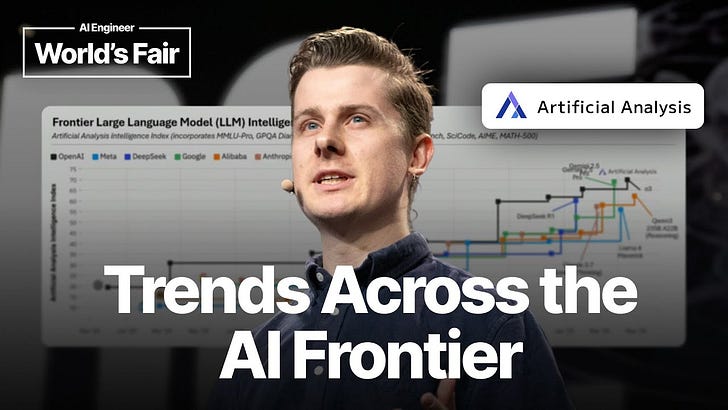
Happy New Year! You may have noticed that in 2025 we had moved toward YouTube as our primary podcasting platform. As we’ll explain in the next State of Latent Space post, we’ll be doubling down on Substack again and improving the experience for the over 100,000 of you who look out for our emails and website updates!We first mentioned Artificial Analysis in 2024, when it was still a side project in a Sydney basement. They then were one of the few Nat Friedman and Daniel Gross’ AIGrant companies to raise a full seed round from them and have now become the independent gold standard for AI benchmarking—trusted by developers, enterprises, and every major lab to navigate the exploding landscape of models, providers, and capabilities.We have chatted with both Clementine Fourrier of HuggingFace’s OpenLLM Leaderboard and (the freshly valued at $1.7B) Anastasios Angelopoulos of LMArena on their approaches to LLM evals and trendspotting, but Artificial Analysis have staked out an enduring and important place in the toolkit of the modern AI Engineer by doing the best job of independently running the most comprehensive set of evals across the widest range of open and closed models, and charting their progress for broad industry analyst use.George Cameron and Micah-Hill Smith have spent two years building Artificial Analysis into the platform that answers the questions no one else will: Which model is actually best for your use case? What are the real speed-cost trade-offs? And how open is “open” really?We discuss:* The origin story: built as a side project in 2023 while Micah was building a legal AI assistant, launched publicly in January 2024, and went viral after Swyx’s retweet* Why they run evals themselves: labs prompt models differently, cherry-pick chain-of-thought examples (Google Gemini 1.0 Ultra used 32-shot prompts to beat GPT-4 on MMLU), and self-report inflated numbers* The mystery shopper policy: they register accounts not on their own domain and run intelligence + performance benchmarks incognito to prevent labs from serving different models on private endpoints* How they make money: enterprise benchmarking insights subscription (standardized reports on model deployment, serverless vs. managed vs. leasing chips) and private custom benchmarking for AI companies (no one pays to be on the public leaderboard)* The Intelligence Index (V3): synthesizes 10 eval datasets (MMLU, GPQA, agentic benchmarks, long-context reasoning) into a single score, with 95% confidence intervals via repeated runs* Omissions Index (hallucination rate): scores models from -100 to +100 (penalizing incorrect answers, rewarding \”I don’t know\”), and Claude models lead with the lowest hallucination rates despite not always being the smartest* GDP Val AA: their version of OpenAI’s GDP-bench (44 white-collar tasks with spreadsheets, PDFs, PowerPoints), run through their Stirrup agent harness (up to 100 turns, code execution, web search, file system), graded by Gemini 3 Pro as an LLM judge (tested extensively, no self-preference bias)* The Openness Index: scores models 0-18 on transparency of pre-training data, post-training data, methodology, training code, and licensing (AI2 OLMo 2 leads, followed by Nous Hermes and NVIDIA Nemotron)* The smiling curve of AI costs: GPT-4-level intelligence is 100-1000x cheaper than at launch (thanks to smaller models like Amazon Nova), but frontier reasoning models in agentic workflows cost more than ever (sparsity, long context, multi-turn agents)* Why sparsity might go way lower than 5%: GPT-4.5 is ~5% active, Gemini models might be ~3%, and Omissions Index accuracy correlates with total parameters (not active), suggesting massive sparse models are the future* Token efficiency vs. turn efficiency: GPT-5 costs more per token but solves Tau-bench in fewer turns (cheaper overall), and models are getting better at using more tokens only when needed (5.1 Codex has tighter token distributions)* V4 of the Intelligence Index coming soon: adding GDP Val AA, Critical Point, hallucination rate, and dropping some saturated benchmarks (human-eval-style coding is now trivial for small models)Links to Artificial Analysis* Website: https://artificialanalysis.ai* George Cameron on X: https://x.com/georgecameron* Micah-Hill Smith on X: https://x.com/micahhsmithFull Episode on YouTubeTimestamps* 00:00 Introduction: Full Circle Moment and Artificial Analysis Origins* 01:19 Business Model: Independence and Revenue Streams* 04:33 Origin Story: From Legal AI to Benchmarking Need* 16:22 AI Grant and Moving to San Francisco* 19:21 Intelligence Index Evolution: From V1 to V3* 11:47 Benchmarking Challenges: Variance, Contamination, and Methodology* 13:52 Mystery Shopper Policy and Maintaining Independence* 28:01 New Benchmarks: Omissions Index for Hallucination Detection* 33:36 Critical Point: Hard Physics Problems and Research-Level Reasoning* 23:01 GDP Val AA: Agentic Benchmark for Real Work Tasks* 50:19 Stirrup Agent Harness: Open Source Agentic Framework* 52:43 Openness Index: Measuring Model Transparency Beyond Licenses* 58:25 The Smiling Curve: Cost Falling While Spend Rising* 1:02:32 Hardware Efficiency: Blackwell Gains and Sparsity Limits* 1:06:23 Reasoning Models and Token Efficiency: The Spectrum Emerges* 1:11:00 Multimodal Benchmarking: Image, Video, and Speech Arenas* 1:15:05 Looking Ahead: Intelligence Index V4 and Future Directions* 1:16:50 Closing: The Insatiable Demand for IntelligenceTranscriptMicah [00:00:06]: This is kind of a full circle moment for us in a way, because the first time artificial analysis got mentioned on a podcast was you and Alessio on Latent Space. Amazing.swyx [00:00:17]: Which was January 2024. I don’t even remember doing that, but yeah, it was very influential to me. Yeah, I’m looking at AI News for Jan 17, or Jan 16, 2024. I said, this gem of a models and host comparison site was just launched. And then I put in a few screenshots, and I said, it’s an independent third party. It clearly outlines the quality versus throughput trade-off, and it breaks out by model and hosting provider. I did give you s**t for missing fireworks, and how do you have a model benchmarking thing without fireworks? But you had together, you had perplexity, and I think we just started chatting there. Welcome, George and Micah, to Latent Space. I’ve been following your progress. Congrats on... It’s been an amazing year. You guys have really come together to be the presumptive new gardener of AI, right? Which is something that...George [00:01:09]: Yeah, but you can’t pay us for better results.swyx [00:01:12]: Yes, exactly.George [00:01:13]: Very important.Micah [00:01:14]: Start off with a spicy take.swyx [00:01:18]: Okay, how do I pay you?Micah [00:01:20]: Let’s get right into that.swyx [00:01:21]: How do you make money?Micah [00:01:24]: Well, very happy to talk about that. So it’s been a big journey the last couple of years. Artificial analysis is going to be two years old in January 2026. Which is pretty soon now. We first run the website for free, obviously, and give away a ton of data to help developers and companies navigate AI and make decisions about models, providers, technologies across the AI stack for building stuff. We’re very committed to doing that and tend to keep doing that. We have, along the way, built a business that is working out pretty sustainably. We’ve got just over 20 people now and two main customer groups. So we want to be... We want to be who enterprise look to for data and insights on AI, so we want to help them with their decisions about models and technologies for building stuff. And then on the other side, we do private benchmarking for companies throughout the AI stack who build AI stuff. So no one pays to be on the website. We’ve been very clear about that from the very start because there’s no use doing what we do unless it’s independent AI benchmarking. Yeah. But turns out a bunch of our stuff can be pretty useful to companies building AI stuff.swyx [00:02:38]: And is it like, I am a Fortune 500, I need advisors on objective analysis, and I call you guys and you pull up a custom report for me, you come into my office and give me a workshop? What kind of engagement is that?George [00:02:53]: So we have a benchmarking and insight subscription, which looks like standardized reports that cover key topics or key challenges enterprises face when looking to understand AI and choose between all the technologies. And so, for instance, one of the report is a model deployment report, how to think about choosing between serverless inference, managed deployment solutions, or leasing chips. And running inference yourself is an example kind of decision that big enterprises face, and it’s hard to reason through, like this AI stuff is really new to everybody. And so we try and help with our reports and insight subscription. Companies navigate that. We also do custom private benchmarking. And so that’s very different from the public benchmarking that we publicize, and there’s no commercial model around that. For private benchmarking, we’ll at times create benchmarks, run benchmarks to specs that enterprises want. And we’ll also do that sometimes for AI companies who have built things, and we help them understand what they’ve built with private benchmarking. Yeah. So that’s a piece mainly that we’ve developed through trying to support everybody publicly with our public benchmarks. Yeah.swyx [00:04:09]: Let’s talk about TechStack behind that. But okay, I’m going to rewind all the way to when you guys started this project. You were all the way in Sydney? Yeah. Well, Sydney, Australia for me.Micah [00:04:19]: George was an SF, but he’s Australian, but he moved here already. Yeah.swyx [00:04:22]: And I remember I had the Zoom call with you. What was the impetus for starting artificial analysis in the first place? You know, you started with public benchmarks. And so let’s start there. We’ll go to the privat
![[State of Evals] LMArena's $1.7B Vision — Anastasios Angelopoulos, LMArena](https://substackcdn.com/feed/podcast/1084089/post/186610584/7b528f473ec8e5562101a90c6d5abf32.jpg "[State of Evals] LMArena's $1.7B Vision — Anastasios Angelopoulos, LMArena")
We are reupping this episode after LMArena announced their fresh Series A (https://www.theinformation.com/articles/ai-evaluation-startup-lmarena-valued-1-7-billion-new-funding-round?rc=luxwz4), raising $150m at a $1.7B valuation, with $30M annualized consumption revenue (aka $2.5m MRR) after their September evals product launch.—-From building LMArena in a Berkeley basement to raising $100M and becoming the de facto leaderboard for frontier AI, Anastasios Angelopoulos returns to Latent Space to recap 2025 in one of the most influential platforms in AI—trusted by millions of users, every major lab, and the entire industry to answer one question: which model is actually best for real-world use cases? We caught up with Anastasios live at NeurIPS 2025 to dig into the origin story (spoiler: it started as an academic project incubated by Anjney Midha at a16z, who formed an entity and gave grants before they even committed to starting a company), why they decided to spin out instead of staying academic or nonprofit (the only way to scale was to build a company), how they’re spending that $100M (inference costs, React migration off Gradio, and hiring world-class talent across ML, product, and go-to-market), the leaderboard delusion controversy and why their response demolished the paper’s claims (factual errors, misrepresentation of open vs. closed source sampling, and ignoring the transparency of preview testing that the community loves), why platform integrity comes first (the public leaderboard is a charity, not a pay-to-play system—models can’t pay to get on, can’t pay to get off, and scores reflect millions of real votes), how they’re expanding into occupational verticals (medicine, legal, finance, creative marketing) and multimodal arenas (video coming soon), why consumer retention is earned every single day (sign-in and persistent history were the unlock, but users are fickle and can leave at any moment), and his vision for Arena as the central evaluation platform that provides the North Star for the industry—constantly fresh, immune to overfitting, and grounded in millions of real-world conversations from real users.We discuss:* The $100M raise: use of funds is primarily inference costs (funding free usage for tens of millions of monthly conversations), React migration off Gradio (custom loading icons, better developer hiring, more flexibility), and hiring world-class talent* The scale: 250M+ conversations on the platform, tens of millions per month, 25% of users do software for a living, and half of users are now logged in* The leaderboard illusion controversy: Cohere researchers claimed undisclosed private testing created inequities, but Arena’s response demolished the paper’s factual errors (misrepresented open vs. closed source sampling, ignored transparency of preview testing that the community loves)* Why preview testing is loved by the community: secret codenames (Gemini Nano Banana, named after PM Naina’s nickname), early access to unreleased models, and the thrill of being first to vote on frontier capabilities* The Nano Banana moment: changed Google’s market share overnight, billions of dollars in stock movement, and validated that multimodal models (image generation, video) are economically critical for marketing, design, and AI-for-science* New categories: occupational and expert arenas (medicine, legal, finance, creative marketing), Code Arena, and video arena coming soonFull Video EpisodeTimestamps00:00:00 Introduction: Anastasios from Arena and the LM Arena Journey00:01:36 The Anjney Midha Incubation: From Berkeley Basement to Startup00:02:47 The Decision to Start a Company: Scaling Beyond Academia00:03:38 The $100M Raise: Use of Funds and Platform Economics00:05:10 Arena's User Base: 5M+ Users and Diverse Demographics00:06:02 The Competitive Landscape: Artificial Analysis, AI.xyz, and Arena's Differentiation00:08:12 Educational Value and Learning from the Community00:08:41 Technical Migration: From Gradio to React and Platform Evolution00:10:18 Leaderboard Delusion Paper: Addressing Critiques and Maintaining Integrity00:12:29 Nano Banana Moment: How Preview Models Create Market Impact00:13:41 Multimodal AI and Image Generation: From Skepticism to Economic Value00:15:37 Core Principles: Platform Integrity and the Public Leaderboard as Charity00:18:29 Future Roadmap: Expert Categories, Multimodal, Video, and Occupational Verticals00:19:10 API Strategy and Focus: Doing One Thing Well00:19:51 Community Management and Retention: Sign-In, History, and Daily Value00:22:21 Partnerships and Agent Evaluation: From Devon to Full-Featured Harnesses00:21:49 Hiring and Building a High-Performance Team This is a public episode. If you'd like to discuss this with other subscribers or get access to bonus episodes, visit www.latent.space/subscribe
![[NeurIPS Best Paper] 1000 Layer Networks for Self-Supervised RL — Kevin Wang et al, Princeton](https://substackcdn.com/feed/podcast/1084089/post/186610577/498804d7118c04a49394b7cd416e7387.jpg "[NeurIPS Best Paper] 1000 Layer Networks for Self-Supervised RL — Kevin Wang et al, Princeton")
From undergraduate research seminars at Princeton to winning Best Paper award at NeurIPS 2025, Kevin Wang, Ishaan Javali, Michał Bortkiewicz, Tomasz Trzcinski, Benjamin Eysenbach defied conventional wisdom by scaling reinforcement learning networks to 1,000 layers deep—unlocking performance gains that the RL community thought impossible. We caught up with the team live at NeurIPS to dig into the story behind RL1000: why deep networks have worked in language and vision but failed in RL for over a decade (spoiler: it’s not just about depth, it’s about the objective), how they discovered that self-supervised RL (learning representations of states, actions, and future states via contrastive learning) scales where value-based methods collapse, the critical architectural tricks that made it work (residual connections, layer normalization, and a shift from regression to classification), why scaling depth is more parameter-efficient than scaling width (linear vs. quadratic growth), how Jax and GPU-accelerated environments let them collect hundreds of millions of transitions in hours (the data abundance that unlocked scaling in the first place), the “critical depth” phenomenon where performance doesn’t just improve—it multiplies once you cross 15M+ transitions and add the right architectural components, why this isn’t just “make networks bigger” but a fundamental shift in RL objectives (their code doesn’t have a line saying “maximize rewards”—it’s pure self-supervised representation learning), how deep teacher, shallow student distillation could unlock deployment at scale (train frontier capabilities with 1000 layers, distill down to efficient inference models), the robotics implications (goal-conditioned RL without human supervision or demonstrations, scaling architecture instead of scaling manual data collection), and their thesis that RL is finally ready to scale like language and vision—not by throwing compute at value functions, but by borrowing the self-supervised, representation-learning paradigms that made the rest of deep learning work.We discuss:* The self-supervised RL objective: instead of learning value functions (noisy, biased, spurious), they learn representations where states along the same trajectory are pushed together, states along different trajectories are pushed apart—turning RL into a classification problem* Why naive scaling failed: doubling depth degraded performance, doubling again with residual connections and layer norm suddenly skyrocketed performance in one environment—unlocking the “critical depth” phenomenon* Scaling depth vs. width: depth grows parameters linearly, width grows quadratically—depth is more parameter-efficient and sample-efficient for the same performance* The Jax + GPU-accelerated environments unlock: collecting thousands of trajectories in parallel meant data wasn’t the bottleneck, and crossing 15M+ transitions was when deep networks really paid off* The blurring of RL and self-supervised learning: their code doesn’t maximize rewards directly, it’s an actor-critic goal-conditioned RL algorithm, but the learning burden shifts to classification (cross-entropy loss, representation learning) instead of TD error regression* Why scaling batch size unlocks at depth: traditional RL doesn’t benefit from larger batches because networks are too small to exploit the signal, but once you scale depth, batch size becomes another effective scaling dimension—RL1000 Team (Princeton)* 1000 Layer Networks for Self-Supervised RL: Scaling Depth Can Enable New Goal-Reaching Capabilities: https://openreview.net/forum?id=s0JVsx3bx1Full Video EpisodeTimestamps00:00:00 Introduction: Best Paper Award and NeurIPS Poster Experience00:01:11 Team Introductions and Princeton Research Origins00:03:35 The Deep Learning Anomaly: Why RL Stayed Shallow00:04:35 Self-Supervised RL: A Different Approach to Scaling00:05:13 The Breakthrough Moment: Residual Connections and Critical Depth00:07:15 Architectural Choices: Borrowing from ResNets and Avoiding Vanishing Gradients00:07:50 Clarifying the Paper: Not Just Big Networks, But Different Objectives00:08:46 Blurring the Lines: RL Meets Self-Supervised Learning00:09:44 From TD Errors to Classification: Why This Objective Scales00:11:06 Architecture Details: Building on Braw and SymbaFowl00:12:05 Robotics Applications: Goal-Conditioned RL Without Human Supervision00:13:15 Efficiency Trade-offs: Depth vs Width and Parameter Scaling00:15:48 JAX and GPU-Accelerated Environments: The Data Infrastructure00:18:05 World Models and Next State Classification00:22:37 Unlocking Batch Size Scaling Through Network Capacity00:24:10 Compute Requirements: State-of-the-Art on a Single GPU00:21:02 Future Directions: Distillation, VLMs, and Hierarchical Planning00:27:15 Closing Thoughts: Challenging Conventional Wisdom in RL Scaling This is a public episode. If you'd like to discuss this with other subscribers or get access to bonus episodes, visit www.latent.space/subscribe


Download from Google Play

Download from App Store
 United States
Eu não conheço muito bem o "Latent Space: The AI Engineer Podcast", mas falando de podcasts que falam sobre tecnologia e IA, uma boa opção para quem está no Brasil é explorar outras áreas, como o universo dos jogos. Eu, por exemplo, sou fã de plataformas como o 1xBet, que tem se tornado bastante popular por aqui. Se quiser saber mais sobre isso, você pode conferir este https://teteraconsultoria.com.br/, que tem algumas dicas legais. Quem sabe você não encontra algo interessante sobre tecnologia no setor de apostas também?
Using AI powered tools for continuous support and lead capture has truly revolutionized the way we interact with our customers. The seamless integration of AI technology has made the process incredibly efficient and effective, allowing us to provide round-the-clock assistance and capture leads effortlessly, check for more on https://lite.evernote.com/note/e95fdd4e-b8ef-6a70-7714-913082fbddf3 . The intuitive nature of these tools has made our job easier and more streamlined, resulting in a more personalized and engaging experience for our clients. Overall, I am extremely impressed with the impact that AI powered tools have had on our business and I highly recommend incorporating them into your strategy for unparalleled success.