


 Claim Ownership
The International Schools Network
Subscribed: 6Played: 115
Subscribe

© ISN 2023
Description
The International Schools Network (ISN) is a space where educators working at international schools can connect, share ideas and inspiration and join discussions on key topics in education today. We'll be sharing these conversations on a weekly basis so stay tuned for more discussions to come!
Join our fast-growing community today: https://isn.education/register
LinkedIn: https://www.linkedin.com/company/international-schools-network/
YouTube: https://www.youtube.com/@theinternationalschoolsnet22
Flipboard: https://flipboard.com/@isnetwork
Join our fast-growing community today: https://isn.education/register
LinkedIn: https://www.linkedin.com/company/international-schools-network/
YouTube: https://www.youtube.com/@theinternationalschoolsnet22
Flipboard: https://flipboard.com/@isnetwork
104 Episodes
Reverse
Take 1) Creating a Culture of mental health support Whatever role you play in a school or organization, it’s important for you and everyone you work with to be someone willing to act if a person may be in need of mental health support. This can be through starting a committee, facilitating a workshop, writing newsletters or any other way you can communicate and remind people of what to do if you are worried about someone. The culture created should be that is a collective responsibility to recognize, understand, and respond appropriately to someone experiencing a mental health issue. Take 2) Notice the signs and trust your gutThe signs of someone who may be in need of mental health support can be obvious or subtle but it is important to notice when they happen. Has there been a change in their behavior, are they experiencing mood swings, becoming withdrawn, voicing concerns, or are they going through high levels of stress, grief, or health issues? This is often the first sign to an outsider that something may be happening to a friend or colleague. If you feel something is amiss, or there has been a change, it could be hard to place exactly what that may be. It is important to trust your gut. It is far better to try and support someone and be wrong than to have a feeling about it and fail to act.Take 3) Have the conversationIf you suspect someone may be experiencing mental health distress, it is important to speak to them. Most of us are not trained psychologists and the conversation needs you to just ask the person if they are ok. Mention a behavior you may have noticed, share that you are worried and most importantly, actively listen with empathy. Allow them to speak and validate their feelings. We can’t fix their problems for them, but we can be a pillar of support and encouragement. Take 4) SignpostIf the conversation has led to the person potentially needing help, it is important to signpost them to appropriate support. In schools I have worked in we have kept an up-to-date contact list of doctors and therapists faculty can access and shared this in newsletters and kept available to everyone on shared drives. This can then be used to provide the person who may be in need of support with the resources to access professional help. This is especially important in schools with staff from around the world who may be new to a country and unaware of the help available. If applicable, also share how the health insurance operates if they do seek help and a step-by-step guide on what to do. These don’t have to be country specific if resources are limited in person, there are also excellent tele-health services available that some insurances will cover the cost for if other options aren’t viable. Take 5) Follow UpIt will often take more than one conversation and more than one attempt to signpost before a person feels safe enough to get help. Follow up with the person, ask if they were able to contact the services you signposted, offer any help such as calling to make an appointment, or accompanying them to the location. Do you have an idea or area of expertise you would like to share on the ISN podcast? Please submit your ideas here: https://www.pages.isn.education/5-takes-podcast
Drawing on her new book, Hannah Wilson, Director of The Belonging Effect, shares five practical insights on building belonging in schools.Take 1) Introduction: Why should we care about DEIB?It does not have to happen to you to matter to you.Understanding power and privilege.We need to stand up, speak out, show support for issues impacting others.Take 2) Belonging in Society: How do we develop it?Increased hate crimes.Riots.Flags.Media and social media.Derogatory language.Take 3) Belonging in Schools: How do we change it?Intentional inclusion. By design.Challenging assumptions and biases.High attrition and exclusion rates.Strategic intent from governance.Take 4) Belonging in the Staffroom: How do we disrupt it?Designing for inclusion.Diversifying recruitment.Talent pipeline and retention initiatives.ITTE and governance.Inclusive workplaces. Take 5) Belonging in the Classroom: How do we foster it?Inclusive classrooms.Psychological safety.Diverse curriculum.Better representation.Call to Action: What do we do next?Consciousness, Confidence, CompetenceCuriosity v CriticalityAllyshipShaping intention into impact.Links and ResourcesFind the book here: https://www.awesomebooks.com/book/9781036206451/a-little-guide-for-teachers-cultivating-belonging-in-schoolsSecure your place and join the virtual book launch on 9th February here: https://www.eventbrite.co.uk/e/1574054442209?aff=oddtdtcreator Learn more about The Belonging Effect here: https://www.thebelongingeffect.co.uk/

Episode 1, 2026: John Dolman, The AI English Teacher – 5 Ways Students Can Use AI to LearnIn this episode, we sit down with John Dolman, The AI English Teacher, who shares five practical ways students can use AI to enhance learning rather than shortcut it.Take 1: Have the Dialogue Start by simply talking with students about their AI use. Focus groups and surveys help uncover whether students are using AI effectively or not. Avoid assumptions—understanding their habits gives you data to guide discussions and teaching.Take 2: The Socratic Tutor Use AI as a guided tutor. LLMs can walk students through topics, answer questions, and summarize learning. The key is crafting prompts that position the AI as a Socratic tutor, e.g., “Explain this topic with questions and answers and summarize in 3–4 bullet points.” This encourages dialogue, comprehension, and active learning rather than passive reading.Take 3: The Quizmaster AI is excellent for quizzing and memorization—key for building knowledge schemas. Students can create flashcards, interactive quizzes, or even games like Jeopardy. Ground the AI with specific content or exam material, and use it as a sparring partner in groups. This turns study into an interactive, engaging process while reinforcing knowledge.Take 4: The Essay Explainer Instead of generating essays, students can use AI to analyze structure. Feed in high-quality essays or model answers and have the AI break them down into components, scaffolds, or step-by-step reasoning. This exposes the underlying patterns in good writing, encourages metacognition, and helps students understand how to structure their own work. AI can also show its “thinking” for each step, helping students explore strategies and techniques.Take 5: The Feedback Loop AI is most effective when used for feedback, not creation. After students write their work, AI can provide critiques and suggestions based on specifications, model answers, or examiner reports. The goal is to identify patterns, understand strengths and weaknesses, and then make improvements independently. Think of AI like a personal trainer: it guides, advises, and critiques, but the learning happens when the student takes action themselves.LinksLearn more about John Dolman: https://theaienglishteacher.wordpress.com/ Do you have a great idea for the ISN podcast? Submit your ideas and feature here: https://www.pages.isn.education/5-takes-podcast

In this panel discussion, our experts highlight the impact of deepfakes, algorithm influence and provide supportive strategies to help students navigate the flood of misinformation online.Speakers:John Mikton – Digital Learning Facilitator, International School of GenevaJohn Dolman – The AI English Teacher; Media & English Teacher, Ponteland International SchoolChristopher Blackwood – Head of Digital Innovation, Victory Heights Primary SchoolElliot Newman – Co-Founder, WellioKey takeawaysPractical Tools for Media Literacy: Gain hands-on strategies and resources to help students critically evaluate news, social media, and online content for credibility and accuracy.Identifying Misinformation: Learn how to teach students to recognise common signs of misinformation and disinformation in both traditional and digital media.Building Critical Thinking Skills: Explore methods for fostering independent, critical thinking in students, empowering them to question sources and cross-check information.Navigating a Changing Digital Landscape: Understand the impact of social media platforms removal of fact-checkers, and how to adapt your teaching to these shifts.Creating a Culture of Responsible Media Consumption: Discover ways to instil a sense of digital and ethical responsibility in your students, preparing them to engage thoughtfully in the digital world.ResourcesWhat is True: Media Literacy: Recalibrating Truth- - - - - - - - To share your story, thoughts or ideas with the ISN community, please send your article draft, podcast or event ideas by emailing our Head of Community at claire.king@isn.education
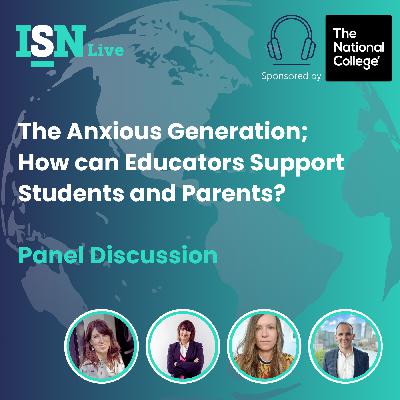
Safeguarding, mental health and well-being experts analyse the findings of Jonathan Haidt's ground-breaking book. SpeakersSian Jorgensen: Safeguarding Consultant and Trainer, International Schools Specialist, ©SAFE Interviewing Trainer Hayley Wilson: Deputy Head of Secondary School (Pastoral Community and Wellbeing) at Kellet School, The British International School in Hong Kong Anna Bateman: Senior Education Consultant, Specialising in Mental Health Strategy and Training.Jamie Ganley: Head of Sales at The National CollegeReports and resourcesPublic attitudes to smart phones 2025 https://www.moreincommon.org.uk/media/flrnzo5x/public-attitudes-to-smartphones-social-media-and-online-safety-1.pdf Lost boys report https://www.centreforsocialjustice.org.uk/library/lost-boys The Instagram post from the guardian that helped launch Kellett School |British International School Hong Kong's phone free school considerations https://www.instagram.com/guardian_us/p/C1pF8NvLHr7/- - - - - - - - To share your story, thoughts or ideas with the ISN community, please send your article draft directly to our editorial team here, or email us at claire.king@isn.education
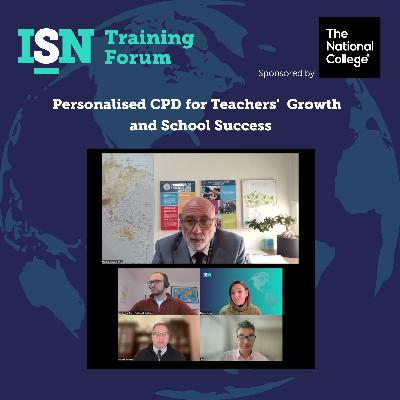
In this session, international school leaders and experts, Mark Leppard MBE, Damian Bacchoo, Jarrett Brown and Jamie Ganley delve into Personalised CPD for Teachers' Growth and School Success, sponsored by our partner The National College.Personalised CPD is reshaping how international schools approach professional learning. When educators take ownership of their growth and leaders empower their teams with the autonomy to design their own CPD journeys; professional development becomes purposeful, motivating and transformative. In this session, our experienced panel will explore how this approach benefits all stakeholders, how educators can take ownership of their CPD journey and how leaders can develop personalised CPD frameworks within their schools. Key themes:How to take ownership of your CPD journey so it aligns with your goals and passions, shaping your professional growth around what matters most and makes CPD motivating and meaningful.How leaders can design personalised CPD frameworks that engage and energise staff, giving teachers real choice and autonomy while still supporting whole-school priorities and strengthening collaboration.How practical tools can be used to embed coaching, reflection, and choice into a school’s development culture, making these practices a natural, everyday rhythm rather than an occasional initiative.How international schools can implement personalised CPD successfully, improving teacher engagement, building expertise, and benefiting students, with real examples you could adapt in your own context.
In this episode, Jarrett Brown, Secondary Principal at ISA International Education Group, shares best practices for fostering meaningful and engaging language learning.Take 1) Go back to basics: Get students to practice in the classroom as much as possible because they won’t have opportunities elsewhere. Take 2) Library meets students' expectations: Having books appropriate for the language level and age appropriate level of the students. We don't want books that are Little Bobby going to school, but something for middle school that is more age appropriateTake 3) Competitions that bring enthusiasm: Everyone likes prizes, and having speaking contests, reading contests, library monthly focus genres, mystery booksTake 4) Make it meaningful: Shouldn't just be recitation, but students need to be active out of the classroom practicing English. Go to the canteen and practice words like "fork" or "knife" or "I would like some more broccoli please"Take 5) Have material relevant to them: Curriculum shouldn't be talking about Shakespeare, Henry Viii or Abraham Lincoln- we should have material relevant and interesting for the- - - - - - - -To share your 5 takes epiosde with the ISN community, please your ideas directly to claire.king@isn.education
In this episode, Abigail Alexis-Olubuyide, Head of Primary at The British School of Beijing, explores how Martin Seligman’s PERMA Model can be used to foster a culture of flourishing.5 takes1) Positive Emotions Create Upward Spirals2) Engagement Flows Through Strengths3) High-Trust Relationships Underpins Flourishing4) Connect to a Higher Purpose Through Meaning5) Frame Accomplishments as Progress That Inspires Growth ----------------------------------------- If you would like to feature on the ISN podcast please contact us by emailing our community manager claire.king@isn.education
Cliona McMenamin, Head of Careers and Teacher of Mathematics at Dubai College, shares the importance of embedding well-being in careers education.1) Start with Self-Discovery, Not Decision-MakingMost careers programmes jump too quickly to the “what” (university courses or job titles) before helping students understand the “who.”When students explore their strengths, values and motivations first, they make more authentic and confident choices later.By integrating reflection tools, personality frameworks and “career conversations” into tutor time or PSHE, we give students permission to see career exploration as part of their wellbeing journey, not a pressure-filled process.Take 2) Make Wellbeing the Foundation, Not an Add-OnA student who is anxious, burnt out or comparing themselves to others can’t meaningfully engage in future planning.Embedding wellbeing strategies (mindfulness, gratitude, resilience or even time to pause and reflect) into careers lessons helps students manage uncertainty with calm and confidence.When students feel psychologically safe, they are more open to growth and more resilient in navigating rejection or change.Take 3) Redefine Success: From Prestige to PurposeToo often, students equate success with prestige - top universities, big salaries or brand names.Our role is to shift that narrative. We should celebrate diverse definitions of success: joy in learning, alignment with values, contribution to society.Using alumni stories and real-world examples helps students see that there are many ways to live a successful, meaningful life.Take 4) Connect the Dots Between Curriculum and CareersStudents often ask, “When will I ever use this?”Careers education becomes transformative when we bridge classroom learning with the world beyond school. Whether through curriculum-linked career talks, employer projects or cross-subject challenges, this approach builds both relevance and confidence, showing students that what they learn today genuinely matters for tomorrow.Take 5) Build a Culture of ConversationThe best careers education doesn’t happen in isolation. It happens in conversations.Creating spaces where students can talk openly about uncertainty, comparison or changing plans builds resilience and agency.Teachers, parents and peers all play a role here. When a school normalises these conversations (from staffroom to classroom) students learn that their pathway doesn’t have to be perfect to be purposeful. Reach out to Cliona here: https://www.linkedin.com/in/cliona-mcmenamin-5279941a1/?miniProfileUrn=urn%3Ali%3Afs_miniProfile%3AACoAAC9PMu8B8VfXXlptgWsF8ggGfEcwZstEsrQ ----------------------------------------- To share your story, thoughts or ideas with the ISN community, please send your article draft directly to our editorial team here, or email us at claire.king@isn.education
In this episode of 5 Takes, counsellor and coach Micheline Foss explores how educators can recharge by recognising what supports them and replenishing areas that need care.Breaking Down Resilience: The 5 Buckets Resilience isn’t one thing—it has 5 capacities:Physical/Behavioral: Habits to overcome difficulty Cognitive: Ability to interpret and manage events Emotional: Tolerance for negative emotions Social: Connection to support systems Spiritual/Motivational: Purpose that drives persistenceReset Your Resilience Identify which type of rest refills your depleted bucket. Important distinction:Sleep = biological state Rest = targeted recoveryRest isn’t laziness—it’s intentional recovery. Pushing through drains, not builds, resilience.Micro-Actions to Recharge Daily Energy Using the 5x7 framework helps target what’s draining you and restore balance.Example: Sofia, a middle school teacher in Bangkok, feels emotionally flat after constant student needs and limited downtime.Emotional Resilience drained → micro-actions:Social Rest: Lunch with a trusted colleague (no school talk)Creative Rest: 10 minutes adding photos to a travel wallEmotional Rest: 2-minute “name it to tame it” check-in before leaving schoolThese small, intentional acts refill emotional reserves without adding tasks.Retoning Your Resilience System Think of resilience like exercise: strained muscles aren’t helped by pushing harder. When stretched thin, parts of your system—physical, emotional, mental, social, or spiritual—go offline. Re-toning gently restores energy flow.Goal: Restore flexibility and balance, not force strength. Requires: Dedicated attention and practice, not just knowledge.Putting It All Together Understanding resilience breakdown and targeting the right rest allows efficient recharge without overhauling your life. Habits, some familiar, help maintain balance and avoid burnout. Some implement alone, others benefit from coaching accountability.Links: Playbook and Coaching book: http://www.aging-boldly.com/store
In this episode, Martin Boother, Vice Principal at Azerbaijan British College, shares five key takes on investing in your teams and unlocking the full potential of every staff member.5 Takes:1) Getting to know them as people not just staff members: 2) Listening needs to be your superpower3) Don’t look for what isn’t there but what is4) It’s not all about you - build them up5) Be prepared to let them go - this isn’t a betrayal but a success storyIf you are interesting in featuring on the ISN podcast, you can learn more and register your interest here: https://www.pages.isn.education/5-takes-podcast
In this episode of the 5 takes podcast, Stephen Feeney, Founder of the Flourishing Man, shares his insights on how to build confidence and best support boys in school.5 takes:1) Confidence and positive behaviour go hand-in-hand.2) A lack of positive role models is a myth3) Celebrate strengths and not behaviour4) Boys need safe spaces for honest conversations5) The term 'Toxic Masculinity' needs to go in the binLearn more about Stephen Feeney here: https://www.theflourishingman.com/ - - - - - - - - Do you have 5 takes that you could share with international educators looking for expertise in a particular field? Learn more and register your interest here: https://www.pages.isn.education/5-takes-podcast
In this latest episode of 5 Takes, Head of Curriculum Support, Daniela Selhuber shares practical strategies for supporting multilingual learners.Take 1: Establish a Clear, Shared Framework for Language Development Clarity and consistency are key. Schools that adopt frameworks such as the Bell Foundation EAL Assessment Framework or WIDA can move from reactive provision to proactive and targeted support.A shared framework:Provides precise language to describe proficiency (e.g. “developing in speaking and listening but at an early stage in reading and writing”).Prevents overestimating social fluency (BICS) or underestimating academic needs (CALP).Equips all staff to scaffold learning, not just EAL specialists (Lucas & Villegas, 2013).Strengthens formative assessment across speaking, listening, reading, and writing (Heritage, 2008).Makes EAL inclusion visible at a systems level (OECD, 2018).Take 2: Know the Learner Behind the Language EAL learners are more than proficiency levels. Two learners at the same English stage may have very different profiles depending on literacy in their first language or prior schooling.Understanding learner backgrounds avoids a “one size fits all” approach. Collaboration between class teachers and EAL specialists combines subject and language expertise. First languages should be viewed as assets: using them for processing ideas, drafting, and vocabulary building accelerates English learning and affirms identity.Take 3: Scaffold, Do Not Simplify Lowering challenge lowers expectations. Learners need access, not easier work. Scaffolding strategies include:Graphic organisers to structure ideas.Talk partners for oral rehearsal.Visuals and realia to anchor concepts.Pre-teaching vocabulary to reduce load.Sentence stems to support academic talk and writing.Cummins’ quadrant model shows the most effective learning is cognitively demanding but well supported. Scaffolding, like building supports, is temporary and removed once learners are independent.Take 4: Prioritise Oracy Talk is the bridge to literacy and wider learning. Before writing, learners need to rehearse orally and practise new vocabulary.Effective strategies:Talk partners to rehearse answers.Sentence stems to structure contributions (“I agree with…”).Structured discussions, debates, and role play for authentic practice.Research shows exploratory talk supports higher order thinking (Mercer & Dawes, 2008) and that improving oracy boosts attainment (EEF, 2016). Oracy also fosters wellbeing and belonging by giving learners a voice.Take 5: Celebrate Multilingualism Multilingualism is an asset, not a deficit. Learners who use multiple languages develop unique perspectives, problem solving skills, and empathy.Ways to celebrate languages:Stock dual language books in libraries.Use signage that reflects community languages.Host heritage language days.Encourage home language writing projects.Greet students in their first language.Celebrating multilingualism affirms identity, increases belonging, and strengthens engagement. Research confirms strong first language skills support second language acquisition and cognitive development (Cummins, 2000).
Experienced Languages and English International Teacher, Suzzanne Pautler shares 5 takes on how to enact design-thinking to bring learning to life.Take 1) Because of design thinking, my students read, wrote, and spoke with a purpose. Title: Student Choice and Voice. Students focused on actual problems or issues they witnessed in their daily lives at school and at home. In their process to problem-solve, they researched online, interviewed others, created prototypes, and delivered a pitch to an audience. They were able to express themselves, listen to others, and seek feedback prior to presenting a solution. Suddenly, their reading, writing, and speaking had a real purpose.Take 2) Because of design thinking, my students were active readers and writers. Title: Active Engagement.Students directed their own learning by shifting their literacy from content consumption to content creation. Their creative collaboration as they problem-solved made the learning process relevant which resulted in high levels of student engagement.Take 3) Because of design thinking, my students deepened their connection with the text.Title: Empathy.Students read various texts about other teenagers (locally and globally) who are designing solutions for problems in their communities. My students then built empathy maps from the perspective of those facing the issues. This process allowed them to move from surface-level reading comprehension to deep, analytical thinking, interpretation, and inference.Take 4) Because of design thinking, my students’ writing was problem solving.Title: Experimentation.Students were involved in a process of trying out different creative formats to see what worked best for the group. The cycle of iteration and feedback allowed students to frame their drafts as prototypes to be tested, not as finished products to be graded. They tested their ideas through the writing of outlines, story maps, pitches, summaries, and explanations which removed the pressure to be perfect, but supported and encouraged the students to play and experiment. Each student could contribute his or her own strengths to the process.Take 5) Because of design thinking, my students connected with the real world and with each other.Title: Authenticity.Students connected with authentic global issues through their literacy work, but they didn’t do it alone. Students collaborated purposefully with one another in an effort to research real community issues, interview stakeholders, problem-solve, and communicate their solutions through websites, presentations, posters, devices, and models.Instead of a one-size-fits-all model, students discovered and developed their best literacy skills.
1) Do Your Homework as much as you can before you arrive: 1-2 minute explanation: Read up as much as you can in the appointment process and certainly in the time you have before you take up the role from Day 1. Know the school’s history, its vision and values, its strong points, its USP, and look at who you will be working with in your team and board. You don’t really get this time again once you hit the ground running from Day 1. It is also the most obvious way to demonstrate you are taking the role for pull factors as much as push. You are “theirs” now as their new school leader. They expect you to be so from Day 1. 2) No capricious fads or whimsical changes for its own sake. 1-2 minute explanation: Sounds obvious but the short-termism of some school leaderships means everyone wants to “make their mark” and then onto the next role. The problem is, the school communities are left with the mess and trying to make a fad work that they didn’t really understand and didn’t really own. The school community wants stability and certainty before change and this is where Take 3 and 4 come in. 3) Listen and Learn from everyone in those first weeks and months. 1-2 minute explanation: The very best time a new school leader can take is to see, be seen, and listen. Listen to everyone. Not just your chair, or deputy or COO. Everyone. This is where being at the school gate daily is vital. Be highly energetic and visible, but not just for this time, but every day. Talk to parents, student council, and walk the school to be seen. Listen and talk to the catering staff, the janitor, the bus drivers, the students in isolation. It will show you are serious and you want to lead the whole school. It is also the best way of knowing the school and taking the temperature daily. 4) Have some sort of plan and timescale of your time in post.1-2 minute explanation: it may seem daft but the days of a school leader sitting in post for years and years, are long gone. Sir Tim Brighouse believed 5-7 years is the optimum time and when a school leader is established and really makes an impact. Leading a school can be like sending an army into battle, the original plan soon is overtaken by the reality on the ground and events. And as the Woody Allen joke goes, how do you make God laugh, say you have a plan. However, having some idea of what your 4-6 years will mean and what meaningful change, leadership and stewardship you can make, given the parameters of context and organisation, is important. I would add in here, a succession plan too. Get the middle leaders and senior leaders trained and ready for the future and even if you could fall under the proverbial bus. 5) It is ok not to know everything. 1-2 minute explanation: A bit of humility in a school leader is not only refreshing but it goes a long way. No one wants to make an obvious faux pas like dropping a lunch tray in front of the whole school, or slipping over on the ice on break duty, it has happened to me, but this is about showing your ability to listen and learn. You are often jack of all trades and master of none. You have a team who are skilled and waiting for the new dynamic to establish with the new person. It is bad enough filling someone else’s shoes but confident is a world a way from arrogance so some humility and allowing the skills of others to support you and build a rapport when you start, is best achieved by learning and building the trust and respect of those you are going to lead and work with closely.

Take 1) Digital Tools Boost Learning OutcomesResearch shows that digital learning tools can enhance student achievement. In my own teaching, students use Quizlet to create flashcards and revise topics before assessments. This active repetition helps reinforce knowledge and improve recall. These tools support personalized learning, allowing students to study at their own pace and target their weaker areas.Take 2) Collaboration and Social Skills Through Game-Based LearningPlatforms like Kahoot and Blooket don’t just quiz students—they build social skills. When students play in teams, they collaborate, communicate, and support one another. This peer interaction fosters a positive classroom environment and strengthens 21st-century skills like teamwork and digital communication.Take 3) Finding the Right Digital ToolsOne major challenge is that no single platform covers everything—lesson planning, assessment, simulations, activities, quizzes, etc. Teachers must try different tools to find the right fit for their subject and students. While it promotes innovation, it also demands time and adaptability from teachers to integrate various tools effectively.Take 4) Cost and Support BarriersMany digital tools come with subscription fees, and using multiple tools across subjects can become expensive. This creates equity issues—especially when school budgets are tight. Schools need to invest not just in the tools, but also in training so teachers can use them meaningfully in the classroom.Take 5) Ethical Use and Student Data PrivacyTeachers must be cautious with student data when using digital tools. Questions around where data is stored, how it's used, and whether ads or external links appear must be considered. It’s critical to review tools in advance to ensure they meet privacy standards and are safe for student use.

For this interview, we are joined by Daniela Selhuber: Head of Curriculum Support at Taylor's International School - Kuala Lumpur, to explore Personalised Learning & Inclusive Pedagogy - specifically through an EAL lensKey Themes:Supporting EAL Learners in the ClassroomIdentifying and Supporting SEND in EAL StudentsParental EngagementEdTech & Learning SupportProcurement & Prioritisation

Laura Mitchelson from Veritas Wild, specialists in strategic HR for schools, presents five forward-thinking takes on professional development that are designed to remain effective both today and in the next five years. Take 1) We demand that people don’t get access to PD unless they ask for it Take 2) We get creative about what PD can beTake 3) We measure the impact of all PDTake 4) We offer multiple ways of accessing PDTake 5) We employ Futures Literacy as a way of stretching all functions to where they will need to be in 5 years timeLearn more about Veritas Wild here: https://www.veritaswild.com/ To share your story, thoughts or ideas with the ISN community, please send your article draft directly to our editorial team here, or email us at claire.king@isn.education
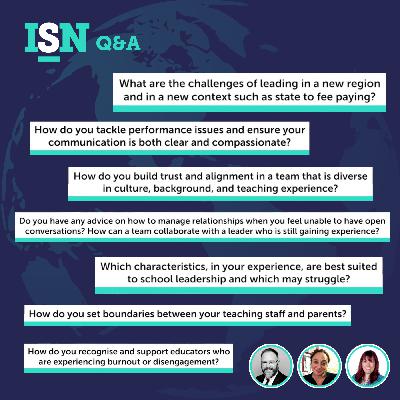
The leaders from our recent ISN Live event, Matthew Burfield, Lauren Binnington and Lucinda Willis answer a selection of your questions in this bonus Q&A session.QuestionsHow do you tackle performance issues and ensure your communication is both clear and compassionate?Do you have any advice on how to manage relationships when you feel unable to have open conversations? How can a team collaborate with a leader who is still gaining experience?How do you recognise and support educators who are experiencing burnout or disengagement?How do you set boundaries between your teaching staff and parents?How do you build trust and alignment in a team that is diverse in culture, background, and teaching experience?How do you incorporate team voices so that staff feel heard and part of bigger decision-making?What are the challenges of leading in a new region and in a new context such as fee paying, that you may not know very well?Which characteristics, in your experience, are best suited to school leadership and which struggle? Are there early signs of those who will succeed and those who may struggle whilst taking on this type of position?

In the latest episode of 5 Takes, award-winning educator and author Edd Moore explores practical and fun ways to incorporate sustainability into the primary school curriculum.5 TakesTake 1) Eco Warriors Take 2) Culture is King/QueenTake 3) Environmental Projects Take 4) Involving Community Take 5) Embed Sustainability across the curriculum LinksFind more about Edd's work and book release here: https://ecoedd.com/ Connect with Edd here: linkedin.com/in/edd-moore-a0369b86


Download from Google Play

Download from App Store
 United States
I totally agree with you, finding your unique style is really important in order to stand out from the rest and write in a truly exciting way. Not everyone has such a talent, but you always have the opportunity to develop it in yourself. It's always easier to do it in a community of like-minded people, I discovered it here https://www.writetrendy.com/