


 Claim Ownership
LawDroid Manifesto Podcast
Subscribed: 3Played: 62
Subscribe

© Thomas G. Martin
Description
In LawDroid Manifesto, Tom Martin discusses the intersection of law and artificial intelligence and what it means for the future of our relationship with justice.
www.lawdroidmanifesto.com
www.lawdroidmanifesto.com
94 Episodes
Reverse

In this episode of LawDroid Manifesto, I interview Ari Kaplan, principal of Ari Kaplan Advisors and one of legal technology's most prolific community builders. With over 1,000 podcast episodes and three decades of connecting people in the legal tech space, Ari shares the personal practices and professional strategies that have sustained his remarkable career.Ari reveals his 30-year journal tradition—writing just once annually to reflect on the past year and project forward—offering profound insights on growth, gratitude, and goal-setting. He discusses his transition from law firm partner to full-time connector and advisor, the risks involved, and how focusing on creating value for others provided a sustainable foundation for his business.Throughout our conversation, Ari emphasizes his core identity as a connector and community builder, someone dedicated to bringing together buyers and sellers, the informed and the less informed, and those seeking opportunities with those who have them. His various initiatives—from Legal Tech Mafia breakfasts to virtual lunch series to running groups—all embody his philosophy of ensuring participants receive twice the value they contribute.Ari also shares touching personal stories, including his decade-long tradition of collecting canned food with his daughter, which evolved from a simple neighborhood walk into thousands of donations and ultimately led to his service on a food bank's board of trustees. These stories illustrate how the same principles of consistency, generosity, and community service that guide his professional work also shape his personal life.For anyone interested in building meaningful professional relationships, creating lasting community impact, or understanding how small, consistent actions compound into extraordinary results over time, this episode offers invaluable insights from someone who has been walking the talk for 30 years. Discover why Ari describes his work as lucky work and learn how you can apply his principles to your own journey in legal innovation.Learn more about building sustainable success through generous service at lawdroidmanifesto.com. This is a public episode. If you'd like to discuss this with other subscribers or get access to bonus episodes, visit www.lawdroidmanifesto.com/subscribe
In this episode, I interview Joey Gartner, Director and Counsel at the ABA Center for Innovation, about his journey from legal aid attorney to helping guide the legal profession through AI transformation. Joey shares insights from the ABA's comprehensive two-year AI Task Force study and discusses practical resources the Center has developed to help lawyers understand and implement new technologies. Learn about Joey's curiosity-driven approach to innovation, his "I'll figure it out" philosophy when facing new challenges, and why asking "why" and "how" questions creates space for broader participation in innovation conversations. Discover the Center's innovation mapping tool, AI glossaries, and trend reports designed to make technology adoption accessible across the profession while maintaining ethical standards and expanding access to justice. For more insights and resources, visit lawdroidmanifesto.com. This is a public episode. If you'd like to discuss this with other subscribers or get access to bonus episodes, visit www.lawdroidmanifesto.com/subscribe
Join host Tom Martin for an illuminating conversation with Brian Liu, founder of LegalZoom and one of the most influential figures in legal technology history. In this episode, Brian shares his journey from creating a company that democratized legal services for millions to his current ventures addressing ongoing gaps in legal access.Brian discusses Elm Tree Law, inspired by his own frustrating experience trying to get estate planning help for his parents, which focuses on making lawyer-prepared living trusts more approachable and user-friendly. He also explains Overture Law, a vetted referral network helping solo practitioners serve clients across jurisdictions in an increasingly complex legal landscape.What sets this episode apart is Brian's refreshingly optimistic perspective on AI's role in law. While many predict fewer lawyers, Brian argues there may actually be more—freed by AI to focus on the human relationships and trust that remain essential to legal practice. He reminds us that behind every legal document is someone's dream, and that understanding this human element is what truly drives transformation in legal services.Discover practical insights on building legal technology that expands access to justice while keeping human needs at the center. For exclusive content and deeper insights from legal innovators like Brian, visit www.lawdroidmanifesto.com to join our community of legal rebels transforming the profession. This is a public episode. If you'd like to discuss this with other subscribers or get access to bonus episodes, visit www.lawdroidmanifesto.com/subscribe
Hey there Legal Rebels! 👋 I’m excited to share with you the 51st episode of the 2025 season of the LawDroid Manifesto podcast, where I will be continuing to interview key legal innovators to learn how they do what they do. I think you’re going to enjoy this one!I have had the pleasure of working with Scheree Gilchrist for a few years now and her ingenuity and resourcefulness have always been impressive. I welcomed the chance to learn more about her in this interview and what makes her tick. Because of her mission-driven dedication to helping people access justice, I have dubbed her, “The Fearless Catalyst.”If you want to understand how to transform legal aid delivery through fearless innovation and truly center services around the people who need them most, you need to listen to this episode. Scheree is at the forefront of legal aid innovation and brings a uniquely purposeful and compassionate perspective to leveraging technology for access to justice.LawDroid Manifesto is a reader-supported publication. To receive new posts and support my work, consider becoming a free or paid subscriber.Scaling Justice Through Fearless Client-Centered InnovationJoin me as I interview Scheree Gilchrist, Chief Innovation Officer at Legal Aid of North Carolina.In this insightful podcast episode, Scheree shares her journey from growing up between Jamaica and the United States to becoming a pioneering force in legal aid innovation. She dives deep into how she’s transforming the way vulnerable North Carolinians access critical legal services through technology, including the Justice Hub portal that integrates AI chatbots, client messaging, document management, and resource referrals into a seamless experience. Scheree demonstrates how her team is meeting clients where they are—whether that’s at 2 a.m. on a Wednesday or any other time they need help.Her stories and insights underscore her fearless approach to innovation, rooted in her experiences as a junior lawyer in rural North Carolina where she witnessed firsthand the circuitous nature of legal aid work. This episode is a must-watch for anyone curious about how technology can break down barriers to justice and create meaningful impact for underserved communities.The SkinnyScheree Gilchrist, Chief Innovation Officer at Legal Aid of North Carolina, shares her journey from splitting her childhood between Jamaica and the United States to becoming a transformative force in legal services innovation. With a deeply client-centered philosophy developed during her time as a junior attorney in rural North Carolina, Scheree demonstrates how she’s leading the development of Justice Hub—a comprehensive portal that integrates intake, AI assistance through Leah, client communications, document management, and resource referrals. Throughout the conversation, Scheree emphasizes that her work is driven by a singular mission: solving problems for people who would otherwise have no access to legal information or the courts, breaking the endless cycle of poverty that traps vulnerable communities. Her Jamaican resilience and optimism, combined with her strategic use of technology and unwavering focus on client needs, exemplifies what fearless innovation looks like in the legal services space.Key Takeaways:* Scheree’s client-centered philosophy stems from her early experiences as a junior lawyer witnessing clients caught in a circuitous cycle of returning for help because their interconnected legal, social, and other needs weren’t fully addressed* Justice Hub represents a comprehensive approach to client services—a “MyChart for legal” that allows clients to apply for services, message attorneys, upload documents, chat with the AI assistant Leah, and access resources all in one portal* The portal meets clients where they are, enabling them to access services at 2 a.m. or whenever they need help, eliminating barriers like taking time off work to visit physical offices* Cherie grew up splitting time between Jamaica, New York, and Florida, attending school and law school in Jamaica, which shaped her culturally Jamaican identity and resilient, optimistic approach to challenges* Her path to innovation began as a practicing attorney questioning “how can we make this better?” rather than accepting the status quo of legal service delivery* The work-life balance myth: Cherie candidly shares that true balance doesn’t exist—instead, it’s about prioritizing what matters each day, having strong support systems, and being honest about the full investment required to achieve meaningful goals* Her motivation remains focused on the end goal: helping people who would otherwise have absolutely no access to legal services or courts, moving them out of the endless cycle of poverty* Jamaicans are warm, friendly, and optimistic by nature—cultural traits that inform Cherie’s approach to her work and her resilient response to challengesNotable Quotes:* “We’re in the middle of trying to launch our new intake portal and get that off the ground and also deal with the holidays. You know, I said it’s kind of like you got to hurry up before you could take some time off. Like you got to accelerate before you decelerate.” - Scheree Gilchrist (00:01:17-00:01:29)* “I like to think of it as my chart for legal. It’s not quite there yet. But if you think of what that could be, where somebody who is applying for services at a legal aid program has just anything they need done, they can get it done in their portal, right?” - Scheree Gilchrist (00:02:02-00:02:17)* “We’re meeting people where they are. If it’s the middle of the night and they need to get something to us, they can do that. If they need to shoot off a message, that message will be there in the morning.” - Scheree Gilchrist (00:03:11-00:03:20)* “One of the things that struck me was just the circuitous nature of our work as a legal services attorney, because we were dealing just with the legal problems, but our clients come to us as sort of the intersection of legal, social, and other needs.” - Scheree Gilchrist (00:04:05-00:04:24)* “I have always questioned, how can we make this better? How can we help our clients? How can we meet them where they are? How can we solve as many problems for them as we can, knowing that we’re attorneys and we’re not gonna be able to address everything, but how can we solve them or at least direct them in the right path?” - Scheree Gilchrist (00:04:33-00:04:53)* “I actually grew up in Jamaica. I split my time between Jamaica, New York and Florida. So my mom has always lived here in the U.S. and my dad lived in Jamaica. And so I’ve always split my time between the U.S. and Jamaica. But I went to school in Jamaica, went to law school in Jamaica. I feel more Jamaican.” - Scheree Gilchrist (00:05:47-00:06:07)* “Jamaicans are resilient people, right? We’re warm and friendly and optimistic by nature. I think that’s just culturally who we are.” - Scheree Gilchrist (00:06:26-00:06:35)* “This is my opinion. There is no work-life balance. There is prioritizing. And what takes priority, that changes day to day.” - Scheree Gilchrist (00:42:03-00:42:13)* “I think it’s a disservice for anybody who is driven and successful, and that drive allowed them to be successful to then say, Oh, you should have work-life balance. Because I guarantee you, if you look at their path to success, there was no balance on that path to success.” - Scheree Gilchrist (00:43:37-00:43:52)* “You cannot realize a goal without a full investment and commitment to get into that goal. But I think along the way, you have to figure out how do you juggle? How do you manage your priorities? What sort of support system you need to have around you?” - Scheree Gilchrist (00:44:26-00:44:43)* “I think at the end of the day, it’s still the people that we serve. I get a lot of satisfaction from solving problems for people who I know were their last hope in some situations, right?” - Scheree Gilchrist (00:45:42-00:45:58)* “I look at our clients and the people that we work with, but for legal aid attorneys and others who are willing to give up their time, pro bono volunteers and others who are willing to give up their time and efforts, you’re talking about people who would have absolutely no access to basic legal information, no access to the courts, and just they would be stuck in an endless cycle of poverty.” - Scheree Gilchrist (00:45:58-00:46:27)ClipsBalance Is Misleading For The Driven There Is No Balance—PrioritizeWhy Rental Assistance Matters Curiosity Beats ConformityScheree’s journey reflects the power of questioning the status quo and refusing to accept that “this is how we’ve always done it.” From her earliest days as a junior lawyer in rural North Carolina, she saw the limitations of a system that only addressed one piece of her clients’ complex, interconnected problems. Rather than accept this reality, she made it her mission to transform how legal aid serves vulnerable communities.What stands out most is Scheree’s unwavering focus on the people she serves. Every technological innovation, every process improvement, every strategic decision is filtered through one lens: does this help people who would otherwise have no access to justice? This clarity of purpose, combined with her Jamaican resilience and optimism, makes her a truly fearless catalyst for change in the legal services space.Closing ThoughtsAs someone who’s worked with Scheree and Legal Aid of North Carolina, I can tell you that her fearless approach to innovation isn’t just talk—it’s deeply embedded in everything she does. What makes her particularly effective is that her innovations aren’t driven by technology for technology’s sake. They’re driven by a fundamental commitment to the people who need help most.The Justice Hub portal she’s launching represents something profound in legal services: a recognition that clients are consumers too, and they deserve the same level of convenience and accessibility that they experience in ot
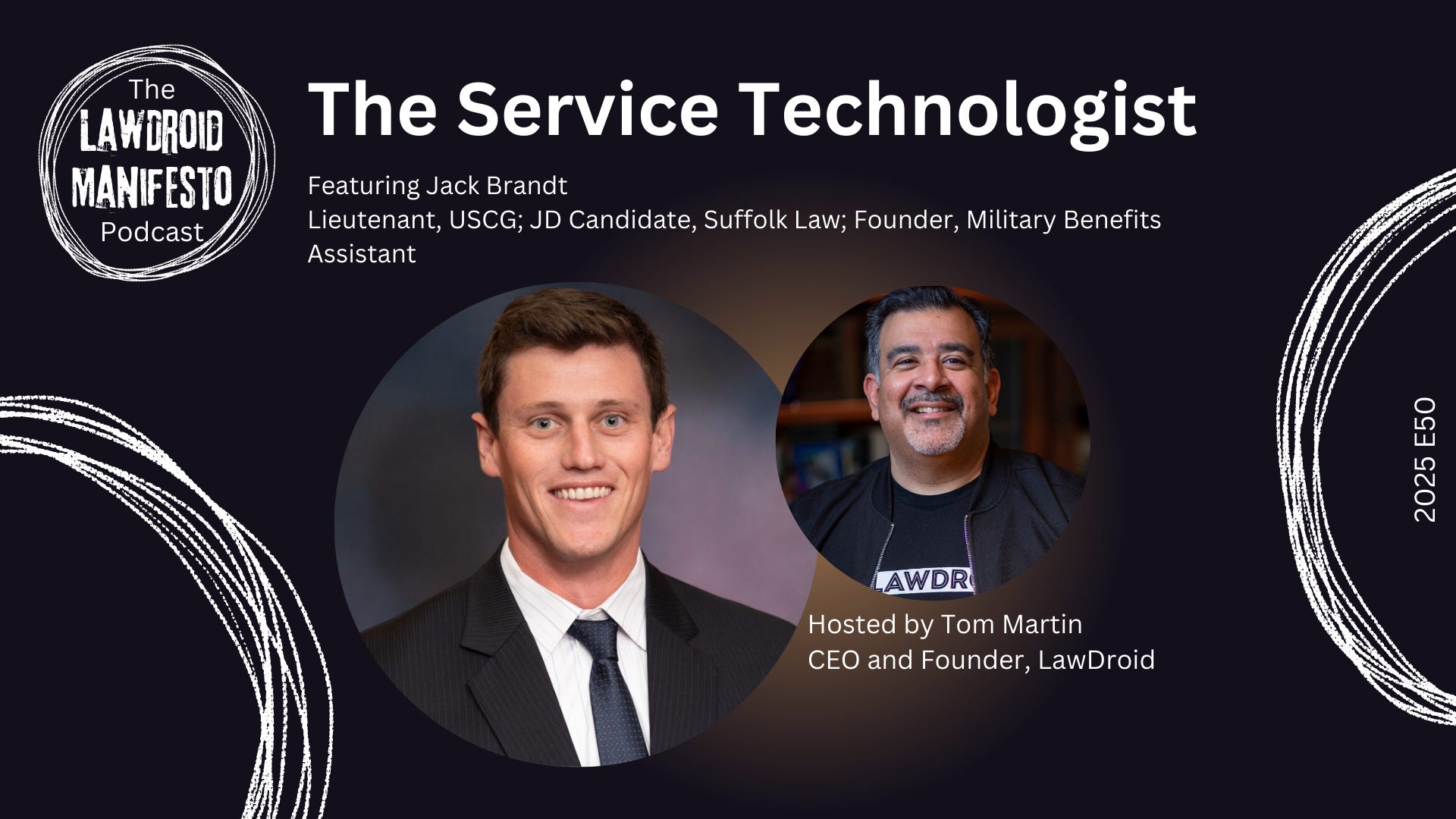
Join Tom Martin as he interviews Jack Brandt, U.S. Coast Guard Lieutenant and founder of Military Benefits Assistant, about building AI-powered tools that help service members access education benefits they've earned but may not know how to claim.Jack shares his journey from paying out of pocket for graduate school to helping 19 crew members access benefits during his deployment as education services officer. He reveals why he evolved Military Benefits Assistant from a custom ChatGPT to a rule-based guided interview tool—demonstrating that sometimes traditional logic serves users better than the newest AI technology.This episode offers valuable insights on choosing the right tool for the problem, building technology grounded in service, and how legal innovation doesn't require being a tech expert—just understanding the problem deeply and staying focused on serving users.Learn more and access exclusive content at www.lawdroidmanifesto.com This is a public episode. If you'd like to discuss this with other subscribers or get access to bonus episodes, visit www.lawdroidmanifesto.com/subscribe
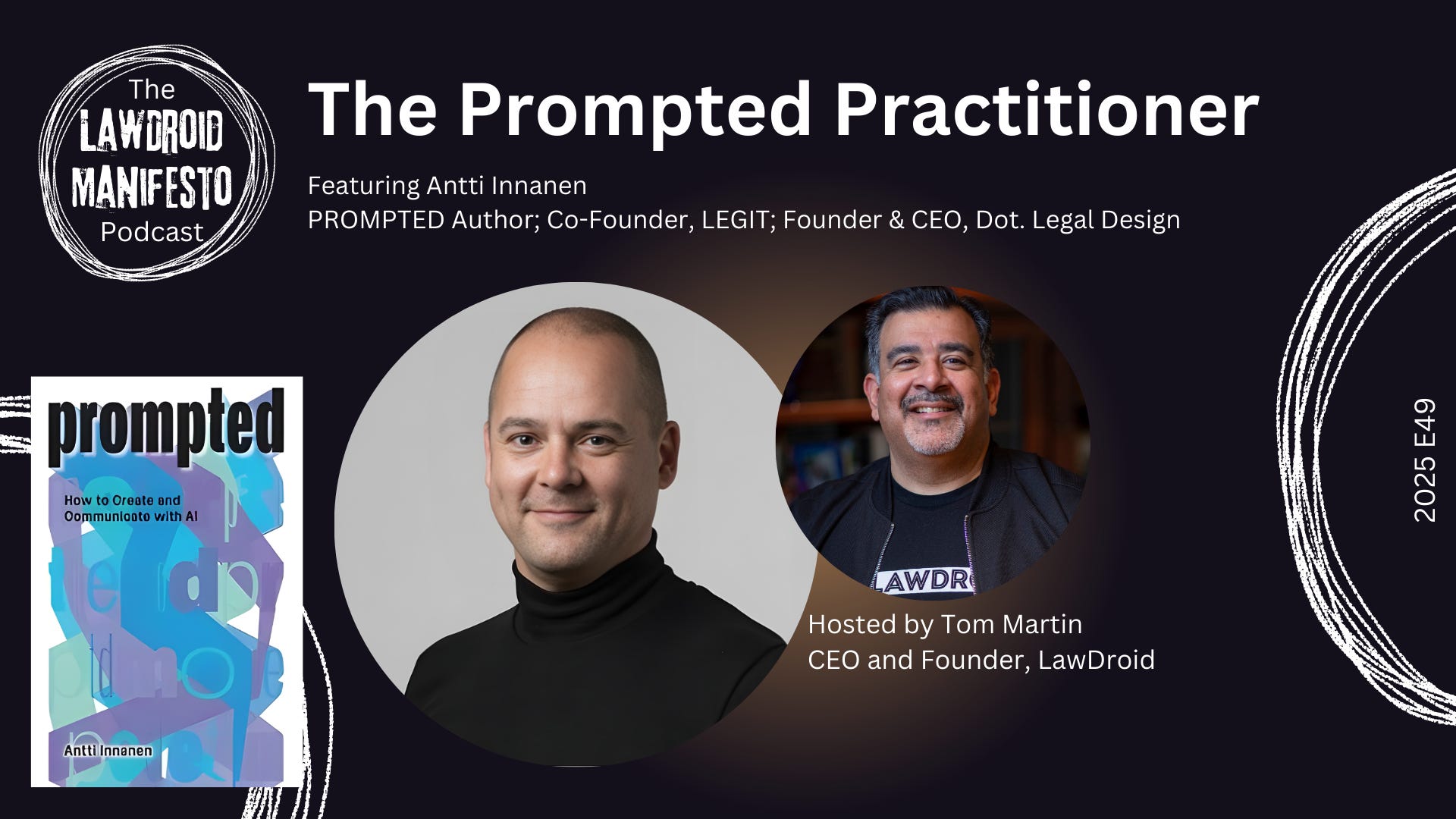
In this episode of LawDroid Manifesto, Tom Martin interviews Antti Innanen, co-founder of Legit and author of the upcoming book Prompted, about his refreshingly unconventional approach to legal innovation and AI adoption.Antti shares his journey from self-described bad student and philosophy dropout in Finland to leading voice in legal design and AI experimentation. Operating from sunny Alicante, Spain, he runs an AI consulting studio, maintains a legal design practice, and even teaches Brazilian Jiu-Jitsu as a black belt—all while building cutting-edge AI agent prototypes for law firms.Discover how Antti's background in legal design shapes his approach to making AI more accessible and human-centered, why he believes playful experimentation beats rigid frameworks, and what his self-driving law firm prototype reveals about the future of legal services. Learn his secrets for balancing multiple pursuits while staying focused on meaningful work over financial success.For show notes, key takeaways, and timestamps of notable quotes, visit www.lawdroidmanifesto.com This is a public episode. If you'd like to discuss this with other subscribers or get access to bonus episodes, visit www.lawdroidmanifesto.com/subscribe
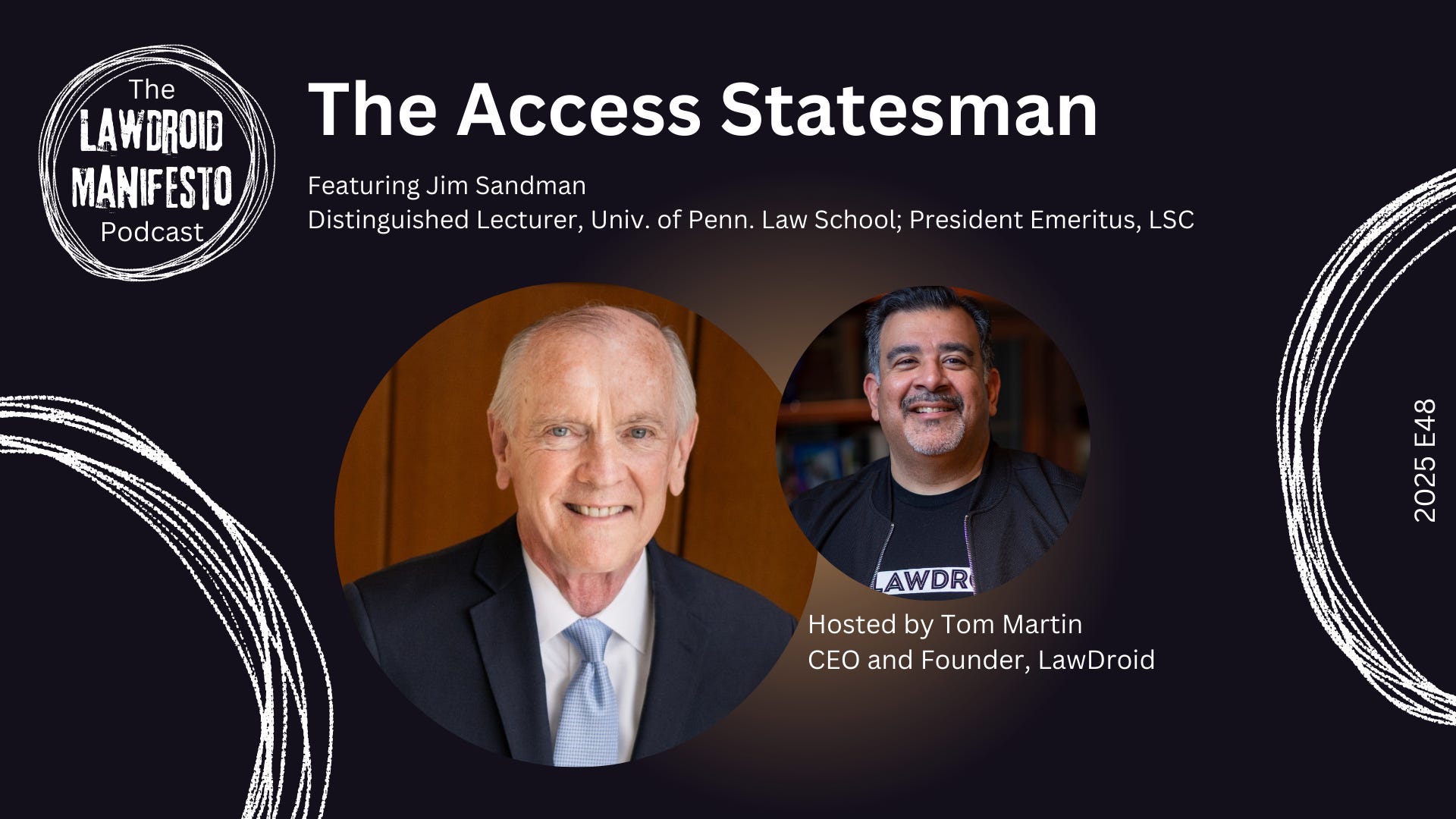
In this powerful episode, I interview Jim Sandman—President Emeritus of Legal Services Corporation and current Penn Law faculty member—about his extraordinary journey from 30 years in big law to becoming one of the most influential voices in access to justice.Jim shares the formative experiences that shaped his path, from his parents' emphasis on service to early pro bono work defending Vista volunteers, to an unexpected role as general counsel of D.C. Public Schools that would prepare him for leading the nation's largest civil legal aid funder.Most importantly, Jim reveals why he believes artificial intelligence represents the greatest opportunity he's seen to expand access to justice—not just by making legal aid organizations more efficient, but ultimately by putting the law directly in people's hands in clear, comprehensible terms.This episode offers invaluable insights on leadership, finding your calling later in career, achieving work-life balance, and the multi-pronged approach needed to truly democratize legal services. Whether you're interested in legal technology, access to justice, or simply how to build a meaningful career in law, Jim's story will inspire and inform.Learn more about the future of legal innovation at www.lawdroidmanifesto.com This is a public episode. If you'd like to discuss this with other subscribers or get access to bonus episodes, visit www.lawdroidmanifesto.com/subscribe
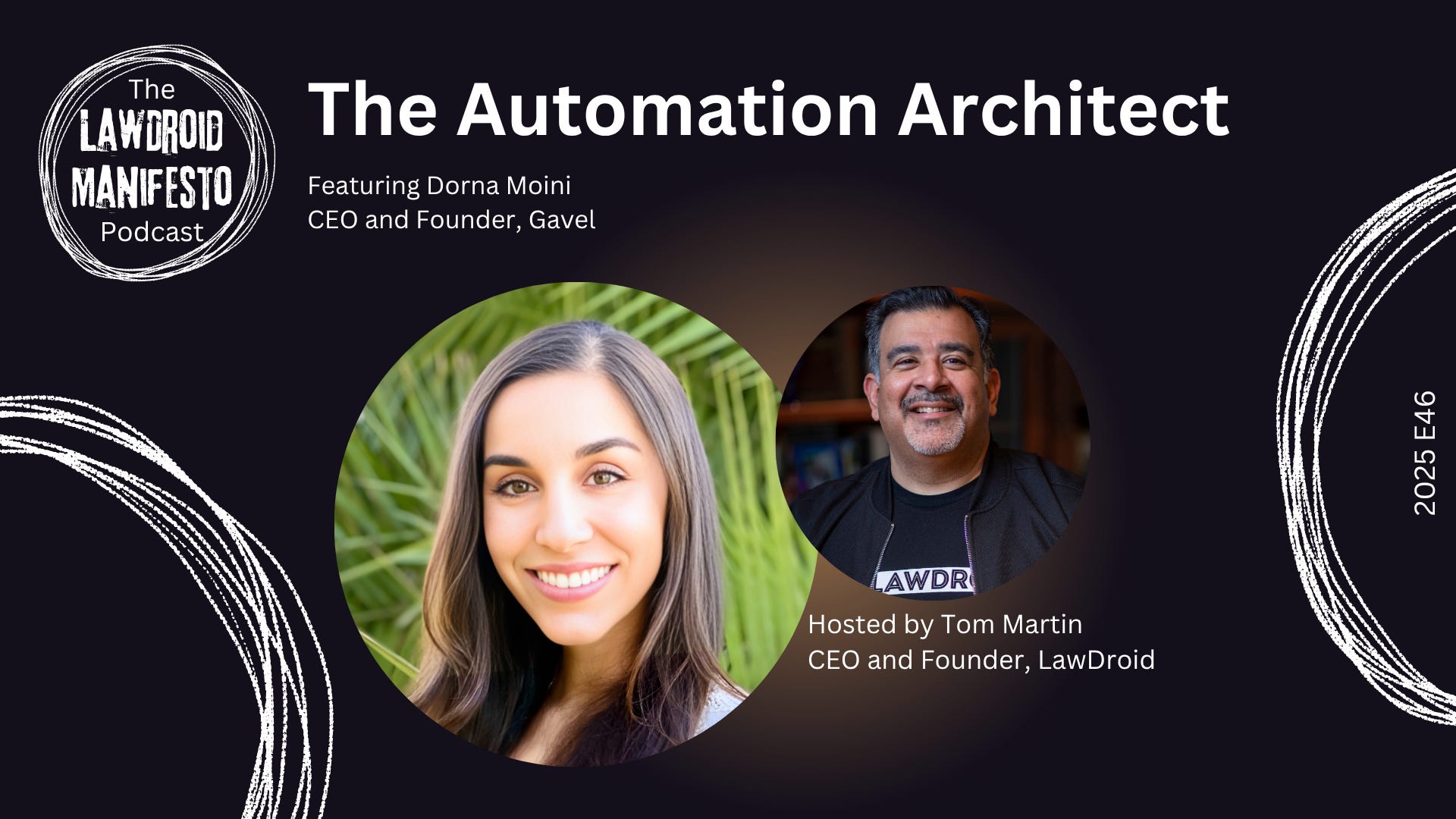
Dorna Moini didn't set out to build legal tech infrastructure—she started by trying to automate forms for legal aid organizations. That practical approach led her to create Gavel, the platform now powering major legal tech companies and enabling lawyers to transform traditional practices into scalable legal products.In this episode, Dorna shares her journey from big law to building technology that serves as the backbone for companies like Hello Divorce and Just Tech. She reveals how lawyers are using Gavel to work from anywhere while serving more clients, why specialization beats generalization in building a career, and how her latest AI innovation helps lawyers draft better contracts by learning from their firm's institutional knowledge. With over 100 law schools using Gavel and legal aid organizations scaling their impact, Dorna's story shows how solving real problems leads to transformative technology.Learn how automation is democratizing legal services and discover practical strategies for building in legal tech at www.lawdroidmanifesto.com This is a public episode. If you'd like to discuss this with other subscribers or get access to bonus episodes, visit www.lawdroidmanifesto.com/subscribe
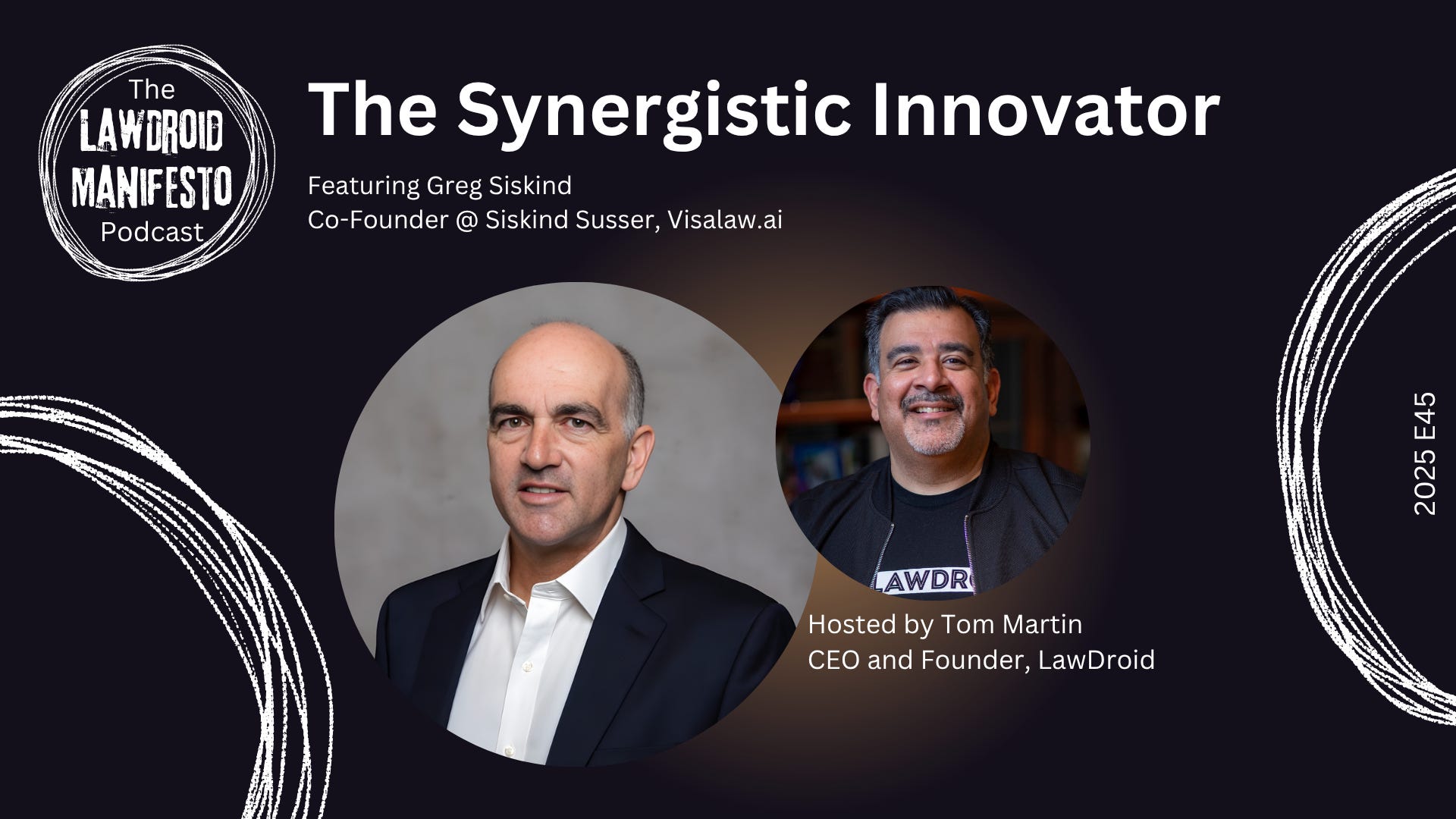
In this compelling episode, Tom Martin interviews Greg Siskind, founding partner at Siskind Susser and creator of VisaLaw.ai, about his remarkable three-decade journey in immigration law. Greg shares how he nearly left the legal profession before discovering immigration law, which he found fascinating due to its deep connection to American history. He discusses his current work challenging a $100,000 H-1B tariff affecting everyone from tech workers to rural teachers and priests, demonstrating the real-world impact of immigration policy.Greg reveals his synergistic approach to building multiple successful ventures simultaneously—from practicing law to authoring eight books to creating award-winning AI tools. He explains how his 4,000-page AILA practice manual became the foundation for VisaLaw.ai and shares practical strategies for managing diverse responsibilities by finding ways each project reinforces the others.This episode offers valuable insights for lawyers interested in building multifaceted careers that combine practice, innovation, and advocacy. Discover how Greg leverages technology and delegation to stay at the forefront of a rapidly evolving field while maintaining his passion for helping immigrants achieve their American dream.For more in-depth legal innovation content and exclusive interviews with leading legal tech pioneers, visit www.lawdroidmanifesto.com This is a public episode. If you'd like to discuss this with other subscribers or get access to bonus episodes, visit www.lawdroidmanifesto.com/subscribe
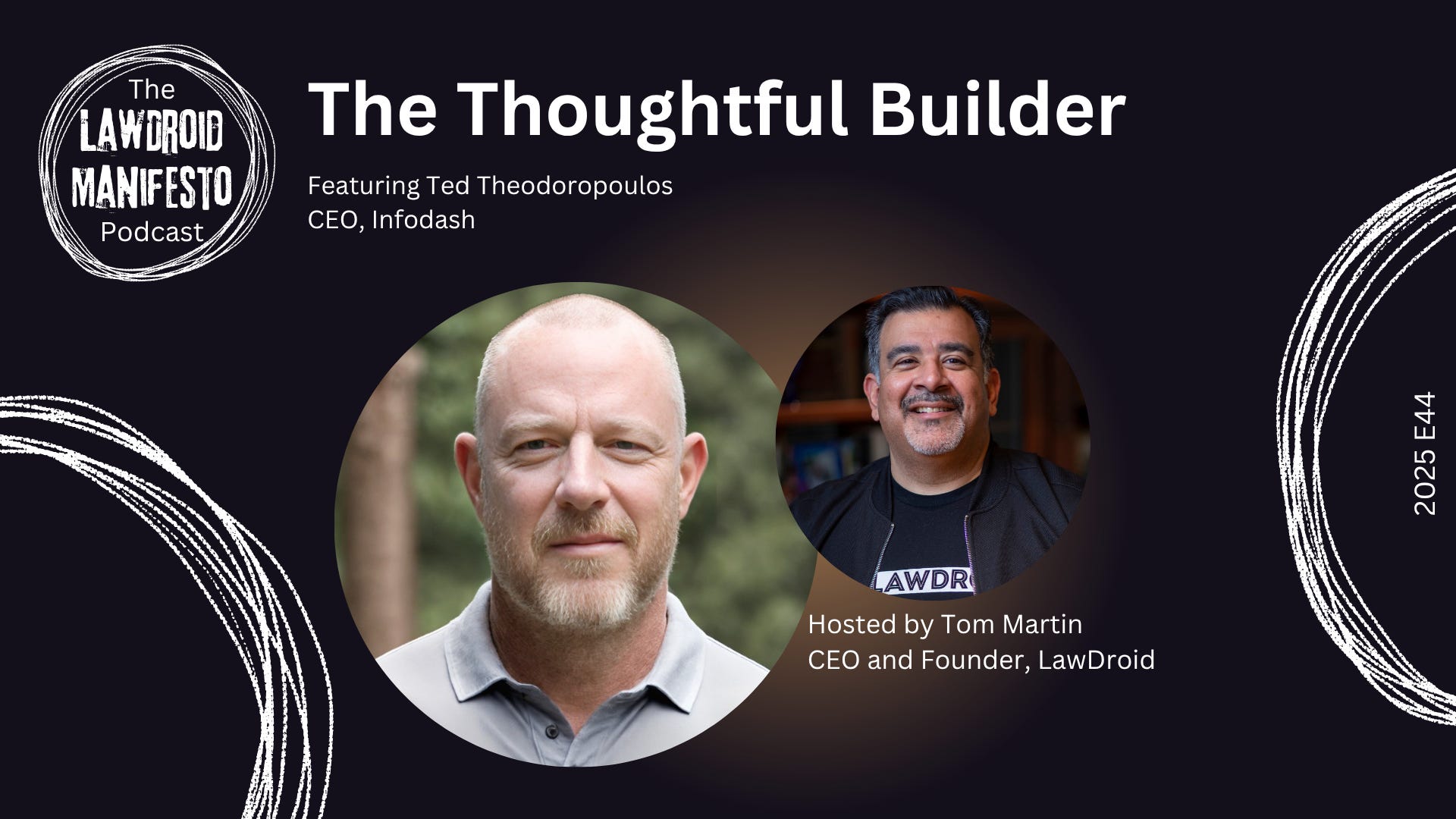
In this episode, I interview Ted Theodoropoulos, CEO of InfoDash and 2024 ILTA Innovative Leader of the Year, about his 32-year entrepreneurial journey and his unique approach to building legal technology that lawyers actually appreciate using.Ted shares how InfoDash evolved from Acrowire's bespoke consulting work into an integrated intranet platform that eliminates the "toggling tax"—the 9% of time information workers lose switching between applications. He discusses his practice of dedicating 30 minutes each morning to pure thinking time, which has generated breakthrough insights for his company.We explore why Ted believes the legal market will transform completely within three to five years, how AI integration through existing infrastructure will accelerate this change, and why he's committed to building a company where innovation thrives rather than dies. His perspective on sustainable entrepreneurship, customer success, and creating meaningful work offers valuable lessons for anyone in legal technology.Discover practical approaches to legal innovation and learn why dedicated thinking time might be the most productive part of your day. Explore more insights and join our community of legal innovators at www.lawdroidmanifesto.com This is a public episode. If you'd like to discuss this with other subscribers or get access to bonus episodes, visit www.lawdroidmanifesto.com/subscribe
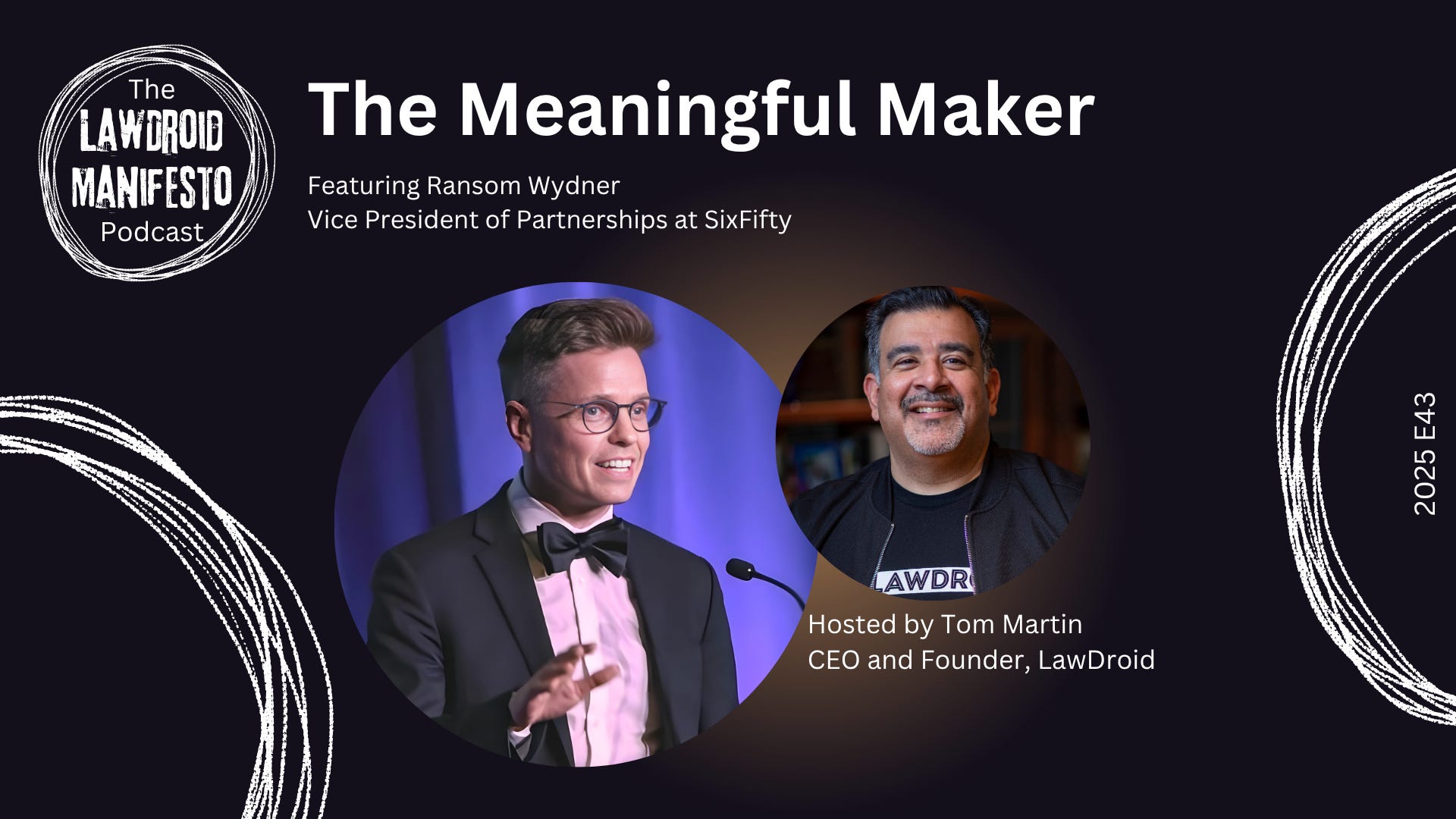
Ransom Widener, VP of Partnerships at 650, reveals how AI is simultaneously disrupting commercial tech and democratizing access to justice. Learn why commoditization of AI capabilities creates both challenges and opportunities, how to build meaningful work that lasts beyond your lifetime, and practical approaches to work-life balance that actually work. Ransom's unique perspective bridging HR tech innovation and legal access initiatives offers essential insights for anyone navigating technology's role in delivering justice. Discover the strategies that matter when everyone has access to the same AI tools and why disconnecting is essential for sustained innovation. For deeper insights and exclusive content, visit www.lawdroidmanifesto.com This is a public episode. If you'd like to discuss this with other subscribers or get access to bonus episodes, visit www.lawdroidmanifesto.com/subscribe
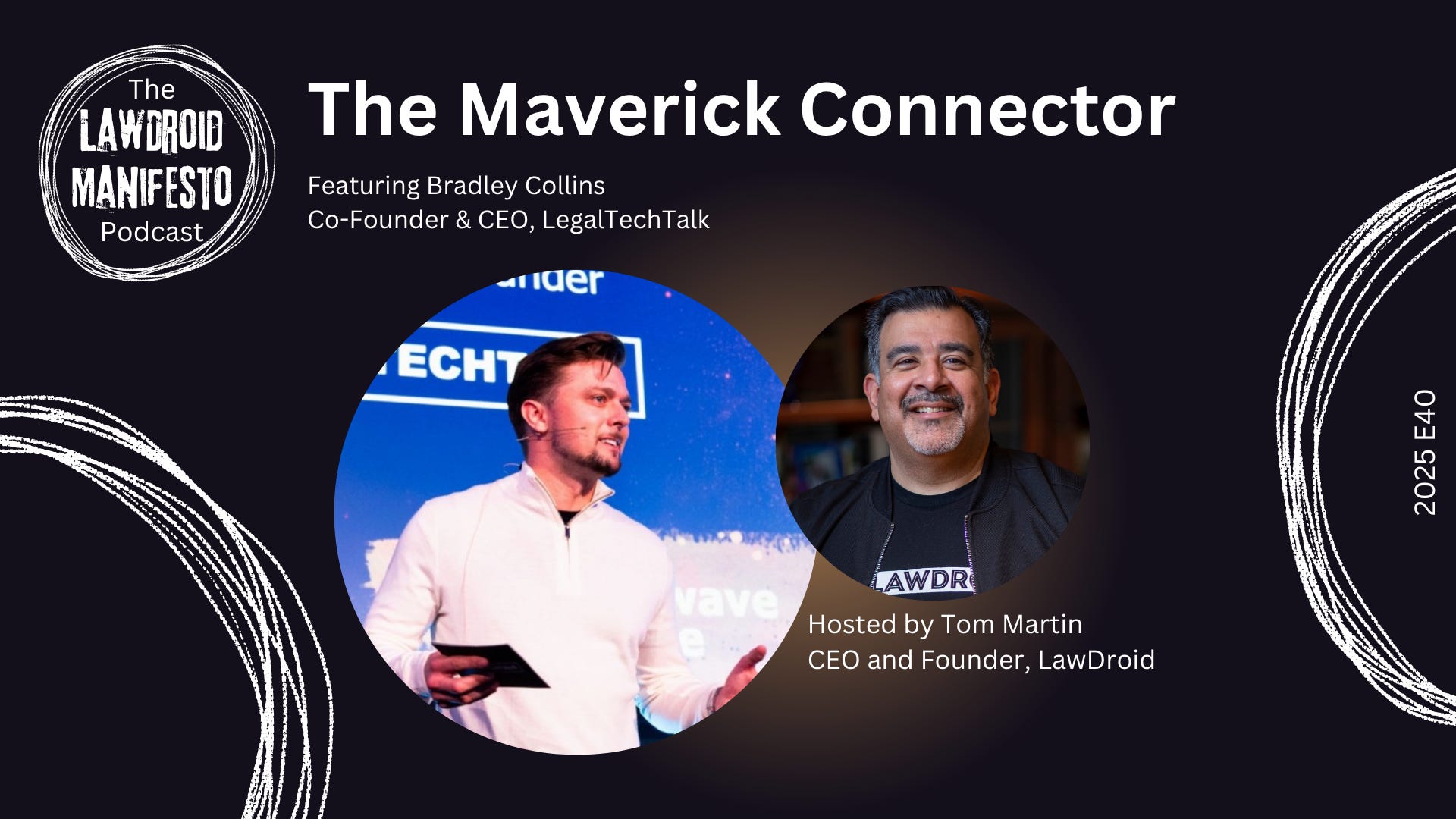
Bradley Collins transformed from working on a building site to creating Legal Tech Talk, which grew to 3,100 attendees in just two years. His outsider's perspective on legal innovation offers powerful insights for anyone building something new or driving change. Bradley shares how he convinced global managing partners, chief legal officers, and tech founders to take a chance on a completely new event, why storytelling matters more than numbers, and how the legal industry's pattern of "no firm wants to be first, but nobody wants to be last" shapes adoption. Learn the mindset shifts that enabled extraordinary growth and discover why focusing on positive impact creates sustainable success.For more episodes and insights on legal innovation, visit www.lawdroidmanifesto.com This is a public episode. If you'd like to discuss this with other subscribers or get access to bonus episodes, visit www.lawdroidmanifesto.com/subscribe
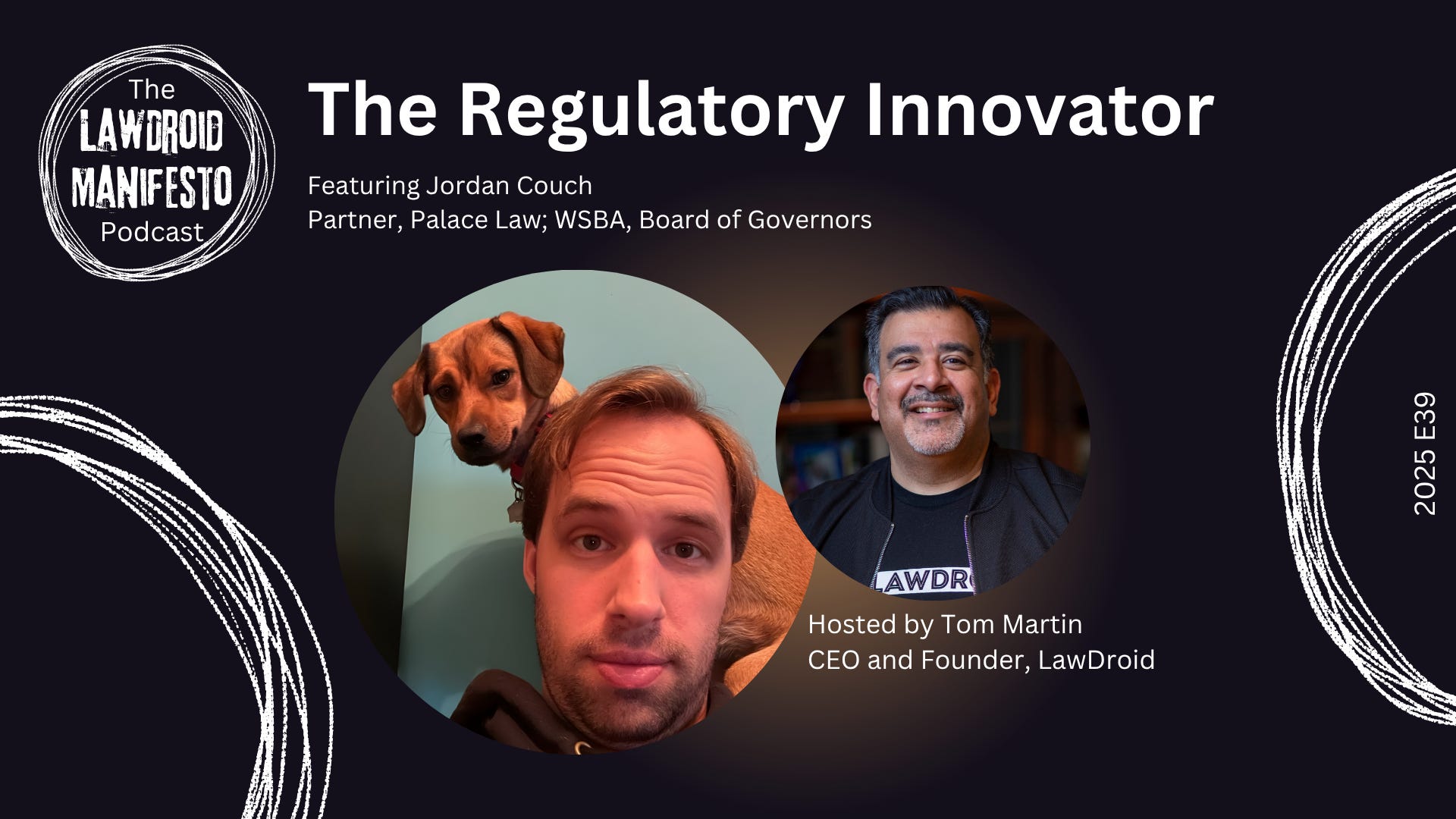
Join Tom Martin as he interviews Jordan Couch, partner at Palace Law, about Washington State's groundbreaking entity-based licensing pilot program. After seven years of regulatory reform work, Jordan reveals how persistence and collaboration transformed an outdated UPL framework into an experimental system that invites innovation. Learn why 85% of people with legal needs go unserved, how Baumol's cost disease explains why legal services cost more while lawyers earn less, and why regulatory innovation represents opportunity rather than threat. Discover practical insights on access to justice, the economics of legal services, and what happens when passion drives meaningful systemic change. Visit lawdroidmanifesto.com for more episodes and exclusive content. This is a public episode. If you'd like to discuss this with other subscribers or get access to bonus episodes, visit www.lawdroidmanifesto.com/subscribe
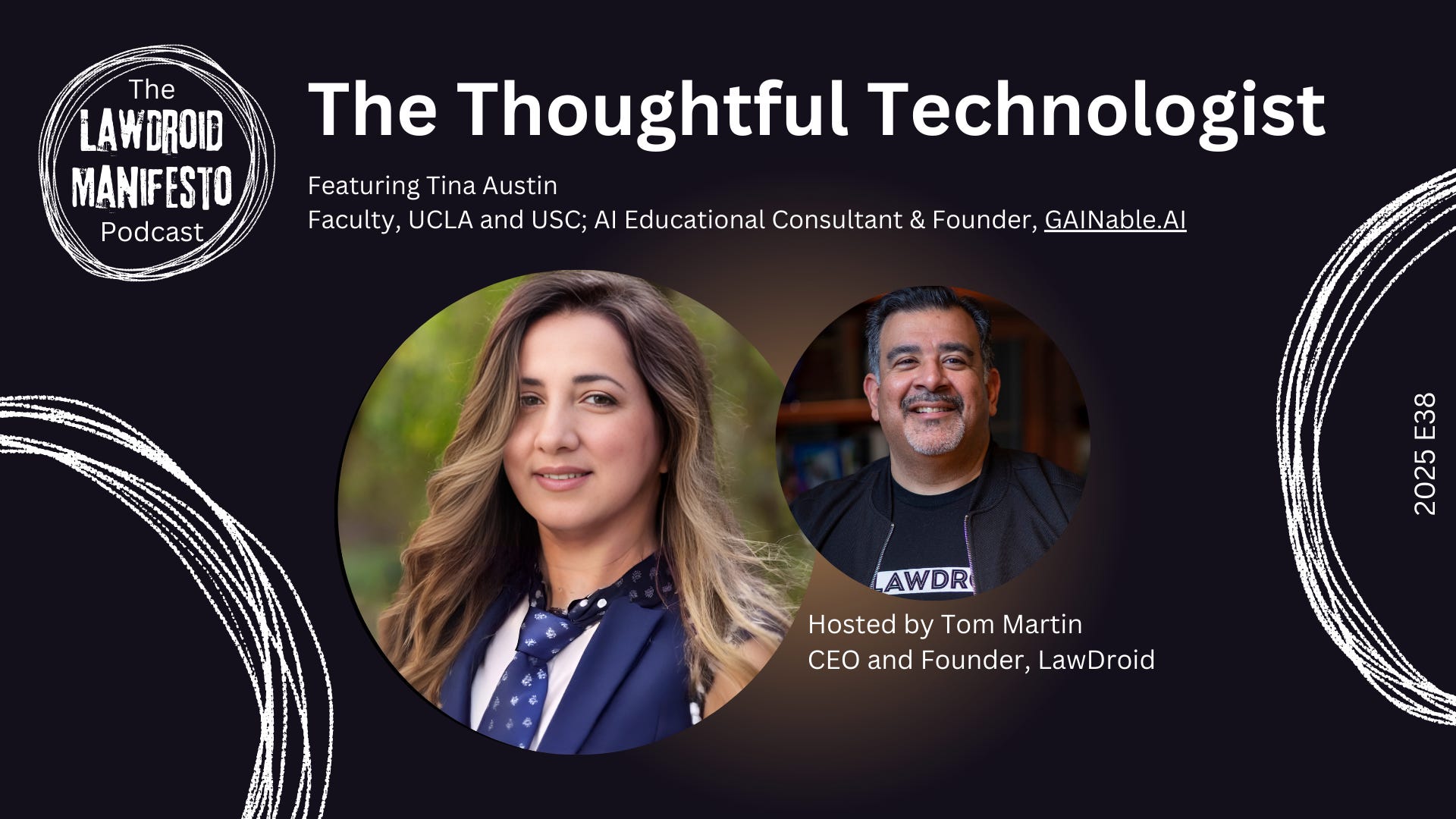
Tina Austin, AI ethics advocate and educator at USC and UCLA, shares her innovative approach to teaching critical AI literacy across universities. From her journey through biomedical research to developing the groundbreaking "Unblooms" methodology, Tina demonstrates how educators can prepare students for an AI-enhanced future. Featuring insights on AI bias detection, protein language models, and concerning trends like student AI companionship, this episode reveals how critical evaluation skills matter more than technical knowledge. Discover actionable strategies for responsible AI education and why teaching students to evaluate rather than just use AI creates better prepared professionals. Essential listening for educators and professionals navigating technological change. Learn more at www.lawdroidmanifesto.com This is a public episode. If you'd like to discuss this with other subscribers or get access to bonus episodes, visit www.lawdroidmanifesto.com/subscribe
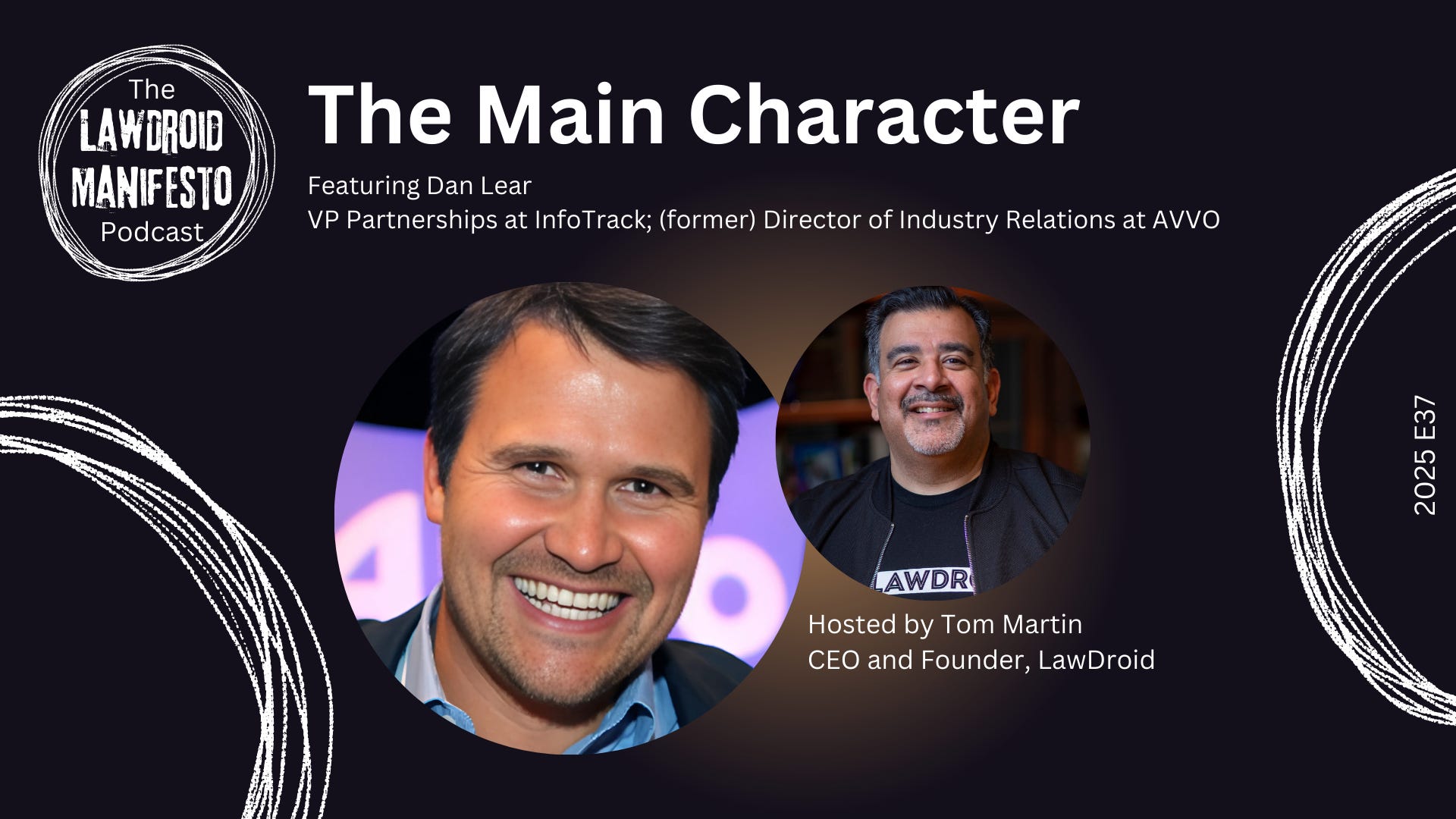
Dan Lear's unconventional journey from a family of lawyers to VP of Partnerships at InfoTrack reveals the courage required to abandon traditional legal practice for meaningful innovation. In this compelling conversation, Dan shares how his experience at Microsoft, community building in Seattle, and pivotal role at Avvo shaped his perspective on legal technology leadership. He introduces his concept of a law degree as both "map and floor" - security you willingly abandon to chart your own course. Learn how authentic networking, gradual skill building, and staying true to your values can lead to transformative career opportunities. Discover more insights at www.lawdroidmanifesto.com This is a public episode. If you'd like to discuss this with other subscribers or get access to bonus episodes, visit www.lawdroidmanifesto.com/subscribe

Join LawDroid CEO Tom Martin as he interviews Ed Walters, Chief Strategy Officer at VLEX and co-founder of Fastcase, about building one of legal tech's most successful companies. From growing up in poverty to serving in the White House speechwriting office to co-founding a platform that serves 1.2 million lawyers, Ed's journey demonstrates how mission-driven entrepreneurship can democratize access to justice. Learn about bootstrapping through the dot-com crash, the power of state bar partnerships, and the strategic VLEX merger that created a global AI powerhouse with Vincent AI. Discover insights on building sustainable legal tech companies at www.lawdroidmanifesto.com This is a public episode. If you'd like to discuss this with other subscribers or get access to bonus episodes, visit www.lawdroidmanifesto.com/subscribe
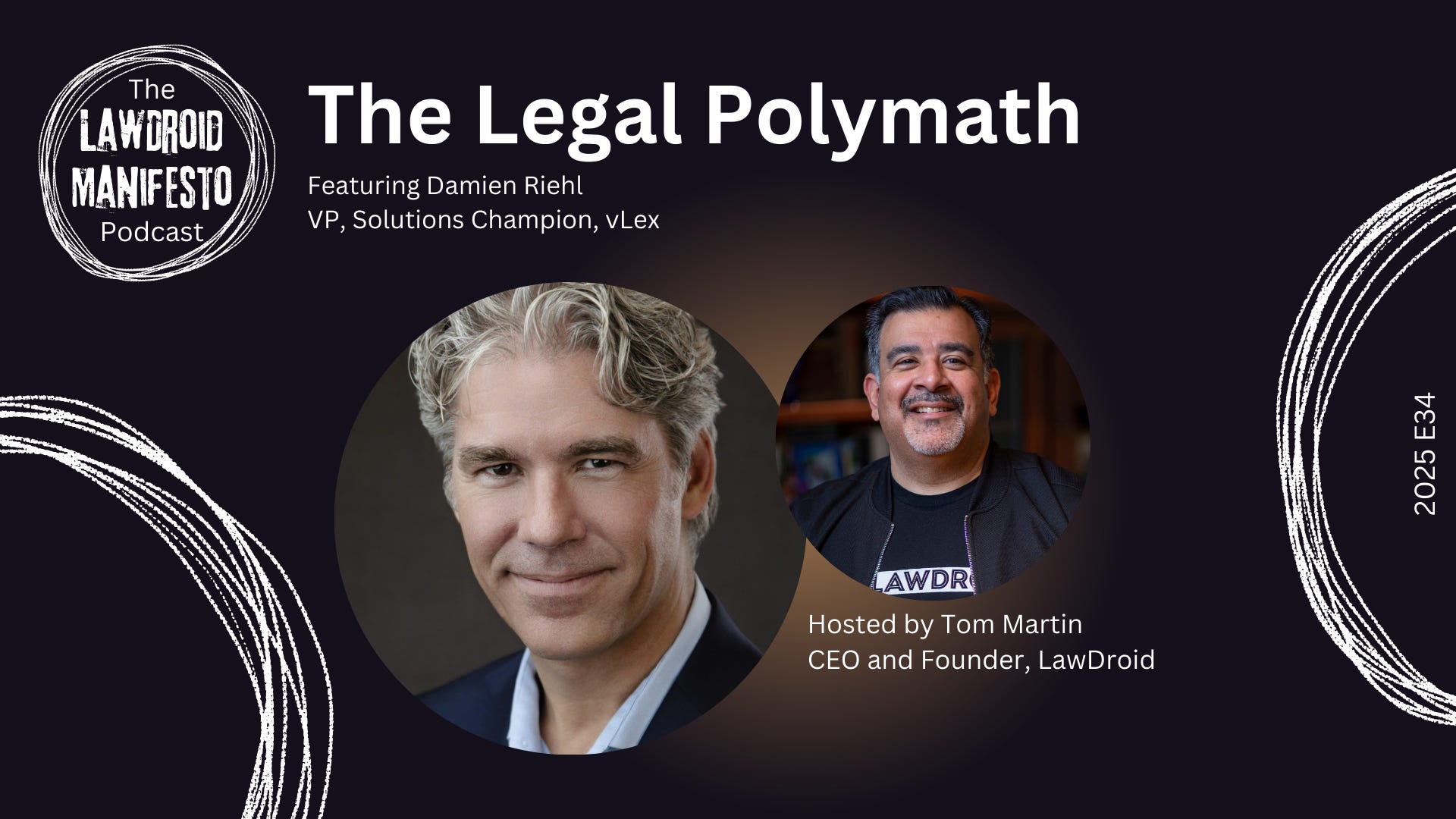
Join host Tom Martin for an eye-opening conversation with Damien Reel, vLEX solutions champion and legal polymath whose groundbreaking work spans AI, data interoperability, and music copyright law. From small-town North Dakota to federal judicial clerkships and BigLaw litigation, Damien's journey led him to create the Sally data standardization project and copyright 471 billion melodies to protect artists from frivolous lawsuits. Discover how AI can address the 92% of unmet legal needs, why data interoperability matters, and how combining technical expertise with legal knowledge creates opportunities to democratize access to justice. Essential listening for forward-thinking legal professionals at lawdroidmanifesto.com. This is a public episode. If you'd like to discuss this with other subscribers or get access to bonus episodes, visit www.lawdroidmanifesto.com/subscribe
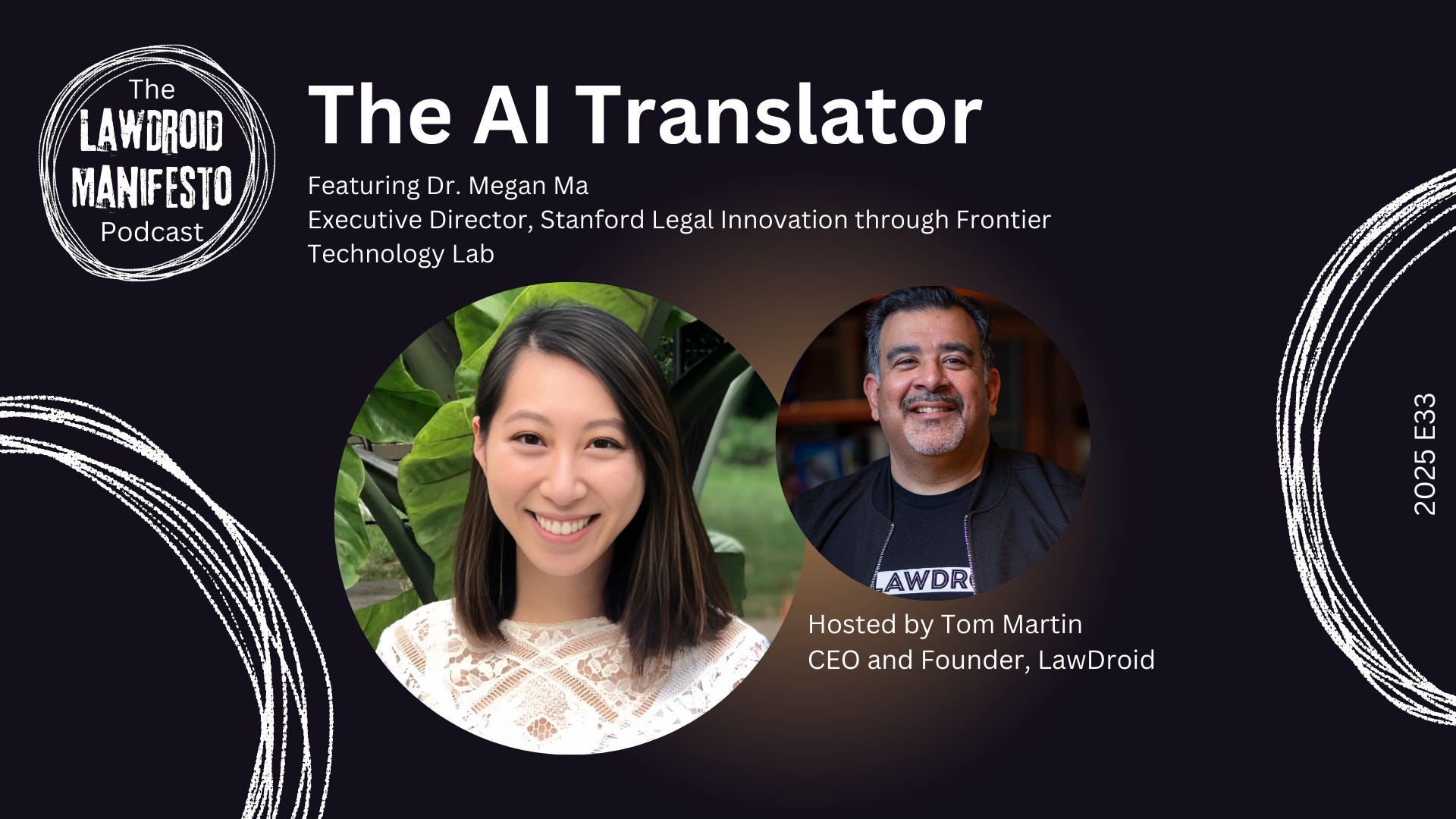
Dr. Megan Ma, founding executive director of Stanford's Lift Lab, shares her journey from childhood language fascination to leading groundbreaking legal AI research. From inventing her own dialects as a trilingual child in Toronto to developing empirical benchmarks that compare human lawyers to AI tools, Megan reveals how her work is shaping the future of legal practice and education. She discusses her TurboTax analogy for legal AI adoption, insights from comparing associates to AI using senior partner evaluations, and her vision for simulation-based legal training. Essential listening for understanding how AI will enhance rather than replace lawyer expertise. Learn more at www.lawdroidmanifesto.com This is a public episode. If you'd like to discuss this with other subscribers or get access to bonus episodes, visit www.lawdroidmanifesto.com/subscribe
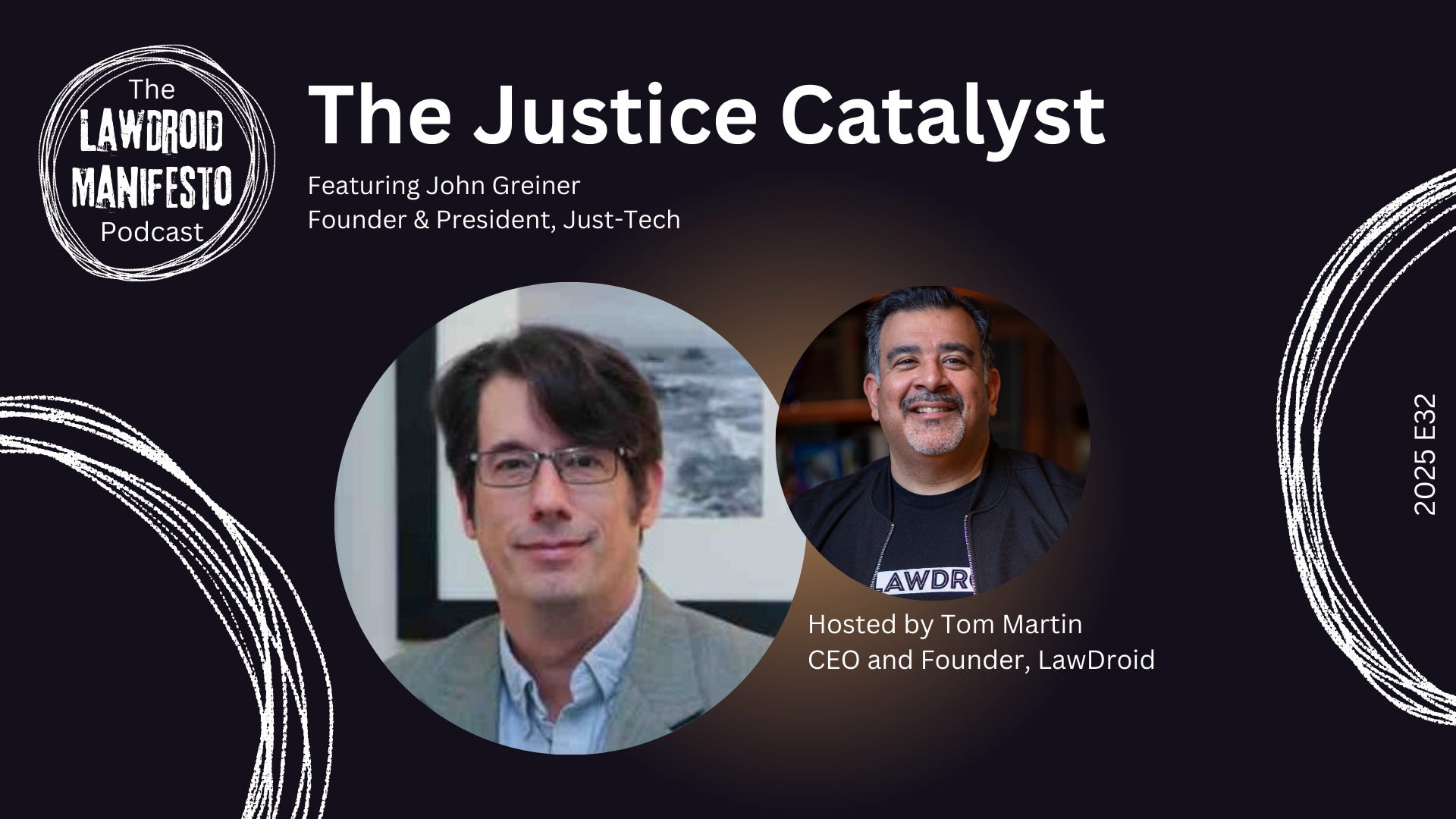
John Greiner, founder of Just Tech, shares his three-decade journey from legal services attorney to technology innovator revolutionizing nonprofit legal aid. From growing up in Manhattan to becoming CIO at the nation's largest civil legal services provider, John reveals how thoughtful technology implementation can multiply impact while preserving essential human connections. He discusses the cultural barriers to innovation in legal services, the critical balance between risk management and progress when serving vulnerable populations, and why the struggle for justice requires both technical expertise and deep understanding of organizational change. Essential listening for anyone interested in technology's role in expanding access to justice. Learn more at www.lawdroidmanifesto.com This is a public episode. If you'd like to discuss this with other subscribers or get access to bonus episodes, visit www.lawdroidmanifesto.com/subscribe

Richard Granat, CEO of Law Media Labs, shares his extraordinary journey from 1960s civil rights activism to becoming legal technology's most influential pioneer. From helping create the nation's legal services program to founding mylawyer.com and DirectLaw, Richard has spent decades democratizing access to justice through innovative technology. In this candid conversation, he reveals his unique business philosophy of "making money while you sleep," discusses his predictions about AI's disruptive impact on legal practice, and explains why sustainable legal tech companies must serve the underserved. Discover insights from a true trailblazer who chose purpose over pure profit. Visit www.lawdroidmanifesto.com for exclusive content. This is a public episode. If you'd like to discuss this with other subscribers or get access to bonus episodes, visit www.lawdroidmanifesto.com/subscribe

Comments

Download from Google Play

Download from App Store
 United States