


 Claim Ownership
People Solve Problems
Subscribed: 6Played: 13
Subscribe

Description
People Solve Problems is an engaging new podcast hosted by Jamie Flinchbaugh, the author of the book with the same title. In this insightful series, Jamie interviews a diverse array of guests – from thought leaders and authors to practitioners and everyday individuals, delving into their unique perspectives on problem solving. This compact, interview-style podcast offers valuable insights into what constitutes effective problem-solving, the challenges faced in the process, and the strategies employed. It aims to equip listeners with a wealth of ideas, best practices, and approaches to enhance their problem-solving skills. Stay tuned for the upcoming episodes by clicking the follow button and signing up today.
70 Episodes
Reverse
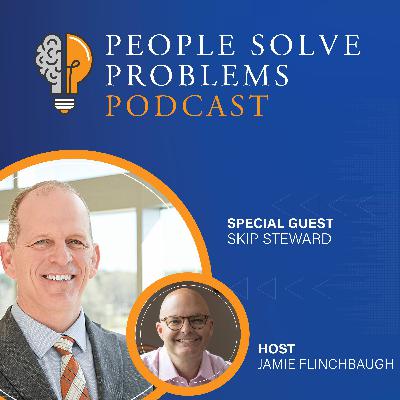
Skip Steward, VP and Chief Improvement Officer at Baptist Memorial Health Care Corporation, sat down with Jamie Flinchbaugh on the People Solve Problems podcast to share what thirty-four years of cross-industry experience looks like when it's put to work inside one of the most complex systems in existence, American healthcare.
The conversation opened on the challenge of prioritization, a particular puzzle in healthcare where competing demands and shifting conditions are the norm. Skip traced his team's solution back to a strategic A3 deployment process he brought to Baptist Memorial nearly thirteen years ago, developed with the guidance of mentor and improvement expert Pascal Dennis, author of Getting the Right Things Done. At the highest level, this process organizes all work under four guiding themes: right care, right time, right place, and right cost. Skip noted that across Baptist's more than twenty-four thousand employees, almost anyone can finish that sentence from memory, a quiet but telling measure of how deeply the direction has taken root throughout the organization.
But strategy at the enterprise level is only part of the story. Skip described how, at the ground level, he returns again and again to one clarifying question: "What are we trying to accomplish?" He shared a recent visit to a clinic where an enthusiastic manager had a full list of ideas and concerns, and fell completely silent when Skip asked that single question. Her honest answer was that she wasn't sure. For Skip, that moment is not a failure. It's the essential starting point. Without knowing what you're anchoring to, he argued, everything else is just activity.
Much of the conversation centered on how Skip and his team build the human side of improvement. The Baptist Management System is built on eleven guiding principles organized around people, process, and purpose, and Skip pointed to two practices that do the most work in making collaboration real. The first is TWI Job Relations, a framework he described as the best way he knows to turn respect for people from a value on a wall into a daily operational skill, helping teams respond to problems objectively rather than emotionally. The second is humble inquiry, which Skip practices as the art of asking open-ended questions you genuinely don't know the answers to, to understand someone's situation before trying to improve it. Whether speaking with a senior physician or someone new to the front lines, Skip described meeting people with curiosity rather than credentials, sometimes literally taking his jacket off to reduce the distance between them.
The final stretch of the conversation turned to healthcare's broader challenges, and Skip was honest about the difficulty. He called healthcare the most complex open sociotechnical system he has encountered in his career, drawing on the thinking of organizational psychologist Edgar Schein. He pushed back firmly on the notion that any single solution, AI included, will fix the system's deep problems. What he believes in is a mindset: the patient, hypothesis-driven thinking that takes on one part of the process at a time. He pointed to a striking example from Baptist's own work, where a daily multidisciplinary patient review meeting that once lasted two hours has been reduced to a focused, information-rich fifteen minutes, the result not of top-down directives but of physicians and nurses experimenting their way forward. One doctor captured the shift with a line Skip clearly treasures: "I learned that it wasn't okay to wait." For Skip, stories like that are the reason for hope.
To learn more about Skip Steward's work, visit baptistonline.org or connect with him on LinkedIn at linkedin.com/in/skipsteward.
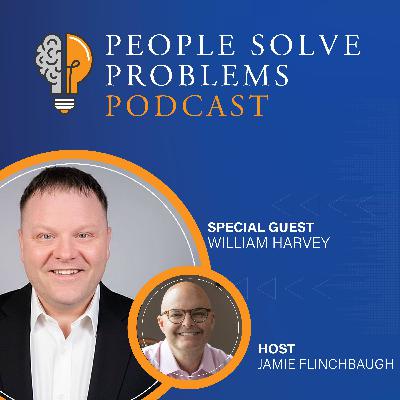
William Harvey, Program Manager for Strategic Initiatives and University Professor, brings a refreshingly practical perspective to leadership and problem-solving. Throughout the conversation, William shares how his diverse background—from the Marine Corps to manufacturing to academia—has shaped his approach to developing people and tackling complex challenges.
William's philosophy on leadership centers on flexibility and situational awareness. He describes his approach as stepping into whatever role the moment demands, whether that's ownership, delegation, coaching, or sponsorship. Drawing an analogy to the movie “300,” where King Leonidas steps into missing spots, William explains that he doesn't declare his role upfront but instead reads the situation and fills gaps as needed. For critical moments—safety incidents, major quality investigations, or when someone is truly struggling—he leads directly. But for planned activities, he creates safe spaces where people can develop new competencies without the pressure of real-time crises forcing immediate action.
One of William's most compelling insights challenges a common assumption in problem-solving work. Before jumping into any methodology or framework, he insists on establishing two fundamentals: does everyone agree it's actually a problem, and where does it fit in the priority list? Without that shared understanding and commitment, all the problem-solving methods in the world won't matter. William also emphasizes diversity of thought as critical to collaboration, pointing out that perspectives shaped by education, family upbringing, international experience, and other life factors often matter more than visible diversity markers alone.
William has learned to manage his own influence carefully. Recognizing that as a senior person, he can easily sway a group, he's developed tactics like voting before discussion and speaking last. He presents ideas as straw man arguments, deliberately inviting critique by asking what's wrong with the plan rather than assuming he's considered everything. This approach reflects his understanding that mental models are never fully accurate—they only become more accurate through constant refinement based on the gap between expectation and reality.
The conversation reveals how William has built learning directly into organizational rhythms at multiple levels. In daily huddles, one-on-ones, and formal after-action reviews, he creates space for reflection. But his most powerful discovery came accidentally when he started asking, "Who's done something worth recognizing since we last met?" before discussing what needs improvement. Within about 30 days, finger-pointing disappeared. By layering genuine praise first, William found that people became far more willing to collaborate on problems, seeing issues as process failures rather than personal attacks.
William also shares his practice of using pre-mortems, taking insights from past post-mortems to identify what could fail in new projects before they launch. This forward-looking application of learning prevents teams from repeating mistakes. He references the "zoom in, zoom out" systems thinking model, noting that while most people excel at zooming in on technical details, they often forget to zoom out to see handoffs between functions and other systemic issues that could derail success.
Looking ahead, William is exploring how AI can make learning content more effective by customizing delivery to resonate with diverse learners—matching accents, appearances, and contexts to help information land more powerfully. It's a natural extension of his commitment to intentional inclusion and meeting people where they are.
Connect with William on LinkedIn: https://www.linkedin.com/in/drwilliamharvey/
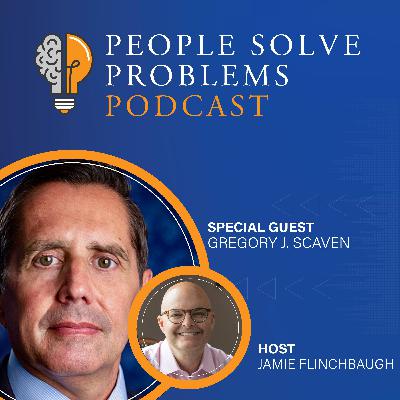
Gregory J. Scaven, CEO, Board Director, Partner, and currently President at Scaven Enterprises, LLC, brings over 30 years of technical engineering leadership and more than 20 years as a P&L leader to this conversation about problem-solving. With deep expertise in pyrotechnics, explosives, and propellants across automotive, aerospace, and defense industries, Greg shares how his approach to problem-solving evolved from the lab to the boardroom.
Greg's introduction to problem-solving came through the lens of high-reliability engineering, where devices that "go boom" must do so only when intended. Working in an industry demanding “six-nines” reliability or better, he learned the discipline of corrective action processes, where finding the true root cause wasn't optional. Greg emphasizes that his early training taught him to demonstrate the ability to turn failure modes on and off, then prove the effectiveness of preventative actions. This rigorous foundation shaped everything that followed.
The transition from engineer to business leader brought formal problem solving training through the Danaher Business System. Greg describes how Danaher focused on training leadership teams, not just front-line workers, because problem solving is a critical leadership skill. The emphasis was revolutionary for him: spend 70% of your time defining what the problem actually is. Greg explains that coaching teams to frame problems correctly became more important than diving into technical details, and he learned to limit his organization to no more than three major problems at any time, integrating them into regular leadership reviews.
Throughout the conversation, Greg returns to a central theme: critical thinking matters more than following forms. He cautions against becoming a slave to any tool, insisting the power lies in the thinking process itself. When young engineers worry about filling out corrective action paperwork, Greg redirects them to focus on what they've learned. He consistently asks teams to reframe their problem statements as new learning emerges, recognizing that the problem definition itself can evolve.
Greg draws a clear distinction between what he calls "cause problems" and "creative problems." As an engineer, he dealt with cause problems where scientific rationale could explain failures through tolerance stack-ups and environmental conditions. As a P&L leader, he faces creative problems like sales shortfalls, where turning failure modes on and off isn't possible. This is where experimentation becomes powerful. Greg encourages teams to quickly test their top three ideas, look for early returns, and double down on what works while abandoning what doesn't.
Creating a learning culture under P&L pressure requires deliberate effort. Greg believes great businesses are naturally curious, filled with people who aren't afraid when experiments fail. He looks for teams that iterate without waiting for permission, teams that come to him saying, "We tried this, it didn't work, so here's what we're doing next." That's his definition of success. Greg emphasizes accountability for follow-through rather than results, building on concepts from his military background around the commander's intent. Teams that understand the big picture, maintain discipline, and show bias for action don't wait for scheduled reviews when critical issues arise.
Greg's approach reveals how curiosity, discipline, and real-time responsiveness create problem-solving cultures that deliver. His journey from engineering to executive leadership demonstrates that while the problems change, the principles of critical thinking, experimentation, and learning remain constant.
To connect with Greg or learn more about his work, visit his LinkedIn profile at www.linkedin.com/in/gjscaven.
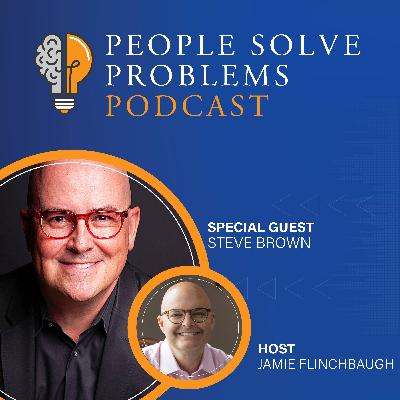
Steve Brown has spent years helping organizations see around corners. As a former executive at both Intel Labs and Google DeepMind, where he served as their in-house futurist, Steve brings a unique perspective on what happens when rapid technological change collides with practical business reality. In this conversation, he challenges leaders to move beyond fear and cost-cutting mentality to embrace AI as a tool for genuine value creation.
Steve explains that being a futurist isn't about making predictions—that's for fortune tellers. Instead, it's a discipline of examining trends, understanding how they intersect over time, and mapping possible futures. But the landscape has grown increasingly complex. The pace of AI development has accelerated so dramatically that projecting even six months ahead has become challenging. What makes AI particularly difficult to forecast isn't just the technology itself, but the ripple effects of having powerful intelligence available on demand at low cost. As Steve puts it, this changes everything about everything.
When it comes to implementation, Steve grounds his approach in a framework he calls "possibility and purpose." He sees AI creating an enormous landscape of what's possible, but warns that the real leadership challenge is figuring out what not to do. By finding the intersection between corporate purpose and this expanded possibility space, organizations can focus their efforts where they'll create the most value.
Steve offers a fresh perspective on AI's relationship with human qualities, such as empathy. While acknowledging that AI simulates rather than truly experiences emotions, he points to promising applications like AI therapists that can reach people who would never seek human help. The key is understanding when simulation serves a genuine need versus when it creates friction in developing essential human skills—like learning to navigate relationships and failures.
The heart of Steve's message centers on reimagining AI not as a replacement for humans, but as a collaborative teammate. He describes three types of AI agents organizations should consider: offload agents that handle boring repetitive work, elevate agents that amplify human capabilities, and extend agents that enable people to do things they couldn't do before. This framework transforms workforce planning from a zero-sum game into an expansion strategy. Steve points to Jensen Huang's vision at NVIDIA—growing from 30,000 employees to 50,000, supported by 100 million AI assistants—as an example of thinking about amplification rather than reduction.
Steve argues that AI project failures typically stem from three core issues: immature technology, poor change management, and messy data. Organizations succeed when they start small with bounded projects, balance short-term wins with medium and long-term initiatives, and treat AI implementation as fundamentally a change management challenge rather than just a technology deployment. He emphasizes that everyone owns the AI transition—from line of business to HR to IT—though having a Chief AI Officer can help drive the organizational transformation required.
Rather than obsessing over traditional ROI calculations, Steve encourages leaders to focus on the human challenges that AI can solve. When the average knowledge worker spends 32 days per year just searching for information, cutting that time in half represents massive value that goes beyond simple efficiency metrics.
Learn more about Steve's work and access his several resources:
AI Resources
https://beacons.ai/aifuturist
AI Course
https://www.stevebrown.ai/ai-course
AI Workshops
https://www.stevebrown.ai/workshop
Keynotes
https://www.stevebrown.ai/keynotes
YouTube
www.youtube.com/@futureofai
Amazon book “The AI Ultimatum: Preparing for a World of Intelligent Machines and Radical Transformation.”
https://a.co/d/1YoFV5C
Connect with him on LinkedIn at https://www.linkedin.com/in/futuresteve/
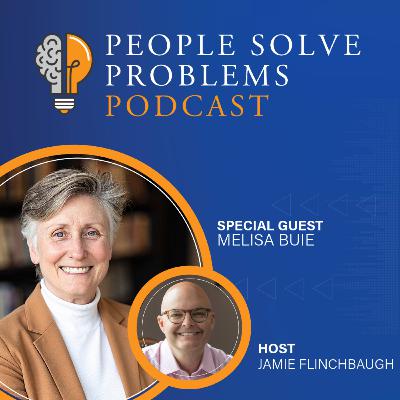
Dr. Melisa Buie brings a fascinating perspective to the challenge of failure, one forged through decades of building high-powered lasers and leading manufacturing transformations in the semiconductor industry. With a PhD in Nuclear Engineering and Plasma Physics from the University of Michigan and over 15 years at Coherent, Inc., Melisa has spent her career solving complex technical problems. But it was a personal struggle that led to her latest book, "Faceplant: FREE Yourself from Failure's Funk," co-authored with Keely Hurley.
Melisa shared a compelling story that became the catalyst for her book. Despite being completely comfortable with failure in the laboratory, where experiments routinely don't work, and models need constant refinement, she discovered she was terrified of failing in her personal life. When she took a Spanish class at Stanford and tried speaking her first sentence to a friend, the friend burst out laughing. Melisa's immediate reaction was to shut down completely. She realized she had developed a fixed mindset about failure outside the lab, and this contradiction troubled her deeply.
She spent years reading everything she could about failure, learning, and growth, ultimately developing the framework that became "Faceplant." The book's title came from Melisa's co-author, Keely, who has a gift for turning her own missteps into hilarious stories. For Keely, every failure was just another face plant to laugh about, and the metaphor stuck immediately.
The subtitle's use of "FREE" isn't just clever wordplay; it's an acronym for a practical framework: Focus, Reflect, Explore, Engage. Melisa explained that the framework grew organically from her lean manufacturing background, particularly the principle of Hansei, which emphasizes self-reflection followed by self-improvement. The first two steps help clarify what actually happened and understand your role in it, while the final two steps push you toward curiosity and experimentation.
When asked about organizational barriers to learning from failure, Melisa highlighted the critical importance of psychological safety, pointing to the work of Amy Edmondson and Mark Graban. She noted that leaders often unintentionally shut down learning through their behaviors, even when they genuinely believe they support it. Melisa offered concrete examples to watch for: Is it easier to get approval for a half-million-dollar piece of equipment than to run a five-thousand-dollar experiment? If equipment purchases are immediate but experiment proposals sit unopened for weeks, that reveals the organization's true priorities. She also pointed to meeting dynamics when brainstorming sessions fall silent except for one voice, or when only a single idea emerges, and everyone rallies around it without discussion, those are warning signs.
Perhaps most striking was Melisa's deliberate choice to use the word "failure" throughout her book, rather than softer alternatives like "learning opportunity" or "mistake." She explained that failure makes us deeply uncomfortable, and she didn't want to step over that discomfort. When one friend admitted to only failing once in life, Melisa felt sad for them, because without taking risks and chances, we miss the rich opportunities that failure provides. She acknowledged the irony: in the lab, ten failed experiments in a design of experiments might be considered a beautiful success because of what was learned. But she wanted to be honest about calling things what they are, pushing past the positive platitudes about failure to actually embrace it.
Learn more about Melisa and her work at www.melisabuie.com and www.faceplantbook.com, or connect with her on LinkedIn.
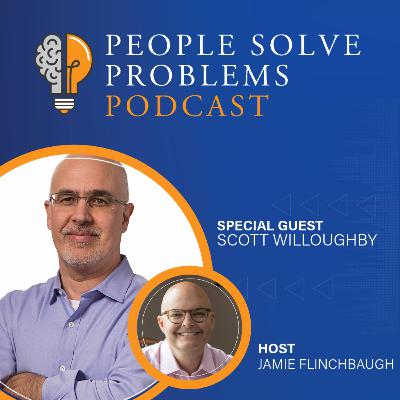
Scott Willoughby, Vice President of Program Excellence at Northrop Grumman and former program manager for the James Webb Space Telescope, joined Jamie Flinchbaugh to share insights on leading one of the most complex systems ever built. With 35 years at Northrop Grumman, a NASA Distinguished Public Service Medal, and membership in the National Academy of Engineering, and we have to include a degree from Lehigh University. Scott brought deep wisdom about managing massive programs where failure simply isn't an option.
Managing the James Webb Space Telescope meant dealing with a system seven times larger than Hubble that had to operate at minus 400 degrees Fahrenheit, a million miles from Earth. Scott explained that tackling such complexity requires breaking problems down through systems engineering, but with a critical twist: don't trust yourself. Everything on Webb was done in twos. NASA and Northrop Grumman each built independent models, particularly for thermal and dynamic performance. When pointing a telescope at light from 13.5 billion years ago, stability matters, and even small temperature changes cause mechanical components to shrink and expand. The two teams challenged each other constantly, ensuring they reached the same conclusions before moving forward.
When models disagreed, which happened often during iteration, teams had to get intimately familiar not just with their own work but with how the other side modeled things. Sometimes, differences came down to using different densities or levels of detail. Other times, teams discovered they were working from different versions of test data. Scott emphasized that much of technical work is about getting people to communicate, to say their assumptions out loud rather than keeping them in folders or inside their heads.
Creating a learning culture among world-class engineers and PhDs required leading by example. Scott realized early that being a leader didn't mean knowing everything. He deliberately asked questions that seemed obvious, sometimes the wrong questions, to get beneath the surface. He echoed back what others said in his own words, creating what he called a safe zone in the middle of dialogue where you don't have to be right until the end. By showing vulnerability and modeling openness, he encouraged teams to converge on solutions without anyone feeling accused of being wrong.
Testing followed a crawl, walk, run philosophy. Scott stressed taking the hardest punch as early and as low in the system as possible. They qualified components by subjecting them to extremes beyond predicted conditions, building margin into designs for things they couldn't model perfectly. The hardest day in any satellite's life is usually day one, which for Webb lasted six months as systems were deployed and activated for the first time.
One of Scott's favorite stories captured the power of listening to everyone. When membrane tears appeared during sunshield deployment testing, engineers wrestled with an apparently intractable problem. The solution came from a technician who suggested using something like a squid jig from his fishing tackle box to align the 107 pin holes through multiple membrane layers gently. His compliant device solved one of the program's most complicated problems. Scott learned that elegant solutions sometimes come from understanding how things get built, not just how they're designed.
For transparency with stakeholders, Scott developed a rhythm of meeting every three months to discuss what had happened since the last time, what they were doing now, and most importantly, what challenges lay ahead. By forecasting risks before they materialized, discussing backup plans, and building anticipation for difficult tests, he made it easier to discuss both failures and successes. What advice would he offer to anyone stepping into similar roles? Take a deep breath, realize it won't go perfectly, and talk to others who've been there. Growth doesn't occur without discomfort, and leaders get measured not by perfection but by how they respond to adversity.
Learn more about Scott's work at https://www.northropgrumman.com/, https://science.nasa.gov/mission/webb/, and https://www.imdb.com/name/nm12283488/. Connect with Scott on LinkedIn.
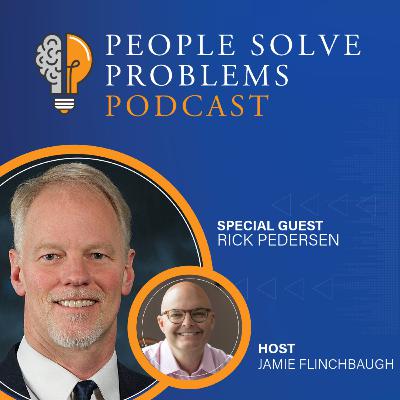
Rick Pedersen, owner of Old Norse Consulting, joined host Jamie Flinchbaugh to explore why product development demands a fundamentally different approach to problem-solving than traditional business processes. During their conversation, Rick explained that while most business functions involve transactional processes that can be documented and repeated, product development centers on building knowledge to solve problems that have never been encountered before.
Rick draws a clear distinction between information gathering and genuine knowledge gaps. He explains that a true knowledge gap exists when answers cannot simply be looked up or obtained from an expert. Instead, teams must invest time and resources in building prototypes, running tests, or conducting simulations to create new knowledge. Rick advises teams facing uncertainty to document potential knowledge gaps quickly, then filter them to determine which require actual investigation versus simple research.
The conversation revealed how knowledge creation serves as the lifeblood of product development, much like flow serves manufacturing. He emphasizes that the real value in product development comes from creating new knowledge and making it reusable. He compares this to compound interest, where teams that fail to document their discoveries essentially discard their gains rather than letting them accumulate over time. This results in organizations repeatedly solving the same problems across different projects, representing significant waste.
Rick advocates for a shift from traditional task-oriented project management to organizing work around knowledge gaps. Rather than focusing solely on completing action items, teams should orient their efforts around closing knowledge gaps through what he calls fast learning loops or fast learning cycles. This approach helps teams understand why they are performing tasks and keeps the focus on building knowledge that enables better decisions.
When discussing learning from industry leaders like Toyota, Rick cautions against simply copying their systems. He stresses the importance of understanding the thinking behind why successful companies use specific tools and behaviors, then adapting those principles to each organization's unique situation. He recommends starting small, selecting one or two pilot projects where teams can experiment with new methods while receiving coaching along the way.
Rick recently launched the LPPD Bootcamp, an immersive workshop designed to accelerate learning about product development principles. He explains that the workshop addresses a fundamental challenge in product development: the years-long timeframe makes it difficult to see results and adjust quickly. The bootcamp compresses an entire product development cycle into less than a week, allowing participants to experience how different improvements interact and deliver benefits. The environment also helps teams practice cross-functional collaboration and establish shared reference points they can draw upon when working on real projects.
Throughout the conversation, Rick emphasized that successful product development requires teams to recognize knowledge gaps, invest in closing them systematically, and capture what they learn for future reuse.
For more information about Rick's work, visit oldnorsellc.com and LPPDBootcamp.com, or connect with him on LinkedIn

Jason Trujillo, a transformational leader with a wide range of experiences, joined Jamie Flinchbaugh on the People Solve Problems podcast to share his unconventional path to becoming a transformational leader and his philosophy on structured problem-solving. With a career spanning companies like Stanley Black & Decker, IBM, Intel, and Harley-Davidson, Jason brings a unique perspective shaped by an unexpected beginning—art school.
Jason explained that his engineering studies actually started at the School of the Art Institute of Chicago, where he explored kinetic sculpture and human-machine interaction. This creative foundation became central to how he approaches problems today. He described problem-solving as fundamentally a creative process, always returning to questions like "What am I looking at? What does that mean? What can I do with it?" This artistic lens has stayed with him throughout his career, providing a unique vantage point for tackling complex business challenges.
A key insight Jason shared is his belief in the power of constraints to fuel creativity. He noted that while young artists often rebel against limitations, there's nothing harder than facing a blank canvas with no boundaries. Jason sees direct parallels between art and business problem solving—just as telling someone to "fix the company" is too broad to be actionable, asking an artist to "make something" without constraints can be paralyzing. He emphasized that frameworks, heuristics, and rubrics provide essential guide rails that allow creative thinking to flourish within defined boundaries.
When discussing his role as a transformation leader, Jason acknowledged the need to wear multiple hats depending on the situation. While he sometimes wishes he could simply fix a broken machine on his own, his current work requires shifting between being an accountable owner in executive meetings and a coach helping others develop their problem-solving capabilities. Jason finds the coaching role most rewarding because he gets to watch people learn, develop, and ultimately succeed—though he candidly admitted that winning doesn't happen as often as people assume, which makes success even sweeter.
Jason introduced a particularly helpful concept he calls "altitude" when working with teams. He explained that sometimes people are working on the right problem but viewing it at the wrong level of detail. Engineers, for instance, might get stuck in technical specifics that aren't relevant to the broader business challenge. By helping them adjust their altitude—lifting up to see the bigger picture—Jason can help technical minds engage with problems at a more appropriate scope.
On the topic of ideation and brainstorming, Jason admitted he used to be "triggered" by traditional brainstorming sessions that often devolved into appeasing the loudest voice or rushing to conclusions. Instead, he advocates for structured ideation using frameworks that make clear whether the group is trying to expand possibilities or converge on solutions. Jason stressed the importance of knowing what outcome to expect from an ideation session and preparing accordingly, transforming what could be an aimless discussion into a constructive planning session that leads to concrete action.
Throughout the conversation, Jason emphasized his core principle: don't solve general problems because nobody has a general problem. Success comes from getting specific, using frameworks intentionally, and helping others build their own problem-solving capabilities.
Connect with Jason Trujillo on LinkedIn to learn more about his approach to transformation and operational excellence.

In this episode of People Solve Problems, host Jamie Flinchbaugh welcomes Norbert Majerus, a creative problem solver at Norbert Majerus Consulting. With 45 years in industrial creativity and 60 US patents to his name, Norbert brings deep expertise from his years implementing lean product development at Goodyear's global innovation centers.
Norbert draws a clear distinction between creativity and innovation that cuts through the confusion around these terms. Creativity, he explains, is about generating new ideas and creating something new. Innovation happens when those creative ideas are brought to market and generate value. Not every creative idea becomes an innovation—only a select few make that leap—but creativity remains essential across all problem-solving contexts, whether the immediate goal involves profit or not.
The conversation turns to a pressing challenge: many organizations find themselves trapped in a box of their own making, unable to think beyond established patterns. Norbert identifies several significant obstacles to industrial creativity. Fear stands as the most formidable barrier. He shares a personal story of nearly being fired by a vice president who refused to allow risky new ideas, illustrating how leaders focused on protecting their careers create cultures where people avoid taking chances. When the perceived risk of failure outweighs the potential for success in someone's mind, creativity withers.
Beyond fear, Norbert points to the physical environment as a surprisingly important factor. He contrasts his experience visiting Google—where the environment changed dramatically every 50 steps, with bikes and stimulating spaces—against his own workplace, which was redesigned with uniform white walls and strict prohibitions on personalization. Environment shapes culture, and culture shapes creativity.
Norbert emphasizes that today's complex problems cannot be solved within narrow functional boundaries. True creativity requires collaboration across disciplines and departments, bringing together different perspectives. Yet many companies inadvertently educate their people to work against each other rather than together. Breaking down these silos requires intentional cultural work.
To foster collaboration, Norbert developed a powerful exercise involving teams solving five interconnected puzzles. Participants initially approach the task individually, trying to solve their own puzzle first. They consistently fail until they realize they can only succeed by helping each other. Even resistant leaders eventually grasp the lesson. Norbert stresses that behaviors must come before beliefs—lecturing about collaboration doesn't work, but creating experiences that demonstrate its value does.
For managers who want to move in this direction without the authority to change company culture, Norbert offers practical advice. First, find a sponsor or supporter who can help break down walls and provide air cover. Second, and critically, start with something significant. Rather than working on countless tiny projects that never make a visible impact, tackle a problem big enough that solving it will bring others to your door, asking how you did it. Success with meaningful challenges builds momentum far more effectively than incremental wins on trivial matters.
Throughout his career, Norbert learned that subtle approaches work better than direct mandates. Taking teams to visit other companies nearby, exposing them to different ways of working, proved transformative. Within six months, teams that initially fought and blamed each other were asking, "How can I help you?" when problems arose.
For more insights on lean-driven innovation and creative problem-solving, visit Norbert's website at leandriveninnovation.com or connect with him on LinkedIn at https://www.linkedin.com/in/norbert-majerus-5a746235/.
You can find Norbert’s books here: Winning Innovation and Lean-Driven Innovation
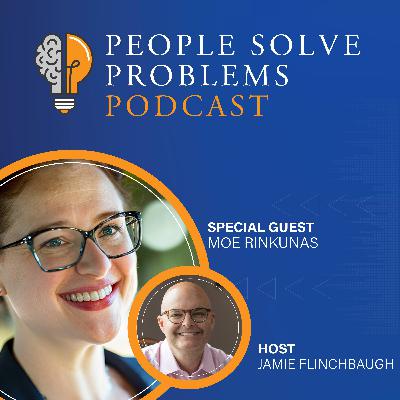
In this episode of People Solve Problems, host Jamie Flinchbaugh speaks with Maureen (Moe) Rinkunas, Director of Insights Membership at Rock Health Advisory. Moe brings over 20 years of experience spanning corporate innovation, venture studios, and advisory leadership at organizations including DuPont, Accenture, Dreamit Ventures, and Redesign Health.
Moe opens the conversation by sharing her fundamental belief that everyone possesses problem-solving capabilities, shaped by evolution itself. However, she emphasizes that people bring different strengths to the table. When working with teams, she takes time to understand individual styles and leverages them strategically throughout the innovation process. Moe explains how naturally optimistic team members excel at generating ideas and maintaining energy during brainstorming sessions, while more skeptical individuals prove invaluable when narrowing options and making final decisions. By understanding these diverse strengths, she creates environments where different personalities contribute at the right moments.
The conversation shifts to collaboration and the messy nature of innovation work. Moe stresses that psychological safety forms the foundation of effective problem-solving. She explains that trust must be built over time, creating a reserve that teams can draw upon when facing uncomfortable challenges. She shares a powerful example from her time at DuPont, where leaders instituted a "Dead Project Day" on the Day of the Dead, encouraging people at all levels to share their failures. Initially met with skepticism, this practice became an annual tradition that normalized risk-taking and built lasting trust within the organization.
When discussing innovation leadership, Moe introduces the concept of leaders as snowplows. She describes how innovation leaders must clear paths for their teams by navigating organizational politics, communicating effectively with senior leadership, and helping others understand that innovative projects require different metrics and timelines than traditional initiatives. This protective role helps create safe spaces where teams can do their best work, even when external pressures threaten psychological safety.
Moe advocates strongly for test-and-learn approaches in innovation work. She emphasizes developing minimal viable solutions paired with "what must be true" statements that guide testing priorities. Her teams create learning plans with clear testing commitments, specific metrics, and defined timeframes. Moe suggests framing decisions around manageable increments, asking what information teams need to decide whether to continue, pivot, or stop after six weeks rather than demanding absolute certainty. This approach makes testing feel achievable and keeps teams moving forward with practical confidence.
Looking at healthcare innovation specifically, Moe identifies significant opportunities in an industry facing mounting pressures around staffing shortages and affordability challenges. She notes that while many innovators develop point solutions addressing specific problems, the real opportunity lies in creating connections between these innovations. She encourages entrepreneurs to think about integrated, holistic healthcare experiences that reflect how people actually live with and experience their health.
Throughout the conversation, Moe demonstrates how thoughtful attention to team dynamics, psychological safety, and structured learning processes enables innovation work to flourish. Her insights offer practical guidance for anyone leading creative problem-solving efforts in complex organizational environments.
To learn more about Moe's work, visit Rock Health Advisory at https://rockhealth.com/advisory/ or connect with her on LinkedIn at https://www.linkedin.com/in/mwrinkunas/.
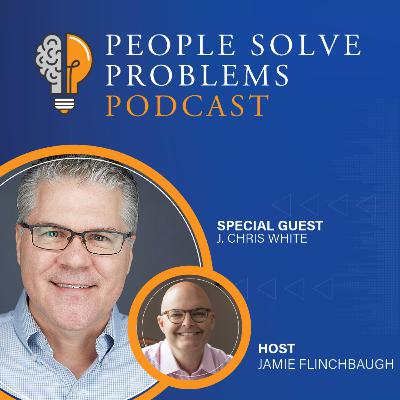
J. Chris White, Co-Founder and CEO of scmBLOX, joined host Jamie Flinchbaugh to explore the critical differences between systems thinking and systems dynamics, and how these approaches can transform supply chain management. As a systems dynamics modeler with 30 years of experience covering operations and supply chains, Chris brought deep expertise to this conversation about solving complex business problems.
Chris explained that while many people embrace systems thinking after reading Peter Senge's "The Fifth Discipline," they often miss that Senge was actually a systems dynamicist trained by Jay Forrester, who created systems dynamics. According to Chris, systems thinking provides valuable guidance, but when it comes to actually solving problems, you need the rigor of systems dynamics modeling and simulation. He described systems thinking as appreciating the use of data in decision making, while systems dynamics is doing all the math to generate that data.
The conversation revealed how he views systems dynamics as another tool in the problem-solving toolbox. He emphasized that it works best for larger, interconnected problems where you need to see the whole system view. He explained that systems are collections of parts that are interrelated and interconnected, all working together to achieve a goal. As systems become more complex, the relationships between parts begin to dominate, which is where systems dynamics shines.
When discussing supply chain management specifically, Chris highlighted how traditional "end-to-end" approaches are actually quite limited. Most companies only track orders from their immediate suppliers to customer delivery, but he pointed out that COVID-19 revealed how interconnected supply chains really are. The disruptions, bullwhip effects, and shortages that dominated news cycles showed that problems happening several tiers upstream can significantly impact your business.
Chris used a tree analogy to illustrate this point: there's little value in optimizing the leaves when you should have been on a different branch strategically to begin with. He emphasized that resilience is more of a system phenomenon than an individual company trait, and that understanding supply chains as systems gives you more power to change the future.
One of the biggest surprises he encounters when working with clients is how little data they actually need to get started. Unlike statistical models that rely heavily on data, systems dynamics focuses on causal connections and structure. He explained that if you know what you're making and have a bill of materials, your supply chain usually mirrors that structure. This allows companies to begin modeling without perfect visibility into every supplier's capacity or inventory levels.
Chris emphasized that when companies optimize only their individual parts of the supply chain, they often create unintended effects that come back to hurt them later. What seems beneficial in the short term can actually cause problems in the long term. The goal is to help companies understand how their decisions impact the entire supply chain system, not just their immediate operations.
Throughout the discussion, Chris demonstrated how systems dynamics provides a scientific approach to understanding supply chain vulnerabilities before disruptions occur, whether they're global events like the Suez Canal blockage or local issues like supplier bankruptcies.
To learn more about Chris White's work in systems dynamics and supply chain management, visit scmblox.com or connect with him on LinkedIn.

Jim Benson joined host Jamie Flinchbaugh on People Solve Problems to discuss his approach to collaboration and visual management as the foundation for successful Lean and Agile implementations. As Inquisitor at Modus Institute and creator of Personal Kanban, Jim brings a unique perspective on how organizations can remove workplace toxicity while dramatically improving effectiveness.
Jim defines collaboration simply yet powerfully: two or more people working toward a common goal with systems in place that allow everyone to act with confidence. This definition cuts through the confusion often created when collaboration gets mixed up with consensus-building or other diluted interpretations. The key insight Jim shared is that confidence drives everything in business, just as consumer confidence drives the free market economy.
Jim illustrated this concept through the story of a young procurement agent at Turner Construction who was responsible for purchasing everything from structural steel to toilet paper for a billion-dollar construction project in New York. Initially working from spreadsheets, he had to justify every decision to three levels of management, creating a cycle of criticism and second-guessing that undermined his confidence. When Jim helped implement an obeya with visual controls, everything changed. He could display his work transparently, allowing managers to see when projects were on track, in trouble but manageable, or requiring their expertise.
The transformation was remarkable. Instead of commenting on everything he did, managers could now apply their expertise strategically when needed. He could act with confidence, knowing that everyone had visibility into his work and could provide help when necessary rather than criticism after the fact. Jim emphasized that this visual management approach removes toxicity from the workplace by creating clarity around roles, responsibilities, and when intervention is needed.
Jim challenged the current trend of CEOs instituting longer work weeks while people are already working at 300% capacity, but only 25% effectiveness. He argued that most knowledge workers are operating far beyond sustainable levels, and the solution isn't more hours but better systems. By creating a better understanding of what people can handle and properly defining work upfront, organizations can increase effective throughput by 200-300% while making work easier and more enjoyable.
The conversation touched on problem-solving approaches, where Jim distinguished between everyday operational issues and strategic thinking opportunities. He noted that most bottlenecks in modern business are actually collaborative opportunities that get addressed through non-collaborative means like new software or individual assignments. Instead, these issues often stem from information flowing between people in the wrong formats, which can be fixed simply by understanding what each person in the value stream actually needs.
Jim offered a provocative alternative to traditional strategic planning, where leadership teams retreat to develop strategy in isolation. He suggested that companies have exponential strategic value equal to the number of employees raised to the power of the number of employees. Rather than excluding people from strategic planning, Jim advocates for involving everyone in developing strategies, tactics, and measures collaboratively. When people understand how their daily tasks connect to broader strategic goals, achieving corporate objectives becomes much easier.
The underlying theme throughout Jim's insights is that most workplace dysfunction stems from people wanting to contribute meaningfully but lacking the systems and clarity to do so effectively. By implementing visual management and collaborative approaches, organizations can tap into this existing motivation while removing the barriers that create frustration and inefficiency.
Jim’s work can be explored further at modusinstitute.com, and he can be found on LinkedIn at linkedin.com/in/jimbenson.
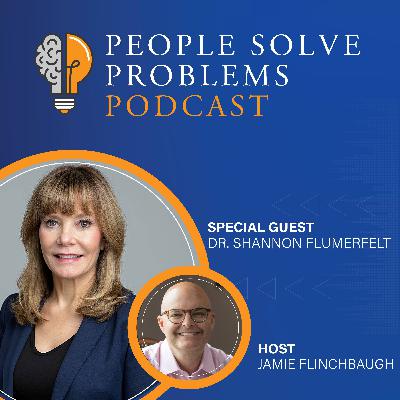
Dr. Shannon Flumerfelt, Founder of Charactership Lean Consulting and Endowed Professor of Lean at Oakland University, joined host Jamie Flinchbaugh to discuss her systematic approach to coaching leaders through difficult situations and complex problem-solving challenges.
Dr. Flumerfelt shared her framework for handling difficult coaching situations, which begins with understanding whether the challenge stems from external factors or internal issues. She explains that external problems—such as skill gaps or training needs—are often easier to address through coaching and mentoring. However, internal challenges require a deeper analysis using what she calls the "head, heart, and hands" approach: examining a person's knowledge, disposition, and actual capabilities.
When faced with complex situations, Dr. Flumerfelt advocates for creating an Ishikawa diagram to break down all contributing factors. She emphasizes the power of co-creating these visual tools with clients, noting that self-reflection becomes most powerful when people can see their challenges mapped out concretely. This approach helps remove emotional drama from the situation and enables more logical, analytical thinking while still respecting people's feelings and perspectives.
Regarding prioritization when multiple problems exist, she stresses that the approach must be organic and context-dependent, true to lean principles. She suggests several methods for determining where to start: ensuring strategic alignment with organizational goals through Hoshin Kanri planning, conducting quality function deployment analysis to understand customer requirements, or using Pareto analysis to tackle the most significant causes first. However, she cautions that sometimes the biggest problems are beyond an individual's scope of influence, requiring a more realistic assessment of what can be accomplished.
Dr. Flumerfelt also recommends using interrelationship diagrams to identify which issues have the most connections to other problems, as addressing these can create the greatest ripple effect of positive change. The key is understanding your level of power, influence, and authority within the organization and working within those realistic boundaries.
When discussing how to tap into people's intuition alongside analytical tools, she acknowledges that lean thinking often appears heavily engineering-focused and black-and-white. However, she emphasizes that successful lean implementation requires understanding the complete framework of lean thinking, not just selecting individual tools. She advocates for using personality assessments like Myers-Briggs to understand team members' strengths and whether they tend toward intuitive or logical approaches.
She highlights the concept of social capital as a competitive advantage, referencing Michael Porter's work. She believes organizations drastically underutilize their human potential, comparing it to how individuals only use a small percentage of their brain capacity. When you multiply underutilized brains across an entire organization, the untapped potential becomes enormous. This perspective drives her approach to individualizing and customizing development for each person, recognizing that people aren't robots and have unique strengths and weaknesses that deserve respect.
Throughout the conversation, the importance of visual management tools and moving beyond just thinking or journaling to drawing out and visualizing problems and solutions was emphasized. This structured approach helps transform messy, complex situations into manageable challenges that can be systematically addressed.
For those interested in experiencing her approach firsthand, Dr. Flumerfelt offers consulting services through Charactership Lean Consulting and teaches in Oakland University's graduate Lean Leadership program—a rare opportunity in higher education.
To learn more about Dr. Flumerfelt's work, visit charactershiplean.org or connect with her on LinkedIn
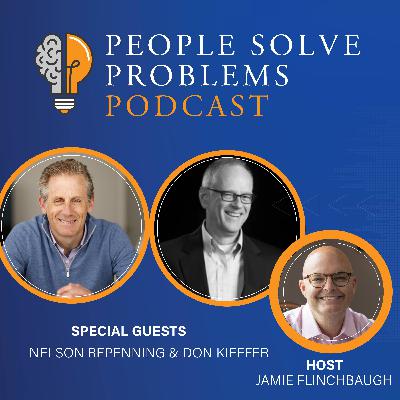
Nelson Repenning and Don Kieffer joined host Jamie Flinchbaugh to discuss their collaborative book "There's Got to Be a Better Way" and their approach to dynamic work design. Nelson Repenning is the School of Management Distinguished Professor at the MIT Sloan School of Management, while Don Kieffer is a senior lecturer in operations management at MIT Sloan and founder of ShiftGear Work Design. Their partnership represents a unique blend of academic rigor and practical factory floor experience spanning nearly three decades.
The conversation began with personal connections, as Jamie noted his long history working with Don during transformation efforts at companies like Harley-Davidson, and his experience as one of Nelson's first students in systems dynamics at MIT. Don shared how Jamie helped translate complex manufacturing concepts into accessible language during their work at Harley-Davidson.
The guests explained how their five core principles evolved through years of teaching and practical application. Nelson compared their development process to a stand-up comedian perfecting their act, starting with rough material and refining it through constant testing. The five principles they developed are: solve the right problem, structure for discovery, connect the human chain, regulate for flow, and visualize the work.
When discussing the challenge of solving the right problem, Nelson referenced Daniel Kahneman's work on conscious versus automatic thinking. He explained how people often revert to automatic processing under pressure, making structured problem-solving methods essential. Don emphasized how experienced problem solvers can jump to solutions too quickly, bypassing the crucial step of properly defining the problem.
The principle of structuring for discovery addresses why organizations should welcome more visible problems rather than hiding them. Don explained that problems reveal weaknesses in systems and create opportunities for innovation and stability. Nelson added that instead of helping people understand complex environments, they focus on structuring environments to be cleaner and more manageable.
Regarding connecting the human chain, Nelson emphasized that humans excel at processing uncertainty and ambiguity, particularly in face-to-face communication. He criticized how many organizations use long PowerPoint meetings for information sharing while handling uncertainty through digital messages. Don illustrated this with the frustration of call center scripts that cannot handle unique problems, explaining their concept of "huddles" versus "handoffs" in work design.
The discussion of visualizing work highlighted the particular challenges of knowledge work. Don explained that unlike manufacturing, where broken equipment is obvious, knowledge work problems remain hidden. People can be continuously interrupted and overloaded without visible signs. Nelson shared a striking example from Harley-Davidson where the average time to solve problems equaled the months remaining until product launch, regardless of when problems were discovered.
Don noted that while executives can easily draw organizational charts, they struggle to map how work actually flows through their organizations. The guests emphasized that simple visualization techniques can yield enormous gains in knowledge work because the dysfunction costs are typically hidden and accepted as normal.
Throughout the conversation, both guests stressed the importance of leaders staying connected to actual work rather than remaining distant from operational realities. They advocate for methods that make work visible and create structures that support both stability and continuous innovation.
For more information about Nelson Repenning and Don Kieffer's work, visit ShiftGear.com
Find their book "There's Got to Be a Better Way"
Nelson can be found on LinkedIn at https://www.linkedin.com/in/nelson-repenning/
Melinda Manente, Process Improvement Coach & Facilitator at GBMP Consulting Group, joins Jamie Flinchbaugh on the People Solve Problems podcast to share her extensive experience in creating transformational change within organizations. With over 30 years of experience at global Fortune 100 companies including Cisco, Parker Hannifin, Intel, and General Electric, Melinda brings valuable insights into developing problem-solving cultures that engage employees at all levels.
Melinda emphasizes that meaningful transformation requires both a clear vision and what she calls a "burning platform" - a compelling reason for change that motivates people to step out of their comfort zones. She explains how organizations can benefit from redefining what constitutes a problem, shifting from focusing solely on large, dramatic issues to addressing smaller, daily challenges. This perspective change allows companies to tap into their most valuable resource - their people - by making problem solving part of everyone's daily job content.
Throughout the conversation, Melinda shares practical strategies for implementing simple yet effective problem-solving methods that showcase learning, build transparency, and foster team collaboration. She advocates for creating systems that encourage experimentation and rapid learning through a "fail fast" approach, allowing teams to iterate quickly and apply their learnings immediately. Her methodology balances the need for action with thoughtful reflection, creating a culture where problems become opportunities for growth rather than sources of stress.
A central theme in Melinda's approach is how the principle of “Respect for People” serves as the foundation for effective problem-solving. She demonstrates how common lean tools like direct observation and 5S become significantly more impactful when implemented within a framework of genuine respect. She shares real-world examples of how this respect-centered approach has transformed organizations she's worked with, creating sustainable change that continues long after formal improvement initiatives end.
The conversation concludes with Melinda's insights on the "inside-out" approach to leading organizational change, emphasizing that transformational leaders must first transform themselves before they can effectively guide others. Jamie and Melinda discuss how this self-awareness and personal growth create the authenticity needed to inspire lasting change across an organization.
For listeners interested in learning more about Melinda Manente's work on problem-solving and the Respect for People approach, they can visit the GBMP website at https://www.gbmp.org and explore the Respect for People Roadmap, or connect with her on LinkedIn at www.linkedin.com/in/melindamanente.
In this episode of People Solve Problems, host Jamie Flinchbaugh welcomes Dr. Greg Jacobson, CEO and Co-founder of KaiNexus, for an insightful conversation about the intersection of medical training, psychological safety, and continuous improvement culture.
Greg's journey into the world of Lean and Kaizen began in 2004 when his department chairman handed him Masaaki Imai's book "Kaizen" and said, "You think like this." As an emergency medicine doctor, Greg was immediately struck by the realization that there was an entire discipline focused on improving systems. He recognized that healthcare had so many operational inefficiencies that applying these principles in the emergency department could yield tremendous results through solving basic problems and capturing low-hanging fruit.
The conversation explores how Greg's medical background both helps and hinders systematic thinking about business problems. He explains that physicians are trained with a scientific mindset where every patient encounter resembles an experiment - gathering evidence, forming hypotheses, running tests, and evaluating outcomes. This mirrors the problem-solving methodology used in Lean thinking, making the transition natural for some medical professionals. However, the competitive nature required to succeed in medical school and residency can create fixed mindsets and reduce curiosity, as many doctors become accustomed to being the "alpha dog" who always has the right answers.
A significant portion of the discussion focuses on psychological safety and its critical role in enabling improvement. Greg defines psychological safety as "being rewarded for being vulnerable" - whether that's admitting you don't know something, raising concerns about broken processes, or challenging existing systems. Through his experience working in emergency departments across the United States and even New Zealand, he observed that departments where people felt safe to speak up consistently had better outcomes than those where the culture encouraged keeping quiet and just getting the job done.
Jamie and Greg explore how technology systems can actually enhance psychological safety by creating a buffer between individuals and problems. When issues are logged in a system rather than raised face-to-face, it shifts the dynamic from personal confrontation to collaborative problem-solving. The issue becomes the common enemy that everyone works together to address, rather than a source of interpersonal tension. Greg notes that rather than reducing human interaction, electronic systems actually increase communication by creating visibility and fostering engagement around improvement opportunities.
The conversation turns to habit science and its application to continuous improvement culture. Greg credits reading "The Power of Habit" by Charles Duhigg, "Atomic Habits" by James Clear, and "Tiny Habits" by BJ Fogg with transforming both his personal life and his understanding of organizational change. He explains how KaiNexus applies the habit loop concept - cue, routine, reward - to create interconnected behaviors across different organizational levels. The routine of one person becomes the trigger for another person's habit, creating a web of positive behaviors that sustain improvement culture.
When asked about his personal habit transformation, Greg shares how he moved from being an inconsistent squash player who would "demolish his body" once or twice a week to someone who exercises daily. After tearing his ACL in his forties, he used habit science principles to change his identity and create sustainable physical activity routines.
Throughout the discussion, Greg emphasizes that KaiNexus is fundamentally about the human transformation that technology enables, not the technology itself. The platform's value comes from people interacting with it in specific ways that foster continuous improvement behaviors across the organization.
For more information about Greg's work, visit kainexus.com or connect with him on LinkedIn.
In this episode of People Solve Problems, host Jamie Flinchbaugh welcomes Mark Reich, Senior Coach and Chief Engineer of Strategy at the Lean Enterprise Institute. Mark brings a wealth of experience from his 23 years at Toyota, where he learned and led management systems, followed by 13 years at the Lean Enterprise Institute spreading that knowledge across industries.
The conversation centers around Mark's new book "Managing on Purpose," which focuses on Hoshin Kanri, a strategic management methodology that was adopted by Toyota in the early 1960s based on Deming's teachings. Mark explains that Hoshin Kanri goes far beyond typical strategy development that often ends with a PowerPoint presentation to the board. Instead, it creates a comprehensive management system that defines long-term direction, builds both vertical and horizontal alignment throughout the organization, manages annual execution, and develops people's capabilities.
Mark emphasizes that the real power of Hoshin Kanri lies in its dual approach to alignment. Vertical alignment ensures that high-level objectives are broken down meaningfully throughout the organization, giving everyone ownership of problems to solve. Horizontal alignment addresses the more challenging task of getting different functions to work together toward broader organizational goals rather than focusing solely on their individual metrics. This requires a cultural shift where leaders must reward people for leading by responsibility rather than authority, encouraging influence across the organization rather than just managing down.
The methodology serves as both a strategic framework and a leadership development tool. They compare it to learning soccer through playing the game rather than just practicing drills. Leaders develop crucial skills by working through the complex interpersonal mechanisms of what he calls "catch ball" - the process of building alignment both vertically and horizontally throughout the organization. However, Mark warns that this is high-risk work since it deals with the future of the entire organization, requiring significant investment from top leadership.
When discussing how to handle uncertainty and volatility, Mark acknowledges that plans rarely survive contact with reality unchanged. Drawing from military strategist Helmut von Moltke's famous observation about battle plans, he explains that the key lies not in the plan itself but in building the organization's planning capability. Teams that practice planning together can quickly realign when circumstances change. The focus should be on developing the skill of alignment rather than rigidly sticking to any particular plan.
Mark identifies rigor as the critical factor that separates successful Hoshin Kanri implementations from failures. This includes rigorous upfront planning, systematic processes for building alignment, and disciplined execution with monthly reviews in visual management spaces. Organizations need to establish standards around the process itself, treating Hoshin Kanri as a systematic approach rather than a one-time exercise.
The conversation reveals Mark's perspective that Hoshin Kanri is essentially company-wide problem solving. By framing strategic objectives as problems to solve, organizations can break them down into specific elements that engage everyone from leadership to frontline workers. This creates a unified approach where strategy deployment becomes a systematic way of distributing problem-solving responsibilities throughout the organization.
Mark concludes by defending his choice of the word "managing" in his book title, distinguishing management systems from leadership capabilities. While leadership involves developing people and drawing out their best abilities, management involves creating robust systems that allow organizations to function effectively even as leaders move on to new challenges.
For more information about Mark's work, visit www.lean.org or connect with him on LinkedIn at www.linkedin.com/in/markareich.
Find his book here: www.lean.org/mop

Laurie Harbour, Partner at Wipfli LLP, joined Jamie Flinchbaugh on the People Solve Problems podcast to discuss leadership's critical role in integrating the next generation of manufacturing talent. Laurie, author of Tradition Meets Transformation, brings over 35 years of manufacturing experience helping companies improve efficiency and profitability.
Laurie explained that American manufacturing faces a significant generational gap. During the 1990s and early 2000s, parents encouraged their children to pursue four-year degrees rather than manufacturing careers, creating a shortage of workers in the 35-45 age range. This gap widened after the Great Recession further diminished interest in manufacturing careers. The result is an aging manufacturing workforce alongside a gradual influx of younger talent with different skillsets.
This talent gap has created serious consequences. Laurie noted that many companies relocated manufacturing to lower-cost regions worldwide partly due to domestic worker shortages. When COVID increased manufacturing demand in North America, companies struggled to find qualified workers, often hiring undertrained temporary labor that negatively impacted quality, delivery, and safety metrics. Many manufacturers now experience 30-40% turnover rates because they fail to engage and retain younger workers.
The new generation brings valuable technology skills to manufacturing, Laurie emphasized. Young workers excel at using tools like Excel, programming languages, and Power BI to analyze data effectively. Their efficiency with technology often exceeds that of experienced workers, and they naturally identify process inefficiencies that veterans might overlook. However, they lack the manufacturing process knowledge that experienced workers possess.
Laurie advised that successful manufacturers create environments where generations collaborate rather than compete. Some older leaders mistakenly believe younger workers need decades of experience before making meaningful contributions. The best companies instead form cross-generational teams where experienced workers share tribal knowledge while younger staff contribute technological insights. This engagement reduces turnover, as younger workers particularly want to feel their contributions matter.
For senior leaders approaching retirement, Laurie recommended embracing transformation rather than coasting on experience. She shared examples of companies that thrived after promoting younger leaders with proper support structures like advisory boards and mentorship programs.
For younger manufacturing professionals, Laurie stressed the importance of humility. She observed that successful young leaders recognize they don't need to be the smartest person in the room but must facilitate dialogue and ask good questions. The most effective emerging leaders actively seek mentorship and embrace being uncomfortable as they grow.
Laurie remains passionate about revitalizing manufacturing's image, particularly among women who represent 50% of the potential workforce. She's dedicated to educating school counselors and others who might discourage manufacturing careers despite their excellent compensation and technological sophistication.
Learn more about Laurie Harbour's work at www.wipfli.com or connect with her on LinkedIn at https://www.linkedin.com/in/laurie-harbour-264a253/.
Kevin Tarrant, Ex-CHRO of WABCO and current President of HR Co-Pilot Consulting, brings 40 years of human capital experience to Jamie Flinchbaugh's People Solve Problems podcast. With a background spanning manufacturing, high tech, software development, and service industries across global organizations, Kevin shares insights from his extensive career, including his last corporate role as Chief Human Resources Officer for Westinghouse Airbrake Company (WABCO).
Kevin emphasizes that problem solving has a significant human component beyond just tools and processes. He notes that employees must trust and respect each other while understanding the different strengths each person brings to a problem-solving team. He explains that employees need to directly impact revenue, reduce costs, or contribute to continuous improvement to remain valuable as companies constantly seek efficiency.
From an HR perspective, Kevin observes a shift toward hiring for competencies rather than specific experience. He encourages job seekers to demonstrate how they've applied their competencies in different situations rather than simply listing their work history. These competencies—like building relationships, problem-solving, resilience, and adaptability—can transfer across industries.
He shares a compelling example from the 2008-2009 financial crisis when WABCO lost 42% of its revenue in one year. Facing potential bankruptcy, the company implemented creative solutions when cash was scarce. They replaced cash bonuses with stock options at the then-low price and conducted "stay interviews" with critical talent to understand what would keep them engaged beyond money. The result: they retained all key employees, and many became millionaires when the stock rebounded.
The foundation for this creativity, Kevin explains, came from WABCO's culture which valued diverse thinking and outside-the-box solutions. He warns that many companies claim employees are their greatest asset on their websites, but actual behaviors during tough times reveal the true culture.
Kevin recommends that organizations build teams around solving problems and implement processes to understand each member's strengths before tackling challenges. He notes that jobs that don't contribute measurably are at risk. Finally, he emphasizes that successful companies focus on continuous improvement and reinvention.
For more information about Kevin Tarrant and his work, visit www.buildwithtact.org or connect with him on LinkedIn at https://www.linkedin.com/in/kevinbtarrant/
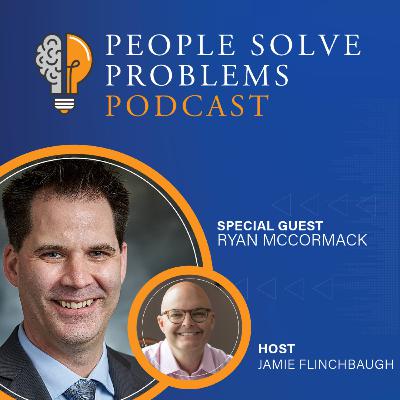
Ryan McCormack, Director of Operational Readiness and Optimization at The Wawanesa Mutual Company, joined Jamie Flinchbaugh on the People Solve Problems podcast to discuss his approach to problem-solving in organizations. Ryan has spent over two decades seeking to understand and apply principles that enrich the working lives of people in large organizations, with experience spanning manufacturing, healthcare, management consulting, and insurance.
Ryan explained that his role in problem solving shifts depending on circumstances, but primarily involves consulting and facilitation. He leads a team of problem solvers and determines how hands-on or hands-off to be based on the capability of people who own the problem and the complexity of the issue. Ryan learned to start by asking questions to understand these factors before deciding whether to take ownership or develop others' skills.
When evaluating his team's capacity to solve problems, Ryan focuses on finding people who have the will and joy for problem-solving—qualities he believes are difficult to teach. His team development strategy centers on a mix of technical problem-solving skills, people skills, and consulting abilities. Rather than keeping people on his team permanently, Ryan prefers to rotate members in and out, giving them skills they can take back to the organization. He measures his career success not by projects completed but by seeing people he's developed go on to leadership roles.
For effective collaboration, Ryan emphasized the importance of having a shared problem that everyone is desperate to solve. Without genuine alignment, collaboration becomes artificial. He shared a pragmatic insight that includes actively resistant people on problem-solving teams who have "worked 0% of the time" in his experience. He also highlighted the crucial role of sponsorship, noting that while most leaders believe they're great sponsors, few actually are, and some can't resist taking over the problem.
When addressing root cause analysis in knowledge work, he pointed out unique challenges. Unlike manufacturing environments, knowledge work involves "decision factories" where the quality of decisions is rarely measured. Traditional techniques like asking why five times are less effective in these settings. Ryan's approach starts with understanding the decision-making process and establishing what quality looks like. He noted that in complex organizations, almost no one actually understands how decisions are made, making it difficult to assess root causes without first agreeing on what constitutes quality.
Ryan lives in Winnipeg, Manitoba with his wife and daughter. Learn more about Ryan's work at https://www.wawanesa.com/ and https://ryanmccormack.substack.com/, or connect with him on LinkedIn at www.linkedin.com/in/rjmccormack.

Comments

Download from Google Play

Download from App Store
 United States